Part 2: The Blood Test Revealed What My Family Refused to See
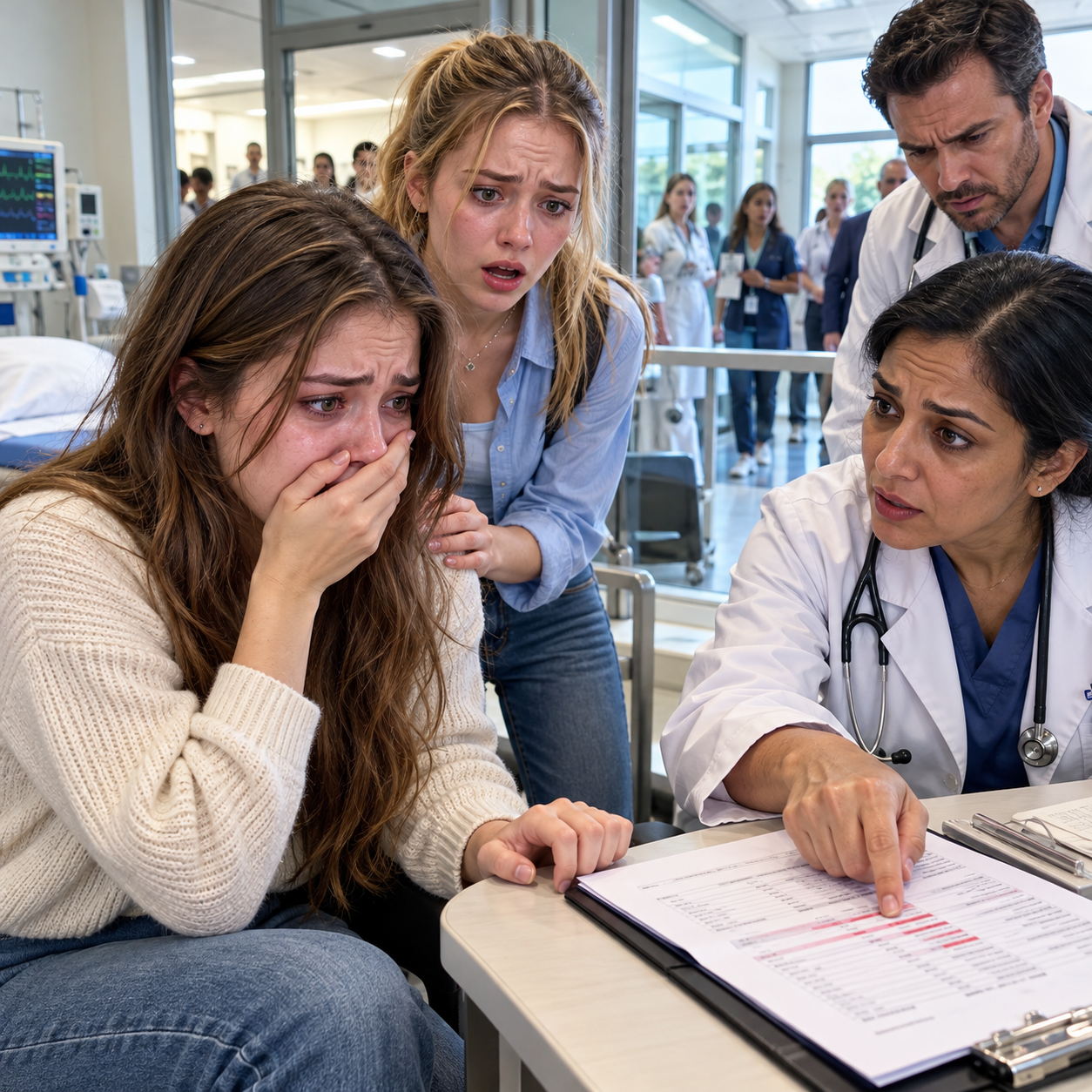
Dr. Samuel Reed, a toxicologist, pulled his chair closer before explaining what the result meant. Thallium was a toxic metal capable of causing serious illness, and the findings were consistent with repeated exposure. Further testing would help establish the extent of the damage and guide treatment. He didn’t tell me who was responsible, but when I described how my symptoms changed depending on where I ate, he asked whether I had recently consumed anything prepared by someone I distrusted.
I remembered the travel mug. It was still in my backpack, though I’d emptied it outside the garage. When I told him, he asked me not to handle it further because investigators might want to examine it. Olivia was sitting close enough that our shoulders touched, and I could feel her trembling. “I kept telling her something was wrong,” she said. Dr. Reed looked at me rather than Olivia. “You were right to seek help. You’re receiving treatment now, and we’re going to take this seriously.”
The hospital contacted the appropriate authorities, and that evening a detective named Sarah Torres came to speak with me. She wore a dark jacket over a gray blouse and carried an ordinary notebook rather than anything resembling the crime dramas my father watched. She explained that investigators needed to distinguish accidental exposure from deliberate harm. “Tell me what you’ve observed,” she said. “Don’t worry about what you think it means. We’ll investigate that part.”
For more than an hour, I described Deanna’s meals, her insistence that I drink special teas, and the way she became irritated whenever I refused something she’d prepared. Olivia shared her symptom log and photographs showing how much weight I’d lost. Detective Torres copied my father’s messages, including the ones he sent from the hospital parking lot after learning where I was. His latest read, “Deanna says you’re trying to turn everyone against her. We need to talk about your behavior.”
When I finally called him, Detective Torres remained beside me. “Dad, did you ever wonder why I was sick all the time?” I asked. There was a pause, followed by the familiar sound of him rubbing his forehead. “Of course I worried,” he said. “But Deanna thought it was stress, and the doctor you saw in August didn’t find anything.” I reminded him that he’d refused to take me back when my symptoms grew worse. He started to answer, then asked what the hospital had found.
“Thallium,” I said. “They found poison in my blood.” He breathed heavily into the phone. In the background, Deanna asked who was calling, and I heard him say, “It’s Anna. She says the hospital found something.” Deanna came onto the line, her voice unusually sharp. “Sweetheart, don’t make accusations you can’t take back. Whatever’s happening, we’ll get through it as a family.”
Detective Torres introduced herself and explained that officers would be contacting them. Deanna said she’d cooperate with anything necessary, but Dad kept asking whether someone had made a mistake at the laboratory. He didn’t ask how I was feeling until the detective reminded him that I was being treated for toxic exposure. That small omission hurt more than I expected. For months, I’d wanted him to defend me, and even now he seemed more frightened of being wrong about Deanna than of what had happened to his daughter.
Investigators obtained warrants and collected food containers, supplements, household records, and electronic devices from our home. They also interviewed neighbors, coworkers, and the physician who’d evaluated me months earlier. I remained in the hospital for treatment and monitoring, learning how to walk down the hallway without becoming dizzy. Every afternoon, Olivia brought homework I couldn’t concentrate on, while Linda worked with hospital social workers to arrange a safe place for me after discharge.
Three days later, Detective Torres returned with photographs and an evidence summary. Investigators had found traces of thallium in several items associated with my meals, along with private notes on Deanna’s computer documenting my symptoms and food intake. The records weren’t ordinary caregiving notes. They contained references to my deteriorating health and calculations about the timing of my eighteenth birthday.
I stared at a photograph of our kitchen counter. There was Mom’s blue ceramic bowl, still filled with oranges, beside an evidence marker. Deanna had been arrested, Detective Torres told me, and prosecutors were reviewing charges of attempted murder and poisoning. Dad had been questioned separately, and investigators had found no evidence that he had knowingly administered anything. But they were also examining his repeated failure to obtain medical care when my condition worsened.
“There’s something else,” Detective Torres said. She moved the photographs aside and opened a folder containing copies of digital records recovered from Deanna’s computer. Among searches about my trust were articles concerning my mother’s accident, records of her final medical complaints, and archived photographs from a charity fundraiser held four years earlier. “Your stepmother seems to have known your mother before she ever met your father,” the detective explained. “We’re trying to determine how.”
I leaned forward to examine the photograph. My mother stood near a banquet table wearing a red dress I remembered helping her choose, one hand resting on the shoulder of a volunteer. Behind her, partially concealed by a flower arrangement, was a younger Deanna. She wasn’t looking toward the camera. She was looking directly at my mother, and beneath the photograph was a caption identifying her as a temporary employee of the organization hosting the event.
Part 3: My Mother’s Hidden Past Finally Brought Our Family to Justice
My first clear memory after seeing the photograph wasn’t anger. It was my mother sitting at our kitchen table, rubbing her temples while a pot of soup cooled on the stove. She’d been unusually tired during the months before her accident, complaining that her hands tingled and her legs sometimes felt weak. Dad had blamed her demanding work schedule, and Mom herself had joked about getting older. I wondered how many ordinary memories might mean something different now.
Detective Torres cautioned me against drawing conclusions before investigators finished their work. She explained that the old accident was being reviewed because of new information, not because anyone had yet established a connection. I appreciated her careful language, though patience felt nearly impossible. That night, I asked Linda to help me locate Mom’s old calendars and medical records, and she contacted the attorney who had handled the estate.
The attorney, Mr. Whitcomb, visited Olivia’s house the following week carrying a cardboard document box. He’d known Mom for nearly twenty years and looked genuinely distressed when I explained why I wanted her records. Inside were insurance forms, copies of her calendar, photographs, and correspondence she had asked him to preserve after becoming concerned about problems at the charity where she volunteered. One letter mentioned a temporary administrator named Deanna Price, who had been dismissed after irregular reimbursements were discovered.
I remembered that name from the fundraising photograph. Deanna had used Price before marrying Dad, and I had never connected it to anything from Mom’s life. Mr. Whitcomb read the letter twice, then set it down carefully. “Margaret asked me whether the organization could recover the missing money without creating a scandal,” he said. “She didn’t want anyone destroyed over a mistake, but she believed someone had deliberately altered the records.”
The investigation expanded over the following months. Detectives obtained financial records, interviewed former volunteers, and reviewed medical evidence preserved from my mother’s death. Additional forensic testing found evidence consistent with toxic exposure before the accident. Investigators also uncovered messages showing that Deanna had continued tracking my family after losing her position and had concealed her prior connection to Mom when she began attending Dad’s grief group.
It wasn’t until Deanna agreed to cooperate with prosecutors that I learned how much of the evidence fit together. Her lawyer negotiated a plea agreement supported by financial records, forensic findings, and details investigators had independently verified. Deanna admitted that she’d deliberately harmed my mother before the fatal accident and later began poisoning me after becoming convinced that my inheritance would eventually secure her future with Dad. She had persuaded herself that she deserved the life my mother built, and when I didn’t welcome her into it, she viewed me as an obstacle.
Her confession didn’t make her actions easier to comprehend. In the interview transcript I was permitted to read, she described my mother’s kindness almost resentfully, as though being helped by someone successful had reminded her of everything she lacked. She also claimed she’d never intended for things to become so serious at first. Detective Torres pointed out that her records contradicted that excuse, particularly the plans she’d made as my birthday approached. I put the transcript away before finishing the last page.
My father called me repeatedly through the following months. After his attorney explained that he might face criminal charges for his neglect, his messages changed from defensive explanations to apologies. I eventually agreed to speak with him during a supervised visit, with Linda waiting outside. He looked older than he had when I’d last seen him, and he kept turning his wedding ring around his finger before remembering it was no longer there.
“I didn’t know what she was doing,” he said as soon as we sat down. I studied his face, searching for the father who once stayed awake beside my bed when I had the flu. “I believe you didn’t know about the poison,” I replied. “But you knew I was sick. You saw me losing weight, missing school, struggling to walk upstairs. Why didn’t that matter enough to find out what was wrong?”
He looked toward the window. “I thought if I admitted something was wrong at home, everything would fall apart again,” he said. “After your mother died, I couldn’t bear the thought of losing another family.” His voice cracked, and for a moment I wanted to reach across the table. Instead, I told him something I wished I’d understood sooner. “I was your family, Dad. I was there the whole time.”
He began crying, quietly enough that I could hear the clock on the wall. He apologized for dismissing me, for allowing Deanna to control our household, and for making me feel like a burden. I believed he regretted what had happened. But regret couldn’t return the months I’d spent frightened of my own kitchen, and it couldn’t bring Mom back. I told him I needed distance and that any relationship we might have in the future would require more than an apology.
By the following September, the criminal cases had reached their conclusions. Deanna received a lengthy prison sentence for crimes involving both my mother and me, while Dad accepted responsibility in a separate child-neglect case and received a prison sentence of his own. Through court proceedings and the help of Mr. Whitcomb, Dad was removed as trustee, and my inheritance remained protected. I’d turned eighteen that spring, quietly, with cupcakes at Olivia’s house and no grand celebration.
Returning to my childhood home was harder than I expected. Linda helped arrange a professional cleaning, and Olivia spent two weekends packing away Deanna’s belongings so I wouldn’t have to sort through them alone. I kept Mom’s photographs, her gardening tools, and the blue ceramic bowl, but I replaced the dishes I associated with months of illness. For several weeks, I ate most dinners at Olivia’s because the thought of sitting alone at our old table made my hands tremble.
Recovery came in uneven pieces. My doctors monitored the lasting effects of the poisoning, and a therapist helped me work through the fear and guilt that surfaced at unexpected moments. Some days I could concentrate on college applications; other days, the smell of oatmeal made me leave the room. Olivia never treated those setbacks as failures. She would simply ask whether I wanted company, then settle on the couch with a movie or a stack of homework.
The following spring, I received an acceptance letter from a university forensic science program. I’d once imagined studying chemistry because Mom loved the sciences and encouraged my curiosity. Now I wanted to understand how evidence could speak when a frightened person struggled to make anyone listen. I placed the letter on the refrigerator, right where Mom used to display my spelling tests and school photographs.
On the anniversary of the day I entered the hospital, I invited Olivia, Linda, and Nora to dinner. I made roasted chicken, potatoes, and a lemon cake from one of Mom’s old recipe cards. As we sat around the table, Olivia noticed I was using the blue ceramic bowl for a salad and smiled. “Your mom would like this,” she said, and I looked around at the people who had helped me find my way back to an ordinary evening.
Later, after everyone left, I washed the last plate and stood beside the pantry door. Mom’s pencil marks were still there, recording my height at ages six, nine, twelve, and fourteen. I found a pencil in the drawer and added one more small line, marking the person I’d become at eighteen. Then I turned off the kitchen light, knowing I would always carry the loss of my mother and the hurt my father caused, but also knowing I no longer had to carry either one alone.
The End .
All characters and events in this story are fictional, created for storytelling and entertainment purposes. Thank you sincerely for reading. Your feedback and support are invaluable and motivate me to continue sharing more stories with you.