
### Part 2: A Champagne Toast Turns An Ambush Into A Public Demand
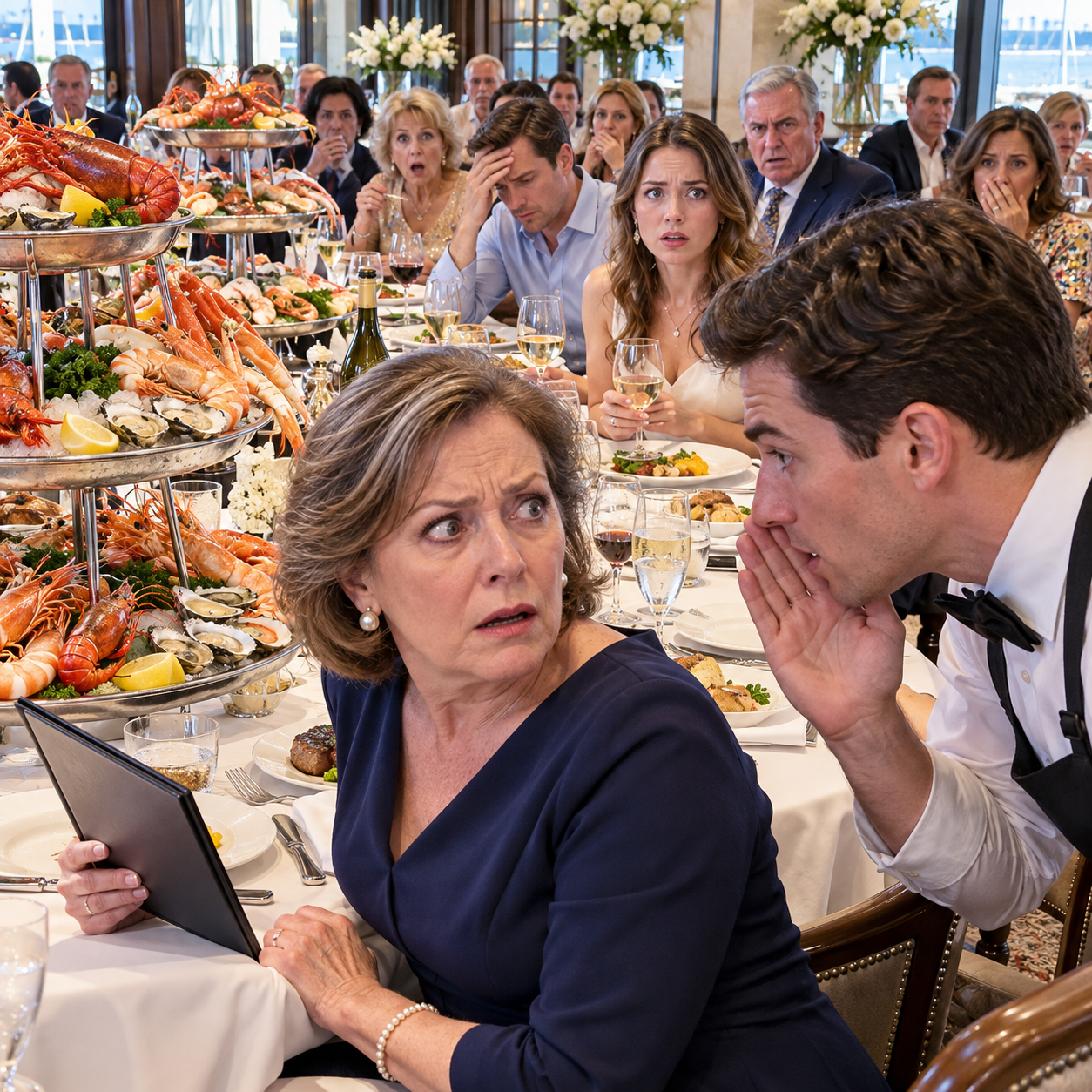
I asked Daniel to leave my water as a separate order while I considered what he had told me. Across the table, Clifton was discussing a waterfront development he hoped to invest in, and Doreen was encouraging everyone to try the crab before it became cold. Nobody seemed particularly interested in how the meal would be paid for. Wesley caught my eye once, then immediately looked toward the kitchen doors.
When the server returned with my water, I asked him whether the restaurant had received any written authorization from me. He said the event coordinator would have that information and offered to bring her over. I thanked him but asked for a little time. I wanted to speak with my son before involving anyone else.
I found Wesley near the hallway leading to the restrooms, where he was checking messages on his phone. “Did you know your in-laws would be here?” I asked. He rubbed his forehead and admitted that Ingrid had mentioned expanding the reservation, though he claimed he hadn’t expected quite so many people. When I asked about the payment arrangement, he said, “She thought you might want to do something generous to bring everyone together.”
“Did you tell her I would?” I asked. Wesley didn’t answer immediately, and a couple passed us on their way to the dining room. Finally, he said Ingrid had been under considerable pressure from her parents and had hoped tonight would make everybody feel better. I told him that my money wasn’t a treatment for his wife’s discomfort, then returned to the table before he could offer another explanation.
Dinner continued as though nothing unusual had happened. Patrick ordered another bottle of wine, and Clifton requested additional steak for a cousin who had arrived hungry. One of Ingrid’s younger relatives, a college student named Abby, asked whether she could take some leftovers home. Doreen laughed and told her not to worry about saving anything because this was a special occasion.
I remembered family birthdays when Thomas and I had saved for weeks to take Wesley out for dinner. We always told him he could choose anything from the menu, though the three of us usually ended up sharing dessert. Watching the expensive food being carried away barely touched, I felt less anger than a weary recognition of how casually people could treat something they hadn’t earned.
As dessert arrived, Ingrid tapped her spoon against her glass. She thanked her parents for raising her to appreciate family traditions and praised Wesley for being such a devoted husband. Then she turned toward me with a smile. “And tonight wouldn’t have been possible without Nora,” she announced. “She’s hosting this whole wonderful evening because she knows how important family is.”
Several guests began applauding. Ingrid lifted her champagne glass higher and added, “You’re hosting tonight, Nora. Isn’t that what we agreed?” Wesley stared at his dessert plate, and Clifton gave me an approving nod that made my decision considerably easier. I placed my napkin beside my untouched bread plate and said, “There seems to be a misunderstanding.”
Ingrid’s smile remained, although her fingers tightened around the stem of her glass. “We can talk about details later,” she said, glancing around at her relatives. I told her I would be happy to discuss it privately with the restaurant manager, then excused myself. Behind me, Doreen was already suggesting coffee for everyone.
The manager, a woman named Rebecca, met me near the service station. She opened the event reservation on her computer and explained that Ingrid had signed the private dining agreement using her own card to guarantee the booking. In the comments section, however, someone had typed a request for the final charges to be given to Nora Bennett as the evening’s sponsor. Rebecca confirmed that my name appeared nowhere on the signed agreement.
“I haven’t agreed to sponsor anything,” I told her. “My son invited me for dinner, and I was told he and his wife were paying.” Rebecca nodded and said the restaurant would not treat an unsigned note as authorization to charge my card. I paid for the bottled water, thanked Daniel for his attentiveness, and asked that the remaining bill go to the person who had arranged the evening.
When I returned, Wesley whispered, “Are you okay?” I told him that I was disappointed and that we would talk when we were alone. Ingrid watched me settle into my chair and asked whether I had spoken with the manager. I nodded, and she pressed her lips together before turning to her mother.
Fifteen minutes later, Rebecca entered with the final statement and approached Ingrid, the reservation holder. “Your party’s account is ready,” she said discreetly, laying a leather folder beside Ingrid’s plate. Ingrid looked first at the folder and then at me, as though expecting someone to correct an obvious mistake. “That’s supposed to go to my mother-in-law,” she said.
Rebecca explained that my separate purchase had already been settled and that the remaining charges belonged to the private dining reservation. Ingrid opened the folder, examined the total, and pushed it toward Wesley. He read the figure twice before turning it slightly toward his wife. Across the table, Clifton asked whether there was a problem.
The statement showed $7,386.42, including the seafood towers, other dishes, drinks, taxes, and service charges. Ingrid looked at me with her cheeks turning red. “You knew we expected you to cover this,” she said, trying to keep her voice quiet. I opened Wesley’s invitation on my phone and showed her the message promising dinner for three, their treat.
Clifton leaned forward and asked why I was making a family occasion so complicated. I replied that everyone had enjoyed a lovely meal but that nobody had obtained my agreement to pay for it. “I think this can be settled without an argument,” I said. Clifton pulled a credit card from his wallet and handed it to Rebecca, telling her to take care of the charges.
A few minutes later, Rebecca returned and spoke softly beside his chair. Clifton frowned, retrieved the card, and asked her to try again. She explained that the transaction had been declined and offered to process a different payment method. Doreen began searching through her purse while Patrick asked to see the itemized statement.
Ingrid pushed her chair away from the table. “You could have prevented all this embarrassment,” she told me, her voice trembling more than she probably intended. I said I wished she’d told me about the guests and the expected bill before making the reservation. Wesley looked at his wife and said, for the first time that evening, “Ingrid, we should have asked her.”
I stood and picked up my handbag. Wesley followed me to the doorway and asked whether I could at least help with part of the bill because they didn’t have enough money available. His face was pale, and I could see he was frightened about the argument waiting for him at home. I touched his sleeve and said, “I love you, but I can’t keep paying for decisions you make without me.”
### Part 3: The People Who Ordered Everything Finally Face Their Own Bill
I drove home without answering the calls that began arriving before I reached the highway. My hands were less steady than I wanted them to be, so I stopped at a well-lit gas station, bought a cup of tea, and sat in my car until I felt ready to continue. I wasn’t pleased about what had happened at the restaurant. Mostly, I was grieving the fact that my son had participated in something designed to corner me.
By Sunday morning, my phone held fourteen missed calls and several messages. Ingrid accused me of deliberately humiliating her parents, while Doreen wrote that family generosity shouldn’t come with conditions. Wesley sent a shorter message asking whether he could explain. I replied that I was willing to talk, but not while anyone expected me to pay the restaurant bill.
That afternoon, I took out the small notebook where I recorded gifts and loans I’d made since Thomas died. Wesley’s transmission, the townhouse deposit, overdue utility bills, and several transfers appeared on different pages. I wasn’t calculating what my son owed me; much of the assistance had been freely given. I was trying to understand when offering help had become something people assumed they could spend in advance.
Three days later, Patrick’s wife, Melissa, called me. She had been sitting across the table during dinner and wanted to apologize for joining a celebration she hadn’t understood. According to her, Ingrid had told the family I wanted to host a reconciliation dinner and had encouraged everyone to order freely. Melissa admitted she’d noticed Wesley looked uncomfortable, but assumed he was merely nervous about the gathering.
The family had ultimately divided the charges among several people. Clifton’s second card covered a portion, Patrick and Melissa contributed, and Doreen paid more than she had planned. Wesley used most of the couple’s available savings and arranged to reimburse Patrick for an additional share. Melissa said the final conversation had been unpleasant, particularly when Clifton accused Ingrid of making promises without consulting anyone.
I thanked her for calling and resisted asking for more details. It would have been easy to enjoy hearing that people who had expected a free celebration were now discussing payment plans. But I knew how financial embarrassment could poison a marriage, and I had no desire to become a spectator to my son’s problems. I wanted him to recognize the part he’d played in creating them.
Wesley appeared on my porch the following Saturday carrying a grocery bag and looking tired. He said he’d brought the bread from the bakery I liked and asked whether we could sit outside. I made coffee, and we settled into the two wooden chairs Thomas had built years earlier. For several minutes, Wesley watched a squirrel struggling to carry an acorn across the yard.
“I knew about the guests,” he finally admitted. “Ingrid told me her parents wanted a proper family dinner, and she said you’d eventually be glad we’d done it.” He explained that when he questioned the cost, Ingrid accused him of always taking my side and making her feel ashamed of their finances. Rather than continue the argument, he’d convinced himself I could afford the dinner and would probably forgive them afterward.
I asked whether he’d believed that when he invited me. He stared at his hands and said, “I wanted to believe it because telling you the truth meant saying no to her.” He paused, then added that he had recognized how much the evening might cost when Ingrid showed him the restaurant’s private dining menu. Hearing that hurt more than any message Ingrid’s relatives had sent.
“You were willing to let me walk into that room without knowing what was expected,” I said. Wesley nodded and began twisting his wedding ring. He told me that keeping peace at home had become so important to him that he stopped asking whether the peace was fair to anyone else. I could see how uncomfortable it was for him to say those words without looking for a way to excuse them.
We talked about Ingrid for nearly an hour. Wesley said her father had recently lost several important business contracts, and the family had been pretending its finances were healthier than they actually were. Ingrid had hoped an impressive reunion dinner would restore some confidence and allow her parents to believe everything was going well. She had also convinced herself that since I had money available, asking me afterward wasn’t much different from asking beforehand.
“Except she didn’t ask,” I said. Wesley agreed, and for once he didn’t add an explanation about her difficult childhood or her parents’ expectations. He told me they had canceled an expensive trip, begun reviewing their credit card balances, and discussed marriage counseling. None of that guaranteed their problems would be solved, but it was the first time I’d heard him describe a plan that didn’t depend on my checking account.
Before leaving, Wesley asked whether we could have breakfast together the following weekend. I said yes, provided the purpose was simply to spend time together. He smiled faintly and promised to bring nothing more expensive than a newspaper. As he walked down the steps, I realized how long it had been since we’d made plans that didn’t involve an emergency.
Ingrid contacted me two weeks later. She didn’t apologize immediately, and I appreciated that she wasn’t pretending the conversation would be comfortable. She admitted that she’d told the restaurant I would pay because she thought I would refuse if she asked beforehand. Then she said, “I wanted my parents to think we were doing better than we are, and I let you become the solution to that.”
I told her that understanding her reasons didn’t erase what she had done. She accepted that, although her voice tightened when she said her parents were still angry. I explained that any future relationship between us would require honesty, and that neither she nor Wesley should expect more loans, guarantees, or surprise expenses from me. She said she understood, but we ended the call without promising everything would return to normal.
Over the next month, Wesley visited several times on his own. Sometimes we discussed work or the garden, and sometimes we spoke about the choices he had avoided making in his marriage. He helped repair a loose porch railing one Saturday and refused the money I offered for materials. When I asked whether things were improving at home, he said they were having difficult conversations, which sounded more promising than another claim that everything was fine.
One Sunday, we made sandwiches in my kitchen and ate at the little table beside the window. Wesley noticed his father’s old fishing photograph on the refrigerator and started laughing about the summer Thomas had dropped an entire tackle box into the lake. We spent the next twenty minutes remembering that vacation, including the terrible sandwiches we’d eaten because nobody wanted to stop fishing long enough to cook. For the first time in months, my son seemed comfortable being with me without needing something.
I still don’t know exactly what will happen between Wesley and Ingrid, or whether her family will ever feel at ease around me again. I hope their marriage becomes stronger, but I understand now that their decisions belong to them. The money I saved over a lifetime of work is meant to support my own security, not protect other adults from every uncomfortable consequence.
Last weekend, Wesley called to invite me to dinner at his house. He said Ingrid was making spaghetti, there would be only three of us, and he wanted to tell me the plan before I accepted. I smiled at the care in his voice and told him I’d bring a homemade pie. This time, I believed the invitation because he had finally learned to offer one without attaching a bill.
The End .
All characters and events in this story are fictional, created for storytelling and entertainment purposes. Thank you sincerely for reading. Your feedback and support are invaluable and motivate me to continue sharing more stories with you.

