## Part 2: A dying man built one final shield against betrayal.
The following Saturday, a dark green sedan appeared outside our house. A thin man in a gray raincoat stepped onto the porch, holding a leather briefcase.
“Mrs. Whitaker? Leonard Mercer. I’ve represented your husband since 1998.”
Franklin had never mentioned him. When I hesitated, Leonard explained that my husband had secretly contacted his office through Carla, our hospice nurse. He’d requested a private appointment away from Graham and Breanna.
Inside the den, Franklin raised his trembling hand toward me. “Trust me one more time, Dotty.”
Leonard asked me to leave while they discussed Franklin’s estate. “If your son challenges these decisions,” he explained, “it must be clear that you exercised no influence.”
I walked into the kitchen feeling as though someone had closed a door on forty-two years of marriage.
Before leaving, Leonard recommended an attorney named Ellen Brandt to protect my own interests. Ellen listened carefully as I described the one-dollar deed and Graham’s demands. She confirmed that Graham couldn’t simply transfer our jointly owned home, then prepared documents naming Franklin’s sister Cynthia as my agent if I ever became incapacitated.
“Not your son?” Ellen asked.
“Not anymore.”
On the second Tuesday of May, Dr. Paul Lindgren arrived to evaluate Franklin’s mental capacity. He questioned him about his property, his family, and the decisions he intended to make.
Franklin answered every question clearly.
“He understands exactly what he’s doing,” the doctor told me afterward.
Leonard returned with two witnesses and a notary. I remained in the kitchen while Franklin signed his documents and recorded a statement explaining his wishes. Whatever arrangements he’d made, the details were kept from me.
When the door finally opened, Leonard looked exhausted.
“The house will be yours when Franklin passes,” he said. “The remaining assets are being placed into a trust with an independent trustee. You’ll be provided for.”
I went straight to Franklin and kissed his forehead.
“Was it difficult?”
He gave me a weak smile. “Harder than starting that gravel lot.”
Only afterward did I notice something strange. Our front door was unlocked, the hallway rug was crooked, and the air smelled of gardenias.
Breanna’s perfume.
She’d been listening.
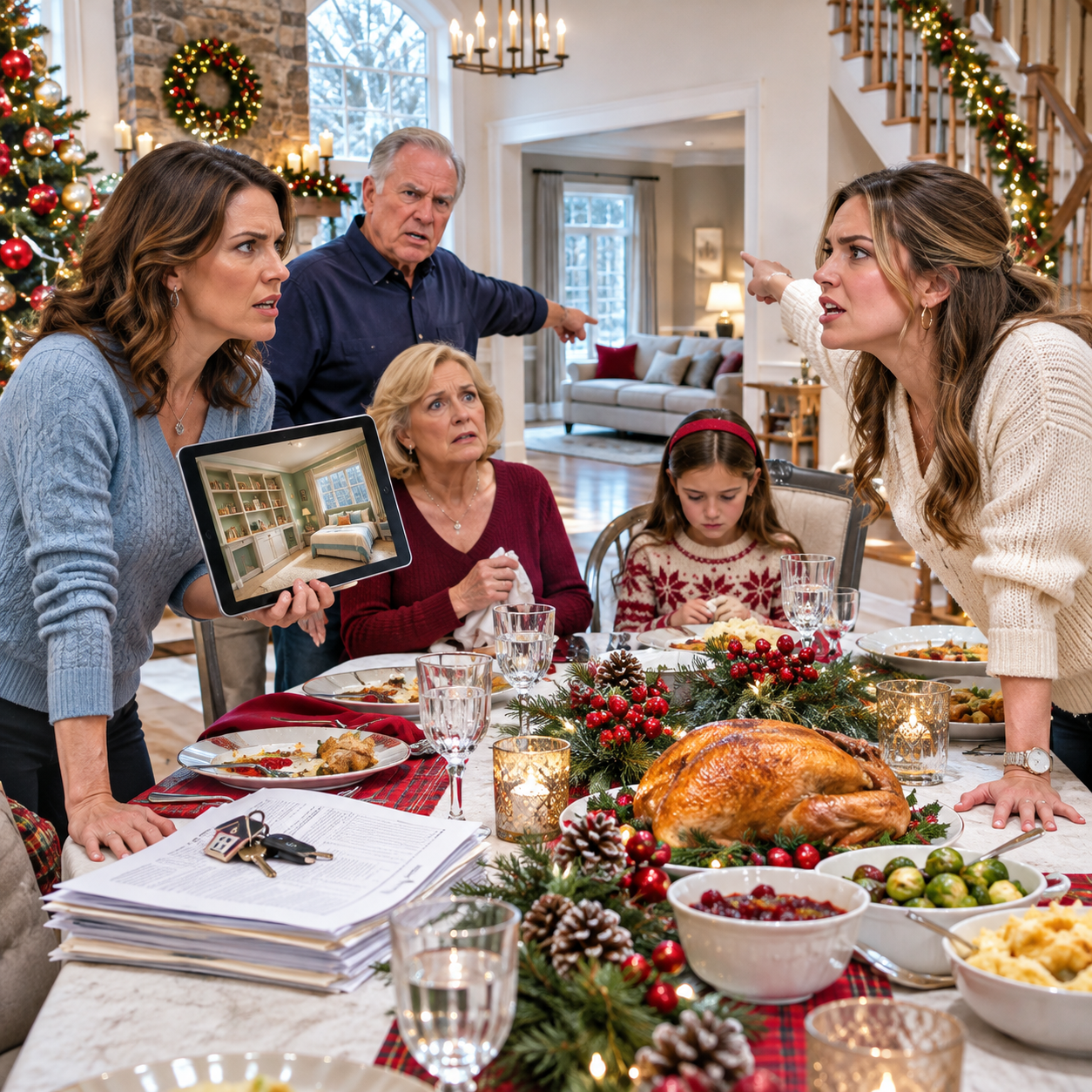
In June, she returned carrying a brochure for Maple Ridge Senior Living.
“After Dad dies, you shouldn’t be alone in this enormous house,” she announced. “We’ll arrange a comfortable room for you.”
“I’ve lived here for forty years.”
“Exactly. It’s time to move on.”
Then she showed me a video she’d secretly filmed through the den doorway during Franklin’s legal appointment. She claimed it would prove I’d manipulated him into changing his estate plans.
I studied the screen. The recording showed the doctor, witnesses, and notary entering the den while I remained elsewhere.
“Thank you, Breanna,” I said.
She blinked. “For what?”
“For recording proof that I wasn’t involved.”
Her smile disappeared.
Two weeks later, Todd Kessler appeared on my porch carrying a document that made my blood run cold.
Graham had borrowed $80,000 from him. Worse, he’d supposedly guaranteed repayment with my signature.
I examined the page. My name looked almost right, but the final flourish was wrong, and the notary section was blank.
“I never signed this.”
Todd frowned. “Your son said you did.”
“Then my son lied.”
I took the document directly to Leonard, who preserved it as evidence. He warned me that Graham’s deception might eventually become a legal matter.
I couldn’t bring myself to report my own child to the authorities while Franklin was dying.
On the first Thursday of July, Franklin stopped eating.
Cynthia moved into our guest room. Audrey sat beside his bed, holding his hand, and cried when he told her to remain kind even to people who hadn’t earned her kindness.
That night, after everyone else left, I climbed carefully onto the bed beside him.
“Dotty,” he whispered, “promise me you’ll keep the books honest.”
“I promise.”
His fingers tightened around mine.
“Forty-two years,” he murmured. “Best bargain I ever made.”
He died just after dawn.
Carla arrived and wept with Cynthia while I stood beside the empty space his voice had occupied. Before leaving, she reminded me that she’d documented Graham’s disturbing conversations in her hospice records.
At nine that morning, Leonard came to the house.
He placed a sealed white envelope in my palm. Across the front, Franklin had written my name in his shaky handwriting.
“He prepared this in May,” Leonard said. “He instructed me to give it to you after his death. He said you’d recognize when to use it.”
“What’s inside?”
“He never told me.”
I hid the envelope inside my mother’s cracked teacup, behind the glass doors of the china cabinet Breanna wanted thrown away.
For several nights, I stared at that cabinet, wondering what my husband could possibly have written.
On the morning of his funeral, I removed the envelope and slipped it into my black handbag.
I didn’t yet understand why Franklin had chosen those instructions.
But I was about to.
## Part 3: A funeral luncheon shattered the family’s lies about inheritance.
Grace Lutheran Church overflowed with mourners. Audrey cried against Cynthia’s shoulder, and Graham delivered a beautiful eulogy about the father who’d taught him the value of hard work. For several minutes, listening to his broken voice, I almost forgot the stolen money and forged signature.
After the service, Graham insisted on taking our immediate family to lunch at the Willow Room, an elegant restaurant overlooking the Lehigh River.
Vincent Marlow, the manager who’d welcomed Franklin and me on our anniversaries for twenty years, greeted me with tears in his eyes.
“Mrs. Whitaker, I saved your husband’s favorite table.”
Before I could thank him properly, Graham steered me toward another table where Breanna’s parents were waiting.
Audrey excused herself to wash her face.
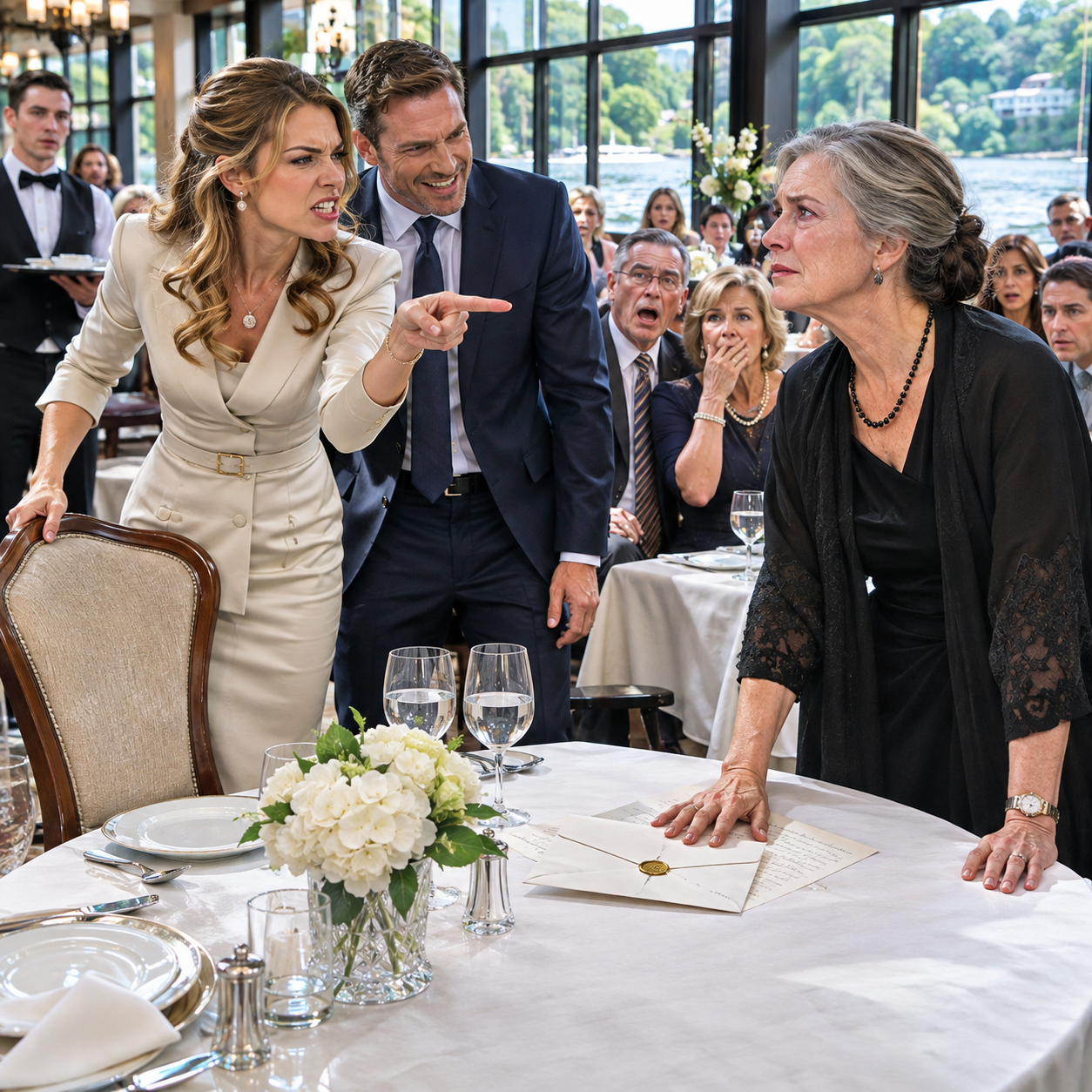
As I reached for a chair, Breanna pulled it away.
“No gold-digging widows at this table!”
My hand struck the tablecloth as I caught my balance. Lorraine giggled behind her napkin, Wendell snorted, and Graham laughed loud enough for nearby diners to turn around.
I looked at the man I’d raised, and something inside me finally hardened.
Without speaking, I opened my handbag.
I placed Franklin’s sealed envelope in front of him.
“Your father left this for you.”
Breanna sneered. “What is it? Another bill?”
“Open it, Graham.”
He tore the envelope and unfolded two handwritten pages. His smile disappeared as his eyes traveled down the first sheet.
“Read it aloud,” Wendell encouraged.
Graham swallowed.
“’To my family. If you’re reading this, I am gone. Graham, you’ve received $126,000 from me in three years. I have accounted for every dollar, including the $24,000 you claimed was needed for medical equipment.’”
His voice faltered.
Breanna snatched at the paper, but he pulled it away.
“’I know about Todd Kessler and the money you borrowed. I know you intended to repay him from my estate.’”
Wendell slammed his palm against the table.
“You borrowed from Todd? You still owe me money!”
“Keep your voice down!” Graham hissed.
But the worst revelation came on the second page.
“’Breanna, I also know you instructed Audrey to request $200,000 from me and have the money placed in your name. My granddaughter refused. She chose honesty when the adults around her would not.’”
Breanna turned chalk-white.
“That’s a lie!”
I stared at her. I hadn’t known anything about that request.
Graham continued reading, his hands trembling.
“’The house belongs to Dorothea. The remaining estate is protected through a trust administered by Naomi Feldman. My wife will receive lifetime financial support. The previous advances to Graham have been counted toward his inheritance, and his remaining bequest is $10,000.’”
For a moment, the entire table went silent.
Then everyone began shouting.
Breanna accused me of manipulating Franklin. Graham demanded to know how his father had discovered Todd’s loan. Wendell insisted Graham had promised him repayment, while Lorraine stared at her daughter in horror.
I remained standing beside my abandoned chair.
“I never saw those documents,” I said. “Your father made his own decisions.”
“You stole my inheritance!” Graham shouted.
The words struck harder than I expected.
I looked into his face. “I held your hand on your first day of school. I stayed awake when you were sick. I helped build the business that paid for your childhood, and I never demanded a penny from you.”
His mouth opened, but no answer came.
Audrey returned from the restroom and froze.
Breanna immediately pointed at her.
“You told Grandpa!”
Audrey’s chin trembled, but she stood her ground.
“You wanted me to ask a dying man for $200,000. I refused. Grandpa deserved to know.”
Vincent approached with two waiters and quietly asked the family to stop disturbing the restaurant.
I gathered my handbag.
“Mrs. Whitaker,” he said gently, “your husband’s table is still available.”
I followed him to the window and sat alone overlooking the river. For the first time since Franklin died, nobody told me where I belonged.
Later that month, we gathered in Leonard’s conference room for the formal explanation of Franklin’s estate.
Naomi Feldman, our accountant of twenty years, had been appointed independent trustee. She confirmed that the trust would cover my living expenses and care, while Graham would receive only his remaining $10,000 bequest.
Graham brought an attorney named Martin Hale.
He announced that he intended to challenge the arrangements, accusing me of influencing Franklin while he was dying.
Leonard calmly presented the doctor’s capacity assessment, the witnessed documents, and evidence that Franklin had acted independently. He also pointed to the trust’s no-contest clause, which threatened Graham’s remaining inheritance if he pursued an unsuccessful challenge.
Breanna insisted her secret hallway video proved misconduct.
Leonard almost smiled.
“Your recording shows Mrs. Whitaker wasn’t even in the room.”
Graham stormed out.
A month later, I received court papers accusing me of fraud and manipulation.
One word in the petition made my stomach turn.
Predator.
I sat at my kitchen table staring at it until Margie arrived with a peach pie and found me shaking.
That night, Leonard called.
“Dorothea, Franklin anticipated this possibility. There’s a recording your son hasn’t seen.”
He paused.
“And I think it’s time he heard his father speak.”
## Part 4: My husband’s final message revealed love’s strongest boundary.
On the Tuesday after Labor Day, I entered Leonard’s conference room with Cynthia and Audrey. Graham sat across from us beside his lawyer, looking thinner than he had at the funeral. Breanna hadn’t come.
Leonard dimmed the lights and inserted a flash drive into the television.
Franklin appeared on the screen, sitting upright in his hospital bed with his cardigan buttoned incorrectly. His cheeks were hollow, but his eyes were unmistakably clear.
“My name is Franklin Albert Whitaker,” he began. “I understand what I own, who my family is, and what these documents mean. My wife has not seen them. Nobody has pressured me.”
Graham lowered his eyes.
Franklin continued, explaining that he had reviewed the financial records and made his decisions voluntarily. His physician’s assessment and the witnesses supported what he was saying.
When the recording ended, Martin Hale leaned toward Graham.
“This is strong evidence against our petition.”
Graham whispered, “Turn it off.”
Leonard shook his head gently.
“There’s another message. Your father addressed it specifically to you.”
Franklin appeared again.
“Graham, son, I made a mistake raising you. Every time you asked me for money, I said yes because I was afraid saying no would mean losing you.”
His voice broke.
“I thought I was helping. But I was teaching you that someone else would always pay for your mistakes.”
Graham pressed his fists against his knees.
“I’m not leaving you less because I love you less,” Franklin continued. “I’m leaving you the chance to build something honestly, the way your mother and I built our first business on that gravel lot.”
He paused, struggling for breath.
“Your mother never took anything from me. She helped me earn everything we had. Don’t punish her because I finally learned to say no.”
The screen went black.
My son buried his face in his hands and cried.
I wanted to hold him. Every instinct from forty-one years of motherhood urged me across the table. But I remained seated, finally understanding that love couldn’t repair choices another person refused to change.
By late September, Graham withdrew his legal challenge.
Naomi also obtained Carla’s hospice records, preserving the notes about Graham’s conversations concerning his father’s approaching death. Todd Kessler’s attorney withdrew any claim against me after reviewing the forged guarantee. The $80,000 remained Graham’s responsibility.
Breanna moved back in with her parents. Her leased white SUV was repossessed, and Wendell demanded repayment of the money Graham owed him.
One evening, Graham appeared on my porch carrying a folder. His shirt was wrinkled and his eyes were red.
“Mom,” he whispered, “I’m sorry. For the sweater, the broken cup, the deed, all of it.”
I invited him to sit in Franklin’s rocking chair.
For a few minutes, I believed he had finally come home to apologize without expecting anything in return.
Then he opened the folder.
Todd’s loan statements lay inside.
“If you could convince Naomi to let the trust pay this just once,” he pleaded, “I swear I’d make it right.”
My heart sank.
“Graham, you’ve brought me another bill disguised as an apology.”
He stared at the floor.
“I don’t know what else to do.”
“Find a job. Make arrangements to repay what you owe. Start telling the truth.”
“Do you forgive me?”
I swallowed.
“I’m trying. But forgiveness doesn’t mean I’ll pay your debts.”
He closed the folder.
At the bottom of the steps, he turned toward me.
“Would you ever let me come back?”
I looked at the empty rocking chair.
“There will always be a place at my table for my son,” I said. “But next time, come with empty hands.”
He walked away without another word.
December brought snow to Allentown, covering the garden where Franklin had once planted lilacs.
On the twenty-second, Leonard delivered one final recording my husband had arranged for me to receive. Cynthia sat beside me in the den as I played it.
Franklin’s face appeared, softer and more peaceful than in the earlier messages.
“Dotty, if you’re watching this, the hardest part should be behind you.”
My fingers tightened around Cynthia’s.
“I spent years thinking I was the one protecting this family. But you kept our books, built our business, and held this home together. I’m sorry I didn’t protect you sooner.”
He smiled.
“Stay in the house we built. Drink your tea from your mother’s cup. And never let anybody make you feel small again.”
I pressed my hand against the screen.
“I won’t, Frank.”
The recording ended, leaving me with his last gift: not money, not property, but permission to stop sacrificing myself to keep other people comfortable.
The next day, Audrey came home from college and drove me to the cemetery. As we stood beside Franklin’s headstone, she told me Graham had found two jobs, working days at a tire warehouse in Bethlehem and driving a cab at night. He was making payments toward Todd’s loan.
“He says it’s his responsibility now,” she whispered.
I brushed the snow from Franklin’s name.
Then Audrey told me something else.
Her grandfather had left her a private recording too. In it, he’d reminded her to be kind, even when kindness was difficult.
“So I invited Dad to dinner,” she admitted. “I hope that’s okay.”
I looked toward the bare trees.
“Tell him Sunday. Five o’clock.”
That Sunday, Cynthia and Audrey helped me set the dining room table. Margie brought apple pie, and I placed my mother’s cracked teacup beside my plate. I couldn’t bear to discard it, and I no longer felt compelled to hide its damage.
At precisely five, the doorbell rang.
Graham stood outside in a clean shirt and an old winter coat. He carried no folder, no envelope, no paperwork. His eyes moved uncertainly from me to the dining room.
“I didn’t know if you’d really want me here.”
“I said you could come.”
He stepped inside, then stopped beside the chair Franklin had always occupied.
“May I sit here?”
For a moment, my throat closed.
“No,” I whispered.
His face fell.
I reached for another chair and pulled it out myself.
“Sit beside Audrey. Your father would want her to know you haven’t forgotten her.”
Audrey moved toward him and wrapped her arms around his waist. Graham held his daughter tightly, his face crumpling against her hair.
At dinner, nobody mentioned inheritances or debts. Graham asked about Audrey’s classes, listened while Cynthia talked about her garden, and thanked Margie for the pie.
When I lifted my mother’s cracked teacup, he noticed the damaged rim.
“Mom,” he said quietly, “I’m sorry Breanna broke that.”
I ran my thumb along the old fracture.
“I know.”
He looked down.
“I should’ve stood up for you.”
“Yes,” I answered. “You should have.”
There was no shouting, no dramatic speech, no sudden promise that everything would become perfect. Just a silence in which my son finally allowed the truth to remain unanswered by excuses.
Then he reached for the water pitcher and filled my glass before his own.
It was a small gesture.
But for the first time in years, he had offered something without asking for anything back.
After dinner, I stood by the window overlooking Franklin’s snow-covered garden. Behind me, Audrey laughed at something her father said, and Cynthia began clearing the plates.
Forty-two years of marriage had taught me that a home wasn’t valuable because of its square footage, its furniture, or the money attached to its deed.
It was valuable because of what happened inside it.
I thought about the restaurant, the chair Breanna had pulled away, and the envelope I’d placed on that white tablecloth.
Franklin hadn’t left me a weapon to destroy our family.
He’d left me the truth, and the courage to stop letting our family destroy me.
I returned to the dining room and took my place at the table.
This time, nobody questioned whether I belonged there.
THE END.
All characters and events in this story are fictional, created for storytelling and entertainment purposes. Thank you sincerely for reading. Your feedback and support are invaluable and motivate me to continue sharing more stories with you.