
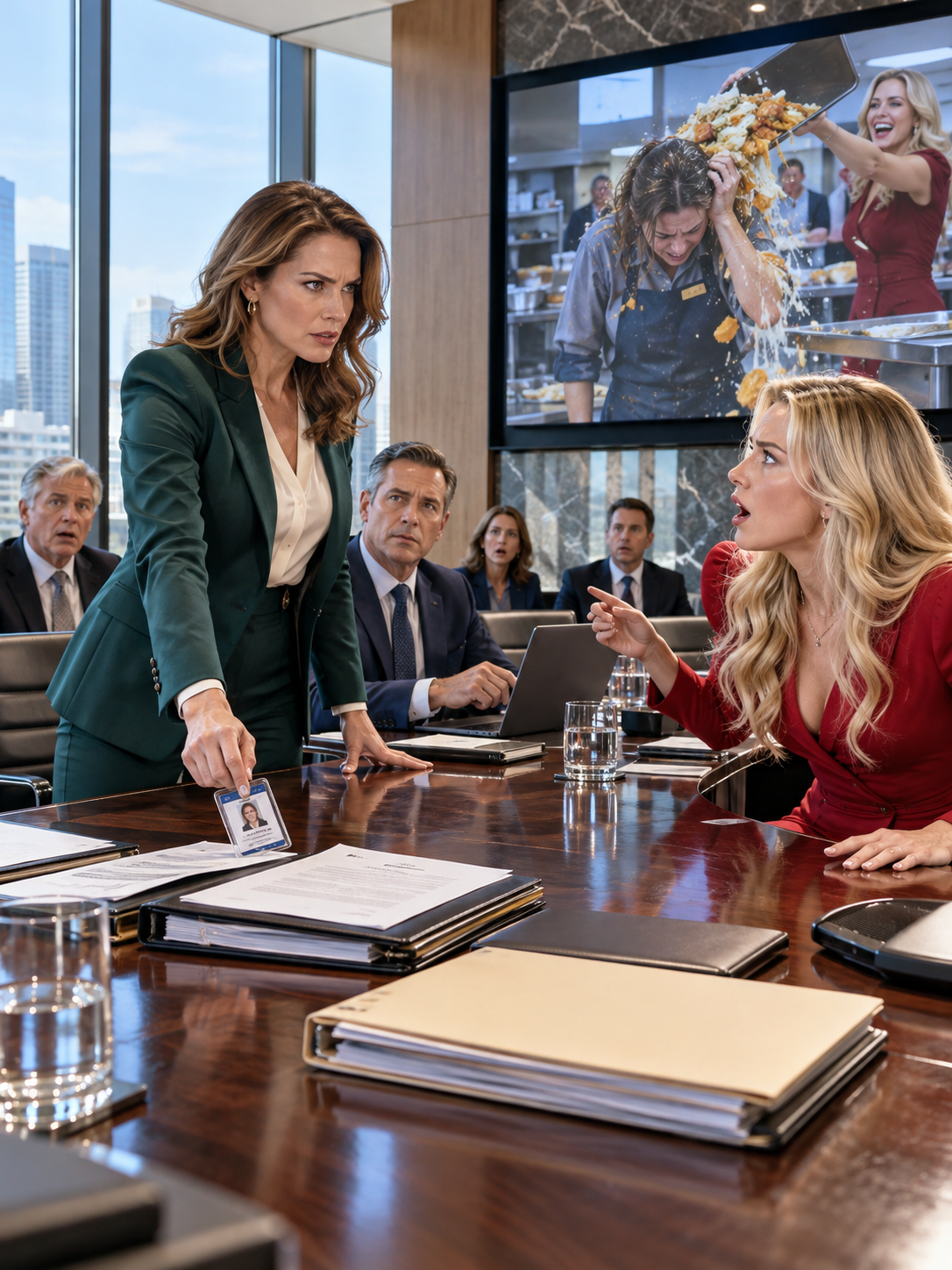
She Dumped Rotten Food on the Janitor and Fired Him—Then Found Him at the Head of Her Boardroom
Yesterday, my CEO kicked over my mop bucket, emptied spoiled food onto my head, and told me I was finished. She thought the gray-haired man in the maintenance uniform had no way to fight back. By eight-thirty the next morning, I was waiting in her boardroom with a split lip, a plastic name badge, and two sealed folders. The first would explain why she should have recognized me. The second would show everyone what she had been hiding from the people who trusted her.
Part 1
The smell hit before the food did: sour milk, spoiled chicken salad, and old coffee. Then something cold slid behind my collar, and everyone crossing the lobby of Whitaker Freight stopped moving. I was kneeling with a scraper when Marissa Vale tipped a trash container over my head. Lettuce landed beside my shoe, bright green against the white marble.
“I told you to remove that stain,” she said. Her red heels clicked toward the elevators, where a dark smear ran across the floor like a tire mark. “Not stand around admiring it.” I explained, as I had ten minutes earlier, that the mark was industrial adhesive and ordinary floor cleaner would spread it. She struck my mouth before I finished the sentence.
I tasted blood and gripped the scraper. A delivery driver stared at his clipboard, and a young receptionist named Elsie covered her mouth. My supervisor, Luis Ortega, hurried out of the hallway, his radio crackling. “Ms. Vale, he’s covering an extra shift,” Luis said. “I’ll get the approved solvent.”
“Charge it to his paycheck,” Marissa said. “And charge him for the executive lunch he ruined.” She shoved my mop bucket with the side of her shoe, sending gray water across the floor. When Luis bent to help me, she snapped, “Are you looking for a new job too?” He stopped, his hands hanging helplessly at his sides.
I’d worn a uniform for nine hours; Luis had worn one here for seventeen years. I knew which of us had more to lose. I raised a hand to stop him and gathered wet napkins from the floor. Marissa watched as if obedience had been her goal all along.
“What’s your name?” she asked. My badge was partly hidden by a wet fold of my jacket. “Tom,” I said. She looked at the badge without bothering to read it, then said, “Consider this your last day.” Her assistant, Nolan Price, laughed softly beside the elevator and nudged the garbage bag closer with his polished shoe.
I straightened slowly, feeling my lower lip swell. “Someone should report what happened here,” I said. Marissa stepped close enough that her perfume overpowered the sour smell on my shirt. “Report it to whom?” she asked. “Security works for me, and nobody here is going to risk their mortgage for a temporary cleaner.”
She walked away, leaving a red heel print in the spilled milk. Nolan followed, tapping something into his phone, while employees hurried through the revolving doors with their eyes forward. I noticed Elsie still standing at reception with her phone beneath the counter. She met my eyes for a second, then shook her head almost imperceptibly.
In the service restroom, I rinsed my hair under a low faucet. Under fluorescent light, the cut looked worse than it felt. Luis handed me a towel and said, “I’m sorry. She does this whenever anyone tells her no.” He sounded as though apologies were part of his job. When I asked how many complaints he had filed, he said human resources forwarded his last three reports directly to Marissa, who then cut his shifts.
I asked Luis to write down what he remembered without using the company system. Outside, diesel exhaust drifted between trailers as trucks rumbled against the dock. The gray morning reminded me of our first loading bay, when I arrived before sunrise carrying coffee for every driver.
Beside my car, I dialed Lydia Hart, my attorney, and told her to preserve the off-site security archive. “No more waiting,” I said. “Bring the independent directors in tomorrow at eight-thirty.” Lydia was quiet for a moment, then asked whether I needed a doctor. “Already arranged,” I told her. “What I need is protection for the people who spoke up.”
Before I could hang up, a message arrived from an unfamiliar number. It was a photograph of a spreadsheet with twenty-three names highlighted in yellow. Beneath it, someone had written, “Nolan has the list. They’re deciding who to fire tonight.” I stared at Luis’s name near the bottom and realized my disguise had put the very people I came to help in immediate danger.
Part 2
I called Lydia before starting the car. “We have a retaliation list,” I told her, forwarding the photograph. She contacted outside investigators who had been examining payroll for three weeks and warned me away from the office network. Then she added, “One of the signatures on that list belongs to a director.”
At a walk-in clinic, a nurse cleaned my lip and closed the cut with two stitches. I explained what happened and requested her notes. In the waiting room, a boy pressed his face against an aquarium while I studied the photograph. Beside the names was an approval code marked R. DELANEY—our audit committee chair’s initials.
Ruth Delaney had been my friend since we rented our first warehouse. She fought for safer loading ramps when I worried about buying trucks. If she’d approved retaliatory firings, I’d misjudged her for twenty years. If someone had forged her name, the problem ran deeper than intimidation.
Six years earlier, cancer treatment changed my appearance and took me away from company events. My hair returned silver, and I spent my recovery helping medical supply networks overseas. The Whitaker Heritage Trust still held sixty-one percent of voting shares. I had approved Marissa’s appointment through counsel, trusting reports I now regretted accepting.
Marissa knew the founder only as a dark-haired man in an old portrait. We’d never met, so she hadn’t connected him to the janitor in her lobby. That disguise was deliberate. After anonymous letters describing stolen overtime and unsafe trucks reached my overseas correspondence address, I wanted to hear what workers said without executives listening.
For eleven days I had worked under a maintenance badge bearing my middle name, Tom. I learned the vending machine near dispatch swallowed dollar bills, and supervisors pressured drivers to revise their start times before payroll closed. Luis showed me handwritten corrections missing from official records. Workers spoke quietly whenever managers passed.
One night, a dispatcher showed me his pay stub and shift schedule. He worked fifty-six hours but was paid for forty. Nolan called the rest probationary training, although the man had worked there nine years. I asked him to submit his account through an independent channel without exposing himself to management.
At a diner near the clinic, Lydia and Priya Shah, an accountant from the audit committee, showed me payments to Meridian Workforce Solutions. Its invoices promised efficiency reviews, but the vendor had no employees and shared an address with Nolan’s brother. Payments coincided with missing overtime and employer retirement contributions. “We need original authorizations,” Lydia cautioned, “not just suspicious patterns.”
Priya compared payroll exports with warehouse door scans and drivers’ logs. Those records contradicted the numbers presented to the board. Six employees supposedly clocked out at five, though their trucks returned after eight. “Someone made the books neat,” she said. “Real work is never this neat.”
Elsie, the receptionist, messaged that she’d recorded several seconds of Marissa confronting me. She also heard Nolan tell a guard to delete camera footage before morning. I told her not to access restricted files or take more risks. Lydia arranged a secure channel for Elsie to provide her own recording to investigators.
At an independent forensic accounting office, an analyst showed us preserved records from a board-authorized, read-only backup. The lobby footage survived on separate storage, but the payroll evidence was complicated: altered timestamps and approvals entered under borrowed credentials. Seven suspicious entries used Ruth’s initials. My stomach knotted as the analyst highlighted them.
I asked Ruth to join us. She arrived in gardening shoes with dirt on one cuff. “I didn’t authorize those,” she said, pointing to entries dated during her hospital stay. Lydia showed access logs identifying a copied approval token used in Marissa’s suite. Ruth’s anger was the first hopeful sign of the day.
Then Priya recovered an email from Marissa to Nolan: “Terminate the twenty-three after tomorrow’s board presentation. No severance discussions until the files are sanitized.” The presentation had been moved to eight-thirty, exactly when I’d summoned the directors. Marissa wasn’t preparing a defense. She was preparing to remove everyone who could contradict her.
Part 3
At eight-fifteen, I stood outside the boardroom in a charcoal suit untouched for two years. Lydia straightened my tie and handed me my scuffed badge marked TOM. “You don’t have to wear it,” she said. “I want it on the table,” I replied. A uniform should never erase a person’s dignity.
The four independent directors sat with Priya and an outside investigator. We’d issued preservation notices, stopped scheduled data deletions, and arranged protection against retaliation. Ruth’s name was provisionally cleared, though she looked furious rather than relieved. Outside, trailers moved beneath a thin strip of sunrise.
Marissa entered with coffee and a leather portfolio, Nolan behind her. She stopped at the sight of me and the badge beside Lydia’s folders. “Who let maintenance in?” she asked, her smile collapsing. “Nolan, call security.” Ruth ordered him to leave the phone alone.
“This meeting was properly called by the board,” Lydia said, placing the trust certificate and current voting register before Marissa. “Mr. Thomas Whitaker is the founder, the trust’s controlling voting representative, and the majority shareholder.” Marissa stared at my face, following the lines of a stranger toward the memory of a portrait. “That’s impossible,” she whispered. “Mr. Whitaker lives overseas.”
Twenty-four years earlier, I had walked this room with a contractor while electricians tested the lights. We couldn’t afford the walnut table then; our meetings happened on folding chairs. Marissa had spent eighteen months telling the board she was preserving my legacy, and I had believed her quarterly numbers. Watching her search for a way to dismiss me, I understood how carefully she had studied the founder’s title while ignoring everything he stood for.
“Not all the time,” I replied. I showed Marissa my identification and her signed appointment records. She stared at my stitched lip as recognition finally arrived. “You should have told me,” she said. “Would you have treated Luis differently?” I asked. She studied her coffee.
Lydia played the lobby footage. Both screens showed the trash container, the slap, and the bucket sliding across marble. My explanation about the adhesive came clearly through the speakers. I watched the directors flinch at how casually Marissa walked away.
“It was a terrible mistake,” Marissa said, breaking the silence. “I was under pressure, and he refused instructions.” She wasn’t denying it; she was calculating its cost. “I’m willing to apologize and settle privately,” she added. “We have a company to protect.”
“We have employees to protect,” Ruth answered. Marissa quoted her employment contract, arguing that a lapse in judgment didn’t justify losing her exit package. Lydia closed the video and pushed forward the first folder: medical notes, witness accounts, and the board’s investigative authority. None of it was a settlement offer.
Marissa reminded the directors that profits were up and customers praised her turnaround. Ruth slid across the latest quarterly report. Deliveries had increased, but reported labor hours had fallen sharply. “That’s efficiency,” Marissa said. Priya requested the supporting timesheets; Marissa said only Nolan could retrieve them, and her eyes moved toward the door.
“Yesterday was reason enough for action,” I said. “But the investigation began earlier.” Nolan moved toward the door, saying he had to check the schedule. An outside investigator in the hallway asked him to remain available for questions in another room. Nolan reluctantly sat down, leaving his portfolio behind.
Marissa turned to Ruth. “Ask her about the approvals. They’re signed.” Lydia displayed the copied digital token used during Ruth’s hospital stay. Authentication records traced it to Marissa’s executive suite. The director Marissa intended to blame now looked her straight in the eyes.
“That doesn’t prove I diverted money,” Marissa said, recovering a thin smile. Lydia placed the heavier second folder between us. Its first page traced transfers to Meridian Workforce Solutions; another column listed workers with missing payments. My stomach tightened at how many names appeared beyond the original twenty-three complainants.
“Before you open it, understand those payments were necessary,” Marissa said, gripping the table. For the first time she sounded afraid. I’d wondered whether the folder revealed fraud or simply disastrous management. The first page provided an answer, but a note on the last tab suggested money wasn’t the only thing missing.
Part 4
Priya read the figures while Marissa stared at the table. Over eighteen months, roughly $3.2 million flowed through invoices for workforce consulting and equipment readiness. Evidence suggested earned pay and promised employer contributions had been diverted, while adjusted books inflated the margins determining Marissa’s bonus. External accountants were tracing what could be recovered.
“You’re calling routine outsourcing theft,” Marissa said. Priya turned to an invoice charging forty thousand dollars for inspecting trucks on a Sunday when the depot was closed. The vendor’s bank account led to a company controlled by Nolan’s brother, and the same account received transfers two days before Marissa’s bonus calculations. “Routine outsourcing leaves deliverables,” Priya replied. “We found fabricated ones.”
On the next sheet, driver Emilio Grant had worked twelve hours but received pay for eight. His letter mentioned taking weekend deliveries to buy his daughter new glasses. I remembered him sharing his coffee with Luis after a late shift. Marissa’s quarterly report called those vanished hours a productivity gain. I could barely look at the phrase.
The next tab concerned safety. A photograph showed a cracked trailer coupling marked in red by mechanic Jasmine Reed. Her inspection failed the trailer, but its digital record showed a pass four hours later. Dispatch assigned it to a driver before maintenance pulled it from service. Nobody was hurt, but luck wasn’t a safety policy.
I remembered Jasmine’s faded lunchbox and how she always checked bolts twice, even when dispatch complained. Two weeks earlier she’d told me, “They want our signatures more than they want safe trucks.” I’d promised to listen. Now her warning was printed on a page in front of the board.
Priya compared inspection timestamps with gate-camera logs. Several trucks had left before their inspections supposedly occurred. Jasmine’s digital signature appeared on reports from shifts when she wasn’t working. Marissa glanced toward the door, as though Nolan could return and take responsibility. For the first time, even Ruth looked shaken.
Marissa pushed back her chair. “Nolan handled vendor approvals and fleet compliance,” she said. “If he forged documents, that is on him.” Priya displayed an email in which Nolan warned that a maintenance report contradicted the monthly performance numbers. Marissa’s written answer was short: “Use the clean figures. We cannot miss the quarter.” The room remained quiet long enough for me to hear a forklift backing up outside.
The final tab listed proposed layoffs. Beside Luis’s name: “Influences others.” Beside Jasmine’s: “Documentation risk.” Beside Elsie’s: “Recorded incident.” Marissa had labeled the workers protecting the company as liabilities. The list predated yesterday, proving the search for whistleblowers had begun while I still cleaned her floors.
I wanted to shout, but asked Lydia whether workers had received protections. “The independent reporting hotline is open,” she said. “Dismissals from this list are frozen pending review, and employee counsel has been notified.” Relief mixed with regret. These safeguards should have existed before I wore a uniform.
Ruth called for a vote to remove Marissa as chief executive for cause, subject to legal review. All four independent directors agreed. Her system access was revoked, and an interim leader was appointed under independent oversight. Nolan was suspended while investigators worked. Nobody confused corporate discipline with a criminal conviction.
State labor investigators and detectives were waiting nearby to receive the preserved evidence. When Lydia mentioned the referral, Marissa turned to me. “We can settle,” she said. “I’ll resign quietly. Think what the headlines will do to your company.” Even now, she worried about the building’s name rather than those who worked inside it.
“Those employees are my company,” I said. “The name on the building is only paint.” For a moment she looked at my injured lip, and I thought an apology might finally come. Instead she asked whether she would still receive her retention bonus. Ruth closed her notebook so sharply that everyone looked up.
After Marissa left to consult counsel, Lydia drew me aside. “There’s a choice before the morning shift ends.” Auditors had identified funds we could advance, but advisers favored a slower, private process to limit exposure. I studied the names in the folder. Firing Marissa meant little if those people spent another winter waiting.
Part 5
At ten-fifteen, I entered the dispatch break room without a tie. It smelled of burnt toast and motor oil, and a television played a forecast nobody watched. Luis stood by the sink with lunch in a paper bag. He looked at my stitches and then at my suit jacket.
“I owe you an explanation,” I said. “I’m Thomas Whitaker. I started this company, and I failed to see what was happening inside it.” Some recognized my name; others looked to Luis. I didn’t demand applause or trust. I told them Marissa had been removed and independent investigators were examining the records.
Nobody cheered. Emilio wanted to know whether a wage claim might endanger his job. A young dispatcher asked when she could see her original time records. Their questions were ordinary, which made them harder to hear. I had studied reports labeled “labor variance” for years without considering the rent and groceries behind each number.
I explained our commitments. A protected company reserve would advance verified back pay, restore substantiated missing employer contributions, and fund independent payroll assistance. Drivers could report hazards directly to an outside administrator. Trailers with questionable inspection histories would undergo fresh checks before returning to the road.
Jasmine raised her hand. “Who’s checking? The people who signed the fake reports?” I promised independent mechanics and direct reporting channels, then offered her a position on the safety committee. “A real seat?” she asked. “With documented authority to stop unsafe work,” I said. She nodded without promising to trust me.
Some advisers had warned us that prompt repayment would tighten the company’s cash position. I asked the board to suspend owner distributions while verified wages were restored. I couldn’t recover every dollar immediately, and I refused to promise what audits hadn’t established. But employees would not bankroll our caution while we defended ourselves in court.
Later Luis asked why I’d kept my identity secret. “I wanted the truth,” I said. He considered that. “You got it. Next time ask us somewhere we don’t have to whisper.” I wrote down his words. Elsie sent her original recording directly to investigators; I thanked her without asking her to appear publicly.
The case advanced slowly through interviews, records requests, and legal arguments. Labor authorities confirmed widespread pay and recordkeeping violations, and the company entered supervised restitution. Prosecutors filed charges against Marissa and Nolan over the alleged financial scheme; they retained the right to contest them. Directors released a corrective-action report that included their own failures.
Initial back-pay checks arrived within weeks, with adjustments after audits. We replaced the bonus formula rewarding artificially low labor costs and required board reports on wages, inspections, and complaints. Employee representatives were elected to listening sessions, which I attended without an entourage. Some were angry with me, and I let them be.
Months later, Marissa’s attorney asked for a private conversation, citing her service, embarrassment, and family. Her letter included one apology for “the unfortunate lobby misunderstanding.” I read it twice and handed it to Lydia. “I won’t meet her,” I said. “Legal proposals go through counsel.”
Nine months after the board meeting, Nolan pleaded guilty to falsifying records and agreed to cooperate. Marissa later pleaded guilty to financial charges, and the court ordered restitution. I didn’t attend. Lydia called with the news while Jasmine and I reviewed inspection procedures, and I finished our conversation before returning her call.
I didn’t hate Marissa, but I owed her no forgiveness or escape from accountability. Her case belonged to investigators and courts, not my temper. Workers deserved a place where a uniform didn’t make them vulnerable to humiliation.
On the anniversary of our first warehouse, I visited before sunrise. Luis was teaching two new cleaners how to remove adhesive, and Jasmine checked a serviced trailer. I grabbed a cloth and wiped down the counter. Luis grinned. “You’ve gotten better at this, Tom.”
The badge stayed in my desk drawer, not a glass case. It reminded me that dignity cannot depend on someone’s name or title. When the first trucks rolled into the morning, I stood beside Luis at the doors and greeted drivers by name. This time, I intended to keep showing up.
Legal Notice: This story is a work of fiction. Names, characters, businesses, events, and incidents are the product of the author’s imagination or are used fictitiously. Any resemblance to actual persons—living or dead—or to actual events is purely coincidental. Thank you! 💓


