
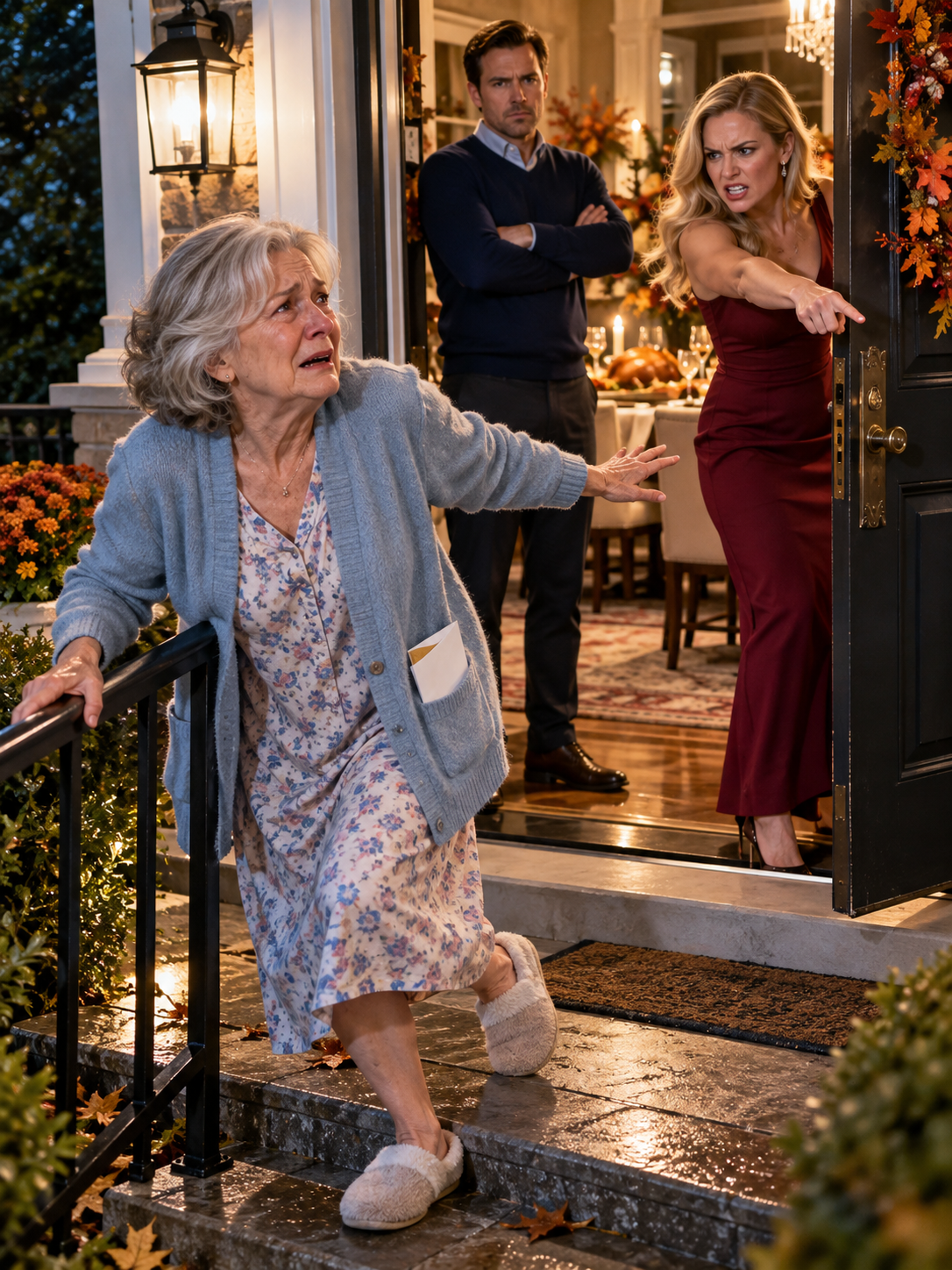
My Son Locked Me Out at 11:47 on Thanksgiving—But He Forgot What Was in My Husband’s Desk
At 11:47 on Thanksgiving night, my daughter-in-law pushed me onto my own porch because I refused to wash two roasting pans. My son watched her lock the door and told me to find a hotel. I was sixty-eight, shivering in slippers and a cardigan. They believed my late husband had left them a claim to the house. I knew there was a document they had never read, but I had no idea how far my son had gone to make their lie come true.
Part 1
The last guest left at 11:36 p.m., carrying pecan pie and calling, “Celeste, you outdid yourself!” My daughter-in-law waved from the doorway as though she had spent two days on her feet. Behind her, my kitchen smelled of turkey grease, cinnamon, and the lemon cleaner I had used on the counters that morning. Twenty-three people had eaten at my tables. I had cooked everything but the bakery rolls Celeste arranged for photographs.
I was scraping my mother’s crystal bowl when Celeste dropped two greasy roasting pans beside the sink. “Get these done before you go up,” she said, still wearing the cream sweater she’d changed into before dinner. I said my knees hurt and I would wash them after breakfast. She glanced at the clock, then at my son, Grant, who was scrolling on his phone. “Your mother is doing that thing again,” she said. “Acting like she’s a guest.”
I set down the sponge. “I’m not a guest, Celeste. This is my kitchen.” Grant sighed without looking up. “Mom, don’t start. She hosted a huge dinner.” The refrigerator hummed into the silence. “I made the dinner,” I answered. “If you two want the pans clean tonight, you can wash them.” Celeste’s smile disappeared, and I knew another reasonable sentence had become a family crisis.
Eighteen months earlier, Grant and Celeste had arrived with three suitcases after a failed business partnership. I had offered spare bedrooms rent-free for six months. By summer they were choosing new paint colors for my living room. In October Celeste packed away my mother’s blue china because it looked “like a nursing home.” Grant answered every protest with, “We’re all trying to make this work.” Somehow “all” always meant me.
That night I tried to go upstairs. Celeste stepped in front of the hallway. “I want a clean house when I wake up.” I told her to move.
She called for Grant, who came over with the annoyed expression he’d once worn when I reminded him to finish homework. “Just apologize,” he told me. “You’re embarrassing her.” I looked at my son’s face and asked, “Grant, who told you either of you gets to order me around in my own home?”
Celeste laughed sharply. “Our home, too. Robert wanted Grant to have it someday.” Hearing his name made the room shrink.
Robert had been gone six years; he had loved this brick house, the crooked maple beside the drive, and the pencil marks inside the pantry door. I asked where Celeste had gotten that idea. Grant looked down at the floor. He didn’t answer, and that silence frightened me more than her arrogance.
“Maybe you need a night somewhere else,” Grant said finally. I thought he meant I should go to bed, until Celeste caught my sleeve and steered me toward the back door. I pulled away, but my shoulder struck the frame. Suddenly I was outside with my purse, thin cardigan, and house slippers, staring through the glass at the place where I’d lived for thirty-nine years. The deadbolt clicked, and Grant said through the glass, “Call Aunt Elaine. We’ll talk tomorrow.”
I pressed my hand against the door, then made myself stop. If I called my sister, she’d shelter me, and tomorrow my son would say he hadn’t meant it. I had forgiven too much for another week of peace.
Instead, I called Howard Keene, the attorney who had settled Robert’s estate. When I told him where I was, his voice sharpened. “Call the police, Nora. Don’t force the door. And don’t let Grant persuade you that the deed says something it doesn’t.”
Two officers arrived while the porch light flickered over my slippers. Celeste was stacking leftovers in plastic containers. Officer Patel asked Grant to unlock the door and then asked who lived there. “We all do,” Grant replied quickly. “It’s a family house.” Celeste added, “It’s practically ours.” I watched my son nod, and knew this wasn’t about dirty pans. Somebody had taught them to expect an inheritance from a woman who was still alive.
Part 2
Officer Patel stood in the entryway, rain beading on his jacket. He asked whether I’d left voluntarily; Grant said, “She was upset.” That wasn’t an answer. When the officer asked again, Grant admitted Celeste had put me outside and he had refused to open the door. Celeste insisted she had only been “guiding” me. My shoulder throbbed whenever I lifted my arm, and Patel took photographs before asking whether I wanted the incident documented. I said yes, despite the look Grant gave me.
I expected the officers to announce that my son had to leave immediately. Instead Patel explained that he could help me regain safe access and document what had happened, but he could not settle a property or tenancy dispute on my doorstep. That sounded painfully ordinary after what felt like the worst betrayal of my life.
I asked the officers to accompany me upstairs while I retrieved my husband’s lockbox. Grant followed so closely that I could smell the coffee on his breath. “Mom,” he whispered, “don’t make this bigger.”
Robert had kept the gray metal box in the bottom drawer of his walnut desk, under old seed catalogs and birthday cards. For six years I had barely touched it. I still knew the combination: the month we married, followed by the year Grant was born. My hands shook as I turned the dial. Inside lay our marriage certificate, a folded survey, and a thick cream envelope marked HOME in Robert’s square handwriting. I slipped it into my purse without opening it.
Celeste was waiting at the foot of the stairs. “Why are you dragging the police into a private disagreement?” she demanded. “Because you put me outside,” I said. She looked at Grant instead of answering.
“Tell her what Robert wanted.” Grant swallowed. Then he said, “Dad always said the house should stay in the family.” Robert had said that while planting tomatoes and teaching Grant to drive. But keeping a house in the family was not the same thing as handing it to whichever family member shouted the loudest.
Officer Patel asked whether Celeste would agree to stay somewhere else for the night so everyone could be safe. She refused. Grant glanced toward my purse, then abruptly offered to take her to a motel. “We’ll figure this out tomorrow,” he muttered. His surrender startled me.
Celeste protested all the way upstairs, and the officers remained while they packed overnight bags. As Grant carried a suitcase down, I noticed a yellow legal pad sticking from its front pocket. Written across the top were the words: “Nora—December signing.”
I asked what he was planning for December. Grant shoved the pad back into the bag. “Just paperwork. Financial planning.” I remembered him suggesting, twice that month, that I meet a friend who could “simplify everything” as I got older. He had even offered to schedule the appointment himself. At the time I thought it was clumsy concern. Now, standing beside my bruised shoulder and the unlocked front door, I was no longer sure what he’d wanted me to sign.
The car finally backed out of the driveway at 12:41 a.m. I stood under the porch light until its red taillights vanished. My house was still covered in dinner plates and abandoned coats, and a pie fork lay inexplicably beneath the hall radiator. I locked the door and sat in Robert’s chair with the envelope on my lap.
A person can love a child for forty-two years and still discover she doesn’t know what he’s capable of. I called Elaine, told her the truth, and asked her to come at sunrise.
Before I went to bed, I opened the cream envelope. The first page carried my name and Robert’s, exactly as I remembered. Behind it, however, was a newer sheet I had never seen, tucked among papers Grant had borrowed from me that summer. It wasn’t a will or a deed. It was a real estate valuation request, listing Grant as the “authorized family representative,” with a follow-up appointment scheduled for the following Monday. Beneath the address, in handwriting I recognized, someone had written: “Mom must agree before Christmas.”
Part 3
Elaine arrived at seven with a thermos of coffee, a wool coat, and the expression she wore when somebody had insulted one of her daughters. She didn’t waste time saying Grant must have misunderstood. Instead, she photographed the valuation request and helped me put the estate papers back in order. The dining room still smelled like yesterday’s gravy. Through the window I could see wet leaves plastered against the maple’s roots, and I remembered Robert telling me never to let anyone rush me into signing something I hadn’t read.
Howard met us at his office at nine. His receptionist offered tea, but my stomach wouldn’t accept anything. Howard spread the original deed beside the survivorship affidavit filed after Robert died. Robert and I had held the house with a right of survivorship. When he died, his interest passed to me; the recorded affidavit confirmed the change.
Grant was not on the deed. There was no hidden family trust. Robert’s will gave our son no authority to sell my house.
I feared what would happen when Grant could no longer pretend not to know. Howard pulled the valuation request closer and studied the brokerage name. “This isn’t proof of a sale,” he said, “but it is proof somebody was preparing to discuss one.” He called the brokerage while Elaine sat with me. By then, someone’s cinnamon tea smelled nauseating.
The agent, Miriam Cole, had visited the house two weeks earlier while I was at physical therapy. Grant had told her I wanted to downsize because the stairs were becoming difficult. Celeste had shown her the kitchen, described the guest rooms as “future children’s rooms,” and discussed a price. Miriam had explained that the actual owner would need to approve and sign any listing agreement. Grant promised I would do that at a family meeting. No house had been listed, and no money had changed hands. Still, they’d toured my rooms with a stranger, pricing my life without asking me.
Howard asked Miriam to send her notes. One line made my chest ache: “Son believes mother will accept assisted-living apartment after transfer.” I had never said I wanted assisted living. My knees were stiff, not my mind.
Celeste had spent months hinting that I was forgetful whenever I couldn’t find an object she had moved. Suddenly the missing measuring cups and rearranged medicine cabinet looked different, although I couldn’t prove those incidents had been anything more than carelessness. I refused to let suspicion replace evidence. The agent’s notes were enough.
Grant called while we were still at Howard’s conference table. I put him on speaker. “Mom, Celeste is sick over what happened,” he said, without asking about my shoulder. “She didn’t sleep.”
I stared at the bruise visible above my collar. “Did you invite an agent into my house?” Silence. Then, “We were exploring options.” I asked whether those options involved selling my home and moving me into assisted living. “Nobody decided anything,” he said. “We were just trying to plan for the future.”
“For whose future?” Elaine asked. Grant snapped that she should stay out of it. Howard raised one finger, advising me not to argue. I asked Grant to bring no one to the house until we had written arrangements for collecting their belongings. “You can’t do that,” he said. “We live there.” Howard took over and calmly explained that lawful occupancy had to be addressed through proper notice and, if necessary, the court. He also told Grant not to contact brokers on my behalf or represent himself as authorized to act for me.
That evening, Miriam forwarded the promised notes and two photographs from the visit. In one, Celeste stood smiling in my kitchen, her hand resting on the back of my chair as though she were already giving a tour. In the other, Grant held a manila folder open on Robert’s desk. Through the clear plastic cover was the title of a document I had never signed: “Proposed Transfer of Real Property.” I enlarged the picture until the letters blurred. The plan hadn’t begun at Thanksgiving, and it hadn’t ended when the police arrived.
Part 4
On Saturday morning, I wanted to change the locks, put their furniture on the lawn, and be finished. Howard talked me out of all three.
Because Grant and Celeste had lived with me for eighteen months, he said, I should not assume I could remove their access without following Ohio’s legal process. We served written notice ending their living arrangement and offered scheduled times to retrieve necessities without an argument. Howard kept copies of the police report, the valuation request, and the agent’s notes. I kept the house quiet and the porch light on.
Grant responded with twenty-seven messages in a day. Some called me cruel. Others described Celeste crying in a motel room, as if my childless Thanksgiving morning had been an ordinary inconvenience. Then he asked to meet without Celeste. I agreed only at Howard’s office.
Grant arrived in the flannel shirt I had bought him last Christmas and spent five minutes studying a coffee stain on the conference table. “She thought Dad left me half,” he finally said. “And you let her think that?” I asked. He rubbed his face. “At first, I didn’t correct her.”
“After that?” Howard asked. Grant admitted that he had told Celeste I would eventually put the house in his name. When their business debt worsened, they’d begun talking about selling it and buying a smaller place for me, with the remaining money to “give them a fresh start.”
My throat tightened. “You planned to spend the difference?” He nodded once. I asked how a real estate agent, a moving van, and a new apartment had become everybody’s business except mine. Grant couldn’t give me an answer that didn’t sound like an excuse.
He reached across the table. “Mom, I never wanted you hurt.” I pulled my hand back. “But you watched her push me out, then refused to open the door.” His eyes filled, and for the first time I saw shame instead of irritation. A part of me wanted to comfort him because I’d spent decades recognizing that look and trying to fix it. Instead, I told him the meeting was over. His tears were real. So was the click of that deadbolt.
By Monday, Celeste had begun telling relatives that I was confused and had called the police over dishes. My cousin called to ask whether I needed help with my memory. I felt a cold, precise anger.
I sent one message to the family group: “I am safe and making my own decisions. Grant and Celeste are moving out. I will not discuss my medical or financial affairs through relatives.” I attached no photographs and demanded no sides. Elaine said it was the first family text she’d ever seen that actually ended a conversation.
Celeste didn’t stop. She sent Howard a letter claiming she’d paid for improvements and deserved reimbursement before she would leave. The attached list included throw pillows, a television stand, and paint samples never used.
Howard replied requesting receipts and explaining that any genuine dispute could be handled separately from possession. Two days later, the couple agreed in writing to vacate by a set date, return their keys, and arrange a supervised collection of the remaining property. The agreement included no transfer of ownership and no promise that I would house them again.
When I signed it, my pen hesitated over my own name. I remembered signing Grant’s school permission slips, his first apartment guarantee, and the check for the caterer at his wedding. This was the first paper I had signed to protect myself from him.
When Grant came to collect boxes, Officer Patel wasn’t there; Elaine and a neutral moving supervisor were. I stayed in the den, sorting Robert’s photographs. From the hallway I heard Celeste say, “She’ll change her mind by Christmas.” Grant answered, “No. I don’t think she will.” For the first time, he sounded as though he understood me. But while checking the empty guest-room closet afterward, I found something slid beneath a loose shelf: an envelope addressed to a retirement community, with a check bearing Grant’s signature and a handwritten note about a deposit “pending Mother’s cooperation.”
Part 5
I took the envelope to Howard instead of calling Grant. The retirement community confirmed that no apartment had been rented in my name and no deposit had been accepted. Grant’s check had never been processed; it was another proposal that required my consent. That distinction mattered.
I would not accuse him of stealing a home he had never legally obtained. What he had actually done was terrible enough: he’d treated my consent as a minor obstacle to a future he’d already designed.
Their agreed move-out date arrived on a gray Wednesday in December. I watched from the breakfast nook as a rented truck swallowed the furniture they’d brought eighteen months earlier. Celeste carried out the throw pillows she had demanded reimbursement for, holding them like trophies.
Grant paused beside the pantry door, where pencil marks showed how tall he’d been at eight, eleven, and fifteen. He touched the highest mark, then turned toward me. I hoped, absurdly, that he would ask how my shoulder was healing.
Instead he said, “We really don’t have anywhere permanent to go.” I looked at his packed truck and thought of the night he’d told me to find a hotel in my slippers. “Then you’ll have to make a plan,” I said. “That’s what adults do.” He glanced toward Celeste, already seated in the passenger seat. “She’s my wife.” “And I’m your mother,” I answered. “You didn’t have to stop being my son to be her husband.” He had no reply, and I didn’t offer him one.
After they left, Elaine and I walked through each room with a checklist. Their keys were on the kitchen counter. We photographed the condition of the rooms and confirmed with Howard that the written surrender had taken effect before changing the locks.
In the guest room, the carpet held four pale squares where their heavy dresser had stood. My china was still packed in cardboard boxes, each plate wrapped in yesterday’s grocery circulars. I opened one box, felt the cool blue rim of my mother’s serving dish, and put it back carefully.
Christmas brought two cards. Celeste’s contained a printed photograph of herself and Grant beside a tree in a furnished rental. On the back she’d written, “Families forgive.”
Grant’s arrived three days later, in his own crooked handwriting. He said he was sorry for leaving me outside and for planning around my property without my permission. He didn’t blame Celeste, which was something. He asked whether we could start over with Sunday dinner, “like before.” I read the card twice, then placed it in Robert’s desk without answering.
In January, Grant called once more. I let it go to voicemail. He sounded quieter than I’d heard him in years. “I understand if you don’t want to see me,” he said. “I hope you’ll believe I’m sorry someday.”
I believed he regretted the consequences. Maybe he regretted the choices, too. I didn’t need to decide. Love wasn’t a courtroom, and I wasn’t required to hold another hearing just because he wanted a different verdict.
I spent part of the winter repairing the things I’d neglected while making room for them. A carpenter fixed the loose pantry shelf. I had the guest room painted a warm yellow and bought a sturdy reading lamp for the corner. At Elaine’s suggestion, I joined the library’s Thursday book club, where nobody called me selfish for saying I wanted to go home. On the first mild Saturday in March, I planted marigolds beside Robert’s maple and used the roasting pans again for a neighborhood potluck, this time with friends who stayed to help wash them.
People sometimes ask whether I’ll reconcile with my only son. I tell them I wish him a decent life, but I won’t hand him the keys to mine. If some future day brings a different relationship, it won’t be built on pretending that Thanksgiving never happened. For now, there is no Sunday dinner and no invitation hidden in my silence.
At 11:47 that night, I stood outside my own house waiting for someone I loved to open the door. Today I turn the key myself, step inside, and know exactly where I belong.
Legal Notice: This story is a work of fiction. Names, characters, businesses, events, and incidents are the product of the author’s imagination or are used fictitiously. Any resemblance to actual persons—living or dead—or to actual events is purely coincidental. Thank you! 💓


