
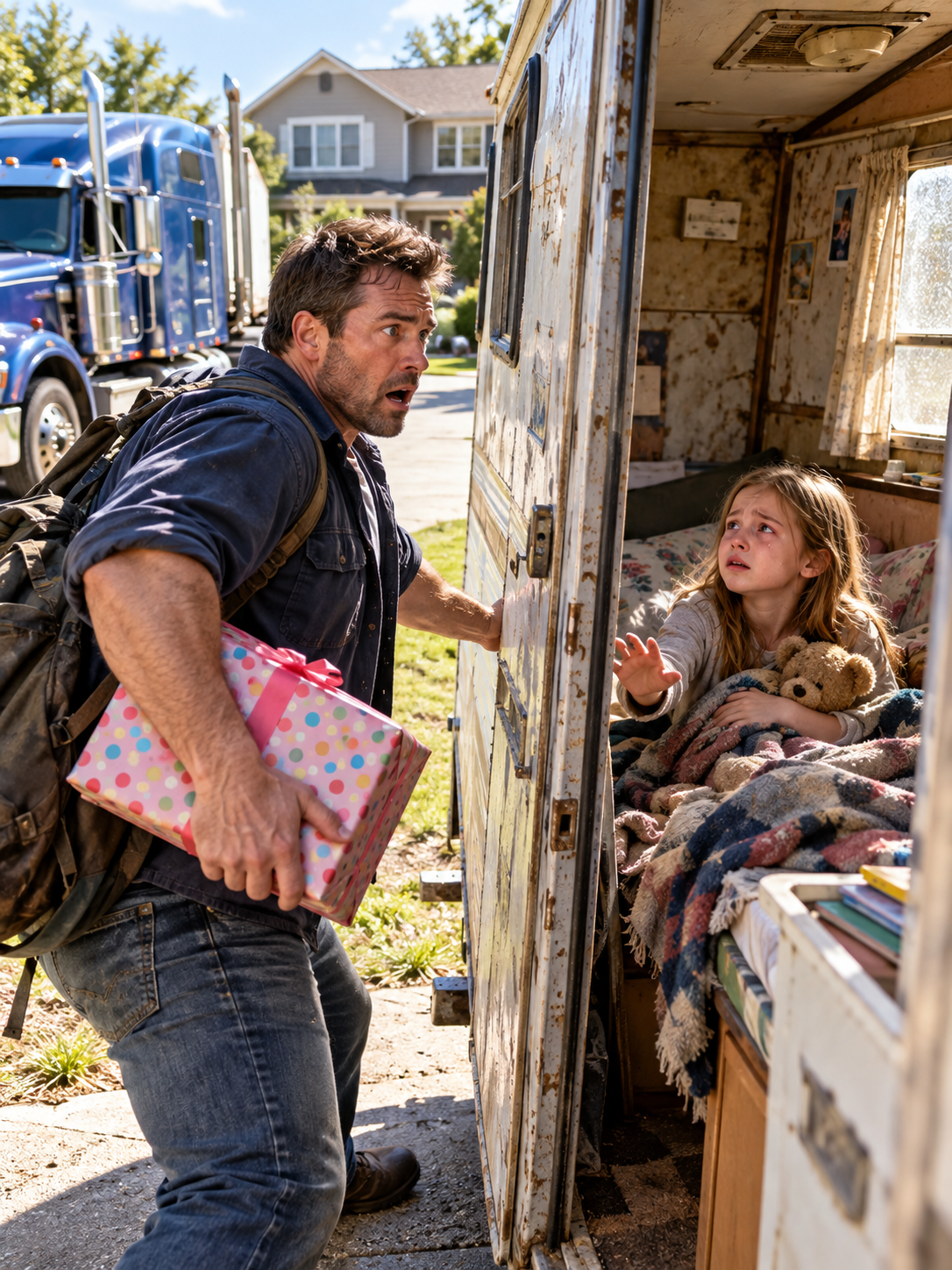
I Came Home Early for My Daughter’s Sixteenth Birthday—and Found Her Sleeping in a Freezing Camper
I spent most of my life hauling freight across the country so my daughter would never worry about having a home. Three days before her sixteenth birthday, I returned with her favorite strawberry cake and found her bedroom turned into a gym. My wife said she preferred sleeping outside; outside meant a rusted camper in nineteen-degree weather, without heat and with a cord holding the door shut. My daughter barely dared to hug me. Then she pointed to a baby monitor and whispered, “Not yet, Dad.”
Part 1
The cake rode shotgun all the way from a grocery store outside Amarillo, its plastic lid rattling whenever my truck hit a seam in the highway. I’d asked the bakery clerk to pipe sixteen little strawberries around the edge because my daughter, Kaylee, had loved them since she could pronounce the word. By the time I turned onto our street outside Canyon, Texas, it was almost midnight Wednesday. I expected darkness, maybe the porch light Kaylee always left burning for me.
Instead, every downstairs window glowed, and the television was loud enough to hear from the driveway. My brother-in-law, Rick, occupied my recliner, work boots planted on the coffee table, a half-eaten sandwich balanced on his chest. He’d moved in for “a few weeks” eighteen months earlier and somehow acquired the remote, the garage, and an opinion on every dollar I spent. Tara came from the kitchen in her bathrobe and hugged me so tightly I couldn’t set down the cake.
“Wade, you’re not due until Sunday,” she said. “I wanted to surprise Kaylee,” I replied. “Where is she?” Tara offered coffee and said my daughter was asleep. I left the cake on the counter and went to her room.
Kaylee’s bedroom smelled of rubber flooring and new paint. Her yellow quilt and bookshelves were gone, replaced by a treadmill, weight bench, and glaring mirror. I stared at the dents where her bedframe had stood. Behind me, Tara said, “She’s older now. She doesn’t need all that space.”
“Where is my daughter?” Tara’s smile thinned, and Rick appeared in the hall, rubbing his eyes. “Don’t make a scene,” she said. “She stole forty dollars from my purse. She chose the camper until her attitude improves.”
We had an old travel camper at the back fence, bought when Amy, my first wife, was still alive. Its roof leaked during summer storms, and the little furnace hadn’t worked in years. The porch thermometer read nineteen degrees as I crossed the yard without a coat, my boots crushing frozen grass. A bungee cord looped through the camper door handle, tight enough that I needed both hands to release it.
Inside smelled of damp canvas and cold metal. Kaylee lay curled on a narrow bench in two jackets and a knit cap, buried under quilts from our linen closet. A space heater sat dark beside her feet; its extension cord was disconnected at the house. When my flashlight touched her face, she recoiled.
“Dad?” She tried to sit up and winced. I knelt and pulled her close, startled by the sharpness of her shoulder blades. Even under the quilts, she trembled. “How long have you been out here, sweetheart?”
“Since Thanksgiving,” she whispered. Five weeks, while I drove between Amarillo and Atlanta, hearing her insist everything was fine. I remembered every rushed phone call and felt sick. “Why didn’t you tell me?” I asked, and she seized my jacket.
“She watches when you call and questions me afterward.” Kaylee glanced toward the window. “Please don’t yell at her. She has papers for a place that takes troubled girls, and she says you’ll believe her.” I promised no one was sending her away, but she shook her head as if promises weren’t enough.
Then she pointed at a white baby monitor taped beside the window. A tiny green light glowed on its face, and a charging cable disappeared into a battery pack under the bench. I recognized it from the box of baby things Amy had saved. Kaylee covered the monitor with her palm and whispered, “At my party, when everybody’s here. Please trust me until then.”
I wanted an explanation, but her teeth were chattering. I carried her inside, wrapped her in warm towels, and called a medical advice line as her color returned. Tara watched from the kitchen doorway. “You’re undoing my discipline,” she complained. Rick snorted: “Kid’s got you trained.”
Kaylee fell asleep with her hand clamped around my sleeve. For two years I’d trusted Tara to protect our family. Now I knew the camper wasn’t the whole story—and whatever Kaylee heard through that monitor scared her more than the cold.
Part 2
At six Thursday morning, Tara waited at the kitchen table with a folder, two coffees, and her customer-service smile. Rick was in the garage; smoke drifted through the side door. She pushed me a mug and asked if Kaylee had apologized. I asked why the camper door had been tied shut.
“To stop the wind,” she replied. “And the heater?” I asked. She said electricity was expensive, then slid over a brochure showing smiling teenagers hiking beneath a blue Utah sky. Its headline promised structure, accountability, and changed lives.
“I spoke to an intake coordinator,” Tara said. “Take Kaylee’s side, and she’ll spend her sixteenth year there. I only need your signature.” The folder accused my daughter of lying, stealing, and aggression, none of it mentioned by her teachers. My name was printed beside a yellow SIGN HERE sticker.
“Okay,” I said, shutting the folder. Tara relaxed and kissed my cheek. She thought I’d agreed. I meant I understood how careful I had to be.
Kaylee woke with aching fingers and a stubborn refusal to eat breakfast until I sat beside her. I called a clinic and took her for an examination, telling Tara we were shopping for birthday decorations. The nurse noticed how Kaylee tucked her hands inside her sleeves whenever an adult entered the room. After checking her over, the clinician documented the cold exposure, asked Kaylee questions privately, and gave us clear instructions for keeping her warm and safe.
On the drive home, I stopped at a diner with cracked red vinyl booths and ordered her pancakes with extra strawberries. She watched the waitress walk away before saying, “I thought about telling Aunt Joanne.” Then she opened her old phone, its screen spiderwebbed from a softball tournament last spring. Her messages to my sister never showed as delivered, and the number saved for Joanne wasn’t Joanne’s number anymore.
“Tara changed it when she said she was helping me set up parental controls,” Kaylee said. “She told me everybody was tired of my stories.” I stared at the wrong digits until they blurred, then asked why she hadn’t told someone at school. Kaylee explained that when her counselor called home about her exhaustion, Tara told her she stayed up gaming, then made Kaylee repeat that explanation the next morning.
Three weeks away every month had kept our bills paid and Kaylee’s college account growing. I’d mistaken financial security for safety. When I apologized, she traced syrup around her plate. “I knew you’d come home eventually,” she said.
While Kaylee rested, I photographed the camper, heater, cord, and empty bedroom. I called Joanne, asking her to come to Saturday’s party with Amy’s parents. I told her enough to make her voice turn sharp. “I’m coming right now,” she said. “She’s with me and safe,” I answered. “Please come Saturday.”
That afternoon I met Denise Calder, the attorney who’d helped after Amy died. She confirmed that Amy’s life-insurance proceeds belonged in a trust for Kaylee, with me as trustee; Tara had no automatic claim. Denise warned me not to sign anything and helped document what I’d found. “Ask what those forms are really meant to buy,” she said.
At home, Tara hung balloons and called everything a fresh start. She told Rick to move paint cans before guests arrived; he snapped that nobody should enter the garage. Seeing me, he forced a smile and offered to clean the grill. Kaylee watched silently from the hall.
I asked my daughter whether the monitor had something to do with the garage. She nodded but wouldn’t play the recordings yet. “Alone, you could say I edited them,” she whispered. “She’ll make you choose whose word to believe.” I said I believed her already, but she wanted Joanne and her grandparents present.
After she went to sleep, I saw a missed call on my phone from an unfamiliar number in Utah. The voicemail was for Tara, not me, and its last sentence made me sit upright: “We’ll need confirmation of who controls the funds before we can finalize your daughter’s placement.”
Part 3
By Friday, the Utah number had called twice more. I saved the messages for Denise, then took Kaylee to speak with her school counselor while I waited outside. She emerged carrying a note excusing her until Monday. For the first time, her shoulders weren’t pulled up around her ears.
“Mrs. Harlan believed me,” she said in the truck. I told her she deserved to be believed the first time, not because she had collected proof but because she’d said she was afraid. She looked through the windshield at the football field, where workers were painting fresh white lines on frozen grass. “Can Grandma and Grandpa still come?” she asked. “I want them there when they find out.”
I called Amy’s parents and told them Kaylee was safe with me but that something serious had happened. Her grandfather, Frank, immediately offered to drive from Lubbock; her grandmother, Ellen, asked whether Kaylee needed her old quilt. Neither demanded an explanation over the phone. They had learned, during Amy’s illness, that some questions could wait until the person answering felt ready.
Tara spent Friday behaving as if she’d won. She gave me a grocery list for Saturday’s birthday party and thanked me for supporting “consistent consequences.” I bought the plates and strawberries she wanted. Behind the garage’s locked side door, Rick kept dragging things across the concrete floor.
That evening, Kaylee sat on my bed, wiping dust from a white plastic speaker. She’d brought the monitor receiver in from the camper and was checking its battery. “The other half is behind the paint cans in the garage,” she explained. “Near their little table.”
She had once overheard Rick mention my name through the kitchen window, followed by the words “too busy to notice.” Remembering Amy’s old baby monitor, she’d tested whether its signal reached the camper. She hid the transmitting half while Tara shopped. At night, she held her old phone by the speaker and recorded whenever their voices came through.
“It doesn’t always work,” she said. “Sometimes it’s just the refrigerator humming next to the garage or Rick coughing.” I asked why she hadn’t simply sent the files, and she pointed to the cracked phone, which Tara had removed from our family plan. She’d saved copies to a memory card hidden inside her softball glove, but she couldn’t know whether Tara would intercept a message. Thirty-one nights of trying to catch enough words to make somebody listen.
On Saturday, Kaylee turned sixteen under a sky as blue and hard as polished glass. I made her scrambled eggs and gave her the small silver pendant Amy had left with instructions that it should be hers on this birthday. She opened its tiny clasp and found a photograph of herself at four, covered in strawberry frosting. Her smile arrived slowly and then broke all at once.
By six, the house smelled of pizza and vanilla candles. Joanne hugged Kaylee, Ellen held her granddaughter’s shoulder, and Frank quietly inspected the back door. Tara welcomed everyone in a bright green sweater, calling Kaylee “our birthday girl.” Rick stood near the cake, checking his watch.
Beside the sink, I showed Joanne my photographs of the camper. She studied the dark heater, the stacked quilts, and the bungee cord, then made a phone call outside. Returning, she said a deputy she knew would be available if needed. I thanked her and wished I could wake up to find this was a nightmare from the road.
Tara placed sixteen candles into the strawberry cake. Kaylee sat beside me, watching the kitchen doorway instead of the flames. Before I could strike a match, Tara said she and Rick needed ice and followed him into the garage. Kaylee slipped the receiver from her hoodie pocket and set it beside my plate.
“Now, Dad,” she whispered. I turned the volume knob, and static crackled through the dining room. Ellen’s fork stopped halfway to her mouth as plastic rattled from the speaker. Then Tara’s voice sounded, clear as if she stood beside us: “One more week in that camper, and she’ll sign anything I put in front of her.”
Part 4
Nobody moved. The little speaker sat between the cake and birthday napkins, broadcasting what Tara never said inside the house. Ice knocked against plastic. Rick asked, “You sure Wade won’t wonder where the money’s going?”
“He never asks,” Tara answered. “He sends a transfer, and I tell him what I spent. Amy left three hundred and ten thousand for that girl, and all he has to do is give me access as co-trustee.” My mother-in-law—Amy’s mother, Ellen—put both hands flat against the table. Rick asked whether the Utah program would really cost ten thousand a month, and Tara laughed. “It’ll cost whatever I tell him it costs.”
Frank’s chair creaked as he rose, but Kaylee caught his wrist. The monitor hissed; Rick asked about the missing forty dollars. “You took it,” Tara said. “Nobody believes a teenager when a grown woman says she lies.”
Joanne held up her phone, recording the sound in the room. I could hear my own breathing and the refrigerator humming behind me. Then Tara spoke again: “Wade’s gone three weeks a month. By the time he understands what happened, she’ll be eighteen and we’ll have used most of it.” Rick said the camper had been bitterly cold, and Tara replied, “Then she ought to be ready to cooperate. Leave the heater off.”
Kaylee covered her ears. I switched off the receiver, not because I wanted to protect Tara but because my daughter had heard enough cruelty for one lifetime. Ellen pulled Kaylee against her shoulder, whispering that she was going home with family, not to any program. Frank remained standing, his expression set in a way that reminded me of Amy when she’d decided an argument was finished.
The garage door opened. Tara entered carrying a bag of ice and wearing the smile she used for birthday photographs. “Who’s ready for cake?” she asked, and then her eyes landed on the monitor in front of me. The ice slipped from her fingers, scattering cubes over the tile.
“What is that?” she demanded. “Kaylee heard you in the garage,” I said. Tara stared at my daughter and then our guests. I could almost see her calculating how to blame Kaylee again.
“Wade, honey, you’re misunderstanding,” she began. “Teenagers edit things. Kaylee’s been trying to turn you against me.” I picked up the glossy Utah brochure I’d placed beside my chair and opened it to the page with my unsigned name. “Did she edit the forty dollars Rick stole? Did she edit your plan to get control of Amy’s money?”
Rick appeared behind her, empty-handed. When Tara started to speak, he said, “I told you this was a bad idea,” and she whipped around on him. Neither asked how Kaylee had survived the cold. Neither looked at the girl whose birthday they had just turned into an interrogation of their own lies.
“I want you both out of my house,” I said. Tara argued that she lived there and had rights, and I refused to turn it into a shouting match. “You’re not going near Kaylee. We’ll handle where you stay through the proper channels, and my attorney will be calling you.” Joanne quietly told us the deputy was on his way.
Kaylee unlocked her old phone and showed us a folder labeled by dates. She had recorded thirty-one nights, including Tara asking Rick to keep me busy on my visits and discussing how to describe the camper as a voluntary choice. We copied the files without altering the originals, and Joanne kept filming while Frank took Kaylee into the living room. The birthday candles burned lower until wax spotted the frosting.
A deputy arrived after eight, listened, photographed the camper, and spoke privately with Kaylee. He said the recordings and conditions would be investigated. Tara stopped lecturing about discipline when he asked about the heater. Rick stared at his shoes.
I thought the worst discovery was already behind us. Then the deputy requested the Utah paperwork, and Denise, whom I’d called, pointed out a page I’d missed. An electronic authorization had already been submitted using my name.
Part 5
Denise arrived Sunday with a laptop and a yellow legal pad. The Utah program had received a consent form that appeared to be from me, though I’d signed nothing. She preserved the records, disputed the authorization, and helped me report the suspected misuse of my name. She also contacted the program to make clear Kaylee would not be enrolled.
Tara called fourteen times before noon, veering between pleading and accusation. She claimed she’d only wanted to straighten Kaylee out, then called the recordings an invasion of privacy. She demanded I stop embarrassing her. I saved every message and replied to none.
For the first few days, the house felt like a place after a storm. An investigator followed up, our attorney arranged the legal steps needed to separate Tara from our home, and Rick collected his belongings under supervision. The inquiry into the cold camper and the authorization continued; I learned not to mistake an investigation for an instant ending. What mattered immediately was that Kaylee slept inside, with a lock she chose and a bedroom door nobody else opened without knocking.
Tara hired a lawyer and claimed she deserved a share of everything because she had helped run the household. Denise laid out the premarital deed, Amy’s trust documents, and the financial records showing where the insurance money had remained. The divorce took months instead of days, but Tara did not receive the house or control of Kaylee’s trust. Our settlement gave her no interest in Amy’s money, and I never spoke to her without going through counsel again.
Rick was arrested later that winter in connection with theft at a convenience store. I didn’t show Kaylee the article; she already knew enough about him. Joanne mentioned it once, then asked if I needed help hauling a treadmill away. That was a better conversation.
I told my dispatcher I couldn’t take three-week runs anymore. He offered fewer miles, so I found a local delivery route that brought me home by six. My pay shrank, but hearing Kaylee argue with a math tutorial from her room felt like a raise. I’d missed too many ordinary evenings.
Healing wasn’t a straight road. Kaylee woke whenever the heater clicked off and kept two sweaters beside her pillow. Even after we removed the camper, she checked the back door nightly. We found a counselor she liked; I learned to offer company without demanding conversation.
One Sunday in March, we tackled her old room. Joanne helped drag the weight bench outside, and Frank dismantled the treadmill while Ellen scraped adhesive from the wall where the mirror had been. Kaylee chose the same pale yellow Amy had picked when she was pregnant. We opened the windows despite the cold, and the smell of fresh paint drifted out across the yard.
We returned her bed and arranged softball trophies near the window. At the bottom of a box, Kaylee discovered the tiny pink glove Amy had bought before she could walk. She pulled it over three fingers, laughed, then cried. I stayed beside her without trying to stop either.
On the nightstand beside Amy’s pendant, she placed one half of the baby monitor. She held the scratched receiver she’d taped to the camper wall. “I don’t need this anymore,” she said, passing it to me. “But keep it, in case you want to hear me sometimes.”
I told her I didn’t need a machine to hear her, and her smile wavered. “I know,” she said. “I just like knowing you’re close.” So I put the receiver in my desk drawer, where it could stay without being useful. Every evening, I knocked on her door and waited until she told me to come in.
Tara sent one last letter, asking forgiveness and mourning the family we might have been. I forwarded it to Denise without answering. Kaylee and I had finished making room for people who mistook control for love. Now I pull into the driveway before dark and see a lamp in Kaylee’s window. Sometimes she’s humming the song Amy used to sing, and I can hear it without a monitor.
Legal Notice: This story is a work of fiction. Names, characters, businesses, events, and incidents are the product of the author’s imagination or are used fictitiously. Any resemblance to actual persons—living or dead—or to actual events is purely coincidental. Thank you! 💓


