My Mother Banned My Baby From Her Birthday—Then Demanded My Christmas Money After Seeing Our Thanksgiving Trip
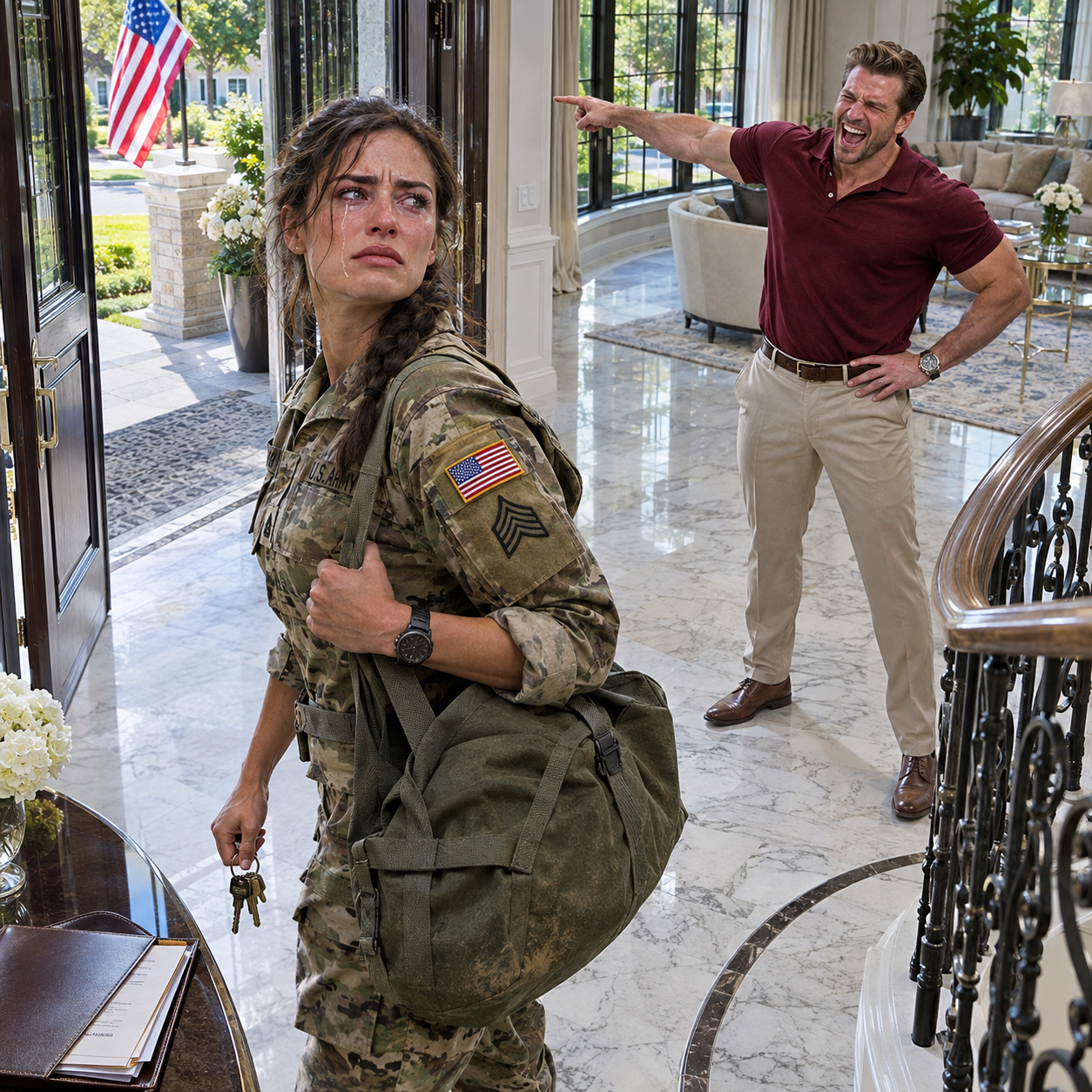
“Don’t come. We need a break from your baby,” my mother texted when I was halfway to her house. I turned the car around with my three-month-old daughter asleep behind me, wondering when we’d become so easy to discard. Two weeks later, a friend welcomed us to a snowy Montana lodge for Thanksgiving. When my mother saw the pictures, she didn’t ask whether we were happy. She wanted to know why I hadn’t paid for her holiday instead.
Part 1
The message came while I was trying to warm a bottle at a highway rest stop south of Olympia. My daughter, Evie, slept in the back seat, her tiny fist pressed against one cheek, and the windshield wipers squeaked across a film of November rain. I’d left Seattle before dawn for Mom’s birthday lunch. Now my phone displayed nine words that made the whole drive feel like a cruel joke: “Don’t come. We need a break from your baby.”
I reread it, searching for an explanation. She was three months old, and her greatest crimes were hiccups during dinner and crying when she needed someone. I’d packed her favorite blanket, a change of clothes, and the lemon cake my mother always requested from a Seattle bakery. The cake sat on the passenger seat in a white box, its ribbon coming loose, while I typed, “Understood. Have a good birthday.”
I didn’t call, because I knew how those calls ended. Mom could turn a simple question into a trial where I had to defend every decision I’d made since becoming pregnant, especially the decision to raise Evie after her father left. My ex, Adam, had moved to Arizona when I was seven months along and sent exactly one message afterward, asking whether I could mail his winter coat. Mom called that situation “the consequences of poor judgment,” as if she’d never held me while I cried over it.
I turned north at the next exit and drove with both hands clamped around the steering wheel. When Evie woke, I stopped to feed her at a gas station. I wanted to cry, but she kept looking at me with the solemn concentration babies have when they’re learning a face. I told her, “We’re going home, sweetheart,” and heard how strange it sounded to apologize for a place we’d never reached.
I’m Clara, a twenty-eight-year-old medical billing supervisor, and the person everyone called when a problem came with a dollar amount. Last spring, my brother Nolan had needed three thousand dollars after his landscaping business lost a contract; the previous summer, my sister Tessa had needed help paying for her wedding photographer. When Mom and Dad’s roof started leaking, I transferred five thousand dollars from savings. Nobody had ever described my money as inconvenient.
By the time I carried Evie into our apartment, the lemon frosting had slid against one side of its box. Hannah called when I stopped answering messages. I showed her the text without explaining, and her cheerful expression disappeared. “She didn’t even call Evie her granddaughter,” Hannah said, quietly enough that I finally let myself cry.
Hannah had been beside me in the hospital when Evie was born, holding my water cup while I learned how to swaddle a wriggling newborn. Mom had visited for twenty minutes, complained about parking, and said she’d return when the baby was on a proper schedule. She hadn’t returned, though she managed to text three times about the roofing bill I’d helped pay. Hearing Hannah describe the pattern made me feel less confused and more furious, which was somehow worse.
That evening I set the ruined cake on the kitchen counter and opened my banking app. The transfers weren’t all large, but together they had quietly eaten most of the emergency fund I’d built over six years. I made a list on the back of a grocery receipt, then wrote a second list of everyone who’d offered to bring soup, change a diaper, or sit with Evie so I could shower. The names on the two lists barely overlapped.
My mother’s birthday passed without another word from me, and she didn’t call to ask why. Two nights later, Dad sent a family photograph from the lunch: smiling relatives, wrapped gifts, and an empty chair at the end of the table. I noticed something tucked beside Mom’s plate, a place card with my name on it, and for one moment I wondered whether she’d expected me to arrive without Evie. Then a message from Tessa appeared beneath the picture: “Mom says you’ll make it up to everyone at Christmas.”
Part 2
I stared at Tessa’s message while Evie kicked beneath her play gym, fascinated by a cloth moon. “Make what up?” I asked, and my sister left the question unread until the following morning. Her eventual reply was breezy: “Missing Mom’s party. Don’t make it a thing.” I was beginning to understand that in our family, hurting me was an ordinary Tuesday, while mentioning it out loud constituted starting a fight.
My family’s Thanksgiving plans had always shifted to suit whichever relative offered the largest dining room. Some years we ate at my parents’ place in Portland; other years Nolan hosted and expected me to arrive early enough to buy groceries, wash potatoes, and entertain his guests. Nobody invited me this year, and I told myself I didn’t care. Still, when I passed a supermarket display of little paper turkeys, I pictured Evie’s first holiday unfolding in an apartment that smelled of reheated soup.
Then Hannah called during my lunch break. “Before you refuse, hear me out,” she said, her voice competing with a coffee grinder. Her friend Celeste and Celeste’s husband, Daniel, had rented a lodge near Whitefish, Montana, for Thanksgiving, but two couples had backed out. Celeste was offering the unused bedrooms to Hannah, Evie, and me, and she wanted to cover our flights because the seats had already been purchased through her travel credit.
I said no so fast that Hannah laughed without sounding amused. I couldn’t imagine arriving at an expensive property with a baby whose feeding schedule ruled my days, especially when I hadn’t even met the hosts. Hannah put Celeste on speakerphone, and a warm, matter-of-fact voice asked what would help Evie feel comfortable. “We have a portable crib, and I can get a bottle warmer delivered,” Celeste said, before adding, “The baby isn’t an exception to the invitation, Clara. She’s included.”
That word, included, made my throat ache. I asked about the flight, the weather, and whether Celeste understood that Evie might cry in the middle of dinner. “Then she cries,” Celeste answered. “Our son Owen did, and he survived being a guest at his own first Thanksgiving.” I accepted before fear could convince me that kindness always carried an invoice I hadn’t seen yet.
On Wednesday morning, Hannah met us at Sea-Tac with a thermos of coffee and a little stuffed rabbit for Evie. I’d barely slept, afraid of forgotten diapers and disapproving strangers, but Hannah kept our boarding passes together and carried the bag I couldn’t manage. At the lodge, tall windows framed a lake rimmed with ice, while snow settled on the dark branches outside. Inside smelled of cedar, baked bread, and something sweet simmering on the stove.
Celeste hugged me like an old friend, then waited for permission before admiring Evie up close. Daniel showed us the quiet room they’d arranged with a crib and a rocking chair, and nine-year-old Owen proudly demonstrated the soft night-light he’d borrowed from his bedroom. Later, Celeste’s business partner, Naomi, and Naomi’s girlfriend, Elise, arrived with bags of groceries and a ridiculous quantity of marshmallows. Nobody asked why Evie’s father wasn’t there, and I began to breathe differently.
On Thanksgiving afternoon, Daniel took over stirring the gravy while I fed Evie near the fireplace. When she fussed just as the turkey reached the table, I stood automatically, ready to retreat upstairs. Celeste pulled out the chair beside her and said, “You can sit here; we’ll take turns carrying plates.” An hour later, when we each named something we were grateful for, I said, “People who make room for both of us,” and my voice held steady.
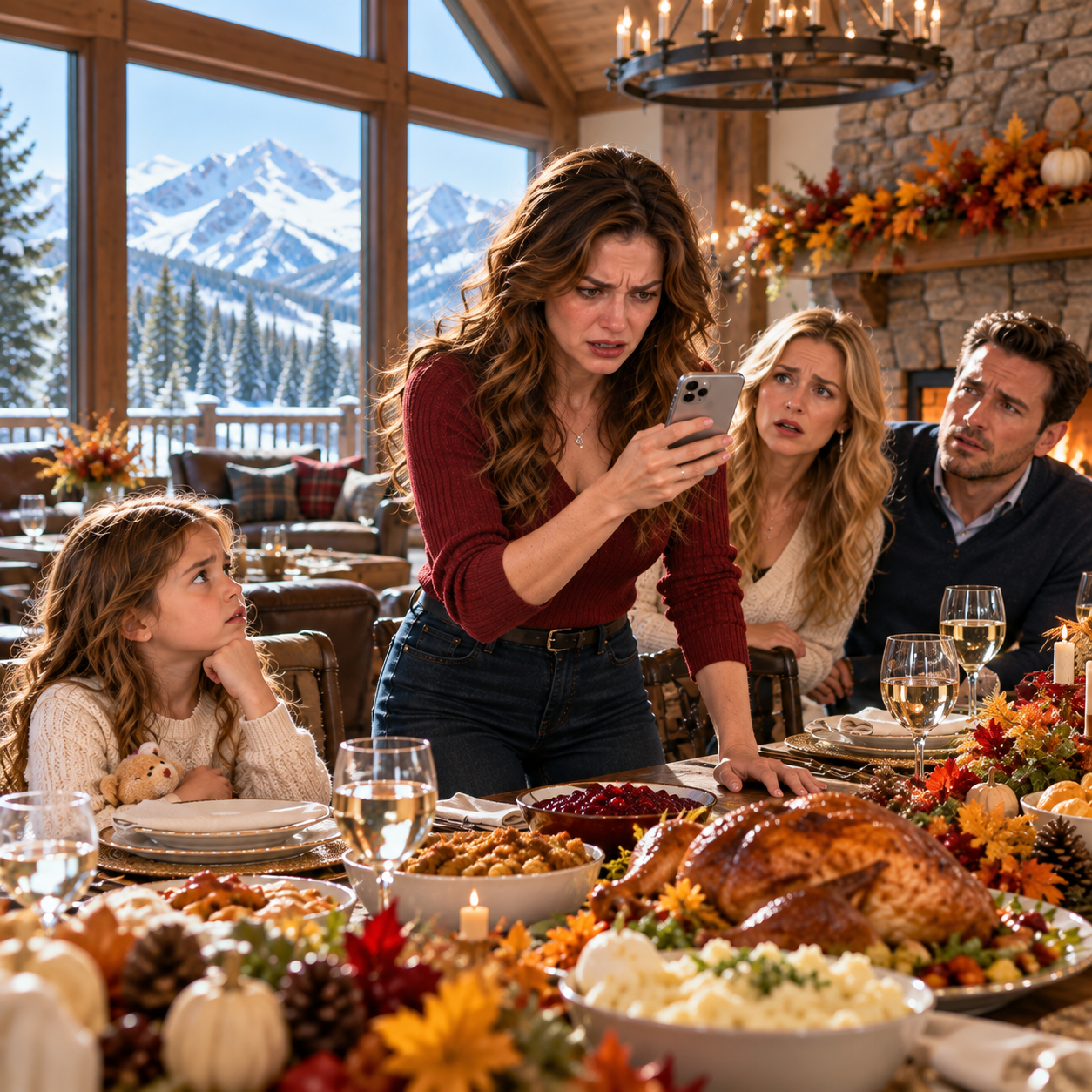
Friday passed in boots and borrowed sweaters, with Owen building a lopsided snowman where the lodge lawn met the trees. Hannah photographed me holding Evie beside the frozen lake, my cheeks bright from cold and my daughter tucked safely inside my coat. She posted a few pictures that evening, including a video of the chef finishing dessert in the kitchen. Less than two hours later, my mother’s name flashed across my screen, followed by a question that had nothing to do with Evie: “If you can afford Montana, why aren’t you paying for Christmas?”
Part 3
For several seconds I watched the typing dots appear beneath Mom’s first message. Then came another: “Taking an infant on a plane is irresponsible, and you didn’t even check what the family was doing for Thanksgiving.” The fireplace snapped behind me, and someone in the kitchen laughed at a story I couldn’t hear. I had been away from my family for barely two weeks, yet their words made this warm room feel suddenly fragile.
I carried my phone onto the covered deck so Evie wouldn’t hear my voice rise. Snow dusted the railing, and beyond it the lake looked like a sheet of slate beneath the porch lights. Mom answered on the second ring, already talking: “Clara, Nolan showed me those pictures. Must be nice to take a luxury vacation while your own parents are trying to figure out how to feed everyone at Christmas.”
“You told me not to come to your birthday,” I said. “I was halfway to Portland with a cake in the car, and you told me you needed a break from my baby.” She gave the impatient sigh I remembered from being twelve and asking whether she’d attend my school play. “That was a birthday party, not a permanent banishment. Babies are loud, and you’ve become so sensitive since Adam abandoned you.”
I gripped the deck rail until the cold pressed through my sleeve. “Her name is Evie,” I said. “She’s your granddaughter, and you’ve barely spent half an hour with her since she was born.” Mom replied that motherhood was hard for everyone and claimed I’d invented a grievance to punish her. Then she asked whether I could send fifteen hundred dollars toward Christmas dinner by Monday, as though the discussion had been a billing reminder all along.
“No,” I said, surprising myself with how little effort the word required. She went silent, so I told her I hadn’t paid for the lodge or the flights and that my hosts had simply wanted us there. “People who barely know us checked that Evie had a safe place to sleep,” I said. “You wouldn’t even let her come to your birthday lunch.” Mom laughed sharply and said I’d be sorry when those “new rich friends” got tired of my baggage.
I told her I was done financing a family that treated my daughter as an embarrassment. She invoked everything she and Dad had sacrificed, then said Nolan and Tessa were counting on me to make Christmas special. “They can make it special themselves,” I answered. “I won’t pay, and I won’t bring Evie somewhere she’s merely tolerated.” Mom’s voice rose: “You cannot just abandon your family,” but I ended the call before she could turn my baby into a debt.
Back inside, Hannah took one look at my face and handed me a mug of hot cider. I told her what had happened while Evie slept against Daniel’s shoulder in the next room, undisturbed by the soft conversation around her. “You don’t have to solve the whole family tonight,” Hannah said. I switched my notifications off and stayed with the people who’d asked whether I’d eaten, rather than whether I could pay.
The next morning, thirteen messages awaited me, most from Nolan. He accused me of humiliating Mom, warned that our parents were on a fixed income, and added a list of Christmas expenses beside a message saying he’d already reserved a caterer. Tessa’s text was stranger: “Why did you tell people Mom banned you? She said you refused to bring the baby because you didn’t want anyone holding her.” When I sent her a screenshot of Mom’s original message, she called immediately.
Tessa sounded shaken, but not for the reason I’d expected. “Clara, she showed us a different text at the birthday lunch,” she whispered. “It said you weren’t coming because you were angry nobody offered you money.” Behind her, a door shut and she lowered her voice further. “And Mom told everyone you promised to cover Christmas months ago. Did you?”
Part 4
I sat upright on the edge of the lodge bed while Evie slept in her portable crib. I’d never promised to cover Christmas, though I remembered Mom mentioning a catered meal in August and saying she’d discuss the cost with everyone. Tessa forwarded a photograph of a printed conversation Mom had laid beside her birthday cake, and I studied the blurred words. The message claiming I’d demanded money had my name above it but no visible phone number or date.
“That’s not from me,” I told Tessa, and the room seemed to tilt slightly. She admitted she hadn’t questioned it because Mom said I was upset about raising Evie alone and taking my frustration out on everyone else. Then she said something that stung even more: “I thought it sounded unlike you, but it was easier not to get involved.” I looked at Evie’s sleeping face and wondered how many times I’d offered my sister the same generosity she’d withheld from me.
Rather than spend my holiday arguing in a dozen private threads, I sent one message to our family group. I attached the original birthday text with its timestamp, the bank confirmations for the roof and wedding transfers, and Mom’s request for Christmas money. “I did not demand money to attend her birthday, and I did not agree to pay for Christmas,” I wrote. “Evie and I were turned away, and I won’t keep funding celebrations where we’re treated as an inconvenience.”
Nolan called instantly, but I let it ring during a drive by the lake. We piled into the SUV as Owen identified deer tracks in the snow. My phone vibrated through my coat for twenty minutes; when I finally checked it, Dad had written, “Your mother was overwhelmed. Airing private family matters won’t help.” Not once did he say she had been wrong.
That evening, Nolan sent a private voice message from what sounded like a crowded restaurant. He insisted the caterer required a deposit and said he’d committed to the expensive menu because Mom had assured him my usual contribution would cover it. “You’re making us look irresponsible,” he complained, “and you know I’m still rebuilding the business.” I listened twice, astonished that the problem wasn’t the money he’d promised on my behalf but my refusal to provide it.
My next call was to my bank, not my mother. I needed to know whether any automatic payments remained. The banker confirmed the old roofing transfer was finished, but a recurring monthly transfer to Nolan’s business account was still active; I’d forgotten I’d arranged it for six months after his contract loss. I canceled the next payment and checked the rest of my accounts before shutting the laptop.
When I told Hannah, she didn’t congratulate me or say I should have done it earlier. She sat beside me, the hearth warming her socks, and said, “What do you want Evie to learn about love when she’s old enough to notice?” I thought of Mom’s place card, the fake conversation, and the blank spaces where ordinary kindness should have been. “That it doesn’t require her to buy admission,” I said, and Hannah squeezed my hand.
The following morning, Dad called without Mom on the line. He confirmed he had seen her message before she sent it and hadn’t objected because “she needed a peaceful birthday,” then admitted she had shown the printed conversation to everyone. “I knew it didn’t sound right,” he said, “but your mother said she’d handle it.” I waited for an apology, listening to the faint ticking of his kitchen clock, and heard only his request that I keep the peace for Christmas.
I told him peace wasn’t the same as silence, and I wouldn’t expose Evie to people who could rewrite what happened whenever it suited them. Dad said, “Well, your mother is going to be devastated when she sees that you aren’t coming.” I asked whether he’d worried about his granddaughter being devastated, once she was old enough to understand why she wasn’t wanted. He didn’t answer, and in that long silence I finally understood that he had made his choice too.
Part 5
We flew home on Sunday with a sleepy Evie tucked against my chest. At the airport, Celeste hugged us and slipped a small photograph into my coat pocket: me at Thanksgiving dinner, laughing while Evie slept in her carrier beside the table. On the back she’d written, “There will always be a seat for both of you.” I carried it home like a treasure.
December began with rain against my apartment windows and a dozen new attempts to draw me back into my family’s plans. Nolan sent a caterer’s invoice without a greeting, and Mom sent a photograph of the dining room dressed in red ribbons with one sentence: “This is what you’re throwing away.” Tessa called to say she believed me now and wanted to understand why Mom had changed the message. I told her she’d need to ask Mom, not me, and that I wasn’t accepting the job of investigating my own mistreatment.
Two days later, Mom appeared outside my building with a shopping bag. I met her in the lobby while Hannah watched Evie upstairs. Mom produced a tiny holiday dress and said, “See? I bought something for her.” It was the first gift she’d ever brought Evie, and she held it as if the price tag erased everything she’d done.
I thanked her for thinking of Evie but said gifts weren’t an apology. Mom’s eyes narrowed, and she replied, “I can’t spend the rest of my life begging forgiveness for one badly worded text.” When I asked about the fake message she’d shown at her birthday, she looked at the floor before saying, “I needed people to understand why you weren’t there.” “You needed them to blame me,” I said, and she didn’t deny it.
She shifted to Christmas, explaining that relatives had already booked hotels and the caterer wouldn’t refund Nolan’s deposit. Then, as if offering a generous compromise, she said Evie could come if I kept her in the guest room during dinner so nobody’s evening was interrupted. I looked at the little dress dangling between us and felt a calm, unmistakable certainty settle over me. “My daughter won’t spend Christmas hidden in a bedroom so other people can pretend she doesn’t exist,” I told her.
Mom began to cry then. She said I was choosing strangers over blood, that Dad’s health couldn’t stand the stress. I wished she’d said, “I was cruel to Evie, and I’ll do better,” without asking me for anything in return. Instead, I handed back the shopping bag and said, “I’m not punishing you. I’m deciding what we’re available for.”
I didn’t block everyone immediately; I sent one final message explaining that Evie and I wouldn’t attend Christmas and that I wouldn’t send money. I said contact could resume only if it began with an honest acknowledgment of what had happened and respect for my boundaries, not a bill or another insult. Tessa replied with an apology for staying quiet. I accepted her words but didn’t offer a visit, because regret and trust are not the same thing.
On Christmas Eve, Hannah arrived with groceries and a small pine wreath she’d made from branches at a flower shop. Celeste, Daniel, Owen, Naomi, and Elise joined us over video while we prepared a simpler dinner than the one Mom had planned, passing the phone around to show off mismatched ornaments. Evie wore soft cotton pajamas instead of scratchy lace and watched the lights on our little tree with wide, delighted eyes. Nobody suggested moving her somewhere quieter just because she made a sound.
Christmas morning, Dad sent one message: “The table felt empty without you.” I looked at the picture Celeste had given me, now standing on the kitchen shelf beside Evie’s first handprint, and thought about the empty chair at Mom’s birthday and all the chances they’d had to change what it meant. I didn’t answer, because missing us was not the same as welcoming us, and my daughter didn’t owe anyone another audition for love. I lifted Evie from her crib, kissed her warm forehead, and carried her toward the people who had already made room.
Legal Notice: This story is a work of fiction. Names, characters, businesses, events, and incidents are the product of the author’s imagination or are used fictitiously. Any resemblance to actual persons—living or dead—or to actual events is purely coincidental. Thank you! 💓