
Chapter 2
I sat at my desk until dawn, staring at Elena Ross’s signature.
Colin had told me Sophie’s birth mother was a young woman from another state who couldn’t afford to raise a child. The adoption had been private, arranged through Sunset Hope Family Services, an agency recommended by an old college friend.
At the time, I had been grateful beyond words.
After four years of fertility treatments and heartbreak, I had finally become a mother. Colin had held me while I cried, promising that Sophie was the answer to our prayers.
Now I wondered what else he had been hiding.
I contacted a private investigator named Daniel Mercer, a former police detective recommended by my attorney. I gave him the adoption documents and asked him to verify the agency’s history and Elena’s connection to my husband.
Meanwhile, life continued inside our home.
Sophie still called me Mommy. She still asked me to braid her hair and read bedtime stories. Sometimes she curled against me on the couch, warm and sleepy, and I remembered how desperately I had loved her.
Other times, she looked at me with an expression I couldn’t understand.
One Saturday afternoon, I was slicing apples in the kitchen when Sophie announced she wanted a book from upstairs.
“Be careful on the steps, sweetheart,” I called.
A moment later, something slammed against the wall.
Then came a scream.
I rushed toward the staircase and found Sophie sitting near the bottom, clutching her knee.
Before I could reach her, she screamed toward our open front door.
“Mommy, stop pushing me! Please don’t hurt me again!”
Our neighbor, Mrs. Henson, was passing through the hallway with her groceries.
She stopped immediately.
“Nora! What on earth happened?”
“She fell,” I said, kneeling beside Sophie. “I didn’t push her.”
But Sophie buried her face in her hands.
“Mommy didn’t mean it,” she sobbed. “Please don’t be mad at her.”
Mrs. Henson’s expression hardened.
By evening, rumors had spread through the entire apartment building.
In our residents’ online group, someone wrote that a mother on the sixth floor had pushed her little girl down the stairs.
Colin came home furious.
“Do you have any idea what people are saying about you?”
“About me?” I repeated. “Our daughter was hurt, Colin. Why aren’t you asking how she’s doing?”
“Because she’s already told me what happened.”
He crossed his arms.
“Nora, if you’re losing your patience with her, you need to admit it.”
I studied the man I had loved for eleven years.
“Do you believe I pushed Sophie?”
He looked away.
“I believe children don’t invent these things out of nowhere.”
I wanted to scream.
Instead, I opened my laptop.
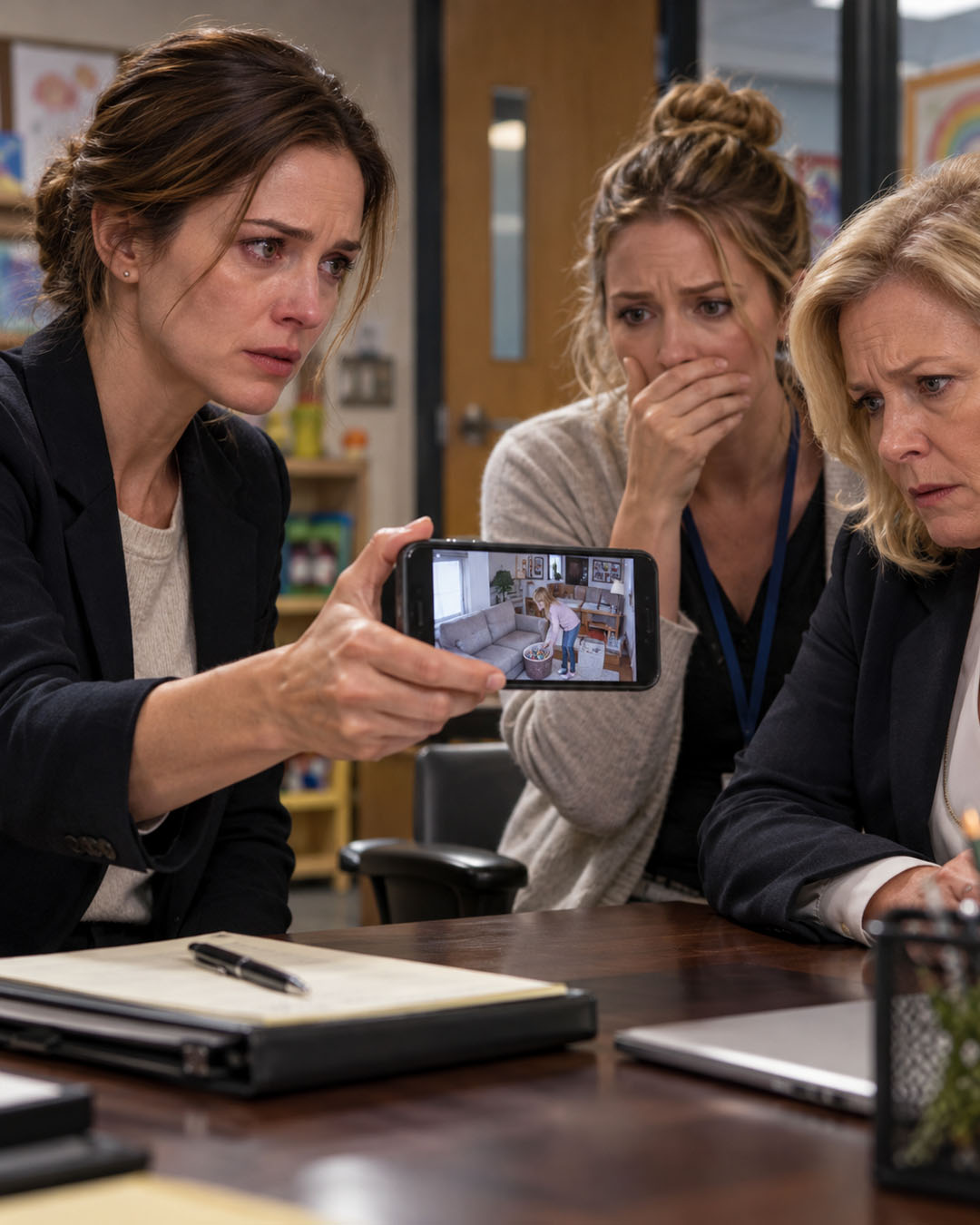
The camera mounted above the staircase had recorded everything.
Sophie had stood on the landing, listening until she heard footsteps outside our front door. Then she deliberately bumped her shoulder against the wall, sat down, and slid down the final three carpeted steps.
She scraped her knee along the way.
The moment Mrs. Henson appeared, Sophie began screaming.
I turned the laptop toward Colin.
“Watch.”
He watched without speaking.
When the video ended, he rubbed his forehead.
“She’s five, Nora. Kids do strange things.”
“She accused me of pushing her down the stairs.”
“Maybe she was scared.”
“Scared of what? I wasn’t even near her.”
His jaw tightened.
“You’re making this into something bigger than it is.”
For the first time, I saw something beneath his concern.
He wasn’t surprised.
He was irritated that I had evidence.
The following Monday, Daniel Mercer called.
“Nora, we need to meet somewhere private.”
We met at a small coffee shop across town.
Daniel placed a folder between us.
“Elena Ross and your husband had a relationship that began while she worked for him,” he explained. “It appears to have lasted nearly two years.”
My stomach tightened.
“Was Sophie born during that time?”
“Yes.”
He opened the folder.
Inside were photographs of Colin and Elena entering restaurants together, old business records, and a copy of a financial agreement involving Sunset Hope Family Services.
Daniel pointed to one document.
“The agency’s founder was Colin’s fraternity brother. There were unusual payments around the time of Sophie’s adoption.”
I struggled to breathe.
“Are you telling me Colin arranged for me to adopt his own daughter?”
“That’s what the records suggest. But there’s more.”
He showed me recent photographs taken outside a neighborhood park.
Colin stood beside a dark-haired woman wearing sunglasses.
Elena.
Between them was Sophie.
In one photograph, Elena knelt and kissed Sophie’s forehead. In another, Sophie wrapped her arms around the woman’s waist.
I covered my mouth.
“How long has this been happening?”
“At least eighteen months, based on what I’ve been able to document.”
Daniel hesitated.
“There’s also reason to believe Colin and Elena have been discussing your marriage.”
I looked at him.
“What kind of discussions?”
He slid another photograph across the table.
It showed Colin leaving an attorney’s office with Elena.
“The office handles divorce and custody cases.”
I stared at the photograph until the faces blurred.
It wasn’t only an affair.
It wasn’t only a fraudulent adoption.
My husband and his former mistress were preparing to take my entire life away.
And they were using the little girl I loved to do it.
Chapter 3
I didn’t confront Colin when I returned home.
Instead, I contacted my attorney, Margaret Shaw, and gave her everything Daniel had uncovered.
Margaret was a practical woman in her early sixties who had spent most of her career handling difficult family cases. She listened without interrupting, then removed her glasses.
“Nora, there’s enough here to raise serious questions about the adoption and your husband’s conduct. But the evidence still needs to be independently verified.”
“I understand.”
“There’s something else,” she continued. “Sophie is a child. Whatever the adults have done, she needs protection, not punishment.”
Those words stayed with me.
In my previous life, I had eventually come to hate Sophie because I believed she had deliberately destroyed me. But the more evidence I uncovered, the clearer it became that someone had taught her how to behave.
Children don’t naturally understand divorce proceedings, criminal accusations, or how to destroy an adult’s reputation.
Someone had given Sophie a script.
And I was beginning to understand who had written it.
Three days later, two county child welfare investigators arrived at our apartment.
Thomas Reed was a serious, soft-spoken man in his forties. His colleague, Nina Cole, carried a notebook and carefully observed the room as they entered.
Sophie sat on the couch in a white dress, her hair tied into two neat ponytails.
She looked like an angel.
“Hello, Sophie,” Mr. Reed said gently. “Would you mind answering a few questions?”
Sophie nodded.
“Of course.”
“Do you feel safe at home?”
She glanced at me.
Then she lowered her eyes.
“Sometimes.”
Mr. Reed leaned forward.
“Can you tell me what makes you feel unsafe?”
Sophie twisted her fingers together.
“Mommy gets angry. She pinches me when I’m bad.”
I remained silent.
“Does anything else happen?”
“Sometimes she locks me outside. And sometimes she doesn’t give me dinner.”
Nina’s pen moved rapidly.
Sophie began crying.
“And she isn’t even my real mommy.”
Mr. Reed stopped writing.
“What do you mean, sweetheart?”
“She stole me from my real mommy.”
The room became painfully quiet.
Sophie wiped her cheeks.
“Daddy told me my real mommy loves me. He said she wants me back, but Nora won’t let her.”
There it was.
The sentence that had destroyed me in my previous life.
But this time, Sophie had unknowingly revealed something important.
“Mr. Reed,” I said calmly, “I have documentation I believe you need to see.”
He raised his hand.
“Mrs. Whitaker, we’ll give you an opportunity to respond.”
“I appreciate that. I’m not asking you to dismiss anything Sophie says. I’m asking you to consider the evidence.”
I connected my laptop to the television.
The first recording showed Sophie opening our balcony door while I was away from home.
She stepped outside with a tablet, pulled the door partly closed, and sat playing games. Several minutes later, when she heard my car approaching, she hid the tablet and began crying for help.
Mr. Reed leaned forward.
“Was she able to come back inside?”
“Yes. The door wasn’t locked. I checked that after finding her.”
The second recording came from our kitchen.
I had prepared chicken, mashed potatoes, and green beans for dinner. After I left the room to switch the laundry, Sophie scraped her food into the trash.
When I returned, she began crying that she was starving.
Nina looked visibly troubled.
“How often has this happened?”
“I’ve documented several incidents. I also have records showing that Sophie has been offered regular meals and has received routine pediatric care.”
Next came the staircase recording.
Mr. Reed watched Sophie deliberately slide down the steps before accusing me of pushing her.
He asked me to replay it.
Then he asked for the original file.
“Absolutely,” I said. “My attorney has preserved copies.”
Finally, I opened another recording.
Sophie stood in front of her bedroom mirror, holding a plastic hairbrush. She struck her own arm several times, then examined the red marks.
Afterward, she practiced crying.
Nina placed her pen on the table.
“Oh, that poor little girl.”
Her reaction surprised me.
She wasn’t looking at Sophie with disgust.
She looked heartbroken.
Mr. Reed turned toward me.
“Mrs. Whitaker, these recordings are significant. But we still need to understand why Sophie is behaving this way.”
“I believe I can explain part of it.”
I brought out the adoption documents.
“Sophie was legally adopted through Sunset Hope Family Services. I have reason to believe the adoption was arranged under false pretenses.”
I handed him Elena’s photograph.
“This is her biological mother, Elena Ross. She was my husband’s assistant.”
Then I showed him Daniel’s findings.
“Elena had a relationship with Colin before Sophie was born. My husband never disclosed that Sophie might be his biological daughter.”
Mr. Reed studied the paperwork.
“Has paternity been confirmed?”
“Not conclusively. My attorney is pursuing the appropriate legal process. But there are financial records, communications, and photographs connecting them.”
Nina examined the pictures.
“This child has been meeting with Elena?”
“During outings Colin told me were just father-daughter time.”
Sophie suddenly stood up.
“She’s not Elena! She’s my real mommy!”
Everyone turned toward her.
“She said she’d come live with Daddy and me when you go away!”
My heart seemed to stop.
“Who told you that, Sophie?”
She hesitated.
Then she whispered, “Daddy.”
Nina approached her gently.
“Sweetheart, did Daddy tell you to say bad things about Nora?”
Sophie began trembling.
“He said I had to help.”
“Help with what?”
“Making Nora go away.”
She looked toward the front door.
“Then we could be a real family.”
I pressed my hand against my chest.
For years, I had wondered what kind of child could say such cruel things about someone who loved her.
Now I was looking at a frightened five-year-old who believed she had to hurt one mother to earn the love of another.
Mr. Reed sat quietly for a moment.
Then he said, “Sophie, you are not responsible for making grown-ups happy. And you should never have to choose who deserves to love you.”
Her lower lip trembled.
“But Daddy said—”
The front door opened.
Colin walked inside, carrying his briefcase.
He stopped when he saw the investigators.
“Oh,” he said, recovering quickly. “You must be from family services.”
He offered a weary smile.
“I’m Colin Whitaker. Look, my wife’s been under tremendous stress. Whatever she’s done, I’m sure we can work through it.”
I stared at him.
Even now, he was prepared to sacrifice me.
Mr. Reed stood.
“Mr. Whitaker, please have a seat.”
Colin looked confused.
“Is there a problem?”
“We have several serious concerns involving your daughter’s welfare and the information she has been given.”
Colin’s eyes moved toward the television.
The paused staircase recording filled the screen.
Beside my laptop lay Elena’s photograph and the adoption records.
His expression changed.
“Nora,” he whispered, “what have you done?”
I looked at him steadily.
“I found out what you did.”
Chapter 4
Colin lowered himself into the armchair as though his knees could no longer support him.
For several seconds, he said nothing. Then he tried to laugh.
“This is ridiculous. Nora, you’re misunderstanding everything.”
“Then explain Elena,” I said.
His eyes flickered toward Sophie.
“Not in front of our daughter.”
“Our daughter has already been dragged into this, Colin. She’s been taught to accuse me of things I never did.”
Mr. Reed interrupted.
“Mr. Whitaker, we’re concerned that Sophie may have been coached to make false allegations. We need to understand what has been happening.”
Colin straightened.
“She’s imaginative. Kids make up stories.”
I almost laughed at the cruelty of it.
For years, he had insisted children never lied about serious things. Now that the accusations threatened him, Sophie was suddenly imaginative.
“Did you tell Sophie I kidnapped her?” I asked.
“No.”
Sophie looked up.
“Daddy?”
“Not now, sweetheart.”
“But you told me!”
His face tightened.
“Sophie, be quiet.”
She recoiled.
The investigators exchanged a glance.
“Mr. Whitaker,” Nina said firmly, “please don’t speak to her that way.”
Colin rubbed both hands over his face.
“All right. Elena is Sophie’s biological mother. I should have told Nora. But I was trying to keep our family together.”
I felt my throat tighten.
“By letting me adopt a child you knew was yours?”
He looked down.
“Nora, you wanted a baby more than anything.”
“And you knew I would love her.”
He nodded weakly.
I remembered the day we brought Sophie home. Colin had taken photographs while I held her against my heart, crying because I finally believed my family was complete.
All those years, I thought we had been blessed.
Instead, I had been deceived.
“Why did you let Elena back into her life without telling me?”
Colin’s expression hardened.
“Elena wanted to know her daughter.”
“Then why not tell me?”
“Because you would have made everything difficult!”
His voice echoed across the room.
Sophie flinched.
Colin stared at the floor.
“Elena said Sophie should know who her real mother was. Things got out of hand.”
“Things?” I repeated. “Your daughter has been hurting herself and accusing me of abuse.”
He covered his face.
“Elena told Sophie that if Nora left, we could all be together. I didn’t think she’d take it so seriously.”
A terrible silence followed.
Mr. Reed finally spoke.
“Mr. Whitaker, what you’re describing raises serious concerns about emotional harm to your daughter. We will need to assess her safety and arrange appropriate support.”
Colin suddenly looked frightened.
“You’re not taking her away, are you?”
“Our decisions will be based on her welfare and a full investigation.”
Sophie began crying.
“Daddy, you promised!”
Colin reached toward her, but she backed away.
“You said if I told them Nora was bad, my real mommy would come home!”
I had never seen Colin look so defeated.
He tried to speak, but no words came.
For the first time, I understood that the real tragedy wasn’t only what had happened to me.
It was what two selfish adults had done to a little girl who trusted them.
I went into the bedroom and collected the suitcase I had packed several nights earlier.
When I returned, Colin stood up.
“Where are you going?”
“I’m leaving.”
“Nora, please. We can fix this.”
I shook my head.
“No, Colin. You can take responsibility for what you’ve done, and Sophie can get the help she needs. But our marriage is over.”
His eyes filled with tears.
“I loved you.”
“Maybe you loved the life I gave you. But love doesn’t require someone to live inside a lie.”
I turned toward Mr. Reed.
“My attorney has already been informed. I’ll cooperate fully with the investigation. I also want Sophie evaluated by an independent child psychologist.”
He nodded.
“We’ll make sure her needs are addressed.”
At the doorway, Sophie called my name.
“Nora?”
I turned.
She stood beside the couch, holding the little stuffed rabbit I had bought her for her third birthday.
“Are you going away because I was bad?”
That question nearly broke me.
I knelt so we were eye to eye.
“No, sweetheart. You’re not bad. But some very wrong things have happened, and the grown-ups need to make them right.”
“Will you come back?”
I swallowed.
“I don’t know what happens next. But none of this is yours to fix.”
For a moment, she looked like the little girl I remembered loving before fear had taken over our home.
Then she lowered her eyes.
“I’m sorry.”
I wanted to gather her into my arms and promise everything would be all right.
But I couldn’t make another promise I didn’t know how to keep.
I gently touched her shoulder.
“I hope someday you understand that you never had to hurt anybody to deserve love.”
Then I stood and walked out.
The hallway was empty.
No accusing neighbors. No whispers. No footsteps rushing after me.
For the first time in years, I could breathe.
The months that followed were difficult, but they were nothing like the nightmare I had lived before.
Investigators reviewed the recordings and the adoption records. Financial documents and communications revealed Colin’s undisclosed relationship with Elena and serious irregularities in the adoption process.
Colin eventually admitted that he had encouraged Sophie to make accusations against me. Elena had reinforced those stories by promising Sophie they would all live together once I was gone.
Both faced legal consequences arising from their conduct, and the agency’s involvement came under scrutiny.
My divorce was finalized the following year.
After extensive legal proceedings, my parental relationship with Sophie was also formally resolved. She received professional support and remained under the supervision of adults responsible for ensuring her safety.
Leaving her was the hardest part of rebuilding my life.
I understood that Sophie had been manipulated. I also understood that loving a child did not mean I had to remain in a home where I was being systematically destroyed.
Sometimes two painful truths have to exist together.
Two years later, I was living in Seattle.
I had started my own architectural consulting firm, rented a sunny apartment overlooking Puget Sound, and slowly learned to enjoy ordinary mornings again.
One October afternoon, an email arrived from Denise Alvarez, my former neighbor.
Denise had apologized months earlier for believing the rumors about me. We exchanged occasional messages, although I rarely asked about Orchard Heights.
This time, her email was unusually long.
Colin had lost his corporate position following the investigation. His mounting legal expenses forced him to sell the condominium, and Elena had eventually disappeared from their lives.
But the most heartbreaking news concerned Sophie.
She was seven now.
According to Denise, Sophie continued making accusations when she felt frightened, rejected, or angry. Several incidents had led to additional investigations, though she was finally receiving consistent psychological treatment.
Colin had reportedly complained to neighbors that nobody believed him when he said Sophie was lying.
I read that sentence several times.
In another life, I might have felt triumphant.
The man who destroyed my reputation was now facing the same terrible helplessness.
But as I looked out across the water, I felt something quieter than satisfaction.
I felt sorrow for the child who had been taught that love was something she had to fight for, manipulate, and win.
Denise ended her message with one final detail.
“Sophie’s new counselor says she’s making progress. Apparently, she told someone recently that she misses the mother who used to read her bedtime stories.”
I closed my eyes.
I remembered Sophie at three, curled beneath her pink blanket, asking me to read the same picture book for the fourth time.
I remembered her laughter when I made silly voices for the animals.
And I remembered how she used to fall asleep holding my finger.
For a moment, the memories hurt.
Then I opened a drawer and took out a photograph.
It showed Sophie and me sitting beneath a maple tree, both smiling into the autumn sunlight.
I had kept only a few pictures.
Not because I wanted to return to the past, but because I refused to let betrayal erase every good moment that had existed.
That evening, I wrote a letter.
I didn’t accuse anyone or ask Sophie to understand what had happened. I simply told her that the years we spent together had mattered to me, that I hoped she was learning to feel safe, and that she deserved a future built on truth.
I gave the letter to my attorney to pass along if her counselor considered it appropriate.
Then I returned to my terrace.
The sunset painted the water gold, and a cool breeze moved through the trees below.
My phone rested silently beside my coffee.
No accusations. No frantic explanations. No desperate need to convince someone I was innocent.
I had once believed being a good mother meant enduring anything for the sake of my child.
Now I understood something different.
Love requires honesty. Children need protection from the terrible mistakes of adults. And sometimes the only way to end a cycle of cruelty is to refuse to participate in it any longer.
I thought about the woman I had been, standing on that sixth-floor ledge, convinced her life was over.
I wished I could tell her that there was still a world waiting beyond her grief.
There were mornings she hadn’t seen, friends she hadn’t met, and a peaceful life she could hardly imagine.
Most of all, there was a future in which she no longer had to prove that she deserved kindness.
As the last light slipped below the horizon, I whispered something I had been unable to say for years.
“I did love you, Sophie. I hope someday you learn what love really means.”
Then I went inside, closed the balcony door, and began preparing dinner.
Tomorrow, I had a meeting with a new client.
And for once, tomorrow was something I looked forward to.
THE END.
⚠️ All characters and events are fictional. Do not imitate or apply them in real life. 😌😌😌

