
Chapter 2
I called Denise from the family waiting room at six in the morning. The coffee beside me had gone cold, but I barely noticed.
“Mrs. Hayes,” she said, “I’m glad you contacted me. I’ve been worried about Lily.”
“Why didn’t you call me before the accident?”
“I tried last week, but I couldn’t reach you. After the accident, I spoke with your ex-husband. He told me the family was handling things and that Lily wouldn’t be returning to school for a while.”
I closed my eyes. “She was in intensive care. I was trying to get here from Chicago.”
“I know, and I’m not blaming you. I just think you need to understand what Lily told me.”
Denise explained that Lily had asked to speak with her privately about two weeks before the crash. She’d become unusually quiet in class and had stopped spending time with several friends she’d known since elementary school. During their first conversation, Lily had mentioned arguments between Grant and Vanessa and complained that Vanessa had been reading her private messages.
“She said things at home had become uncomfortable,” Denise told me. “She was worried that if she complained, her father would accuse her of causing trouble.”
“Did she tell you Vanessa had threatened her?”
“Not directly. Lily didn’t describe an immediate physical threat, but she seemed anxious. She came back for another meeting a few days later and said she’d seen something on a laptop at her father’s house. She thought someone was taking money that didn’t belong to them.”
My fingers tightened around the phone.
“Did she say whose money?”
“No. She was afraid of naming the wrong person. She also mentioned that Vanessa had sent her a message asking her to keep quiet about something she’d seen.”
I looked through the glass wall toward the hospital corridor. I had spent years treating injuries and helping families through crises, but there was no medical training for discovering that your child had been frightened and you hadn’t known.
“Do you have copies of your notes?”
“I have records of our meetings, subject to the school’s privacy rules. I can explain what I personally observed, and the school can advise you about requesting relevant records. I don’t want to share anything I’m not authorized to disclose.”
It was a reasonable answer. I appreciated her professionalism, even as part of me wanted every message, every note, and every scrap of information immediately.
Before we hung up, Denise said something that stayed with me.
“Lily didn’t seem afraid of her father all the time. She seemed afraid of what would happen when he got angry with Vanessa.”
That distinction mattered, though I didn’t yet understand why.
At seven, I returned to Lily’s room. Dr. Samuel Reed, the neurologist overseeing her care, met me outside the door. He was in his mid-fifties, with silver at his temples and reading glasses tucked into his coat pocket.
“I’m told you have questions about tomorrow’s meeting,” he said.
“I do. Grant made it sound as though the decision had already been made.”
Dr. Reed frowned. “No decision has been made. We want to review her condition, discuss the assessments, and explain the uncertainty ahead. Lily remains critically ill, and I don’t want to offer false reassurance. But I won’t tell you there’s no hope when the evidence doesn’t justify that conclusion.”
I asked about the hand squeezes.
“It’s important that we document what you observed,” he said. “But one movement doesn’t establish awareness. We’ll continue structured neurological assessments and look for responses that can be reproduced under consistent conditions.”
I nodded. I respected his honesty, even though every cautious sentence felt like another weight on my chest.
The family meeting began at nine. Grant sat beside Vanessa, who had brought a designer handbag and a bottle of sparkling water. I sat opposite them, with my hands folded tightly in my lap.
Dr. Reed explained Lily’s injuries, the tests performed so far, and the reasons no one could reliably predict her recovery. Grant kept returning to the same question.
“At what point do we stop putting her through this?”
“We need to consider her quality of life,” Dr. Reed replied, “but we also need to distinguish what we know from what we fear. We’re not asking you to make an immediate decision today.”
Vanessa leaned forward. “Surely there’s a point where keeping someone alive becomes selfish.”
“This is Lily’s medical meeting,” I said. “Your personal philosophy isn’t the issue.”
Her cheeks reddened. Grant tapped the table.
“Amber, don’t start.”
“I haven’t started anything. I’m asking the doctors to explain what’s happening to our daughter.”
Dr. Reed brought the discussion back to Lily’s condition. The meeting ended with a plan for continued assessments and another discussion after the team had more information.
Outside the conference room, Grant caught up with me.
“You embarrassed me in there.”
“I asked questions.”
“You made Vanessa look like a monster.”
“She managed that without my help.”
He stared at me, apparently surprised by my answer. Then his expression hardened.
“You need to stop digging into things that have nothing to do with Lily’s treatment.”
“Then tell me why her phone is missing.”
For a moment, his confidence slipped. “What are you talking about?”
“Denise told me Lily was frightened about something she saw at your house. Vanessa was asking questions about it, and now Lily’s phone has disappeared.”
“You have no idea what you’re talking about.”
“Then help me understand.”
He walked away.
That afternoon, I went home to collect clean clothes and Lily’s stuffed fox. Our house in Lakewood looked exactly as I’d left it, except for the stack of mail beside the toaster and the half-dead basil plant on the kitchen windowsill. Among the envelopes were overdue bills for Lily’s orthodontist and school activities, along with several messages from Grant asking me to cover expenses he’d promised to pay.
I checked my banking records and discovered that I’d already paid some of those bills. It wasn’t proof of wrongdoing, but it was another detail I couldn’t ignore.
I searched Lily’s bedroom for her newer phone, the one she’d taken to her father’s house. It wasn’t there. I texted Grant and asked where it was.
“Vanessa put it somewhere safe,” he replied.
I called Vanessa.
“Where is Lily’s phone?”
“I don’t know. I’m busy, Amber.”
“Grant says you put it somewhere safe.”
“Then ask Grant.”
“I did. He says you have it.”
Silence followed. Then Vanessa’s voice sharpened.
“Maybe you should focus on your daughter instead of turning this into another one of your investigations.”
“I am focusing on my daughter. That’s why I’m asking.”
She hung up.
I returned to the hospital that evening, carrying Lily’s fox and a bag of clothes. Grant was sitting beside her bed, speaking softly. He stopped when I entered and slipped his phone into his pocket.
“What were you telling her?” I asked.
“Just that I love her.”
“Then keep telling her that.”
As he passed me, his phone lit up again. The screen displayed a message from Vanessa.
I caught only a few words before he snatched it away.
“She can’t find out what Lily saw.”
For the first time since the accident, Grant looked genuinely frightened.
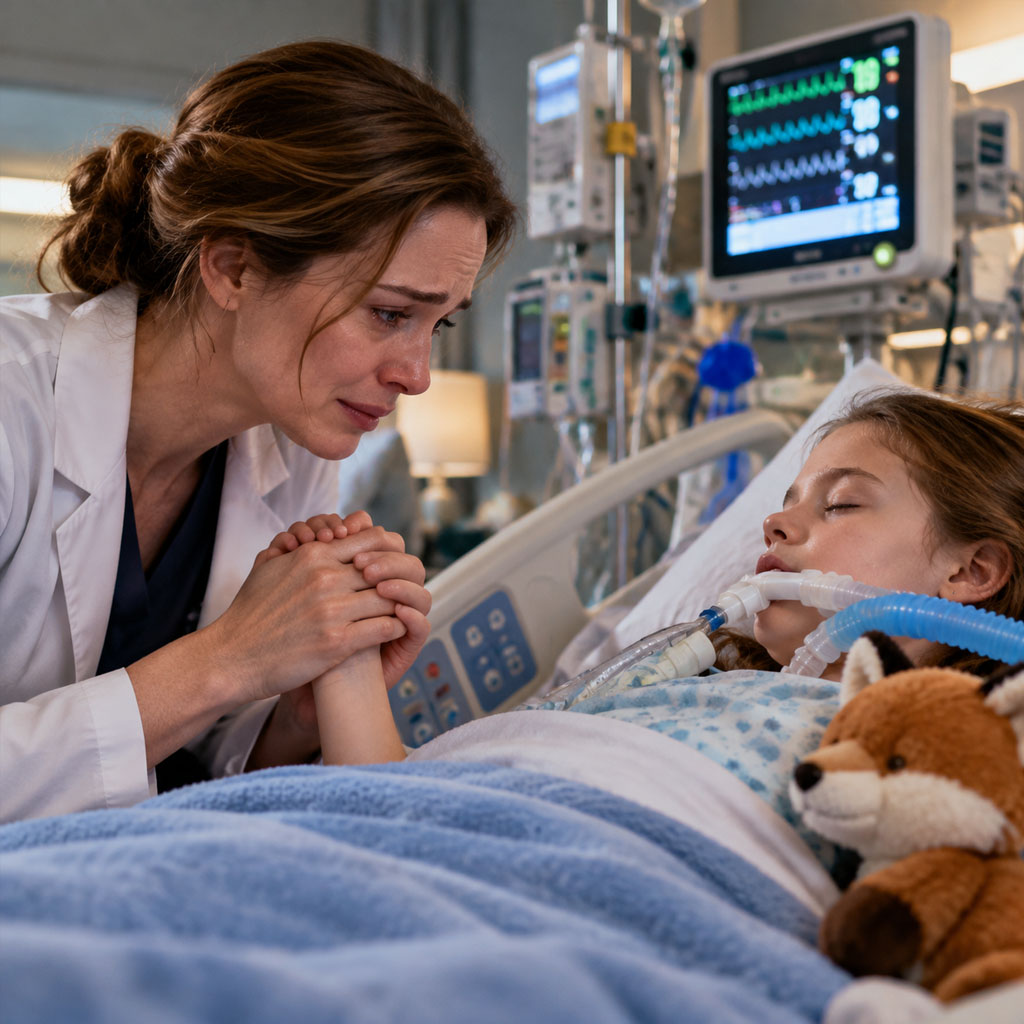
I waited until he had left the room before sitting beside my daughter. I didn’t ask her to squeeze my hand again, and I didn’t pretend I knew what the movement meant. I simply took her hand and spoke softly.
“I don’t know what you saw, sweetheart. But I’m going to find out.”
The next morning, I met Mary Ann Brooks, the hospital’s patient advocate. I explained the message, Denise’s account, and the missing phone, carefully separating what I knew from what I suspected. Mary Ann documented my concerns and explained that any disagreement about Lily’s care or decision-making authority would have to follow hospital policy and applicable legal procedures.
“Nobody can simply decide in a hallway that treatment ends tomorrow,” she said. “The medical team must evaluate Lily’s condition, and any decisions must follow the appropriate process.”
It was the first time in days I’d felt someone had put a solid floor beneath my feet.
My sister Rachel arrived that afternoon with coffee and a grocery-store rotisserie chicken. A high school history teacher in Arvada, she had always been better than I was at noticing details hidden in plain sight.
We spread Grant’s financial requests, bills, and old emails across my kitchen table. At first, nothing looked unusual. Then Rachel found an email from Grant asking her to lend him fifteen thousand dollars to cover a business emergency.
“He told me he’d pay it back in sixty days,” she said. “That was six weeks ago.”
She showed me a draft business agreement involving Grant’s real estate company and a small investment firm. Vanessa’s name appeared in a section describing a possible management role, and several payments listed in Grant’s records didn’t seem to match the explanations he’d given Rachel.
“Could these be legitimate?” I asked.
“Some might be. I don’t know enough to say otherwise.”
“Then we don’t make accusations.”
Rachel studied me. “You’re still trying very hard not to think badly of him.”
“I’m trying not to confuse suspicion with proof.”
We scanned the records and saved copies. I contacted Lily’s school to learn how to request the relevant counseling records, then called the police officer assigned to the crash, Daniel Foster, to report my concerns about the missing phone.
He reviewed the information without making promises.
“If the phone contains evidence relevant to the collision, we’ll evaluate it,” he said. “But I need evidence, not assumptions.”
I understood. I was a physician. I knew how dangerous it could be to decide what had happened before all the facts were available.
That evening, Grant came to the hospital with a paper bag from Lily’s favorite sandwich shop. He set it on the table beside her bed.
“I thought you might not have eaten.”
I hadn’t, but I didn’t reach for the bag.
“What did Lily see?”
His face tightened. “Rachel has been talking to you.”
“She showed me your business records.”
“Those are private financial matters.”
“Then explain them.”
Grant looked toward Lily. “My company has been in trouble. A deal fell through, and I borrowed money to cover some obligations.”
“Did you have permission to move the money?”
“That’s what I’m trying to sort out.”
“Who is we?”
“My attorney and me.”
I waited.
“Vanessa thought someone had been moving funds between accounts without authorization,” he finally admitted. “Lily came into the room while we were arguing about it. She saw a spreadsheet on my laptop and asked questions.”
“What kind of questions?”
“Why money had been transferred. Where it had gone. Things a child shouldn’t have to worry about.”
“Then why was Vanessa asking her what she’d copied?”
He looked down.
“I think Lily took photographs of some records. Vanessa was afraid she’d show them to you. I told Lily to stay out of it until I’d sorted everything out.”
“Was she frightened?”
Grant didn’t answer immediately.
“Did you take her phone?”
“No. I don’t think so. After the crash, I picked up some belongings from the vehicle. I may have handed it to Vanessa without thinking.”
“Then tell Officer Foster that.”
“I was confused. I didn’t want to say something that might be wrong.”
“Grant, our daughter was frightened enough to ask her school counselor for help. You don’t get to make my questions disappear just because you don’t like the answers.”
He lowered his head. “I was trying to protect her.”
“From what?”
He opened his mouth, but no answer came.
A nurse entered to check Lily’s medication, ending the conversation. Grant left the sandwich behind. Inside the bag were Lily’s usual turkey sandwich, apple slices, and a small chocolate cookie.
The sight of it nearly broke me. Grant remembered what she liked. He was still her father, and he was still frightened for her.
But love and honesty were not the same thing.
That night, I recorded his account in my notebook and sent the relevant information to Officer Foster. The next morning, the medical team continued Lily’s assessments, while Mary Ann ensured that all discussions about her treatment followed the proper process.
No one had an answer about the crash. The phone was still missing, and the financial questions remained unresolved.
Then, that afternoon, as I sat beside Lily’s bed, I felt her fingers tighten around mine.
It was brief, but this time Melissa was standing nearby and saw it happen.
“Keep talking to her,” she said quietly. “I’ll document what I observed.”
I leaned toward my daughter.
“Lily, sweetheart, it’s Mom. If you can hear me, try to squeeze my hand again.”
Nothing happened.
I didn’t repeat the request. Melissa recorded the response and notified Dr. Reed, who arranged for the team to evaluate it alongside Lily’s other neurological findings.
It wasn’t proof that she understood me, and it wasn’t a promise that she’d recover.
But it was something the doctors could assess.
And for the first time, I didn’t feel entirely helpless.
Chapter 3
Three days after Lily’s hand tightened around mine, Officer Foster called with news about the missing phone.
“We located it,” he said. “It was in Ms. Cole’s vehicle. She turned it over after we contacted her.”
I gripped the edge of the hospital desk.
“Did you recover anything?”
“Some data was accessible. Investigators are reviewing it, and there appear to be messages relevant to the financial dispute you described. The collision investigation is separate, and we haven’t reached a conclusion about that.”
I thanked him and wrote down the time of the call. I’d spent so long imagining the phone would contain one perfect answer that I had nearly forgotten what evidence really looked like. It wasn’t a magical object that could explain everything. It was one piece of a much larger picture.
Two days later, Foster called again. Messages on Lily’s phone showed that she had photographed financial records on Grant’s laptop, sending one image to herself and another to a trusted contact. The messages also showed Vanessa asking Lily whether she’d copied anything and telling her to delete the photographs.
There was no confession that Vanessa had caused the crash. There was no evidence proving Grant had deliberately endangered his daughter. But the messages confirmed that Lily had discovered something the adults wanted kept quiet, and that Vanessa had pressured her to erase it.
“Are you saying Vanessa committed a crime?” I asked.
“I’m saying the information is being reviewed by the appropriate authorities. I don’t want you drawing conclusions from an incomplete investigation.”
I thanked him again.
It was the same distinction I had been trying to maintain from the beginning: what we knew, what we suspected, and what still had to be established.
That evening, Grant arrived alone. He looked exhausted, with dark circles beneath his eyes and a shirt that had clearly been worn more than once.
“My attorney says I should cooperate fully with the investigation,” he said.
“That’s probably good advice.”
“Vanessa says the messages make her look guilty.”
I studied him. “What do you think?”
He sat beside Lily’s bed and stared at her still face.
“I think I made a mess of everything.”
It wasn’t an answer about Vanessa, but it was the first time he’d spoken without trying to make me the enemy.
“I should have told you about the money,” he continued. “I should have told you about the argument. And I shouldn’t have made you feel crazy for asking questions.”
“No, you shouldn’t have.”
“I was scared.”
“So was Lily.”
His eyes filled with tears. “I know.”
I wanted him to understand that fear explained his behavior but didn’t excuse it. I also knew a hospital room wasn’t the place to settle every consequence of our marriage.
“You need to tell the investigators the truth,” I said. “Whatever happens to your business, stop making Lily carry the burden of your decisions.”
He nodded. For once, he didn’t ask me to promise I’d protect him.
The following days passed in a blur of medical assessments, phone calls, and sleepless nights. Lily’s condition remained critical, and the doctors were careful not to turn small changes into predictions. I learned to celebrate what I could without demanding that every improvement lead to another.
A more consistent response during an examination mattered. A change in her ability to follow a command mattered. A quiet afternoon without complications mattered, too.
I also began to understand how much uncertainty had distorted my judgment. Every time a doctor hesitated, I wondered whether someone was withholding information. Every time Grant looked away, I suspected he was hiding something new. Yet Dr. Reed and his team were not working against me. They were trying to understand an injury whose outcome no one could predict with certainty.
One morning, Mary Ann arranged another meeting with the medical team and Grant. Vanessa was not included because she was not Lily’s parent or legal guardian.
Dr. Reed reviewed the latest assessments and explained the treatment options. Grant listened with his arms folded, then asked what would happen if Lily never regained meaningful awareness.
“We cannot answer that question with certainty today,” Dr. Reed said. “We can discuss the possibilities, Lily’s known values, and the appropriate medical and ethical considerations. But we will not make a decision based on pressure or fear.”
Grant glanced at me.
“I don’t want her suffering.”
“Neither do I,” I replied. “But we need to understand what we’re deciding and why.”
For once, he didn’t argue.
After the meeting, I asked Dr. Reed whether the team had learned anything more about Lily’s hand movements.
“We’re continuing structured assessments,” he said. “The responses you’ve described are important to document, but we have to interpret them alongside the rest of her examination. If we observe a reproducible response to a command, we’ll evaluate it carefully.”
I thanked him and returned to Lily’s room.
I told her about the library books waiting on her desk, the bracelet she’d left unfinished beside the kitchen sink, and the fox resting near her pillow. I didn’t tell her she had to wake up for me. I didn’t ask her to be brave.
I told her I loved her, and that I was there.
Later that afternoon, Officer Foster called with an update. Investigators had spoken with Grant again and were examining the circumstances surrounding the collision, including his account of another vehicle forcing him to swerve.
“Has he admitted taking Lily’s phone?” I asked.
“Not to me. He says he doesn’t remember seeing it after the crash. We’re checking that statement against the available evidence.”
I thanked him and returned to Lily’s room.
That evening, Rachel brought dinner and sat with me in the family lounge. After we’d eaten, she asked the question I’d been avoiding.
“What do you think Grant was trying to protect?”
“His business, his reputation, maybe Vanessa. I don’t know.”
“And what about the crash?”
“I don’t know whether the financial mess had anything to do with it.”
Rachel nodded slowly. “That’s fair. Just don’t let him use your uncertainty to make you doubt everything you do know.”
Her words stayed with me.
I knew Lily had been frightened. I knew she’d spoken to Denise. I knew Grant had admitted there was an argument about money, and I knew Vanessa had been worried about what Lily might have copied. Those facts mattered even if they didn’t explain why the SUV had left the road.
The next morning, Grant arrived with a confession of sorts, though it came in pieces.
“Vanessa invested money in one of my property deals,” he said. “When the deal started falling apart, I moved funds between accounts to cover payments that were due.”
“Did you have permission?”
“Some of the money belonged to Vanessa. Some was supposed to be held for property expenses. I thought I could replace it before anyone noticed.”
“Could you?”
He stared at his hands.
“No.”
The word was so quiet I almost missed it.
He explained that Vanessa had accused him of moving money without authorization. Lily had entered the room during the argument and seen the spreadsheet. When she asked questions, Vanessa told her it was none of her business. Lily had said she might tell me what she’d seen.
“I was afraid she’d tell you everything before I could fix it,” Grant admitted.
“So you told her to stay quiet.”
“I told her to wait. I thought I could sort it out.”
“And when she was frightened?”
“I didn’t realize how frightened she was.”
“You didn’t ask.”
He looked at me, and for a moment I saw the full shape of his fear. His business was failing, his relationship was unraveling, and his carefully maintained reputation was in danger. He had spent months trying to control the damage, and when our daughter stumbled into the truth, he treated her questions as another problem to manage.
But none of that proved he’d caused the crash.
I made that distinction clear when I spoke with Officer Foster later that day. I relayed Grant’s account and provided the documents I’d received, leaving investigators to determine what the evidence meant.
Then I returned to Lily.
Melissa was updating her chart when I pulled my chair close to the bed. I placed my hand gently around Lily’s.
“I’m here, sweetheart.”
I waited without moving her fingers or asking her to respond.
After several seconds, her hand tightened around mine again.
Melissa came closer. “Lily, if you can hear us, can you squeeze your mother’s hand again?”
We waited.
Nothing happened.
Melissa documented the response and informed Dr. Reed, who arranged further assessment. I sat back, my heart pounding, knowing that one moment could not erase the uncertainty of the past week.
When Grant returned that evening, I told him what had happened. He covered his mouth with one hand and sank into the chair beside the bed.
“Did she really squeeze your hand?”
“Melissa saw it. The doctors will evaluate it.”
He began to cry.
I didn’t comfort him, but I didn’t turn away, either. We were two frightened parents sitting beside the same child, each carrying regrets we couldn’t undo.
Grant leaned toward Lily and whispered, “I’m sorry, sweetheart.”
I couldn’t tell whether he was apologizing for the argument, the secrecy, or the pressure he’d placed on her. I didn’t ask him to explain. That apology belonged to him and his daughter, and I would not make myself its judge.
The police still had questions. The hospital still had no certainty about Lily’s future. The missing phone had been recovered, but the financial records needed careful examination, and the collision investigation remained open.
Nothing had been resolved.
But the balance had changed. Grant had acknowledged what Lily had seen, the medical team was continuing to assess her condition, and no one was treating a hallway conversation as a final decision about her life.
For the first time since I’d returned from Chicago, I could breathe without feeling that every important decision was being made behind my back.
Chapter 4
Over the next several weeks, Lily’s condition changed slowly. There were difficult examinations, frustrating setbacks, and mornings when I drove to the hospital convinced I couldn’t bear another day of uncertainty. Then there were small moments that reminded me why we had to keep looking at the evidence rather than allowing fear to make our decisions.
One rainy Tuesday morning, Dr. Reed called me into Lily’s room.
“We’ve seen a meaningful change in her responsiveness,” he said. “She is showing signs that warrant cautious optimism, though we still need to assess her carefully.”
I sat beside her and took her hand.
“Lily, sweetheart, it’s Mom.”
Her eyelids fluttered.
For a moment, I couldn’t breathe. I was afraid that if I hoped too loudly, the moment would disappear.
“Can you hear me?”
Her eyes opened a fraction, then closed again.
Melissa called Dr. Reed back, and the team began another assessment. Lily wasn’t suddenly well, and no one pretended she was. She remained seriously injured, and her future still involved uncertainty, rehabilitation, and a long road toward whatever recovery might be possible.
But she was responding in ways she hadn’t before.
I cried only after the doctors finished their examination.
When Grant arrived, I told him what had happened. He stood beside the bed, unable to speak for several seconds.
“She’s still here,” he whispered.
“Yes,” I said. “She’s still here.”
We didn’t hug or pretend the past few weeks had repaired what he’d broken. We simply stood on opposite sides of our daughter’s bed, grateful for a moment neither of us had dared to expect.
The investigations continued long after Lily began to improve. Through official updates and documents made available to the people involved, I learned that Grant’s business partner disputed the way certain funds had been moved. The records supported concerns that money had been transferred without proper authorization, and the matter was referred to financial investigators.
Grant eventually entered a legal agreement requiring him to repay the disputed funds. He also lost a major business contract after his partners learned the extent of his financial troubles.
Vanessa denied knowingly participating in wrongdoing. The evidence established that she had pressured Lily to delete the photographs, but it did not establish that she had caused the crash. I never claimed otherwise.
The collision investigation reached its own conclusion months later. Investigators determined that Grant had lost control of the SUV in heavy rain. They found insufficient evidence to establish that another driver had forced him off the road, as he’d initially reported. Grant received a citation related to the driving circumstances, but the investigation did not conclude that he had deliberately caused the collision.
That distinction mattered to me.
I wanted the truth, not a story that made my anger feel justified.
The most difficult meeting took place in a conference room with Grant, his attorney, financial investigators, and the business partners who had lost money. I attended because I’d been asked to clarify the records I had received and the circumstances surrounding Lily’s photographs.
No one shouted. There was no dramatic confession or sudden revelation that explained everything. Documents were placed on the table, dates were reviewed, and Grant was asked to account for the transfers.
He couldn’t explain all of them.
At one point, an investigator asked why he’d told Lily to keep quiet instead of reassuring her that the adults would handle the problem.
Grant looked down at his hands.
“Because I thought I could fix it before anyone found out.”
“And when you couldn’t?”
He swallowed. “I kept trying to control who knew.”
For the first time, he said it without looking at me as though I were his enemy.
The consequences were real. Grant had to repay money, lost professional relationships, and faced restrictions on future business arrangements. His reputation suffered because the records contradicted the image he’d worked so hard to maintain. Vanessa ended their relationship after the financial dispute became known among their business associates.
None of that healed Lily’s injuries. None of it gave me back the days I’d spent wondering whether my daughter would ever open her eyes.
But it meant the adults could no longer use silence as a substitute for accountability.
Lily’s recovery took months. She attended rehabilitation appointments, worked through frustrating exercises, and slowly regained abilities that had once seemed automatic. There were days when she grew angry because her body couldn’t do what she remembered. There were evenings when she cried because she wanted her old life back.
I never told her that everything happened for a reason. Some things don’t, and pretending otherwise can make suffering feel like a lesson someone was supposed to learn.
Instead, I told her she was allowed to be angry. I reminded her that she hadn’t caused the adults’ problems, and that asking questions didn’t make her responsible for the answers.
One afternoon, several months after the accident, we sat together at our kitchen table. Lily was still tired easily, but she could move around the house with more independence, and she’d started reading again in short stretches. Her stuffed fox rested beside her, its bent ear poking out from beneath her elbow.
“Mom?” she asked.
“I’m right here.”
“Was Dad mad at me because I saw those papers?”
I set down the cup I was holding.
“He was afraid of what would happen if people found out about his money problems. He made some bad decisions because of that fear.”
“Was I supposed to keep it secret?”
“No, sweetheart. You weren’t responsible for protecting him from the consequences of his choices.”
She looked down at the fox, rubbing its worn ear between her fingers.
“I thought I’d get everyone in trouble.”
I pulled out the chair beside her and sat down.
“You didn’t create the problem by noticing it, Lily. The people who made those decisions were responsible for them. You were a child, and you deserved to feel safe enough to ask for help.”
She leaned against me, and I held her until she was ready to sit up again.
Grant’s relationship with Lily took longer to repair than her physical injuries. He began attending family counseling and, for the first time, learned to answer difficult questions without turning them into arguments. Lily didn’t immediately trust his promises, and I didn’t ask her to.
Trust, I learned, is not a bill you can pay all at once. It is a balance rebuilt through ordinary actions, repeated honestly over time.
Grant had to learn that being a father meant more than remembering her favorite sandwich or sitting beside her hospital bed. It meant making room for her fears, telling the truth when it was uncomfortable, and never asking her to carry the weight of an adult’s secrets.
As for me, I returned to emergency medicine gradually. I still treated patients, still explained difficult diagnoses, and still reminded families that medicine sometimes required patience when certainty was impossible. But I listened differently now when someone told me a loved one had made a small movement that might mean something.
I didn’t tell them to assume it was a miracle. I didn’t dismiss what they had noticed, either.
I told them what I had learned beside Lily’s bed: document what you see, ask careful questions, and let the evidence guide the next decision.
Every so often, I still think about that first night in the hospital. I remember Grant standing beneath the fluorescent lights, speaking as though our daughter’s future had already been decided. I remember Vanessa’s cold smile, the message from Denise, and the missing phone that revealed how frightened Lily had been before the crash.
Most of all, I remember the warmth of my daughter’s hand in mine.
Those two small squeezes didn’t prove that Lily understood everything happening around her. They didn’t promise she’d recover, and they didn’t tell me what had happened on the road that night. What they did was remind me to pay attention, to keep asking questions, and to refuse to let fear become a substitute for truth.
I used to think protecting my child meant shielding her from the hardest parts of life. Now I understand that protection sometimes means giving her permission to speak, even when what she says makes the adults uncomfortable.
It means refusing to confuse someone’s confidence with certainty or someone’s love with the right to control every decision.
And it means remembering that a frightened child should never have to carry the secrets of the people who are supposed to protect her.
One evening, long after Lily had come home, she reached for my hand while we sat together on the couch. She squeezed my fingers twice, then rested her head against my shoulder.
I looked down at her, and she smiled faintly.
“Just checking,” she whispered.
I held her hand and smiled back.
“I’m here, sweetheart. I understand.”
This time, there were no machines between us, no doctors waiting to explain what a movement might mean, and no unanswered messages lighting up my phone. There was only my daughter, still healing, and the quiet certainty that she no longer had to face her fears alone.
I couldn’t promise her that life would never hurt again. I could promise to listen when she spoke, to believe that her questions mattered, and to stand beside her while we searched for the truth.
Sometimes love means fighting for someone when they cannot speak for themselves. Sometimes it means telling the truth about someone you love, even when the truth carries consequences. And sometimes, the most important thing a parent can do is hold a child’s hand and make sure she knows she is not alone.
THE END.
⚠️ All characters and events are fictional. Do not imitate or apply them in real life. 😌😌😌


