
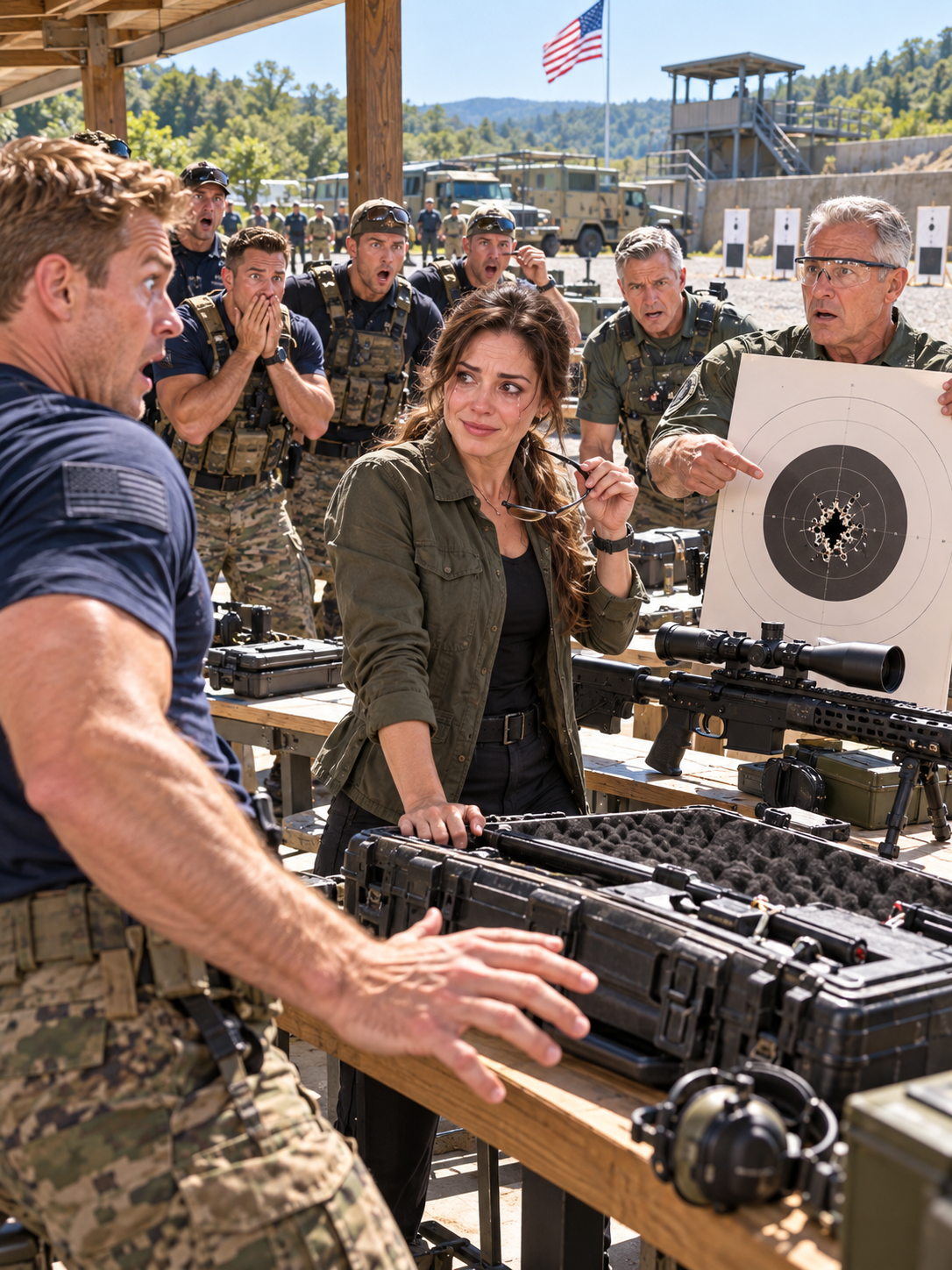
A Navy SEAL looked at my plain jacket, my battered rifle case, and apparently decided he knew exactly what I was. “Leave the shooting to the men, honey,” he announced loudly enough for his entire team to laugh. I could have told him my rank. I could have told him why I was really on that range. Instead, I said nothing, took my place on the firing line, and let the target answer him. Twenty minutes later, nobody was laughing.
### Part 1
There is a particular kind of quiet that settles over a military firing range just before sunrise, when the target frames are still dark rectangles against a gray horizon and the damp grass smells like cold earth and yesterday’s rain. I had always liked arriving during that hour because nobody was performing yet; there were no shouted scores, no exaggerated stories, no little competitions happening behind the actual competition. That Tuesday morning, I parked near the wooden range office before most of the shooters arrived, lifted a scarred black rifle case from my trunk, and walked inside wearing jeans, boots, a charcoal jacket, and absolutely nothing that explained who I was.
The young Marine behind the desk barely looked at me when I signed the roster. “Open points are twelve through eighteen, ma’am,” he said, sliding the clipboard back toward himself, and I thanked him before heading outside with my coffee cooling untouched in my hand. He had no reason to recognize my name, and I had no intention of helping him; for once, I wanted to be treated as whatever people assumed I was when rank, position, and reputation were taken away.
That desire sounds strange until you have spent enough years in uniform to understand what authority does to a room. The moment people know the senior officer is watching, backs straighten, voices change, mistakes disappear until the officer leaves, and everyone suddenly becomes the version of themselves they think the boss wants to see. I was tired of polished versions, and I had come to that range because I wanted one final morning of honest wind, honest paper, and honest mistakes before my professional life changed in a way almost nobody there knew about yet.
By six-thirty, the place had come alive. Trucks rolled in, ammunition cans thumped onto tables, men called to friends across the gravel, and a Navy group occupied several points near mine with the confident noise of people accustomed to being watched. They were good; I could tell before any of them fired a shot, because experience shows up in little things long before it shows up on paper.
One of them was louder than the others. He was lean, maybe early thirties, with the restless confidence of a man who had earned difficult things and had slowly begun confusing those achievements with permission to judge everybody else. I later learned his name was Lieutenant Evan Hale, a Navy SEAL, but that morning he was simply the man two firing points down who kept making comments loud enough for his teammates to hear.
I opened my case, checked my equipment, and began laying out my gear. Hale watched for perhaps thirty seconds before strolling over, not aggressively, exactly, but with the easy possession of someone who believed the space already belonged to him. He looked from me to my rifle, then back to me, and smiled.
“Leave the shooting to the men, honey.”
He said it loudly. That was the important part, because the sentence was not really meant for me; it was meant for his audience, and several members of his team rewarded him immediately with laughter. Hale glanced over his shoulder, satisfied, then nodded toward the buildings behind us and added, “There’s coffee near the spectator area. Probably more comfortable back there.”
I looked at him without answering. Silence bothers people who are performing because it gives them nothing to work with, and after a few seconds his smile tightened as though I had missed a cue. “Seriously,” he continued, lowering his voice while somehow becoming more insulting, “this isn’t the place to figure out which end does what.”
Two positions away, an older Marine gunnery sergeant had been checking a younger shooter’s sling. I saw his head come up, then watched him start to stand with the expression of a man who had heard enough. I met his eyes and gave him the smallest shake of my head.
He stopped. His eyebrows narrowed, not because he understood me, but because something in the gesture made him reconsider what he thought he was seeing. Hale noticed none of it.
“You sure you belong on this line?” he asked.
“I signed the roster.”
For the first time, one of his teammates did not laugh. The man was holding binoculars against his chest, and he studied me for a second before looking away. Hale, however, seemed amused by my answer.
“Well, congratulations,” he said. “Paperwork accomplished.”
He went back to his team while I finished setting up. My hands moved through the familiar routine almost independently, and I felt the noise around me begin to lose importance the way it always did once I focused on the work in front of me. A female staff sergeant coaching a Marine nearby glanced toward my position, watched my hands for several seconds, and said, “Ma’am, I’m guessing this isn’t your first morning on a range.”
“Not my first.”
“That’s what I thought.”
Her name tape read MONROE. She gave me a knowing half smile and returned to her shooter.
I settled behind the rifle and stared downrange while the range personnel finished their safety checks. Hale’s laughter still drifted from behind me occasionally, and twenty years earlier it might have gotten inside my head; I would have wanted to beat him, embarrass him, make every shot an argument aimed directly at his pride. At forty-one, I knew better, mostly because a patient Gunnery Sergeant named Daniel Crowley had spent years teaching me that the moment you begin shooting at a person instead of a target, the other person has already stolen something from you.
Crowley had been dead for fourteen years.
Some mornings I could remember him without pain. Other mornings the smell of damp canvas, gun oil, or burned coffee opened a door I preferred to keep closed, and there he was again, standing behind a much younger version of me and saying, “The trigger is the easy part, Mercer. Everything before it is the job.”
That Tuesday, his voice arrived so clearly I almost turned my head.
The range went hot.
I heard bolts move, breathing change, and the small mechanical sounds of people preparing to do something that tolerated very little dishonesty. Hale disappeared from my thoughts, the laughter disappeared with him, and I let myself become exactly what I had come there to be.
One shooter.
Nothing more.
For the moment.
### Part 2
Gunnery Sergeant Daniel Crowley met me when I was twenty-four and convinced I was already excellent at everything worth doing. I was a young Marine officer with quick hands, quicker opinions, and the dangerous belief that talent excused impatience. Crowley corrected all three without ever raising his voice, which irritated me far more effectively than shouting would have.
“The impatient shooter is always paying interest on a decision she made half a second too early,” he once told me after I ruined a string I should have owned. I had expected criticism of my technique; instead, he made me sit beside him and watch the wind move across the grass for ten minutes without touching the rifle. At twenty-four, ten silent minutes felt like punishment, but years later I understood that silence was the lesson.
Crowley taught me that shooting was mostly restraint disguised as action. The dramatic moment was brief, but everything that mattered happened before it: observation, judgment, discipline, and the willingness to wait when your ego wanted desperately to do something. “Anybody can make noise,” he used to say. “Professionals know when noise is necessary.”
I carried that sentence into places far beyond ranges. I carried it overseas, into command posts where bad information moved faster than good information, into meetings where the loudest person often understood the least, and into one terrible deployment where experience and skill still failed to save people I believed I should have been able to save. Crowley was there during part of that deployment, older by then, near the end of his career, still maddeningly calm.
He did not come home.
For years afterward, I treated grief like contraband. I kept it locked away because I believed competent people were supposed to be untouched by the things they survived, and every time some smell or phrase brought Crowley back, I shoved him away again. It took me much longer than it should have to understand that the strongest people I had known were not people who felt nothing; they were people who felt everything and still chose carefully what to do next.
That was the man whose voice followed me onto the line while Evan Hale waited for me to embarrass myself.
I settled into position, let the range around me become background, and focused only on what the morning was telling me. The air had shifted slightly since sunrise, the flat gray sky brightening without becoming warm, and somewhere behind me a coffee thermos fell from a bench with a metallic bang followed by somebody muttering under his breath. I heard it, registered it, and let it go.
Then I fired my first string.
I will not romanticize what happened next by describing every mark on the target. Shooters who brag about their own groups are usually telling you something more important than their score, and it is rarely flattering. I will only say that my hands remembered their work, the conditions cooperated enough, and the result downrange was the sort of result experienced people notice.
The first person to notice was the SEAL with the binoculars.
His name, I later learned, was Petty Officer Ryan Cole. He had been one of the few men on Hale’s team who had not laughed when Hale spoke to me, and he was scanning the targets between strings when his binoculars reached mine. He stayed there long enough that another man beside him asked what he was looking at.
Cole lowered the binoculars slowly.
“Hale.”
“What?”
“You might want to see this.”
Hale did not immediately respond. I was still behind the rifle, so I could not see his face, but I heard the change in his voice when he answered. “See what?”
Cole did not explain.
A few seconds later another pair of binoculars came up. Then another.
Staff Sergeant Monroe noticed the shift before I did. She was standing behind her young Marine, and when she glanced toward me there was a small expression of satisfaction on her face that made me suspect the entire line was beginning to understand something I had not intended to announce.
I finished the string, made the rifle safe, and remained still for a moment.
When I finally sat up, the atmosphere had changed.
Nobody announced it. No one shouted a score or made a speech, but several conversations had stopped, and people who had been openly watching me suddenly became interested in their equipment. Hale stood near his point with his arms crossed and the guarded expression of a man whose joke had somehow become expensive.
“What?” he said to his team. “She can shoot. Great.”
Cole kept his eyes down.
“It was a joke,” Hale added.
Nobody answered him.
That was when Master Sergeant Owen Briggs began walking toward me.
I had noticed Briggs earlier because good range safety officers are difficult not to notice. They move constantly without looking hurried, see things without staring, and somehow know which conversation matters before anybody else realizes there is a problem. Briggs was in his late forties, silver beginning at his temples, and he carried a clipboard like it had spent half its life in his hand.
He looked at the clipboard.
Then he looked at me.
Then he looked back at the clipboard.
I felt something inside me tighten.
The problem with anonymity is that it survives only until somebody competent decides to check.
Briggs stopped several feet away, and his expression had become carefully neutral. “Ma’am,” he said, “when you finish this string, the range officer would like a word.”
Behind him, Hale shifted.
“Something wrong?” I asked.
“No, ma’am.”
The second “ma’am” carried a different weight from the first.
Briggs leaned closer, lowering his voice so the surrounding shooters could not hear. “We didn’t connect the roster information correctly when you checked in. That’s on us.”
I looked past him toward the range office. A man I recognized stood in the doorway, holding a radio against his chest and staring directly at me.
So much for being nobody.
“Do I need to leave the line?” I asked.
“No, ma’am. Finish what you came to do.”
Briggs started to step away, then hesitated. His eyes moved briefly toward Hale and back to me, and in that tiny glance was a question I had seen from senior enlisted Marines my entire career.
How do you want this handled?
I gave him almost nothing in return.
“Nothing has happened that affects range safety, Master Sergeant.”
Understanding moved across his face.
“No, ma’am.”
“Then we keep shooting.”
“Yes, ma’am.”
He walked away.
Behind me, somebody whispered something too quietly to catch. Hale said, louder than necessary, “What’s with all the ‘ma’am’?”
No one answered.
I looked down at my rifle and heard Crowley’s voice again, as calm as if fourteen years had not passed.
Anybody can make noise.
I thought the difficult part of the morning had been putting the rounds where they belonged.
I was beginning to understand that the difficult part had not started yet.
### Part 3
Hale lasted another five minutes before the silence got to him. Men like him are comfortable with noise because noise can be steered, challenged, or drowned out; silence gives them nothing to fight except their own imagination. He finally walked over while I was checking my equipment and stopped several feet away this time instead of crowding me.
“So what’s going on?” he asked.
I looked up.
“With the range officer. Briggs. Everybody acting weird.”
“You should probably ask them.”
His jaw tightened. “I was joking earlier.”
“I heard you.”
“Everybody jokes on ranges.”
“Do they?”
He opened his mouth, then shut it again.
The older gunnery sergeant who had nearly defended me earlier watched from two points away. Monroe was pretending to focus entirely on her Marine’s target, which fooled nobody, and Cole had developed a sudden fascination with cleaning his binocular lenses.
Hale tried again. “Look, if you took it personally—”
“I didn’t say I did.”
That unsettled him more than anger would have.
The truth was that I had taken it personally, at least for a few seconds. Being experienced does not turn you into stone; it simply gives you more choices about what you do with the first ugly thing that rises inside you. Part of me still remembered being twenty-four and furious every time somebody mistook my sex for a measure of my competence, and that younger version of me would have enjoyed what was happening to him.
But I had spent too many years watching authority used badly.
I had seen commanders publicly crush people over mistakes that could have been corrected quietly. I had seen resentment disguised as discipline and humiliation sold as leadership, and almost every time the person doing it claimed they were “setting a standard.” What they usually set was fear, and fear makes people hide exactly the mistakes leaders most need to see.
Hale had been arrogant and insulting. He had also not endangered anyone.
That distinction mattered.
The range went cold for target changes, and shooters began standing and stretching. Hale remained near me as if he knew walking away before he understood what was happening would somehow make things worse.
Briggs approached again.
“Ma’am, Captain Ellis says there’s no urgency, but he wanted me to let you know he’s aware you’re here.”
“Thank you.”
Briggs started to leave, then Hale spoke.
“Master Sergeant, who exactly is she?”
Briggs stopped.
There are moments when an entire story turns on whether one person chooses to enjoy another person’s embarrassment. I saw the opportunity arrive on Briggs’s face, because he knew exactly how satisfying it would be to answer loudly enough for the whole line. Then his eyes met mine, and whatever he saw there made him choose differently.
“You can ask her, Lieutenant.”
Hale looked back at me.
I almost smiled.
“Are you with the range staff?”
“No.”
“Competition team?”
“Not anymore.”
His face changed slightly at the word anymore.
“Marine Corps?”
“Yes.”
“What rank?”
Before I could answer, a young Marine behind Monroe dropped a target backer and swore. Monroe bent to help him, and while they worked he whispered, “Who is she?”
He was not nearly as quiet as he thought.
Monroe answered him without looking toward me.
“That’s Major Claire Mercer.”
The young Marine froze.
Monroe continued in the same practical tone. “She’s taking command of the Advanced Marksmanship Training Detachment next month.”
Hale heard every word.
So did his team.
That was the second silence.
It did not arrive dramatically. Nobody gasped, nobody saluted, nobody dropped anything, but a strange stillness spread outward from Hale as the pieces finally connected: Briggs’s tone, the range officer watching from the building, the target downrange, the name on the roster, and the woman he had directed toward the spectator tent.
Hale’s face lost color.
“Major?”
I stood.
He straightened automatically.
“Relax, Lieutenant.”
He did not relax.
“I didn’t know.”
“I know.”
“If I’d known—”
“That’s the problem.”
The words came out more sharply than I intended, and for a second the younger version of me leaned toward the opening. Every person on that line was listening now, however carefully they pretended otherwise, and I could have dismantled him with almost no effort.
He had provided every piece I would need.
If I had known you outranked me, I would have treated you with respect.
What a terrible thing to accidentally confess.
Hale realized it too.
His eyes dropped.
I could feel the line waiting.
Crowley’s old lesson came back with almost physical weight: the shot you most want to take is often the one that deserves the longest pause.
So I paused.
“Hale,” I said quietly.
He looked up.
“Walk with me.”
We moved perhaps twenty yards away, near a rack of empty target frames where the wind carried our voices away from the firing points. I could see disappointment on a few faces behind us because the audience wanted the scene, and part of me understood; public arrogance seems to demand public punishment.
But punishment and correction are not the same thing.
“I’m going to tell you something,” I said, “and I’m telling you privately because I’m giving you the chance to decide what kind of lesson this becomes.”
“Yes, ma’am.”
“You’re clearly competent. Your team watches you, which means you’ve earned something from them. But this morning you used that influence to decide someone didn’t belong here based on what she looked like, and then you made your team participate.”
His face tightened.
“I was messing around.”
“I know. That doesn’t make it smaller.”
He nodded once.
“You weren’t wrong because I happen to be a major,” I continued. “You were wrong before you knew who I was.”
That landed.
I saw it in the way his shoulders lowered.
“If I had been a civilian woman who had never touched a rifle before,” I said, “you still would have had no reason to humiliate me. If I had been terrible, the correct response would have been safety and instruction, not entertainment.”
“Yes, ma’am.”
“And if I had been exactly who I am but had shot badly today, I still would have deserved to be here.”
He swallowed.
“Yes, ma’am.”
I let the silence stretch.
Then I said the thing I suspected nobody behind us expected.
“Go finish your string.”
He blinked.
“That’s it?”
“No. That isn’t it. You get to decide the rest.”
I turned toward the line.
“Major.”
I stopped.
“I’m sorry.”
I looked back.
For the first time that morning, there was no performance in his face.
“I believe you,” I said. “Now make the apology worth something.”
When we returned, nobody laughed.
Hale went directly to his position.
And what surprised me most was how relieved I felt that the man behind the noise still seemed capable of learning.
### Part 4
Hale shot well after that. I mean genuinely well, the kind of disciplined string that made it obvious the arrogance had been sitting on top of real ability rather than replacing it, and I found myself quietly pleased because talent wasted by ego is still waste. The performance was gone from his movements now, and when he finished, Cole leaned over and said something to him that I could not hear.
Later, Cole told me what it was.
“You told her to leave the shooting to the men.”
That was all.
Hale had apparently stared at him for a moment and answered, “Yeah.”
Cole replied, “Might want to remember how that turned out.”
Cruelty from me could have become a story Hale told himself about unfair authority. One plain sentence from a teammate he respected was harder to escape because it came from inside his own circle. Sometimes correction works best when it arrives from the person whose approval created the bad behavior in the first place.
The line gradually returned to normal. Targets went down and came up, brass accumulated along the concrete, coffee disappeared, and conversations resumed with a slightly different tone. Nobody mentioned my score directly to me, which I appreciated.
The young Marine Monroe had been coaching finally gathered enough courage to approach while I was packing part of my gear.
“Major?”
“Yes?”
“How long did it take you to get that good?”
I laughed. “Long enough to stop believing getting good was the interesting part.”
He looked confused.
People always expect a secret technique when they ask that question. They want something clean and transferable, preferably a sentence they can remember, because “years of boring repetition and being corrected by people smarter than you” is not exciting enough to feel like wisdom.
“A better shooter than me taught me something,” I said. “The dramatic part is the smallest part. Everything that matters happens before it.”
He nodded slowly.
“Learn to observe,” I continued. “Learn patience. Learn what your own ego feels like when it starts making decisions for you. The moment itself is easy compared with everything required to arrive there correctly.”
His eyes flicked toward Hale.
“That apply to what happened earlier too?”
I followed his glance.
“Especially that.”
He shifted his weight. “Did you want to embarrass him?”
It was such an honest question that I could not insult him with a polished answer.
“Yes.”
His eyebrows rose.
“Very much, for about thirty seconds.”
He smiled.
“I’m serious,” I said. “Being disciplined doesn’t mean you stop wanting the satisfying thing. It means wanting it doesn’t get to make the decision.”
The smile disappeared as he listened.
“One day somebody is going to hand you enough authority to hurt them legally, professionally, or socially,” I said. “You’ll have every excuse, maybe even a cheering crowd. That’s when you find out whether your self-control was real or just something you practiced when nothing was at stake.”
He stood there quietly.
Then he said, “Who taught you that?”
I looked toward the gray sky.
“Gunnery Sergeant Daniel Crowley.”
The name changed the face of the man standing ten feet behind him.
Master Sergeant Briggs.
I noticed because he had stopped walking.
“You knew Gunny Crowley?” he asked.
Something inside my chest shifted.
“Yes.”
Briggs stared at me with an expression I could not immediately read. “Which Crowley?”
“Daniel. Marksmanship instructor. Retired before he ever got to enjoy retirement.”
Briggs took off his cover and rubbed one hand over his hair.
“Ma’am,” he said slowly, “I served with him.”
The range sounds seemed to pull farther away.
“Where?”
He named the deployment.
My throat closed.
There are memories that fade around the edges until somebody says one word and suddenly the entire room returns: canvas walls snapping in dry wind, dust collecting in the seams of boots, exhausted coffee, faces of people I had spent years teaching myself not to picture too clearly. Crowley standing near a doorway with his sleeves rolled up, looking irritated because someone had misplaced equipment again.
Briggs saw the change in my face and lowered his voice.
“He used to talk about a lieutenant,” he said. “Young officer. Stubborn. Good shot.”
I managed, “That could describe half the Marine Corps.”
“No.” Briggs smiled faintly. “He said this one listened better than she shot, and she shot better than she had any right to at that age.”
My eyes burned.
I looked away toward the targets.
“He said her name?”
“No. Not that I remember.”
“That sounds like him.”
Briggs sat beside me on the bench without asking, which was exactly the right thing to do.
For a while neither of us spoke.
Then he said, “He told me the trigger was the easy part.”
I closed my eyes.
Of course he had.
For years, I had treated Crowley’s words as something almost private, a thread between a dead mentor and the officer he had left behind. Hearing them from Briggs made me realize the lesson had never belonged to me at all; Crowley had been giving it away everywhere he went.
“I’ve used that line for twenty years,” Briggs said. “Every class I coached.”
“So have I.”
He laughed softly. “Then the old man got his money’s worth.”
I laughed too, and the sound surprised me because I had not expected grief to make room for humor that morning.
Briggs became serious again.
“He would’ve liked what you did with Hale.”
I stared across the range.
“You don’t know that.”
“I know exactly that.”
My hands tightened around the zipper of my rifle case.
Briggs nodded toward Hale, who was helping one of his teammates gather gear. “You had him dead to rights and didn’t spend it.”
“Crowley would’ve told me not to confuse restraint with avoiding the problem.”
“You didn’t avoid it.”
“No.”
“You just didn’t make a meal out of him.”
That sounded so much like something Crowley might have said that I had to look down.
By then, the range was beginning to empty.
I had come wanting one anonymous morning before command changed the way people behaved around me.
Instead, the range had given me a man who underestimated me, a test I had not asked for, and a voice from fourteen years ago returning through someone else’s memory.
I thought the morning was finished with me.
It was not.
### Part 5
I stayed after most of the shooters left. The target frames stood empty in the distance, a flag near the range office moved lazily in the afternoon wind, and the smell of burned powder was gradually being replaced by wet grass as another thin band of rain approached. Briggs had returned to his duties, and for several minutes I had the bench to myself.
That was when I finally allowed Crowley to sit beside me in my imagination.
For years, I had believed professionalism meant keeping grief outside the room where skill lived. I thought sorrow was contamination, something that would shake the hands, cloud judgment, make a person softer in all the wrong ways. The truth was almost the opposite: Crowley had taught restraint because he understood consequence, and he understood consequence because he cared deeply about people.
The best professionals I have known were never empty.
They simply did not make everyone else pay for what they carried.
I thought about the people we lost overseas and the useless arithmetic I had performed afterward. If I had noticed more, trained harder, planned differently, arrived thirty seconds earlier, been better at the one thing everyone kept telling me I was exceptionally good at. Grief can turn skill into an accusation if you let it.
For fourteen years, part of me had looked at every marksmanship award and heard the same bitter question.
What good was being excellent if excellence could not save everyone?
Crowley would have hated the question because it was dishonest. Skill was never a promise that nothing terrible would happen; it was a responsibility to do the next thing as well and as carefully as possible. Sometimes the next thing was taking a difficult shot, sometimes it was teaching a frightened nineteen-year-old, and sometimes it was choosing not to use power simply because using it would feel satisfying.
Footsteps approached.
I looked up.
Hale stood several yards away carrying his case.
“Major?”
“Lieutenant.”
“Can I say something?”
“You’re already doing it.”
A nervous smile appeared and vanished.
He came closer but remained standing. “I’ve been trying to figure out how to apologize without turning the apology into another performance.”
That was better than anything polished.
“Keep going.”
“I was showing off,” he said. “You were right about that. And if you had been somebody with no rank at all, I probably would’ve told myself it didn’t matter.”
He looked toward the empty firing points.
“That bothers me more than finding out who you actually are.”
“Good.”
He nodded.
“I don’t mean good that you feel bad. I mean good that you understand what the real mistake was.”
“Yes, ma’am.”
I stood and lifted my case.
“Hale, I’m not going to tell you this was nothing. It wasn’t. People watch you, and that makes small things bigger whether you want them to be or not.”
“I understand.”
“Do you?”
He considered the question instead of answering immediately.
“I think I’m starting to.”
“That’s enough for today.”
He extended a hand, hesitated as if unsure whether he had earned the gesture, and I took it.
“Good shooting, Major.”
“You too, Lieutenant.”
We parted there.
Three weeks later, I stood in front of the Advanced Marksmanship Training Detachment wearing a uniform instead of a plain jacket. Nobody had to guess my rank now, and there was no anonymity left to protect. Marines and sailors sat in rows while I looked over faces that would soon become familiar: confident ones, nervous ones, skeptical ones, eager ones, and several carefully blank expressions belonging to people determined not to reveal what they were thinking in front of the new commander.
I did not tell them the story of Evan Hale.
I did not tell them about the target, the silence, or the joke.
I told them one thing.
“On my ranges, everybody earns respect by how they conduct themselves after they arrive, not by what somebody assumes before they begin.”
Then we got to work.
Months later, Hale’s team returned for another joint training block.
I spotted him across the range while talking with Monroe, who had since become one of the coaches I relied on most. Hale saw me, gave a respectful nod, and went back to helping his people unload equipment.
A young female sailor arrived late carrying borrowed gear and looking embarrassed.
One of Hale’s teammates made a comment I could not hear.
Hale turned.
I watched his posture change.
For half a second I wondered whether the old version of him was about to reappear.
Instead, he pointed toward the open position beside him.
“She signed the roster,” he said. “She gets the line. Help her get set up.”
He never looked toward me.
That was what made it matter.
People often imagine change as a confession, a dramatic apology, or some visible transformation accompanied by music. Most real change is quieter. It is a person behaving differently on an ordinary afternoon when the people who corrected him are not supposed to be watching.
I turned away before Hale could discover that I had heard him.
He did not owe me a performance.
Crowley had taught me that too.
A few weeks after that, I found an envelope on my desk with no return address. Inside was an old photocopy of a photograph Briggs had discovered while going through a box from his deployment: Gunnery Sergeant Daniel Crowley standing beside a range table, thinner and younger than I remembered him, sunglasses pushed onto his forehead, one hand lifted as if he had been caught in the middle of explaining something important.
On the back, in Briggs’s handwriting, were seven words.
“He kept teaching after you went home.”
I sat with that photograph for a long time.
Then I placed it inside the top drawer of my desk instead of locking it away somewhere I would never have to see it.
That was the difference.
I no longer wanted the people I had lost hidden in the dark parts of my memory. Crowley belonged in the room with the work because the work had his fingerprints all over it.
Years earlier, he had taught a loud, impatient lieutenant that the hardest part of being skilled was learning when not to use everything you had. On a gray Tuesday morning, a younger Navy officer accidentally gave me the chance to discover whether I had finally learned the lesson.
I had.
Not perfectly.
Not painlessly.
But enough.
People sometimes hear this story and think my proudest moment was when Hale’s teammates lowered their binoculars and the firing line went quiet.
It wasn’t.
The shooting was familiar.
What happened afterward was harder.
My proudest moment was standing there with every advantage, every witness, every justification, and enough authority to make a man feel as small as he had tried to make me—and deciding that correction mattered more than revenge.
Anybody can use power when the room is cheering.
The real measure is what you do when nobody would blame you for being cruel.
So if someone looks at you and decides what you cannot possibly be before you have said a word, remember this: you do not owe them a performance. You do not have to explain your entire history to earn permission to exist in a place you have every right to stand.
Do the work.
Let the truth accumulate.
And when the moment finally comes when you could crush the person who underestimated you, understand that you have been handed a second test, one harder than the first.
Winning is easy when winning means proving somebody wrong.
The difficult victory is leaving the situation without becoming the kind of person who needs somebody else to be small in order to feel large.
I still shoot.
I still teach.
Some mornings, when the weather is gray and the range has not fully awakened, I hear Crowley as clearly as I did when I was twenty-four.
“The trigger is the easy part, Mercer.”
He was right.
The shot is almost never the hardest decision.
The hardest decision is what you choose not to fire.
THE END!
Disclaimer: Our stories are inspired by real-life events but are carefully rewritten for entertainment. Any resemblance to actual people or situations is purely coincidental.


