
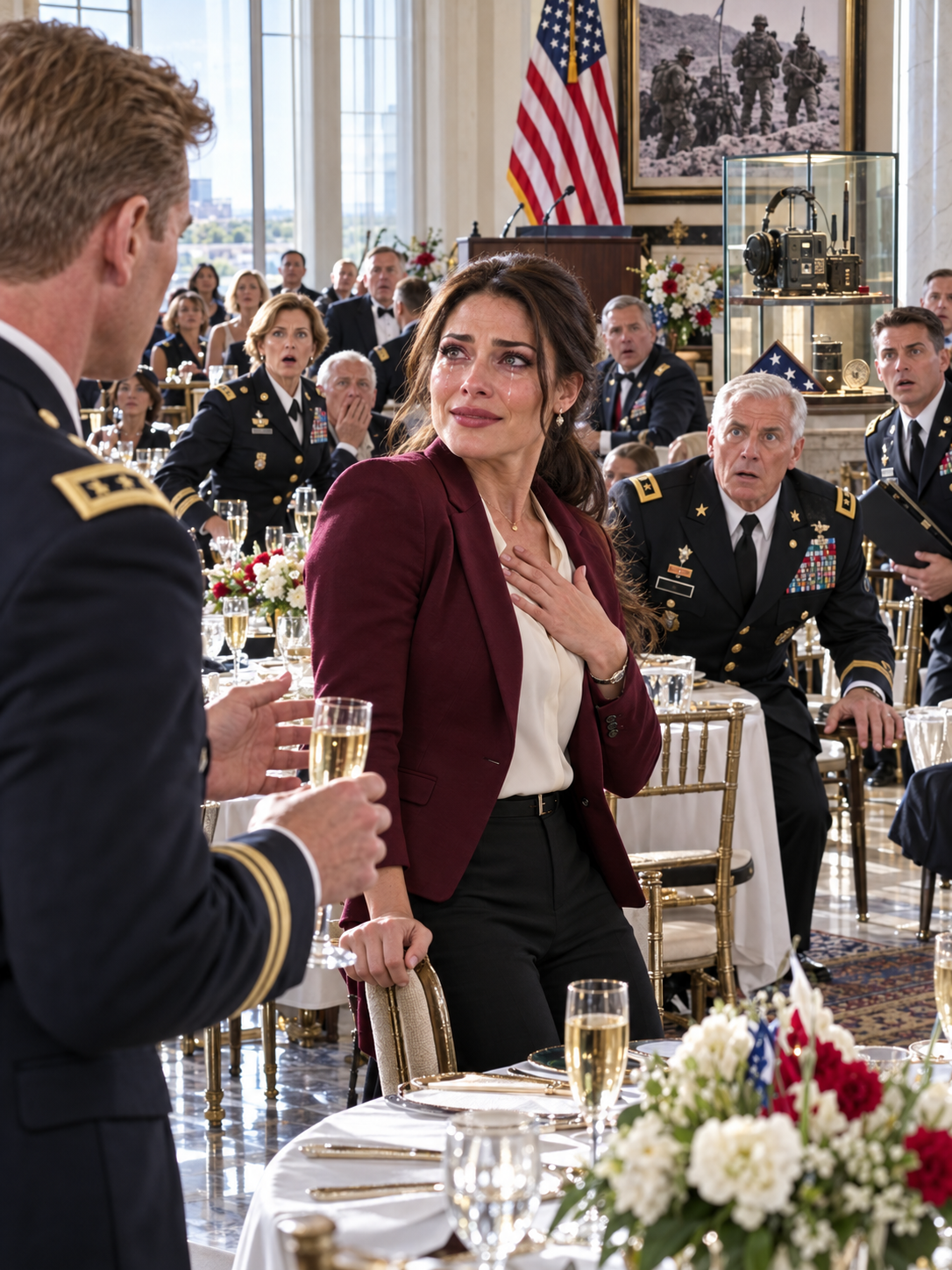
I thought I was attending an old classmate’s promotion party, not walking into a story he had been telling about me for 15 years. When Mason Reed laughed and said, “Even LONGSHOT never scared me,” I stayed quiet because he had no idea that call sign had belonged to me. Then Brigadier General Thomas Mercer spotted me across the room, pushed back his chair, and stood. What happened the next morning exposed more than one old lie—and forced me to decide whether silence was still dignity.
### Part 1
I knew Mason was in trouble before he did, and the strange part was that I had not said a single word. I was standing near the back wall of a private dining room outside Newport News, holding a glass of iced tea slick with condensation while Mason worked a semicircle of officers, relatives, and former classmates with the confidence of a man who had spent years learning exactly when to pause for laughter. The room smelled like smoked brisket, coffee, and the lemon polish the restaurant used on its dark wood tables, and every few feet someone had propped up another framed photo from Mason’s Army career. I had planned to stay an hour, congratulate him on making major, hug his wife, and disappear before the cake was cut.
Mason had always loved an audience, even when we were seventeen and his audience was six kids leaning against dented lockers after chemistry class. He was smart, disciplined, athletic, and genuinely hardworking, which was probably why it took me so long to notice the habit underneath all that charm: every achievement in the room somehow became smaller when it was placed beside his. When I scored highest on a test, he asked whether I had spent the whole weekend studying; when I won a statewide academic competition, he congratulated me and immediately mentioned that the strongest school in our district had not entered that year. He never raised his voice or called anyone stupid, and because he smiled afterward, everyone called it teasing.
At the party, an old classmate asked him which course had been toughest, and Mason gave the exact half-smile I remembered from high school. “Sniper course was no joke,” he said, tapping two fingers against his glass, “but I finished at the top of my class.” A retired officer asked whether the stories about a joint evaluator called LONGSHOT were true, and Mason laughed as if the name belonged to a ghost people had exaggerated for fun. “People talked about her like she could see through walls,” he said. “Honestly? Even LONGSHOT never scared me.”
I nearly laughed, but not for the reason anyone in that room would have guessed. LONGSHOT had been my call sign during a joint training assignment years earlier, and Mason had never known the evaluator he spent years boasting about beating was the same woman he still described as his cautious, desk-bound high school friend. I remembered the old exercise clearly enough to feel the weight of a rain-soaked notebook in my hand and hear an instructor muttering that Mason’s judgment had almost washed him out of the rotation. Mason had not outperformed LONGSHOT; he had made one impulsive decision, failed a critical phase, and been allowed to continue only after I argued that a single mistake should not define an otherwise capable candidate.
Before I could decide whether his comment deserved an answer, a chair scraped sharply against the floor behind him. Brigadier General Thomas Mercer had been sitting with two retired officers near the windows, mostly listening, but now he was standing and staring directly at me. “Claire Bennett?” he called, and half the room turned. Mercer crossed the room with the quick grin of a man who had just found someone he never expected to see, shook my hand with both of his, and said, “Well, I’ll be damned. It’s been too long.”
Mason blinked as if someone had changed the lighting. “Sir, you two know each other?” he asked, and Mercer looked from him to me with a flicker of amusement that made my stomach tighten. “Commander Bennett and I worked joint training years ago,” he said. “She was one of the people you listened to if you were smart.” Mason’s eyes moved over my civilian dress as though he were trying to fit that sentence into the version of me he had carried around since high school.
He recovered fast, because Mason always recovered fast in front of an audience. “Claire never talks about any of that,” he said with a laugh. “She always was the quiet one.” Mercer lifted one eyebrow, and I could tell he heard the implication even if Mason did not. “Quiet is not the same as inexperienced,” he replied, then glanced back toward the group that had been discussing the old course.
“So, Major Reed,” Mercer said, “you really think you could handle LONGSHOT?” Mason chuckled. “Any day, sir.” Mercer nodded once, slowly enough that I recognized the tone before Mason did. “Good. Your unit has its monthly evaluation tomorrow morning, correct?”
Mason straightened. “Yes, sir.” Mercer turned to me. “Commander, if your schedule allows, I could use an experienced guest observer.” I raised an eyebrow because I knew Mercer well enough to understand exactly what he was doing, but Mason jumped in before I could answer.
“Absolutely,” he said. “Bring LONGSHOT too, if you can find her.” Mercer looked at me again, and this time the smile reached his eyes. “I think I can manage that.”
The laughter around us was polite, but something about the moment left a cold little space in my chest. Mason thought he had accepted a challenge; he had no idea he had just invited the woman he had been bragging about into his evaluation the next morning. I still did not intend to embarrass him, and I certainly did not plan to settle a high school rivalry on military time. But as I stood there listening to him talk, I kept hearing the sentence he had used at reunions for years: “Claire was always the brains. I was the one who liked the hard stuff.”
My father, George Bennett, had repeated a softer version of it once at a cookout, saying Mason had always gone after the difficult assignments before telling me he was glad I had built myself “a stable career.” He had meant it kindly, and at the time I had let the difference slide: Mason’s work was hard, mine was stable; his stories were brave, mine were sensible. I had spent years believing that correcting people would sound insecure, so I let silence do the work I thought dignity required. What I had not understood was that if you leave enough blank space in your own story, someone else may eventually decide they have the right to fill it.
Mason caught me near the restaurant door as I was leaving. “Tomorrow should be fun,” he said, loosening his tie with one hand. “You’ll finally get to see what the hard stuff looks like.” I looked at him for a long second, hearing fifteen years of little comparisons packed inside that one sentence, then smiled and said, “I’ll be there.”
On the drive home, I made myself one promise: I would not use the truth to humiliate him. But for the first time in a very long while, I was also not going to help Mason look bigger by making myself smaller.
### Part 2
LONGSHOT had started as a joke, which was one reason I had never treated it like a medal. Years earlier, I was assigned to a joint training program in Virginia where people from different services worked through observation, planning, fieldcraft, and decision-making problems under pressure. I was Navy in a building full of Army patches, maps with grease-pencil marks, battered coffee mugs, and instructors who cared far more about whether you noticed a bad assumption than what branch was stitched over your pocket. I was not a sniper, and I never claimed to be one; my value was patience, planning, and the irritating habit of seeing small things other people rushed past.
During one training problem, conditions changed midway through the exercise and the original plan stopped making sense. An instructor asked what I would do, and I chose to wait, reassess, and act only when the situation supported it. Afterward he lowered his binoculars, shook his head, and said, “That was a hell of a long shot, Bennett.” Somebody repeated it at lunch, another person shortened it, and within a week I was LONGSHOT.
The nickname grew faster than the truth. By the next training cycle, incoming students had heard that LONGSHOT never missed, never slept, and could somehow predict what a team would do before the team knew it themselves. None of that was true, but stories rarely improve when they are repeated by people who were not there. What was true was less glamorous: I was good at recognizing the moment ambition began interfering with judgment.
That was how Mason came back into my life. His name appeared on a roster one Monday morning, and I stared at it for several seconds before deciding not to tell him I was on the evaluation staff. I did not want our high school history helping him or hurting him, and I trusted the system enough to believe he deserved the same standards as everyone else. For the first several days, he justified that decision.
Mason was prepared, physically capable, quick to absorb instruction, and excellent at projecting confidence to the people around him. The problem appeared during a field scenario that required his team to observe, confirm what they knew, and make a decision without letting the clock pressure them into guessing. One of his teammates told him they did not have enough information and recommended waiting. Mason looked at the time, decided he understood the situation anyway, and pushed ahead because another team was moving faster.
The scenario ended almost immediately after that. Nobody was hurt; it was controlled training, but Mason had committed his element based on an assumption that had not been verified, and the result exposed exactly the kind of judgment problem the exercise was designed to reveal. In the review afterward, he defended the choice longer than he should have, saying the information had looked sufficient. What I wrote in my notes was simpler: “Candidate allowed the desire to finish first to replace the requirement to be certain.”
The instructors debated whether he should continue. One argued that Mason had knowingly ignored the instruction and therefore had already demonstrated the lesson the course was meant to test. Thomas Mercer was not a general then, but he was part of the oversight team, and I still remembered him turning toward me and asking, “Your recommendation?” I looked at Mason’s earlier work, then at the failed scenario, and said, “Let him continue.”
Mercer asked why. “Because training is where people are supposed to discover what bad judgment costs before the stakes are real,” I said. “One poor decision should not define an otherwise capable candidate if he can show he learned from it.” Mason stayed in the program, improved after that, and finished the rotation respectably; I never told him I had been the evaluator who argued for the second chance because I did not believe fairness required gratitude.
Over the years, I heard fragments of the story Mason told instead. In his version, LONGSHOT was some legendary evaluator who had tried to rattle him and failed; depending on the audience, he had either outthought her, ignored her pressure, or proved he could perform under conditions she expected him to fail. I usually heard those stories secondhand and dismissed them as harmless polishing. People sand the rough edges off old memories all the time, and I had better things to do than chase every exaggerated anecdote.
What bothered me the night after his promotion party was not that he remembered himself more generously. It was the ease with which he had used the story to place me beneath him without realizing I was the person in it. To Mason, Claire Bennett remained the smart girl who chose the safer road, the woman who attended meetings while men like him did the difficult work. The irony was almost funny until I remembered how many people had heard him say it.
At seven the next morning, I stood in my kitchen drinking coffee that tasted slightly burned and looking at my uniform hanging from the back of a chair. I did not feel triumphant; mostly I felt tired, because I knew what could happen when personal history entered a professional space. So before I left, I wrote one sentence at the top of a fresh notebook page: “Evaluate the officer in front of you, not the boy you remember.” Then I underlined it once.
Mercer met me outside the operations building shortly before eight. The morning air was already warm, cicadas buzzing in the trees beyond the parking area, and Mason’s team was preparing equipment nearby. Mercer glanced toward them and asked quietly, “You comfortable with this?” I said, “I’m here to observe an evaluation that was already scheduled, not settle an argument from high school,” and he gave me the small approving nod I remembered from years earlier.
Mason walked over a few minutes later and stopped short when he saw me in uniform. His smile weakened, but only for a second. “Commander Bennett,” he said, then looked past me at Mercer. “Sir, is LONGSHOT coming?”
Mercer’s face remained perfectly straight. “She’s here.” Mason glanced toward the building, then across the training area, searching for someone else. I lowered my eyes to my notebook before my expression could betray me. By the time the exercise began, he was still looking for LONGSHOT—and I was standing ten yards away.
### Part 3
For the first hour, Mason performed well enough that I wondered whether the morning would end anticlimactically. He communicated clearly, delegated without hovering, and adjusted when the first route his team considered became less useful than expected. I wrote down the good decisions exactly as I would have for anyone else, because personal history did not belong in an official assessment. If Mason had become a better leader than the young man I remembered, I wanted the record to show it.
Then his team reached the decision point. They had partial information about an opposing position ahead, and the senior NCO beside Mason studied the terrain before saying, “Sir, I’d hold here another minute. Something doesn’t fit.” Mason checked the time. “We have enough.” The NCO answered, “I don’t think we do.”
From where I stood, fifteen years collapsed into one second. Different field, different rank, same impatience—the tightening around Mason’s mouth whenever waiting felt too much like losing. He glanced toward Mercer and then toward me, and I understood the temptation. He did not just want to finish; he wanted to finish decisively while the general and his old classmate watched.
He ordered the movement. Within minutes, exercise control stopped the phase because his element had committed to the wrong approach and exposed itself to a position it had not properly confirmed. No one shouted, and there was no theatrical humiliation, only the uncomfortable quiet of trained people who already knew where the decision had gone wrong. Mason removed his gloves slowly and stared across the terrain.
During the after-action review, Mercer asked, “Major Reed, what beat you?” Mason started with incomplete information, then corrected himself. “I rushed the decision, sir.” Mercer asked why, and Mason answered, “I wanted us to have enough information more than I actually knew we had it.”
Mercer turned to me. “Commander Bennett?” Every face shifted in my direction. I kept my voice even. “Your NCO gave you good information. You chose momentum over verification because finishing cleanly mattered more than admitting you needed another minute.”
Mason’s eyes narrowed with recognition. I could almost see him searching old memory for a sentence he had read years earlier. Mercer folded his arms. “Still not afraid of LONGSHOT?”
The color left Mason’s face. He looked at Mercer, then at me. “No,” he said, but it sounded like a question. Mercer said nothing, and Mason stared at me for two full seconds before whispering, “You?”
I closed my notebook. “Morning, Mason.” Nobody laughed, which made the silence heavier. Mercer moved the review forward almost immediately, focusing on the lesson rather than Mason’s embarrassment, and I respected him for it.
By noon, my role was finished. I left believing the matter had closed itself neatly: Mason had learned who LONGSHOT was, the world had not ended, and I had done my job without turning a professional evaluation into personal theater. Three days later, that feeling disappeared.
My phone buzzed while I was unloading groceries. The message came from Hannah Price, another classmate from high school, and it contained screenshots from an alumni group I barely checked. “Claire,” she wrote, “I think you need to see how long he’s been doing this.”
The first screenshot was four years old. Someone had asked what I was doing in the Navy, and Mason had replied, “Mostly behind a desk these days. Claire was always better at planning than getting dirty.” Under another post about my promotion, he implied staff officers advanced through a different, easier path; when someone mentioned that I had worked in joint training, Mason wrote, “She’s always been good at making ordinary work sound impressive.”
That sentence stopped me because I had barely described my work at all. I kept scrolling, and the pattern sharpened: if someone praised me, Mason qualified the praise; if my father mentioned an assignment, Mason explained why it was less significant than it sounded. He had been doing socially what he had always done in person—moving me down half a step so he could stand a little higher.
The worst screenshot looked harmless at first. Dad had posted years earlier that he was proud I was working with personnel from several services, and Mason had replied, “George, don’t let her fool you. Joint usually just means more uniforms sitting around the same table.” Dad had reacted with a thumbs-up.
I called Hannah and asked why she was sending them now. She told me word had traveled that Mason had a rough evaluation and someone on the training staff had mentioned I was LONGSHOT. “I thought the old posts were friendly rivalry,” she said. “Now I’m not sure.”
That evening, I drove to Dad’s house and found him in the garage trying to repair a lamp that had been broken since I was in college. I showed him two screenshots without explanation, and his shoulders dropped. “I remember these,” he said. I asked, “Did you believe him?”
Dad set the screwdriver down carefully. “I believed he knew what he was talking about.” There it was: not cruelty, but years of quiet erosion. Mason had used the spaces I left empty to build a version of me that made his own life look harder and more important, and people who loved me had absorbed parts of it because he spoke confidently while I stayed silent.
Driving home, anger finally arrived—not hot or reckless, but cold enough to clarify what I would and would not do. I was not going to ruin Mason’s career, expose old training records, or use the Army to punish a personal grievance. But I was finished protecting the version of him that existed only because everyone else had been too polite to correct the story.
### Part 4
Two days after I found the screenshots, Mason called me. His voice had the controlled flatness of someone who had rehearsed being calm. “We need to talk about the evaluation,” he said. “LONGSHOT. Whatever you’ve been telling people.” I looked at the screenshots spread across my kitchen table and answered, “I haven’t told anyone anything.”
He asked me to meet him the next morning at a coffee shop halfway between Norfolk and Newport News. Mason was already in the back corner when I arrived, wearing jeans and a gray pullover instead of a uniform, and he stood before I sat down. “You could have stopped Mercer,” he said. “You knew he was going to reveal you in front of my team.”
“I knew who I was, Mason.” His jaw tightened. “You let me stand there looking like an idiot.” I stirred my coffee even though I had added nothing to it. “You told a room full of people you weren’t afraid of LONGSHOT, then invited LONGSHOT to your own evaluation. I didn’t arrange that for you.”
He leaned back. “I didn’t know it was you.” “That isn’t my fault.” For one second I saw the seventeen-year-old who could lose a race and spend the afternoon explaining why the wind had favored the other lane. Then he said, “You always hated that I was better at this than you.”
I reached into my bag and placed a thin folder on the table. The pages inside were my own non-sensitive notes from the old training period and material Mason had already received years earlier. I slid one page toward him and tapped the last paragraph. “Read that.”
His eyes moved across the page until they stopped at a sentence I knew by memory: one poor decision should not define an otherwise capable candidate if he demonstrates that he can learn from it. Mason looked up. “What about it?” I said, “I wrote that recommendation.”
His face went still. I told him that after he ignored the hold instruction, one instructor had recommended removing him from the rotation, and Mercer had asked for my assessment. “I argued that training was where people were supposed to discover what bad judgment cost before the stakes were real,” I said. “I recommended you continue because I thought one mistake shouldn’t define you if you learned from it.”
Mason stared at the page. “Why didn’t you tell me?” I gave him the answer I had carried for fifteen years. “Because I wasn’t doing you a personal favor. I was doing my job fairly.” He looked down again, and I watched him absorb the part of his favorite story he had never known: LONGSHOT had not been the rival he defeated; she had been one of the people who protected his chance to recover.
Then I placed my phone beside the folder and opened the alumni screenshots. Mason’s expression hardened. “So this is what this is really about.” I shook my head. “No. This is what I learned afterward.”
He scrolled through several posts. “Those were jokes.” I pointed to the one my father had reacted to. “For years, whenever someone respected what I did, you found a way to make it sound easier, safer, or less important. You implied I advanced because I knew the right people, and you let my father believe you understood my career better than he did.”
“I never said you were incompetent.” “You didn’t have to.” I leaned back. “You used me as the softer comparison whenever you needed your own story to sound harder.”
Mason said quietly, “I didn’t know you were LONGSHOT.” That was when I realized he still did not understand. “That should not matter,” I said. “You should not need to discover that I once helped you before deciding I deserved basic respect. If I had spent twenty-five years behind a desk, those posts would still have been unfair.”
The anger left his face. What replaced it was shame. He had spent years turning me down by half an inch whenever he wanted to feel taller, and for the first time there was no audience to reward him for it.
“I’m sorry,” he said. I closed the folder. “I hope someday you understand what you’re apologizing for.” When he asked what I wanted, I answered, “Nothing.”
He looked genuinely confused, so I made the boundary plain. “I’m not calling your command, posting your old evaluation, or asking Mercer to punish you. But I’m also not covering the awkwardness, correcting people for you, or pretending the stories were harmless.” Mason nodded slowly. “So that’s it?” I stood. “That’s it.”
Outside, he called my name before I reached my car. “Claire, I really am sorry.” I turned and said, “Then let what you do next prove you understand why.” I drove away without offering friendship, forgiveness, or a clean reset.
Two days later, Dad arrived at my house carrying barbecue sandwiches in a paper bag, which was George Bennett’s preferred substitute for knowing how to begin a painful conversation. After five minutes of weather and neighborhood gossip, he put his sandwich down. “I owe you an apology,” he said. “I thought Mason had the tougher career.”
I nodded because hearing it plainly mattered more than hearing it softened. Dad rubbed his thumb along the edge of his napkin. “I never thought your work didn’t matter, but Mason always had a story, and you always said everything was fine. I let the person with the louder version fill in what I didn’t know.”
I told him he had not intended to diminish me. Then I admitted my part: I had treated silence as proof of humility for so long that I expected people to understand a life I refused to explain. “You didn’t owe me a briefing,” Dad said. “No,” I answered, “but I also didn’t have to make myself invisible.”
He reached across the table and squeezed my hand. “I’m proud of you, Claire.” This time, the words felt cleaner because they were no longer sitting on top of an unspoken comparison. Later that night, after Dad left, my phone lit up with a notification from the alumni group.
Mason Reed had posted publicly, and the first line made me sit down before I read the rest.
### Part 5
Mason’s post was not dramatic, and that was the first reason I believed he had written it himself instead of asking someone how to sound sorry. “I’ve told stories over the years about an old training exercise involving an evaluator called LONGSHOT,” he wrote. “I made myself look better in those stories than I deserved. I did not beat LONGSHOT. I made a poor decision, was given another opportunity to learn from it, and I should have remembered the lesson more honestly.”
He did not identify me as LONGSHOT. Instead, he added, “I’ve also made comments about Claire Bennett’s career without knowing enough about the work she actually did. I treated our lives like a competition long after there was any reason to, and that was unfair.” I read the post twice, then handed my phone to Dad, who was sitting on my porch with a glass of tea. “Enough?” he asked.
“It’s a start,” I said. That was all I was willing to call it, because an apology posted on a screen could not erase fifteen years of quiet belittling. Mason did not lose his rank, get pushed out of the Army, or watch a general destroy his future over an old rivalry, and I was glad he did not. Accountability did not require catastrophe.
What Mason lost was control over the version of himself he had spent years polishing. Some classmates replied with jokes, some told him they respected the correction, and several said nothing at all. For the first time, he had to live in a room where people knew his best story had been exaggerated and where he could not restore the old balance by making somebody else smaller.
A few weeks later, Mercer called me about an unrelated training matter. Near the end of the conversation, he said, “Reed listened to his NCO last week when the man challenged his approach.” I smiled despite myself. “That shouldn’t be headline news, sir.” Mercer laughed. “No, but progress usually looks boring from the outside.”
That sentence stayed with me. I had spent so much time thinking about the moment Mason learned who LONGSHOT was that I nearly missed the more important question: what would he do after learning it? Embarrassment can make someone defensive for life, or it can finally make them curious about the parts of themselves other people have been too polite to name.
My relationship with Dad changed in smaller ways. He stopped asking for impressive stories and started asking better questions: whether I liked the work, whether the people around me were good, whether I still felt useful. I also changed, because I stopped answering every question with “Fine” simply because explaining myself felt dangerously close to bragging.
Months later, Dad and I attended a veterans and military families event in Hampton Roads. The room smelled like barbecue sauce, coffee, and the faint rubber scent of folding-table feet on a polished floor, and Dad immediately announced that any event offering free brisket deserved our respect. I was talking with a retired Navy chief when I saw Mason across the room.
He noticed me almost immediately. In the past, he would have crossed the room carrying a story like a tray, ready to set it down wherever people were listening. This time he walked over with empty hands and stopped at a respectful distance. “Claire,” he said.
“Mason.” He nodded to Dad. “Mr. Bennett.” Dad returned the greeting, then suddenly discovered an urgent need to inspect the dessert table.
Mason watched him leave and gave a small, embarrassed smile. “I owe him an apology too.” I said, “That’s between you and Dad.” He nodded, and for a few seconds we stood in the kind of silence that used to make him reach for a joke.
“I spent a lot of years trying to be the most impressive person in every room,” he said. I raised an eyebrow. “Did it work?” He laughed once, without much humor. “Until I walked into a room that remembered the truth.”
Then his expression changed. “I’m sorry, Claire.” I waited, because I had heard the words before. Mason continued, “Not because Mercer embarrassed me. Not because people saw the old posts. I’m sorry because I kept making you smaller so I could feel bigger.”
There it was—the apology he had not been able to give in the coffee shop because he had not yet understood the offense. “I accept that,” I said. Relief crossed his face, but I lifted one hand before he could mistake acceptance for restoration. “That does not mean we go back to being old friends, Mason.”
“I know.” “And it doesn’t erase fifteen years.” “I know that too.” The fact that he did not argue was the only reason the conversation felt peaceful.
I did not forgive him in the sentimental way people sometimes expect stories like ours to end. I did not invite him back into the center of my life, start calling him every week, or pretend his public correction balanced years of private erosion. I let go of the need to be angry every time I heard his name, but indifference and trust are different things, and he had not earned the second one back.
Mercer joined us a few minutes later and looked between us. “Nobody fighting?” he asked. “Promising.” Mason laughed, and Mercer turned to me. “Still answering to LONGSHOT?”
“Not for years, sir.” Mercer nodded. “Good. Call signs belong to chapters, Commander. Not whole lives.”
On the drive home, I thought about the younger version of me who had believed competence should speak entirely for itself. There was dignity in not needing applause, but I had learned there was danger in confusing humility with disappearance. Silence can be honorable when it protects what should remain private; it can also become permission for the loudest person in the room to rewrite you.
Mason had once needed a second chance, and I had helped make sure he received one. Years later, when he betrayed the spirit of that kindness, I had the opportunity to hurt him back and chose not to. That did not make me noble; it simply made the outcome mine instead of his.
I did not need revenge. I needed the lie to stop.
As Dad and I crossed the parking lot, Mason called my name. I turned and saw him several yards away, standing beside his car. He gave me a small salute—not formal, not performative, just a gesture between two people who finally understood exactly where they stood.
I nodded once and kept walking. LONGSHOT had been part of my life, but it was never the measure of my worth, and Mason’s opinion had never been one either. The strongest thing I did was not proving I could stand taller than him; it was refusing, finally, to crouch so he could.
THE END!
Disclaimer: Our stories are inspired by real-life events but are carefully rewritten for entertainment. Any resemblance to actual people or situations is purely coincidental.


