
Chapter 2
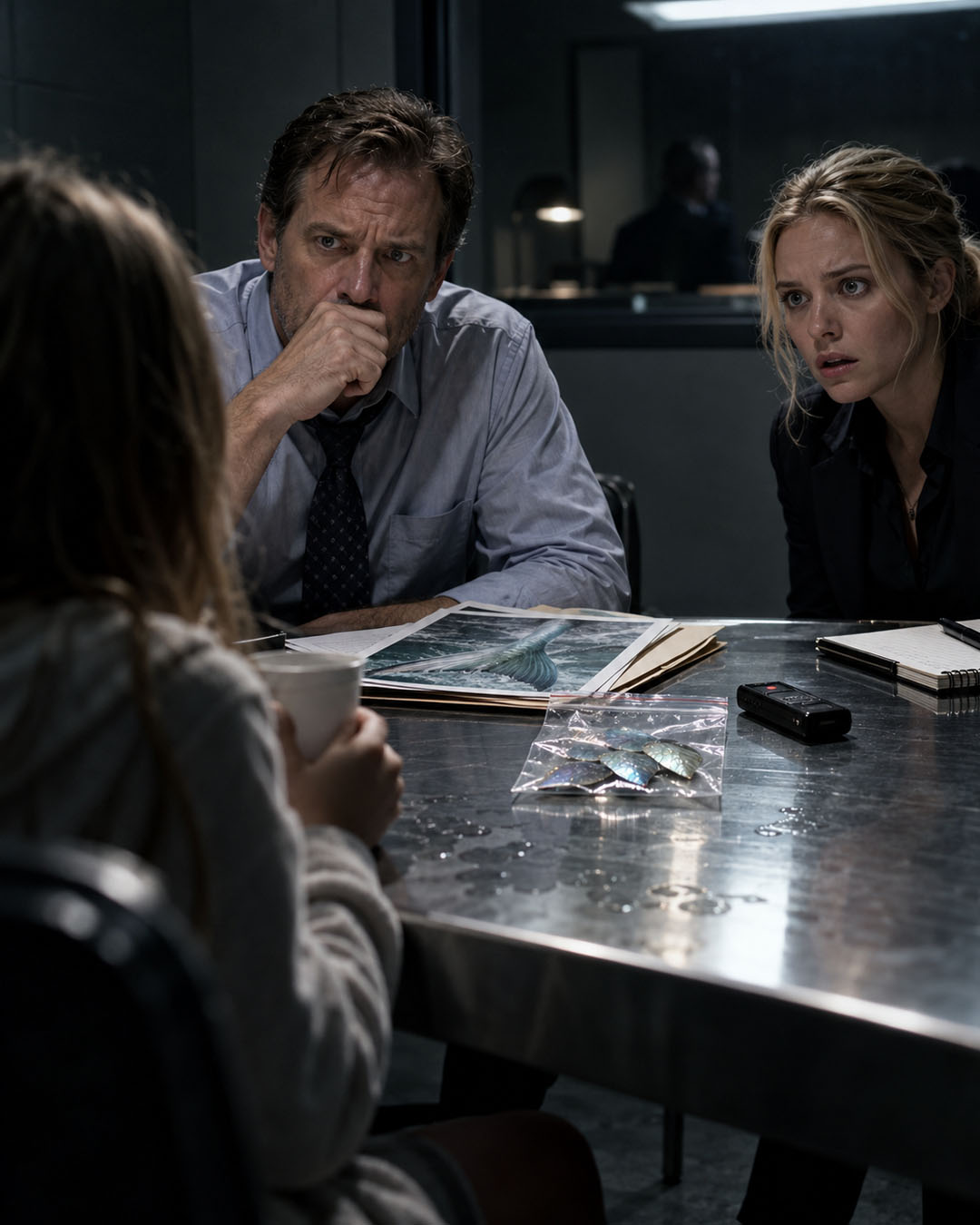
Detective Lewis took me to the station that afternoon. A younger officer named Rachel Bennett sat beside me while he asked about my father’s relationship with Ariel. I told them about the arguments, the drinking, and the strange things Ariel had said about being a creature of the sea.
Lewis listened patiently until I mentioned the transformation potion.
“Transformation potion?” he repeated.
I nodded. “Ariel said she needed special medicine to turn back into a mermaid. She told me that one day she’d return to the ocean and nobody would ever find her.”
He exchanged a glance with Officer Bennett. I recognized the expression immediately. Adults had been looking at me that way for years, usually when I tried to explain what happened inside our house.
“Azure,” he said carefully, “I need you to understand that we’re investigating a death. We have to distinguish between things you saw and things somebody told you.”
“I saw her change,” I insisted. “Once, near the aquarium, her legs looked like they were covered in scales.”
Lewis made a note without commenting.
The medical examiner’s preliminary findings raised more questions than answers. My father had drowned, yet the bathroom fixtures were dry. There were scratches on his arms and face, but the injuries didn’t fully explain his death.
The water on the bedroom floor contained salt and minerals consistent with seawater.
“Someone brought that water into the room,” Lewis said. “The question is why.”
I stared at the paper cup between my hands. “Because Ariel brought the sea with her.”
He sighed.
Over the next several days, investigators searched for Ariel. They discovered that she had worked at a seaside tourist attraction before meeting Dad, but the information she had supplied to her employer was incomplete. She had no established relatives in Wilmington, and nobody could say where she might have gone.
Meanwhile, I became the object of neighborhood sympathy. People brought casseroles and offered prayers, just as they had after Mom died. Some called me courageous for surviving so much tragedy, while others whispered that something terrible seemed to follow the Scott family.
I wanted only to be left alone.
Then the police received a surprising call.
A woman resembling Ariel had appeared at the downtown bus terminal wearing a dark coat and sunglasses. Security personnel stopped her because her identification appeared suspicious. By the time Detective Lewis arrived, however, she had vanished from the locked security office.
The door hadn’t been opened, and the window was sealed.
On the floor lay a puddle of saltwater and several fish scales.
When Officer Bennett told me, I nearly fainted.
Detective Lewis came to see me at the hospital later that evening. He was visibly frustrated, his normally neat hair disheveled and his eyes dark with exhaustion.
“Azure, I need you to think carefully,” he said. “Did Ariel ever tell you how she planned to disappear?”
“She said water could take her anywhere.”
“That’s not possible.”
“Neither is dying in a dry bedroom surrounded by seawater,” I replied.
He fell silent.
The police arranged for me to speak with a counselor. They were concerned that the trauma of losing my parents had affected my understanding of events. I answered every question calmly and explained that Ariel had always insisted she was a mermaid.
Eventually, the investigators let me return home. Ariel remained their principal suspect, and her disappearance became the subject of local speculation. Some newspapers called it the strangest unsolved death in the county.
For me, life continued.
I went back to school, completed my assignments, and worked evenings at a small grocery store. My teachers encouraged me to apply to college, and the school helped me obtain financial assistance. I kept my grades high because I wanted to leave Wilmington forever.
Detective Lewis checked on me occasionally. He brought groceries during the holidays and once gave me a secondhand laptop when mine stopped working. Despite everything, I knew he was trying to help.
Months passed, and Ariel remained missing.
By late summer, I had been accepted into a state university several hours away. My father’s house had become mine through his estate, and I decided to sell it. I couldn’t bear the damp walls, the smell of the aquarium, or the memories waiting behind every door.
A real estate agent named Linda came to inspect the property. She wrinkled her nose the moment she stepped inside.
“Honey, this place has serious moisture damage,” she said. “You’re going to have trouble finding a buyer.”
“I’ll accept less than it’s worth,” I told her. “I just want to start over.”
While examining the bedroom, Linda noticed something beneath the baseboard. She bent down and retrieved a small pearl earring.
“Is this yours, sweetheart?”
My heart seemed to stop.
It was a single white pearl mounted on a delicate gold post. I recognized it immediately, and my fingers closed around it so tightly that the sharp end pierced my palm.
“Where exactly did you find that?” I asked.
“Right there by the wall. It must have rolled underneath months ago.”
I thanked her and hurried her toward the door.
The moment she left, I began packing.
By evening, I was standing at the downtown train station with a suitcase and a canvas bag. My college classes wouldn’t begin for another week, but I couldn’t spend another night inside that house.
I had almost reached the platform when someone called my name.
“Azure! Stop!”
Detective Lewis was hurrying toward me through the crowd.
He looked older than I remembered, with deep shadows beneath his eyes. When he reached me, he glanced at my luggage and then at my tightly closed fist.
“We need to talk,” he said.
“About what?”
He leaned closer, lowering his voice.
“I finally understand why you kept telling everyone your stepmother was a mermaid.”
I couldn’t move.
“And Azure,” he continued, “I know what really happened to both of them.”
Chapter 3
Detective Lewis led me into a small security office near the station’s east entrance. It was the same room where Ariel had supposedly disappeared months earlier. A fluorescent light flickered above a metal desk, and the air smelled faintly of cleaning solution.
He closed the door and set a thick folder in front of me.
“Sit down, Azure.”
“My train leaves soon.”
“Then we should stop wasting time.”
He opened the folder and spread several photographs across the desk. One showed the saltwater aquarium that once occupied our living room. Another showed the bedroom floor where my father had died.
“The water wasn’t from the Atlantic Ocean,” Lewis said. “It came from a manufactured marine salt mixture used in home aquariums. Your house contained everything needed to produce that exact chemical composition.”
I kept my face still.
“Ariel maintained the aquarium,” I replied. “That doesn’t prove she didn’t kill him.”
“No,” he admitted. “But it proves the ocean didn’t come looking for your father.”
He turned to another document. A specialist had reviewed preserved evidence from Dad’s autopsy and identified signs of exposure to a powerful naturally occurring marine toxin. Lewis believed the substance had left Dad unable to defend himself before he drowned.
“The original tests didn’t identify it,” he explained. “We weren’t looking for something associated with marine life.”
I swallowed hard.
“You’re saying Ariel poisoned him?”
“I’m saying someone used knowledge of that aquarium to make a murder look like something supernatural.”
He walked toward the far wall.
“Now let’s discuss the miraculous disappearance.”
He pointed toward a ceiling panel above the desk. Beyond it was a maintenance space connecting several rooms in the station. The panel could be moved, and an access opening led toward a nearby restroom.
“Whoever security stopped that day didn’t vanish,” Lewis said. “She escaped through a service passage. The water and scales were left behind deliberately.”
“Then why didn’t the cameras find her?”
“Because the woman changed her appearance after she left this building. We found a discarded wig and clothing matching what the witness described.”
He watched my face.
“We also identified someone who helped create that little performance. A young woman named Chloe Mercer. She’s admitted she was paid to impersonate Ariel, although she claims she thought it was an elaborate prank.”
My chest tightened.
Lewis returned to the desk and opened the last section of his folder.
“There’s something else.”
He told me that city maintenance workers had discovered human remains in an old drainage chamber beneath my father’s house. The remains had been hidden there for months, wrapped in heavy material and concealed beneath debris.
The medical examiner believed the victim had died from a severe head injury.
Lewis placed a photograph beside the others. It showed a small piece of jewelry recovered with the remains.
A pearl earring.
My fingers loosened.
The matching earring fell from my palm onto the desk with a tiny metallic click.
Lewis stared at it sadly.
“We found Ariel, Azure. She never left that house alive.”
For several seconds, neither of us spoke. The distant announcement of an arriving train echoed through the station. I looked at the pearl resting beside the photograph and felt something inside me finally give way.
“You figured out almost everything,” I said quietly.
“Almost?”
“You still don’t know who killed her.”
Lewis pulled out a chair and sat opposite me. “Then tell me.”
I looked at the photograph of Ariel’s earring.
“Before I explain, you need to understand what happened to my mother.”
I told him about the years of violence. How Dad would come home drunk and find reasons to punish Mom for everything from cold coffee to an unpaid bill. How she would apologize even when she had done nothing wrong.
I told him about the four times I had sought help. About the officers who listened to Dad’s explanations, accepted Mom’s frightened reassurances, and left us alone again. About the afternoon Dad shoved her down the basement stairs.
“She was still alive afterward,” I whispered. “He waited hours before calling an ambulance. By then, it was too late.”
Lewis looked down at his hands.
I picked up the pearl earring.
“This belonged to my mother. Her grandmother gave her the pair when she turned eighteen. Dad took them after she died and gave them to Ariel.”
“Why would he do that?”
“Because he wanted someone else wearing what Mom treasured.”
Ariel wasn’t a mermaid, of course. She had worked as a performer at a marine attraction, spending hours wearing a costume tail and swimming behind thick glass. Years of exposure to harsh chemicals had damaged her skin, leaving patches that peeled and resembled scales.
She used humidifiers because the moisture eased her discomfort. She ate unusually soft seafood dishes because she had developed painful problems swallowing. Her mermaid stories were partly an old stage persona and partly a way of convincing herself she was stronger than ordinary women.
But she wasn’t stronger than my father.
“That night, I didn’t sleep,” I told Lewis. “I was sitting on the stairs. I saw everything.”
Dad struck Ariel repeatedly after she confronted him about his affair. She fought back, scratching his face and screaming that the sea would punish him. When she fell against the kitchen counter, he grabbed a heavy cast-iron skillet.
I heard the impact.
Then Ariel stopped moving.
Lewis closed his eyes briefly.
“Dad carried her downstairs,” I continued. “He hid her beneath the house and spent hours making sure nobody would find her.”
“Did he know you were watching?”
“Not until afterward.”
I remembered him standing in my bedroom doorway, smelling of bourbon and sweat. His shirt was stained, and he held the skillet loosely at his side. He smiled at me the way he used to smile after Mom stopped crying.
“Looks like it’s just you and me now, sweetheart,” he said. “Tomorrow we start fresh.”
I knew what those words meant.
Mom was dead. Ariel was dead. And Dad was standing between me and the bedroom door.
“When he finally left,” I whispered, “I knew I had to survive that night.”
Lewis watched me carefully.
“What did you do?”
I told him I had interfered with his bourbon using something dangerous Ariel had kept among her marine supplies. I didn’t describe the details, only that I knew it could leave a person helpless. Later, when Dad collapsed, I brought water from the aquarium into his bedroom.
“I could have called for help,” I said. “Instead, I let everything I’d watched happen to Mom and Ariel decide what happened next.”
Lewis’s expression tightened.
“You drowned him.”
I nodded.
“Then I scattered scales around the room. I wanted everybody to remember Ariel’s promise about the sea.”
He stared at me for a long time.
“And Chloe?”
“I paid her to pretend she was Ariel. She believed she was helping with a stupid trick. She didn’t know two people were dead.”
“Why go through all that trouble?”
“Because I was afraid the police would blame me for everything,” I answered. “And because I wanted someone to believe the sea had finally punished him.”
The silence grew heavy.
Lewis looked at the photographs of two dead adults, then at the girl sitting across from him.
“You let us spend months chasing a woman who was already dead.”
“Yes.”
“You knew we were trying to help you.”
“I knew you wanted answers,” I said. “I wasn’t sure anyone wanted the answers I had.”
Chapter 4
Detective Lewis didn’t speak for a long time. Outside the security office, trains arrived and departed while ordinary people hurried toward ordinary destinations. Their lives continued beyond the walls, untouched by the terrible history of my family.
Finally, Lewis removed his glasses and rubbed his eyes.
“You should have been protected, Azure,” he said. “Your mother should have been protected, too.”
I looked at the pearl earring resting on the desk.
“But we weren’t.”
“No,” he admitted. “You weren’t.”
He studied me carefully, and I could see how much the truth troubled him. My father had murdered two women, and the systems meant to protect our family had failed repeatedly. But I had also taken a life, hidden evidence, and deliberately misled an investigation.
“You understand that I can’t simply pretend this conversation never happened,” he said.
I nodded.
For months, I had imagined that the truth would end with someone shouting at me or dragging me away. Instead, the detective sounded unbearably tired.
“I thought killing him would make everything stop,” I whispered. “But sometimes I still hear Mom crying. Sometimes I wake up thinking Ariel is screaming downstairs.”
Lewis leaned forward.
“That’s because what happened to you doesn’t disappear just because the person responsible is dead.”
I began crying then, quietly at first. I had cried at Mom’s funeral, but those tears had been mixed with shock and fear. These were different. They came from somewhere deep inside me, a place I had kept locked for years.
Lewis handed me a box of tissues.
“I don’t know what happens to me now,” I said.
“We’re going to find out,” he answered. “And we’re going to make sure you have someone looking out for you while we do.”
He called another officer and arranged for an attorney experienced in representing young people. He also asked that I be evaluated by a trauma specialist. When the other officers arrived, he told them to treat me with care.
I didn’t board the train that evening.
Instead, I spent the night in a supervised youth residence, staring at the ceiling and wondering whether the ocean ever truly washed anything clean.
Over the following weeks, investigators examined my father’s death again. They confirmed that Ariel had been killed by a blow to the head and that evidence connected Dad to the concealment of her body. My account of the years of violence also prompted a review of Mom’s death.
The official conclusion about her fall was reconsidered. Witnesses who had remained silent finally came forward, including a neighbor who remembered hearing a violent argument shortly before the ambulance arrived. Old medical records revealed injuries that were difficult to reconcile with Dad’s repeated explanations.
None of those discoveries brought Mom back.
But for the first time, the public record reflected what she had endured.
The authorities also investigated my involvement in Dad’s death. Because I had been a minor living under prolonged abuse, the proceedings considered my age, trauma, and immediate circumstances. My actions were not excused, but neither were they treated as though they had occurred in an ordinary home.
I accepted responsibility for what I had done. I spent time in a supervised residential program, received intensive counseling, and continued my education. The court required ongoing treatment and supervision, recognizing both the seriousness of my actions and the extraordinary danger that had shaped my life.
For a long time, I struggled with anger.
Some days, I hated my father so fiercely that I could barely breathe. Other days, I hated myself for becoming involved in the violence I had spent my childhood trying to escape. My counselor helped me understand that those feelings could exist together without defining the rest of my life.
“A terrible thing happened to you,” she told me once. “And you made a terrible choice. Both can be true.”
I didn’t like hearing that at first. I wanted a world divided into monsters and victims, because that was the only world I had ever known. Slowly, I learned that surviving was more complicated than simply deciding who deserved punishment.
Two years later, I graduated from high school through an alternative education program. Detective Lewis attended the ceremony, standing quietly near the back of the auditorium. When I crossed the stage, he applauded with the other families.
Afterward, he approached me carrying a small bouquet of yellow roses.
“Your mother would have been proud of you,” he said.
I looked down at the flowers.
“Do you really think so?”
“I think she’d be glad you’re still here, Azure. And I think she’d want you to have a life that isn’t ruled by what happened in that house.”
For the first time, I believed him.
Eventually, I began taking college classes. I studied social work because I wanted to understand why frightened people so often remained trapped in dangerous homes. I also wanted to understand how institutions could overlook suffering even when the warning signs were impossible to ignore.
I volunteered at a community organization that supported families recovering from domestic violence. I didn’t tell every person my story. When I did share parts of it, I spoke about the importance of getting help early, documenting concerns through safe channels, and believing people who said they were afraid.
I never described what I had done as justice.
There had been no victory in my father’s bedroom. Only another death, another secret, and another young person left carrying consequences too heavy for her age.
Years later, I returned to Wilmington for the anniversary of my mother’s death. The house had been sold, renovated, and painted a cheerful shade of yellow. Someone had planted white hydrangeas beside the porch where Mom once kept her flowerpots.
I stood across the street for a while, remembering the kitchen, the stairs, and the living room aquarium. For years, I had pictured that house as a prison. Seeing it filled with sunlight and children’s bicycles surprised me.
Life had continued there.
I visited Mom’s grave that afternoon and brought a small bouquet of daisies, her favorite flowers. I told her about my classes, my work, and the friends who had become my family. I also told her that I was beginning to forgive the frightened girl I had once been.
Then I drove to the coast.
The Atlantic stretched before me, endless and gray beneath the autumn sky. Waves broke against the shore, leaving delicate white foam that vanished almost as soon as it appeared. I stood barefoot in the damp sand, holding the pearl earring I had kept all those years.
It was the last piece of jewelry my mother had treasured. For a long time, I had believed it belonged with my memories of suffering. But now I understood that it also represented a woman who had loved music, flowers, and her daughter before fear consumed her life.
I closed my fingers around the pearl.
Ariel’s voice returned to me, clear as though she were standing beside me in her glittering dress.
“The ocean protects its own.”
I remembered how fiercely she had believed that. She had wanted to be something untouchable, something no man could hurt. Beneath her strange stories and defiant laughter was another frightened woman who had mistaken bravery for invincibility.
I wished she had escaped.
I wished Mom had escaped.
Most of all, I wished I had known that escape didn’t have to come through violence.
A breeze swept across the beach, lifting my hair from my shoulders. I looked down at the pearl, then carefully tucked it into the small pocket inside my jacket. I no longer wanted to throw away the last thing that connected me to my mother’s happier years.
As the sun began to set, I walked back toward my car.
For years, I had believed Ariel’s story that the sea would come for anyone who harmed her. The truth was simpler and far more painful. The sea had never punished my father. The violence in our home had destroyed itself, taking too many lives with it.
I could not change the choices that had brought me here. I could only decide what kind of woman I wanted to become.
I was no mermaid, and I had no magical power to wash away the past. But I had something I once believed was impossible.
I had a future.
And this time, I intended to protect it without destroying anyone else.
THE END.
⚠️ All characters and events are fictional. Do not imitate or apply them in real life. 😌😌😌

