Chapter 2
Detective Robert Hayes was a broad-shouldered man in his late fifties with tired eyes and a calm voice. His partner, Detective Laura Benson, sat beside him with a legal pad.
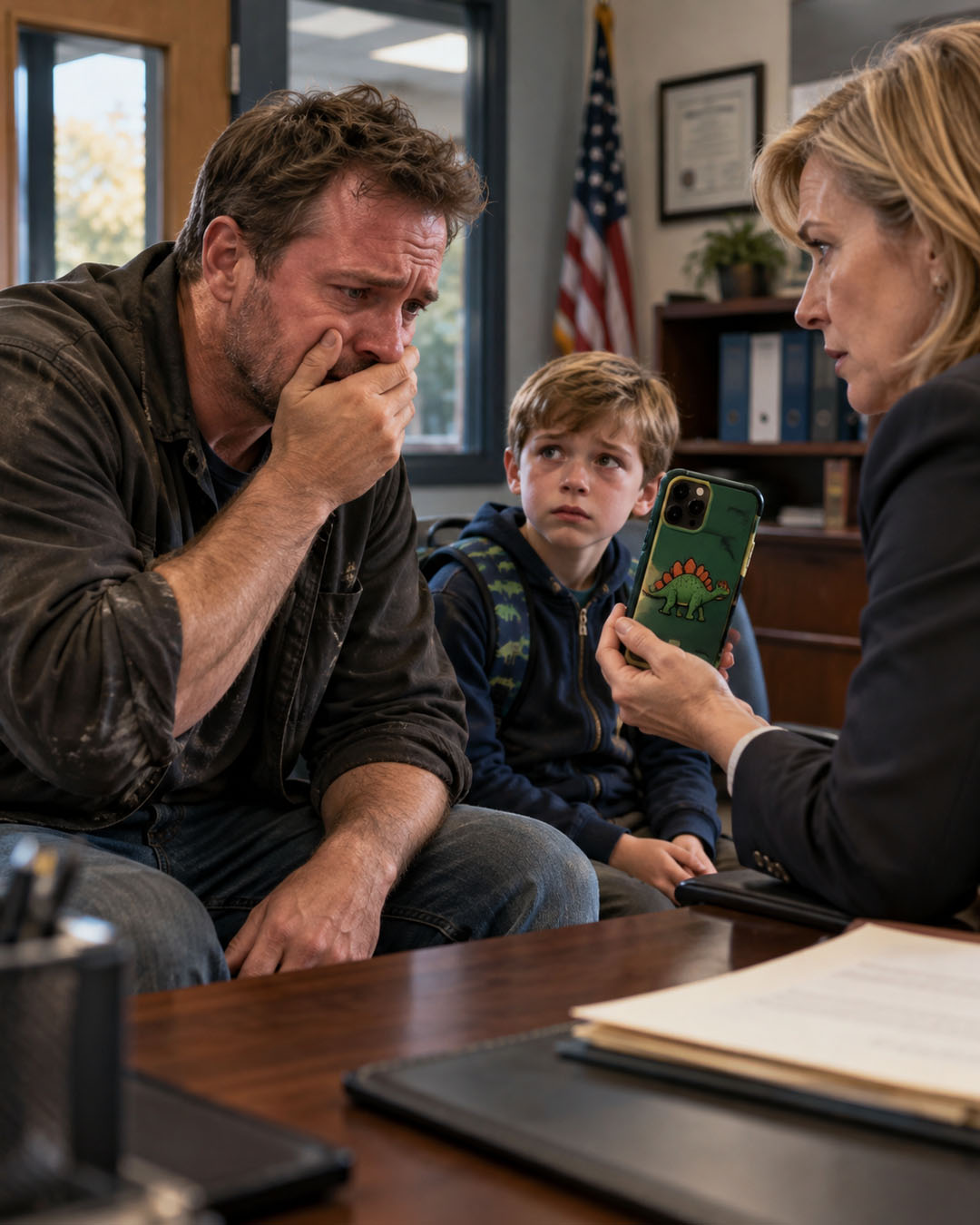
Principal Ellen Brooks closed the office door and pulled up a chair.
She explained that Benjamin had accidentally taken his grandmother’s phone to school.
During indoor recess, he’d tried to open his dinosaur game. When it didn’t appear, he opened the photo gallery, looking for a dinosaur video Patricia had saved.
Instead, he found the photograph of my damaged pickup.
He showed it to the little girl sitting beside him.
Emily Collins.
Matthew’s younger sister.
Emily recognized the truck from the police notices about her brother’s accident. She started crying, and her teacher immediately took the phone to the principal.
School officials contacted the police.
While the phone was in the office, a new message appeared on its screen.
Detective Hayes pointed to it.
It came from Amanda.
“Mom, did you erase those truck pictures? We can’t let David find out before Friday.”
I stared at the words.
“What happens Friday?” I whispered.
“That’s what we need to discuss.”
Detective Benson explained that investigators had secured the phone and were seeking the proper authorization to examine its contents fully. The visible messages and photographs had already raised serious concerns.
Hayes showed me a conversation involving Patricia, Amanda, and Jason.
The messages began two days after Matthew’s accident.
At first, they used vague language about a deer, a damaged truck, and getting repairs finished quickly.
Then the messages became more direct.
Patricia wrote that investigators would eventually identify the pickup.
Amanda replied, “What are we going to do?”
Patricia answered, “We need one story, and everyone must stick to it.”
A few messages later, I saw my name.
“If the police find the truck, David was driving. It’s registered to him. Nobody can prove he stayed home.”
My hands began trembling.
I kept reading.
Patricia had outlined a plan.
She would contact investigators anonymously and claim she’d seen me return home late that Friday night.
Jason would say I’d paid him cash to repair the pickup after hitting a deer.
Amanda would tell detectives she’d been frightened of my temper and suspected I was hiding something.
Then I saw a note about Benjamin.
It was labeled “What Ben Remembers.”
The instructions were simple.
“Daddy went out after bedtime. Daddy came home angry. Daddy told me to keep quiet.”
I couldn’t breathe.
My own mother-in-law had been trying to teach my eight-year-old son to give a false account against me.
Amanda had written beneath the note, “Mom, he’s only eight.”
Patricia’s reply made my blood run cold.
“Eight is old enough if we repeat it often.”
I pushed the phone away.
For several seconds, I couldn’t speak.
Then Hayes quietly asked, “Mr. Carter, were you driving your truck that night?”
“No.”
“Where were you?”
“Home. Asleep.”
“Can anyone confirm that?”
I looked at him helplessly.
“My son was sleeping. My wife wasn’t home. Patricia was upstairs.”
Detective Benson wrote something down.
Hayes leaned forward.
“I’m going to be very clear. These messages suggest someone may be planning to frame you, but we still have to establish who actually drove the vehicle.”
I nodded.
He continued.
“Your son is not in trouble. Neither is Emily. Their teacher did exactly what she should have done by bringing this to our attention.”
I stared at the photograph again.
My truck had been wrecked badly enough that I couldn’t imagine anyone mistaking it for a mailbox scrape.
Someone had struck Matthew.
Someone had arranged a secret repair.
And three people close to me had been discussing how to make me take responsibility.
Then Benson showed me another set of messages.
Amanda and Jason had been exchanging affectionate photographs and discussing hotel reservations.
Their relationship had apparently been going on for months.
One message from Jason read, “Once this is over, you won’t have to keep sneaking around.”
Amanda had responded, “If David gets charged, the divorce will be easier.”
I felt as though someone had punched me in the chest.
My marriage hadn’t merely been falling apart.
My wife had been planning a future with another man while considering how to send me to prison.
But one message confused me.
Patricia had written privately to Jason, “If David doesn’t work, I still have the shoes.”
Jason had responded with a question mark.
There was no further explanation.
I asked Detective Hayes what it meant.
“We don’t know yet,” he said. “But we intend to find out.”
Shortly afterward, the principal received a telephone call.
It was Patricia.
She explained cheerfully that she and Benjamin had accidentally exchanged phones. She asked whether the school could keep hers safe until dismissal.
Principal Brooks assured her everything was fine.
After the call, Hayes looked at me.
“Mr. Carter, it’s important that you don’t confront anyone right now. We need time to verify the evidence and protect your son.”
He paused.
“Can you go home and behave as though nothing unusual happened?”
The thought made me sick.
“You want me to have dinner with them?”
“For the moment, yes. But if you feel unsafe, contact us immediately.”
I looked through the office window.
Children were playing outside.
Somewhere among them was my son, completely unaware that he’d uncovered a plan to destroy his father’s life.
“I’ll do whatever protects Benjamin,” I said.
That evening, Patricia served meatloaf and mashed potatoes.
Amanda arrived home smiling at something on her phone.
Benjamin talked about a spelling test and a classmate who’d fallen off the monkey bars.
I watched my wife pass the salt to her mother.
They looked like ordinary people having an ordinary family dinner.
I wondered how many times they’d discussed sending me to prison while sitting at that same table.
Halfway through the meal, Patricia turned toward Benjamin.
“Honey, did you play any games on Grandma’s phone today?”
Benjamin hesitated.
“No, Grandma. It stayed in my school cubby.”
She smiled.
“Good boy.”
I lowered my eyes to my plate.
For the first time in thirteen years of marriage, I realized I was sitting among people I could no longer trust.
After dinner, I went into the garage.
I needed to examine my truck properly.
And what I discovered beneath the passenger-side floor mat changed everything.
Chapter 3
I brought home a paint-thickness gauge from the shop, along with a flashlight and a small inspection mirror.
I’d spent nearly two decades reading the history of damaged vehicles. Now I was examining my own truck as though it belonged to a stranger.
The passenger-side fender had clearly been repainted.
The replacement bumper didn’t quite match the mounting brackets. Someone had drilled new holes to make it fit.
Then I looked inside the front passenger wheel well.
Tiny black specks covered the plastic lining.
They weren’t ordinary mud.
They were hardened droplets of road-sealing material.
Earlier that month, county crews had applied fresh chip seal to Hollow Creek Road. The process involved spreading hot asphalt emulsion and pressing crushed stone into it.
For several hours afterward, the surface remained tacky.
Vehicles traveling over it picked up black specks that could cling stubbornly to tires and undercarriages.
I knew about the roadwork because our shop frequently cleaned the residue from customers’ vehicles.
I crouched beside the truck.
The black droplets were concentrated near the front passenger wheel.
Someone had cleaned the exterior but overlooked the undercarriage.
Then I opened the passenger door.
The floor mat wasn’t the original Ford mat.
It was a cheap universal replacement.
Underneath it, the carpet contained several dark marks that resembled the residue beneath the wheel well.
Similar marks appeared along the passenger-side step.
The driver’s carpet, however, looked clean.
I stood motionless.
Someone had walked on the freshly sealed roadway, then climbed back into the passenger seat.
But whoever drove the truck appeared to have remained inside.
I remembered the driver’s seat pushed almost against the steering wheel when the truck returned.
The mirrors angled downward.
Patricia was barely five feet tall.
Amanda was several inches taller.
I sat on my garage stool and tried to think clearly.
It seemed possible that Patricia had been driving and Amanda had been in the passenger seat.
But possibility wasn’t proof.
I photographed nothing further and contacted Detective Hayes, explaining what I’d noticed. He instructed me to leave the truck untouched until investigators could examine it.
The following morning, detectives met me at the shop.
I described the unusual paintwork, replacement parts, and the residue beneath the passenger mat.
Hayes listened carefully.
“That could be important,” he said. “We’ll have our technicians examine it.”
Then Benson showed me a new report.
Matthew Collins had regained consciousness.
He was weak and unable to remember the entire accident, but he’d told a nurse something unexpected.
He remembered a young woman’s voice.
She’d been crying and repeating, “He’s breathing, Mom. He’s still breathing.”
I stared at the detective.
“Mom?”
Benson nodded.
“He remembers someone else shouting from the vehicle.”
Suddenly, the message about the shoes seemed much more significant.
If Patricia had driven the truck and Amanda had stepped onto the wet roadway, the residue might still be attached to Amanda’s shoes.
But why would Patricia have kept them?
I had no answer.
Over the next two days, I watched the atmosphere inside our house change.
Patricia no longer seemed relaxed.
She asked fewer questions about my schedule. She stopped taking photographs when I fell asleep on the couch.
On Saturday evening, she made an odd remark about Amanda drinking too much.
Amanda looked surprised.
“Mom, what are you talking about?”
“I’m just worried about you, sweetheart.”
Their eyes met across the kitchen.
For the first time, Amanda seemed frightened of her own mother.
Sunday afternoon, Patricia came into the garage carrying two cups of coffee.
She closed the door behind her.
“David, we need to talk.”
I put down the sandpaper I’d been using on an old lawn mower.
She sat beside the workbench.
For several moments, she looked genuinely distressed.
Then she began to cry.
She told me Amanda hadn’t attended book club on September 12. Instead, she’d spent the evening with Jason and had been drinking.
Patricia claimed Amanda later borrowed my truck, drove down Hollow Creek Road, and struck Matthew.
“She called me afterward,” Patricia whispered. “She was hysterical. I couldn’t let her destroy her life.”
I watched her carefully.
“So you helped cover it up?”
She nodded.
“Jason repaired the truck. We told you the mailbox story. I’ve felt terrible ever since.”
I waited.
Then she reached across the bench and squeezed my wrist.
“Your wife was going to let you take the blame, David. I stopped her.”
I thought about the messages on her phone.
About the instructions she’d written for Benjamin.
About her willingness to send an innocent man to prison.
“Why are you telling me now?” I asked.
“Because that poor boy woke up. We can’t keep hiding what happened.”
She wiped her eyes.
“I want us to go to the sheriff together on Wednesday. You and me.”
“Why me?”
“Because you’re Amanda’s husband. They’ll believe you when you explain how she’s been behaving.”
Then she mentioned the shoes.
“I found the sneakers Amanda wore that night. She claimed she’d thrown them away, but I kept them.”
“Where?”
“Somewhere safe.”
I looked at her.
“Wednesday?”
She nodded.
“I need one more day to get my affairs in order. Then we’ll go together.”
When she left, I immediately called Detective Hayes.
“She’s changing her story,” I told him.
He listened without interrupting.
Then he said, “David, don’t confront her. We need to bring this to a conclusion carefully.”
On Monday, investigators arranged to examine my pickup with the appropriate authorization.
A county road supervisor confirmed that the type of sealing material found on the truck was consistent with what had been applied to Hollow Creek Road that Friday.
The evidence still required proper analysis, but the pattern was becoming clearer.
The driver’s side showed no obvious trace of someone stepping onto the wet surface.
The passenger side did.
Someone had driven.
Someone else had gotten out.
And someone had decided not to help a badly injured young man.
Tuesday evening, Patricia attended church choir practice.
Amanda took Benjamin shopping for school shoes.
I was home alone.
While passing the stairs, I thought about the storage compartment I’d built beneath Patricia’s sloping bedroom ceiling.
She kept Christmas decorations there.
I had no intention of disturbing anything. The detectives had specifically told me not to touch potential evidence.
But then I noticed the compartment door wasn’t properly closed.
Through the narrow opening, I could see a grocery bag tucked behind a plastic bin.
Inside the translucent bag was the outline of a pair of white sneakers.
The soles appeared dark and heavily stained.
I recognized them immediately.
I’d bought those sneakers for Amanda’s birthday.
I stepped away and called Hayes.
He told me to leave everything exactly as I’d found it.
I closed the bedroom door and went downstairs.
Twenty minutes later, Amanda came home with Benjamin.
My son rushed inside wearing bright green sneakers.
“Daddy, look! They light up!”
I knelt to examine them.
“Those are pretty impressive, buddy.”
Amanda stood in the kitchen doorway watching us.
For a moment, she looked as though she wanted to say something.
“David…”
I looked up.
“What is it?”
Her expression crumpled.
Then her phone rang.
She glanced at the screen.
“Nothing,” she whispered. “I’m going upstairs.”
I watched her leave.
Part of me wanted to call after her.
Another part knew that whatever confession she might offer now wouldn’t erase what she’d already done.
Wednesday morning, Patricia dressed in a navy blazer and carried a large leather purse downstairs.
She told Amanda I was taking her to a medical appointment.
Then she turned to me.
“Ready, David?”
I looked at the woman who’d eaten at my table, played games with my son, and spent weeks preparing to destroy my life.
“Yes,” I said quietly. “I’m ready.”
Chapter 4
Detective Hayes met us at the sheriff’s office as though he’d never spoken to me before.
He led us into a small interview room containing a table, three chairs, and a recording camera mounted near the ceiling.
Patricia placed her handbag on the table.
“Thank you for seeing us,” she told him. “This has been weighing on me terribly.”
Her voice was steady.
She began telling the same story she’d told me in the garage.
Amanda had been drinking.
Amanda had borrowed my truck.
Amanda had struck Matthew and fled.
Patricia claimed she’d helped arrange the repairs only because she was terrified of losing her daughter.
Then she reached into her handbag.
She removed a grocery bag and placed a pair of white sneakers on the table.
“These were Amanda’s,” she said. “She wore them that night.”
The soles were covered in hardened black residue.
I stared at them.
The woman had kept those shoes for weeks.
She’d hidden evidence that could connect her own daughter to the crash, waiting until it became useful to her.
Hayes examined the bag without touching its contents.
“Mrs. Monroe, you’re certain Amanda was driving alone?”
“Absolutely.”
“And she stepped out of the truck after hitting Matthew?”
“That’s what she told me.”
Hayes opened a folder.
He placed several photographs on the table.
One showed the clean driver’s-side carpeting.
Another showed the residue beneath the passenger floor mat.
A third showed dark material along the passenger-side step.
“These photographs document what our technicians found in Mr. Carter’s pickup,” Hayes explained. “The residue is consistent with material from the freshly sealed road where Matthew was struck.”
Patricia studied the photographs.
“Well, Amanda must have walked around the vehicle.”
“That’s possible,” Hayes said. “But it doesn’t explain everything.”
He showed her another report.
“Matthew remembers hearing a younger woman call out to her mother. He also remembers someone shouting from inside the truck.”
Patricia folded her hands.
“She must have been talking to me on the phone.”
Hayes shook his head.
“That explanation doesn’t fit the information we have.”
He paused.
“We also have evidence placing Amanda at Jason Miller’s property shortly before the accident. And the condition of the vehicle suggests the person driving was considerably shorter than Amanda.”
Patricia remained silent.
Hayes leaned forward.
“Mrs. Monroe, we believe you were driving Mr. Carter’s truck.”
For the first time, her carefully controlled expression changed.
Only slightly.
But I saw it.
She looked toward me.
I didn’t speak.
Detective Benson entered and placed another folder beside Hayes.
“We’ve been examining the messages and communications surrounding the incident,” she said. “We also know someone was preparing to identify David as the driver before that plan changed.”
Patricia’s eyes narrowed.
“That’s ridiculous.”
Hayes looked directly at her.
“We know about the instructions written for Benjamin.”
She froze.
“We know about the photographs of David sleeping. We know about the proposed anonymous report.”
Her breathing became shallow.
Then she turned toward me.
“You knew?”
I looked at her.
“Since Benjamin accidentally took your phone.”
She leaned back.
For several seconds, she appeared to calculate what that meant.
Then she straightened her blazer.
“I’d like to speak to an attorney.”
Hayes nodded.
“That’s your right.”
He ended the interview.
Elsewhere in the building, investigators had been speaking with Amanda.
They’d contacted her at the dental office and asked her to come in regarding the September accident. Once she learned that her mother was providing a statement placing responsibility on her, Amanda finally began telling the truth.
She admitted Patricia had picked her up from Jason’s place that night because she’d been drinking.
Patricia was driving my truck.
While traveling along Hollow Creek Road, she’d become distracted by her phone.
The truck drifted toward the edge of the lane.
There was a terrible impact.
Amanda insisted she’d begged her mother to stop.
After the collision, she’d jumped from the passenger seat and run back to Matthew.
He was unconscious but breathing.
She’d called out repeatedly.
“Mom, he’s alive! Please call somebody!”
But Patricia had shouted for her to return to the truck.
Amanda said her mother threatened to tell police she’d been driving if she refused.
Terrified, Amanda climbed back inside.
They left Matthew lying in the ditch.
When they arrived at Jason’s salvage yard, Patricia instructed him to repair the truck before anyone noticed the damage.
At first, their plan was simply to hide what had happened.
Then investigators announced they were searching for a white Ford pickup.
Patricia began devising another solution.
She would blame me.
Amanda admitted she’d agreed to the plan, believing it would protect her from prosecution and allow her to leave our marriage without facing the consequences of her actions.
The confession destroyed whatever remained of my trust in her.
Later that morning, officers questioned Jason and obtained records relating to the secret repair.
He eventually admitted helping conceal the damaged pickup and dispose of certain replacement parts.
Patricia was taken into custody.
I was standing near the hallway when two deputies escorted her past me.
Without her polished blazer and carefully arranged hair, she looked much older.
She stopped.
“David.”
I looked at her.
“How long did you know?”
“Since Benjamin took your phone.”
Her expression changed.
“The dinosaur cases?”
I nodded.
“You bought them yourself.”
She looked down.
Then the deputies guided her away.
I watched until she disappeared around the corner.
Detective Hayes stood beside me.
“Are you all right?”
I almost laughed.
My marriage had collapsed.
My son had unknowingly uncovered a crime.
My mother-in-law had tried to frame me for a hit-and-run.
And a nineteen-year-old young man was recovering from injuries that might have killed him.
“No,” I said. “But I will be.”
When I returned home, Benjamin was waiting for me.
He ran into my arms.
“Daddy, Grandma isn’t coming back?”
I held him tightly.
“Not right now, buddy.”
“Did I do something bad?”
I closed my eyes.
“No, Benjamin. You didn’t do anything wrong.”
He looked up.
“Then why is everybody crying?”
I carried him to the couch.
And for the hardest conversation of my life, I tried to explain that adults sometimes make terrible choices, and those choices can hurt the people who love them.
I told him none of it was his fault.
He listened quietly.
Then he asked the question I wasn’t prepared for.
“Is Mommy going away too?”
I held him closer.
“I don’t know yet, sweetheart.”
Chapter 5
The months afterward were painful in ways I hadn’t expected.
There were meetings with attorneys, court proceedings, and countless questions about what happened on Hollow Creek Road.
The most difficult part wasn’t hearing the evidence.
It was realizing how ordinary our family had appeared while such terrible decisions were being made behind closed doors.
Patricia eventually entered guilty pleas to serious charges related to the collision, leaving the scene, concealing evidence, and attempting to obstruct the investigation.
She received a lengthy prison sentence.
At sentencing, Matthew’s mother spoke about the night she’d waited for news of her son.
She described sitting beside his hospital bed, wondering whether he’d ever recognize her voice again.
Then she looked toward Patricia.
“You were a mother yourself,” she said. “You knew what it would mean if my son never came home.”
Patricia didn’t answer.
Amanda also faced criminal consequences for leaving Matthew without assistance and participating in the concealment afterward.
She cooperated with investigators and received a shorter custodial sentence followed by supervision.
Jason was held responsible for helping conceal the damaged vehicle and its repair history.
Our divorce was finalized the following spring.
Amanda didn’t contest Benjamin living with me.
Eventually, arrangements were made for carefully supervised contact between them.
I agreed because Benjamin still loved his mother.
I didn’t want his childhood to become a lesson that people could only be good or bad, without any room for regret, responsibility, or change.
But I made one thing clear.
“Benjamin’s safety comes first,” I told Amanda through our attorneys. “Everything else comes afterward.”
She accepted that.
The recovery that mattered most, however, belonged to Matthew Collins.
He spent months in rehabilitation, learning to walk confidently again and rebuilding strength in his injured leg.
By Christmas, he was home.
When spring arrived, his mother contacted our shop.
“Matthew wants to ride his bicycle again,” she explained. “He found a used one, but it needs work. Someone told me you might be able to help.”
I thought about the boy lying injured beside that dark road.
Then I thought about Benjamin’s little blue ribbon hanging on the school tree.
“Bring it over,” I said.
The bicycle was scratched and worn.
I stripped the frame, repaired the damaged areas, and painted it the brightest orange I could mix.
Benjamin helped me prepare the parts, carefully handing me tools while I worked.
“Why orange, Daddy?”
“So drivers can see him.”
“Will it keep him safe?”
“It’ll help. But everybody on the road still has to pay attention.”
When Matthew came to collect the bicycle, he walked with a cane.
He was thin and moved slowly, but his smile was genuine.
“You didn’t have to do all this,” he told me.
“I wanted to.”
He looked at the frame.
“That’s pretty bright.”
I smiled.
“That’s the idea.”
Benjamin stepped forward.
“My dad’s really good at painting things.”
Matthew laughed softly.
“I can see that.”
Before leaving, he crouched carefully in front of my son.
“Your teacher told my family what happened at school,” he said. “You helped people find out the truth.”
Benjamin lowered his eyes.
“I didn’t mean to.”
“I know. But I’m glad you did.”
For weeks afterward, those words stayed with my son.
He’d become quiet since the arrests.
Sometimes he asked whether Patricia would come home.
Other times he wondered whether Amanda still loved him.
I answered as honestly as I could without burdening him with adult details he wasn’t ready to understand.
One night, while I was reading his dinosaur book, he interrupted me.
“Daddy?”
“Yes, buddy?”
“If I hadn’t taken Grandma’s phone, would she still live here?”
I closed the book.
“Maybe for a little while.”
He stared at the blanket.
“Then maybe I shouldn’t have taken it.”
I sat beside him.
“Benjamin, look at me.”
He raised his eyes.
“You didn’t make Grandma do anything wrong. She made those choices herself. You accidentally picked up the wrong phone, and your teacher took care of what happened next.”
“But Mommy went away too.”
I swallowed.
“Your mom made choices she has to take responsibility for. That isn’t your fault either.”
He thought about it for a long time.
Then he whispered, “I miss when everybody lived here.”
I put my arm around him.
“I know, sweetheart. Sometimes I miss parts of it too.”
He leaned against me.
“Can things ever be normal again?”
I looked around his bedroom.
The dinosaur posters were still on the walls. His favorite books sat beside the bed, and his new school sneakers lay crooked beneath the chair.
Some things hadn’t changed at all.
Other things would never be the same.
“We’ll make a new normal,” I told him. “And we’ll make sure it’s a good one.”
He nodded.
“Can we still have pancakes on Saturdays?”
I smiled.
“Every Saturday.”
The following September, nearly a year after Matthew’s accident, the county resurfaced Hollow Creek Road.
Benjamin and I drove along it one afternoon on our way to visit a nearby state park.
Fresh road-sealing material gave off its familiar warm, sharp smell.
The same smell that had helped connect our truck to the accident.
Benjamin looked out the window.
“Daddy, is this where Matthew got hurt?”
“Yes.”
He watched the passing fields.
“Can I ask you something?”
“Anything.”
He hesitated.
“Did Grandma ever really love me?”
That question hurt more than anything I’d heard in court.
I thought about Patricia playing dinosaur games with him, making pancakes, and reading bedtime stories.
Then I thought about the instructions she’d written to make him repeat something untrue.
I didn’t want to lie.
And I didn’t want him growing up believing that someone else’s wrongdoing meant he had never been loved.
“I think Grandma loved you in the way she knew how,” I said carefully. “But she made very wrong choices, and love doesn’t make those choices acceptable.”
He considered that.
“Can somebody love you and still hurt you?”
“Yes, sweetheart. Unfortunately, they can.”
“Then how do you know who to trust?”
I slowed the truck as we approached a bend.
“You watch what people do, not just what they say. People who love you should want you safe, and they should never ask you to do something wrong to prove you love them.”
Benjamin nodded slowly.
“Like lying?”
“Exactly.”
He sat quietly for another minute.
Then he asked, “Will you ever ask me to lie for you?”
I felt tears sting my eyes.
“No, buddy. I promise I won’t.”
He looked relieved.
“Good.”
We drove the rest of the way with the windows cracked, listening to the wind moving through the fields.
I thought about Patricia’s favorite saying.
People always underestimate the details.
She’d been right.
But the details that exposed her weren’t the ones she expected.
A damaged fender.
A patch of road-sealing material.
A pair of stained sneakers.
And two identical dinosaur phone cases.
Yet I learned something more important than how the truth was discovered.
A secret isn’t necessarily an act of protection.
Sometimes the person who promises to keep your secret is really keeping power over you.
Patricia claimed she’d been protecting Amanda, but she’d saved those shoes so she could decide who would take the blame.
When she needed someone else to suffer, she was prepared to sacrifice her own daughter.
Before that, she’d been willing to sacrifice me.
And she’d nearly sacrificed the innocence of an eight-year-old child who trusted her completely.
That was the hardest truth to accept.
Not everyone who claims to protect a family is protecting the people inside it.
Some are protecting themselves.
A few months later, Benjamin’s school held an assembly honoring teachers and students who’d helped their community.
His third-grade teacher, Mrs. Sullivan, received special recognition for responding thoughtfully when Emily became upset after seeing the photograph.
She hadn’t dismissed the little girl’s distress.
She hadn’t assumed the photograph was meaningless.
She’d taken the situation seriously and asked the appropriate people to help.
After the ceremony, I approached her.
“I don’t know how to thank you,” I said.
Mrs. Sullivan smiled.
“Your son was honest about what he found. Emily recognized something important. I simply listened.”
I shook my head.
“You did more than that.”
She looked toward the playground, where Benjamin and Emily were laughing together.
“Sometimes listening is exactly what a child needs.”
I watched them for a moment.
Two children whose lives had been changed by the terrible choices of adults.
Both were learning how to feel safe again.
That evening, Benjamin and I stopped for pizza on the way home.
He told me about a science project he wanted to build, involving a volcano, baking soda, and what sounded like an alarming amount of red food coloring.
I laughed harder than I had in months.
When we reached home, he ran upstairs to change into his pajamas.
I stood alone in the kitchen.
The counter was clean.
His school papers were stacked beside the refrigerator.
And near the fruit bowl lay his phone, now protected by a bright orange case.
No more matching green dinosaurs.
I picked it up and smiled.
For so long, I’d believed that being a good husband and father meant trusting the people I loved without question.
Now I understood that trust also required honesty, accountability, and the courage to recognize when something was wrong.
I couldn’t change what had happened to our family.
But I could decide what kind of home Benjamin would grow up in.
A home where mistakes could be admitted.
Where apologies meant something.
Where nobody had to earn love by keeping another person’s secrets.
From upstairs, I heard Benjamin call my name.
“Dad! Can you come read with me?”
I switched off the kitchen light.
“Coming, buddy.”
As I climbed the stairs, I realized that the greatest thing my son had brought home from school that terrible Thursday wasn’t a secret, a police investigation, or even the truth about the people we’d trusted.
It was the chance to begin again.
And this time, we would build our lives on something stronger than appearances.
We would build them on the truth.
THE END. ⚠️ All characters and events are fictional. Do not imitate or apply them in real life. 😌😌😌