Chapter 2
I didn’t ask another question until we were inside the house.
Shawn stood at the kitchen counter, pouring coffee from the same old pot he’d used for nearly twenty years.
He turned when the door opened.
His eyes settled on Lena.
The coffee pot stopped halfway to his cup.
“Ruth?”
I felt my chest tighten.
Lena looked at me, confused.
“Shawn,” I said gently, “this is Lena. She’s going to stay with us for a little while.”
But he was still staring.
“Ruth, sweetheart, you’ve gotten so tall.”
I crossed the kitchen and touched his arm.
“Her name is Lena.”
He blinked, struggling to place the information.
For a moment I feared another episode of confusion. On difficult days, Shawn could spend hours searching the house for a daughter who wasn’t coming home.
Then he looked at Lena again.
“Have you eaten?”
She shook her head.
“Well, there’s chicken soup. I made enough for an army.”
He pulled out a chair.
Lena hesitated before sitting.
“Thank you, sir.”
“Shawn’s fine.”
I watched as he heated the soup, placed crackers beside her bowl, and poured a glass of water.
He moved with a purpose I hadn’t seen in months.
After Ruth died, Shawn had become quieter with each passing year. His memory problems meant that even familiar conversations sometimes exhausted him.
But he knew how to take care of a child.
That part of him had survived.
Lena ate slowly, watching us as though expecting someone to announce that the kindness had been a mistake.
When she finished, Shawn offered her more.
“No, thank you,” she said. “It was really good.”
He smiled.
“Don’t sound so surprised. I used to be a pretty decent cook.”
For the first time that morning, Lena almost smiled back.
Later, I showed her the bedrooms.
There was a small guest room beside the kitchen, but Lena stopped in front of Ruth’s old room.
The door stood slightly open.
Inside were white curtains, a wooden desk, bookshelves, and a quilt my mother had sewn for Ruth’s tenth birthday.
I rarely entered that room.
For fourteen years, it had remained almost untouched.
“Whose room is this?” Lena asked.
“Ruth’s.”
She looked at the photographs on the desk.
“Can I stay here?”
The request surprised me.
“You don’t have to. There’s another room.”
“I know. But this one feels safe.”
I studied the bed, the books, the little blue lamp.
Then I stepped aside.
“Of course.”
Lena set her small bag beside the dresser.
She had brought almost nothing with her.
A change of clothes, a toothbrush, and a thin sweatshirt.
I found fresh pajamas and showed her how to lock the door from inside.
“Nobody here will enter without knocking,” I told her.
She looked up sharply.
“Really?”
“Really.”
That evening, Shawn and Lena watched an old game show together. He remembered the answers to questions about classic movies, and Lena laughed when he got one spectacularly wrong.
I stood in the hallway listening.
The sound was unfamiliar.
Laughter.
Not the polite kind exchanged with neighbors, but real laughter drifting through a house that had forgotten what it sounded like.
For several minutes, I simply stood there.
Then I went to the kitchen and cried quietly into a dish towel.
It wasn’t because I had forgotten Ruth.
It was because I hadn’t.
And somehow, hearing another girl laugh in our living room hurt and comforted me at the same time.
Near midnight, I found Lena sitting at the kitchen table.
A small notebook lay in front of her.
She looked exhausted.
“Couldn’t sleep?” I asked.
She shook her head.
“Can I tell you something?”
I sat opposite her.
“Anything you want.”
She glanced toward the hallway.
“Shawn won’t hear?”
“He’s asleep.”
Lena opened the notebook.
“I was at that place almost two years.”
She explained that the facility had advertised itself as a residential program for girls who needed housing, education, and help preparing for independent living.
At first, she’d been grateful.
Her mother had died when she was little. She had never known her father. After moving between temporary homes, she thought she’d finally found somewhere she could stay.
But girls kept leaving.
Staff members called them transfers.
Some supposedly went to foster families. Others were said to be attending programs in neighboring states.
“They never let us say goodbye,” Lena whispered.
“Did you ask where they went?”
“At first.”
“What happened?”
“They told me questions made things harder for everyone.”
Lena turned another page.
A list of names filled the paper in small, careful handwriting.
Beside each name were dates, towns, and occasional addresses.
“Who wrote this?”
“My friend Maya.”
Maya had been sixteen, the oldest girl in their dormitory.
Unlike the others, she refused to accept vague explanations.
She recorded everything she could remember about the girls who left.
Then she learned that she, too, was being transferred.
“The night before they took her, she gave me this.”
Lena touched the notebook.
“She told me to hide it. She said if anything happened, I needed to find somebody outside.”
“What happened to Maya?”
Lena shook her head.
“They said she went to a hospital.”
“Did you hear from her?”
“No.”
Her voice broke.
“They took all her things away. Even her pictures.”
I carefully turned the pages.
Eighteen names.
Some of the addresses were in Wisconsin. Others were in Illinois and Iowa.
The final page contained Lena’s name.
Beside it, a date had been written in red ink.
Monday.
The following day.
“That’s when they were going to move me,” Lena said.
“Did they tell you where?”
“No. They just said a family had been arranged.”
She covered her face.
“I heard one of the men say I knew too much.”
I moved my chair closer.
“Lena, listen to me. You did the right thing by getting help. We’ll give this to the police, and they’ll investigate.”
She wiped her eyes.
“Will they believe me?”
“I can’t promise how quickly they’ll find answers. But I can promise I’m going to make sure somebody listens.”
She studied me.
“Why did your daughter die?”
The sudden question left me speechless.
After a moment, I told her about the accident.
Ruth had been twelve. We were driving home from visiting relatives when another driver lost control on a wet road.
Shawn survived, but his injury changed his memory and his ability to process painful information.
“Does he know?” Lena whispered.
“Sometimes. But he can’t always hold on to what happened. When he becomes confused, we work through it with his doctors.”
“That’s why he called me Ruth?”
“Yes.”
Lena looked toward the hallway.
“Does it make you sad when he does that?”
“Very.”
She considered my answer.
Then she reached across the table and took my hand.
“I’m not trying to take her place.”
I squeezed her fingers.
“I know, sweetheart.”
We sat together until the clock passed one.
Before returning to bed, Lena pushed the notebook toward me.
“Please don’t lose it.”
I laid my palm over its worn cover.
“I won’t.”
Chapter 3
Brian Yates looked through the notebook without speaking.
We sat in a small interview room at the police station Monday morning.
I had left Lena at home with Shawn after confirming the arrangements with Margaret.
Brian turned each page slowly, studying the names and addresses.
Finally, he closed it.
“Diana, where did she get this?”
“Another girl at the facility. Maya.”
“Has Lena told anyone else about it?”
“Not that I know of.”
Brian leaned back.
“This could be important. But we need to verify what these records mean.”
“What if those girls are in danger?”
“Then we’ll work with the appropriate agencies to find them.”
He explained that several addresses appeared to be connected to legitimate residential programs.
But one name kept appearing in the paperwork.
Gloria Spence.
She was a regional administrator responsible for reviewing placements involving vulnerable minors.
According to Brian, her office had approved transfers between several facilities listed in Maya’s notebook.
“Does that mean she’s involved?” I asked.
“Not necessarily. Her signature alone doesn’t establish wrongdoing. We need records and witnesses.”
Brian contacted his supervisor and the assigned child protective services investigator.
The notebook was officially documented as potential evidence.
As I prepared to leave, Brian stopped me.
“Diana, those men know what you look like.”
“I figured.”
“They may try to contact you. Don’t meet them alone or confront them. If anything suspicious happens, call us.”
I nodded.
On the drive home, I checked my mirrors more often than usual.
Nothing seemed unusual.
But that afternoon, a dark SUV drove slowly past our house.
I recognized it immediately.
The same vehicle from the bus stop.
It passed once.
Then again twenty minutes later.
I photographed the license plate from inside the house and called Brian.
He arranged for a patrol officer to check the neighborhood.
Lena was sitting on the couch when I returned from the window.
“Was it them?”
I didn’t answer quickly enough.
She pulled her knees against her chest.
“They found me.”
I sat beside her.
“The police know they’re here.”
She stared at the curtains.
“They don’t give up, Diana.”
I wanted to tell her she was completely safe.
But I had promised her honesty.
So I said, “We’re taking every precaution. And you’re not facing this by yourself.”
That evening, Shawn noticed the patrol car parked outside.
“Something going on?”
“Just a safety check.”
He considered this.
“Should I make the officers coffee?”
Despite everything, I laughed.
“No, honey. I think they’re fine.”
He nodded and returned to the kitchen.
A few minutes later, I heard him ask Lena whether she’d ever played gin rummy.
She hadn’t.
He brought out a battered deck of cards and began explaining the rules.
Watching them, I realized how much I’d underestimated him.
His memory was unreliable, but his kindness wasn’t.
Three days later, my phone rang.
An unfamiliar man introduced himself as an associate of Raymond Holt, a businessman connected to the residential programs.
Mr. Holt wanted to speak with me.
“About Lena,” the man said.
I immediately contacted Brian.
He advised me not to arrange a private meeting. After investigators reviewed the situation, they agreed that I could attend a brief conversation in a public coffee shop, with officers nearby.
Raymond Holt arrived wearing an expensive gray suit.
He looked younger than I’d expected, perhaps forty-five, with neatly combed hair and a polished smile.
“Mrs. Harlo,” he said, extending his hand.
I left mine on the table.
He sat down.
“Let’s not make this unnecessarily complicated.”
“Then tell me why four men were chasing a thirteen-year-old girl.”
His smile faded slightly.
“Lena has had a difficult upbringing. Children with her background sometimes misunderstand routine arrangements.”
“She says girls disappeared from your programs.”
His eyes sharpened.
“That’s a serious accusation.”
“Then I’m sure you’ll cooperate with investigators.”
He stirred his coffee.
“You’re a martial arts instructor, correct?”
I said nothing.
“And your husband has some medical difficulties.”
A cold sensation traveled down my spine.
Holt continued pleasantly.
“You’ve carried quite a burden. Losing a daughter, caring for a husband whose memory is unreliable. It must be exhausting.”
I stared at him.
Those details weren’t part of our public conversation.
“How do you know about my family?”
He shrugged.
“We do our homework when someone’s welfare is involved.”
Then he leaned forward.
“Lena needs professional care. Your household isn’t equipped for this responsibility.”
“That’s for the agency to decide.”
“You’re getting involved in something you don’t understand.”
I pushed my chair back.
“Then we’re finished.”
His expression hardened.
“Be careful, Mrs. Harlo. Sometimes people lose what matters most because they refuse to recognize their limitations.”
I stood.
“Don’t contact my family again.”
Outside, I walked straight toward the officers positioned nearby.
My hands were shaking when I repeated Holt’s words.
Brian called an hour later.
“We’re adding the conversation to the case file. Meanwhile, we’ve found someone willing to talk.”
“Who?”
“A former employee.”
The woman, whose name was Karen Miller, had worked overnight shifts at one of the facilities.
She had kept copies of records because she was concerned about irregular transfers.
Brian couldn’t reveal everything, but he told me her information appeared to match several dates in Maya’s notebook.
For the first time, Lena’s story was supported by someone outside the facility.
That night, I found her sitting at Ruth’s desk.
She was looking at an old photograph.
Ruth stood between Shawn and me at a county fair, holding a stuffed bear nearly as big as herself.
“She looks happy,” Lena said.
“She was.”
“Did she like school?”
“Most days. Except math.”
Lena smiled.
“I hate math.”
“Then you two would’ve had plenty to talk about.”
She put the photograph down carefully.
“Diana?”
“Yes?”
“Do you ever wish you’d never met me?”
The question struck harder than Holt’s threats.
I sat on the bed.
“Why would you ask that?”
“Because now those men know where you live. And Shawn gets confused. And everything was quiet before I came.”
I took her hand.
“Lena, quiet isn’t always the same as happy.”
She looked down.
“I don’t want to ruin your family.”
“You haven’t ruined anything.”
For a moment, she seemed younger than thirteen.
Then she leaned against me and cried.
I held her until her breathing steadied.
Chapter 4
The investigation widened over the following two weeks.
Karen Miller provided shift records showing that several girls had left residential facilities without the usual transfer documentation.
Two young women whose names appeared in Maya’s notebook also agreed to speak with investigators.
One had been moved to an unlicensed home in Illinois.
The other had been sent to a Wisconsin program where she was pressured to sign documents she didn’t understand.
Both described being denied ordinary contact with their assigned caseworkers.
Their statements helped investigators connect discrepancies across multiple facilities.
Gloria Spence’s name appeared repeatedly on approvals that lacked required supporting records.
Raymond Holt, investigators discovered, had financial interests in companies providing transportation and housing services to several of the programs.
The apparent pattern involved questionable placements, falsified documentation, and money paid for services that hadn’t been properly provided.
As the evidence accumulated, investigators began looking for more children whose whereabouts needed to be confirmed.
Brian was careful about what he told me.
“This is bigger than a few missing forms,” he said one afternoon. “But finding out exactly what happened takes time.”
I thought about Maya.
“Have you found her?”
“Not yet.”
I dreaded telling Lena.
She sat across from me at the kitchen table, twisting a napkin between her fingers.
“Did they find Maya?”
“Not yet, sweetheart.”
Her eyes filled.
“I should’ve gone to the police sooner.”
“You were a child living under the control of adults who were supposed to protect you.”
“But I had the notebook.”
“You brought it out when you found a chance. That mattered.”
She looked unconvinced.
I reached for her hand.
“Maya trusted you. You didn’t let her down.”
Meanwhile, Margaret continued her visits to our home.
She checked Lena’s well-being, arranged medical appointments, and helped enroll her in a supervised educational program while the case remained open.
She also reviewed whether our home could remain an appropriate placement.
One afternoon, she spoke privately with me.
“Diana, I need to ask something difficult.”
“Go ahead.”
“Are you caring for Lena because she reminds you of Ruth?”
I looked at her.
The question hurt because I had asked myself the same thing.
“No,” I answered finally. “Ruth was my daughter. Lena is Lena.”
Margaret waited.
“I miss Ruth every day,” I continued. “But Lena doesn’t laugh like her, doesn’t think like her, and certainly doesn’t like the same breakfast. I don’t want a replacement. I want this child to have a chance.”
Margaret nodded.
“That’s an important distinction.”
That evening, Shawn surprised me.
He was helping Lena with fractions when she grew frustrated and dropped her pencil.
“I’ll never understand this.”
Shawn looked at the worksheet.
“Well, I don’t understand half the things on television anymore, but I still watch.”
Lena laughed.
He handed her the pencil.
“Try again. We have all evening.”
I watched from the doorway.
For the first time since she arrived, he hadn’t called her Ruth all day.
He knew who was sitting beside him.
Lena.
A separate person with her own fears, her own future, and her own place at our table.
Later that night, Shawn found me folding laundry.
“She’s a good kid,” he said.
“She is.”
He hesitated.
“Ruth would’ve liked her.”
I froze.
He stared at the towel in his hands.
Sometimes Shawn remembered the accident clearly. Other times the knowledge slipped away, leaving him searching for Ruth again.
I had spent years navigating those painful shifts with guidance from his medical team.
“Yes,” I said softly. “I think she would have.”
He sat beside me.
“I miss our girl.”
I reached for his hand.
“Me too.”
We remained together in silence.
For once, I didn’t try to fill it with an explanation.
The next morning, Brian called before sunrise.
“Diana, we’re executing warrants today.”
My heart raced.
“At the facilities?”
“Several locations. I can’t discuss everything yet. But the investigation has reached the point where we can act.”
I stood in the kitchen, holding the phone.
Lena appeared in the doorway wearing slippers and an oversized sweatshirt.
“What’s happening?”
I covered the phone.
“The police are checking the places in your notebook.”
Her eyes widened.
“All of them?”
“They’re working on it.”
She walked to the table and sat without another word.
For hours, the house seemed suspended between fear and hope.
Shawn made breakfast.
Nobody ate much.
Around noon, Brian called again.
Raymond Holt had been taken into custody.
Several associates, including men connected to the SUV, were also detained as investigators carried out warrants.
Gloria Spence had been removed from her official duties pending investigation.
Prosecutors were preparing charges involving fraud, conspiracy, and child endangerment, based on the evidence gathered.
There would still be hearings, further investigation, and legal proceedings. Brian warned me not to assume that an arrest meant the entire case was resolved.
But the immediate network that had pursued Lena was being disrupted.
I turned toward her.
“They’ve arrested Raymond Holt.”
She stared at me.
“The man who sent them?”
“Yes.”
“And the others?”
“Some of them, too.”
She held my gaze.
Then she began to cry.
Not loudly.
She simply folded forward, covered her face, and let months of fear escape.
I knelt beside her and held her.
Shawn came over from the stove.
He looked from Lena to me, then rested a hand gently on her shoulder.
“It’s all right, kiddo,” he said. “You’re home.”
Chapter 5
Three days after the arrests, Brian called with news I barely dared to hope for.
They had found Maya.
She was alive.
Investigators had located her in a residential placement in Iowa, where she had been transferred under questionable paperwork. She was safe and receiving assistance from local child welfare authorities.
I sat down so suddenly that the kitchen chair scraped against the floor.
“Are you sure?”
“Yes. She’s been interviewed, and she’s getting help. We can’t share private details, but I wanted Lena to know.”
I covered my mouth.
For weeks, I had imagined telling Lena that her friend could not be found.
Now I could give her something entirely different.
I found her in Ruth’s room, reading one of the old mystery novels from the shelf.
“Lena, honey, I have news.”
She looked up.
Something in my expression made her put the book down.
“What?”
“They found Maya.”
She went completely still.
“Alive?”
“Alive.”
Her face changed slowly, as though the words needed time to reach her heart.
“Really?”
I nodded.
“She’s safe.”
Lena crossed the room and threw her arms around me.
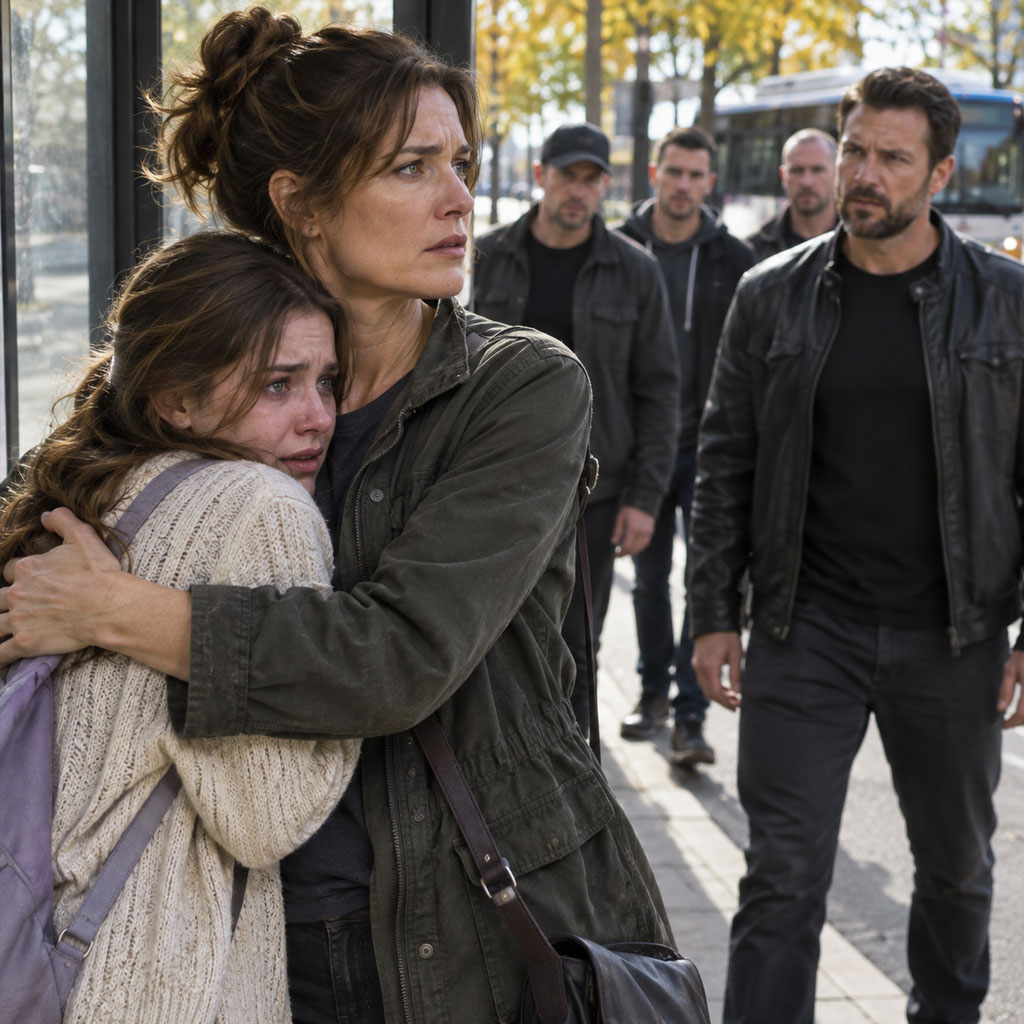
This time, the embrace was different from the desperate one at the bus stop.
She wasn’t asking me to protect her from someone.
She was simply happy.
When she finally stepped back, she was laughing through tears.
“I knew she’d make it,” she whispered.
A few weeks later, with permission from their caseworkers, Lena and Maya were able to speak by video call.
I gave them privacy.
From the hallway, I heard Lena laughing and crying and telling Maya about Shawn’s terrible card-playing jokes.
When the call ended, she came into the kitchen with red eyes and a smile.
“She said she’s proud of me.”
“She should be.”
Lena shook her head.
“She said I saved her notebook.”
I touched her shoulder.
“You did more than that.”
The months that followed weren’t easy.
The legal case continued. Investigators reviewed additional records, and the children involved received services through appropriate agencies.
Some families were reunited. Other young people required new placements and long-term support.
No single arrest could undo the harm caused by years of failed oversight.
But the investigation had finally brought those failures into the open.
For our family, life gradually settled into a new rhythm.
Lena started attending school regularly.
She made a friend named Sophie who loved drawing and talked endlessly about horses.
She learned how to bake cornbread with Shawn, although their first attempt looked more like a paving stone.
She also began taking karate lessons at my studio.
I taught her the same principles I taught every student: awareness, self-control, confidence, and the importance of seeking help when a situation was unsafe.
One afternoon, after class, she asked me something unexpected.
“Do you think I could stay here forever?”
I stopped putting away the training pads.
“Is that what you want?”
She nodded.
“I know you didn’t plan on having another daughter.”
The word caught in my throat.
Daughter.
I sat beside her on the mat.
“Lena, loving Ruth doesn’t mean there’s no room in my heart for you.”
She searched my face.
“But she’s your real daughter.”
“She will always be my daughter. And you don’t have to be born into a family to belong to it.”
Lena looked down at her hands.
“Could you adopt me?”
I had considered the possibility, but I didn’t want to promise something the courts might not allow.
So I told her the truth.
“I would like that very much. We’ll have to talk with Margaret and find out what the law allows.”
She smiled.
“Okay.”
That night, I spoke with Shawn.
We were sitting on the porch beneath the light he always insisted on leaving on after dark.
I told him what Lena had asked.
He listened carefully.
“Do you want to adopt her?” I asked.
He looked toward the window, where Lena sat doing homework.
“I already worry about whether she’s eaten enough,” he said. “I suppose that’s a start.”
I laughed.
Then he grew serious.
“Ruth is our daughter, Diana.”
“I know.”
“And Lena is Lena.”
“Yes.”
He reached for my hand.
“There’s room for both.”
I leaned against his shoulder.
For fourteen years, I had feared that any change to our household might hurt him.
Yet here he was, understanding something I had struggled to accept myself.
Love wasn’t a limited supply.
Caring for Lena wouldn’t diminish what we had shared with Ruth.
It would simply give that love somewhere new to grow.
With the help of Margaret and an attorney, we began the process of seeking permanent guardianship and adoption.
There were interviews, medical assessments, background checks, and careful reviews of Shawn’s condition and our ability to provide consistent care.
We also had to establish Lena’s legal eligibility for adoption.
Nothing happened quickly.
Some weeks brought encouraging news.
Others brought delays.
Through it all, Lena continued building a life.
She joined an art club.
She learned to ride a bicycle.
She argued about bedtime, complained about homework, and discovered that Shawn could be talked into making pancakes for dinner.
Ordinary problems.
Wonderful, ordinary problems.
Six months after the arrests, following completion of the required reviews, we stood together in family court.
Lena wore a blue dress she’d chosen herself.
Shawn had put on his best jacket.
The judge reviewed the final documents and asked Lena whether she understood what adoption meant.
She nodded.
“It means they’re going to be my parents.”
“And is that what you want?”
Lena looked at us.
“More than anything.”
The judge smiled and signed the order.
I heard the scratch of the pen.
Such a small sound for something so enormous.
Then it was official.
Lena Harlo.
Our daughter.
Outside the courthouse, Brian waited near his car.
He hugged me, shook Shawn’s hand, and congratulated Lena.
She grinned.
“Does this mean I can stop being nervous?”
Brian smiled.
“I think you’ve earned a little peace.”
On the drive home, Lena sat in the back seat humming softly.
Shawn reached over and squeezed my hand.
Neither of us said much.
We didn’t need to.
Chapter 6
That evening, Lena asked whether we could visit the bus stop.
I was surprised.
“Are you sure?”
She nodded.
“I want to see it again. With you.”
So we drove across Madison as the sun began to set.
The old bench was still there.
So was the faded route schedule and the little patch of grass beside the shelter.
Nothing about the place looked extraordinary.
Buses arrived.
People climbed aboard.
Cars passed through the intersection.
I stood beside Lena, remembering the morning she’d run toward me with terror in her eyes.
She slipped her hand into mine.
“Do you know why I picked you?”
I looked at her.
“I’ve wondered.”
She smiled faintly.
“You were sitting there looking sad. Everybody else was busy with their phones or talking. But you were watching people.”
I swallowed.
“I thought maybe you’d notice if someone needed help,” she continued. “I didn’t know what else to do.”
I squeezed her hand.
“I’m glad you came to me.”
She looked toward the road.
“Were you thinking about Ruth that morning?”
“Yes.”
“Do you still come here for her?”
“Sometimes.”
Lena leaned against me.
“Could we come together next time?”
I looked at the place where Ruth had once stood with her backpack, waiting impatiently for the bus.
For years, I’d returned alone because I believed grief was something I had to carry privately.
Now Lena stood beside me, offering to share the quiet.
“I’d like that,” I said.
She slipped her arms around my waist.
“I love you, Mom.”
The word came naturally.
No pretending.
No frightened whisper.
No men approaching from the sidewalk.
Just a girl holding her mother’s hand.
“I love you too, sweetheart.”
We stayed until the streetlights came on.
When we returned home, Shawn was in the kitchen making dinner.
He looked up as Lena walked through the door.
“There you are. I was about to send out a search party.”
She laughed.
“Did you save me any potatoes?”
“Only if you set the table.”
She hurried toward the cupboard.
I watched them move around each other, exchanging familiar jokes and small complaints.
Then my eyes drifted toward the hallway.
Ruth’s photograph still sat on the desk.
We hadn’t removed it.
We never would.
Lena had added her own drawings to the walls and placed her schoolbooks beside Ruth’s old collection.
The room had changed without erasing its history.
So had our family.
Shawn still experienced difficult days with his memory. Some mornings he asked questions that brought tears to my eyes. We continued working with his doctors and meeting each day with patience.
But he had also learned to recognize Lena as her own person.
And Lena understood that remembering Ruth was not a rejection of her.
One night, I found Shawn standing outside the girls’ bedroom.
He was looking at a photograph of Ruth that Lena had placed beside one of herself.
“Two beautiful girls,” he said quietly.
I stood beside him.
“Yes.”
He put his arm around me.
“We’ve been lucky, haven’t we?”
The word surprised me.
Lucky.
For so long, I had believed that our story was defined entirely by what we’d lost.
But standing there, looking at those two photographs, I understood what he meant.
We had suffered a loss that would never stop mattering.
We had also been given the chance to love again.
Not because the past could be repaired.
Not because one child could replace another.
But because a family could make room for sorrow and happiness at the same table.
Later, when I turned off the kitchen lights, Lena called from her bedroom.
“Good night, Mom.”
“Good night, sweetheart.”
Shawn was already waiting for me in the living room.
He had left the porch light on.
I used to think he kept it burning because he was waiting for someone who could never return.
Now I saw it differently.
That little light was also there for the people who still needed to find their way home.
And as I closed the curtains, I thought of Maya, of the girls whose names had filled that notebook, and of the courage it had taken for Lena to ask a stranger for help.
I couldn’t change what had happened to Ruth.
I couldn’t give Lena back the childhood she’d lost.
But I could be there for the days ahead.
I could listen when she was frightened, celebrate when she succeeded, and remind her that she belonged even when life became difficult.
I could keep loving my first daughter while raising my second.
Fourteen years earlier, I’d learned that a family could be changed forever in a single moment.
That Sunday at the bus stop, I learned something else.
Sometimes a family begins again when one frightened child reaches out, and someone chooses not to turn away.
THE END.\
⚠️ All characters and events are fictional. Do not imitate or apply them in real life. 😌😌😌