Chapter 2
Patrick rose slowly from his chair.
He was six feet three inches tall, but he had never used his size to intimidate anyone.
“What exactly is this?” he asked.
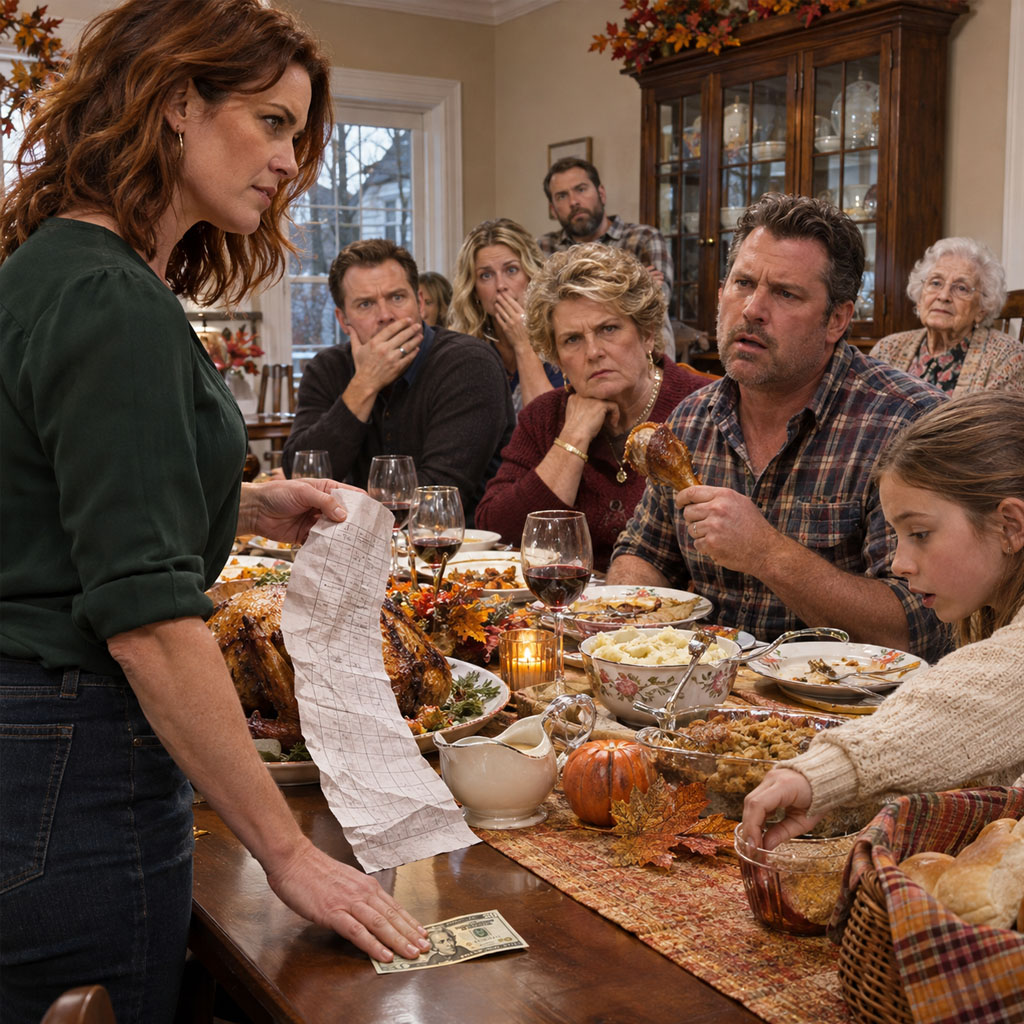
I handed him the chart.
He examined it carefully, moving his finger down the rows.
Rory cleared his throat.
“Pat, don’t make a big deal out of it. It’s harmless fun.”
“How long?”
“What?”
“How long have you been doing this?”
Rory glanced toward his mother.
“Since the wedding, more or less.”
Patrick looked at the chart again.
“Nine years?”
Nobody answered.
His eyes stopped on Colleen’s handwriting.
“Mom, you participated?”
Colleen removed her glasses.
“Patrick, honey, nobody meant any harm.”
“You chose our wedding anniversary.”
“It was just a date!”
Patrick turned toward his brother.
“You told everyone about this except me?”
Rory shrugged.
“Because you can’t take a joke.”
My husband laid the chart flat on the table.
He took a pen from Uncle Wally and wrote something in the empty margin.
Then he turned the paper toward me.
In his careful block letters were six words.
WHERE YOU GO, I GO.
They were the words we’d included in our wedding vows, inspired by the Book of Ruth.
Patrick looked at me.
“Get your coat, sweetheart.”
I blinked.
“We’re leaving?”
“Whenever you’re ready.”
For a moment, I couldn’t speak.
I’d spent nine years trying to earn a place at that table.
My husband had needed only a minute to decide where he belonged.
Then a small voice interrupted.
“Wait. There’s something underneath.”
Piper, Rory’s twelve-year-old daughter, stood beside the table.
She was pointing at the folded bottom of the chart.
Before anyone could stop her, she carefully lifted the tape.
The hidden section unfolded.
There was another row.
The handwriting was large and unsteady, becoming increasingly crooked across the years.
Instead of a date, each square contained the same word.
NEVER.
Nine times.
Piper looked at her father.
“Dad, why does Great-Grandma always write ‘never’?”
Rory laughed nervously.
“Sweetheart, Grandma doesn’t really understand the game. I just let her put in twenty dollars every year.”
From the corner beside the radiator came a quiet voice.
“I understand it perfectly.”
Everyone turned.
Nell sat with her hands resting on the table.
“Rory showed me the chart the first year,” she said. “He thought I’d find it funny.”
Rory shifted uncomfortably.
“Grandma, come on.”
“He asked when I thought the marriage would end. I told him it wouldn’t.”
Her voice was thin but steady.
“He said I had to pay twenty dollars to write that down. So I did.”
I stared at her.
“Every year?”
Nell nodded.
“Every Thanksgiving.”
My eyes filled.
“Why didn’t you tell me?”
She turned her face toward my voice.
“Because you were trying so hard to belong, honey. I didn’t want you believing everybody in this family was against you.”
Rory threw up his hands.
“Good grief. Now we’re making a federal case out of a silly game.”
Patrick pointed toward the rules.
“It says if we reach ten years, the person who predicted it wins.”
“That’s right.”
“Grandma predicted we’d stay together.”
Rory smirked.
“Fine. If you make it to next June, she wins.”
“Then remember that.”
Nell pushed her chair backward.
“Patrick, what time is it?”
“Almost four, Grandma.”
“St. Clement’s serves Thanksgiving dinner until six.”
“Yes, ma’am.”
She reached for her purse.
“I’d like to go there.”
I helped her stand.
Nobody protested when the three of us walked out.
I left my $20 on the table.
I’d paid for my square, and I intended to keep it.
Chapter 3
Patrick drove through Toledo with both hands on the steering wheel.
Nell sat beside him, holding the folded chart in her lap.
I sat in the back, trying to understand how one small piece of paper had exposed so much about a family I’d loved for almost a decade.
After several blocks, I spoke.
“Nell, you knew about that game all along.”
“Yes, honey.”
“You could have told me.”
She was quiet.
Then she said, “And what would you have done?”
I looked out the window.
I knew the answer.
I’d have stopped attending family dinners. Patrick would have defended me. His relatives would have blamed me for dividing the family.
Nell seemed to read my thoughts.
“Rory wanted you to feel unwelcome,” she said. “I couldn’t stop him. But I wasn’t going to help him win.”
Patrick made a small sound.
I glanced toward the driver’s seat.
He was crying.
My steady, practical husband, who rarely showed emotion, wiped his cheek with the back of his hand.
“Grandma,” he said, “I’m sorry I didn’t know.”
Nell reached across and patted his arm.
“You know now.”
We reached St. Clement’s shortly after four.
The parish hall smelled of sage, coffee, and freshly baked bread.
Volunteers were clearing tables after serving a crowd.
An elderly woman in an apron looked up from the kitchen.
She stared at Nell.
Then she dropped the dish towel she was holding.
“Nell Malloy?”
Nell turned toward the voice.
“Dot?”
The woman hurried across the room and embraced her.
“Oh, my goodness! We thought we’d never see you again.”
Nell smiled.
“I’m not that difficult to find.”
Dot pulled back.
“But Rory said you didn’t want visitors.”
The smile vanished.
“What?”
“He told us your memory was failing. That you got confused around people and didn’t want anyone coming by.”
Patrick and I exchanged a look.
Dot continued.
“I called at least a dozen times. Rory always said you weren’t having a good day.”
Nell gripped the edge of a chair.
“That boy told me the parish van stopped running. Said the kitchen had been given to someone younger because I was becoming a burden.”
Dot stared at her.
“Nell, nobody said that. We’ve missed you terribly.”
For several seconds, Nell didn’t speak.
Then she straightened.
“Well, is there any dressing left?”
Dot laughed through her tears.
“Plenty.”
“And please tell me you haven’t started putting raisins in it.”
Within minutes, people were gathering around Nell.
Old friends embraced her.
Father Tim, the parish priest, came from the kitchen and welcomed her warmly.
We ate Thanksgiving dinner at a long table covered with white paper.
Nobody made jokes about my marriage.
Nobody treated Nell like she was invisible.
She laughed, told stories, and corrected Dot’s description of how much sage belonged in the dressing.
Watching her, I began to understand something troubling.
Rory hadn’t merely been unkind.
He had somehow managed to separate his grandmother from the community she loved.
On the drive home, Nell was quiet.
When we reached her bungalow, she held my sleeve.
“Marissa, you’re coming next Saturday?”
“Of course.”
“Bring your reading glasses. There’s something I want you to look at.”
“What is it?”
“Some papers Rory has been asking me to sign.”
Patrick turned toward her.
“What papers?”
“I’m not sure anymore.”
She looked down at her hands.
“He’s been helping with my banking since my eyesight got worse. Tonight, I started wondering whether I’ve trusted him too much.”
Chapter 4
The Friday after Thanksgiving, Rory appeared on our front porch carrying a pecan pie.
He wore his flooring company’s work jacket and the same broad smile I’d known for nine years.
“Peace offering, Temp.”
I stood behind the screen door.
“What do you want, Rory?”
“Come on. Everybody’s embarrassed. You made your point.”
He held out the pie.
“Mom’s upset. Patrick isn’t answering his phone. Let’s put this behind us before Christmas.”
“Did you apologize to Patrick?”
He shrugged.
“He knows how I am.”
“Did you apologize to me?”
Rory’s smile tightened.
“You’re really going to hold a little joke against us?”
“Nine years isn’t a little joke.”
He looked past me into the house.
“Marissa, you’ve got to understand something. Families tease each other. That’s how it works.”
“Not every family.”
His expression changed.
“Well, where else are you going to go?”
I stared at him.
There it was.
The belief that I would accept anything rather than lose the family I’d worked so hard to join.
“I already have a home,” I said. “And Patrick is in it.”
Rory set the pie on the porch railing.
“Seven months until your anniversary, Temp.”
He winked.
“Let’s see how everything looks then.”
I closed the door.
The following Saturday, I visited Nell.
She insisted we have our usual coffee before discussing anything serious.
Then she brought a battered shoebox from her bedroom.
Inside were envelopes containing bank statements.
“I can’t read the small print anymore,” she explained. “Rory tells me what they say.”
I opened the first statement.
Then another.
And another.
There was a recurring monthly payment of $600 to Malloy Floors.
The description read “home care.”
I frowned.
“Nell, who provides your home care?”
She looked puzzled.
“You visit me. And a neighbor helps with the heavier cleaning when I ask.”
“Does anyone from Rory’s business come here?”
“Rory comes once a month with a sandwich. He helps with the bills.”
I spread the statements across the table.
The payments had continued for fifty-five months.
Thirty-three thousand dollars.
“Nell, have you been paying Rory six hundred dollars every month?”
She shook her head.
“Not knowingly.”
I explained what the records showed.
She listened without interrupting.
When I finished, she sat with both hands flat against the table.
The kitchen clock ticked.
Outside, someone was scraping frost from a windshield.
Finally, she said, “That’s an expensive sandwich.”
I laughed despite myself.
Then I went to the sink because I was suddenly too upset to sit still.
When Patrick arrived, he wanted to confront his brother immediately.
Nell stopped him.
“No.”
“Grandma, he took your money.”
“We need to find out exactly what happened.”
Patrick paced the kitchen.
“He’s been lying to you for years.”
“Then we need the truth documented properly,” she replied.
We contacted Evelyn Beck, an attorney who specialized in elder law.
She reviewed the statements and explained that Nell had the right to obtain complete banking records.
She also advised us not to confront Rory until the documents had been examined.
“We don’t want to make accusations we can’t yet prove,” she said.
Nell agreed.
For the next several weeks, we said nothing.
Chapter 5
Christmas was strange that year.
The Malloys sent cards, voicemail messages, and awkward invitations.
Aunt Debbie wrote, “Sorry if your feelings were hurt.”
Uncle Wally said the marriage pool had been harmless fun.
Nobody acknowledged how cruel it had been.
We didn’t attend Colleen’s Christmas gathering.
Instead, Patrick and I hosted dinner at our house.
Nell came.
So did Dot from St. Clement’s.
My sister, Cindy, drove from Erie with homemade cookies and a suitcase full of gifts.
There were only five of us.
Our dining table didn’t need an extra leaf.
But I felt more comfortable than I ever had at Colleen’s crowded holiday dinners.
Two weeks before Christmas, I happened to be at Nell’s house when Rory arrived for his monthly visit.
He carried a sandwich wrapped in wax paper and a folder under his arm.
“Well, look who’s here,” he said. “Still playing nursemaid, Temp?”
“I’m visiting Nell.”
“Of course you are.”
He kissed his grandmother’s forehead.
“How’s my favorite girl?”
Nell smiled faintly.
“Fine, Rory.”
He removed a document from the folder.
“Just need your signature on the annual care agreement.”
He placed a pen in her hand.
“I’ll show you where.”
Nell didn’t move.
“Leave it here, dear. Marissa can read it to me later.”
Rory paused.
Then he shrugged.
“Whatever you want.”
At the door, he glanced back at me.
“Easter, Temp. I’m feeling lucky.”
After he left, I photographed the document for Evelyn.
It was an agreement authorizing another $7,200 in payments for supposed home care services.
Nell sat quietly while I read it aloud.
“I never agreed to that,” she said.
I took her hand.
“Then you won’t sign it.”
In January, something unexpected happened.
Colleen appeared on my schedule at the dental office.
She’d been a regular patient for eight years, coming in every six months.
My office manager offered to transfer her appointment to another hygienist.
I shook my head.
“She’s my patient. I’ll do my job.”
Colleen arrived looking tired.
Neither of us mentioned Thanksgiving while I prepared the room.
I completed her examination and cleaning professionally.
When she was sitting upright again, she studied the paper cup in her hands.
“Marissa,” she said quietly, “I owe you an apology.”
I waited.
“I shouldn’t have participated in that horrible game.”
“No, you shouldn’t have.”
She nodded.
“Jack died the year before Patrick met you. I was lonely. Then Patrick fell in love, and I was afraid he’d stop coming home.”
I looked at her.
“So you hoped we’d divorce?”
Her eyes filled.
“I told myself it was only a joke. If I made light of your marriage, I didn’t have to admit how frightened I was.”
“And Rory?”
She lowered her gaze.
“Rory has always been good at making people laugh. Sometimes I let him get away with things I shouldn’t.”
I thought about Nell, alone in her bungalow, believing her church friends no longer wanted her.
“Colleen, making excuses for someone isn’t the same as loving them.”
She nodded slowly.
“I know.”
I wasn’t ready to forgive her.
But for the first time, she’d admitted the truth without blaming me.
That mattered.
Chapter 6
At the end of January, Evelyn Beck received Nell’s complete bank records.
The payments were exactly what we’d suspected.
Fifty-five monthly transfers of $600, totaling $33,000, had gone into Rory’s flooring business.
There was no documented home care provider.
No legitimate care arrangement explaining the charges.
And the annual agreements had been presented to Nell when she could no longer read them independently.
Evelyn arranged a meeting at her office.
Rory arrived in a sport coat, carrying a box of doughnuts.
His wife, Sarah, accompanied him.
She handled bookkeeping for Malloy Floors.
Rory looked around at Nell, Patrick, me, and the bank representative.
“Quite a turnout,” he joked.
Evelyn didn’t smile.
“Mr. Malloy, we’d like you to explain these payments.”
She placed the statements in front of him.
“Six hundred dollars every month for fifty-five months, labeled home care.”
Rory leaned back.
“I look after Grandma. Everybody knows that.”
“What services were provided?”
“Whatever she needed.”
“Can you provide invoices, caregiver records, or a written explanation of the fees?”
His expression hardened.
“It’s a family arrangement.”
The bank representative confirmed that the transfers had been deposited into the business account.
Sarah picked up one of the statements.
Her face changed.
“Rory, you told me these deposits were loan proceeds.”
He turned sharply.
“Sarah, not now.”
“I entered them as loan funds in the books.”
“That’s enough.”
She stared at him.
“Whose loan?”
Rory pushed back his chair.
“This whole thing is ridiculous.”
He pointed toward me.
“She’s been stirring up trouble since Thanksgiving. Nine years she’s wanted to turn everyone against me.”
Patrick stood.
“Sit down, Rory.”
Rory looked at his brother.
Then he slowly lowered himself into the chair.
For the first time, his confidence seemed to desert him.
He turned toward Nell.
“Grandma, business has been rough. I had employees depending on me. Families needed those paychecks.”
Nell sat very still.
“I would have helped you if you’d asked.”
Rory swallowed.
“I was going to pay everything back.”
“Then why didn’t you tell me?”
He looked down.
She continued.
“Why did you tell the people at St. Clement’s that my memory was failing?”
He didn’t answer.
“And why did you tell me they didn’t want me anymore?”
Silence filled the office.
Nell’s voice trembled.
“I could have forgiven you for needing money, Rory. I knew what it was like to struggle. But you made me believe my friends had forgotten me.”
Rory covered his face.
Evelyn placed a written repayment proposal on the table.
It required the full amount to be returned under an agreed schedule, with the first payment due March 1.
She explained that failure to resolve the matter could result in the records being referred to the appropriate authorities.
Rory took the papers.
At the door, he found enough confidence to look back at me.
“Four months until Easter, Temp.”
I didn’t answer.
Sarah left separately.
And March 1 came without a payment.
So did March 8.
And March 15.
Nell gave him until the end of the month.
Nothing arrived.
On April 2, a representative from the county probate court appeared at Nell’s door.
His name was Mr. Lang.
He explained that Rory had filed a petition asking to be appointed Nell’s legal guardian.
If successful, the guardianship could give him authority over her finances and major personal decisions.
Nell called me immediately.
I was at work, but I arranged to leave as soon as my patient was finished.
Then I made a phone call I’d never expected to make.
“Colleen, it’s Marissa. Rory is trying to take control of Nell’s affairs. There’s a court representative at her house.”
Silence.
Then I said, “You’ve known her for forty-five years. You’re a retired nurse. If you believe she’s capable of making her own decisions, she needs you to tell the truth.”
Colleen didn’t speak for several seconds.
Finally, she said, “I’ll be there.”
Chapter 7
Mr. Lang sat at Nell’s kitchen table with a folder open in front of him.
He was a patient man in his early sixties, wearing a damp raincoat and sensible shoes.
Rory’s petition described Nell as confused, forgetful, and vulnerable to manipulation.
He also claimed that I was influencing her against the family.
Mr. Lang asked Nell several questions.
She answered calmly.
Then he showed her a photograph of the Thanksgiving marriage pool.
“Your grandson says you repeatedly wrote a word that wasn’t a valid date,” he explained. “He suggests this demonstrates difficulty understanding instructions.”
Nell held out her hand.
“Read me the rules, please.”
Mr. Lang did.
She nodded.
“So if they stay married ten years, the person who predicted that wins?”
“Yes.”
“Then my answer was perfectly sensible.”
He looked up.
“How so?”
“Everyone else chose a date for the marriage to end. I chose never. It’s the only answer that keeps winning as long as they’re happy.”
Mr. Lang smiled faintly.
Nell continued.
“It’s April 2. They’ve got a little over ten weeks until their tenth anniversary. You’re welcome to come to the party.”
At that moment, Colleen arrived.
She wore her good navy coat and carried an old nursing bag.
She introduced herself to Mr. Lang.
“I was a school nurse for twenty-eight years. Mrs. Malloy is my mother-in-law, and Rory is my son.”
She paused.
“I’d like to provide some observations.”
For nearly twenty minutes, she explained how Nell managed her daily life, maintained conversations, remembered events, and made independent decisions.
She described the difference between poor eyesight and cognitive impairment.
Then she looked directly at Mr. Lang.
“Nell has limited vision. She does not lack judgment. If anything, she’s been more perceptive than the rest of us.”
I felt tears gather.
Colleen’s hands were shaking, but she continued.
“I love my son. That doesn’t mean I can support what he’s doing.”
When Mr. Lang left, none of us spoke for a while.
Nell finally broke the silence.
“Colleen, would you make some toast?”
Colleen stood.
“Of course.”
She knew exactly where the bread was.
When she returned, she placed a plate in front of Nell.
Then another in front of me.
“Marissa,” she said quietly, “I intend to make things right.”
The guardianship hearing took place later that month.
Dot attended with statements describing her attempts to contact Nell.
Father Tim provided information about Nell’s continued relationship with St. Clement’s.
Mr. Lang submitted his assessment.
And Sarah arrived carrying a box of business records.
She testified about the deposits and how Rory had represented them in the company books.
She had also brought the marriage pool’s red coffee can.
Inside was a handwritten card.
“I owe the can — R.”
It appeared Rory had been borrowing from the pool, too.
The magistrate dismissed his guardianship petition.
The financial records were referred for further investigation.
Rory stood outside the courtroom, looking stunned.
As we walked toward the elevator, he approached Nell.
“Grandma, come on. We’ve all made mistakes. Can’t we just relax?”
Nell stopped.
She turned toward his voice.
“Relax, Rory?”
He nodded.
“It’s family.”
She waited a moment.
Then she said, “You had until March 1 to begin paying me back. You’ve already outlasted March.”
Patrick put his arm around her.
And we walked away.
Chapter 8
The investigation resulted in a negotiated legal resolution.
Rory was placed on probation and ordered to repay the money he’d taken from Nell.
He sold Malloy Floors that summer to one of his longtime employees.
Sarah moved into an apartment with Piper.
Their marriage didn’t survive what she’d learned about the business and the lies.
The repayment plan required $600 a month until the $33,000 was returned.
When Evelyn explained the schedule, Nell did the arithmetic.
“Fifty-five months,” she said. “I’ll be ninety-one when he’s finished.”
She smiled.
“Well, the Lord will simply have to be patient with me.”
Meanwhile, Nell returned to St. Clement’s.
The church bulletin carried a cheerful notice announcing that she was no longer on the prayer list for serious illness and would welcome visits from old friends.
Dot called her almost every day.
Father Tim arranged transportation to Sunday Mass.
And Nell resumed giving advice about the parish kitchen, whether anyone requested it or not.
One Saturday morning in May, I visited her as usual.
After coffee, we sat at the kitchen table.
There was something I’d wanted to ask since Thanksgiving.
“Nell, why did you choose never?”
She smiled.
“You know why.”
“No, I mean the very first year. You barely knew me. Why were you so certain Patrick and I would last?”
She rested her hands on the table.
Then she told me something I’d completely forgotten.
At our first Thanksgiving together, the family had served a large baked ham.
Nell had bitten into a piece that hurt her gums.
Nobody noticed.
Everyone was talking and laughing.
But I had seen her wince.
Without drawing attention to it, I’d passed her the applesauce and quietly put some on her plate.
“You didn’t embarrass me,” Nell said. “You just noticed I needed something softer.”
I remembered the moment vaguely.
It had seemed so small.
“That’s why you bet on me?”
“That’s when I knew you were a keeper.”
I laughed.
She continued.
“You were sitting there in your nice dress, and Rory had been calling you the Temp all afternoon. Yet you still noticed an old woman nobody else was paying attention to.”
Her eyes grew moist.
“People who notice others are worth keeping.”
I couldn’t speak.
“And then, years later, you started visiting me. You helped me find a dentist and brought me coffee. You listened when I talked about Howard.”
She reached for my hand.
“Everybody else kissed the top of my head and hurried away. You sat down and talked to me as though I still mattered.”
I moved my chair closer.
“You do matter, Nell.”
She smiled.
“I know that now, honey.”
For a long moment, we sat together holding hands.
Then she squeezed my fingers.
“Now, would you please make us some toast? All this sentiment is making me hungry.”
Chapter 9
June 14 fell on a Sunday.
Patrick and I celebrated our tenth wedding anniversary in our backyard beneath the big maple tree.
We invited friends from work, my sister Cindy, Nell, Dot, Father Tim, and several relatives who had treated us with genuine kindness.
Patrick grilled chicken and hamburgers.
I made potato salad.
Nell sat in a comfortable chair beneath the tree, with a little sign Piper had made.
RESERVED FOR GREAT-GRANDMA.
Piper, now thirteen, had finally gotten her braces.
She proudly showed them to everyone.
Around three o’clock, a car pulled up in front of the house.
Colleen walked around the side yard carrying a red coffee can.
Behind her came Uncle Wally, Aunt Debbie, Cousin Howie, and several other relatives.
They looked nervous.
Patrick glanced at me.
I nodded.
Colleen approached Nell.
“Happy anniversary, you two.”
Then she held out the can.
“Ten years. Just as you predicted, Mother Malloy.”
Nell smiled.
“Is that my prize?”
“It is.”
Colleen cleared her throat.
“Twelve players altogether, counting Marissa’s late entry. Nine years of contributions. Two thousand one hundred eighty dollars.”
She placed the can in Nell’s lap.
“Every penny is there.”
I later learned that Colleen had spent weeks visiting the relatives who’d participated.
She’d insisted that each person contribute what was owed.
Some apologized immediately.
Others needed time.
But Colleen hadn’t accepted excuses.
Now she turned toward me.
“Marissa, I owe you an apology.”
Her voice trembled.
“I treated you like someone who was taking my son away. I should have been grateful that he found a woman who loved him.”
I looked at her.
“You hurt me, Colleen.”
“I know.”
“It wasn’t just the game. It was years of feeling like I didn’t belong.”
She nodded, tears sliding down her cheeks.
“I know that too.”
She didn’t ask me to forget.
She didn’t insist I forgive her immediately.
She simply said, “I’m sorry, Marissa.”
For the first time in ten years, she said my name without a qualification or an uncomfortable little joke.
I stepped forward and embraced her.
It didn’t erase the past.
But it gave us a place to begin again.
Nell patted the coffee can.
“Now, what am I supposed to do with all this money?”
Patrick grinned.
“Whatever you want, Grandma.”
She thought for a moment.
“How many turkeys would it buy?”
We all laughed.
But Nell was serious.
She wanted the entire amount donated to St. Clement’s Thanksgiving dinner program.
That November, the parish purchased twenty-two large turkeys, along with vegetables, bread, and other supplies.
The volunteers served more than four hundred people.
Nell arrived early, wearing her best cardigan with a tissue tucked into her sleeve.
Dot had arranged a high-backed stool in the kitchen.
From that seat, Nell supervised the stuffing, corrected the seasoning, and insisted that nobody put raisins anywhere near her dressing.
Colleen peeled potatoes.
Uncle Wally served coffee.
Sarah counted guests at the door.
Piper helped carry rolls to the tables.
Patrick and I worked side by side, grateful for the quiet happiness of doing something useful together.
When the final guests had been served, the volunteers gathered around a long table for their own meal.
Father Tim stood to say grace.
Just before he began, Piper appeared beside me with a small notebook.
“Aunt Marissa,” she whispered, “want to enter the pool?”
I raised an eyebrow.
“What pool?”
She grinned.
“One dollar to guess who cries first during grace. All the money goes toward next year’s turkeys.”
I laughed.
“Who’s Grandma betting on?”
Piper showed me the notebook.
In large, shaky letters, Nell had written one name.
PATRICK.
I took a dollar from my purse.
“Put me down for the same.”
Piper hurried away.
Ninety seconds into Father Tim’s prayer, my husband reached for a tissue.
Nell started laughing.
“So,” Patrick said afterward, wiping his eyes, “I suppose I lost.”
“No, sweetheart,” I told him. “I think we all won.”
That evening, I placed the original marriage pool chart in a frame.
It hangs inside my pantry door now.
The dates are still there.
So are the unkind jokes, the little drawing of a lawyer, and the names of people who once doubted our marriage.
But at the bottom are nine crooked entries, all written by the same elderly hand.
NEVER.
And beside them are Patrick’s words.
WHERE YOU GO, I GO.
Sometimes, when I open the pantry, I stop and look at that chart.
It reminds me that family isn’t measured by the number of chairs around a table.
It isn’t created by sharing a last name or pretending hurtful behavior is harmless.
Real family is built by people who notice when you’re hurting, who stand beside you when it matters, and who tell the truth even when it costs them something.
For years, I thought I needed the approval of eleven people to belong.
But while they were betting against me, one quiet woman sitting beside a radiator had been believing in me all along.
She’d spent twenty dollars every Thanksgiving to say so.
And she had been right.
THE END.\
⚠️ All characters and events are fictional. Do not imitate or apply them in real life. 😌😌😌