Chapter 2
Paul came downstairs when he heard Lauren crying.
He stopped in the kitchen doorway, still wearing his bathrobe.
“Dad,” she whispered, “did you sell Juniper?”
He looked at me.
I looked away.
Finally, he said, “Yes.”
Lauren stood perfectly still.
For several seconds, she seemed unable to understand what he’d said.
Then she asked, “Why?”
Paul explained the wedding expenses, the missed deadline, and Garrett Voss’s offer.
He said we’d planned to replace Juniper.
Lauren stared at him.
“She’s my medical-alert dog.”
“We understand that, sweetheart.”
“No, you don’t.”
Her voice shook.
“She’s the reason I can go to sleep without being afraid. She’s the reason I can walk outside. She warns me when something is happening that I can’t feel myself.”
I reached for her hand.
She stepped away.
“I raised almost all the money for her myself. People donated because they wanted me to be safe.”
“We’ll pay for another one,” I promised.
“With what money?”
Neither of us answered.
“Where is she?”
“Jamestown,” Paul said.
“Then call the man. Tell him you made a mistake.”
Paul rubbed his forehead.
“The money has already been paid toward the wedding.”
Lauren looked at him.
“You spent it?”
He nodded.
She slowly lowered herself into a kitchen chair.
“I don’t understand how you could do this without even asking me.”
“Your brother’s wedding—” Paul began.
“Is more important than my safety?”
He fell silent.
Lauren wiped her cheeks.
“You’ve spent eight years telling me to be careful. And now you’ve taken away the one thing that helps me do that.”
She stood up.
“Please don’t come downstairs tonight.”
Then she picked up her flashlight and disappeared into her room.
The following morning, Paul called Garrett Voss.
He explained that Juniper belonged to our adult daughter and had been sold without her permission.
There was a long pause.
“Did she agree to this sale?” Voss asked.
“No.”
“Mr. Ferris, you should have told me that.”
Paul offered to arrange repayment.
Voss explained that he’d already begun evaluating Juniper for another placement and would need to address the legal and financial complications. He wouldn’t promise an immediate return.
The conversation ended badly.
Mitch came over that afternoon.
When he learned what we’d done, his face drained of color.
“You sold Lauren’s dog for my wedding?”
Paul said, “We were trying to help you.”
“Dad, I never asked you to do that!”
“You sent the advertisement.”
“I thought you were exploring other ways to raise money. I didn’t know you meant Juniper.”
Mitch sank onto the staircase.
“She’s going to hate me.”
I told him we’d make things right.
But none of us knew how.
Lauren hardly spoke to us.
She continued her bookkeeping work and stayed mostly downstairs. I tried to remain nearby, but she resented being watched after so many months of independence.
On the third day without Juniper, Lauren went upstairs to shower.
I was preparing lunch when I heard a heavy noise from the bathroom.
I called her name.
No answer.
I hurried upstairs and found she’d experienced a seizure and fallen.
Paul called 911 while I followed the emergency instructions her medical team had taught us.
Paramedics arrived and took her to the hospital.
Lauren had suffered a head injury and breathing complications that required close observation.
She spent two nights in the intensive care unit.
Her neurologist, Dr. Shaw, met with us.
“Where is Juniper?” she asked.
I started crying.
Then I told her everything.
Dr. Shaw listened without interrupting.
When I’d finished, she said, “Lauren’s dog has been an important part of her safety plan. Removing that support without arranging an appropriate alternative has placed her at considerable risk.”
Paul stared at the floor.
“We know,” he whispered.
The doctor shook her head.
“Knowing now doesn’t change what happened. You need to work with Lauren to restore her safety and independence.”
I called Garrett repeatedly.
Eventually, a woman at his business answered and said he was away at a training event.
I explained that Lauren was hospitalized.
The woman expressed concern but couldn’t authorize Juniper’s return herself.
That night, I telephoned my sister.
I told her what Paul and I had done.
She was silent for so long that I thought the call had disconnected.
Finally, she said, “Nancy, why would you ever think that was yours to sell?”
I had no answer.
Lauren came home on the fifth day.
She looked exhausted, with a dressing over her forehead.
She walked slowly downstairs and closed her bedroom door.
I carried her a bowl of soup.
“Sweetheart, I made your favorite.”
“Leave it outside, please.”
I set the tray down.
“I’m so sorry.”
“I know, Mom.”
“Can I do anything?”
There was a long silence.
Then she said, “I just want Juniper.”
I stood outside her door, crying quietly.
That evening, Paul and I discussed borrowing against the house, selling another vehicle, or finding some way to reimburse Garrett.
Nothing could be arranged immediately.
The next night, heavy rain swept across Erie.
Neither of us slept much.
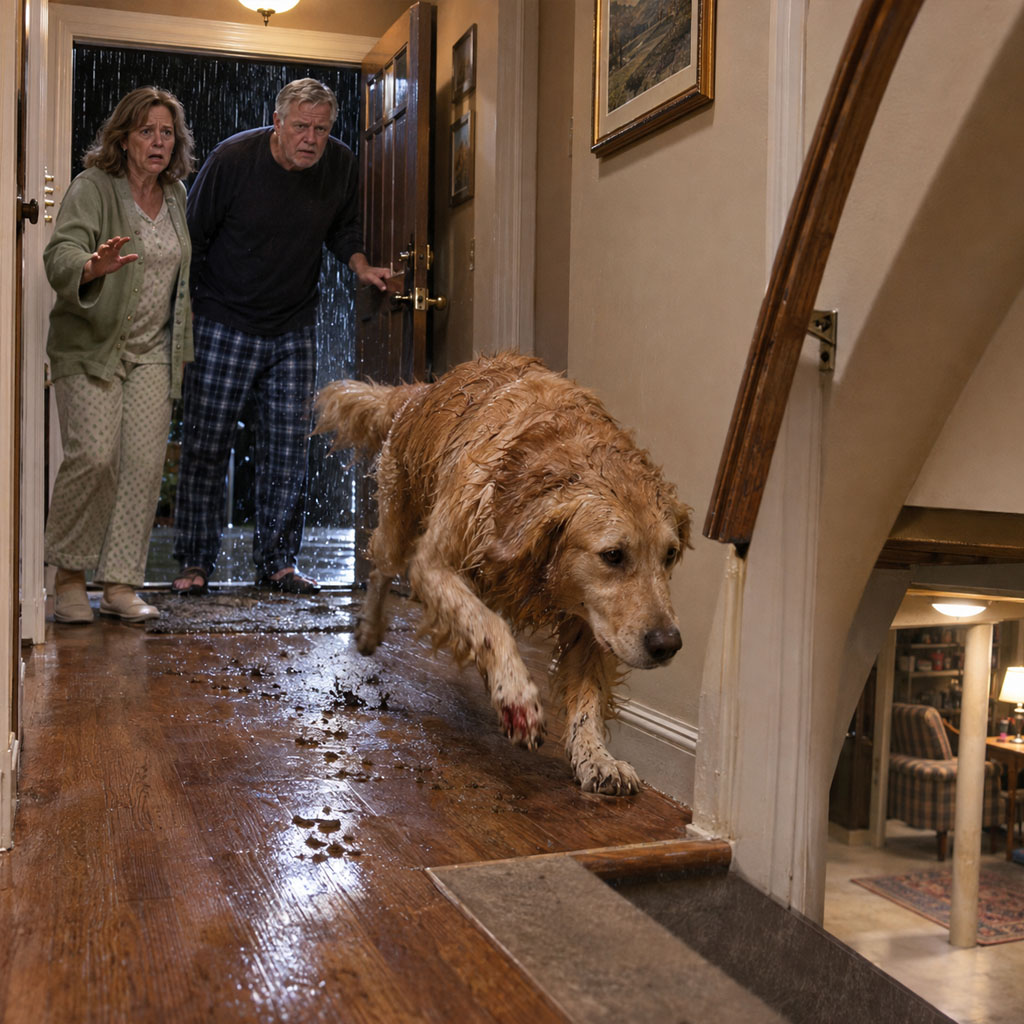
At 2:49 a.m., I heard scratching at the back door.
Paul sat upright.
“Did you hear that?”
I nodded.
He put on his slippers and went downstairs.
A moment later, I heard him open the door.
Then he called out a single word.
“Juniper?”
Chapter 3
I hurried downstairs.
There, beneath the porch light, stood a golden retriever covered in mud.
Her coat was tangled with leaves. She was painfully thin, and her paws looked sore from traveling over rough ground.
“Juniper,” I whispered.
She barely glanced at me.
Instead, she stepped past Paul and hurried through the kitchen.
She went straight toward the basement stairs.
Then she began barking.
It wasn’t her ordinary greeting bark.
It was sharp, urgent, and repeated.
Paul followed her.
“Lauren!” he called. “Wake up!”
The basement door opened.
Lauren stood there in her pajamas, blinking in confusion.
Juniper rushed toward her and pressed her head against my daughter’s legs.
For a moment, Lauren just stared.
Then she knelt.
“Juniper?”
Her voice cracked.
“Oh, sweetheart. You’re home.”
She wrapped her arms around the dog, careful of her injured paws.
Juniper leaned into the embrace.
But she didn’t settle.
She lifted a paw against Lauren’s knee.
Then she circled and stared.
Lauren’s face changed.
“Mom, she’s alerting.”
My heart began pounding.
“Are you sure?”
“Yes. We need to follow my seizure plan.”
Paul immediately helped clear a safe space on the floor. I brought the supplies Lauren kept nearby, including a pillow and her emergency information.
We stayed beside her as she settled down.
Juniper lay close to Lauren, trembling with exhaustion.
Paul watched the clock.
The rain beat against the windows.
At 3:03 a.m., approximately 11 minutes after the alert, Lauren experienced a seizure.
This time, she was already in a safer position, with us following her care plan and monitoring her closely.
The episode passed without another fall.
When she began recovering, she looked toward Juniper.
The dog lifted her head and gently nuzzled Lauren’s hand.
“You found me,” Lauren whispered.
I sat beside them, unable to speak.
The animal we’d sold had somehow returned to the person who needed her.
Later, Garrett helped us piece together what had happened.
Juniper had escaped from his fenced training property after spending two nights there.
He had searched the surrounding area, contacted local animal services, and notified several communities.
Over the following days, reports came in of a golden retriever traveling through southwestern New York toward Pennsylvania.
A farmer had seen her crossing a field. A truck driver reported giving water to a similar dog near Ripley. Another resident remembered leaving food outside for a tired golden retriever.
The likely route covered approximately 54 miles.
We couldn’t establish every mile she’d traveled, but Juniper had crossed a remarkable distance to return home.
Garrett sounded stunned when Paul called.
“She’s there?” he asked.
“She’s with Lauren.”
There was silence.
Then Garrett said, “I’ve worked with dogs for 30 years. I’ve seen them form extraordinary bonds, but I’ve never experienced anything quite like this.”
Paul offered to return the $15,000.
Garrett refused to let the dispute delay Juniper’s return to Lauren. He agreed to resolve the paperwork and payment questions separately.
“That dog belongs with your daughter,” he said.
After a veterinary examination, Juniper received treatment for exhaustion and her injured paws.
Lauren refused to let her out of sight.
For the next several days, she sat beside Juniper’s bed, offering water and small meals under the veterinarian’s guidance.
Sometimes she simply rested her hand on the dog’s fur.
I watched from the doorway.
Every time Lauren looked at Juniper, her expression softened.
Every time she looked at me, that softness vanished.
One afternoon, Lauren began packing.
I found her folding sweaters into a suitcase.
“What are you doing?”
“Moving.”
I stared at her.
“Where?”
“Marcy has a spare bedroom. She said Juniper and I can stay until I find an apartment.”
Marcy was Lauren’s former college roommate. They had remained friends, even after Lauren left school.
I sat on the edge of the bed.
“Sweetheart, we can work this out.”
Lauren kept folding.
“Mom, I love you. But I don’t trust you.”
Those words settled heavily between us.
“I know we made a terrible mistake.”
“You made a decision about my life without asking me.”
I reached for a sweater, hoping to help.
She took it gently from my hands.
“I spent years learning how to live with epilepsy. Juniper gave me back a little independence. Then you sold her because Mitch wanted a wedding venue.”
Tears filled my eyes.
“Your father and I were afraid of disappointing him.”
“And you weren’t afraid of losing me?”
I couldn’t answer.
Lauren closed her suitcase.
“I need to live somewhere I know my medical needs won’t be treated as optional.”
Paul came downstairs when she was ready to leave.
He begged her to stay.
She shook her head.
“Dad, I know you’re sorry. But I can’t pretend everything is fine just because Juniper came back.”
Juniper stood beside her, wearing a fresh bandage.
At the front door, Lauren paused.
“Mom, do you remember what Juniper did before that man took her?”
I nodded.
“She put her paw on your knee. Then she circled.”
My throat tightened.
“Yes.”
“She was frightened. Maybe she was asking you to pay attention.”
I started crying.
Lauren looked at me sadly.
“She trusted you to look after her. So did I.”
Then she picked up her suitcase.
Juniper followed her through the front door.
I stood beside Paul as Marcy’s car disappeared down the street.
For the first time in 27 years, I didn’t know when my daughter would come home again.
Chapter 4
Mitch and Brooke married in May.
The wedding took place at Lakeview Estate, beneath an arch decorated with white roses.
There was a string quartet, a beautifully arranged dinner, and more flowers than I’d ever seen in one room.
Everything looked perfect.
Except for the empty chair beside our family table.
A small place card read “Lauren Ferris.”
She had declined the invitation.
Mitch had called her several times before the wedding. He’d apologized, explaining that he’d never intended for Juniper to be sold.
Lauren listened.
But she told him she wasn’t ready to celebrate an event that had cost her so much.
At the reception, Mitch took the microphone.
He thanked Brooke’s parents, the guests, and everyone who had helped organize the celebration.
Then his voice changed.
“There’s something I need to say.”
Brooke reached for his hand.
Mitch looked toward our table.
“My sister isn’t here tonight because of something our family did. Something that should never have happened.”
The room grew quiet.
“I didn’t understand what my parents were sacrificing to help pay for this wedding. When I found out, I should have done more to fix it.”
Paul lowered his eyes.
Mitch continued.
“Lauren, if you ever hear this, I’m sorry. No wedding is worth losing your trust.”
He put down the microphone.
Brooke embraced him.
I stood near the back of the room, unable to stop crying.
I’d spent months worrying that the Hartwells would think poorly of us if we couldn’t afford the wedding.
Now I was surrounded by expensive decorations, realizing that the respect of strangers had never been worth my daughter’s peace of mind.
After the wedding, Paul and I began making changes.
He reduced his business expenses and stopped making financial promises without discussing them first.
I started seeing a counselor.
During our sessions, I talked about how easily I’d accepted the idea that Mitch’s happiness mattered more than Lauren’s needs.
The counselor asked me a question I still remember.
“When Lauren was growing up, what happened when she asked for something?”
I thought about it.
Lauren had always been quiet.
If Mitch wanted a new bicycle, he argued until Paul found a way to buy it.
If Lauren needed something, she waited until we could afford it.
We had praised her for being understanding.
We’d praised Mitch for being ambitious.
And slowly, without intending to, we’d taught one child that his wishes deserved urgent attention and the other that her needs could wait.
Understanding that pattern didn’t excuse our behavior.
But it helped me see how we had reached such a terrible decision.
I wrote Lauren a letter.
I didn’t ask her to come home.
I didn’t tell her how much I was suffering.
I simply admitted what we’d done.
I told her she had every right to be angry and that I would respect whatever boundaries she needed.
She didn’t answer.
In August, a video about Juniper appeared online.
Marcy had helped Lauren put it together.
It showed Juniper before her disappearance, a map of the approximate route she had traveled, and photographs of her recovery.
The caption explained that a trained seizure-alert dog had found her way home after being sold without her handler’s consent.
People shared it widely.
Local reporters contacted Lauren.
Eventually, she agreed to a television interview.
Paul and I watched from our living room.
Lauren sat in her new apartment with Juniper resting at her feet.
The reporter asked how Juniper had become separated from her.
“Someone sold her without asking me,” Lauren said.
“Who?”
Lauren paused.
“People who should have understood how much I needed her.”
She didn’t mention our names.
She didn’t need to.
People in Erie knew the story.
Some neighbors stopped speaking to us. Others expressed sympathy but kept their distance.
Our pastor suggested that Paul and I take time away from certain church activities while the situation remained painful for the community.
At first, I felt humiliated.
Then I remembered Lauren walking through the neighborhood, desperately searching for Juniper while I’d pretended not to know where she was.
Whatever embarrassment I felt was small compared with that betrayal.
The public attention brought something unexpected.
Donations began arriving from people who wanted to help other individuals obtain trained service dogs.
Lauren established a small charitable fund called Eleven Minutes.
She partnered with an established service-dog organization to help cover training and placement costs for people with seizure disorders.
Over time, the fund raised more than $40,000.
It helped several families who otherwise would have faced years of waiting and fundraising.
Lauren also insisted that the financial arrangements surrounding Juniper be settled fairly.
Garrett Voss had refused to keep money from a disputed sale after learning the circumstances.
Lauren sent him repayment installments anyway, despite his objections.
Eventually, he accepted an agreed amount and directed it toward service-dog training.
Paul offered to contribute.
Lauren declined.
“I’m doing this myself,” she told him.
He respected her decision.
In October, she began speaking publicly about epilepsy, independence, and the importance of service animals.
Her story reached people who had never understood the difference between a beloved pet and a trained working dog.
I attended every event I could find online.
But I didn’t contact her.
One afternoon, I received a postcard.
It showed Lake Erie at sunset.
On the back, Lauren had written:
“Juniper is doing well. My new apartment is comfortable. I’m working full-time again. I hope you and Dad are healthy.”
I read those three sentences at least 20 times.
They weren’t forgiveness.
But they were the first words she’d sent me in months.
I placed the postcard on my bedside table.
Every night, before turning off the light, I looked at it.
Chapter 5
The following spring, Lauren was invited to speak at the Erie Public Library.
The event was organized by a local epilepsy support group.
I learned about it from a community newsletter.
For several days, I debated whether to attend.
I didn’t want to intrude on her life.
But I wanted to hear her speak.
On the afternoon of the event, I put on a gray cardigan and drove to the library.
About 80 people sat in folding chairs arranged before a small platform.
I slipped into the back row.
Lauren stood near a lectern, speaking quietly with the event organizer.
She looked healthier than she had when she left home.
Her hair was shorter, and she wore a simple blue blouse.
A faint scar crossed her forehead.
Juniper lay at her feet in a red service vest.
When Lauren began speaking, I hardly recognized her confidence.
She described receiving her diagnosis at 19, leaving college, and struggling to build a life around unpredictable seizures.
She explained how Juniper’s alerts helped her prepare for some episodes and avoid injuries.
“She’s not a cure,” Lauren said. “I still have epilepsy. I still take medication and follow my doctor’s recommendations. But she’s one of the reasons I can live more independently.”
People nodded.
She discussed the cost of obtaining a trained dog and the importance of supporting organizations that place them responsibly.
Then someone asked whether her family relationships had improved.
Lauren paused.
I gripped my purse.
“My parents and I are still figuring that out,” she said.
The audience grew quiet.
“People sometimes think forgiveness is something you’re supposed to offer immediately after someone apologizes. But trust doesn’t return just because someone says they’re sorry.”
I lowered my eyes.
Lauren continued.
“I don’t spend every day being angry anymore. I have a good life. I have friends who care about me, work I enjoy, and a dog who apparently has a better sense of direction than most people.”
The audience laughed softly.
“But I’m learning that loving someone doesn’t mean giving them unlimited opportunities to hurt you.”
I pressed a tissue against my eyes.
When the presentation ended, the audience applauded.
People gathered around Lauren to ask questions.
I remained seated.
I hadn’t planned to approach her.
I wanted to leave without making the afternoon about me.
Then the organizer announced a short break, and Lauren removed Juniper’s vest so she could rest.
The dog stood, stretched, and shook out her golden coat.
Then she looked toward the back of the room.
I watched her walk down the aisle.
Past the front rows.
Past a group of teenagers.
Past the middle seats.
She came straight toward me.
I stopped breathing.
Juniper stood in front of my chair, her brown eyes studying my face.
Then she lowered herself onto my feet.
Her chin rested against my shoe.
I sat perfectly still.
“Hello, sweetheart,” I whispered.
Her tail moved once against the floor.
I reached down slowly and touched the soft fur behind her ears.
She let out a long, contented sigh.
For a moment, I was back on our front porch, watching her climb into Garrett Voss’s truck.
I remembered the paw against my knee.
The hesitation.
The way she’d looked toward Lauren’s basement window.
I had ignored every sign that what we were doing was wrong because I wanted to believe there would be an easy solution afterward.
There hadn’t been.
Juniper’s return had given Lauren back a precious part of her independence.
But it hadn’t erased what Paul and I had done.
Across the room, I noticed Lauren watching us.
She didn’t approach immediately.
She finished speaking to a woman near the lectern, then walked slowly down the aisle.
“Hi, Mom.”
I looked up.
“Hello, honey.”
She glanced at Juniper.
“She’s always liked you.”
Tears filled my eyes.
“I don’t deserve that.”
Lauren pulled out the chair beside me.
“She’s a dog, Mom. She doesn’t think about things the way we do.”
“I know.”
For a while, neither of us spoke.
Then I said, “I’m sorry I came without telling you. I didn’t want to upset you.”
Lauren looked toward the front of the room.
“I’m glad you heard the talk.”
I nodded.
“You were wonderful.”
“Thank you.”
Juniper shifted her weight and rested more comfortably against my shoes.
I stroked her fur.
“Lauren, I know I’ve apologized before. I don’t expect you to forgive me because of anything I say today.”
She listened.
“I made a choice that put your safety at risk. Then I lied to you while you searched for her. I was more concerned about keeping a promise to Mitch than protecting something essential to you.”
My voice trembled.
“There’s no excuse for that.”
Lauren looked at me for a long time.
“That’s what I needed you to understand.”
“I do.”
She folded her hands.
“I’m not ready for everything to go back to the way it was.”
“I know.”
“But maybe we could have coffee sometime.”
I pressed the tissue against my mouth.
“I’d like that very much.”
She gave a small smile.
“No promises beyond coffee, okay?”
“Of course.”
Juniper lifted her head and looked between us.
Lauren laughed softly.
“She’s probably wondering why we’re both crying.”
I laughed through my tears.
For the first time in more than a year, my daughter sat beside me without looking as though she needed to escape.
It wasn’t a perfect reconciliation.
It wasn’t even forgiveness.
But it was a beginning.
Over the following months, Lauren and I met occasionally at a little café near the lake.
Sometimes we talked about her work. Sometimes she told me stories about Juniper’s adventures.
We rarely discussed the wedding.
When we did, I listened.
Paul began meeting Lauren separately, too. He was learning that rebuilding trust required patience, not grand gestures.
Mitch and Lauren also started exchanging messages.
Their relationship remained complicated, but he had stopped expecting a quick resolution.
One afternoon, Lauren invited me to visit her apartment.
Juniper greeted me at the door, wagging her tail.
Lauren made tea while I sat at the kitchen table.
Her home was bright, with photographs on the walls and a small desk overlooking a garden.
I noticed a framed picture near the window.
It showed Lauren kneeling beside Juniper on the day they’d first met.
Underneath, in Lauren’s handwriting, were two words:
“Still together.”
I looked at the picture for a long time.
Then I turned toward my daughter.
“I’m proud of the life you’ve made.”
Lauren smiled.
“Me too, Mom.”
Juniper settled beneath the table, placing her head on Lauren’s foot.
And I understood that there were things money could purchase, things money could replace, and things that should never have been assigned a price.
We had spent $15,000 trying to protect our son’s happiness.
In doing so, we’d nearly destroyed our daughter’s trust and taken away an essential part of her safety.
A wedding lasted one afternoon.
The consequences of our choice followed us for years.
Juniper had traveled more than 50 miles to return to the person she loved and served.
Paul and I had lived under the same roof as our daughter and somehow failed to recognize how much she depended on that bond.
I used to think being a good mother meant making sacrifices for my children.
Now I understand that a sacrifice is not truly yours to make when someone else must bear its cost.
Lauren may never completely forgive us.
She doesn’t owe us that.
But every time I see Juniper resting peacefully beside her, I’m reminded of something I should have understood from the beginning.
Love isn’t measured by what we can afford to give someone.
It’s measured by what we’re unwilling to take away.
THE END.\
⚠️ All characters and events are fictional. Do not imitate or apply them in real life. 😌😌😌