Chapter 2
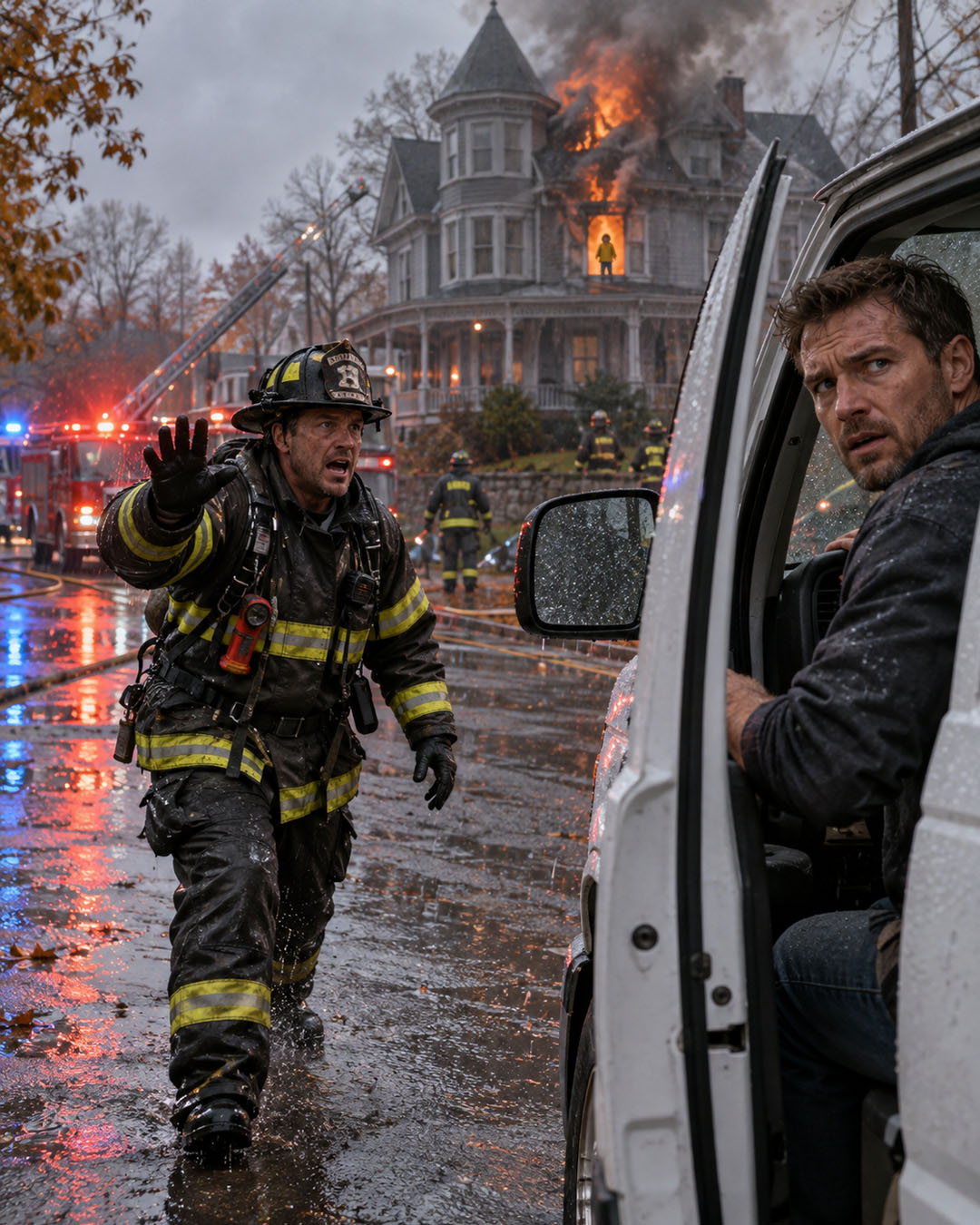
I jumped out before the car had completely stopped. Rain struck my face, but beneath the smell of wet grass and fallen leaves was something sharp and sickening.
Burning plastic.
“ELLIE!”
I sprinted toward the porch while Thomas studied the house with the terrible calm of a man who understood exactly what he was seeing.
The front door was locked.
I slammed my shoulder against it.
Nothing.
I tried again.
“Mark!” Thomas grabbed my arm. “Listen to me. We need to work smart.”
“She’s up there!”
“I see her. Call 911 and give them the address. Tell them a child is trapped on the third floor.”
I fumbled for my phone.
The dispatcher assured me engines were coming.
Six minutes.
Six minutes sounded like an eternity.
Thomas examined the side of the house.
“Where’s the gas shutoff?”
“Northeast corner. Beside the basement window.”
“Can you close it?”
“I installed the regulator myself.”
“Do it. Then bring me something I can use to break that window.”
I ran to my car, opened the trunk, and grabbed my tool bag.
The valve was stiff with old paint, but my adjustable wrench broke it loose.
I turned it closed and raced back.
Thomas had already climbed the iron trellis to the porch roof.
He was fifty-six years old, soaked, and recovering from nearly drowning in a freezing creek. Yet he moved with astonishing determination.
I climbed after him.
The wet roof was slippery beneath my boots.
“Give me the pry bar!” he shouted.
I passed it up.
Thomas braced himself against the wall and shattered the third-floor window.
Glass scattered across the shingles.
Smoke poured toward us.
“Ellie!” I yelled. “Daddy’s here!”
A small, terrified face appeared.
“Daddy!”
Thomas leaned through the opening.
“Sweetheart, I’m Captain Bennett. I’m a firefighter, and your daddy’s right here. Can you climb onto that bed?”
Ellie nodded.
She coughed violently.
“That’s it,” Thomas encouraged. “Keep your head low. Come toward my voice.”
For several horrifying seconds, I couldn’t see her.
Then her little hand appeared.
Thomas caught her wrist, lifted her through the opening, and passed her down to me.
I gathered her against my chest.
She was trembling, her cheeks blackened with soot.
“Daddy,” she sobbed. “I tried to get out. Grandpa locked the door.”
Everything inside me went cold.
“What?”
“Uncle Danny said it was a game. I was supposed to stay quiet until Mommy came.”
Flames suddenly burst through the broken window.
Thomas shouted for us to move.
We scrambled down the porch roof, and I lowered Ellie into the arms of firefighters arriving below.
Moments later, a section of the roof collapsed inward.
Had we arrived five minutes later, I might never have heard my daughter’s voice again.
An ambulance crew wrapped Ellie in blankets and placed an oxygen mask over her face.
She gripped my hand so tightly my fingers hurt.
“I’m sorry, Daddy.”
“Sorry for what, baby?”
“I wasn’t quiet like Grandpa said.”
I pressed my forehead against hers.
“You did absolutely nothing wrong.”
Her eyes filled with fresh tears.
“Mommy was there, too.”
I stared at her.
“What did you say?”
“Mommy was at Grandpa’s house. I heard her downstairs.”
“No, sweetheart. She’s in Columbus.”
Ellie shook her head.
“She had her special perfume. The one she wears when she gets dressed up.”
I knew the perfume.
Caroline wore it only on occasions she considered important.
“Did Mommy talk to you?”
“No. I heard her telling Grandpa to hurry up and get everything finished. Then somebody shut my door.”
I looked toward the burning house.
The third-floor windows glowed orange.
For the first time, I wondered whether the fire was the worst thing my family had done that afternoon.
At the hospital, doctors treated Ellie for smoke inhalation and a minor burn on her hand.
They expected a full recovery.
I should have felt nothing but relief.
Instead, I sat outside her room with shaking hands, unable to stop imagining what would’ve happened if I’d ignored the firefighter.
Around nine that evening, Captain Bennett returned with Fire Marshal Susan Keller.
She was a stern woman in her early sixties who spoke carefully and listened even more carefully.
“Mr. Mercer, your daughter was incredibly fortunate,” she said.
I nodded.
“There is something you need to know.”
She opened a folder.
“Firefighters found a heavy brass bolt on the outside of the playroom door. It was in the locked position.”
I felt sick.
“The adults left her alone in that room,” Susan continued. “The fire appears to have traveled through an interior wall cavity before reaching the upper floor.”
“I warned Richard about the wiring two years ago.”
Her expression sharpened.
“Do you have documentation?”
“An invoice. And notes from the service visit.”
“Keep them.”
Before she could say more, voices echoed down the corridor.
Richard Whitmore arrived wearing an expensive wool overcoat.
Daniel followed, looking pale.
Between them walked Caroline.
She wasn’t wearing conference clothes.
She wore a dark green dress, high heels, and a man’s oversized leather jacket.
“Mark!” she cried. “Where’s Ellie?”
“She’s sleeping.”
Caroline moved toward the room.
I stepped in front of her.
“Where were you today?”
“Columbus. I came back as soon as Dad called.”
“Ellie says you were at your father’s house.”
Her face changed.
Only slightly.
But after twelve years of marriage, I knew what that expression meant.
Richard stepped between us.
“Mark, everyone’s exhausted. This isn’t the time for accusations.”
“Was my daughter locked upstairs?”
“The latch was for her protection.”
“From what?”
“The stairs, obviously.”
“She almost died!”
Daniel cleared his throat.
“The fire was probably caused by the electrical work you did.”
I stared at him.
“What electrical work?”
“The renovations,” Richard said smoothly. “When you replaced the heating system.”
“I replaced a boiler. I didn’t rewire your house.”
Richard sighed.
“Son, I understand you’re upset. But we need to let the professionals establish the facts.”
Susan had been standing quietly nearby.
Now she closed her folder.
“We certainly will, Mr. Whitmore.”
Richard gave her a practiced smile.
“Of course.”
Then he looked back at me.
“I suggest you contact an attorney, Mark. We all need to protect Ellie from further harm.”
His voice was gentle.
His meaning wasn’t.
Early the next morning, a courier delivered an envelope to the hospital.
Inside was a petition for emergency custody.
Caroline was asking the court to remove Ellie from my care.
The documents claimed my negligent electrical work had caused the fire and that I’d endangered our daughter by leaving her with inadequate supervision.
The hearing was scheduled for Monday morning.
I read the papers twice.
My wife had signed them.
The woman I’d loved since college was accusing me of nearly killing our child.
And the family responsible for locking Ellie inside that house intended to make me pay for their actions.
Chapter 3
I called my oldest friend, attorney David Harris, before eight Sunday morning.
David and I had played baseball together in high school. He practiced family law in a modest office downtown and had never been impressed by people who measured their worth in dollars.
He listened without interrupting.
When I finished, he said, “Mark, this is worse than you think.”
“How could it be worse?”
“Richard has money, influence, and three people prepared to tell the same story. Right now, you have your word against theirs.”
“I have my daughter.”
“And we’re going to protect her.”
I told him about the dangerous wiring and the bolt.
David considered it.
“Can you prove Richard knew the electrical system was unsafe?”
“I warned him.”
“Will he admit it?”
“Not voluntarily.”
There was a long silence.
Then an idea came to me.
“David, can we get a court-ordered inspection of the house this afternoon?”
“Why?”
“Because Richard can’t stand being corrected about anything he owns.”
David sounded doubtful.
“That’s your strategy?”
“Trust me. I’ve spent twelve years listening to that man explain how the world works.”
He promised to contact a judge.
At ten, Caroline found me in the hospital cafeteria.
She wore jeans, a sweatshirt, and no makeup.
For an instant, she resembled the young woman I’d married.
“Can we talk?” she asked.
I nodded.
She sat across from me, staring at her untouched coffee.
“Mark, please don’t fight the custody petition.”
I couldn’t believe what I was hearing.
“Caroline, our daughter almost died yesterday.”
“I know.”
“Your father locked her in a room.”
“He wasn’t trying to hurt her.”
“Then what was he trying to do?”
She rubbed her forehead.
“We wanted Ellie occupied while we handled some paperwork.”
“What paperwork?”
She hesitated.
“Divorce papers. Custody arrangements.”
The cafeteria seemed to grow quieter.
“You planned to divorce me?”
Her eyes filled with tears.
“I haven’t been happy for a long time.”
“I know.”
That surprised her.
I continued.
“What I didn’t know was that you intended to take our daughter without discussing it with me.”
“Dad said we needed everything arranged before you became difficult.”
I looked at her.
“Where are you planning to live?”
“Michigan.”
“Why Michigan?”
She swallowed.
“There’s someone else.”
I’d suspected an affair.
Hearing it spoken aloud still felt like a blow to my chest.
“His name is Gregory Shaw,” she said. “He’s a real estate developer. He owns a vacation property near Traverse City.”
“How long?”
“Eighteen months.”
I thought of all the conferences, delayed flights, and weekends when she claimed to be working.
Then I asked the question that mattered.
“Were you at your father’s house yesterday?”
She stared at the table.
“Yes.”
“Did you know Ellie was locked upstairs?”
“Dad said it was a precaution.”
“Did you know he intended to leave her alone?”
“We were only supposed to be gone for a couple of hours.”
I closed my eyes.
“Caroline, you left our seven-year-old daughter locked in a room with faulty electrical wiring.”
“I didn’t think there would be a fire!”
“That’s the problem. None of you thought about her at all.”
She began crying.
“Dad said you’d lose everything if you fought us. Your business, your license, maybe even the house.”
I stood.
“Tell your father I’ll see him at three.”
“Where?”
“At the house.”
As I walked away, she called after me.
“Mark, he won’t back down.”
I stopped.
“Neither will I.”
Captain Bennett was waiting near the hospital entrance.
Beside him stood a thin, gray-haired man who looked as though life had gradually worn away his confidence.
“This is my brother, Frank,” Thomas said.
Frank shook my hand.
“Tom told me what happened. I’m grateful you stopped for him.”
“I’m grateful he noticed the smoke.”
Frank nodded.
Then he looked down.
“My house burned two years ago. Whitmore Insurance told me my policy had never been activated.”
“Thomas mentioned that.”
“I thought I was the only one.”
He explained that he’d eventually found other families with similar experiences.
A retired schoolteacher.
A widow.
A bakery owner.
Twenty-three households altogether.
Every one of them had paid Whitmore Family Insurance.
Every one had later discovered missing or nonexistent coverage.
“We meet at a church once a month,” Frank said. “Most of us lost our savings. Some lost their homes.”
Thomas folded his arms.
“Richard’s been getting away with this for years.”
Frank looked embarrassed.
“We don’t have much evidence beyond our payment records.”
I thought about Richard’s confidence.
The way he’d threatened my business.
The way he’d blamed me before anyone had completed an investigation.
Then I remembered something my father used to say.
“A man who thinks he’s the smartest person in the room usually can’t resist proving it.”
I asked Thomas a question.
“How many of those families could come to Larchmont Road this afternoon?”
Frank looked puzzled.
“Probably all of them.”
“Ask them to stay outside the property unless they’re invited in. And bring whatever paperwork they have.”
Thomas studied me.
“What are you planning?”
“I’m going to let Richard do the talking.”
At half past eleven, David called.
“We’ve got the inspection order,” he said. “Three o’clock. Fire marshal present, court reporter, both legal teams notified.”
“Did Richard agree?”
“He insisted on attending.”
I almost smiled.
Of course he did.
By three, the rain had stopped.
The Whitmore mansion stood blackened and broken beneath a pale autumn sky.
Richard arrived in a silver Mercedes with Daniel, Caroline, and an attorney named Lawrence Vance.
A second vehicle pulled up behind them.
A tall, well-dressed man stepped out.
Gregory Shaw.
I recognized him from photographs Caroline had once described as pictures of a business associate.
He stood beside her without looking at me.
David approached.
“Stay calm,” he whispered. “Answer questions. Don’t argue.”
“I won’t.”
Fire Marshal Keller led us through the damaged portions of the house that investigators had cleared as safe to enter.
A court reporter followed with her recording equipment.
The air smelled of wet ash.
On the second floor, Susan pointed toward a blackened wall.
“Our preliminary findings indicate the fire originated near this junction box.”
I stepped forward.
“Mr. Whitmore, you’ve claimed my company installed the wiring responsible for this fire.”
“Correct,” Richard said.
I pointed toward the exposed copper pipes.
“My crew installed those heating lines. They carry hot water. They don’t carry electricity.”
Richard frowned.
“What’s your point?”
“This junction box appears to have been added independently. It doesn’t meet code.”
“That’s ridiculous.”
“Perhaps I’m mistaken. Maybe I installed it without remembering.”
Richard’s face reddened.
“You most certainly did not!”
Daniel glanced at him nervously.
“Dad—”
“Be quiet, Daniel.”
Richard turned back toward me.
“That electrical splice was installed in 2019, three years before your boiler work. Daniel handled it when the old circuit failed.”
Nobody spoke.
Richard continued, apparently pleased to correct me.
“We avoided a complete rewiring because the estimate was outrageous. Forty thousand dollars to repair a floor nobody used regularly.”
Susan looked up from her notes.
“So you were aware the wiring needed replacement?”
Richard stiffened.
“I made a reasonable financial decision.”
“And your son performed the repair?”
“Yes.”
“Was there a permit?”
Richard hesitated.
“No.”
The court reporter’s machine continued recording.
David looked down, hiding his expression.
I felt the smallest flicker of hope.
We continued upstairs.
Near the ruined playroom, the brass bolt remained attached to the scorched doorframe.
Susan pointed toward it.
“Mr. Whitmore, why was this lock installed?”
“Child safety.”
“Why was it on the outside?”
“To prevent Ellie from wandering.”
“Did she have any way to open it herself?”
Richard sighed impatiently.
“Of course not. That would defeat the purpose.”
Caroline looked away.
I asked quietly, “Did you lock it yesterday?”
“Yes, Mark. And I’d do it again under the same circumstances.”
Susan stopped writing.
“What circumstances?”
“We needed a few hours of privacy. Caroline was finalizing her divorce arrangements, and the child had a tendency to call Mark whenever she became upset.”
David spoke.
“So you locked her inside to prevent her from contacting her father?”
Richard’s expression hardened.
“She had a tablet, snacks, and everything she needed. We weren’t gone long.”
“The house was empty when the fire started,” Susan said.
“An unfortunate coincidence.”
“You knew the wiring was dangerous.”
“That’s an exaggeration.”
“You left a child locked upstairs anyway.”
Richard lifted his chin.
“I refuse to be treated like a criminal for making sensible family decisions.”
The silence that followed was extraordinary.
Then Susan turned another page.
“Mr. Whitmore, who insured this property?”
“My own agency, naturally.”
“According to the carrier’s preliminary records, your coverage lapsed in March.”
For the first time, Richard looked genuinely uncomfortable.
“A temporary cash-flow decision.”
“Your house wasn’t insured?”
“Not at that particular moment.”
He tried to laugh.
“Premiums are money coming in and going out. An insurance businessman has to know how to manage that flow.”
Frank Bennett’s story rushed through my mind.
I asked, “And my business insurance, Richard?”
He smiled.
“Your policy was canceled for nonpayment yesterday morning.”
“My payments are current.”
“Administrative matters can be complicated, son.”
Thomas moved slightly beside the doorway.
Richard didn’t notice.
“Your liability carrier won’t be helping you,” Richard continued. “Fortunately, the authorities will see who was responsible for this unfortunate accident.”
Gregory Shaw suddenly stepped forward.
“Wait a minute.”
Everyone turned.
“Richard, you insured my development project in Michigan.”
Richard frowned.
“Gregory, not now.”
“You told me my six-million-dollar lodge was fully covered.”
“Of course.”
“Is it?”
Richard said nothing.
Gregory’s face drained of color.
“Is it, Richard?”
“We’ll discuss the documentation privately.”
Gregory stepped away from Caroline.
“No. I want a complete review of every policy you handled for me.”
He turned toward Susan.
“I’d like to make a statement.”
At that moment, Thomas walked to the front entrance and opened the gate.
Outside stood Frank and more than twenty other people.
Some held folders.
Others carried envelopes filled with years of payment records.
An elderly woman stepped forward.
“Mr. Whitmore,” she said, her voice trembling, “I’ve been paying your agency for nineteen years.”
Richard stared at her.
She continued.
“When my husband died, you told me our coverage had never existed.”
Frank raised his folder.
“You told me the same thing.”
Richard looked toward his attorney.
For once, Lawrence Vance had nothing to say.
Then Susan closed her notebook.
“Mr. Whitmore, I believe several agencies will want to examine your business records.”
Richard opened his mouth.
No words came out.
Chapter 4
The emergency custody hearing began Monday morning at nine.
I hadn’t slept more than three hours.
Ellie remained at the hospital for observation, and leaving her there with the nurses had been harder than walking into the courtroom.
Caroline sat across the aisle from me.
Richard occupied the front row beside Daniel.
He wore the same expensive suit he’d worn to countless charity dinners and business meetings, but his confidence had vanished.
Judge Margaret Reynolds entered carrying a thick folder.
She was a small woman with silver hair and a voice that needed no microphone.
“I’ve reviewed the preliminary fire investigation, the inspection transcript, and the supporting records,” she began.
Richard’s attorney stood.
“Your Honor, we’d like to withdraw the emergency petition.”
The judge removed her glasses.
“That does not erase the allegations made in it, counselor.”
She reviewed the evidence with painstaking care.
The dangerous wiring.
The unpermitted repairs.
The bolt locked from outside.
The adults leaving Ellie alone.
The attempt to blame my business.
Then she looked toward Caroline.
“Mrs. Mercer, did you know your daughter was being confined in that room?”
Caroline began crying.
“Yes, Your Honor.”
“And you left anyway?”
“Yes.”
The judge was silent for a moment.
Then she said, “A child is not an inconvenience to be secured behind a locked door while adults arrange their personal affairs.”
Caroline lowered her head.
The judge granted me sole temporary custody, ordered supervised contact for Caroline, and directed appropriate agencies to investigate the circumstances surrounding the fire.
When the hearing ended, Richard tried to approach me.
“Mark, perhaps we can discuss this privately.”
I looked at him.
“For years, you treated me like I wasn’t good enough for your family.”
His lips tightened.
“I never said that.”
“You never had to.”
He glanced toward the reporters waiting outside.
“We should keep this within the family.”
I shook my head.
“You stopped being concerned about family when you left Ellie behind that door.”
Then I walked away.
The investigations continued for months.
Investigators eventually uncovered extensive financial misconduct within Whitmore Family Insurance.
Premium payments had been diverted, policy records altered, and customers misled about coverage.
Richard faced charges involving fraud, theft, and child endangerment.
His insurance license was permanently revoked.
He eventually accepted a plea agreement and received a prison sentence.
Daniel admitted he’d performed the unsafe electrical repairs under his father’s direction. He also acknowledged helping install the playroom bolt.
He cooperated with investigators and received a lesser sentence.
I never forgot the look on his face when he testified.
He seemed like a man discovering, far too late, that obeying someone powerful didn’t relieve him of responsibility.
Gregory Shaw’s development project became entangled in insurance and financing disputes.
His relationship with Caroline ended almost immediately.
I learned about it through our attorneys.
By then, I had stopped caring who she loved.
The betrayal that mattered most had nothing to do with another man.
Caroline pleaded guilty to a child-endangerment charge.
She received probation, mandatory parenting classes, and supervised visits.
For a while, she attended every visit.
Then she moved to Michigan.
Some months, she called Ellie.
Other months, she didn’t.
I never taught my daughter to hate her mother.
But I also never pretended that love could excuse everything.
When Ellie asked why Mommy didn’t live with us anymore, I told her the truth in words a child could understand.
“Sometimes grown-ups make choices that hurt the people they love. Those choices have consequences.”
“Does Mommy still love me?”
I held her close.
“I believe she does, sweetheart. But love also means keeping someone safe, and she didn’t do that.”
Ellie was quiet for a long time.
Then she whispered, “You came back.”
I kissed her forehead.
“Yes, baby. I came back.”
Meanwhile, Thomas Bennett’s brother and the other families received long-overdue attention.
Investigators helped establish the extent of their losses, and compensation was eventually arranged through applicable recovery programs, settlements, and recovered assets.
Frank received enough to begin rebuilding his life.
The day he called to tell me, his voice broke.
“For two years,” he said, “I thought I’d done something wrong.”
“You didn’t.”
“I know that now.”
He paused.
“Funny how much it matters to hear somebody say it.”
I understood exactly what he meant.
At the beginning of November, Fire Marshal Keller called with unexpected news.
During a final examination of the damaged playroom, investigators had recovered a small stuffed fox.
Its tail was scorched, and one ear had been badly singed.
But the little brown face was recognizable.
Pickles.
Ellie’s favorite toy since she was three.
She’d cried for him at the hospital, even while doctors were examining her burned hand.
I’d assumed he’d been destroyed.
Susan arranged to return him once he was released from the investigation.
When I told Thomas, he had an idea.
“Let’s give that little girl a birthday party she’ll never forget.”
And for once, I had absolutely no objection.
Chapter 5
Ellie’s seventh birthday celebration took place at Fire Station Four, one week after she came home from the hospital.
The firefighters had moved their engine outside and decorated the garage with yellow balloons.
A long table held chocolate cake, pizza, lemonade, and enough presents to fill the back of my car.
Ellie walked through the entrance wearing her favorite purple sneakers.
When she saw Thomas, she ran straight into his arms.
“Captain Tom!”
He scooped her up.
“There’s my favorite little firefighter!”
She examined the paper crown balanced on his gray head.
“Why are you wearing that?”
“Because they won’t let me drive the fire truck with it on.”
Ellie laughed.
Then Thomas handed her a small box.
Inside was Pickles.
His damaged ear had been carefully cleaned, and a tiny blue ribbon circled his neck.
Ellie stared at him.
For several seconds, she didn’t speak.
Then she lifted the fox and pressed him to her cheek.
“You came back, too,” she whispered.
I turned away before anyone saw my eyes fill.
Thomas rested a hand on my shoulder.
“She’s a tough little girl.”
“She shouldn’t have needed to be.”
“No,” he agreed. “She shouldn’t.”
Later, the firefighters showed Ellie the equipment, let her sit in the driver’s seat, and presented her with a child-sized helmet.
She wore it throughout dinner.
At one point, she stood on a folding chair and raised her lemonade cup.
“I want to thank Captain Tom,” she announced solemnly, “because he climbed a house even though he’s kind of old.”
The entire station erupted in laughter.
Thomas placed a hand over his heart.
“Kind of old? Young lady, I’m practically brand-new.”
Ellie considered that.
“Then why do you have so much gray hair?”
The laughter grew louder.
For the first time since the fire, I laughed without feeling guilty.
That evening, Thomas walked us to the car.
He shook my hand.
“You know, Mark, I probably owe you my life.”
I shook my head.
“You saved my daughter’s.”
“We helped each other.”
I looked at him for a moment.
“I almost didn’t stop.”
He nodded.
“Most people wouldn’t have.”
“I was tired. I had another job waiting. I kept thinking about how late I’d be.”
Thomas glanced toward Ellie, who was fastening Pickles into the seat belt beside her.
“Sometimes the road takes you somewhere you didn’t plan to go.”
I smiled faintly.
“That’s one way to put it.”
He gripped my shoulder.
“Your father would’ve been proud of you.”
I had told him about Dad’s old rule, about never leaving a house colder than you found it.
Hearing Thomas say those words meant more than he knew.
On our way home, I took County Road 16.
The creek had settled back between its banks, and the broken stretch of road had been repaired.
Autumn leaves scattered across the pavement beneath the headlights.
Ellie sat quietly in the back seat, holding Pickles against her chest.
Then she leaned forward.
“Daddy?”
“Yes, sweetheart?”
“Is this where Captain Tom was standing?”
I glanced toward the curve.
“It is.”
“Right there?”
“Right beside the creek.”
She studied the dark roadside.
“And you turned around?”
“Yes.”
“Why?”
It was such a simple question.
Yet I couldn’t immediately answer.
I thought about the elderly residents waiting for heat. I thought about the rain, the ruined pickup, and the stranger who had asked for help.
I thought about the years I’d spent worrying that I wasn’t successful enough for Richard’s family.
And I thought about the terrible possibility that I might have kept driving.
Finally, I said, “Because he needed a ride, honey. And I had a car.”
Ellie considered that answer with the seriousness only children possess.
“That’s good,” she said.
Then she settled back into her seat.
A few minutes later, she spoke again.
“Daddy, when I grow up, I want to help people like Captain Tom.”
I caught her eyes in the rearview mirror.
“That’s a wonderful thing to want.”
“And like you.”
My throat tightened.
I didn’t trust myself to speak.
So I reached back at the next stop sign and squeezed her little hand.
Life didn’t become perfect after that.
I still worked long hours.
Some nights, Ellie woke from dreams of smoke and locked doors.
There were appointments, difficult conversations, and mornings when I wished I could make the world as safe as she’d once believed it was.
But our home slowly filled with laughter again.
We baked cookies on Sundays.
We adopted another dog when our old retriever passed away.
And whenever Ellie heard a fire engine, she insisted on waving until it disappeared.
Thomas became part of our family.
He came to Thanksgiving dinner, attended school concerts, and taught Ellie how to check the smoke alarms.
Frank came too, bringing his wife and photographs of the modest new home they were building.
Sometimes I looked around that table and wondered how many lives had changed because one man had stood in the rain, waiting for someone to stop.
Years later, Ellie would remember the fire mostly in fragments.
A yellow raincoat.
A broken window.
A man’s voice telling her to crawl toward him.
And her father’s arms pulling her into the cold October air.
But I remembered everything.
The bolt.
The smoke.
The terrified look on her face.
And that moment on the county road when I had almost decided I was too busy to help a stranger.
My father used to say that a person’s character isn’t measured by the grand things they promise to do.
It’s measured by the small things they choose to do when nobody is watching.
I didn’t understand the full meaning of that until the afternoon I turned my car around.
I had thought I was rescuing a stranger from the rain.
Instead, that stranger helped me rescue my daughter.
And somewhere between the flooded creek and a burning third-floor window, I learned something I’ll carry for the rest of my life.
We never know how far one act of kindness may travel, or whose tomorrow may depend on the choice we make today.
Sometimes the greatest blessing in our lives begins with an inconvenience we almost refuse.
THE END. ⚠️ All characters and events are fictional. Do not imitate or apply them in real life. 😌😌😌