
Chapter 2
I wanted to drive straight to Patricia’s house and demand an explanation. Instead, I sat alone in the hospital parking lot until my hands stopped trembling.
Then I called an attorney.
Rachel Nguyen practiced family law in New Haven. She listened while I described Patricia’s comments, the missing cup, and the laboratory’s telephone call.
“Your mother-in-law had no authority to arrange genetic testing for Lily without appropriate parental authorization,” Rachel explained. “We need to preserve the records and establish exactly what she submitted.”
“Can I stop her?”
“You can protect your daughter. But I recommend you don’t confront Patricia until we understand what she’s doing.”
Rachel advised me to document everything and contact the laboratory again to confirm the cancellation.
That evening, I opened the notebook where I’d recorded Patricia’s remarks over the previous year. Fourteen separate incidents filled several pages.
I added another entry.
For the next few days, I behaved normally.
I went to work, helped children recovering from injuries, made dinner, and read bedtime stories to Lily. Mark was busy managing several construction projects and barely noticed my distraction.
But something inside me had changed.
For years, I’d swallowed Patricia’s insults to preserve family peace. Now she’d crossed a line that no reasonable grandmother should cross.
Five days after the laboratory called, I stopped at Patricia’s house to collect a pair of Lily’s shoes.
Courtney answered the door.
“Mom’s at the salon. Come on in.”
As I searched the mudroom, I overheard Courtney talking on speakerphone in the living room.
“Mom got the results,” she said excitedly. “She’s going to show everyone at Sunday dinner.”
A muffled voice answered.
Courtney laughed.
“She says Mark won’t be able to deny it anymore. It’s going to be unbelievable.”
My heart pounded.
So Patricia hadn’t stopped with the canceled laboratory request. She had apparently used another testing service, one with fewer safeguards.
I walked back into the living room holding Lily’s shoes.
Courtney immediately ended her call.
“Find everything?”
“Sure did,” I answered.
Outside, I sat in my car for several minutes.
Patricia was planning to humiliate me in front of the entire family.
She’d already decided what the results would say.
That night, I called Rachel again.
“She has another set of results,” I explained. “She’s presenting them Sunday.”
Rachel asked whether I wanted to confront Patricia beforehand.
I considered it carefully.
If I approached her privately, I knew what would happen. Patricia would cry, Mark would ask everyone to forgive her, and eventually the family would pretend nothing serious had occurred.
“Not this time,” I said.
Rachel helped me prepare a formal request for the testing records and advised me to keep Lily’s information private. She also explained that genetic matching reports could reveal relatives beyond the person being tested.
That detail became important sooner than I expected.
Two days later, Mark mentioned something unusual.
“Mom called asking whether I’d ever done one of those ancestry tests,” he said while rinsing dinner plates.
“What did you tell her?”
“That I mailed one in years ago. Remember? Courtney bought everybody kits for Christmas.”
I remembered the holiday. Mark, Courtney, and Warren had participated, while Patricia had insisted she wasn’t interested.
“Why was she asking?”
Mark shrugged.
“No idea. She’s been acting strange lately.”
I nearly told him everything.
Instead, I asked whether he’d kept his old results.
“Probably somewhere in my email.”
He opened his laptop and found the account. The original ancestry report showed exactly what we’d expected: a mixture of European family backgrounds.
But there was something new in the relative-matching section.
A message from a man named James Callahan, thirty-six, living in Portland, Oregon.
The message had arrived that week.
Mark read it aloud.
“I was adopted as an infant in Connecticut. Our DNA suggests we’re close biological relatives. If you’re comfortable talking, I’d appreciate hearing from you.”
Mark frowned.
“That’s weird. Maybe he’s some cousin Dad never mentioned.”
I looked at the relationship estimate displayed beneath James’s name.
Half brother.
The room suddenly felt very quiet.
“Mark,” I said carefully, “that doesn’t say cousin.”
He leaned closer to the screen.
Neither of us spoke for several seconds.
“Half brother?” he whispered. “That doesn’t make sense.”
I couldn’t explain it either.
Warren had been a devoted father for as long as Mark could remember. He and Patricia had married before Courtney was born, and Mark believed their family history contained no serious mysteries.
But James’s profile revealed something else.
He had been born in Hartford two years before Patricia and Warren married.
Mark pushed his chair away from the table.
“Maybe Dad had a child before he met Mom.”
“Maybe,” I answered.
Yet I remembered Patricia’s obsession with family origins. I remembered her constant questions about Lily and her insistence that our daughter couldn’t possibly be an Atwood.
For the first time, I wondered whether Patricia’s determination to uncover someone else’s secret came from fear of her own.
Mark wanted to contact James immediately.
I suggested he speak with Rachel first, so we could understand what the results could actually establish. Genetic estimates weren’t proof of every detail, and James deserved to be treated with care.
The following afternoon, Rachel explained that the reported relationship was consistent with James sharing a biological parent with Mark. Additional testing and family information would be needed to confirm the connection.
Mark spent most of that evening staring at an old photograph album.
Then he stopped on a picture of his mother, taken when she was about twenty.
Her hair was bright copper red.
“Danielle,” he said softly, “come look at this.”
I sat beside him.
Patricia had spent decades dyeing her hair dark brown. I’d never seen a photograph of her before she started coloring it.
The young woman in that picture had Lily’s curls.
And suddenly, I understood just how cruel Patricia’s accusations had been.
She had spent years insisting the very feature our daughter inherited couldn’t possibly belong to her family.
Mark closed the album.
“We’re going to Sunday dinner,” he said.
“And if she brings up Lily?”
He looked directly at me.
“Then she’s finally going to hear what I should’ve said years ago.”
Chapter 3
Sunday arrived with clear skies and a cool autumn breeze.
I dressed Lily in a blue dress with little white flowers. She twirled in front of the hallway mirror while Mark searched for his car keys.
“Mommy, do I look like a princess?”
“You look like my favorite girl in the whole world.”
She threw her arms around my neck.
For a moment, I wished we could spend the afternoon anywhere else.
But Mark had made his decision.
When we reached Patricia’s house, several cars were already parked outside. Warren’s pickup sat beside Courtney’s sedan, and Aunt Margot’s silver Buick occupied the driveway.
Patricia greeted us wearing her pearls and a satisfied smile.
“Everyone’s here. Isn’t that wonderful?”
She kissed Mark and bent to hug Lily. When she reached for one of Lily’s curls, my daughter instinctively stepped closer to me.
I noticed.
So did Mark.
Dinner began with pot roast, mashed potatoes, and Patricia’s famous apple pie waiting on the kitchen counter.
Warren talked about a fishing trip. Uncle Dennis complained about rising repair costs, and Courtney laughed too loudly at nearly everything.
Patricia barely touched her food.
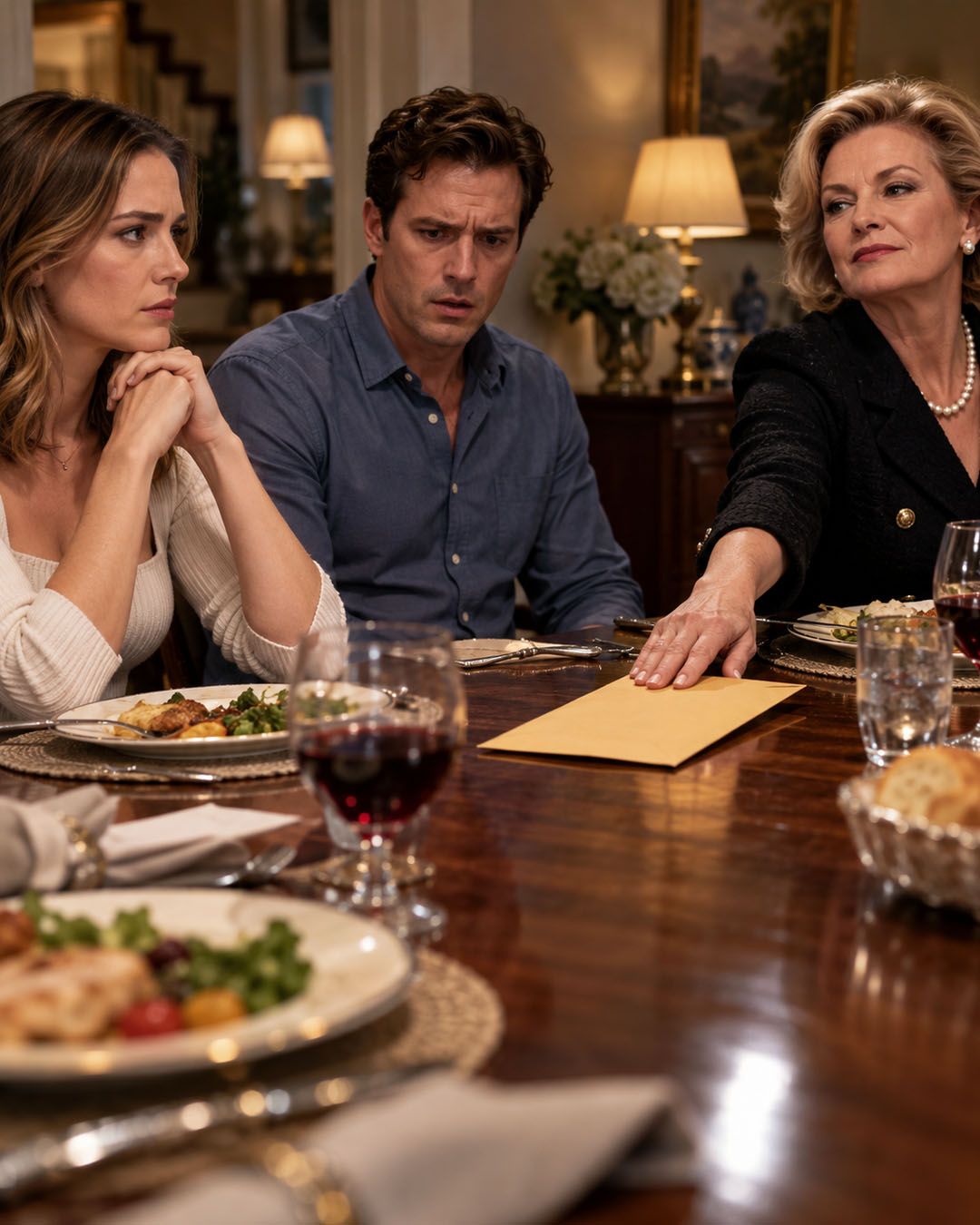
A thick manila envelope rested on the sideboard.
Halfway through dinner, she stood.
“Before dessert, there’s something important this family needs to discuss.”
Warren looked up.
“Pat, can’t it wait?”
“No, Warren. I’ve waited long enough.”
She retrieved the envelope and placed it in front of Mark.
“I did something difficult because I love you. Because I refuse to watch you be taken advantage of.”
Mark didn’t reach for the envelope.
“What did you do?”
Patricia glanced toward me.
“I had Lily’s DNA tested.”
Warren dropped his fork.
“You did what?”
Patricia ignored him.
“That little girl doesn’t resemble anyone in our family. I’ve had concerns for years, and Danielle has never given me a satisfactory explanation.”
Courtney nodded.
“Mom only wanted to be sure.”
Mark turned toward his sister.
“Did you know about this?”
Courtney looked away.
Patricia pushed the envelope closer.
“Read it, Mark. You deserve the truth.”
Our daughter was upstairs napping in the guest bedroom. I was grateful she couldn’t hear the conversation.
Mark opened the envelope.
Inside were several printed pages, including a paternity analysis Patricia had obtained through a private mail-in service.
He read silently.
Then he read the first page again.
Patricia leaned forward.
“Well?”
Mark raised his eyes.
“The reported probability of paternity is 99.9998 percent.”
Patricia blinked.
“What?”
“Lily is my biological daughter, Mom.”
The room became completely still.
Patricia snatched at the papers, but Mark pulled them away.
“That can’t be right,” she insisted. “Look at her hair!”
“Her hair?” Mark repeated. “You put my wife through years of humiliation because of our daughter’s hair?”
“I was protecting you.”
“No. You were accusing Danielle of betraying me without a shred of evidence.”
Courtney whispered that the laboratory might have made a mistake.
Mark turned toward her.
“Enough, Courtney.”
His voice wasn’t loud, but she’d never heard him speak that firmly.
I finally stood.
“Patricia, the original laboratory called me because you tried to submit Lily’s sample without parental authorization. I canceled that request. My attorney has copies of the correspondence.”
Warren stared at his wife.
“You took something from our granddaughter and sent it away without asking her parents?”
Patricia’s face reddened.
“I did what I thought was necessary.”
“You had no right,” I said.
She pointed at me.
“Of course you’re angry. You’ve always wanted to turn my son against me.”
Mark shook his head.
“Mom, you’re doing that all by yourself.”
I looked at the envelope.
“And there’s something else we need to discuss.”
Patricia’s eyes narrowed.
“What else?”
Mark opened his laptop bag and removed the old photograph album he’d brought from home. He set it beside the envelope.
“Before we get to that, Mom, tell everyone why you’ve spent years insisting red hair doesn’t run in our family.”
Patricia looked confused.
“Because it doesn’t.”
Mark opened the album to the photograph we’d found.
“Then who’s this?”
Warren leaned across the table.
“Good Lord, Patricia. That’s you at the lake.”
The photograph showed Patricia at twenty, smiling beside an old station wagon, her red curls shining in the summer sunlight.
Aunt Margot closed her eyes.
Patricia’s fingers moved toward her pearl earring.
“I started coloring it when I was young,” she murmured. “I never liked being a redhead.”
Mark stared at her.
“You knew Lily could have inherited that hair from you.”
Patricia didn’t answer.
“You knew,” he repeated.
For the first time, the woman who always had an explanation had nothing to say.
But the photograph wasn’t the biggest secret waiting at that table.
Mark opened his laptop.
“There’s also a man named James Callahan.”
Aunt Margot’s glass slipped from her hand.
It struck the table and spilled water across the linen cloth.
Patricia went pale.
Mark looked from one woman to the other.
“Do you know him?”
Margot gripped the edge of her chair.
“Patricia,” she whispered, “you need to tell them.”
Warren slowly turned toward his wife.
“Tell us what?”
Patricia began shaking her head.
“No. Please. Not here.”
Mark’s voice softened.
“Mom, is James your son?”
She covered her mouth.
Then she started crying.
Real, frightened sobs that seemed to come from somewhere she’d kept locked away for decades.
“I was twenty-five,” she finally whispered. “I was alone, and my parents were ashamed. They sent me away until the baby was born.”
Warren looked stunned.
“A baby?”
Patricia nodded.
“A boy. I named him Michael before they took him.”
Margot reached for her sister’s hand.
“I was the only one who knew.”
Mark swallowed.
“James Michael Callahan,” he said. “He’s thirty-six. He was adopted in Hartford.”
Patricia closed her eyes.
“That’s my baby.”
The words seemed to drain all the air from the room.
Warren rose slowly.
“We’ve been married thirty-four years, Patricia.”
“I know.”
“And you never told me you had a son?”
“I thought you’d leave me.”
Warren stared at her.
“I loved you. I would have helped you find him.”
Patricia looked down at her hands.
“I convinced myself it was too late. Every year made it harder.”
For one brief moment, I felt tremendous pity.
I imagined a frightened young woman being pressured to surrender her baby, then carrying that sorrow into marriage and motherhood.
But sympathy couldn’t erase what Patricia had done to Lily.
Mark spoke quietly.
“Your son has been looking for his birth mother for years. He reached out to me because we’re a close DNA match.”
Patricia wiped her cheeks.
“Does he know about me?”
“Not yet. I wanted to talk to you first.”
She looked toward me, and something bitter returned to her expression.
“This wouldn’t be happening if Danielle hadn’t turned everyone against me.”
Mark stood so abruptly his chair scraped across the hardwood floor.
“Stop blaming my wife!”
Everyone froze.
“You arranged the test. You invited the family. You wanted to embarrass Danielle in front of everyone.”
His voice broke.
“And all this time, you were hiding your own child.”
Patricia lowered her head.
Warren picked up his jacket.
“I’m going to Dennis’s for a while.”
“Warren, please.”
He paused beside the door.
“I’m not leaving because you had a baby before we met. I’m leaving because you didn’t trust me with the truth, and because I don’t recognize what you’ve done to our family.”
Then he walked outside.
I went upstairs and lifted Lily from the guest bed.
She curled against my shoulder, still half asleep.
When we came downstairs, Patricia was sitting alone at the dining table. Her pearls were beside the untouched apple pie.
She looked at Lily and began crying again.
Mark opened the front door.
“Come on, sweetheart. We’re going home.”
Chapter 4
The drive home was quiet until Lily fell asleep in her car seat.
Mark stared at the road, his hands tight around the steering wheel.
“Why didn’t you tell me about the laboratory call right away?” he finally asked.
“Because I was afraid you’d forgive her before you understood how far she’d gone.”
He was silent for a long time.
Then he sighed.
“You had reason to think that. I’ve spent our whole marriage asking you to tolerate things I should’ve stopped.”
I looked at him.
“I never wanted you to choose between your mother and me, Mark.”
“I know. But I should’ve chosen to protect our family.”
He reached across the console and took my hand.
That small gesture meant more than any speech he could have given.
The following morning, Mark called Patricia. He told her we needed space and that she wasn’t to visit Lily without our permission.
For once, Patricia didn’t argue.
Rachel sent a formal letter addressing the unauthorized testing and requesting that Lily’s genetic information be deleted from every service where Patricia had submitted it. We also made arrangements to address any remaining copies of the records.
Protecting our daughter’s privacy mattered more to me than punishing Patricia.
Meanwhile, Mark couldn’t stop thinking about James.
On Saturday morning, he sat at our kitchen table composing a message. He typed it, erased it, and started again several times.
Finally, he wrote:
“Hello, James. My name is Mark Atwood. Based on our DNA match and some family information we’ve recently learned, I believe we’re half brothers. I understand you’ve been searching for your biological family. If you’d like to talk, I would too.”
James responded that afternoon.
“I’ve wondered about my birth family my entire life. I never expected to find a brother.”
They arranged a video call.
I stayed in the living room with Lily while Mark sat alone at the kitchen table. At first, their conversation was awkward, filled with nervous laughter and ordinary questions.
James was a high school history teacher in Oregon. He was married, had a four-year-old daughter, and coached basketball after school.
He had grown up with loving adoptive parents who’d always encouraged him to understand his beginnings.
After twenty minutes, I heard Mark crying.
When I glanced into the kitchen, James was wiping tears from his own face.
The resemblance was remarkable.
They shared the same square jaw, dark eyes, and crooked smile.
“I don’t want to hurt anybody,” James told him.
“You’re not hurting anyone,” Mark answered. “You’re family.”
Later, James said something that stayed with me.
“I never needed my birth mother to explain why she couldn’t raise me. I just wanted to know she remembered I existed.”
Mark couldn’t speak for several seconds.
Then he promised to tell Patricia.
Two weeks later, my mother-in-law appeared at our front door.
She looked smaller somehow, wearing a plain gray cardigan instead of her usual carefully coordinated clothes.
“I know I shouldn’t have come without calling,” she said. “But I needed to apologize.”
Mark stood beside me.
“Then we’re listening.”
Patricia clasped her hands.
“I was wrong about Danielle. Terribly wrong. I convinced myself I was protecting you, but I was acting out of fear.”
She looked at me.
“I was afraid of losing my family. I spent so many years hiding my past that I started seeing threats everywhere.”
I studied her carefully.
“Patricia, you didn’t just hurt me. You involved a little girl who trusted you.”
Her eyes filled.
“I know.”
“She notices when you question her appearance. She asks why Grandma always touches her hair.”
Patricia covered her mouth.
“I never meant to make her feel different.”
“But you did.”
She nodded slowly.
Mark stepped forward.
“Mom, if you want to be part of Lily’s life, things have to change.”
He explained that visits would be arranged in advance, that she couldn’t be alone with Lily for the foreseeable future, and that there would be no more questioning our daughter’s identity.
Patricia agreed to every condition.
Then Mark told her about James.
“He wants to know you, Mom. But he doesn’t want to be another secret.”
Patricia pressed a hand against her chest.
“Would he really speak to me?”
“Yes. When you’re both ready.”
For the first time since I’d known her, Patricia didn’t try to control what happened next.
She simply whispered, “Thank you.”
Warren stayed with Dennis for nearly two months. During that time, he began counseling and spent weekends visiting Lily.
One Saturday, he brought her a little wooden truck he’d made himself.
Lily squealed when she saw it.
“Grandpa! You made me a car!”
Warren laughed and lifted her into his arms.
“That’s right, pumpkin. Every princess needs a good truck.”
Watching them, I realized that our family wasn’t falling apart the way Patricia had feared.
It was changing.
And some of those changes were long overdue.
Eventually, Warren returned home, though he and Patricia continued working through the damage to their marriage. He told Mark that forgiveness wasn’t something he could promise on a schedule.
“I can understand a frightened young woman making a painful choice,” he said. “But your mother has to understand what all those years of silence did to us.”
Mark respected that.
Courtney apologized too. She admitted she’d repeated her mother’s suspicions because she’d never learned to question Patricia.
Our relationship didn’t recover overnight, but she began making an effort.
Several months later, Mark flew to Portland to meet James in person.
He returned with photographs of the brothers standing outside James’s house, smiling awkwardly with their arms around each other’s shoulders.
James’s little daughter had the same bright red curls as Lily.
When Mark showed me the picture, we both laughed.
“Wait until Mom sees this,” he said.
Patricia eventually did meet James.
Their first conversation was private, and Mark respected their wish to keep it that way. What he told me afterward was simple.
His mother apologized for the silence. James told her about the good life he’d had with his adoptive parents, and they agreed to begin getting acquainted slowly.
He didn’t call her Mom that day.
She didn’t ask him to.
For someone who once demanded that everyone follow her plans, Patricia was finally learning that love couldn’t be ordered or controlled.
The following spring, we gathered for Lily’s fourth birthday at our house.
Warren brought another wooden toy. Courtney arrived with balloons, and Patricia brought a cake decorated with little pink flowers.
James and his family joined us by video call from Oregon.
As everyone sang “Happy Birthday,” Lily stood on a chair beside Mark, her red curls glowing in the afternoon sunlight.
Patricia watched her quietly.
When the song ended, Lily reached for her grandmother.
“Grandma Pat, look! My hair is just like the little girl in Daddy’s old picture!”
Patricia knelt beside her.
“Yes, sweetheart. It is.”
“Was that you?”
Patricia smiled through sudden tears.
“That was me.”
Lily gently touched one of Patricia’s dark curls.
“Why isn’t your hair red anymore?”
Patricia looked at Mark, then at me.
“Because I spent a long time trying to be somebody I thought people would like better.”
Lily considered that with the seriousness only a four-year-old can manage.
“I like my red hair.”
Patricia brushed a curl away from her granddaughter’s forehead.
“So do I, sweetheart. I think it’s beautiful.”
That afternoon, as the family gathered around the birthday cake, I thought about everything we’d endured.
Patricia had believed that bloodlines determined who belonged. She’d treated appearances as evidence of loyalty and secrets as something worth protecting at any cost.
But the DNA test she’d arranged to push me out of the family had brought a missing son home.
It had also forced my husband to stand up for his wife and daughter, and taught a frightened woman that the truth she’d spent decades avoiding wasn’t nearly as terrible as the harm she’d caused trying to hide it.
I hadn’t forgotten what Patricia did. I wasn’t certain I’d ever trust her the way I once hoped I could.
But forgiveness, I had learned, didn’t require pretending the past hadn’t happened. It meant allowing room for change while keeping the people we loved safe.
That evening, after the guests had gone, Mark helped me clean the kitchen.
Lily was asleep upstairs, her new wooden truck beside her pillow.
Mark picked up a stray birthday candle and smiled.
“Funny, isn’t it? Mom was so determined to prove Lily wasn’t one of us.”
I dried the last plate.
“And now?”
He wrapped his arms around me.
“Now I think she’s finally beginning to understand what family means.”
I leaned against him and looked toward the staircase where our daughter slept peacefully.
Family wasn’t measured by matching hair, shared last names, or perfect histories.
It was measured by the people who chose to love, protect, and stand beside one another when the truth became difficult.
And that was the only inheritance I wanted to pass on to my daughter.
THE END.

