
Chapter 2
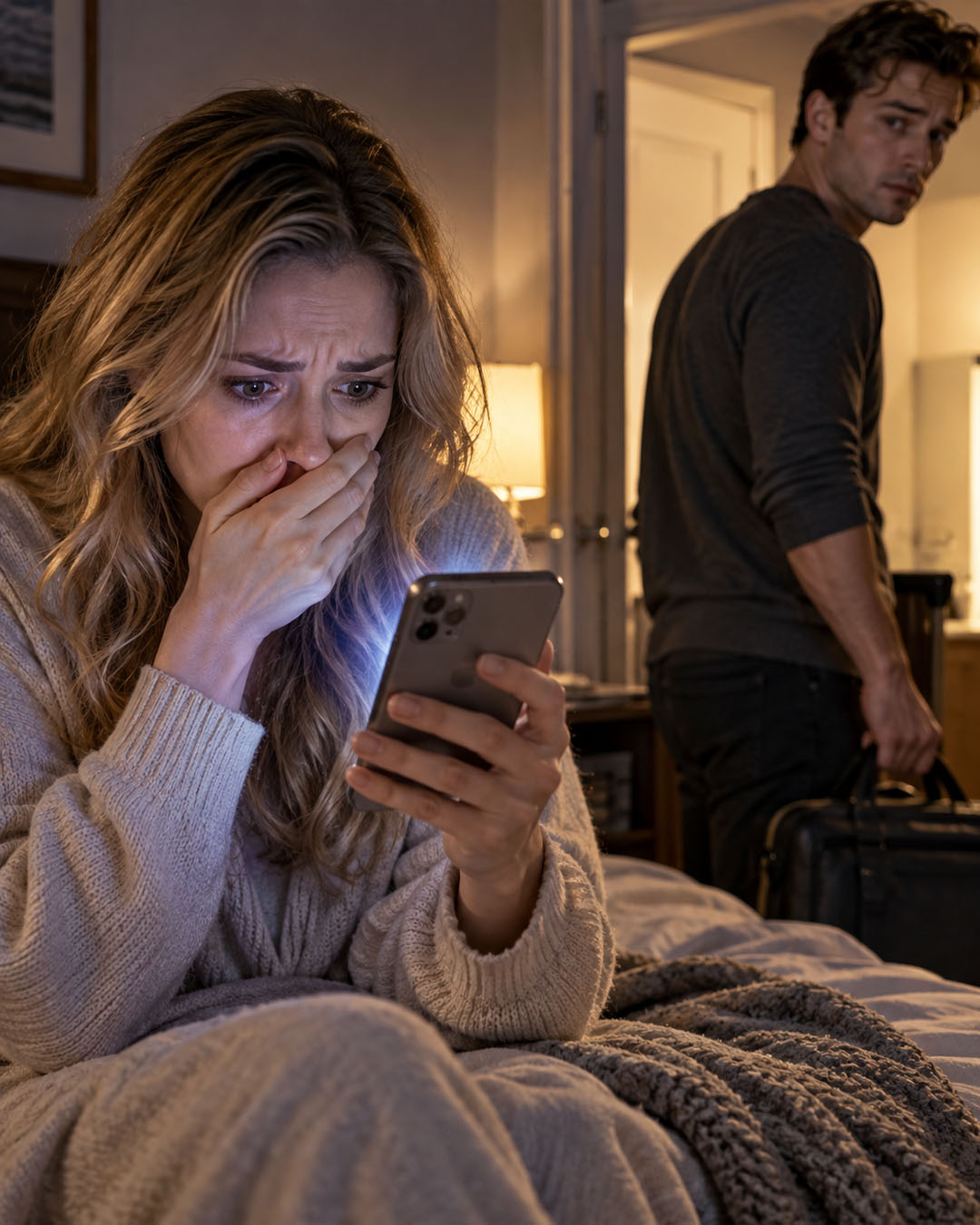
I barely slept that night. Every time I closed my eyes, I saw Jake smiling across my parents’ dinner table, praising my mother’s cooking and asking my father about his retirement plans. How could the same man be writing such terrible things?
The next morning, I called in sick and began reviewing everything carefully. I saved screenshots of the Reddit posts, copied the page addresses, and wrote down the times each update had appeared. As an accountant, I’d learned that suspicions meant little without reliable records.
Jake texted around lunchtime, saying he’d unexpectedly left town for business.
I didn’t believe him.
That evening, one of his friends posted a photograph from a sports bar in Columbus. Jake’s face wasn’t visible, but a man’s hand rested beside a beer glass. On one finger was a silver ring engraved with the initials J and S.
I’d given Jake that ring on our third-month anniversary.
When I texted asking where he was, he replied that he was still out of town.
The lie frightened me more than the photograph itself.
Over the following days, Jake repeatedly called and sent affectionate messages. I avoided seeing him, telling my parents that I needed time to think. Eventually, my mother asked whether something had happened between us.
I showed her the Reddit posts.
At first, she looked confused. Then she read the details about our wedding conversation, and her expression changed.
“Sarah, these are things you told Jake privately.”
“I know, Mom.”
My father read the posts without speaking. When he reached the part about intentionally harming the woman, he removed his glasses and placed them carefully on the table.
“You’re not meeting him alone again,” he said.
My mother decided to call Jake’s parents about his refusal to undergo medical screening. She didn’t mention the Reddit account, but she made it clear that we wouldn’t consider an engagement without both of us freely agreeing to appropriate medical consultations.
That evening, Jake called.
“Sarah, honey, I’ve been thinking,” he began. “I acted foolishly. Mom told me I was being stubborn, and she’s right. If those tests make you comfortable, let’s do them.”
I kept my voice calm.
“I’m glad you’ve changed your mind.”
“I’ve already arranged everything,” he continued. “My cousin knows somebody at Oakridge Diagnostics. It’s a small private clinic on the north side. We can go Tuesday morning.”
Something about his sudden enthusiasm bothered me.
“That’s thoughtful. Let me check my work schedule.”
“No need to worry about anything,” he said cheerfully. “I’ve got it handled.”
Twenty minutes after we hung up, I checked Reddit again.
The anonymous account had another update.
The writer complained that his fiancée’s mother had contacted his parents, forcing him to agree to medical testing. Fortunately, he claimed, he knew someone at a private clinic willing to provide false negative paperwork for a few hundred dollars.
Once his fiancée saw the results, she’d agree to marry him immediately.
Then came a sentence that removed whatever doubt remained in my mind.
He mocked the woman for believing she was clever simply because she worked with numbers all day.
I closed my laptop.
For six months, I’d believed Jake was a decent man who wanted to build a future with me. Now I feared he saw me as a solution to his family’s financial troubles.
I needed help.
My college roommate’s older brother, Mark Reynolds, was an attorney who specialized in healthcare compliance. We’d remained friends through the years, and I trusted his judgment.
When I explained everything, he listened carefully.
“Sarah, the most important thing is your safety,” he said. “Do not confront him alone, and don’t go to that clinic.”
I told him about the plan to obtain fraudulent test results.
“Preserve everything you can,” Mark advised. “A Reddit post isn’t proof of who wrote it. And private medical information can’t simply be pulled from a hospital because somebody is suspicious. But these threats may justify contacting law enforcement.”
He recommended reporting the posts and consulting a detective experienced in online threats. He also suggested that I arrange my own medical appointment and let Jake decide whether to attend a legitimate clinic independently.
That evening, I met my parents at their house and explained the situation.
My mother cried when she read the newest update. My father sat motionless, his jaw clenched, before asking the question I’d been avoiding.
“Sarah, what if he really intends to hurt you?”
“Then I need to get away from him,” I said. “And I want to make sure there’s a record of what he’s threatened.”
The next morning, Mark helped me speak with Detective Laura Miller of the Columbus Police Department. She reviewed the screenshots, listened to my account, and opened an investigation into the threats.
She explained that establishing who controlled the account would require proper legal procedures. She also warned me not to attempt to trap Jake or take risks to obtain evidence.
I agreed.
On Monday afternoon, I sent Jake a message.
“I scheduled my appointment at St. Catherine’s Medical Center for Tuesday morning. You’re welcome to arrange yours there too. I won’t accept results from Oakridge.”
His reply arrived almost immediately.
“Why would you change everything? I already made arrangements.”
“Because I want us to use a clinic we both trust.”
He called three times before I answered.
“Sarah, you’re making this unnecessarily complicated.”
“Then don’t go,” I said. “It’s your decision.”
There was a long silence.
Finally, he muttered, “Fine. I’ll meet you there.”
After the call, I forwarded the exchange to Detective Miller.
I thought Jake’s decision to attend might mean he was finally willing to tell the truth.
But the following morning, I discovered how desperately he still wanted to control it.
Chapter 3
Tuesday arrived gray and cold. I drove to St. Catherine’s with my father following in his own car, and he stayed nearby while I checked in for my appointment. Jake appeared shortly afterward, looking exhausted.
He wore the blue button-down shirt I’d bought him for his birthday. Usually, seeing him in it made me smile. That morning, it reminded me how easily familiar things could become painful.
“Sarah,” he said, approaching me. “Can we talk outside?”
“We can talk here.”
He looked around the waiting room.
“This place is crowded. Oakridge would’ve been much easier.”
“I’ve already checked in.”
He lowered his voice.
“You’re acting like I’m some kind of criminal.”
I looked directly at him.
“I’m asking for honesty, Jake. That’s all I’ve ever asked.”
He stared at me for several seconds before turning toward the reception desk.
We attended separate appointments, and I gave my doctor an accurate account of my concerns. She explained that HIV is a treatable medical condition and that people receiving effective treatment who maintain an undetectable viral load do not transmit HIV sexually. She also made something clear that I desperately needed to hear.
Having HIV didn’t make someone dishonest or dangerous. Threatening another person’s safety and deliberately concealing crucial information were entirely different matters.
When I finished my appointment, Jake was waiting near the entrance.
“Let’s have lunch,” he suggested.
“I have plans with my parents.”
His expression darkened.
“Why are they suddenly involved in everything?”
“Because I needed their support.”
He stepped closer.
“You’re going to ruin us over nothing.”
I felt the old instinct to comfort him rising inside me. For months, whenever Jake was upset, I’d tried to smooth things over. But this time, I moved away.
“If there’s nothing wrong, then there’s nothing to hide.”
I walked toward my father’s car without looking back.
That afternoon, I received my own test results through the hospital’s secure patient portal. My HIV screening was negative, and my doctor explained whether any follow-up testing would be appropriate based on possible exposure dates. I felt relieved, although the emotional weight of the past week remained.
Jake’s private results were not mine to access, and I didn’t ask anyone to obtain them. Whatever they showed, he would have to decide whether to tell me the truth.
At 4:17 p.m., he called.
“Sarah, there’s been a mistake.”
I stood beside my office window, watching traffic crawl along High Street.
“What mistake?”
“The hospital says my HIV screening was reactive. They want to run more tests, but I know it’s wrong.”
A reactive screening result isn’t by itself a confirmed diagnosis, and my doctor had explained why follow-up testing matters. Yet Jake sounded less concerned about understanding his health than about what I might do next.
“Have the confirmatory testing done,” I said gently.
“You’re not listening. This could destroy everything.”
“Jake, have you ever tested positive before?”
He didn’t answer.
“Please,” I said. “Just tell me.”
After a long silence, his voice cracked.
“Yes.”
I closed my eyes.
“How long have you known?”
“Before we met.”
The office seemed to tilt around me. For six months, he’d looked me in the eyes and talked about our future while hiding something he knew could fundamentally affect my decision to marry him.
“Why didn’t you tell me?”
“Because I knew you’d leave.”
“You never gave me the chance to decide.”
He began crying.
“I was scared, Sarah. I thought if you married me first, you’d understand eventually.”
I remembered the Reddit posts, the threats, the plan to obtain fraudulent documents.
“Did you write about me online?”
His crying stopped.
“What are you talking about?”
“The Reddit account. The posts about hiding HIV from an accountant fiancée.”
“That could be anybody.”
“The post describing our wedding budget. The one about my mother calling your parents. The one about Oakridge.”
His breathing became audible through the phone.
“Sarah, please don’t do this.”
“Did you write them?”
“I was angry,” he whispered. “I said things I didn’t mean.”
My knees weakened.
He hadn’t directly admitted every detail, but he’d admitted enough for me to understand that the posts were connected to him.
“You said you’d deliberately hurt me.”
“I wouldn’t have done that.”
“You wrote that my parents would pay to keep me alive, and you’d take the money.”
“I was desperate!”
His voice rose suddenly.
“The shop is collapsing. Dad owes nearly ninety thousand dollars. We could lose everything. I needed help, and I didn’t know what else to do.”
I pressed my free hand against the windowsill.
“So you were going to marry me for my family’s money?”
“No! I loved you!”
“Then why did you plan to deceive me?”
He had no answer.
I ended the call and immediately contacted Detective Miller, who asked me to preserve my notes about the conversation. Because I hadn’t recorded it, I wrote down the words while they were still fresh in my mind.
The following afternoon, Jake showed up at my parents’ house without warning.
My father called me before opening the door.
“He’s here, Sarah. He wants to explain.”
I was already with Mark discussing the investigation. Mark advised that I shouldn’t meet Jake, and Detective Miller was notified of his arrival.
But Jake wouldn’t leave the porch.
He kept ringing the bell, calling my phone, and begging my parents to convince me to forgive him. Finally, my father spoke to him through the closed door.
“Jake, Sarah doesn’t want contact. You need to leave.”
Instead, Jake shouted that the hospital had ruined his life and that I was turning everyone against him.
When officers arrived, he was still on the porch.
He stopped shouting the moment he saw the patrol car.
The officers instructed him to leave and explained the consequences of continuing unwanted contact. Detective Miller later told us the online threats were still being investigated separately.
I watched the scene from my car across the street, with Mark beside me.
For the first time since discovering the Reddit post, I didn’t feel confused about what I needed to do.
I knew the relationship was over.
But I still didn’t know whether Jake would ever accept responsibility for what he’d done.
Chapter 4
Over the following weeks, the investigation uncovered more than I’d expected.
Through appropriate legal requests, detectives obtained records connecting Jake to the anonymous Reddit account. Investigators also discovered messages in which he’d discussed obtaining false medical documents through an acquaintance associated with Oakridge Diagnostics.
The acquaintance had not provided the forged results, and the clinic denied involvement in the proposed scheme. But the messages supported what Jake had written online: he’d considered using fraudulent paperwork to persuade me that there was no reason to question his health.
Detective Miller called me one Friday afternoon.
“Sarah, we’ve confirmed that Jake controlled the account,” she said. “The evidence also supports that he was making preparations to deceive you.”
I sat down at my desk, feeling an unexpected sadness.
Some part of me had still hoped there might be an explanation that made the man I’d loved less frightening.
There wasn’t.
Jake was questioned by investigators and later faced charges related to the documented threats and attempted fraud. The specific charges depended on the evidence and applicable Ohio law, not simply on his HIV diagnosis. His medical condition was not a crime, and I never wanted it treated as one.
What mattered was his conduct.
Months later, prosecutors informed me that Jake had accepted a plea agreement involving criminal penalties, supervised probation, and a court order prohibiting contact with me. The consequences weren’t as dramatic as the angry conversations I’d imagined during sleepless nights. There was no satisfying moment when everyone applauded and the past disappeared.
Instead, there were court dates, statements, meetings with attorneys, and painful conversations with people who had once believed Jake and I would marry.
His family’s machine shop eventually closed under the weight of its debts. His parents sent my parents a letter expressing regret for what had happened, though they insisted they hadn’t known about the online threats.
My mother cried while reading it.
“I used to imagine the two of you raising children together,” she admitted. “I thought we’d all spend Christmas around the same table.”
“I know, Mom.”
She reached for my hand.
“I’m grateful you listened to yourself when something felt wrong.”
That evening, my father brought over a box of belongings Jake had left at my apartment. Inside were a sweater, a paperback novel, and several photographs of us together.
I picked up one taken at a summer festival.
Jake had his arm around my shoulders, and we were both laughing. Behind us, children were riding a carousel while an elderly couple danced to a country band.
I’d remembered that day as one of the happiest afternoons of my life.
Now I struggled to understand how real happiness could exist alongside such calculated deception.
My father sat beside me.
“Are you going to throw everything away?”
“I don’t know.”
He studied the photograph.
“You can admit you were happy that day, Sarah. Finding out what he did doesn’t mean every smile you had was fake.”
I looked at him.
“But his promises were.”
“Then mourn the promises,” Dad said. “Just don’t let him take your good memories too.”
I cried that night for the first time since the hospital appointment.
Not because I wanted Jake back, but because I finally understood what I’d lost. I’d loved the possibility of a life with someone who appeared kind, dependable, and devoted. I’d imagined ordinary Sundays, anniversaries, grandchildren visiting my parents, and growing old beside a man who would still reach for my hand.
Those hopes had been real, even if the person I’d attached them to wasn’t who I believed him to be.
Recovering took time.
I began seeing a counselor, returned to my regular church volunteer work, and slowly stopped checking my phone whenever an unfamiliar number called. My doctor helped me understand my health concerns without fear or unnecessary shame.
She reminded me that millions of people live meaningful lives with HIV and that modern treatment can be highly effective. I understood that Jake’s diagnosis hadn’t made him cruel. His decisions to lie, threaten me, and attempt to exploit my family were what had placed me in danger.
That distinction became important to me.
I didn’t want the experience to turn me into someone who feared everyone with a medical condition. Nor did I want to spend the rest of my life believing that every kind gesture concealed a hidden motive.
I simply wanted to become better at recognizing when someone’s words and actions didn’t agree.
Six months after Jake’s arrest, I received a promotion to senior audit director at my accounting firm.
My colleagues celebrated with a small lunch, complete with a chocolate cake and a crooked sign that read CONGRATULATIONS, SARAH! For the first time in months, I laughed without immediately feeling guilty.
That afternoon, I stopped at a coffee shop near the office.
Autumn sunlight covered the sidewalk, and maple leaves drifted around the outdoor tables. I ordered a cappuccino and sat beneath a red umbrella, enjoying the sort of quiet afternoon I’d once taken for granted.
My phone buzzed with a message from Mom.
“Dinner Sunday? Your father is making his famous pot roast.”
I smiled and replied that I’d bring dessert.
Then, almost without thinking, I opened the saved copy of the Reddit thread.
The original account had been deleted.
But the comments remained in my archived records.
Strangers had argued about whether the story could possibly be true. Some insisted no person would behave so cruelly toward someone they claimed to love. Others warned that secrecy and manipulation could exist behind even the most charming appearance.
I remembered being one of those strangers, reading an anonymous post and desperately hoping it had nothing to do with me.
For a long moment, I considered writing an update.
I could tell everyone what had happened, how the investigation ended, and how close I’d come to trusting someone who’d never truly respected my right to choose.
Instead, I closed the page.
I didn’t owe strangers an explanation of my pain.
Later, while I was finishing my coffee, an older couple approached the table beside mine. The husband pulled out his wife’s chair, then carefully folded her cardigan over its back.
They looked to be in their seventies.
When the waiter came, the woman ordered tea, and her husband laughed because she’d changed her mind twice. She gently touched his wrist and told him he’d been teasing her about her indecision for forty-eight years.
I watched them for a moment before returning to my book.
Their affection was quiet, ordinary, and comfortable. It didn’t demand proof of devotion through sacrifice or silence. Neither seemed afraid to speak, disagree, or simply be themselves.
I realized that was still the kind of love I wanted.
I hadn’t abandoned the hope of marriage. I hadn’t decided that trusting another person was foolish. I’d only learned that trust should be earned through honesty, not demanded as evidence of love.
When I got home, I placed the photograph from the summer festival in a memory box along with a few other reminders of that chapter of my life.
I didn’t destroy it.
The photograph belonged to my past, but it no longer controlled my future.
On Sunday, I drove to my parents’ house carrying a homemade apple pie. Dad met me at the door wearing his ridiculous barbecue apron, even though he was cooking indoors.
“There’s my favorite accountant,” he announced.
“Your only accountant,” I replied.
“Still my favorite.”
Mom called from the kitchen that dinner would be ready in twenty minutes. The house smelled of roasted potatoes, fresh bread, and cinnamon, and I felt a sense of peace I hadn’t known for a long time.
As I helped set the table, my mother asked whether I was happy.
I thought about the question before answering.
“I’m getting there,” I said. “And I think that’s enough for now.”
She smiled and handed me the silverware.
For months, I’d believed the hardest part of my experience was discovering Jake’s secret. But I finally understood that the greater challenge had been learning to trust my own judgment again.
I hadn’t been saved by a perfect plan or by being smarter than someone else. I’d been helped by a warning I took seriously, people who believed in my right to feel safe, and my decision not to ignore the truth simply because it was painful.
And although I would never forget what happened, I no longer wanted it to define the rest of my life.
Love, I realized, does not require us to close our eyes.
The right person will never ask us to.
THE END.
⚠️ All characters and events are fictional. Do not imitate or apply them in real life. 😌😌😌

