Chapter 2
By late March, Victoria and Patricia had stopped pretending they wanted me around.
They frequently went shopping together, leaving me with the nurses and Ethan’s care schedule. Ryan spent most evenings at the house, and I sometimes heard the three of them laughing over dinner while my son lay only thirty feet away.
Their indifference hurt more than their insults.
One afternoon, I was dusting a high shelf in the hallway when I discovered a small linen-covered box.
Inside were photographs, hotel receipts, and travel confirmations.
Victoria and Ryan appeared together in nearly every picture.
There were trips to Santa Barbara and Las Vegas, romantic dinners, and a weekend at a resort in San Diego.
Several dates were from months before Ethan’s accident.
I sat down heavily.
I’d suspected an affair, but holding the proof made it real.
My son had been working twelve-hour days to build his company while his wife traveled with another man.
I carefully returned everything to the box.
I’d learned over forty years in business that anger could make a man careless.
I wasn’t going to confront Victoria without knowing what else she was hiding.
On March 28, Ethan’s company celebrated its fifth anniversary.
Every year, he took fresh bread to the office for his employees.
That morning, I sat beside him and described the little celebration we’d held when he’d signed his first restaurant contract.
“Five years, buddy,” I said. “You built something good. Those people are still depending on you.”
Later that afternoon, Victoria returned carrying a thick envelope from a law office.
A paper slipped onto the kitchen counter.
I saw the heading before she snatched it away.
Agreement for Transfer of Business Interest.
I recognized the company name printed beneath it.
My son’s company.
Before I could ask a question, she disappeared into the bedroom.
That same afternoon, my phone rang.
The caller was Marcus Webb, Ethan’s longtime finance director.
“Mr. Hayes, I apologize for calling you directly, but I’m concerned.”
“About Ethan?”
“About his business.”
Marcus explained that significant sums had been transferred from company accounts during Ethan’s illness.
The transactions didn’t resemble normal operating expenses.
Some appeared connected to Ryan Cole.
“I’ve preserved the records,” Marcus said. “I didn’t want to make accusations without being certain.”
I thanked him and asked him to keep everything secure.
Then I sat alone at the kitchen table, thinking about the legal paperwork Victoria had carried home.
She wasn’t merely spending my son’s money.
She appeared to be preparing to sell the business he’d spent five years building.
That evening, I tried to speak with Patricia.
She smiled sympathetically.
“Walter, financial matters are complicated. Victoria has power of attorney. She’s doing what’s necessary.”
“Necessary for whom?”
Her smile disappeared.
“You’re becoming suspicious of everyone, dear. That worries me.”
After that, I stopped asking questions.
But Victoria continued mocking my visits.
One night in April, she found me reading an old family Bible beside Ethan’s bed.
“You’re still doing that?” she asked.
“Reading?”
“Talking to him as if he’s going to answer.”
“He’s my son.”
“He’s not coming back the way you remember him, Walter. You need to accept that.”
She spoke with such certainty that I wanted to shout.
Instead, I waited until she left.
Then I covered my face with my hands and cried.
I hadn’t allowed myself to cry in front of anyone since the accident.
Now I couldn’t stop.
I was tired, lonely, and frightened.
For the first time, I considered going home.
I imagined reopening my bakery, turning on the ovens, and returning to the familiar life I’d abandoned.
Then I looked at Ethan.
Who would sit with him in the evenings?
Who would remember that he hated cold coffee but loved burnt toast?
Who would speak to him as though he were still a husband, a brother, a son, and a person?
I picked up the Bible again.
“Well, buddy,” I whispered, “looks like you’re stuck with your old man.”
I stayed.
By the end of May, four months had passed since the accident.
One Thursday evening, Victoria and Patricia went out to dinner.
Ryan went with them.
For the first time in days, the house was peaceful.
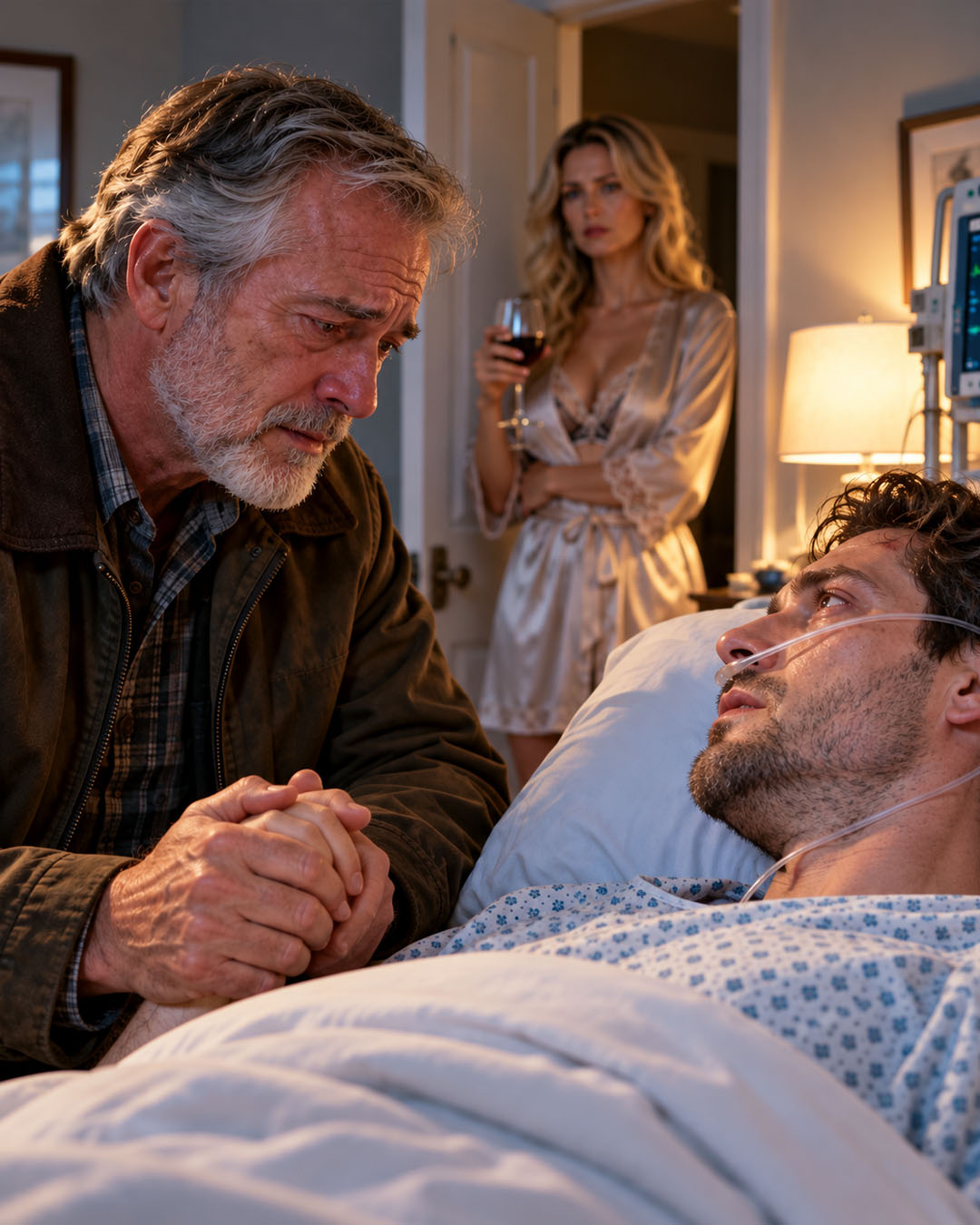
I warmed some oatmeal, washed my bowl, and went to Ethan’s room.
The evening light was fading beyond the window.
I pulled my chair closer and took his hand.
“Son, I’ve been thinking about something.”
His breathing remained steady.
“Do you remember October of 1996?”
I smiled at the memory.
“You were nine years old, and you begged me to take you to the bakery before school.”
I described the old Ford pickup, the chilly kitchen, and the smell of fresh yeast.
“You wanted to learn how sourdough worked. You thought bread was some kind of magic.”
I laughed softly.
“Then I showed you the starter. Remember what you said?”
I paused.
“You said, ‘Dad, it smells alive.’ And I told you that’s because it was.”
I could picture him standing beside me with flour on his nose.
“You put both hands into that dough. Made a terrible mess of my counter.”
My voice thickened.
“Then you looked up and said, ‘Dad, now I understand why you love doing this.'”
I lowered my head.
“I wish I could go back to that morning, Ethan. Just for five minutes.”
Something moved.
His fingers slowly tightened around mine.
I stopped speaking.
“Ethan?”
His eyelids fluttered.
Then his eyes opened.
Not the empty, unfocused movement I’d sometimes seen before.
He looked directly at me.
My heart hammered.
“Son? Can you hear me?”
His lips trembled.
I leaned closer.
“Dad,” he whispered.
I nearly fell out of my chair.
“Oh, thank God.”
He struggled to speak again.
“Briefcase.”
“What, son?”
“My briefcase. Office. Bottom cabinet.”
His eyes filled with tears.
“Get it.”
I held his hand tighter.
“All right. I will.”
He swallowed painfully.
Then, with an effort that seemed to drain every bit of strength from his body, he whispered something that turned my blood cold.
“Dad… she knew.”
Chapter 3
I froze beside my son’s bed.
Ethan’s eyes remained fixed on mine, desperate and frightened.
“What did she know?” I whispered.
He struggled for breath.
“Money. Transfers.”
I leaned closer.
“Victoria?”
He nodded faintly.
“To Ryan.”
The room seemed to tilt.
I’d suspected the affair and financial theft, but hearing my son confirm them was different.
“How long have you known?”
“Before… accident.”
I felt my hands growing cold.
Ethan explained in broken phrases that he’d discovered suspicious company withdrawals and traced several payments to Ryan Cole.
He’d confronted Victoria.
He’d told her he wanted a divorce.
That same night, she’d asked him to meet her somewhere private.
She’d suggested the canyon road where his car later crashed.
“She knew\… I’d found out,” he whispered.
I stared at him.
“Are you saying she caused the accident?”
His eyes filled with anguish.
“Don’t know.”
Those two words mattered.
He wasn’t accusing her of something he couldn’t prove.
He was telling me what he remembered.
I asked whether he’d told anyone else about the financial records.
He shook his head.
“Briefcase,” he repeated. “Behind files. Bottom drawer.”
He paused.
“Letter for you.”
I squeezed his hand.
“I’ll find it. I promise.”
Then he said something that nearly broke me.
“Knew you’d stay.”
My eyes burned.
“Of course I stayed, son.”
His strength was fading.
I reached for the nurse’s contact number and called for medical guidance, explaining that Ethan had unexpectedly become responsive.
The on-call clinician arranged an urgent assessment.
Before the medical team arrived, I whispered, “You don’t have to force yourself to talk anymore. Just rest.”
His eyes closed.
But I had seen my son look at me.
I had heard his voice.
And no one would ever convince me again that there had been nobody behind those eyes.
The following morning, Dr. Brooks examined Ethan and arranged further neurological evaluation.
She was cautiously encouraged by his responses.
“Recovery after a severe brain injury can be unpredictable,” she reminded me. “What happened last night is important, but we need to assess him carefully.”
I understood.
There would be no miraculous return to normal overnight.
Still, hope had entered that room.
After the medical assessment, I remembered the briefcase.
Ethan’s office stood at the front of the house.
The filing cabinet was exactly where he’d described it.
Behind several hanging folders, I found a slim brown leather case.
Inside were bank statements, printed transfer confirmations, photographs, and a sealed envelope with my name on it.
I sat at his desk and examined the records.
The transfers went back eight months.
Amounts varied, but the destination appeared repeatedly.
Ryan Cole.
The photographs confirmed the affair.
One showed Victoria and Ryan entering a law office months before Ethan’s accident.
Then I opened the envelope.
The letter was handwritten.
Dad,
If you’re reading this, something has gone terribly wrong, or I’ve finally found the courage to tell you what’s happening.
I’ve discovered that Victoria has been taking money from the company. Some of it has gone to Ryan. I’ve gathered enough records to know this isn’t a mistake.
I plan to confront her tonight.
I don’t know how she’ll react. I hope we can settle everything without hurting anyone else.
But if things go badly, I want you to know something.
I couldn’t have built my business without what you taught me.
You worked every morning before the sun came up, even when your hands hurt and your back was tired. You never took shortcuts with other people’s trust.
I used to think you were stubborn.
Now I understand you were teaching us how to live.
If something happens to me, please look after Jesse. And please remember that I was proud to be your son.
I trust you, Dad.
Always.
Ethan.
I read those last words three times.
Then I pressed the letter against my chest and wept.
For four months, I had been frightened of losing my son.
Now I understood he’d been frightened before the accident, too.
And he had trusted me to help.
I folded the letter carefully.
Whatever Victoria had done, I would not answer wrongdoing with recklessness.
I would let the evidence speak.
I called Jesse.
For the first time, I told him everything.
He listened without interrupting.
When I finished, he asked, “Dad, why didn’t you tell me sooner?”
“Because I didn’t know what I could prove.”
“You should never have been carrying this alone.”
His voice cracked.
“Does Ethan really recognize you?”
“He does.”
There was a long silence.
Then Jesse whispered, “I’m coming.”
I also contacted an attorney recommended by a longtime customer, and I arranged to meet Marcus Webb.
Marcus brought detailed financial records showing the same suspicious transfers Ethan had identified.
Together, they painted a troubling picture.
Victoria had apparently used her authority over Ethan’s affairs to benefit herself and Ryan.
Worse, a pending agreement could transfer controlling interest in the company to buyers associated with Ryan.
Our attorney moved quickly to seek protective court orders and notify the appropriate authorities.
Meanwhile, Jesse arrived in Los Angeles.
When he entered Ethan’s bedroom, his older brother opened his eyes.
“Hey, little brother,” Ethan whispered.
Jesse dropped into the chair and covered his face.
“Don’t you ever scare us like that again.”
Ethan managed the smallest smile.
“Bossy.”
Jesse laughed through his tears.
It was the most beautiful sound I’d heard in months.
But the hardest part was still ahead.
Victoria and Patricia had no idea how much had changed.
They still treated Ethan as though he could understand nothing.
One evening, I heard them discussing the pending sale in the living room.
Ryan was there, drinking wine in Ethan’s chair.
“The attorneys say another week,” Victoria announced.
“And the house?” Patricia asked.
“That will be handled after the incapacity proceedings.”
Ryan laughed.
“What about Walter?”
Victoria sighed.
“He’ll go back to Pasadena. We only needed him to help with Ethan so we wouldn’t have to pay for more care.”
Patricia chuckled.
“Well, he certainly made himself useful.”
I sat beside my son in the dark.
He had heard the conversation.
His eyes were open, staring toward the doorway.
I rested my hand over his.
“Don’t worry,” I whispered. “We’re not going to fight them with shouting.”
His fingers tightened around mine.
“We’re going to tell the truth.”
Chapter 4
The morning everything changed began at five-thirty, the same hour I’d opened my bakery for forty-three years.
I made coffee and sat at Ethan’s kitchen table.
His leather briefcase rested in front of me.
Jesse sat beside me, exhausted from the journey but determined to stay.
Our attorney, Daniel Reyes, had arranged an urgent meeting involving the medical team, legal representatives, and an investigator reviewing the financial allegations.
We had no intention of staging a confrontation that might endanger Ethan.
The medical professionals would determine what he could safely manage.
Shortly after eight, Victoria entered wearing an expensive cream-colored robe.
She stopped when she saw Jesse.
“What are you doing here?”
He stood.
“Visiting my brother.”
Her eyes narrowed.
“You should have called.”
“I don’t need your permission to love my family.”
Patricia appeared behind her.
“Walter, dear, what’s all this?”
I pointed toward the coffee pot.
“There’s fresh coffee if you’d like some.”
Neither woman smiled.
Victoria noticed the briefcase.
“Where did you get that?”
“It belongs to Ethan.”
“You had no right to touch his private things.”
I looked at her.
“Interesting. You never seemed concerned about his privacy when Ryan moved his clothes into Ethan’s closet.”
Her face reddened.
Before she could answer, the doorbell rang.
Daniel Reyes arrived with an investigator assigned to the financial matter.
A few minutes later, Dr. Brooks arrived with two members of Ethan’s rehabilitation team.
Victoria stepped backward.
“What is going on?”
Daniel opened his briefcase.
“Mrs. Hayes, concerns have been raised about transfers from your husband’s company and the proposed sale of his ownership interest.”
“That’s ridiculous. I have power of attorney.”
“That authority doesn’t permit financial misconduct or eliminate your obligation to act in his interests.”
Patricia moved forward.
“My daughter has managed an impossible situation. Walter has become confused and suspicious.”
Dr. Brooks spoke calmly.
“Mrs. Hayes, there’s also been a significant change in Ethan’s condition.”
Victoria blinked.
“What change?”
At that moment, the rehabilitation nurse appeared in the hallway.
Ethan was seated in a wheelchair, dressed in a blue sweater.
His face was pale.
His body remained weak.
But his eyes were open.
And they were fixed on his wife.
Victoria’s glass slipped from her hand and shattered against the kitchen floor.
“Ethan?”
He looked at her for several seconds.
Then he spoke.
“I heard you.”
Nobody moved.
Victoria’s lips parted.
“Sweetheart, you’re awake?”
“I heard you,” he repeated, his voice faint but steady.
“You said I wasn’t there anymore.”
Victoria began to cry.
“Oh, Ethan. I was frightened. I didn’t know what to do.”
He looked toward Ryan’s empty chair.
“You knew what to do with my money.”
The investigator stepped forward.
“Mrs. Hayes, we’d like to discuss several financial transactions and the documents supporting the proposed business transfer.”
Victoria looked at Patricia.
For once, her mother had no reassuring words.
I watched them both.
All those months, they had assumed that age made me harmless and illness made Ethan irrelevant.
They had mistaken silence for weakness.
And now the room belonged to the truth.
The investigation took time.
There were interviews, financial audits, legal filings, and medical assessments.
The proposed sale of Ethan’s company was halted before completion.
Additional court orders protected the accounts while investigators examined the transactions.
Ryan was questioned about the money transferred to him.
Victoria’s power of attorney was challenged and subsequently terminated through the appropriate legal process.
As for the accident, investigators reviewed the available records, Ethan’s account, and the circumstances surrounding that night.
They found troubling inconsistencies, but no reliable proof that Victoria had deliberately caused the crash.
I refused to claim otherwise.
What we could prove was already serious enough.
The financial evidence eventually supported charges against Victoria and Ryan involving the misuse and diversion of company funds.
They faced legal consequences, including restitution obligations.
Patricia’s involvement was investigated, although not every suspicion against her could be established.
That was difficult for me to accept at first.
But my son reminded me of something important.
“Dad,” he told me during rehabilitation, “we don’t need to turn every suspicion into a certainty.”
He was right.
Justice shouldn’t require us to become careless with the truth.
Eleven days after his first meaningful response, Ethan signed documents beginning divorce proceedings.
His hand trembled.
His signature wasn’t as neat as it once had been.
But he wrote his name himself.
When he finished, he leaned back and closed his eyes.
I sat quietly beside him.
After a while, he asked, “You disappointed in me, Dad?”
The question startled me.
“Why would I be?”
“For marrying her. For not seeing it sooner.”
I took his hand.
“Son, trusting someone you love isn’t something to be ashamed of. What they do with that trust is their responsibility.”
He looked away.
A tear rolled down his cheek.
I didn’t mention Victoria again that afternoon.
There were more important things to discuss.
Like whether the Dodgers might finally put together a decent season.
And whether he remembered the recipe for his mother’s apple cake.
And how much cinnamon was too much.
Those ordinary conversations were the beginning of our healing.
Chapter 5
By August, Ethan could walk twenty steps with a cane.
By September, he could make his own breakfast.
His neurologist described his progress as encouraging, though he still struggled with fatigue, concentration, and occasional gaps in memory.
Recovery wasn’t a straight road.
Some days he could walk across the living room.
Other days, simply getting dressed exhausted him.
But he was alive.
He was improving.
And he was beginning to smile again.
Jesse stayed in Los Angeles for several weeks, helping with appointments and the business.
Marcus kept the company running while Ethan gradually returned to decision-making.
The employees had never abandoned him.
When Ethan visited the office for the first time, twelve people stood waiting near the entrance.
They didn’t make speeches.
They simply applauded.
Ethan covered his face with one hand.
Later, he told me that he’d been more nervous walking through that office door than he’d been during any physical therapy session.
“I thought they’d see a different man,” he admitted.
“They did,” I said. “They saw a man who fought his way back.”
He shook his head.
“Dad, you did the fighting.”
“No, son. I just kept you company.”
One evening, Ethan asked me about the bakery.
“Is it still closed?”
“Yes.”
“Are you going to reopen?”
I shrugged.
“Maybe. I’m getting old.”
He studied me.
“You’ve been saying that since you turned fifty.”
I laughed.
“Well, eventually I’m going to be right.”
He smiled, then grew serious.
“Dad, there’s something I need to tell you.”
I waited.
“That night in April, when you thought about leaving, I heard you.”
My throat tightened.
He continued slowly.
“I couldn’t move. I couldn’t tell you I was there. But I remember you saying nobody else in the house seemed to remember I was still a person.”
I stared at him.
“You heard that?”
He nodded.
“I wanted to reach for you. I tried so hard.”
His eyes filled.
“And when you said you were staying, I felt like I had something to hold on to.”
I turned toward the window.
For months, I’d wondered whether those endless conversations had meant anything.
Now my son was telling me that at least some of them had reached him.
I didn’t need a scientific explanation for every moment.
I only needed to hear him say it.
That night, I called the owner of the building on Colorado Boulevard.
The bakery space was still available.
Most of the equipment remained inside.
I lay awake imagining the ovens warming again.
In December, Ethan and Jesse helped me reopen.
We arrived before sunrise.
The old bakery smelled exactly as I remembered.
Flour.
Yeast.
Coffee.
And forty-three years of mornings that had shaped my life.
I stood in the doorway holding the keys.
For a moment, I couldn’t move.
Then Jesse put his arm around my shoulders.
“Come on, Dad. We’ve got customers coming.”
Ethan walked past me with his cane.
“Besides, somebody needs to make sure you don’t burn the cinnamon rolls.”
I laughed.
“Young man, I’ve been baking longer than you’ve been breathing.”
“Yeah, and you’ve been overbaking them just as long.”
It sounded so much like the old Ethan that I had to lean against the counter.
At seven, our first customer arrived.
Donna Miller had lived beside us for twenty-two years.
She was sixty-eight, outspoken, and one of Margaret’s dearest friends.
She walked through the door, saw Ethan standing beside the oven, and stopped.
Then she crossed the room and hugged him.
No words.
Just a long, trembling embrace.
By eight, a line stretched down the sidewalk.
Customers brought flowers, cards, and photographs.
One elderly gentleman placed a worn recipe card on the counter.
“Your wife gave this to me twenty years ago,” he told me. “Best apple cake I ever tasted.”
I looked at Margaret’s handwriting.
For a moment, the years fell away.
I could almost see her standing beside the register, laughing as she reminded me to stop giving free coffee to everybody who looked lonely.
That afternoon, when the rush finally slowed, Ethan stood beside me at the worktable.
“Can I help?” he asked.
I handed him a wooden spoon.
“Think you remember how?”
He smiled.
“Some things you don’t forget.”
We worked quietly together.
The radio played an old Frank Sinatra song.
Outside, December sunlight spilled across Colorado Boulevard.
Ethan leaned against the counter when he grew tired, but he refused to leave until the last loaf was finished.
When we locked up that evening, he looked around the bakery.
“Dad, you closed this place because of me.”
“Of course I did.”
“You gave up four months of your life.”
I shook my head.
“I didn’t give up anything, son.”
He looked at me, waiting.
I rested my hand on his shoulder.
“I got four more months with you when I was afraid I might not get another day.”
His eyes grew wet.
I continued.
“When your mother died, I learned something I wish I’d understood sooner. Time with the people you love isn’t an interruption to your life. It’s the most important part of it.”
Ethan stepped closer and embraced me.
He held on for a long time.
I could feel his heartbeat against my chest.
Strong.
Steady.
Real.
That was enough.
Over the following year, Ethan continued recovering. Some abilities returned more fully than others, and there were still hard days, but he rebuilt a life that belonged to him.
He kept his company.
He repaired friendships that had suffered during his illness.
And every March 28, he brought fresh bread to his employees.
Jesse visited whenever he could.
Our family dinners became louder, messier, and happier.
Sometimes, after closing the bakery, I still drove to Silver Lake and sat on Ethan’s porch beneath the lemon tree.
We talked about baseball, business, and whatever else happened to be on our minds.
And sometimes we said nothing at all.
Those silences were different from the ones I’d known beside his hospital bed.
They were peaceful.
One Sunday evening, Ethan asked me a question.
“Dad, were you ever afraid I wouldn’t wake up?”
I looked toward the setting sun.
“Every day.”
“Then why did you keep talking?”
I thought about all the times Victoria had laughed at me.
All the times Patricia had suggested I was foolish.
All the lonely nights when I’d read newspapers to a son who couldn’t answer.
Finally, I said, “Because being unable to answer doesn’t mean a person stops deserving to be spoken to.”
Ethan nodded.
“And because you loved me?”
I smiled.
“That too.”
He laughed softly.
Then he reached across the porch table and took my hand.
For a moment, I remembered that terrible evening when his fingers had first closed around mine.
I’d believed I was holding on to him.
Perhaps, in his own way, he’d been holding on to me.
I’m an old baker, not a philosopher. But seventy years have taught me that love isn’t measured by how loudly we announce it, how much money we spend, or how impressive we appear to other people.
It’s measured in the ordinary moments when staying would be easier to avoid.
It’s found in the chair beside a sickbed, in the familiar story told for the hundredth time, and in the hand that keeps reaching out even when no one reaches back.
Victoria believed my son was already gone.
Patricia believed I was too old to matter.
Ryan believed everything important in that house could be bought, sold, or taken.
They were wrong.
My son was still there.
And so was I.
Today, every morning before sunrise, I unlock the bakery, turn on the ovens, and place Margaret’s blue apron beside the register.
Sometimes Ethan joins me.
He moves a little more slowly than he once did, and now and then he needs to sit down.
But when he smiles at me across that flour-covered counter, I see the same nine-year-old boy who once looked into a bowl of sourdough starter and discovered that something quiet could still be wonderfully alive.
And whenever he asks why I never stopped talking to him, I give him the same answer.
“Because, son, I never stopped believing you were listening.”
THE END.
⚠️ All characters and events are fictional. Do not imitate or apply them in real life. 😌😌😌