
Chapter 2
She tried to recover by saying she might have mixed up the dates. Maybe it was another coffee shop. Maybe she’d driven by there once and remembered the awning without realizing it. Her explanations came faster and made less sense with every sentence.
“Who have you been talking to?” I asked.
“Nobody.”
“Somebody gave you those details.”
“No.”
“Then where did they come from?”
She turned away from me.
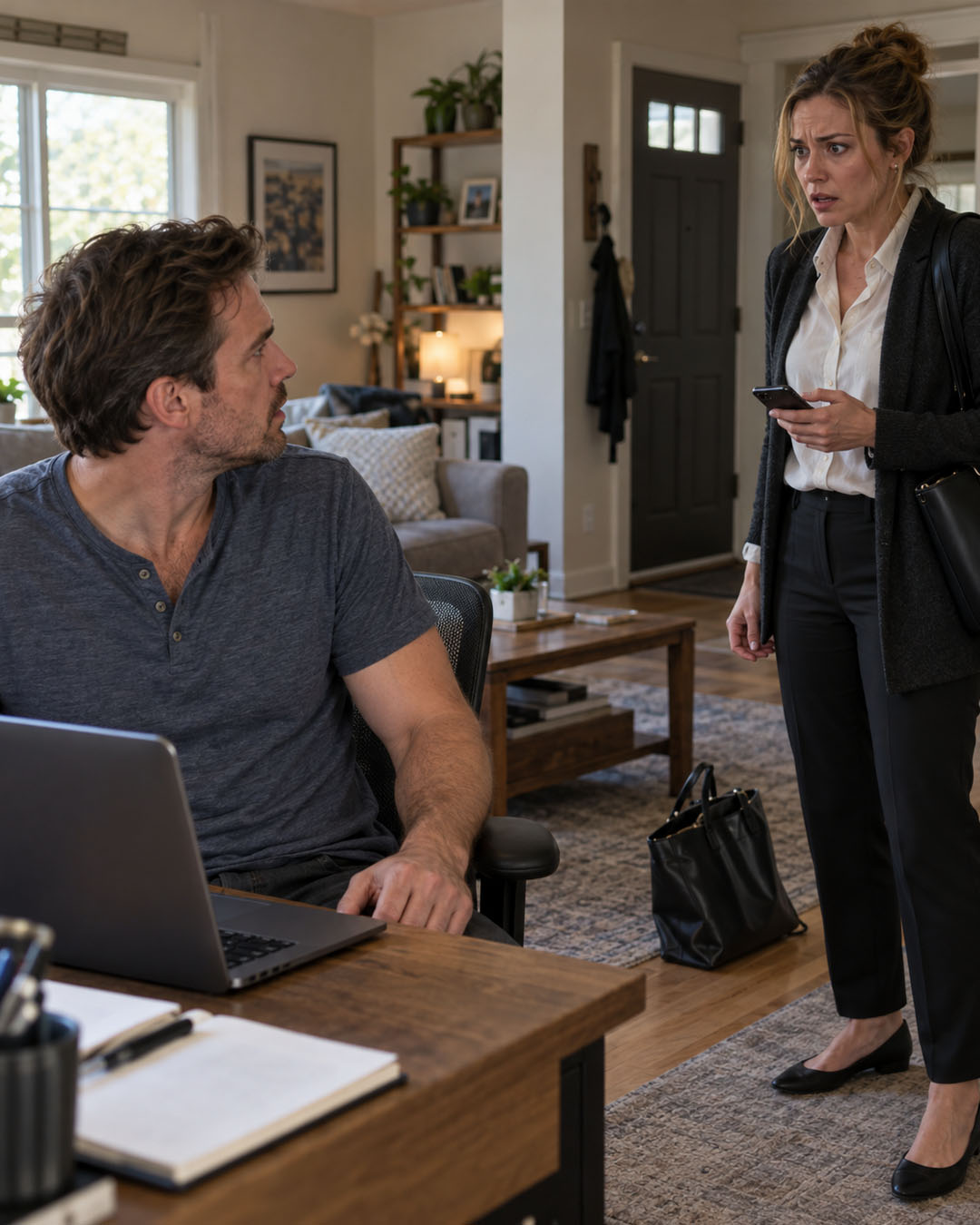
I stood and crossed the room, not toward her, but toward the kitchen counter where I’d left my water. My hands were beginning to shake, and I didn’t want her mistaking that for fear.
“Rachel, you just accused me of meeting someone at a specific business on a specific date. You knew what the building looked like. I wasn’t there, and I never told you about it. So either you’re making this up, or someone else is.”
She sat on the couch and covered her face with both hands.
“I hired somebody.”
For a moment I thought I’d misunderstood.
“You what?”
“I hired somebody to look into things.”
I didn’t speak.
She lifted her face. “It’s not what you’re thinking.”
“I’m not sure you know what I’m thinking.”
“It wasn’t exactly a private investigator.”
“That’s supposed to make this better?”
She explained that she’d found an online company offering what it called relationship verification services. The website promised discreet research into questionable behavior, social media activity, location patterns, public records, and other information that might help someone determine whether a partner was being dishonest.
I felt my chest tighten.
“What did you give them?”
“Just some information.”
“What information?”
She hesitated.
“Rachel.”
“Your name. Your work information. Some account details.”
“What account details?”
Her silence answered before she did.
“Passwords?”
“I thought they needed them to verify things.”
“You gave strangers my passwords?”
“I changed some things afterward.”
“You had no right to give them anything.”
“I needed to know the truth.”
“You needed to know the truth, so you gave strangers access to my private accounts?”
Her eyes filled with tears. “You don’t understand what this has been like for me.”
“No, apparently I don’t.”
She pulled up a document on her phone and handed it to me. It looked official at first glance, full of timestamps, maps, locations, and clean formatting. Someone had constructed an entire month of my supposed movements.
Some entries were accurate.
That made the false ones more disturbing.
It listed my office, my gym, our apartment building, and stores I regularly visited. But mixed among those were places I’d never been: the café with the blue awning, a downtown bar, a hotel parking garage, and a restaurant forty minutes away.
“How much did you pay for this?” I asked.
She wiped her eyes. “It doesn’t matter.”
“How much?”
“Eight hundred dollars.”
I stared at her.
“You paid eight hundred dollars for this?”
“I thought it was real.”
“This says I was at O’Malley’s downtown at eleven o’clock on the nineteenth.”
Her mouth tightened.
“Remember the nineteenth?” I asked. “We were here together. We watched that nature documentary about penguins because you said you needed something relaxing after work.”
She looked at the screen.
“Maybe the date is off.”
“Here’s another one. It says I went to Easton alone on Saturday afternoon. You were with me. We bought your mother’s birthday gift.”
Rachel began scrolling.
I watched certainty disappear from her face line by line.
A Sunday morning entry placed me at a gym while the two of us were having breakfast with her sister. Another claimed I’d spent ninety minutes at an apartment complex across town while I was sitting beside Rachel at urgent care because she’d sprained her wrist.
“Oh my God,” she whispered.
I didn’t answer.
“They lied.”
“Looks that way.”
She started crying then, not quietly. The anger that had carried her through the door collapsed, and she looked suddenly exhausted.
“I was so sure.”
“Sure of what?”
“That you were cheating.”
“Why?”
“You’ve been distant.”
“I’ve been working.”
“You don’t text during the day anymore.”
“I’m in meetings.”
“You come home distracted.”
“I’m tired.”
“I know that now.”
“No. You knew it before. You just decided another explanation felt more convincing.”
She pressed her palms against her eyes.
I should have felt vindicated.
Instead, I felt invaded.
“Who else knows?” I asked.
She lowered her hands.
“What?”
“Who did you tell?”
“No one.”
I held her gaze.
“Rachel.”
“My sister.”
“Anybody else?”
“My friend Megan.”
I looked away.
“They think I’m cheating on you.”
“I’ll tell them I was wrong.”
“That’s not the point.”
“I’ll explain everything.”
“And they’ll always remember you thought I was capable of it.”
“They’ll understand.”
“Will they?”
I walked to the dining table and opened my laptop again.
“What are you doing?”
“Changing every password I have.”
“Daniel—”
“You gave strangers access to my personal information. I have no idea what they logged into, what they copied, what they still have, or what they’re planning to do with it.”
“I didn’t think—”
“No. You didn’t.”
For the next two hours I changed passwords, checked bank activity, reviewed email logins, and enabled two-factor authentication wherever I could. I found several unfamiliar attempts to access my main email account from an address I didn’t recognize.
Rachel sat on the couch watching me.
Every few minutes she whispered, “I’m sorry.”
Eventually I stopped answering.
Around six, I packed a duffel bag.
Her face crumpled when she saw it.
“Where are you going?”
“Somewhere else for a few days.”
“Where?”
I looked at her.
The question itself told me how much had changed.
“I’m not telling you.”
She flinched.
“Please don’t go.”
“I need space.”
“We can fix this.”
“Maybe.”
“Are you breaking up with me?”
“I don’t know.”
She stepped closer, but I moved toward the door.
“Daniel, I was scared.”
I picked up my keys.
“I thought I was losing you.”
I looked at the woman I’d planned to build a future with and realized I no longer trusted her enough to tell her where I would sleep that night.
“You were afraid of losing me,” I said, “so you became the person I needed protection from.”
Then I left.
Chapter 3
I stayed with my older brother, Mark, who lived twenty minutes away and had the rare talent of knowing when not to ask too many questions. After I gave him the short version, he stared at me for several seconds and said, “She hired strangers to investigate you?”
“Apparently.”
“And gave them your passwords?”
“Some of them.”
Mark shook his head. “That’s not jealousy. That’s a breach.”
Rachel texted constantly for the next four days. She apologized, begged me to come home, promised counseling, and said she’d contacted the investigation service to demand a refund. They refused, insisted their report was accurate, and warned her that public accusations against them could have legal consequences.
That frightened her enough to stop calling them.
On the third night, she sent me a long email.
I read it once before bed, then again the next morning.
Rachel wrote about Eric, the boyfriend who had cheated on her years earlier. She described how he’d stayed late at work, guarded his phone, and dismissed her concerns until she discovered he’d been having an affair with a coworker. She admitted that when my work hours changed, old memories returned with a force she hadn’t expected.
At first she’d told herself she was being irrational.
Then she began collecting small things.
A late arrival became evidence. A missed text became evidence. My fatigue became evidence. Once she decided something was wrong, every harmless event seemed to confirm it.
She found the investigation service during a sleepless night and convinced herself it could either prove her fears or finally put them to rest.
Instead, it destroyed us.
Part of me understood her.
People don’t leave painful experiences neatly behind simply because years pass. Hurt can teach lessons that protect us, but it can also teach us to see danger where none exists.
Still, understanding why Rachel had done something didn’t erase what she’d done.
On the fifth day, I agreed to meet her at a coffee shop. Not ours. Not anywhere connected to us. I wanted neutral ground.
She arrived looking older than she had a week earlier.
“Thank you for coming,” she said.
“I said I’d listen.”
She wrapped both hands around her cup without drinking.
“I started looking for a therapist.”
“Good.”
“I mean it. Someone who works with anxiety and relationship trauma.”
“That’s good.”
“And I’ll pay for couples counseling.”
I looked through the window at cars moving through the intersection.
“The issue isn’t only that you didn’t trust me.”
“I know.”
“You tried to prove I was guilty.”
Her eyes lowered.
“And when you didn’t have evidence, you bought evidence from strangers.”
“I didn’t know it was fake.”
“You didn’t check.”
“I thought they were professionals.”
“You wanted their story to be true enough that you never checked whether I could have been at those places.”
She started crying quietly.
“I hate hearing it said that way.”
“That’s what happened.”
“I know.”
“And you told your sister and Megan.”
“I’ll tell them everything.”
“Everything?”
She nodded quickly.
“You’ll tell them you hired someone? That you gave strangers my information? That you paid eight hundred dollars for a report full of false claims?”
“Yes.”
I studied her face.
“I don’t believe you.”
That hurt her more than anything else I’d said.
She sat back as if I’d pushed her.
“I deserve that.”
“Maybe. But that’s where we are now.”
We talked for another hour.
Rachel offered every solution she could imagine. She would sleep in the guest room. She would move out temporarily. She would pay for counseling. She would give me complete access to her phone and accounts, as though mutual surveillance could somehow restore trust.
I finally stopped her.
“You’re trying to find the right action that makes this disappear.”
“I want to make it right.”
“Some things don’t become right because you do ten things afterward.”
She looked down.
“I love you.”
“I know.”
“Don’t you love me?”
I closed my eyes.
“That’s what makes this difficult.”
A week after I’d left, I returned to our apartment.
Rachel had moved into the guest room.
We lived politely.
That was almost worse than fighting.
She started therapy and never missed an appointment. Sometimes she left the confirmation email open on the kitchen counter where I could see it. I knew she was trying, and I respected that.
But effort didn’t return me to the man I’d been before that Tuesday afternoon.
Every time she asked where I was going, even casually, my shoulders tightened.
Every time her phone buzzed, I wondered whether she’d contacted the investigation company again.
Every time I looked at her, I remembered the blue awning.
Then, two weeks after I came home, my phone rang from an unfamiliar number.
I almost ignored it.
Instead, I answered.
“Is this Daniel Mercer?”
“Yes.”
“This is regarding the relationship verification inquiry submitted by your partner. We’re conducting a customer service follow-up.”
I hung up.
They called again.
I let it go to voicemail.
The message was calm, professional, and somehow that made it worse. They said they wanted to resolve any misunderstanding and ensure customer satisfaction.
That evening I played it for Rachel.
Her face drained of color.
“Why do they have my number?” I asked.
“I don’t know.”
“You gave them yours.”
“I filled out forms. Maybe yours was on one of them.”
“My phone number?”
She shook her head.
“My address?”
Silence.
“Rachel.”
“They asked for identifying information.”
“How much?”
“I don’t remember.”
That night, I started researching the company myself.
What I found changed the situation all over again.
Chapter 4
The company’s website looked polished but strangely empty. There was no physical address, no verifiable ownership information, and no real customer support beyond a web form and phone number. The glowing testimonials sounded generic, and the photographs beside them looked like stock images.
After digging through search results, I found forum posts from people describing nearly identical experiences.
They had paid hundreds of dollars for detailed reports that mixed publicly available information with fabricated locations. When customers challenged the results, the company refused refunds. One person claimed the company had threatened to expose personal information after a dispute.
I handed my laptop to Rachel.
She read silently.
When she reached the third account, her hand flew to her mouth.
“What did I do?”
I didn’t answer.
She kept reading.
“What did I do, Daniel?”
“You trusted the wrong people because you didn’t trust me.”
Her eyes filled again.
“I’m so sorry.”
“I know.”
“I’ll fix it.”
I shook my head.
“Rachel, you keep saying that like there’s a switch somewhere.”
The next three weeks were some of the strangest of my life.
We still shared an address but no longer shared a life. We divided groceries. We ate at different times. She went to therapy. I took longer walks after work because I dreaded entering the apartment and feeling the weight of everything unsaid.
She did tell her sister and Megan the truth.
I knew because Megan sent me a message apologizing for believing the accusation. Rachel’s sister sent one too, saying she was horrified by what had happened and hoped we’d eventually find a way forward.
Their apologies were kind.
They didn’t help.
One Friday night, Rachel stood in the kitchen doorway while I washed dishes.
“My therapist says I keep trying to earn forgiveness because I’m terrified of accepting that you might not give it.”
I turned off the faucet.
“That sounds accurate.”
“She also says I can’t control your decision.”
“No.”
Rachel nodded slowly.
“I hate that.”
“I know.”
“I keep thinking if I explain it the right way, you’ll understand.”
“I do understand.”
She looked surprised.
“I understand why you were afraid. I understand what happened with Eric. I understand why my schedule triggered those memories. I understand why that company looked convincing when you were already looking for answers.”
She waited.
“But none of that makes me trust you.”
Her eyes closed.
That was the hardest truth between us.
Compassion and trust were not the same thing.
I could forgive the frightened woman who had acted irrationally and still decide I couldn’t share a home, a bank account, a future, or maybe one day children with someone who had crossed that boundary.
Three weeks after the confrontation, I asked Rachel to sit with me in the living room.
She knew before I spoke.
“No,” she whispered.
“I can’t keep doing this.”
“Please.”
“I want to end the relationship.”
She started crying immediately.
“Give me more time.”
“I have.”
“Three weeks isn’t enough.”
“This isn’t about punishing you.”
“Then don’t leave.”
“I can’t stay just to prove I’m not punishing you.”
She stood and paced toward the window.
“I’m getting better.”
“I know.”
“I’m doing everything you asked.”
“I never asked you to do those things.”
She turned.
“You said I needed help.”
“I said what happened wasn’t healthy. Getting help is good, Rachel. But therapy is for you. It can’t be payment for keeping me.”
She sank into the chair.
“Do you still love me?”
I took a long breath.
“Yes.”
Her face changed with sudden hope.
Then I continued.
“But love isn’t enough when I don’t feel safe giving you the ordinary details of my life.”
The hope disappeared.
I explained that we’d break the lease, divide our things, and figure out the remaining expenses fairly. She could stay until she found somewhere else. I wasn’t going to throw her out overnight.
She cried.
She pleaded.
Then, eventually, she stopped.
“I really did love you,” she said.
“I know.”
“I wasn’t trying to hurt you.”
“I know that too.”
“Doesn’t that matter?”
“It matters. It just doesn’t change the result.”
Rachel moved out two weeks later.
There was no screaming, no dramatic scene, no smashed dishes, no revenge.
That almost made it sadder.
We stood among cardboard boxes and quietly divided a life we’d once assumed would keep expanding. She took the gray sofa because she’d bought it before we met. I kept the dining table. She packed the framed photograph from our trip to Lake Erie, then stared at it for a long time before putting it facedown in a box.
When everything was loaded, she stood by the door.
“This is really it.”
“Yeah.”
“I’m sorry.”
“I know.”
She looked as if she wanted to hug me.
I wasn’t sure what I wanted.
Finally, I opened my arms.
She stepped into them and cried against my shoulder for less than a minute.
Then we let go.
A few days later, her sister texted me. She said Rachel had told the family the entire truth, including the report, the passwords, and the accusations. She said she understood why I’d ended the relationship but wanted me to know Rachel was genuinely sorry and still loved me.
I thanked her.
There was nothing else to say.
Some endings come with betrayal you can point to: an affair, a lie, an emptied bank account, a secret life.
Ours ended because suspicion became more powerful than reality.
Chapter 5
Four months later, I was living alone in a smaller apartment ten minutes from work.
At first, the quiet bothered me.
I had grown used to hearing Rachel moving through the kitchen, complaining about the upstairs neighbors, asking whether I’d remembered to buy coffee, or laughing at some ridiculous commercial from the other room. Even when a relationship ends for the right reason, the absence of ordinary things can feel like grief.
Rachel reached out occasionally.
Her messages were brief and respectful.
Hope you’re doing okay.
Saw that your team finished the client project. Congratulations.
Happy birthday. I hope you’re having a good one.
I answered without cruelty.
Thanks. Hope you’re doing well too.
There was no reason to punish her forever.
Through mutual friends, I heard that she stayed in therapy. She was working on the fear she’d carried from her old relationship and the habits that fear had created. Someone told me she had started dating again but was moving slowly, and that when a friend became suspicious of her own husband, Rachel told her exactly what had happened between us.
Apparently she said, “Don’t go looking for proof when what you really need is a conversation.”
I hoped she meant it.
I hoped the next man in her life met the version of Rachel who had learned something from losing me.
As for me, the anger faded faster than I expected.
What remained was sadness.
Sometimes I remembered our weekend trips, the way she danced badly while making pancakes, or the winter night our heat stopped working and we slept in coats under every blanket we owned. Those memories didn’t become false because the relationship ended.
That’s one of the harder lessons age teaches you.
Something can have been real and still fail.
Someone can have loved you and still hurt you.
You can forgive a person without inviting them back into the place where they broke your trust.
I thought often about that Tuesday afternoon.
Not the crying.
Not the breakup.
Not even the passwords.
I remembered the blue awning.
Rachel had stood in our living room with the confidence of someone who thought the truth belonged entirely to her. She believed she knew where I’d been, who I’d seen, what I’d done, and why I’d done it.
Then she mentioned one detail she couldn’t possibly know.
A coffee shop I’d never visited.
A blue awning I’d never seen.
One false detail cracked open the whole story.
That was when our relationship truly ended.
Not when I packed my bag.
Not when she moved into the guest room.
Not when we divided the furniture.
The ending began the instant I realized the woman beside me had trusted strangers more than she trusted my word.
For a while, I blamed the investigation company. They were scammers, certainly, and what they sold was designed to feed people exactly what they feared.
But eventually I understood that they hadn’t created the crack between Rachel and me.
They had simply found it.
Rachel’s fear was already there.
My frustration was already there.
Our communication had become shallow because I was tired of defending ordinary behavior, and she had become afraid to admit how suspicious she’d grown because she knew it sounded unreasonable.
Something was wrong between us long before she spent eight hundred dollars.
She thought the problem was another woman.
I thought the problem was stress.
The real problem was that fear had replaced trust, quietly enough that neither of us recognized how serious it had become until it was too late.
I’m 36 years old now, single again, and figuring out what comes next.
I don’t hate Rachel.
I don’t tell the story because I want people to think she was crazy or cruel. She was neither. She was a frightened person who made a terrible decision and kept making worse ones because she believed certainty would protect her from being hurt again.
Instead, certainty cost her the relationship she was trying to protect.
And I learned something too.
Trust isn’t proved by handing someone your phone.
It isn’t proved by sharing passwords, answering every question, or accounting for every fifteen minutes of your day.
Real trust is what exists when there are unanswered questions and you still choose conversation over accusation.
It is the willingness to believe the person beside you deserves a chance to speak before fear writes the story for them.
Rachel showed up unannounced that Tuesday afternoon, furious, demanding answers I never owed her.
She believed she had uncovered my secret.
What she actually uncovered was the truth about us.
There was no affair.
There was no mysterious woman.
There was no coffee meeting beneath a blue awning.
But there was something broken between us, and in trying desperately to prove I had broken it, Rachel finally broke it herself.
Sometimes a relationship doesn’t end because someone was unfaithful.
Sometimes it ends because suspicion becomes a third person in the room, and eventually there isn’t enough space left for love.
THE END.
⚠️ All characters and events are fictional. Do not imitate or apply them in real life. 😌😌😌

