Chapter 2
The following morning, I met Sarah and financial analyst Mason Hayes at a small coffee shop downtown.
Mason had once worked on Wall Street investigating complicated corporate transactions. Years earlier, I’d helped him resolve a professional dispute involving research data, and we’d remained friends.
He pushed a folder across the table.
“I’ve reviewed publicly available property records and some documents your attorney obtained through the divorce proceedings,” he said. “There are serious inconsistencies.”
I opened the folder.
Several properties belonging to Sterling Development Group appeared in financing arrangements that raised questions about whether lenders had been given accurate information.
“Is it illegal to borrow against the same property more than once?” I asked.
“Not automatically,” Mason explained. “Multiple liens can be legitimate when properly disclosed. The problem is that some applications appear to omit existing obligations or contain conflicting valuations.”
He showed me a document.
Rebecca’s signature appeared near the bottom.
“She approved this loan while working at First National Bank.”
I recognized her handwriting.
Mason continued.
“Another bank received a different account of the property’s existing debt. We can’t establish the entire scheme from these records, but there’s enough to warrant investigation.”
“How much money are we discussing?”
“Potentially hundreds of millions across the lending portfolio.”
I closed the folder.
For years, Rebecca had criticized my supposedly poor business judgment.
Now the success she’d admired in Richard seemed increasingly questionable.
“There’s another concern,” Mason said.
He showed me information about a luxury condominium development near a former industrial area along the river.
Environmental reports had identified possible soil contamination.
Yet public documents supporting the project’s permits appeared to describe the site as suitable for construction without substantial remediation.
“Richard’s company commissioned the studies,” Mason explained. “Some documents don’t match what was eventually submitted to the city.”
I looked at Sarah.
“What happens now?”
“We report credible evidence to the appropriate authorities. They determine whether crimes occurred.”
“Do it.”
Sarah studied me.
“James, I understand you’re angry. But this cannot become a personal campaign.”
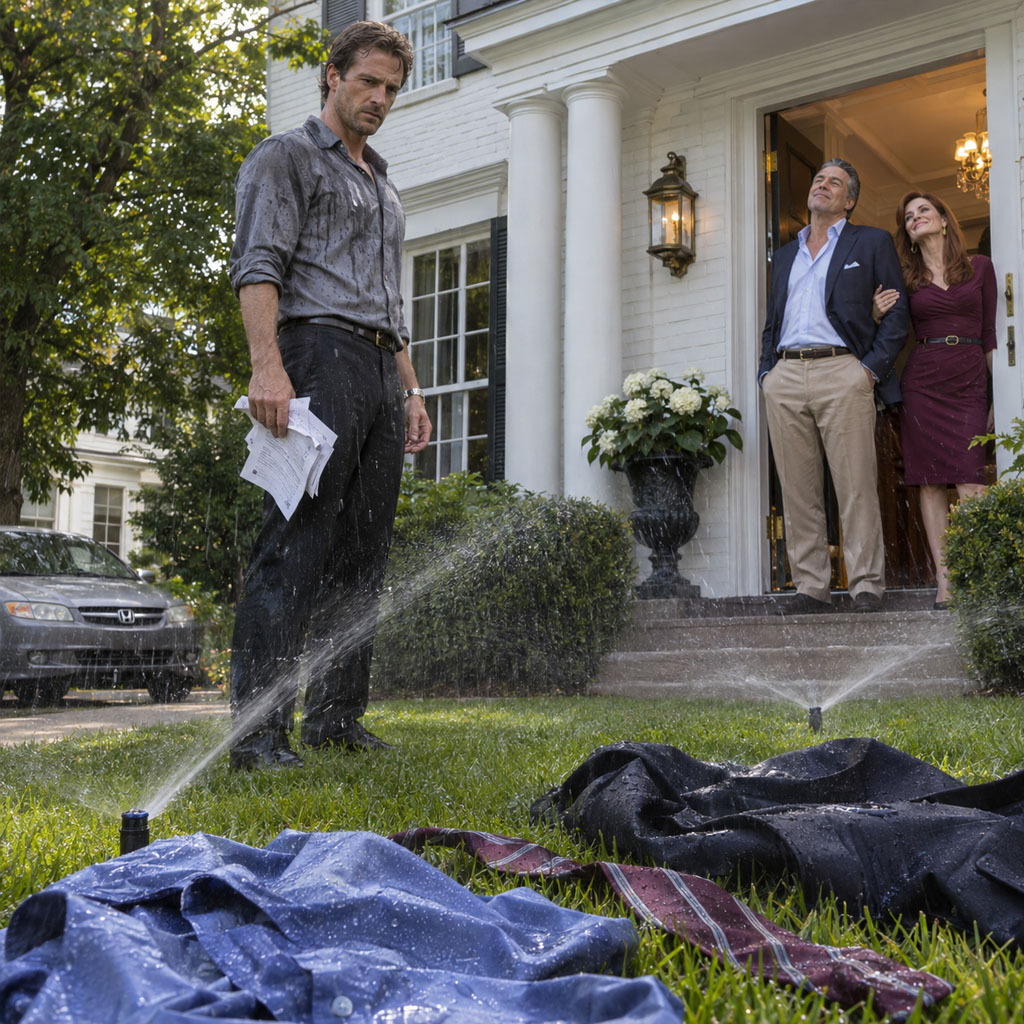
I thought about my clothes scattered across the lawn.
“I want the facts examined,” I said. “If Rebecca and Richard have done nothing wrong, the investigation will establish that.”
Mason nodded.
“And if they haven’t?”
I looked down at the documents.
“Then they’ll have to answer for it.”
Over the next two weeks, our attorneys prepared reports for banking regulators and federal investigators.
We preserved the original documents, identified the sources of the information, and avoided making accusations we couldn’t support.
At the same time, my scientific work was reaching an important milestone.
Katherine Patterson visited our laboratory to review the latest independent testing.
She stood beside me while researchers discussed the results.
“James, these findings are remarkable,” she said afterward.
Our experimental delivery platform showed promise in directing certain medications toward targeted tissues.
It was not an approved treatment, and we still needed extensive testing to establish safety and effectiveness.
But it represented years of difficult work finally producing meaningful progress.
“The company is prepared to offer five hundred million dollars for Morrison Biotech,” Katherine told me privately. “That includes the intellectual property, facilities, and ongoing research program, subject to final approvals.”
I remained silent.
Five hundred million.
The amount seemed almost unreal.
Of course, the money wouldn’t all belong to me. Our investors, employees with equity, and outstanding obligations had to be considered.
But my ownership stake was substantial.
More importantly, the acquisition would provide resources for the research to continue.
“We also want you to lead the new drug-delivery research division,” Katherine added.
I looked through the glass wall at my staff.
Several had remained with the company through years when they could have earned far more elsewhere.
“I want written commitments protecting the research team and the ongoing clinical program.”
Katherine smiled.
“I expected you to say that.”
We shook hands.
That afternoon, Sarah called with an update on the divorce.
Rebecca’s attorney had sent another letter demanding information about the current value of Morrison Biotech.
“Has she learned about the acquisition discussions?” I asked.
“We don’t know. Her attorney may simply be reassessing the financial disclosures.”
“Everything was properly disclosed.”
“Yes. The company was independently valued during the divorce. We also disclosed that possible commercial partnerships existed, although no acquisition agreement had been finalized.”
I rubbed my forehead.
“Could she reopen the settlement?”
“She can ask the court. Whether she succeeds depends on the facts and applicable law. We have preserved the records showing that you complied with the disclosure requirements.”
I thanked her.
After the call, I returned to the laboratory.
My senior scientist, Elena Torres, was reviewing a series of test results.
“Long day?” she asked.
“Long year.”
She smiled sympathetically.
“You know, when I joined this company, you told me that most worthwhile discoveries begin with unanswered questions.”
“I remember.”
“Well, I think we’re finally getting some answers.”
I looked at the data.
For the first time in months, I felt something stronger than anger.
Hope.
Chapter 3
At nine o’clock on a Monday morning, the acquisition announcement became public.
Pharmaco Research Group confirmed its agreement to acquire Morrison Biotech for approximately five hundred million dollars, with James Morrison continuing as head of the expanded research program.
The press release emphasized the experimental nature of our technology and the additional studies required before any treatment could reach patients.
Within minutes, my phone began ringing.
Former colleagues offered congratulations. Journalists requested interviews. Investors wanted details.
Then Rebecca called.
I let it go to voicemail.
She called again.
And again.
Finally, a message appeared.
“James, we need to talk. You deliberately hid this from me.”
I forwarded it to Sarah.
An hour later, Rebecca sent another.
“You let me believe your company was worthless. How could you do this?”
I stared at the words.
For years, I’d explained my research to her.
She hadn’t believed in it.
Now she seemed to believe that my success was something I’d taken from her.
Sarah called shortly afterward.
“Her attorney is filing a motion challenging the divorce settlement.”
“On what grounds?”
“They’re arguing that the company was significantly undervalued.”
“But the acquisition wasn’t completed when we divorced.”
“Correct. We’ll present the valuation reports, disclosure records, and the timeline of negotiations. The court will decide whether the settlement requires review.”
I leaned back.
“Do what you need to do.”
Meanwhile, the financial investigation into Sterling Development Group had begun attracting attention.
Several lenders were reviewing loans involving Richard’s companies.
Environmental regulators had requested records concerning the riverfront development.
And investors had started asking questions.
One afternoon, a sharply dressed man entered my office.
He introduced himself as Thomas Wright, one of Richard Sterling’s major financial backers.
“Dr. Morrison, I understand you’ve had dealings with Sterling.”
“Only through my former marriage.”
Thomas sat down.
“I’ve invested fifty million dollars in his latest development. Some people are raising concerns about the financing.”
“Then you should speak with your attorney and the appropriate financial professionals.”
He hesitated.
“Do you know something I should know?”
I studied him.
“Mr. Wright, if you’re concerned about your investment, obtain an independent audit. I can’t advise you about Richard’s business.”
He stood reluctantly.
After he left, I called Sarah.
“He was asking questions.”
“Don’t discuss the investigation with him,” she said. “We have reported what we know. Let the authorities handle it.”
The next morning, investigative journalist Isabella Martinez published the opening article in a series examining questionable development practices in Chicago.
Her reporting focused on environmental concerns, inconsistent property records, and allegations that certain officials had provided unusually favorable treatment to Sterling projects.
She had independently verified the information and obtained responses from the people involved.
Richard denied wrongdoing.
Rebecca declined to comment.
But the story drew attention.
Environmental groups demanded answers. Banks requested additional documentation. Construction activity slowed at several sites while regulators reviewed the permits.
Richard’s polished image began showing cracks.
Then the counterattack started.
Chapter 4
A headline appeared on a local business website accusing me of stealing scientific research from a former employee.
The article quoted Dr. Marcus Webb, who claimed he had developed the foundation of our cancer-delivery technology years earlier.
I read it twice.
Marcus had worked at Morrison Biotech briefly before leaving after a disagreement over research priorities.
He had contributed to an early project, but the specific technology under development had emerged later through work documented by our current team.
Katherine entered my office carrying a tablet.
“The board wants an explanation.”
“They should have one,” I said.
I handed her the research records.
Every major stage of development had been documented through dated laboratory records, internal reviews, patent filings, and independent verification.
Our legal department had preserved the history carefully because intellectual property disputes were common in biotechnology.
Katherine spent twenty minutes reviewing the material.
“This is comprehensive.”
“It needs to be.”
Our attorneys contacted the publication and requested corrections supported by evidence.
Isabella independently examined Marcus’s claims and discovered inconsistencies in his account, along with questions surrounding recent financial dealings involving a Sterling-connected business.
Within days, several news outlets withdrew or substantially revised their original reports.
An independent legal investigation followed.
I was relieved, but not satisfied.
My employees had worked too hard to have their reputations damaged by unsupported accusations.
Then Richard arrived at Pharmaco headquarters.
Security called before allowing him into the building.
“Dr. Morrison, Mr. Sterling is demanding an appointment.”
“Does he have one?”
“No, sir.”
“Then ask him to contact my attorney.”
Richard refused to leave.
After consulting security and counsel, I agreed to a brief meeting in a conference room with a company representative present.
He entered looking considerably different from the man who’d laughed at me on my lawn.
His expensive suit was wrinkled. His eyes were tired.
“You think you’re clever,” he said.
I remained seated.
“What do you want, Richard?”
“You’ve been feeding lies to the press.”
“I haven’t spoken publicly about your finances.”
“Don’t insult me. Rebecca says you’ve been investigating us for months.”
“Any concerns supported by documents were referred to professionals and appropriate authorities.”
He leaned across the table.
“You’re doing this because she chose me.”
I looked at him.
“Rebecca’s decision to end our marriage is between us. Your business records are a separate matter.”
“You want to ruin me.”
“If your company is operating honestly, an investigation should establish that.”
His jaw tightened.
“You don’t understand who you’re dealing with.”
I glanced toward the company representative.
“This meeting is over.”
Richard stood abruptly.
He pointed at me.
“You’ll regret this.”
Security escorted him out without incident.
I documented the conversation and sent the details to Sarah.
That evening, Rebecca left another message.
Her voice was angry, but underneath the anger I heard something else.
Fear.
“James, Richard says you can make this stop. Please. Whatever you’re doing, stop it.”
I listened quietly.
For fifteen years, she’d known me as a man who avoided confrontation.
She had mistaken patience for weakness.
But I was not controlling the investigation.
The evidence had already reached the people responsible for examining it.
Whatever happened next would depend on what they found.
Chapter 5
Federal investigators eventually obtained warrants to search several Sterling Development Group offices.
The searches included financial records, communications, and documents related to the riverfront project.
Rebecca’s employer, First National Bank, placed her on administrative leave while conducting its own review.
I learned about the searches from the morning news.
Richard’s face appeared outside his corporate headquarters as reporters shouted questions.
He refused to comment.
Later that day, Sarah called.
“Investigators may request another interview with you.”
“Of course.”
“They’re also reviewing the attempted access to Morrison Biotech’s confidential research.”
I looked toward the laboratory.
“What about Rebecca?”
“That matter is included in the evidence we’ve provided. The government will decide whether charges are appropriate.”
During the following weeks, investigators uncovered evidence of a broad financial scheme involving falsified loan applications, concealed debts, inflated appraisals, and transactions designed to disguise the true financial condition of Sterling’s businesses.
Rebecca’s role appeared far more substantial than I’d expected.
As a senior loan officer, she’d allegedly helped prepare and approve applications containing information she knew to be false.
She had also communicated with Richard about how to present certain transactions to lenders.
The environmental investigation uncovered additional concerns about misleading reports and improper influence over permitting decisions.
Eventually, federal prosecutors announced charges against Richard, Rebecca, and several associates.
The accusations included bank fraud, wire fraud, conspiracy, and related financial offenses.
Richard was also connected to environmental misconduct investigated through separate regulatory proceedings.
The news spread quickly.
Richard’s investors filed lawsuits. Lenders sought repayment and pursued their legal remedies. Several development projects were suspended or sold under court supervision.
Rebecca lost her banking position.
Then she came to my office.
My assistant called from downstairs.
“Dr. Morrison, your former wife is here.”
I stared at the telephone.
“What does she want?”
“She says it’s important.”
I considered asking security to escort her out.
Instead, I told my assistant to have Rebecca leave a message with my attorney’s office.
Ten minutes later, she called my private number.
I answered.
“James, please don’t hang up.”
Her voice trembled.
“I don’t have anyone else to turn to.”
I stood beside the window.
“What do you need, Rebecca?”
“Richard’s lawyers are saying I knew everything. They’re trying to blame me.”
“Did you know?”
She began crying.
“It’s complicated.”
“Then explain it to your attorney.”
“You don’t understand. I could go to prison.”
I closed my eyes.
I remembered her standing on the porch, laughing while my clothes became soaked.
But the memory no longer brought the satisfaction I might once have expected.
“I didn’t file false loan applications, Rebecca.”
“You collected information about us.”
“I reported evidence. The authorities conducted their own investigation.”
She whispered, “You could tell them I wasn’t involved.”
“Only if that were true.”
Silence.
Then she said, “I made a terrible mistake leaving you.”
I looked down at the busy street.
“The affair was a betrayal. But the financial decisions were your own.”
“James—”
“I hope you tell the truth and take responsibility. That’s all I can say.”
I ended the call.
For several minutes, I stood without moving.
I had once imagined that hearing Rebecca beg for my help would feel like justice.
Instead, it felt profoundly sad.
The woman I had loved had become someone whose choices I barely recognized.
Chapter 6
The federal trial began the following spring.
By then, prosecutors had compiled extensive evidence from banks, business records, cooperating witnesses, and financial experts.
Richard and Rebecca were tried together on the central financial conspiracy charges, represented by separate legal teams.
I was called as a witness because of the documents I’d provided and my knowledge of Rebecca’s activities during our marriage.
Before testifying, Sarah reminded me of something important.
“Answer only what you’re asked. Don’t speculate. Let the records speak.”
I nodded.
Inside the courtroom, Rebecca sat beside her attorney.
She looked older.
Her familiar polished appearance remained, but the confidence I’d once mistaken for strength was gone.
Richard sat several feet away.
Neither looked at the other.
The prosecutor asked me to describe how I’d discovered the suspicious transactions.
I explained the unusual withdrawals, the records found during the divorce review, and my decision to bring the concerns to counsel.
I also described the unauthorized access to the laboratory and the measures we’d taken to protect confidential information.
Everything I said was supported by documentation.
During cross-examination, Rebecca’s attorney approached.
“Dr. Morrison, you were angry with my client after learning about her affair, weren’t you?”
“Yes.”
“And you wanted revenge?”
“I wanted to protect my company and understand the financial irregularities we’d discovered.”
“But you didn’t like Richard Sterling.”
“No.”
“So you had a personal motive to damage them.”
I paused.
“My personal feelings didn’t create the banking records.”
The attorney turned toward the jury.
“You waited until after your divorce to bring this matter to investigators.”
“Certain evidence came to light during the divorce proceedings. My attorneys reported the concerns as they were verified.”
He asked several more questions.
I answered carefully.
When I left the witness stand, I felt exhausted.
Not triumphant.
Just tired of talking about a marriage that had already ended.
The trial continued for weeks.
Bank employees described applications containing false information. Financial specialists explained how the transactions had concealed significant debt.
Former Sterling employees testified about misleading documents and improper practices.
Environmental experts discussed contaminated land and the consequences of approving construction without accurate assessments.
The most damaging testimony came from people who had worked closely with Richard and Rebecca.
Several witnesses described Rebecca as an experienced banking professional who understood the significance of the documents she approved.
Others testified that Richard had directed the broader scheme while relying on her knowledge of lending procedures.
Their legal teams attempted to shift responsibility.
Richard’s defense argued that Rebecca had controlled the loan documentation.
Rebecca’s defense portrayed her as someone who had trusted Richard and followed his directions.
But the government presented communications showing that both had participated knowingly.
The jury deliberated for several days.
I was not present when the verdict was read, but Sarah called afterward.
“James, the jury found both of them guilty on the major fraud and conspiracy counts.”
I sat in silence.
“Are you all right?” she asked.
“Yes.”
“There’s still sentencing.”
“I understand.”
A few months later, the court imposed its sentences after reviewing the offenses, financial losses, individual roles, and other relevant factors.
Richard received a substantial federal prison sentence.
Rebecca received fifteen years.
Fifteen years.
The same number of years we’d been married.
When Sarah told me, I looked at the photograph of our research team hanging on my office wall.
I felt no urge to celebrate.
Rebecca hadn’t gone to prison for being unfaithful.
She was sentenced because a jury had found that she’d knowingly participated in serious financial crimes.
The betrayal had led me to question things I’d previously overlooked.
But the documented misconduct, not my heartbreak, had determined the outcome.
That distinction mattered to me.
Chapter 7
A year after the trial, Katherine Patterson joined me outside a vacant property on the outskirts of Chicago.
The building was a former corporate training center that had been purchased with funds from my share of the acquisition.
Its windows were dusty, and weeds pushed through cracks in the parking lot.
But the structure was sound.
Katherine unfolded a set of plans across the hood of her car.
“Twenty research stations, shared laboratory equipment, meeting rooms, and space for visiting fellows,” she said.
I studied the drawings.
“And the grant program?”
“Fully funded for the first five years.”
I smiled.
The Morrison Research Institute had begun as an idea during the darkest months of my divorce.
I wanted to create a place where talented researchers could pursue promising medical projects without constantly fearing the loss of funding.
Young scientists with good ideas often spent more time searching for grants than conducting experiments.
I knew that struggle intimately.
Now I had the means to do something about it.
Katherine pointed toward the entrance.
“We could have the first research teams working here by next fall.”
I looked across the empty property.
For years, I’d spent Sunday mornings maintaining the lawn of a house that was supposed to represent my success as a husband.
Now I was standing on another lawn, planning something that might help strangers I’d never meet.
The contrast was impossible to ignore.
“Let’s do it,” I said.
The institute opened the following year.
Twenty-five scientists joined the initial research program, working on cancer therapies, genetic disorders, and rare diseases.
We established an independent scientific review board and made research integrity a central requirement of our funding.
The institute wasn’t meant to produce publicity.
It was meant to produce knowledge.
Meanwhile, Richard’s former development sites were being reviewed, sold, or rehabilitated.
Some required significant environmental remediation.
Several affected lenders and investors pursued restitution through the legal system.
Rebecca sent me letters from prison.
The first asked whether I could help with her appeal.
The second said she regretted how she’d treated me.
The third accused Richard of manipulating her.
I read them, then placed them with Sarah for safekeeping.
I didn’t respond.
There was nothing I could say that would change her sentence or repair our marriage.
As the years passed, I gradually stopped following every development in Richard’s and Rebecca’s cases.
Mason occasionally mentioned a court ruling or an unsuccessful appeal.
I listened, thanked him, and returned to work.
One afternoon, Katherine noticed me looking at a framed photograph of the institute’s first graduating research fellows.
“Do you ever think about what happened?” she asked.
“Sometimes.”
“Do you regret exposing them?”
I considered the question carefully.
“No. People were being deceived, and the evidence needed to be examined.”
She nodded.
“But?”
“I regret how much anger I carried. For a while, I thought proving Rebecca wrong would make me happy.”
“Didn’t it?”
“Not nearly as much as this.”
I gestured toward the photograph.
The young researchers were smiling, holding certificates beside their mentors.
Katherine smiled.
“I think that’s a better measure of success.”
“So do I.”
Chapter 8
Five years after the trial, I stood backstage at an international medical research conference, waiting to deliver the opening address.
I was fifty-one when my marriage ended.
Now, at fifty-six, I had gray at my temples, a slower golf swing, and a deeper appreciation for quiet evenings.
The research program I’d helped develop had advanced through additional clinical studies, showing encouraging results in several areas.
Some applications were still experimental. Others were moving toward broader regulatory review.
There remained difficult scientific questions, and I refused to make promises that the evidence couldn’t support.
But the work was progressing.
The Morrison Research Institute had funded more than one hundred projects.
Some had failed.
Some had produced small, useful discoveries.
A few had opened possibilities none of us had anticipated.
I considered all of them worthwhile.
Katherine approached with a glass of water.
“Ready?”
“As I’ll ever be.”
She glanced toward the audience.
“There’s something you should know. Isabella Martinez is here.”
I smiled.
Isabella’s reporting on the Sterling scandal had received national recognition. She now directed an investigative journalism organization focused on financial misconduct and public accountability.
“Good. I hope she enjoys the conference.”
Katherine hesitated.
“She asked whether you wanted an update about Rebecca.”
I looked at her.
“Is there something I need to know?”
“No. Nothing requiring your attention.”
“Then I think I’ll leave the past where it belongs.”
The announcer introduced me.
I walked onto the stage to warm applause.
Behind me, a large screen displayed photographs of our laboratories, researchers, and medical collaborators.
I looked out at the audience.
Scientists. Physicians. Students. Patients and their families.
People who had come because they believed that difficult medical problems deserved patient, persistent effort.
“Progress in medicine,” I began, “rarely comes from one person working alone.”
I paused.
“It comes from people willing to share ideas, question assumptions, and continue working when the answers aren’t easy.”
As I spoke, I thought of the long nights in my original laboratory.
The missed holidays.
The financial worries.
The moments when failure seemed more likely than success.
I also thought of Rebecca.
Not with hatred.
With the sadness of remembering someone who had once been important to me and was now a stranger.
She had believed money and social status were the clearest measures of a person’s worth.
Richard had believed influence could protect him from consequences.
For a long time, I had believed that being patient and loyal would be enough to preserve a marriage.
We’d all been wrong about something.
But only Rebecca and Richard had chosen to cross the line into deliberate wrongdoing.
Their convictions hadn’t restored my marriage.
They hadn’t returned the years I’d spent trusting someone who deceived me.
And they hadn’t made me a better scientist.
What changed my life was the decision to keep building after everything familiar had fallen apart.
When my speech ended, the audience stood.
I felt grateful, but not because I’d defeated anyone.
I was standing in a room full of people who believed in the same purpose.
That evening, I returned to my home overlooking a quiet stretch of Lake Michigan.
It was comfortable but not extravagant.
There were books everywhere, photographs of friends, and a small garden I maintained myself.
On my desk sat an old picture of my first research team.
Beside it was a newer photograph of the institute’s scientists celebrating the opening of another laboratory wing.
I studied both pictures.
The distance between them represented years of hard work, disappointment, persistence, and unexpected opportunity.
My phone rang.
It was Mason.
“James, I wanted to congratulate you. I watched the conference.”
“Thank you.”
He laughed.
“You’re becoming quite the public speaker.”
“Don’t spread that rumor.”
We talked about our families, retirement plans, and a fishing trip we’d been postponing for years.
Then Mason grew quiet.
“There’s something else. Richard’s latest appeal was denied.”
I looked out at the lake.
“I see.”
“And Rebecca’s attorney filed another request for relief. The court hasn’t ruled yet.”
“That’s between her and the court.”
Mason paused.
“You really don’t want updates anymore, do you?”
“Not unless there’s a legitimate reason I need to be involved.”
He chuckled softly.
“Fair enough.”
After we hung up, I walked outside.
The evening air was cool.
Across the water, distant lights shimmered along the shoreline.
I remembered standing beside my Honda on the morning Rebecca threw my clothes onto the lawn.
Back then, I had wanted her to understand how much she’d hurt me.
I wanted Richard to understand that a person’s value couldn’t be measured by the price of his suit or the size of his house.
I wanted them both to recognize what they had thrown away.
Now, years later, their opinions no longer mattered.
Rebecca was serving the fifteen-year sentence imposed for her role in the financial scheme.
Richard was facing the consequences of his own crimes.
Their appeals and legal proceedings belonged to the courts.
My future belonged to me.
I hadn’t become wealthy because I wanted revenge.
I’d become successful because I’d stayed committed to work I believed could help people.
I hadn’t exposed their misconduct by inventing accusations or manipulating the law.
I’d brought legitimate concerns to professionals and investigators, who followed the evidence.
And I hadn’t rebuilt my life by waiting for the people who hurt me to apologize.
I’d rebuilt it by choosing not to let their choices define the man I would become.
The next morning, I planned to visit the institute and meet a group of young researchers studying rare childhood disorders.
Afterward, I’d have lunch with Katherine and finally arrange that fishing trip with Mason.
Ordinary plans.
Good plans.
Plans that belonged to a life I was grateful to have.
I stood outside a little longer, listening to the wind moving through the trees.
The house was peaceful.
There were no sprinklers soaking my belongings, no cruel laughter, and no one telling me I was worthless.
There was simply the quiet satisfaction of knowing I’d survived a painful ending without allowing it to become the end of my story.
The greatest victory wasn’t seeing Rebecca and Richard punished.
It was realizing I no longer needed their defeat to feel whole.
I turned toward the house and went inside.
Tomorrow, there was meaningful work to do.
And that mattered far more than anything I’d left behind.
THE END.
⚠️ All characters and events are fictional. Do not imitate or apply them in real life. 😌😌😌