
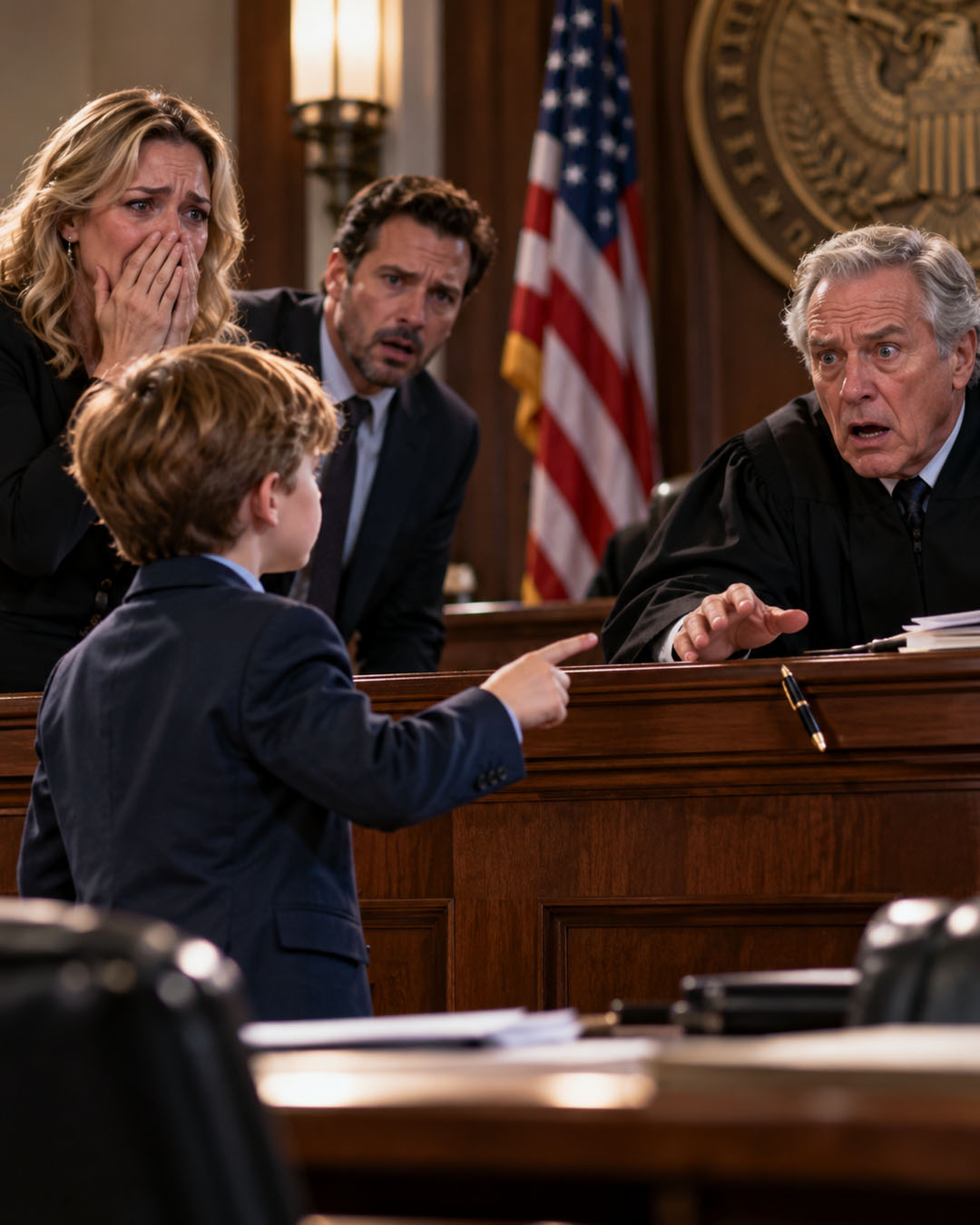
Chapter 2
Detective James Johnson arrived at the courthouse with two deputies about twenty minutes later. He was a broad-shouldered man in his late fifties, with silver hair and tired brown eyes. Instead of questioning me in front of everyone, he took me into a quiet room and offered me a glass of water.
“Tommy, I’m Jim,” he said, pulling up a chair. “The judge told me what you said about your brother. Can you tell me where he is?”
“In our freezer,” I replied. “The white one on the porch. It has a little race car sticker on the lid.”
He wrote something in his notebook. “Who put the sticker there?”
“I did. Leo liked cars, even though he couldn’t play with them very well.”
Detective Johnson studied my face. Then he asked whether I could show the officers where the freezer was. I nodded, and he told a woman named Officer Ramirez to stay beside me.
Dad protested when they separated us. He insisted that I was frightened and confused, and that he should accompany me. Detective Johnson told him firmly that everyone would be more comfortable if he waited at the courthouse.
Our apartment was in an older brick building near the edge of town. The grass outside hadn’t been cut in weeks, and Mrs. Peterson from downstairs was standing beside her mailbox when the police cars arrived. She watched us walk upstairs, her hand pressed against her mouth.
Inside, everything looked ordinary. Dad’s newspaper was folded on the kitchen counter, Mom’s blue coffee mug sat beside the sink, and our family photograph still hung above the couch. In that picture, all three of us were smiling at the county fair.
I hadn’t looked at that photograph in months. It reminded me of a family I wasn’t sure had ever existed.
The freezer stood on our enclosed back porch, humming softly beneath a dusty window. Mom kept it locked, saying she bought meat in bulk to save money. Dad always claimed he had no reason to bother with it.
When I pointed it out, Detective Johnson asked Officer Ramirez to take me into the living room. She sat beside me and started talking about her dog, a golden retriever named Buddy. I tried to listen, but all I could think about was what the officers were doing behind the closed porch door.
A sharp metallic crack interrupted her story. Then somebody spoke quietly into a radio. Officer Ramirez reached for my hand.
Detective Johnson appeared a few minutes later. He looked older than he had at the courthouse. He knelt in front of me and rested one hand on my shoulder.
“Tommy, we’re going to take you somewhere safe,” he said. “There are people who can help you, and you’re not in trouble.”
“Did you find Leo?” I asked.
He swallowed before answering. “Yes, son. We found him.”
“Is he coming with me?”
Detective Johnson looked down for a moment. “We’re going to take good care of him now.”
At the police station, Officer Ramirez brought me vanilla ice cream in a paper cup. I watched it melt while people walked past the small room where I sat. Through the narrow window, I saw Dad being escorted down one hallway and Mom down another.
I learned much later what happened behind those doors.
Mom broke down almost immediately when Detective Johnson told her what had been discovered. Leo was her son from a relationship before she married Dad. His biological father had disappeared before Leo was born, leaving her frightened and alone.
When Mom met Michael, she thought she had finally found security. Dad had money, a respectable business, and a charming way of making promises. But he also had a cruel temper, especially when he believed somebody had embarrassed him.
Mom became pregnant with Leo shortly before she married Michael. Because Dad spent months away managing construction projects, she concealed the pregnancy. After Leo was born prematurely with serious heart and breathing problems, she arranged for another woman to care for him.
She paid that woman from the small amount she earned doing bookkeeping. Later, when the woman moved away, Mom brought Leo into our apartment. She kept him in the spare bedroom, telling Dad the room was locked because of a plumbing problem.
Mom visited Leo whenever Dad worked late. I sometimes sat beside his little bed, showing him picture books or rolling toy cars across his blanket. He had dark curls, enormous blue eyes, and a laugh that sounded like hiccups.
He called me “Tee,” because he couldn’t pronounce Tommy.
I loved him more than anybody knew.
Mom told Detective Johnson that Leo had died during a terrible breathing episode while Dad was away. She claimed she panicked, concealed his body, and became too frightened to admit what she had done. Her marriage had eventually collapsed under the weight of her guilt.
Dad told a different story. He described Mom as unstable, secretive, and prone to imagining things. He said he knew nothing about Leo and had never opened the freezer.
“My only concern is Tommy,” he repeated. “That boy is my whole world.”
For two days, the investigators tried to understand how a child could disappear inside his own home without anyone reporting him missing. Then Dr. Elaine Morris, the medical examiner, called Detective Johnson with findings that changed everything.
Leo had not died from a sudden illness.
The examination revealed evidence that someone had deliberately obstructed his breathing. Other findings indicated that he had still been alive when he was sealed inside the freezer.
Detective Johnson sat silently with the report spread across his desk. Mom had admitted hiding her son, but the evidence no longer fit her story. Someone had killed Leo, and someone had worked very hard to make his death disappear.
That afternoon, he returned to speak with me.
I was sitting on the porch of a temporary foster home, drawing our old apartment with crayons. I had colored the freezer black, even though it was white. Detective Johnson sat beside me without disturbing my picture.
“Tommy,” he said, “there’s something I need to understand. When your mother talked about Leo, did she seem afraid of the freezer?”
I nodded. “She wouldn’t even go near the porch anymore.”
“Was she afraid of Leo?”
I shook my head. “She was afraid of Dad.”
He grew very still. “Why would she be afraid of your father?”
I stared at the black rectangle on my drawing. Then I told him something neither of my parents had mentioned.
“Dad found Leo before Thanksgiving,” I whispered. “I was there when it happened.”
Chapter 3
The memory had lived inside me for nearly a year. Sometimes it came back when a door slammed or when someone spoke too loudly. Other times, it returned while I was brushing my teeth, making me wonder how the world could continue as though nothing terrible had happened.
That afternoon, Dad came home early from work. Mom was in Leo’s room feeding him, and I was hiding behind the hallway coats during a game. Leo started crying, and Dad heard him through the closed door.
He demanded to know who was inside. Mom tried to stop him, but he forced the door open. I could see everything through the narrow opening of the closet.
“What is this?” Dad shouted. “Whose child is that?”
Mom begged him to lower his voice. She explained that Leo was her son and that she had been terrified to tell him. Dad looked at the little boy in the crib as if he were something rotten left on his doorstep.
“You expect me to support somebody else’s kid?” he yelled. “After everything I’ve done for you?”
Mom said she wasn’t asking him to support Leo. She promised to find another arrangement, and she kept apologizing. But Dad grew angrier with every word.
He lifted Leo from the crib. Leo began crying harder, frightened by the noise and the unfamiliar hands. When Dad covered his mouth to silence him, Mom screamed.
I remembered her pulling at Dad’s arm. I remembered him shoving her backward and the horrible sound her head made when it struck the corner of a table. She fell to the floor and didn’t move.
Dad kept holding Leo until his crying stopped.
I stayed hidden because I was terrified. I wanted to run to Leo, but my legs wouldn’t obey me. The apartment became strangely quiet, and Dad stood motionless with my brother in his arms.
Then he carried Leo toward the kitchen.
When Mom regained consciousness, Dad was sealing a large black bag with silver tape. She crawled toward him, sobbing and asking where Leo was. Dad told her it was too late.
“He stopped breathing because you brought him here,” Dad said. “You caused this mess, Sarah. And if anybody finds out, you’ll be the one they blame.”
Mom begged him to call for help. Dad grabbed her wrist and told her that if she ever spoke about Leo, he would take me away. He said no judge would believe a woman who had hidden a child from her husband.
Then he told her something worse.
“If you try to ruin my life, Tommy will be next.”
Detective Johnson listened without interrupting. His hand tightened around the notebook resting on his knee. Finally, he asked whether Dad had known I was watching.
“Not then,” I answered. “But later he found me crying beside Leo’s empty bed.”
“What did he say?”
“He told me Leo had gone somewhere better, and good boys didn’t ask questions. Then he said Mom was sick, and if I loved her, I’d never tell anybody about the freezer.”
Dad installed security cameras in the apartment afterward. He checked Mom’s cellphone and questioned her whenever she left the house. Sometimes he acted cheerful for days, buying me toys or taking us out for pancakes, but the fear never disappeared.
Mom became quieter. She stopped laughing at television shows and began waking in the night crying. Whenever I mentioned Leo, she hugged me so tightly I could hardly breathe.
Eventually, she told Dad she wanted a divorce. He agreed, but only after announcing that he would fight for full custody of me. He told Mom she wasn’t fit to raise a child and promised to make sure I never saw her again.
That was when I began thinking about the courthouse.
I had heard Mom explain that judges were supposed to protect children. I knew police officers came to the courthouse, too. And I knew Dad loved winning more than almost anything.
Detective Johnson looked at me carefully. “Tommy, if you were frightened of your father, why did you tell the judge you wanted to live with him?”
I put down my crayon. “Because Dad was watching me. If I chose Mom, he’d get angry and maybe leave before anybody found Leo.”
“But choosing him made him happy?”
“Yes,” I said. “When Dad’s happy, he stops being careful.”
Detective Johnson glanced toward the front yard. He seemed to be searching for words, but I had one more thing to explain. It was the part I had thought about every night before the custody hearing.
“I knew the judge would listen if I asked about my brother,” I said. “And Dad couldn’t make the judge stop listening.”
Detective Johnson reached for a tissue from his coat pocket. He pressed it against his eyes before looking at me again. “Tommy, you should never have had to carry something like this alone.”
I didn’t understand why he was crying. I was the one who had lost a brother, and I had spent so many nights trying not to cry that tears no longer came easily. I picked up my black crayon again.
“I just wanted Leo out of there,” I whispered. “He didn’t like being alone.”
Detective Johnson arranged for a child interview specialist to speak with me, and investigators began reviewing the evidence again. They found Dad’s fingerprints on the tape used to seal the bag. Additional evidence connected him to the assault, and Mom’s medical records supported her account of the head injury she had suffered that day.
The investigators also recovered information from Dad’s old security system. Much of the footage had been deleted, but the records showed that the cameras were installed immediately after Leo disappeared. Other records helped establish that Dad had been home when he claimed to be working.
When Detective Johnson confronted him, Dad maintained his innocence. He accused Mom of inventing the story and insisted I had been coached. But as more evidence emerged, his calm expression began to crack.
Eventually, he admitted that he had discovered Leo and confronted Mom. He still claimed the child’s death was accidental, but investigators had already uncovered too much for that explanation to hold. Facing a murder prosecution supported by physical evidence and witness testimony, he later agreed to plead guilty.
I wasn’t present when the judge sentenced him. My foster mother, Helen, told me that Dad would spend the rest of his life in prison without the possibility of parole. She didn’t smile when she said it, and neither did I.
I thought I would feel happy knowing he could never hurt us again. Instead, I felt tired, as though I had been holding a heavy door closed for so long that I had forgotten how to let go.
Then Helen hugged me.
For once, I didn’t have to wonder what would happen afterward.
Chapter 4
The next year changed my life in ways I could never have imagined. I stayed with Helen and her husband, Robert, a retired school principal who liked woodworking and baseball. Their house had a garden, a noisy grandfather clock, and a yellow Labrador named Daisy who slept beside my bed.
They never shouted at each other. When Robert accidentally broke a plate, Helen simply helped him sweep up the pieces. I remember standing in the kitchen doorway, waiting for someone to get angry, until Robert noticed me and asked whether I’d like another slice of apple pie.
For months, ordinary kindness confused me more than anything. I kept expecting it to disappear. But every morning, Helen made breakfast, Robert drove me to school, and Daisy greeted me when I came home.
Mom’s case was handled separately from Dad’s. The court considered the years of threats and violence she had endured, along with her failure to seek help for Leo. She received a suspended sentence, court-ordered treatment, and continued supervision, but she was not permitted to resume caring for me.
I visited her once at the treatment center.
She looked thinner, with gray strands appearing in her brown hair. When she saw me, she covered her mouth with both hands and began crying. I stood beside Helen until Mom asked whether she could hug me.
“I’m sorry, sweetheart,” she whispered, holding me close. “I’m sorry I wasn’t brave enough. I should have protected both of you.”
I wanted to tell her that she had protected me sometimes. She used to stand between Dad and me when he was furious, and she read bedtime stories even when she was exhausted. But I also remembered the locked freezer and the months when she had been too frightened to tell anyone what happened.
“I miss Leo,” I said.
Mom began sobbing again. “I miss him, too, Tommy. Every single day.”
We sat together for a while, talking about the little things she remembered. Leo had loved the sound of rain against the windows. He liked mashed bananas, soft blankets, and the bright red fire truck I once gave him.
Before I left, Mom took my hand. “Do you think you could ever forgive me?”
I looked at her for a long time. At seven, I had believed that forgiving someone meant everything could return to the way it was. At eight, I was beginning to understand that some things could never be repaired.
“I don’t hate you, Mom,” I answered. “But I can’t come home with you.”
She closed her eyes, and tears slipped down her cheeks. Then she nodded. “I know, sweetheart. I know.”
A year after the custody hearing, Helen and Robert adopted me. They asked whether I wanted to keep the Wilson name, and I said yes because Leo had been a Wilson, too. They respected my decision without questioning it.
On adoption day, Robert wore the same navy-blue suit he had worn to his retirement ceremony. Helen brought a small bouquet of flowers, and Daisy waited at home with a new toy for me. When the judge announced that we were officially a family, Helen squeezed my hand.
I didn’t feel that I had replaced Mom or Dad. I felt that somebody had finally opened a door and invited me into a life where I didn’t have to be afraid.
As the years passed, I learned that healing wasn’t as simple as growing older. I sometimes woke from dreams in which I heard Leo crying behind a locked door. Certain sounds, especially the low hum of an appliance on a quiet afternoon, could bring those memories back without warning.
Helen never told me to forget. Robert never insisted that I be grateful or cheerful. They took me to a counselor who helped me understand that what happened to Leo was not something I had caused or could have been expected to prevent.
By the time I turned sixteen, I had grown taller than Helen. I played baseball, worked weekends at the local hardware store, and learned to repair old bicycles with Robert. Sometimes I laughed so hard at the dinner table that tears ran down my cheeks.
I still thought about Leo.
Every November, we visited his grave in a small cemetery outside Columbus. Helen brought flowers, Robert quietly cleaned the headstone, and I left a toy car beside it. We never stayed long, but nobody rushed me when I needed another minute.
When I was eighteen, Mom sent me a letter through the proper channels. She wrote that she had completed years of treatment, found steady work, and was learning to live with the consequences of her choices. She didn’t ask me to come back or insist that I forgive her.
Instead, she wrote about Leo.
She remembered the morning he first smiled, how his tiny fingers wrapped around hers, and how proud he had been when he finally learned to say my nickname. At the bottom of the letter, she wrote that she hoped I had found the peace she had failed to give me.
I folded the pages and placed them in a wooden box Robert had made for me. Inside were Leo’s photograph, a faded race car sticker, and the first drawing I had made at the foster home. They were small things, but they belonged to a life I refused to pretend had never existed.
Years later, when I became a father myself, I finally understood something about that day in court.
People often imagine courage as a grand gesture. They picture someone standing tall, speaking confidently, and knowing exactly what to do. But I had been a frightened little boy who wanted his brother to be treated with dignity and his mother to stop living in terror.
Choosing Dad had never meant that I loved him more. It had been the only way my seven-year-old mind could imagine bringing the truth into a room filled with adults who had the power to help. Looking back, I wish I had known sooner that I could tell a trusted teacher or another safe adult without having to devise a plan myself.
I also came to understand my mother’s fear. Dad had spent years convincing her that she was powerless, and fear can make people surrender pieces of themselves they never imagined losing. Understanding that didn’t erase what had happened, but it helped me release the anger that once consumed me.
My father had spent his life believing that money, reputation, and threats could protect him from consequences. He could buy expensive suits and hire talented attorneys, but none of those things changed what he had done. In the end, the truth he had tried to bury was stronger than his lies.
One autumn afternoon, I took my own son to visit Leo’s grave. He was six years old, with freckles across his nose and the same curious blue eyes I remembered from my little brother. He placed a bright red toy truck beside the headstone.
“Daddy,” he asked, “was Uncle Leo a good little boy?”
I knelt beside him and brushed a fallen leaf from the stone. “He was a wonderful little boy,” I said. “He loved toy cars, and he had the sweetest laugh you’ve ever heard.”
My son looked at the grave, then slipped his small hand into mine. “I wish I could’ve met him.”
“So do I,” I whispered.
We stood together beneath the maple trees while the afternoon sunlight moved across the grass. For the first time in many years, remembering Leo didn’t bring back only the darkness of that apartment. I remembered his laughter, his warm little hand, and the happiness he had brought into my childhood.
As we walked back toward the car, my son asked whether we could come again next year. I told him we could come whenever he wanted. Then I lifted him into his seat, fastened his seat belt, and kissed the top of his head.
I had grown up believing that love was something people proved by fighting to possess one another. My parents had fought over me in a courtroom, each insisting that I belonged to them. But the people who truly saved me were the ones who understood that a child is not a prize to be won.
Love means protecting someone, even when it requires courage. It means telling the truth, taking responsibility, and making sure the people entrusted to your care can sleep without fear.
And whenever I think about that terrible morning when a judge asked me to choose between my parents, I remember the little brother who never got to grow up.
I couldn’t bring Leo home with me.
But I could make sure the world finally knew he had been there.
THE END.
All characters and events are fictional. Do not imitate or apply them in real life. 😌😌😌

