
Chapter 2
Rob’s children moved in permanently the following summer.
His son, Tyler, was eighteen, and his daughter, Chloe, was nineteen. Both seemed to believe that because their father was dating my mother, they were entitled to everything inside our house.
They took over the bathrooms, left dirty dishes everywhere, and treated the living room like a hotel lounge. Their laundry piled up in the hallway, and their friends came over without asking anyone.
My mother seemed delighted.
She bought them expensive snacks, cooked their favorite meals, and spent weekends shopping for things they wanted.
Meanwhile, if I asked for money to replace a pair of worn-out shoes, she complained about how expensive everything had become.
The difference was impossible to miss.
Whenever I entered the kitchen and found all four of them laughing together, the conversation would suddenly change. Tyler would glance at his father, Chloe would look at her phone, and my mother would ask whether I had finished my homework.
I became an inconvenience in my own home.
Family vacations made things worse.
My mother would announce a weekend at a lakeside cabin or a road trip to the coast. Then, just before they left, she’d turn to me.
“Wouldn’t you rather spend the weekend with your grandparents? You haven’t seen them in a while.”
I knew what she meant.
She wanted Rob and his children to enjoy themselves without having me around.
I spent Thanksgiving and Christmas with my paternal grandparents more often than I spent them with my own mother. My grandparents never complained. They welcomed me with warm meals, familiar stories, and the kind of affection I desperately needed.
But every holiday reminded me that my mother had built a new family and apparently decided I didn’t belong in it.
By the time I turned seventeen, Rob had stopped pretending to be a guest.
He began giving me orders.
“Take out the trash.”
“Clean up the kitchen.”
“Stop leaving your school stuff everywhere.”
I would look at him and ask why he thought he could command me.
He always gave the same answer.
“I’m the man of this house now.”
That sentence made my blood boil.
One afternoon, he demanded that I clean up the mess Tyler had left in the living room. I looked at the empty food containers scattered across the coffee table.
“Tell your son to clean up after himself.”
Rob stepped closer.
“You need to learn some respect, kid.”
“Then maybe you should start showing some.”
My mother heard us and immediately came rushing in.
“Mark! Why do you always have to make everything difficult?”
I tried to explain that Rob was treating me like a servant.
She grabbed my arm and lowered her voice.
“He’s part of this family now. You need to accept that.”
“He’s not my father.”
“You don’t have to keep reminding everyone!”
I pulled away.
“And you don’t have to pretend this is his house.”
She looked furious, but Rob walked away before the argument could continue.
The final confrontation happened on a Tuesday evening.
I was sitting in the living room doing homework when Rob came in carrying a beer. He complained that I hadn’t taken out the trash and demanded that I get a part-time job to start paying for my own groceries.
I looked up.
“Why should I pay for groceries in my own house?”
He put his drink down.
“Because you’re old enough to contribute. You eat here, use the electricity, and take up space. Around here, my rules apply.”
I slowly closed my textbook.
“You’re not my father. You never will be. And this isn’t your house.”
His face turned red.
He stepped toward me, shouting that I had no right to speak to him that way. I stood my ground, but before the argument could get worse, my mother came rushing in.
She pushed herself between us.
“Enough! Both of you!”
Then she turned toward me.
“Why can’t you just respect him? Why do you have to ruin everything?”
I looked at her in disbelief.
“He just told me I don’t belong here!”
“Because you’re constantly disrespecting him!”
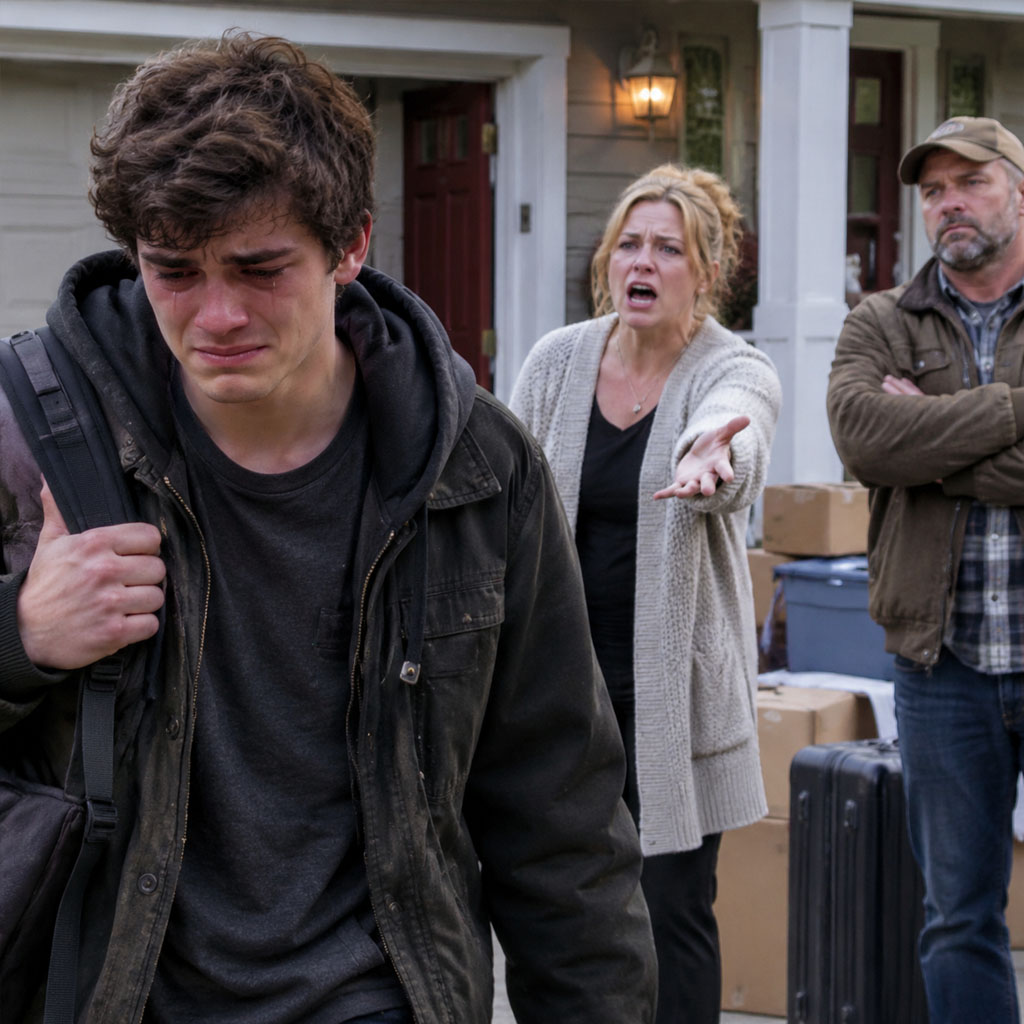
Rob stormed out, slamming the front door so hard the pictures on the wall rattled.
My mother stood in the middle of the living room, breathing heavily.
Then she looked at me.
“This isn’t working anymore.”
I waited.
“I think it’s best if you stay somewhere else for a while.”
For a moment, I couldn’t understand the words.
“Where?”
“Your grandparents’ house, perhaps.”
“You’re actually kicking me out?”
She crossed her arms.
“Don’t make this more dramatic than it needs to be.”
I looked at her, hoping she’d see what she was doing.
I was seventeen. I was still in high school. My father had been dead for two years, and she was asking me to leave the home he’d built for us.
“Mom, this is my house.”
She sighed.
“It’s not just your house, Mark. It’s our home. Rob and his children deserve to feel comfortable here, too.”
I stood there for several seconds.
Then I went upstairs.
I pulled several black trash bags from the closet and started packing. Clothes, textbooks, photographs, my father’s old baseball glove, and a small wooden model airplane we’d built together.
I didn’t know where I would live long-term, but I knew I couldn’t stay.
Before leaving, I called my grandfather.
He answered immediately.
“What’s wrong, son?”
I tried to speak, but my voice broke.
“Grandpa, Mom says I have to leave.”
There was a brief silence.
“Stay right where you are. I’m coming.”
When I carried the bags downstairs, my mother was standing beside Rob. Neither offered to help.
She simply watched.
I walked through the front door and climbed into my grandfather’s truck.
As we drove away, I looked back at the porch lights.
I had lost my father. Now I’d lost the home where he’d raised me.
At least, that’s what I thought.
Chapter 3
Living with my grandparents changed everything.
Their house wasn’t large or luxurious, but it was peaceful. My grandmother cooked breakfast every morning, and my grandfather never made me feel like I was taking up too much space.
The night I arrived, he carried my bags into the spare bedroom.
“You’re welcome here for as long as you need, Mark.”
I sat on the edge of the bed.
“Thanks, Grandpa.”
He rested a hand on my shoulder.
“Your father would want you to finish school, build a good life, and never let anyone convince you that you don’t matter.”
That night, I finally cried.
Not because I wanted to return to my mother, but because I missed the father who would have stood beside me.
My mother occasionally visited.
She arrived with boxes of my childhood belongings, including old toys, baseball trophies, and video games. She spoke as though sending me away had been a perfectly reasonable arrangement.
“I love you, Mark. I just need everyone to get along.”
I rarely responded.
Sometimes she’d mention how happy Rob and the children were now that there was less tension in the house.
I learned not to ask questions.
Instead, I focused on school.
My father’s trust covered my education, so I didn’t have to worry about taking out enormous student loans. I graduated with honors and entered a competitive university program in business and finance.
I studied hard, worked internships, and learned how to manage money.
By the time I graduated, I had secured a position with a major corporate logistics company. I worked long hours, accepted difficult assignments, and earned a promotion within two years.
I was twenty-one when the trust restrictions finally expired.
Mr. Abernathy invited me back to his office and reviewed the final documents. Once everything was signed, I had full legal control of my inheritance.
That included the house.
I sat in his office holding the deed, thinking about the seventeen-year-old boy who had carried his life away in trash bags.
The property had never belonged to my mother or Rob.
My father had made sure of that.
I didn’t immediately rush over and throw anyone out. I wanted to understand the condition of the property and make a sensible decision.
I also wanted to avoid doing anything out of anger that could create legal problems.
Mr. Abernathy advised me to have the property inspected, review the occupancy arrangements, and follow the proper legal process if I intended to reclaim it.
I agreed.
Over the next few years, I quietly built my career and saved money. My mother and Rob continued living in the house without paying rent.
I covered the property taxes and insurance through the estate.
They seemed perfectly comfortable.
Rob’s truck occupied most of the driveway. Tyler and Chloe came and went as they pleased. My father’s old furniture was either damaged, discarded, or replaced with things Rob preferred.
I occasionally drove past the property, but I didn’t go inside.
I needed distance.
By twenty-four, I was financially independent, had a respectable corporate position, and was beginning to consider graduate school.
Then I decided it was time to deal with the house.
I wanted to renovate it, repair the damage, and put it on the rental market. The property was in a desirable neighborhood, and the potential income would help fund my future plans.
I called Mr. Abernathy.
He reviewed the documents and helped me prepare the necessary notices. We agreed on a reasonable timetable and made sure the process followed local housing laws.
I wanted to handle the situation professionally.
I drove to the house one Tuesday afternoon with the property documents in a leather folder.
Nobody answered the door.
Rob’s truck was gone. The windows were dark, and the house seemed empty.
I waited thirty minutes, called my mother, and sent a message explaining that I needed to discuss the property.
She didn’t respond.
When I returned to my grandparents’ house, my grandmother mentioned something over dinner.
“Oh, didn’t your mother tell you? They went to Florida.”
I looked up.
“Florida?”
“Two weeks at the beach. She posted pictures online.”
I stared at my grandmother.
They had left the house without telling me, despite my attempts to contact them about its future.
They were living there rent-free while taking expensive vacations, and apparently saw no reason to discuss the property with its legal owner.
I opened my laptop and looked at the photographs.
There was my mother holding a tropical drink. Rob was standing beside a hotel pool. Chloe and Tyler were smiling beneath a bright blue sky.
The final photograph showed the four of them having dinner at a waterfront restaurant.
My mother had written:
“Nothing better than being surrounded by the people who truly make life beautiful.”
I closed the laptop.
For years, I’d felt guilty about reclaiming the property. I kept telling myself that perhaps I should wait until they were ready.
But they had never considered waiting when they asked me to leave.
I called Mr. Abernathy the following morning.
“Let’s move forward.”
He confirmed that the proper notices had been served and that we needed to follow the agreed process. I also arranged for a locksmith to update the exterior locks as part of a security and key-control plan, with a new key available to the occupants during the notice period.
I wasn’t going to leave anyone without access while the legal process was underway.
But I was no longer going to let them pretend the house belonged to them.
The next morning, I arrived with a locksmith named Mike.
He checked my ownership documents, confirmed the work order, and began replacing the old hardware.
The new locks were installed on the front door, back patio entrance, and garage.
I then used my key to enter the property.
What I found inside was heartbreaking.
The hardwood floors my father had carefully installed were deeply scratched. The kitchen counters were stained, the sink was full of old dishes, and empty beer cans had been shoved between the living room cushions.
My father’s favorite room had become a storage area for Rob’s belongings.
There was a lingering smell of smoke in the curtains.
I stood in the middle of the living room and looked around.
For a moment, I could almost hear my father asking whether I’d finished my homework.
Then I remembered how my mother had packed his photographs into boxes.
I left the house, secured the door, and returned to work.
Two days later, my phone started ringing.
Chapter 4
My mother’s name appeared on the screen fourteen times in less than thirty minutes.
I was at my office reviewing a logistics contract when I finally answered.
She didn’t even let me say hello.
“Mark! What have you done to the house?”
I leaned back in my chair.
“Good afternoon, Mom.”
“Don’t you dare speak to me like that! Our keys don’t work! We’ve been standing outside with all our luggage!”
I explained that I had arranged the lock replacement and that a new key was available through a secured lockbox at the side gate.
She demanded the code.
I gave it to her.
Then I explained the formal notice and the deadline.
“You have fourteen days to make arrangements to leave the property. The renovation work is scheduled to begin after that.”
There was silence.
Then she began shouting.
“You cannot throw us out! I raised you in that house!”
“You don’t own the house, Mom.”
“It’s our home!”
“It’s my property. Dad left it to me, and the deed is in my name.”
She began crying.
“We have nowhere to go!”
I looked at the contract on my desk.
“Then you should start looking for somewhere to live.”
“You’re making your own mother homeless!”
I took a breath.
“I’m giving you fourteen days and following the legal process. You have had years to make other arrangements.”
Her voice turned bitter.
“You’re acting exactly like your father.”
I paused.
“Thank you.”
Then I ended the call.
I thought that would be the worst of it.
It wasn’t.
The following morning, I drove to the property to meet my contractor, John, and discuss the renovation schedule.
Rob came charging out of the front door before I could reach the porch.
His face was red, and his fists were clenched.
“You think you can just show up here and order us around?”
I looked at him.
“Good morning, Rob.”
“Don’t play games with me! I’ve been taking care of this family for years. I’m the man of this house!”
I almost laughed.
“No. You’re a man who’s been living in a house he doesn’t own.”
He stepped closer.
“Your father isn’t here anymore. You need to grow up and understand how the real world works.”
I looked directly at him.
“My father worked sixty-hour weeks to build this life. You moved into it without contributing, and now you’re angry because the actual owner wants his property back.”
He started shouting again.
My mother rushed onto the porch.
“Mark, please! This is ridiculous. We need more time.”
“You’ve had years.”
“We don’t have money for a deposit!”
I glanced toward the driveway.
“How much did the Florida vacation cost?”
She looked away.
Before she could answer, Chloe appeared in the doorway.
She was wearing an oversized sweatshirt, and her eyes were swollen from crying. One hand rested on her visibly pregnant stomach.
My mother immediately went to her.
“Look at her, Mark. She’s pregnant!”
I stared at Chloe.
I hadn’t known.
My mother stepped forward, her voice rising.
“You’re seriously going to put a pregnant young woman out of her home? She needs stability. She needs somewhere safe to have her baby!”
For a moment, I didn’t know what to say.
Chloe was young, frightened, and clearly overwhelmed. I felt sorry for her.
But I also knew what my mother was doing.
She was using Chloe’s pregnancy to make me feel responsible for a situation I hadn’t created.
“I’m sorry Chloe is going through a difficult time,” I said. “But that doesn’t change the ownership of the property or the legal notice.”
My mother began crying.
“How can you be so heartless?”
“How could you kick your seventeen-year-old son out of this house?”
Her expression froze.
Rob stepped between us.
“Don’t bring up the past!”
“The past is exactly why we’re here.”
I looked at Chloe.
“I hope you have the support you need. But your father and my mother have had plenty of time to make financial arrangements. This house isn’t a permanent solution.”
I turned toward John, who had been waiting beside his truck.
“Let’s go over the measurements.”
My mother continued crying behind me.
I didn’t turn around.
That evening, my phone was flooded with messages from relatives.
My mother had clearly spent the day calling everyone she knew.
One aunt accused me of throwing a pregnant girl onto the street. A cousin called me greedy. Another relative said I was destroying the family over a house.
None of them mentioned that my mother had once thrown her own teenage son out of that same house.
I sat at my grandparents’ kitchen table, reading the messages.
My grandmother noticed my expression.
“What’s happened?”
I showed her the phone.
She read several messages, then placed it face down.
“Mark, let me ask you something. Which one of these people has offered to take your mother and Rob into their home?”
I didn’t answer.
“Exactly,” she said.
She poured me a cup of coffee.
“Your father left you that house to protect your future. Not to provide an endless free ride for people who don’t respect you.”
She sat across from me.
“If your relatives are so concerned about your mother, they can help her themselves. They can offer her a bedroom, pay her deposit, or rent her an apartment.”
I looked at the phone again.
Nobody had offered.
“They just want you to solve a problem they don’t intend to share.”
My grandmother was right.
I turned off the notifications and went upstairs.
The deadline was approaching.
And I had no intention of changing it.
Chapter 5
The fourteenth day arrived on a clear Monday morning.
I dressed carefully, collected the finalized renovation contracts, and drove to the property.
Part of me hoped they’d moved out quietly.
I would have preferred that.
Instead, the front lawn looked like a moving sale gone wrong.
Cardboard boxes were scattered across the grass. Black trash bags were piled beside the driveway, and several pieces of furniture sat near the porch.
But the belongings weren’t the only things waiting for me.
A group of relatives stood near the front steps.
My mother had invited an audience.
Aunt Denise, the cousin who had called me greedy, and several other family members were standing with their arms crossed.
They looked at me as though I had committed some terrible offense.
My mother rushed toward me.
“Mark! How could you do this to us?”
Her face was red, and tears ran down her cheeks.
“You’re my only son! I gave you everything, and this is how you repay me?”
Aunt Denise stepped forward.
“Family is supposed to take care of family. Your mother raised you, and now you’re treating her like a stranger.”
I looked at her.
“Did Mom tell you she kicked me out when I was seventeen?”
She frowned.
“She said you went to live with your grandparents because you and Rob weren’t getting along.”
“She told me to pack my belongings and leave. I was still in high school.”
Nobody spoke.
I continued.
“She chose Rob and his children over me. I didn’t get a vote. I didn’t get an explanation. I got a pile of trash bags and a ride to my grandparents’ house.”
Aunt Denise looked toward my mother.
My mother shook her head.
“That isn’t how it happened.”
“Then tell them how it happened.”
She said nothing.
I turned toward the relatives.
“For seven years, I’ve allowed Mom and Rob to live in this property without paying rent. I’ve covered the insurance and property taxes. I’ve given them time to make arrangements, and I’ve followed the legal process to reclaim the house.”
I took the property documents from my folder.
“This isn’t a family argument about who deserves a place to live. It’s a property I legally own, inherited from my father, and intend to renovate.”
My mother began shaking her head.
“Please, Mark. Don’t do this in front of everyone.”
“You invited everyone.”
That stopped her.
I looked at the boxes scattered across the lawn.
“The deadline has arrived. My contractor is scheduled to begin work, and I need the property returned in accordance with the notice and legal arrangements.”
My mother rushed closer.
“Just give us another month. Thirty days. We promise we’ll find somewhere.”
I remembered the night she’d stood in the living room and told me to leave.
I remembered packing my father’s baseball glove into a trash bag because I had no proper suitcase.
I remembered looking at her and asking whether she really meant it.
She had not hesitated.
Now she was standing in front of me, asking for the time she had refused to give her own child.
“Mom, I gave you the time you never gave me.”
She grabbed my arm.
“Please. I’m your mother.”
I gently removed her hand.
“You made your choice when you sent me away. I’m making mine now.”
Rob stood near the pickup truck, looking at the ground.
He no longer seemed like the powerful man who had once ordered me around in my own living room.
He looked like someone who had finally realized that the arrangement he had enjoyed for years was over.
Chloe sat in the passenger seat, staring through the window. Tyler was loading the last few boxes into the truck bed.
The relatives gradually began backing away.
Nobody seemed eager to offer the family a place to stay.
My mother looked at me one final time.
“I will never forgive you for this.”
I looked at her quietly.
“I understand.”
Rob closed the tailgate.
The truck started, and the family pulled away.
I stood on the porch until the vehicle disappeared around the corner.
Then I unlocked the front door.
The house was empty.
For several minutes, I simply stood in the living room.
There was no shouting, no television, no beer cans, and no arguments echoing through the hallway.
Just silence.
I walked toward the den, where my father’s old recliner had once stood. The chair was gone, but the outline of its former position remained faintly visible on the carpet.
I ran my hand along the wooden railing he’d built beside the staircase.
For the first time in seven years, I could imagine making this house feel like home again.
Chapter 6
The renovation began that afternoon.
John and his crew arrived with their equipment, and we started with the kitchen. The old cabinets came down, the damaged flooring was removed, and the plumbing was inspected.
Over the following three months, the property underwent a complete transformation.
We replaced the worn flooring, repaired the roof, updated the bathrooms, and repainted the interior. The landscaping was restored, and the front porch received a fresh coat of paint.
I chose bright, welcoming colors rather than the dark shades Rob had preferred.
I also created a small study in the room where my father used to organize his engineering plans.
I kept a few things that had survived the years.
His old steel toolbox, a framed photograph of him at a construction site, and the little ceramic coffee mug my mother had once donated without asking.
I’d found the mug in a box at my grandparents’ house.
It still had the chipped rim.
I placed it on a shelf in the study.
When the work was finished, the house looked completely different. It was clean, bright, and ready for a new chapter.
Rather than selling it, I decided to rent it.
Within a week, a quiet young couple with a small child signed a two-year lease. They were respectful, financially responsible, and genuinely excited about the property.
The rental income comfortably covered the annual expenses and provided additional money for my investments and graduate education.
My father’s planning had given me something far more valuable than a house.
It had given me choices.
As for my mother, Rob, Tyler, and Chloe, I heard very little about them afterward.
My mother withdrew from my life, though she occasionally tried to contact me through relatives. I made it clear that I wasn’t interested in discussing the property or revisiting the argument.
I blocked her number and removed myself from the family conversations that had become nothing more than accusations.
I didn’t feel obligated to explain myself repeatedly to people who had never bothered to ask what happened when I was seventeen.
A few months later, Aunt Denise sent me a short message.
She apologized for judging me without knowing the full story.
I accepted the apology, but I didn’t return to the relationship we once had.
Some things can be forgiven without being allowed back into your life.
My grandfather continued checking on me. My grandmother still made enough food for three people whenever I visited, even though I was perfectly capable of cooking for myself.
One Sunday afternoon, my grandfather and I sat on the porch looking at photographs of my father.
He pointed to one taken when Dad was about thirty.
“That’s the day he finished the house,” he said.
I studied the photograph.
Dad was standing in the front yard, covered in dust, smiling beside the newly completed porch.
“He was so proud of this place,” my grandfather continued. “He used to say that a house wasn’t just walls and a roof. It was a place where your family could feel safe.”
I looked down at the photograph.
“I wish he’d been here.”
My grandfather nodded.
“Me too, son.”
We sat quietly for a while.
Then he added something I’ll never forget.
“Your father didn’t leave you that house because he expected you to spend your life fighting over it. He left it because he wanted you to have somewhere to begin.”
That helped me understand something I’d struggled with for years.
I had spent so much time thinking about taking the house back that I’d forgotten what I actually wanted.
I didn’t want to punish my mother forever.
I didn’t want to spend the rest of my life arguing with Rob.
I wanted the freedom to build a life without constantly worrying about being pushed aside, manipulated, or made to feel guilty for protecting what belonged to me.
My father had worked hard to provide that freedom.
And I finally understood how to use it.
At twenty-four, I had a growing career in corporate logistics, a solid investment portfolio, and a property that generated reliable rental income. I was preparing for graduate school and had surrounded myself with people who respected me.
I wasn’t the frightened seventeen-year-old carrying his childhood in black trash bags anymore.
I was an adult who understood that love and entitlement were not the same thing.
My mother had given birth to me, but that didn’t mean she could take away my dignity, my inheritance, or my future.
Being family didn’t give anyone permission to treat me as disposable.
And being a good son didn’t mean surrendering everything my father had worked to protect.
Sometimes, the most important thing a parent can leave a child isn’t money or property.
It’s the opportunity to stand on their own two feet.
My father had made sure I had that opportunity.
And I intended to honor him by making something meaningful out of it.
THE END.
⚠️ All characters and events are fictional. Do not imitate or apply them in real life. 😌😌😌

