
Chapter 2
My father called at 8:40 that night, just as I was folding laundry on the couch. Jill was in the bath singing a cartoon theme song, and I had folded the same towel three times because my hands needed something to do.
“Bethany,” Dad said after a long pause. “It’s your father.”
“I know, Dad.”
“Your mother opened the card.”
I sat down. “What did she say?”
He explained that Mom had read the first lines aloud, apparently expecting another affectionate Mother’s Day message. Then she reached the part explaining that the monthly payments had come from me, not April, and stopped reading.
The card had been written the previous night at my kitchen table. It said, “Mom, every month since June 2021, the money has come from me. April passed it along because you said you would never take a dime from me. I’m not telling you this so you’ll thank me. I’m telling you because Jill has started asking why you thank Aunt April for everything, and I don’t want my daughter growing up believing her mother gives nothing. Happy Mother’s Day. I love you.”
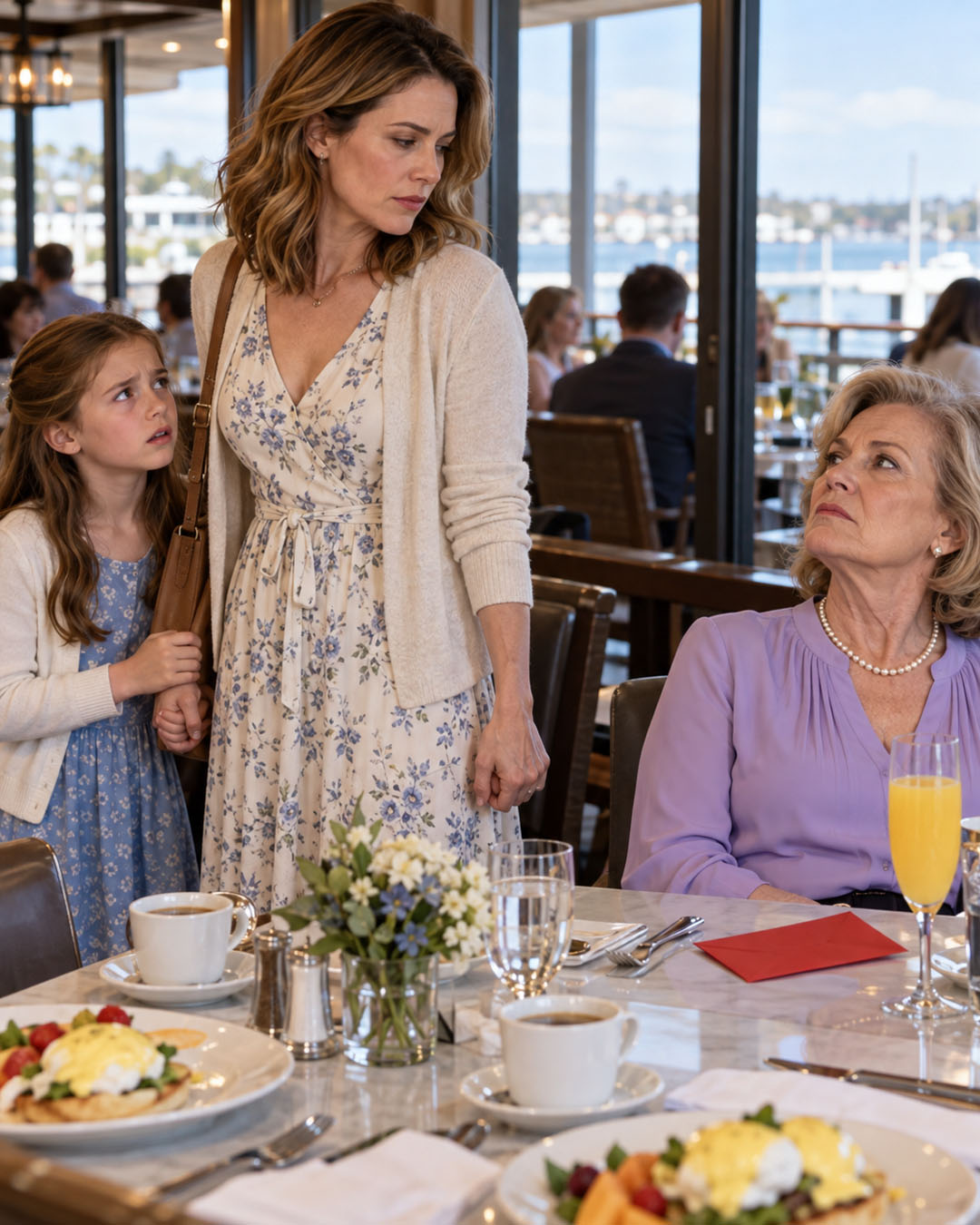
At brunch, after my mother insulted Jill, I had taken the restaurant’s pen and added one final line beneath my signature: “The May payment was the last one.”
My father said Mom had gone pale when she read it. She immediately turned to April and asked whether it was true, but my sister insisted I was lying because I was jealous of her.
Then Mom took the phone from Dad.
“Do you understand what you’ve done to this family?” she demanded.
“I understand that I left a brunch where you insulted my daughter.”
“You humiliated me in front of people from church. We were left with a two-hundred-dollar bill, and now you’ve stopped the money we depend on.”
“Zach can pay the restaurant bill, can’t he?”
“That’s not the point. Your sister has carried this family for five years, and you want to take that away from her, too. Nine hundred dollars every month, Bethany. Nine hundred dollars out of her own household budget, and you can’t stand that she’s the one who helped us.”
I stopped folding laundry.
“Nine hundred dollars?”
“Don’t pretend you don’t know. It goes into our account on the second of every month.”
I stared at the phone. I had been sending April fourteen hundred dollars each month, believing she was forwarding the entire amount to our parents. If Mom was receiving nine hundred, then five hundred dollars was disappearing every month before it reached them.
“Did April tell you she was giving you nine hundred?”
“I can read a bank statement.”
“Can you?” I asked quietly.
“What is that supposed to mean?”
“Good night, Mom.”
I ended the call before she could answer. Down the hallway, Jill had moved on to singing about a dolphin, completely unaware that her grandmother had just given me another reason to question everything I thought I knew.
The next morning, April called while I was packing Jill’s lunch.
“Mom didn’t sleep last night,” she announced without saying hello. “She’s been sitting in the kitchen since five. You need to turn the money back on before the first. Her mortgage is due on the tenth, and Dad’s medication isn’t cheap.”
“The money was always mine, April.”
“Oh, my God, Bethany. You couldn’t let me have one thing. Mom was finally proud of somebody, and you had to ruin it.”
I closed Jill’s lunchbox and stepped onto the back porch.
“How much do you give Mom every month?”
“Whatever you sent, she got.”
“That’s not an amount. How much?”
“I’m not doing this with you. You’ve always been bitter because I finished college and you didn’t.”
“I left college to run Dad’s store while you went to school. That store paid your tuition.”
“Here comes the martyr speech.”
“April, say the number.”
She hung up.
I stood on the porch for a moment, listening to the neighbor’s sprinkler tick across the lawn. Then I went inside and made three decisions before eight o’clock.
First, I called Jill’s school and removed my mother from the authorized pickup list. Second, I downloaded five years of bank statements showing every transfer to April. Third, I texted my father and asked whether he still kept the statements for my parents’ checking account in the desk at home.
He didn’t respond that day or the next.
That afternoon, my cousin sent me a screenshot of April’s Facebook post. It showed Mom smiling at brunch with her mimosa raised, taken before the argument began. April had written a long caption about daughters who used money as a weapon and abandoned their aging mothers on holidays.
Within hours, dozens of people had commented. My aunt offered prayers, a woman from church wrote that some people forgot who raised them, and my mother liked nearly every comment.
I didn’t reply.
My operations manager, Tucker, found me staring at the screen in my office.
“You’re not going to answer that?”
“No.”
“Somebody says that about my family, I’d have a few things to say.”
“If I answer publicly, it becomes a fight. If I wait, it becomes a record.”
Tucker studied me for a moment. “You’ve got something.”
“I’ve got half of something.”
The next morning, my mother walked into my office as though she had come to inspect a building she owned. Our headquarters occupied a converted auto-parts store on the east side of town, with our vans parked out back and framed photographs of our crews lining the hallway.
She looked around at the employees signing in and drinking coffee before turning to Tucker.
“I’m here to see the owner.”
“Everybody signs in, ma’am.”
“I’m her mother.”
“Yes, ma’am. Line four.”
I came out of my office before she could argue further.
“You will turn that money back on,” she said, loud enough for half my staff to hear. “Your sister has been crying for three days, your father won’t speak to me, and people at church are talking about how you abandoned me.”
“I stopped paying. I didn’t abandon you.”
“You don’t stop paying your own mother.”
“You told me you’d rather lose your house than take money from me. I’m respecting your wishes.”
She glanced at my employees, then lowered her voice without making the conversation any less public.
“April says you’ve never sent us a cent.”
“Then you have nothing to worry about. Her payments will continue on the second, just as they always have.”
For a moment, my mother looked as though she had forgotten what she intended to say.
“You owe me,” she finally snapped. “I carried you for nine months. I fed you for eighteen years.”
“And I worked for four years in Dad’s store for twelve dollars an hour. I think we’ve both contributed to this family.”
“You clean bathrooms because you didn’t have the ambition to finish school.”
Before I could respond, Maria, one of my night-shift supervisors, set down her coffee.
“Ma’am, your daughter paid for my son’s braces when my husband left. She never told anybody about it, either.”
My mother stared at her, unable to find a response. I walked to the front door and held it open.
“I have a crew meeting, Mom.”
She left with her purse clutched against her chest, warning me that the whole town would learn what kind of daughter I was.
“Everyone will know,” I told her. “I promise.”
That afternoon, the school called. My mother had shown up claiming there was a family emergency and demanding to take Jill home early. The office refused because she was no longer authorized to collect her.
When I arrived, Mom was waiting beside her car.
“They wouldn’t let me take my own granddaughter,” she said.
“I asked them not to.”
“You did that on Monday?”
“Yes.”
She removed her sunglasses. For one brief moment, she looked less angry than exhausted.
“Jill needs to hear my side.”
“She heard your side on Sunday. You said what you said directly to her.”
“It was a joke.”
“Jill asked me whether something counts as a joke when only Aunt April laughs. What would you have told her?”
My mother’s jaw tightened. “She gets that smart mouth from you.”
I went inside, signed Jill out early, and took her to the park by the river. We spent the afternoon counting her attempts on the monkey bars, and I let myself remember that protecting my daughter did not require me to win an argument with my mother.
That night, a little after ten, headlights swept across my living-room window.
My father stood on the porch holding a thick manila folder against his chest.
“Your mother thinks I’m at the gas station,” he said when I stepped outside.
“Are you going to buy gas on the way home?”
“I’ll buy gas. I’m not lying to her completely.”
We sat on the porch steps. He looked older than he had a week earlier, and for once he didn’t try to hide behind a baseball game or a plate of food.
“I kept eating at brunch,” he said. “I do that whenever your mother starts in on somebody. Forty-one years of keeping my mouth full so nobody can ask me to pick a side.”
He rubbed his face.
“I’ve been thinking about the store. About you coming home when I had my surgery. I never thanked you properly, did I?”
“No, Dad.”
“Your mother thought if we made too much of it, you’d never go back to school. The truth is, the store needed you more than it needed me those last couple of years.”
I had waited eighteen years to hear those words. When they finally came, they were quieter than I had imagined, but I let myself accept them.
He tapped the folder.
“I pay the bills, and I’ve kept every bank statement since the payments started. Your mother doesn’t open anything from the bank because she says it gives her headaches. I haven’t examined all these pages the way you will, but I think you need to.”
He told me April had been arranging a family gathering for Memorial Day. She had invited our aunt, our cousins, and the church neighbor who had been commenting on Facebook. She intended to make me apologize publicly for cutting off the money.
My father stood slowly and placed the folder in my hands.
“Whatever you find, Bethany, you be the one to say it.”
Chapter 3
I spread the statements across my kitchen table after Dad left, placing my records on the right and his on the left. Mine showed a transfer of fourteen hundred dollars to April on the first of every month, beginning in June 2021. His showed deposits of nine hundred dollars from April on the second.
I checked every month, one by one, until my coffee went cold and the house was silent around me. Sixty payments had left my account, totaling eighty-four thousand dollars, while my parents had received fifty-four thousand. Thirty thousand dollars was unaccounted for.
I knew April had always enjoyed a comfortable life, but I had never imagined she was taking a portion of the money meant to keep our parents in their home. I also understood why she had never answered my question about the amount she gave them.
On the kitchen counter, I placed a printed copy of the message she had sent me before the first payment. I’d saved it years earlier because her words had reassured me that the arrangement would work.
“Send it to me. She’ll take it from me. I’ll make sure every penny gets to her. I promise, Bethy.”
She hadn’t called me Bethy since we were children.
The following afternoon, my brother-in-law, Zach, called. He was a decent man who coached his sons’ soccer team, helped neighbors repair fences, and rarely raised his voice. He told me April had been acting strangely since Mother’s Day, and when he asked how much they were sending my parents, she had changed the subject.
“I’m not trying to get in the middle,” he said. “But is there something I should know about the money?”
“I want you to hear everything at the same time as the rest of the family. Can you come to Mom’s cookout on Monday and let me explain it there?”
He was quiet for a moment.
“That bad?”
“I didn’t make it bad, Zach. I just did the math.”
“You bet,” he said softly.
Over the weekend, I mowed my lawn, took Jill to the library, and packed the folder into my tote bag. She noticed it Sunday evening as I prepared her clothes for the next day.
“Are you going to Grandma’s?”
“Yes.”
“Are you going to yell at her?”
“No, baby. I’m going to read something to her.”
“Like a story?”
“Sort of. It has a lot of numbers in it.”
She wrinkled her nose. “That sounds like a bad story for Grandma.”
I kissed her forehead and promised that she wouldn’t have to attend the gathering. Tucker’s wife had invited Jill to spend Memorial Day afternoon swimming with their youngest daughter, and I accepted before she finished asking.
On Monday, I arrived at my parents’ house fifteen minutes late. The backyard looked exactly as it had during my childhood, with green shutters on the house, an American flag beside the garage, and the same concrete patio where every family photograph seemed to place April in the middle and me somewhere near the edge.
Everyone was already seated at a long folding table. Mom sat at the head wearing a red, white, and blue scarf, with April beside her in a white sundress. Our aunt, two cousins, and Mrs. Henderson from church sat along the opposite side, while Dad stood near the grill with an untouched plate of potato salad.
April rose when she saw me.
“Thank you for coming, Beth. I know this is hard, but we all want to heal as a family.”
“That’s a nice dress, April.”
She blinked, clearly unprepared for an ordinary compliment.
“Sit down, Bethany,” Mom ordered, pointing to an empty lawn chair placed slightly apart from the others.
I set my tote bag on the table instead.
April took a breath and began the speech she had obviously rehearsed. She explained that I had humiliated our mother on Mother’s Day, left the family with an unpaid restaurant bill, and cut off the financial support Mom and Dad depended on. All they wanted, she said, was a public apology and a promise that the payments would resume.
“Your mother is sixty-four years old,” my aunt reminded me gently. “You have to think about her needs.”
“I do think about her needs,” I replied. “That’s why I have these.”
I opened the folder and removed my bank statement from June 2021.
“On June first, I transferred fourteen hundred dollars to April. The memo says, ‘Mom monthly.’ On June second, Dad’s statement shows a deposit of nine hundred dollars from April.”
My mother stared at the pages without speaking.
“July first, fourteen hundred dollars left my account. July second, nine hundred dollars went into theirs. August was the same. September was the same.”
“Stop it,” April snapped. “You could have printed anything.”
I laid the next several statements on the table.
“Sixty months,” I said. “Every month from June 2021 through this May, I sent fourteen hundred dollars. Mom and Dad received nine hundred. That leaves five hundred dollars missing every month.”
My cousin began doing the arithmetic aloud.
“Five hundred times sixty. That’s thirty thousand dollars.”
Nobody moved.
April’s face had turned pale. “There were fees,” she said. “You don’t understand how banking works. There were taxes and expenses.”
“Then you would have told me,” I replied. “You promised every penny would reach Mom and Dad.”
“I was going to pay you back.”
“So you knew you’d taken it.”
She opened her mouth, but nothing came out. Then she looked toward our mother, expecting the same unquestioning support she had always received.
Instead, Mom was staring at the bank statements as though she had never seen numbers before.
I placed the old message on top of the stack.
“Here’s April’s promise from the week this arrangement began. She said she’d make sure every penny reached Mom. She even called me Bethy.”
Zach slowly set down his beer.
“The kitchen,” he said.
April turned toward him. “What?”
“The kitchen counters two summers ago. You told me you’d paid for them with your commissions. You said you’d been saving for months.”
“Zach, not here.”
“You told me your sales had been down that year. Where did the money come from, April?”
She began crying, but he didn’t look away. He asked her to explain the difference between what I sent and what our parents received, and she had no answer.
Mom finally spoke, and her voice was barely above a whisper.
“You let me thank you in church.”
April lowered her head.
For five years, my mother had publicly praised my sister for supporting the family. At Christmas, she had raised her glass to April, telling relatives how fortunate she was to have such a generous daughter. Meanwhile, I had sat quietly at the edge of the table, content to let Mom believe whatever made it easier for her to accept help.
I had never needed applause. I had only wanted my parents to remain safe in their home.
My mother turned toward me.
“Why didn’t you tell me?”
“I did. In 2021, I offered to help, and you said you’d rather lose the house than take money from me because you thought I’d hold it over your head. So I let April pass it along. I let you thank her because keeping you in your home mattered more to me than receiving credit.”
“Then why stop now?”
I looked toward the gate, remembering Jill’s small hand in mine outside the restaurant.
“Because you looked at my daughter and told her not to grow up like me. You said it while you were eating a meal I had arranged and paid for, with money that had come from my account for five years. I could have lived without your gratitude, Mom. I will not teach Jill that love means accepting humiliation.”
My mother flinched. I had never seen her do that before.
April stood so abruptly that her chair tipped onto the patio.
“She planned this,” she shouted. “She waited until she could embarrass everybody. This is what she’s always wanted!”
“Yes,” I said calmly. “I planned to bring the bank statements. Just as you planned this cookout so I would apologize in front of our family and Mrs. Henderson. The difference is that my plan has evidence.”
Dad rose from his place beside the grill.
“Nell, sit down and let her finish.”
Mom sat back in her chair. For once, she didn’t argue with him.
I gathered the statements into the folder, leaving the old message on the table.
“The payments will not resume. Not to April, not to either of you. You told me you’d rather lose the house than take my money. I’m finally respecting that choice.”
“Bethany, we’ll lose the house,” Mom whispered.
“Maybe. April can repay the thirty thousand dollars she kept, and that may help you recover some of what you lost. But I’m no longer responsible for managing this family’s finances.”
I looked around the table at my aunt, who had prayed publicly for my mother while believing April’s version of events, and at my cousins, who had accepted the same story without asking questions. Mrs. Henderson removed her sunglasses and folded them carefully in her lap.
“For eighteen years, I was the disappointment in this family,” I said. “I left college to keep Dad’s store open, built a business from a used van, and paid my parents’ bills for five years without asking for recognition. If that’s what a disappointment looks like, then I hope Jill grows up to be a tremendous one.”
I picked up my bag.
“Happy Memorial Day.”
Then I walked through the gate.
I sat in my car for five minutes, my hands trembling against the steering wheel. I wasn’t crying, and I didn’t force myself to. I simply let the feelings come and go until I was ready to drive.
My phone lit up with a message from Tucker.
“Jill caught a frog. She’s named it Grandpa.”
I laughed so hard I had to rest my forehead against the steering wheel. Then I drove to Tucker’s house, where my daughter was waiting beside an aboveground pool, proudly introducing everyone to her new amphibian friend.
For the first time in days, I felt as though I could breathe.
Chapter 4
The first of June arrived eight days later. For the first time in five years, no money left my account that morning, and I woke at six out of habit to check the balance anyway. It sat there quietly, belonging to me, and I felt neither guilty nor triumphant.
I made chocolate chip pancakes with whipped cream for Jill. When she asked what we were celebrating, I told her it was the first of the month, and she accepted that as a perfectly good reason.
The consequences unfolded slowly. Mrs. Henderson told people at church that the bank statements had changed her understanding of the entire dispute. By the second Sunday in June, Mom had stepped down from the women’s luncheon committee, claiming she needed time to rest. April’s Facebook post disappeared on Tuesday, along with all sixty-one comments, but the people who had read it remembered what it said.
Zach called me in July. He had moved into his brother’s basement temporarily while he and April tried to work through what had happened, especially for the sake of their two boys. He had reviewed their accounts and confirmed that the thirty thousand dollars had been spent on things April had claimed to pay for herself.
He had made her sign a written repayment agreement, requiring her to return five hundred dollars a month until the full amount was repaid.
“Sixty months,” he told me. “Same number of months she kept the money. Seems fair.”
“That’s between you and April,” I said.
“I know. I just wanted you to understand that I believe you.”
After a pause, he added, “I’m sorry I didn’t say anything at brunch. I didn’t laugh, but I should have spoken up.”
“You didn’t laugh,” I reminded him. “That was more than most people managed.”
The repayments weren’t enough to cover my parents’ mortgage, car payment, and medication expenses. In August, a real estate sign appeared beside the flag at their house, and by the end of September, my parents had sold the place where I had grown up. They moved into a two-bedroom rental across from the town library.
Mom told people they were downsizing. My aunt told the truth.
In early September, I received a letter in a white envelope. My mother usually preferred colorful stationery, so I recognized that she had put some thought into the choice. The letter was a page and a half long, and she wrote that she was sorry I had felt unappreciated, that April had put her in a difficult position, and that families had to forgive each other.
The last paragraph asked whether I could help pay the moving expenses.
I read it twice and placed it in the drawer with my bank statements. I didn’t answer. Some letters are answered by refusing to pretend that the person who wrote them has understood the problem.
My father was another matter.
That summer, Tucker mentioned that he needed part-time help maintaining our vans. I thought about it for a week before calling Dad and offering him the position. I explained the hours and the pay, making it clear that he would earn exactly what another qualified employee would earn.
“You’d hire your old man?” he asked.
“I’d hire a man who can rebuild an engine without looking at a manual. You happen to be my old man.”
He began working every Tuesday and Thursday. He was good at it, and Tucker admitted that Dad was better at diagnosing mechanical problems than he was, a confession Tucker made with considerable reluctance.
Every two weeks, Dad received a paycheck with Dwire Commercial Cleaning printed across the top. He was proud of that check, and I was proud to give it to him.
On Saturdays when Jill didn’t have soccer, Dad came to my garage and showed her how to use tools. He taught her how to tighten a bolt, repair a loose handle, and rewire an old lamp under his careful supervision. She wore safety glasses that were two sizes too big and took every instruction seriously.
One afternoon in October, I came into the garage carrying lemonade and heard Jill ask him a question.
“Grandpa, why did you keep eating at brunch when Grandma said that thing to Mom?”
I stopped in the doorway.
Dad set down his screwdriver. He considered the question for so long that I wondered whether he would answer at all.
“Because I was a coward, sweetheart,” he finally said. “For a long time, your grandmother wasn’t kind to your mom, and I kept my mouth shut because I didn’t want an argument. I told myself that staying quiet kept the peace, but really, it made things easier for me.”
Jill looked down at the lamp between them.
“Did Mom know?”
“I think she always knew. She was brave enough to keep doing what was right, even when the rest of us didn’t give her much help.”
Jill glanced toward the doorway, where I was still standing.
“I don’t miss it,” she said.
Dad smiled sadly. “No, you don’t. You’re like your mother.”
“Is that good?”
He picked up the screwdriver and placed it in her hand, handle first.
“It’s the best thing anybody in this family has ever been.”
I set the lemonade on the workbench and went back inside before either of them could see my face. Through the wall, I heard Dad explaining that a screw turned clockwise to tighten, while Jill insisted she already knew that.
For the first time, my father was not merely watching my daughter grow up. He was helping her learn the things I had always hoped someone in our family would teach her: that work had dignity, that honesty mattered, and that speaking up for someone you loved was not the same as starting a fight.
Chapter 5
My mother still lived across from the library. She sent Jill a birthday card that autumn in a bright blue envelope, with ten dollars tucked inside. Jill wrote a thank-you note in her careful handwriting because that was how I had raised her, and I let her decide what to say without correcting the spelling or asking whether she missed her grandmother.
I didn’t forbid Jill from loving Mom. I simply made it clear that love did not require her to accept unkindness or keep secrets that made her uncomfortable.
April continued making her monthly repayments. I didn’t ask Zach for updates, and I didn’t discuss the agreement with our relatives. Whatever happened between April and her husband was theirs to resolve, just as the choices I had made were mine.
My relationship with Dad grew stronger, although neither of us pretended that one honest conversation erased years of silence. He began calling me on Sundays, sometimes to ask about Jill and sometimes to tell me a story about the hardware store. Once, he apologized for making me feel that leaving college had been a failure.
“You gave up something important for us,” he said. “I should have made sure you had a chance to return when things settled down.”
“I had a chance to build something else, Dad. I’m proud of what I built.”
“I know. I just wish I’d told you that sooner.”
It was enough for that day.
My business continued to grow, and I began mentoring younger women who were trying to build careers in industries where people often underestimated them. I didn’t tell them they had to prove everyone wrong. I told them to learn their numbers, keep their records, pay their employees fairly, and never mistake another person’s approval for evidence of their worth.
Sometimes I told them that I had once spent five years quietly supporting people who believed I contributed nothing. I didn’t share every detail, but I wanted them to understand that generosity could become a trap when you allowed others to decide what your kindness meant.
At home, Jill was thriving. She was curious, funny, and stubborn in ways that reminded me of myself at her age. She still loved pancakes with whipped cream, and whenever we went to the diner on Fifth Street, she asked for a paper placemat and a crayon.
One evening, her school sent home a writing assignment. The teacher had asked each student to write a paragraph about someone they admired. Jill’s paper included a drawing of one of my company vans, complete with crooked windows and a smiling stick figure standing beside it.
The final sentence read, “When I grow up, I want to be a dissapointment just like my mom.”
She had spelled the word with one p again.
I sat at the kitchen table and read the sentence several times. Then I pressed the paper against my chest and let myself cry, not from hurt this time, but from the relief of knowing that my daughter had understood something I had spent most of my life trying to learn.
I didn’t correct her spelling.
Instead, I framed the paper and hung it beside a photograph of my first cleaning van, the used vehicle I had bought for thirty-two hundred dollars. I wanted Jill to see both whenever she walked past my office at home: the beginning of my business and the words she had written about the woman I had become.
I thought about the people who had called me a disappointment because I hadn’t followed the future they imagined for me. I thought about the store I had helped keep open, the employees whose families depended on their paychecks, the bills I had paid without expecting recognition, and the daughter who now understood that kindness and strength could live in the same person.
My mother had wanted me to become someone she could be proud of, but only if I succeeded according to her definition. My sister had wanted to be admired, even when admiration depended on taking credit for someone else’s sacrifices. My father had wanted peace so badly that he had mistaken silence for kindness.
I had wanted to be loved by all three of them, and for years I had believed that if I worked hard enough, gave enough, and asked for little enough, they would eventually see me clearly.
I know better now.
You cannot force someone to appreciate what you give them. You cannot make another person tell the truth, and you cannot protect your child from every hurtful thing a relative might say. What you can do is show your child that love should never require her to surrender her dignity, and that walking away from cruelty is not the same as abandoning someone.
I still love my mother. I don’t know whether she will ever fully understand what happened, and I have stopped making my peace depend on her understanding. If she chooses to build a healthier relationship with me and Jill, the door is not locked, but it will not be opened by guilt, demands, or another request for money.
As for April, I hope she learns to live honestly with the choices she has made. I don’t need to punish her, expose her further, or wait for her life to become difficult before I can move forward. The truth came out, the money stopped, and the responsibility for her decisions returned to her.
That is enough.
Sometimes, when Dad visits on a Saturday, Jill asks him to help her fix something in the garage. He always tells her to hand him the right tool, and she always insists she already knows which one he needs. Their arguments are small and affectionate, the kind that end with laughter instead of someone leaving the room feeling ashamed.
Watching them together reminds me that families can change, even when they change slowly. An apology doesn’t erase the past, and a second chance doesn’t mean pretending nothing happened. But people can learn to speak when silence is hurting someone, and they can choose to treat the people they love with more care than they did before.
I don’t know whether Jill will grow up to own a business, become a teacher, raise a family, or choose a life I can’t imagine yet. I hope she grows into a woman who trusts her own judgment, takes pride in honest work, and understands that her worth does not rise or fall with anyone else’s opinion.
And if she ever makes a choice that disappoints me, I hope I remember the little girl who sat beside me in a restaurant and asked whether her grandmother’s cruelty was supposed to be a joke. I hope I remember how carefully she wrote that note on a paper placemat, offering her mother the reassurance she had needed for years.
Most of all, I hope she never feels that she must earn the right to be treated well.
On the first of every month, I still notice the date. For five years, it had meant a transfer, a sacrifice, and another quiet promise that my parents would have what they needed. Now it means something simpler: I can decide what to do with the money I earn, and I can give because I want to rather than because I’m afraid of what will happen if I stop.
I still help people. I still pay my employees fairly, support causes I believe in, and lend a hand when someone genuinely needs one. The difference is that I no longer confuse generosity with an obligation to let people hurt me.
My mother once told my daughter that she hoped Jill would not grow up to be a disappointment like her mother. She meant it as an insult, a warning about the kind of woman she believed I had become.
But Jill heard something else.
She saw a mother who left a table where she was being humiliated, who kept her promises until they became harmful, and who finally chose to protect her child instead of protecting a family secret. She saw a woman who built a business, cared for others, admitted when she was hurt, and refused to let shame decide the rest of her life.
If that is what disappointment looks like, then I can live with the title.
Because the day I stopped trying to earn my mother’s approval was the day I finally began living a life I could be proud of.
And if my daughter grows up to be a disappointment just like me, I hope she becomes the kind who tells the truth, keeps her dignity, and never teaches her own child to accept less love than she deserves.
THE END.
⚠️ All characters and events are fictional. Do not imitate or apply them in real life. 😌😌😌


