
Chapter 2
“Everyone needs to leave,” I said.
Patricia stopped turning pages. My father looked up from the couch, and my mother gave a little laugh that sounded more like disbelief than amusement.
“James, don’t be ridiculous. Patricia has taken time out of her Saturday to help us.”
“She was hired to help with a deal I never agreed to. I’m sorry she was brought into this, but I am not exchanging my home.”
Patricia slowly closed her folder. “Your parents told me everyone involved was open to the arrangement. I wasn’t aware that you hadn’t agreed to anything.”
“I haven’t agreed to anything because nobody asked me.”
My mother pressed a hand to her chest. “We’re trying to solve a family problem.”
“No, you’re trying to solve David’s housing problem with my property.”
Dad stood, his expression darkening. “You’re being disrespectful. We’re your parents, and we’re trying to help you make a sensible decision.”
“Then respect my decision when I tell you no.”
Patricia gathered her papers and apologized quietly before leaving. My parents lingered long enough for Mom to tell me she had never imagined raising such an ungrateful son.
I opened the front door wider.
“Leave now, or I’ll call the police and ask them to remove you from my property.”
Dad stared at me as though I had crossed some unforgivable line. Then he walked outside, pausing on the porch to deliver one final warning.
“This isn’t over. David’s family deserves better than that cramped apartment, and you know it.”
After they left, I stood in the living room for several minutes, trying to comprehend what had just happened. My parents had brought a real estate agent into my home without permission and instructed her to evaluate it for someone else’s benefit.
I called David immediately.
“Did you know Mom was bringing a realtor to my house?”
There was a long pause.
“She mentioned talking to someone. I told her not to make a big deal out of it.”
“That’s not what I asked. Did you know she was bringing Patricia here to arrange a property exchange?”
“I didn’t know she’d actually do it. Look, James, I agree the whole thing got out of hand, but maybe we could work something out.”
I closed my eyes.
“What does that mean?”
“You could rent our apartment, and we could rent your house. That way, nobody loses money, and we get the space we need.”
I let out a disbelieving laugh.
“You want to rent my house from me because you can’t afford to buy one, after Mom and Dad just tried to convince me to trade it for your apartment?”
“I’m trying to find a compromise.”
“You could start by telling our parents to stop trying to take something that belongs to me.”
“Mom and Dad mean well, James. They just want what’s best for Nathan.”
“And what about what’s best for me?”
He didn’t answer.
I ended the call and spent the afternoon installing security cameras and changing the locks. Then I sent my parents a message informing them that they were no longer welcome at my house without an explicit invitation.
The family group chat exploded within an hour.
According to my mother, I had thrown my elderly parents out of my home for trying to help my struggling brother. My aunt Margaret asked how I could hoard a family-sized house while a little boy suffered in a tiny apartment. Cousins I hadn’t spoken to in months suddenly had strong opinions about my character.
I muted the conversation.
Over the next six weeks, I reduced contact with my parents and David. I blocked Mom on social media after she posted an article about how materialism was destroying family relationships, adding a pointed caption about people who valued possessions over blood.
Meanwhile, I focused on work, started renovating my basement into a small home gym, and began dating Sarah, a marketing manager I had met through mutual friends. She listened to the whole story over dinner one evening, her eyebrows climbing higher with every detail.
“They brought a realtor to your house without your permission?” she asked.
“Yes.”
“And then your brother suggested you should rent your own house to him?”
“That’s the short version.”
Sarah shook her head. “James, I need you to understand something. Saying no doesn’t make you selfish. It makes you a person who knows where his responsibilities end.”
For the first time since the argument began, I felt someone understood what was happening.
The quiet didn’t last.
One Tuesday evening, I returned from dinner with Sarah and found an envelope taped directly to my front door. It wasn’t in the mailbox, where ordinary correspondence belonged. Someone had gone out of their way to make sure I couldn’t miss it.
I recognized my father’s handwriting.
Inside was a formal letter from a law firm called Brennan Associates and Partners. The letter outlined several proposed solutions to what it called the “Intra-Family Housing Dispute,” including a direct exchange of properties, a sale of my house to David at seventy percent of market value, and the addition of David as a co-owner with primary occupancy rights.
The final proposal was even more outrageous. My parents wanted to establish a family trust that would own both properties, with the trustees assessing each relative’s housing needs every five years and deciding who deserved to live where.
The letter ended with a warning that the family was prepared to explore all available legal remedies to ensure an equitable distribution of resources.
I called my own attorney, whom I had consulted after the realtor incident. He read the letter, paused, and then gave a short, incredulous laugh.
“They have no legal claim to your house, James. You own it. This letter is an intimidation tactic, not a legitimate demand that you surrender your property. Keep every document, save every message, and don’t agree to anything without talking to me first.”
I thanked him and hung up, relieved that the law was on my side.
Then my cousin Lisa called.
She had attended Sunday dinner at my parents’ house the previous weekend and sounded as though she had witnessed a crime committed with office supplies.
“James, you are not going to believe what your mother did.”
“I’m almost afraid to ask.”
“She made a PowerPoint presentation.”
I sat down.
“A what?”
“A PowerPoint. The title was The Importance of Family Resource Allocation: A Case Study. Your mother actually presented slides comparing David’s apartment to your house, complete with photographs and charts about childhood development.”
Lisa explained that my parents had printed handouts containing quotations about generosity, family values, and the dangers of materialism. One slide calculated the “wasted potential” of a three-bedroom house occupied by a single man. Another compared my lifestyle with David’s family needs and concluded that I was an inefficient user of residential property.
The final slide showed two possible futures. In one, I chose family and everyone lived happily ever after. In the other, I kept my house, grew old alone, and regretted my selfishness.
I rubbed my forehead.
“Did David say anything?”
“Not really. He looked embarrassed, but he sat there and let them do it. Michelle even showed everyone a drawing Nathan had made of your house, with their family standing in front of it.”
The drawing, Lisa said, had been presented as evidence of how much Nathan wanted a yard.
I thanked her for telling me and sat quietly after the call ended.
It wasn’t simply that my parents disagreed with me. They were building a case against me, recruiting relatives, consulting professionals, and using a child’s innocent affection to make me feel responsible for a situation I had not created.
I had once imagined that I might help David buy a home when I was financially ready. I might have contributed toward a down payment or helped him understand the mortgage process.
Now, after the attempted property exchange, the surprise realtor visit, and the lawyer’s letter, I couldn’t imagine offering him another dollar.
Sarah found me sitting on the back steps that evening, staring at the garden I had planted.
“You okay?” she asked.
“I’m not sure.”
She sat beside me and waited until I was ready to speak.
“I keep wondering whether I’m being too hard on them. They’re my parents. David is my brother. Nathan is a little boy who didn’t ask for any of this.”
“That’s true,” she said gently. “But none of those things means you have to give up your home. You can love a child without accepting responsibility for every decision his parents make.”
I knew she was right, but grief didn’t disappear simply because logic had settled the argument.
That night, I scheduled another appointment with my attorney and began working with a therapist. I needed to understand how people who had raised me to be independent could become so convinced that my independence was a personal betrayal.
Chapter 3
For several weeks, the family fell silent. There were no more surprise visits, no new messages from my father, and no fresh lectures from my mother about the moral obligations of homeowners.
I almost began to believe the matter was finished.
Then, one Thursday evening at eight o’clock, my doorbell rang.
Through the security camera, I saw my parents standing on the porch with David and Michelle. A man in a dark suit stood beside them, carrying a thick leather briefcase.
Nathan wasn’t there, which was a small mercy.
I opened the door but kept the security chain fastened.
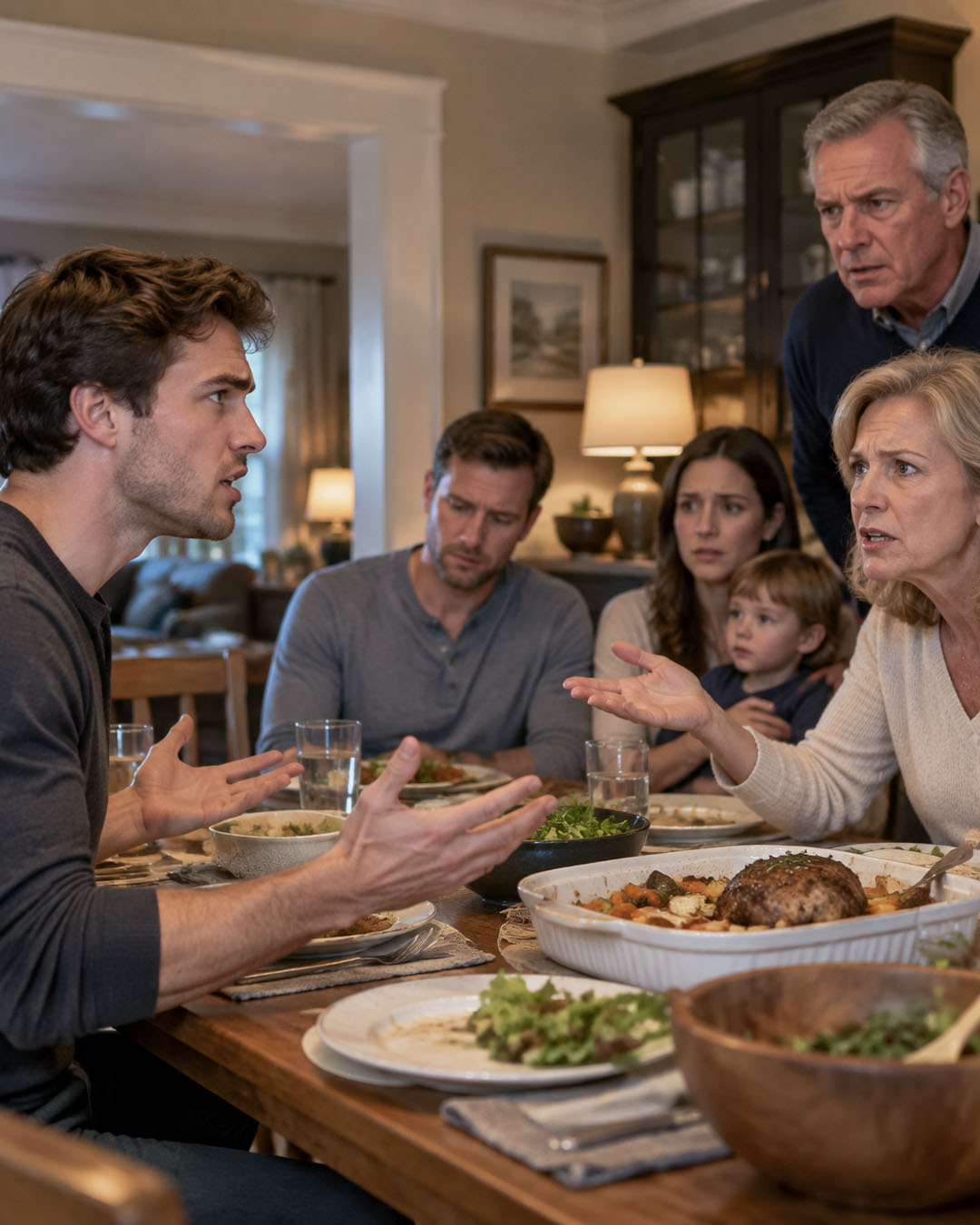
“James,” my father announced formally, “we need to have a family meeting.”
I looked at the stranger. “And who is that?”
“This is Mr. Peterson, our attorney,” Mom said. Her eyes were already shiny with tears. “Please, sweetheart. Just hear us out. We’ve found a solution that works for everyone.”
“If you don’t have a court order, you need to leave.”
Dad’s jaw tightened. “We’re not here to fight. We’re here to resolve this.”
I should have closed the door. Instead, curiosity got the better of me, and I unfastened the chain on the condition that they keep the conversation calm. I had my phone recording in my pocket, and I made it clear that the meeting was taking place in my home with my permission only as a discussion, not as consent to any agreement.
They filed into the living room with the solemnity of people attending a funeral. Mr. Peterson opened his briefcase, removed several documents, and began explaining a proposed family trust as though he were presenting a perfectly ordinary financial arrangement.
Under the plan, the trust would own both my house and David’s apartment. My parents and David would serve as trustees, with the authority to evaluate each family member’s housing needs every five years and allocate the properties accordingly.
“Given the current circumstances,” Mr. Peterson explained, “the house would be assigned to David and his family, while James would occupy the apartment. If circumstances change, the trustees could review the allocation at the next assessment.”
I folded my arms.
“And what happens if I have a family in five years?”
“The trustees would evaluate whether your needs supersede your brother’s.”
“And if David votes that his family still needs the house more than I do?”
My father answered before the attorney could speak.
“Then you’d remain in the apartment. But at least we’d all know the properties were being used efficiently.”
“Efficiently,” I repeated.
My mother leaned forward, mistaking my tone for interest.
“Exactly. A single person doesn’t need three bedrooms. If you eventually marry, we can reassess. If you don’t, there’s no reason for you to occupy a family home.”
Mr. Peterson continued discussing tax implications, legal mechanisms, and the benefits of pooling family resources. He even referred to the principle of distributing resources according to need, as though a slogan could transform my privately owned home into communal property.
Then Michelle reached into her handbag and pulled out a folded sheet of paper.
“Nathan drew something for you,” she said. “He wanted to give it to Uncle James himself, but it was past his bedtime.”
She handed me a crayon drawing of a house with a broad green lawn. Several stick figures stood in front, labeled Mommy, Daddy, Nathan, and Baby Sister.
I stared at the final label.
“Baby sister?”
Michelle placed a hand on her stomach. “We’re trying for another child. But we can’t do that in the apartment. There’s simply no room.”
For a moment, nobody spoke.
Then I set the drawing on the coffee table.
“Then you need to find a home you can afford.”
David leaned forward. “James, we’re already stretched thin. We’re asking for a little understanding.”
“Understanding what? That you want another child but expect me to provide the bedroom?”
Mom gasped. “How can you be so cold?”
“How can you be so entitled?”
My voice remained steady, even though my heart was pounding.
“Your decision to have children is yours. Your responsibility to house them is yours. I’m not responsible for financing your family by giving up a house I spent years saving for.”
“Stealing is a strong word,” Mr. Peterson interjected, glancing down at his papers. “This is simply a proposed family arrangement.”
“An arrangement I do not consent to. And if these documents are meant to pressure me into transferring property I legally own, my attorney will be very interested in reviewing them.”
The lawyer’s expression changed slightly.
I stood and walked to the front door.
“Everyone needs to leave. Now.”
David rose, his face flushed. “We’re trying to be fair. You have more than you need.”
“According to whom? You, Mom, Dad, and the committee you’ve appointed to decide what I deserve based on whether I’m married?”
My father stood beside him. “Your nephew is suffering because of your selfishness.”
“Nathan is two years old. He has parents, a home, food, and people who love him. Millions of children grow up happily in apartments. If you truly believe David needs a larger house, why don’t you give him yours?”
Dad opened his mouth, then closed it.
Mom looked almost offended by the question.
“We need our home. Your father is retired, and I have my own responsibilities.”
“And I have mine.”
Michelle began crying, clutching the empty space where Nathan’s drawing had been. “We’re family, James. How can you do this to us?”
“Family doesn’t ambush family with real estate agents. Family doesn’t hire lawyers to pressure someone into giving up their home. And family doesn’t use a child to make an adult feel guilty.”
I looked at David.
“You could have stopped this at any point. You could have told Mom and Dad that you weren’t going to take my house. Instead, you sat here while a lawyer explained how to put it under your control.”
He looked away.
I turned to Mr. Peterson. “Please tell your clients to leave. Any further attempts to pressure me into a property transfer will go through my attorney.”
They finally filed out, though my mother paused on the porch long enough to deliver one last warning.
“You’ll regret this when you’re old and alone. You’ll remember that you chose a house over your family.”
I held her gaze.
“I chose respect over manipulation. There’s a difference.”
The next morning, my attorney sent a formal cease-and-desist letter demanding that my family stop attempting to coerce a property transfer and stop entering my property without permission. He also advised me to continue documenting every contact and to seek further legal remedies if the behavior escalated.
The family fallout was immediate.
My mother told relatives that I had threatened to have my parents arrested for caring too much. Several cousins unfriended me on social media, and Aunt Margaret announced that I had become the kind of uncle who hated children.
Lisa kept me informed, but I stopped trying to correct every rumor.
Sarah reminded me that I didn’t need to win an argument with every person who had heard only one side of the story.
“You know what happened,” she said. “Your lawyer knows what happened. The people who genuinely care about you will eventually see the truth, and the people who don’t were never going to be persuaded by another explanation.”
I began to accept that losing my family’s approval might be the price of keeping my peace.
Two weeks later, I updated my will. Rather than dividing my assets among relatives by default, I designated three charities I supported to receive my estate, with clear instructions that my parents and brother were not to inherit from me.
It wasn’t a decision I made lightly. But I wanted my wishes to be unmistakable, and I no longer wanted anyone assuming that sharing my last name entitled them to the fruits of my labor.
My therapist helped me understand that boundaries were not punishments. They were a way of deciding what I could safely allow into my life.
I finished the basement gym, planted vegetables in the backyard, and began planning a kitchen renovation for the following year. Every small improvement reminded me that the house was not merely a financial asset or a collection of rooms.
It was the place where I could finally live without being told that my needs mattered less than someone else’s.
Sarah and I decided to host a housewarming dinner for the friends who had supported me through the ordeal. We jokingly called it the Still My House Party, and the name made me laugh more than it probably should have.
For the first time in months, I looked forward to opening my front door.
Chapter 4
I thought the Still My House Party would be the final chapter of the whole miserable affair. The legal letter had been sent, the unwanted visits had stopped, and my parents had apparently decided to direct their energy toward convincing the extended family that I was beyond redemption.
Then, one month later, David’s apartment building was sold to a developer.
The tenants were given sixty days to purchase their units at market prices or move out. With housing prices downtown already beyond their budget, buying the apartment wasn’t an option for David and Michelle.
I heard about the sale through Lisa, who called to ask whether I was doing all right before delivering the news. I told her I was sorry they were facing a difficult situation, and I meant it. I could feel sympathy for my brother’s circumstances without changing my position about my home.
Two days later, my phone rang.
David’s name appeared on the screen for the first time in weeks. I considered letting it go to voicemail, but I answered because I wanted to hear what he had to say.
“James, I know things have been bad between us,” he began. “But Michelle and I are in a really difficult position. We have to be out of the apartment in sixty days, and we’re struggling to find something we can afford.”
I waited.
“Could we stay with you for a few months while we figure things out?”
For several seconds, I genuinely thought I had misunderstood him.
“Let me get this straight,” I said. “After Mom and Dad tried to exchange my house, after you brought a realtor and a lawyer into the whole mess, and after the family spent months calling me selfish, you want to move into my house?”
“That’s not fair. Mom and Dad pushed most of this.”
“You sat in my living room while their attorney explained how to transfer my property into a trust you would control.”
“I know, and I’m sorry. But this is different. We’re desperate, James. Nathan needs stability.”
I heard him take a breath.
“Michelle is pregnant, too. We just found out a few months ago.”
There it was again: a new family need presented as a reason I should change my life.
“David, according to Mom and Dad, I don’t deserve my house because I’m single. According to you, it should belong to you because you have a family. So why would I let you live in a house you apparently believe I shouldn’t have in the first place?”
“Come on, man. We’re brothers.”
“We are brothers. But you lost my trust when you allowed our parents to campaign against me instead of telling them to stop. You lost it when you sat quietly while a lawyer proposed taking control of my property. You never once stood up for me, even when you knew what they were doing was wrong.”
“I didn’t want everyone fighting.”
“So you let everyone fight me instead.”
He exhaled sharply.
“Are you really going to let us end up without a place to live?”
“You’re not without options. You both have jobs, and you have sixty days to find a place that fits your budget. I hope you find something good for your family, but you cannot move into my house.”
He fell silent.
I could hear the familiar disappointment in his breathing, the unspoken expectation that if he waited long enough, I would give in and rescue him.
“I can’t help you with this, David.”
He ended the call without saying goodbye.
Twenty minutes later, an unknown number appeared on my phone. I answered, assuming it might be work.
Instead, I heard my mother’s voice.
“Your brother is going to be homeless with a pregnant wife and a toddler because of your selfishness!”
I moved the phone away from my ear and waited for her to finish shouting.
“No, Mom. David and Michelle need to find appropriate housing for their family and their budget. They’re adults, and they can make decisions about their finances.”
“They can’t afford anything decent!”
“Then they need to look at what they can afford.”
“Your nephew needs a yard. Your future niece needs a bedroom. What kind of person sits in a big empty house while his own family struggles?”
“The kind of person who worked hard to buy that house and has every right to live in it.”
She began crying, then turned to anger again.
“You’ll be sorry when you’re old and alone. Don’t come crying to us when nobody wants to look after you.”
I looked around my living room, at the bookshelves I had assembled, the photographs of friends on the mantel, and the warm light falling across the floor.
“I’m happy, Mom. My home is peaceful, and no one is trying to take it from me. I intend to keep it that way.”
She shouted something I couldn’t make out before I ended the call and blocked the number.
That evening, Sarah and I hosted our dinner party. Six friends came over with food, flowers, and enough stories to keep the table lively until late. We ate in the dining room my mother had once described as wasted space, and afterward, everyone moved into the backyard to enjoy the cool night air.
At one point, my friend Marcus raised his glass.
“To James,” he said. “For remembering that standing up for yourself doesn’t become wrong just because the pressure comes from family.”
Everyone laughed and lifted their glasses.
I looked around the table and realized that my home was full of people who respected me without needing to own anything I had. They weren’t there because they expected a favor, a loan, or a place to live. They were there because they enjoyed my company and wanted to share an evening with me.
That was what family was supposed to feel like.
David and Michelle would have to solve their housing problem. My parents could either reconsider what they had done or remain convinced that I was the villain in their story. I couldn’t control either outcome, and for the first time, I didn’t feel responsible for trying.
I had spent months wondering whether keeping my house made me selfish. Now I understood that the real question had never been whether I had enough rooms.
It was whether the people demanding access to my life respected me enough to hear the word no.
Chapter 5
The weeks after the dinner party were quieter than I expected. My parents didn’t contact me, David didn’t try calling again, and the family group chat continued without me, according to Lisa, who occasionally sent a short update when she thought I might want to know what was happening.
I didn’t ask for details about where David and Michelle eventually moved. I hoped they found a suitable place, and I hoped the baby would arrive healthy and be welcomed into a stable home. Whatever mistakes my brother had made, Nathan and his future sister were children, and they deserved a chance to grow up without being caught in the middle of adult resentment.
But I no longer believed it was my responsibility to repair the consequences of decisions I hadn’t made.
Sarah and I continued seeing each other. She never suggested moving into my house, never treated my spare bedroom as an asset waiting to be claimed, and never measured my affection by how much I was willing to sacrifice.
One afternoon, while we were planning the kitchen renovation, she asked whether I had ever considered selling the house and moving somewhere smaller.
I thought about it for a moment.
“Not because of anyone else’s expectations,” I said. “Maybe someday, if I want something different. But right now, I like it here.”
She smiled. “Then that’s the answer.”
It was such a simple response that I almost laughed. For months, every conversation about my home had been framed as a moral question, a test of loyalty, or a negotiation in which my wishes were the least important consideration.
Sarah had reminded me that a home could simply be a home.
I kept working, saving, and improving the property. The backyard garden flourished, and I planted a small magnolia tree near the fence. I imagined it growing taller over the years, its branches spreading wide enough to provide shade for anyone who sat beneath it.
I was thirty years old, and I had no idea what my life would look like at forty or sixty. I might marry. I might have children. I might remain single and spend my weekends traveling with friends, reading on the porch, or working on projects that interested me.
Whatever happened, I wanted the choices to be mine.
My mother had tried to convince me that an unmarried man was merely holding space until someone more deserving came along. My father had treated homeownership as a privilege I was obligated to surrender to the person with the larger family. David had accepted their reasoning because it offered him an easier path than finding a solution of his own.
None of them had asked what the house meant to me.
It represented years of discipline, long evenings spent learning new skills, and weekends sacrificed to work when I could have been doing something more entertaining. It represented the first time I had been able to look at my life and know that I had built something solid with my own hands and decisions.
I didn’t need to apologize for being proud of that.
A few months after the family dinner, Lisa invited me to lunch. She told me that several relatives had begun questioning my mother’s version of events after learning that I had never agreed to the property exchange and that the proposed trust would have given David control over my home.
Some relatives apologized for judging me too quickly. Others remained silent, apparently unwilling to admit that they had been wrong.
I thanked the ones who reached out, but I didn’t reopen every relationship. Forgiveness, I was learning, didn’t require pretending nothing had happened. It simply meant deciding how much space a person deserved in my future.
As for David, I still hadn’t answered his last message, the one in which he said he hoped we could talk again when things calmed down. Maybe someday we would have that conversation. If we did, it would begin with an honest acknowledgment of what had happened, not another request for me to prove my love by giving something up.
Until then, distance was the healthiest choice.
On a bright Saturday morning, Sarah and I stood in the kitchen looking at paint samples. Sunlight poured through the windows, and the house smelled of fresh coffee and the cinnamon rolls she had brought from a bakery nearby.
She held up two colors and asked which I preferred.
I chose the warmer shade.
“Good choice,” she said, kissing my cheek before returning to the samples.
I looked around the room and felt a quiet gratitude that had nothing to do with winning an argument. The walls needed fresh paint, the kitchen still needed new cabinets, and the basement gym had a few finishing touches left. There would always be something to repair, improve, or plan.
That was part of owning a home.
It was also part of building a life.
I had once thought that being a good son and brother meant making myself available whenever my family needed something. I had confused generosity with obligation and loyalty with surrender. When they asked for more than I could reasonably give, I assumed the problem must be that I wasn’t giving enough.
Now I understood that genuine love could survive a boundary. It might be disappointed, frustrated, or inconvenienced by a refusal, but it wouldn’t require someone to surrender their independence to prove they cared.
The people who loved me could want good things for David and still respect my right to keep my house. They could care about Nathan’s future without pretending that a suburban yard was the only way a child could thrive. They could offer help without demanding that someone else pay the price.
I couldn’t force my parents to see that. I couldn’t make David take responsibility for his choices, and I couldn’t convince every relative that I wasn’t the villain.
But I could decide how I would live.
That evening, I stepped onto the back porch and looked across the garden. The magnolia tree was still small, its leaves moving gently in the breeze, but it had taken root and was beginning to grow.
I thought about the boy I had been, the young man who believed that doing everything right would guarantee that the people he loved would treat him fairly. I wished I could tell that younger version of myself that hard work was worth it even when others failed to appreciate it, and that boundaries weren’t a betrayal of the people who raised him.
They were a promise to himself.
My phone buzzed with a message from Marcus asking whether we were still on for golf the next morning. I replied that I would be there, then put the phone away and went inside.
The house was quiet, but it wasn’t empty. It held the work I had done, the memories I had chosen to keep, and the freedom to decide what came next.
My parents might always believe that I had chosen property over family. David might always think I could have made his life easier if I had been more generous. They were entitled to their opinions, but they were not entitled to my home.
I had earned it, I paid for it, and I would decide what happened to it.
Being single didn’t make me less deserving of security, comfort, or a future of my own. Having no children didn’t mean I had no needs. And sharing DNA with someone didn’t give them the right to claim what I had worked for.
My house remained my house, and my life remained my own.
For the first time in a long while, that felt like more than a victory.
It felt like peace.
THE END.
⚠️ All characters and events are fictional. Do not imitate or apply them in real life. 😌😌😌


