Chapter 2
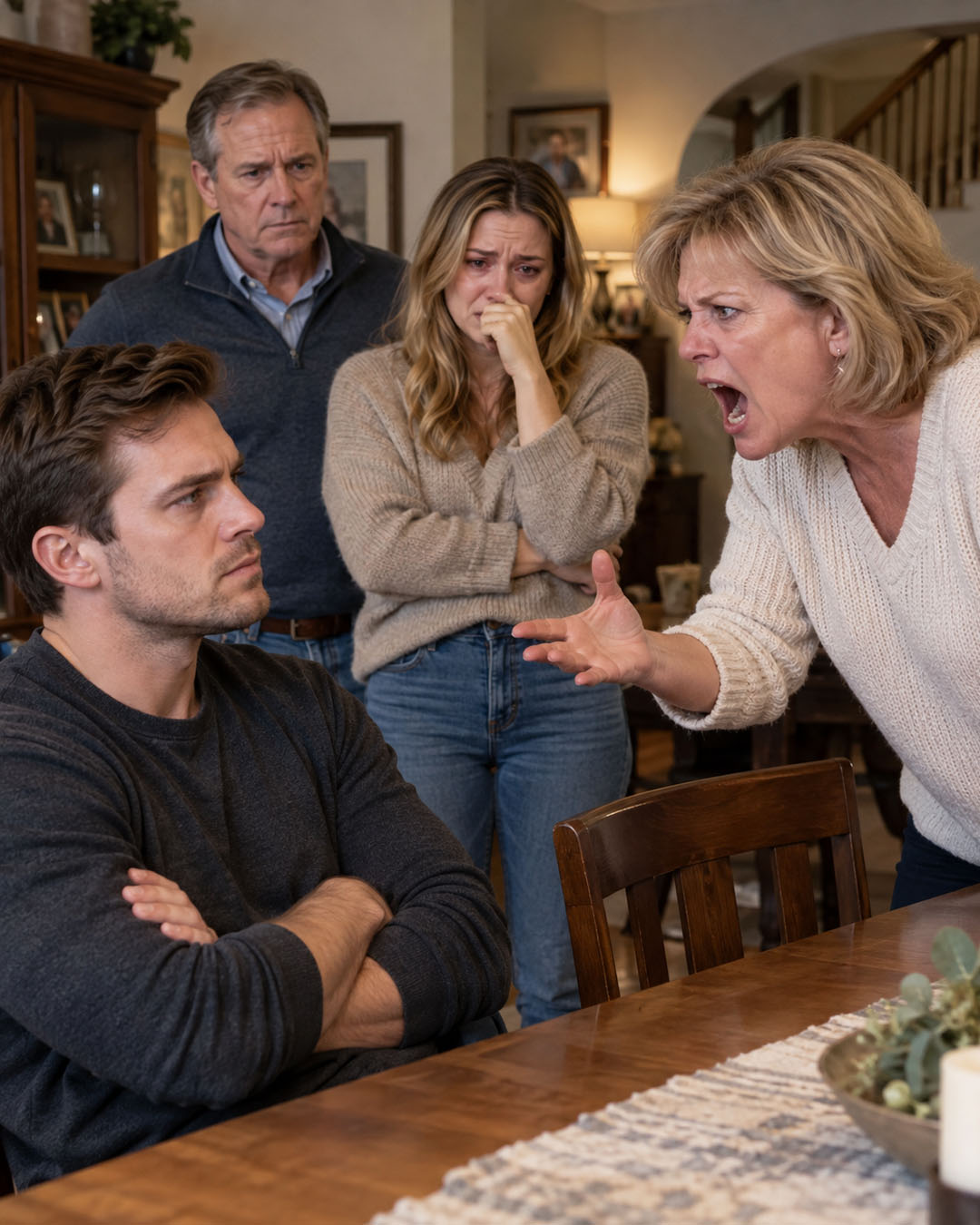
Mom’s Sunday dinners were never casual. She used cloth napkins, served pot roast in a heavy blue dish that had belonged to my grandmother, and somehow turned mashed potatoes into a setting for emotional negotiations. That evening, Aunt Cheryl, Uncle Dale, Belle, Paige, my parents, and I were all there.
For an hour, I thought I might escape without trouble. Uncle Dale told an overly long story about backing his truck into a mailbox. Belle whispered jokes under her breath. Paige ate quietly while Mom delivered cheerful reports about her new apartment.
“Paige found the prettiest curtains.”
“Paige may get a little sectional for the living room.”
“Paige is finally starting to feel hopeful.”
Every sentence reinforced the same story. Paige had survived something terrible, and we were all supposed to help rebuild her.
I kept eating.
Then Mom turned to me.
“Jake, I’ve been thinking.”
Those words had never improved my evening.
She folded her hands. “It’s time you really stepped up.”
“I have stepped up.”
“I mean financially.”
The table became very still.
“Mom.”
“She’s your sister.”
“I know who she is.”
“Then act like it.”
I set my fork down.
Dad cleared his throat. “Your mother has a point.”
Paige stared at her plate.
That bothered me more than anything.
She knew what Mom was asking. She knew why she needed the money. Most important, she knew I had been lied to.
Yet she let everybody pressure me.
“I’m not giving Paige $10,000,” I said.
Mom’s jaw tightened. “You can afford it.”
“You don’t know what I can afford.”
“You have savings. You have no family responsibilities. What is the money for if you won’t help your own sister?”
“My life.”
She stared at me.
I continued. “My retirement. A house someday. Emergencies. Maybe a family of my own eventually. My money isn’t sitting there waiting for somebody else to need it.”
Mom’s voice rose. “Your sister is suffering.”
Something inside me finally gave way.
Not violently. Not even angrily.
I simply became too tired to protect a lie that wasn’t mine.
I looked at Mom.
“Maybe Paige shouldn’t have cheated on Marcus.”
Silence.
Paige’s head snapped up.
Mom’s face went white.
Dad’s fork stopped halfway to his mouth. Aunt Cheryl covered her lips. Uncle Dale suddenly found his water glass fascinating.
“What did you say?” Paige whispered.
“I know about Drew.”
Her eyes widened.
“I know the affair went on for months. I know Marcus found out. I know he offered counseling, and you refused.”
“Who told you that?”
“It doesn’t matter.”
“It absolutely matters.”
“Does it make it less true?”
Paige looked toward Mom, almost instinctively.
Then she attacked.
“You have no idea what happened in my marriage.”
“I know you cheated.”
“You know what Marcus wants people to think.”
“Marcus never told me anything.”
That slowed her down.
I told the table what Owen had said. Paige denied parts of it, called Marcus manipulative, then accused me of always resenting her.
“Jealous?” I said. “Of what? Your divorce?”
Mom stood so abruptly her chair scraped the floor.
“How dare you?”
Her voice shook the room.
“Mom, sit down.”
“No. How dare you come into my home and humiliate your sister in front of this family?”
“You brought my finances up in front of this family.”
“That is different.”
“How?”
“Because Paige needs help!”
“She needs help because everybody thinks Marcus abandoned her.”
“You owe your sister support.”
I stared at her.
“I don’t owe her $10,000 because she lied to all of you.”
Mom pointed at me.
“You owe her an apology.”
“They’re not lies.”
“I don’t care if they’re true or not!”
That sentence ended the argument for me.
Not because she had won.
Because she had finally said the truth about our family out loud.
Facts were less important than protecting Paige.
I stood, took my jacket from the chair, and looked around the table.
“I’m not apologizing for telling the truth, and I’m not writing a check to keep a lie comfortable.”
Then I left.
I sat in my car for several minutes because my hands were trembling too badly to drive. Inside, I could see silhouettes moving behind the curtains. Nobody came outside.
By the time I reached home, the messages had started.
Mom: You are not the son I raised.
Dad: Disappointed
Paige sent a long message calling me cruel, bitter, selfish, and jealous. Then she blocked me.
Belle’s message arrived ten minutes later.
That was insane.
At least it was honest.
For several days, nobody else contacted me.
I went to work, came home, ate alone, and checked my phone far more often than I care to admit. Some childish part of me expected my parents to investigate and call me.
Jake, you were right.
We’re sorry.
That call never came.
Something else happened instead.
I began sleeping better.
The family silence hurt, but the pressure disappeared with it. Nobody asked for money. Nobody lectured me about responsibility. Nobody explained why Paige’s needs were morally superior to mine.
I started running again in the mornings.
For the first time, I could see that what hurt wasn’t simply the argument. I was grieving an old belief: that if I stayed reasonable long enough, worked hard enough, and asked for little enough, my family would eventually notice and value that.
They hadn’t.
Ten days after the dinner, Marcus called.
I nearly ignored it.
When I answered, his voice was quieter than I remembered.
“Owen told me what happened.”
“He has a big mouth.”
“He feels terrible.”
“He shouldn’t.”
Marcus paused. “Neither should you.”
We talked for almost an hour.
He confirmed everything.
The affair had lasted nearly four months. He discovered it when a message appeared on Paige’s phone while she was in the shower. He confronted her that night.
“She denied it for maybe ten minutes,” he said. “Then she admitted it and told me I hadn’t been there for her emotionally.”
“Did you offer counseling?”
“Twice.”
“And?”
“She said if I couldn’t get past it, that was my problem.”
Marcus moved out two weeks later.
The part I hadn’t known came next.
After he left, Paige asked him to keep the real reason private.
“She said telling her parents would make everything uglier,” Marcus explained. “I still cared about her. I figured we didn’t need a public war.”
“So you let everybody blame you.”
“I thought she’d tell them privately.”
I leaned back against my couch and closed my eyes.
His silence had not caused Paige’s lie.
But it had given the lie room to grow.
“I’m sorry you got pulled into it,” he said.
“You didn’t pull me into anything.”
“I should’ve spoken sooner.”
“Maybe.”
Then I added, “But you shouldn’t have to campaign for people to believe you weren’t the villain.”
After we hung up, I felt something different from anger.
Clarity.
Paige had built a safer version of reality because the truth embarrassed her. Mom had embraced that version because it preserved her image of Paige. Then they both expected everybody else to pay the price of keeping that version intact.
Including me.
A few days later, I called Belle.
She told me what the family was saying.
Apparently, Mom had described me as bitter and lonely. She told Aunt Cheryl that I had been jealous of Paige for years and used the divorce as an excuse to attack her.
“That’s rough,” I said.
Belle sighed. “I don’t believe it.”
“Why?”
“Because I checked.”
She had contacted a mutual friend who knew Marcus.
The friend confirmed the affair.
Belle then spoke to her mother.
Aunt Cheryl called Mom.
And slowly, the story began collapsing.
Then somebody saw Paige holding hands with Drew at a coffee shop.
Chapter 3
The sighting came from one of Mom’s friends, a woman named Carol who had known our family since church potlucks and Little League fundraisers. Carol apparently saw Paige and Drew sitting together at a coffee shop, leaning across the table like a couple who had been comfortable together for much longer than two weeks.
Mom confronted Paige.
According to Belle, Paige tried to say Drew was someone new.
Then Mom asked when they met.
Paige’s answer changed twice.
After that, rumors did what facts had been unable to do.
The family began asking questions.
Aunt Cheryl told Mom directly that she owed me an apology. Mom said she “wasn’t ready for that conversation.”
Dad, meanwhile, admitted to Cheryl that he had heard enough by then to suspect I had been telling the truth.
That discovery hurt more than I expected.
Dad had known there might be truth behind what I said, yet he had still sent me that one-word text.
Disappointed.
I stopped waiting for them to come rescue our relationship.
If reconciliation happened, it would not happen because I crawled back and apologized for being inconvenient.
Three weeks after the dinner, Mom finally called.
“We need to talk.”
I nearly laughed at the opening, but I agreed to come over Saturday.
When I arrived, Mom and Dad were sitting in the living room. Paige was in an armchair by the window with her arms crossed tightly over her chest.
I chose the chair closest to the doorway.
Mom began.
“I’ve learned some things.”
Paige looked down.
Mom continued carefully. “I understand now that the situation between Paige and Marcus was more complicated than I knew.”
“More complicated?”
She frowned. “Jake.”
“No, I’m listening.”
She inhaled.
“But even if what you said was true, the way you said it was wrong.”
There it was.
“You humiliated your sister.”
I nodded slowly. “When exactly would you have preferred I tell you?”
“Privately.”
“I told you privately that I wasn’t giving her money.”
“That’s not what I mean.”
“I know. I’m asking when I was supposed to tell you the rest. Before or after you called Dad? Before or after Aunt Cheryl? Before or after half the family contacted me because you decided my savings were a group resource?”
Mom looked away.
“You wouldn’t accept no,” I said. “You made it public.”
Dad shifted in his recliner.
I turned toward Paige.
“Why did you lie?”
Her eyes lifted.
“Jake—”
“No. Not why the marriage ended. Why did you lie to us?”
Her mouth tightened.
“I was ashamed.”
The answer came quietly.
“I didn’t know how to tell Mom and Dad.”
For the first time since the whole thing began, she sounded like my sister instead of someone defending a position.
“I knew what everybody thought of Marcus and me,” she continued. “Mom was always talking about our marriage like we had everything figured out. I couldn’t stand the idea of telling her I’d ruined it.”
Mom flinched at the word ruined.
Paige wiped her eyes.
“So I said Marcus had become distant. That part wasn’t completely false. We had problems.”
“Problems don’t make cheating somebody else’s fault.”
“I know.”
“Do you?”
She looked at me.
“Yes.”
Her voice cracked.
“I know now.”
I believed the shame. I even understood it.
But understanding an explanation is not the same thing as excusing what came after.
“You didn’t just hide the reason for the divorce,” I said. “You let Marcus take all the blame. You let Mom and Dad pay your bills. You sat at that dinner and watched them tell me I owed you $10,000.”
Paige began crying.
“I didn’t ask Mom to do that.”
“You didn’t stop her either.”
She had no answer.
Mom immediately reached over and touched Paige’s knee.
That small gesture hit me harder than the yelling had.
Even now, Mom’s instinct was the same.
Protect Paige.
Comfort Paige.
I looked at her.
“Why has it always been like this?”
She blinked.
“What?”
“You heard me.”
“I don’t understand.”
“Yes, you do.”
Dad became very still.
I took a breath.
“You helped Paige through college. When my turn came, you told me to work harder.”
“We didn’t have as much money then.”
“I know. But nobody ever acknowledged what that meant for me.”
Mom opened her mouth, but I continued.
“You helped pay for her wedding. You turned the guest room into a recovery retreat when she got divorced. Dad paid her bills. You called relatives and organized a pressure campaign because I wouldn’t give her money.”
“Jake, we love you both equally.”
“I didn’t ask whether you love me.”
The room fell quiet.
“I asked why you have never treated us equally.”
Mom stared at me.
I had never said those words before.
Not at 16 when Paige got the better car. Not at 21 when I was working weekends while she came home from college for breaks. Not when she missed my graduation because she was traveling with Marcus.
“I got promoted last year,” I said. “Nobody remembered.”
Dad looked at the floor.
“At dinner that night, Mom spent 20 minutes talking about Paige fighting with her homeowners’ association.”
“That’s not fair,” Mom whispered.
“It happened.”
“I didn’t realize.”
“That’s the point.”
My voice softened.
“You didn’t realize because I was always the kid who was fine. I became independent because I learned early that needing less made life easier for everybody.”
Dad rubbed his forehead.
“We never meant to make you feel that way.”
I looked at him.
“I believe you.”
His eyes met mine.
“But you did.”
Nobody spoke for a while.
The clock on the mantel sounded unusually loud.
Mom finally leaned back.
“I pushed too hard about the money.”
I waited.
“And I shouldn’t have said you weren’t the son I raised.”
Her eyes filled.
“I’m sorry for that.”
It wasn’t the sweeping apology a part of me still wanted.
But it was real enough to cost her something.
Paige looked at me next.
“I’m sorry too.”
I said nothing.
“I lied because I was ashamed. Then I kept lying because telling the truth got harder every day.”
She swallowed.
“And I’m sorry I let you take the blame when you wouldn’t give me money.”
I nodded once.
She continued.
“You were there for me more than I deserved. You helped me move. You called. You took me to dinner. I acted like none of that counted because Mom was talking about money.”
Tears rolled down her cheeks.
“I haven’t been much of a sister to you.”
That one hurt because it was the first time she had ever admitted it.
“Thank you,” I said.
I didn’t tell her it was okay.
It wasn’t.
I stood.
Mom looked worried. “You’re leaving?”
“Yes.”
“Are we all right?”
That question would once have made me rush to comfort her.
Instead, I answered honestly.
“We’re better than we were.”
She wiped her eyes.
“I need some space,” I said. “Not forever. I just need to figure out what relationship I want with everybody when I’m not playing the role I’ve always played.”
“What role?” Dad asked.
“The one who doesn’t need anything.”
Dad stood when I reached the door.
He didn’t hug me.
Glenn Mercer was a man who considered prolonged eye contact dangerously emotional.
Instead, he held out his hand.
I shook it.
He gripped mine with both of his.
“I should’ve listened sooner.”
That was enough.
Paige came to the doorway.
“Jake.”
I turned.
She hugged me.
For a moment, I stood stiffly.
Then I hugged her back.
“I’ll be here when you’re ready,” she whispered.
“I know.”
I drove home feeling lighter than I had in years.
Not because the family was fixed.
Because I had stopped pretending it had never been broken.
Chapter 4
The weeks afterward were quieter.
Mom and I exchanged short texts. Nothing dramatic. She asked whether work was busy. I asked whether Dad had finally fixed the loose railing on the back porch.
Dad began texting too.
His messages were still short enough to fit on fortune cookies.
Game Sunday?
Need anything from Costco?
Saw your old coach at gas station.
For my father, that qualified as emotional outreach.
Paige unblocked me.
We didn’t immediately become close. Life doesn’t usually repair itself that neatly. She had damage to face that had nothing to do with me, and I had years of resentment that could not disappear because of one tearful afternoon.
She also had to deal with the consequences of the story she had told.
Mom and Dad stopped covering every expense automatically. Dad sat down with Paige and helped her build a budget instead of writing checks. Paige got a smaller apartment than the one she originally wanted and bought some furniture secondhand.
She hated it at first.
Then, according to Dad, she began taking pride in managing on her own.
Drew did not last.
I never asked for details.
Marcus and I spoke once more.
I told him the family knew the truth.
He was silent for several seconds.
“I’m glad,” he said.
“You sound relieved.”
“I am.”
“Because Paige got exposed?”
“No.”
He sighed.
“Because I got tired of being the villain in a story I didn’t write.”
That sentence stayed with me.
I understood it too well.
For years, I had been a character in my own family’s story too. Paige was the one who needed help. I was the one who could handle himself. Paige was sensitive. I was practical. Paige required support. I had resources.
Once those roles become established, families stop questioning them.
The strong child becomes strong because nobody checks whether he has another option.
A month after our living-room conversation, Mom invited me to Sunday dinner again.
I almost declined.
Then she added, “No money conversations. I promise.”
I went.
Aunt Cheryl and Uncle Dale were there. Belle came too. Paige arrived carrying a salad she had made herself, which shocked everyone enough that Dad took a picture of it.
The dinner was awkward for about 15 minutes.
Then Uncle Dale started telling another story about his truck.
Some things survive any family crisis.
Halfway through the meal, Aunt Cheryl asked how work was going.
“Fine.”
Mom looked at me.
“Don’t say fine. Tell them.”
“Tell them what?”
“Your promotion.”
I stared at her.
“I told you about that last year.”
“I know.”
Her face softened.
“I should’ve made more of it then.”
Everybody looked at me.
For a second, I wanted to brush it off.
That was my old instinct.
Don’t need attention.
Don’t make anybody uncomfortable.
Then I let myself answer.
“I’m up for another promotion now.”
Dad smiled. “That’s my boy.”
We talked about my work for nearly ten minutes.
It felt strange.
Good, but strange.
After dinner, Paige found me on the back porch.
She handed me a beer and sat in the chair beside mine.
“I owe Marcus an apology.”
“Yes.”
“I wrote one.”
“That’s good.”
“I don’t know if I should send it.”
I thought about that.
“Are you sending it because you want him to forgive you?”
She shook her head.
“No. I don’t expect that.”
“Then send it.”
She stared across the yard.
“I was angry with you.”
“I noticed.”
“I thought you ruined everything.”
“I know.”
She gave a short laugh.
“Then I realized everything was already ruined. You were just the one who turned on the lights.”
That was probably the closest Paige would ever come to poetry.
I smiled.
“I’ll take that.”
She became serious again.
“Mom told me something.”
“What?”
“She said she thinks she made you independent by accident.”
I laughed.
“That sounds like Mom.”
“She feels bad.”
“She should feel something. But I don’t want her living in guilt forever.”
Paige looked over at me.
“You’re nicer than me.”
“No, I’m not.”
“You gave me grace when I didn’t deserve it.”
“I gave you boundaries.”
“Same thing, apparently.”
I thought about that for a moment.
Maybe she was right.
Grace without boundaries becomes permission.
Boundaries without grace become punishment.
For the first time in our adult lives, Paige and I were trying to find the space between those two things.
Several months later, I put an offer on a townhouse.
It wasn’t extravagant. Two bedrooms, a small deck, a kitchen with enough counter space for someone who mostly ordered takeout, and a garage that actually fit a car.
I used the savings Mom once thought I should hand over to Paige.
When my offer was accepted, I called my parents.
Dad whooped.
Mom cried.
Then she said, “See? This is why you saved your money.”
I went quiet.
Mom went quiet too.
Finally, she sighed.
“I walked right into that one, didn’t I?”
“You really did.”
She laughed.
“I’m learning.”
On moving day, Dad arrived at 7:00 in the morning with a toolbox and enough extension cords to wire a small stadium. Trent brought coffee. Belle appeared with doughnuts.
Then Paige pulled up.
She climbed out carrying a lamp.
“Where’d that come from?”
“My apartment.”
“You’re giving me your lamp?”
“You always liked it.”
“I never said that.”
“You looked at it twice.”
“That is not the same thing.”
She shrugged. “Take the lamp, Jake.”
So I took the lamp.
We spent the afternoon hauling boxes and arguing about furniture placement. At one point, Paige told me my couch looked ridiculous against the far wall.
I told her she had forfeited decorating privileges after the curtain scandal of her divorce apartment.
Mom laughed so hard she had to sit down.
No one got angry.
No one pretended the past hadn’t happened.
We simply survived the joke.
That evening, after everybody left, Dad stayed behind for a few minutes.
He stood in my new kitchen with his hands in his pockets.
“Proud of you, son.”
“Thanks.”
He nodded toward the living room.
“Built yourself a good life.”
I knew he wasn’t talking about the townhouse.
“So far.”
Dad nodded.
Then he did something rare.
He hugged me.
It lasted maybe two seconds.
For Glenn Mercer, it was practically a speech.
Later that night, I sat alone on the back deck with a beer and thought about that Sunday dinner months earlier.
For a long time, I had wondered whether I should have kept quiet.
Maybe I could have confronted Paige privately. Maybe I could have softened the truth. Maybe I could have avoided humiliating her.
But every version of that question ignored what had actually happened.
I had said no privately.
My no had not been respected.
I had been pressured, judged, and publicly accused of failing my sister because I would not sacrifice my own future to protect a false story.
Sometimes the truth sounds cruel only because people have built something comfortable on top of a lie.
That doesn’t mean truth should be used as a weapon. It doesn’t mean humiliation is noble, or that every private mistake belongs at a dinner table.
It means there comes a point when keeping someone else’s secret begins requiring you to betray yourself.
That was the line I had crossed.
Not when I exposed Paige.
When I finally refused to disappear for her.
Mom and I are closer now, though different. She still worries too much about Paige. She still occasionally starts a sentence with, “Your sister could really use—” then catches herself and laughs.
Paige and I talk once or twice a week.
She apologized to Marcus without asking him to respond. He accepted the apology but made clear that reconciliation was not possible. Paige respected that.
She is dating nobody right now.
For once, she says she wants to understand herself before asking somebody else to understand her.
And me?
I still work too much.
I still watch basketball.
I still eat takeout more often than my doctor would approve of.
But I no longer confuse being low-maintenance with being unimportant.
That may have been the most expensive lesson nobody ever charged me for.
One Sunday, months after everything settled, we were eating pot roast again at my parents’ house.
Mom passed the potatoes to Paige, then to me.
She looked around the table and smiled.
“Everybody have enough?”
For years, I would have automatically said yes.
That night, I looked at the nearly empty serving bowl.
“Actually, I’d like a little more.”
Mom smiled and scraped the last potatoes onto my plate.
Nobody complained.
Nobody needed them more.
Nobody told me to give them up.
It was only mashed potatoes.
But sometimes the smallest things show you that a family is finally learning a different way to love.
And for once, I let myself have my share.
THE END.
⚠️ All characters and events are fictional. Do not imitate or apply them in real life. 😌😌😌