
Chapter 2
I worked in medical records at a regional hospital outside Portland, Oregon. It was not dramatic work, but after nearly a decade I had learned one useful lesson: records have memories people do not.
Every entry leaves a trail.
The note in Grace’s chart bothered me because neither Daniel nor I had reported any family history involving birthmarks, heart problems, genetic disorders, or a woman named Evelyn.
I checked the authorization history.
The note had been entered by a maternal-fetal medicine nurse after an outside phone call.
A callback number had been recorded automatically.
I knew the number.
Margaret’s.
I sat staring at my computer until my supervisor, Denise Carter, noticed.
“You okay?”
I printed the audit page and took it into her office.
“I need a second set of eyes.”
Denise had worked hospital records for nineteen years. Very little surprised her.
She read the page twice.
“Someone called shortly after delivery and reported a possible hereditary condition associated with a skin marker.”
“That’s what I thought.”
“You know this number?”
“My mother-in-law.”
Denise looked up.
“She told us nothing until the next morning.”
“She told someone here.”
“Why would she do that?”
Denise leaned back.
“Maybe she was afraid you wouldn’t take her seriously.”
The thought followed me home.
Margaret had not merely panicked when she saw Grace.
She had been afraid before she arrived.
Which meant she knew enough about Evelyn’s history to believe my daughter might be at risk.
Daniel was at the kitchen table when I came in, holding a manila envelope.
“What’s that?”
“My adoption records.”
I stopped.
“You requested them?”
“Three days ago.”
He looked tired.
“I needed to know if she was telling the truth.”
He slid the papers toward me.
There was an adoption decree, a relinquishment form, and several legal documents from more than three decades earlier.
Something about them looked wrong.
The relinquishment page referenced a notarization format that had not existed when Daniel was born. Another document had clearly been reissued later.
“This paperwork was cleaned up after the fact,” I said.
Daniel frowned.
“What does that mean?”
“It could mean nothing criminal. But somebody wanted the record to look simpler than the original arrangement.”
He rubbed both hands over his face.
“Why?”
“You don’t hide an adoption that happened legally.”
I looked at the papers again.
“You hide the person connected to it.”
He called Margaret.
She ignored four calls.
On the fifth, she answered.
Daniel put the phone on speaker.
“Mom.”
“I know.”
“No, you don’t know. I found the records.”
Silence.
“They were changed.”
Margaret exhaled shakily.
“I need to come over.”
“Why can’t you just tell me now?”
“Because I have something you need to see.”
She arrived that evening carrying an old shoebox.
No gifts. No casseroles.
She sat on our couch and removed a faded photograph.
Two teenage girls stood in front of a modest ranch house.
One was unmistakably Margaret.
The other had Daniel’s eyes.
His jaw.
Even the slight crookedness in his smile.
And on her left forearm, partly visible below the sleeve of her T-shirt, was a dark oval mark.
Daniel did not speak for several seconds.
“That’s Evelyn?”
Margaret nodded.
“My younger sister.”
Daniel’s head snapped toward her.
“You told me you were an only child.”
“I let you believe that.”
“Why?”
“Because our parents wanted Evelyn erased from the family.”
Margaret folded her hands.
“When I was twenty, Evelyn was eighteen. She became pregnant. Our parents were deeply ashamed. They told her to leave.”
I felt sick.
“She was eighteen?”
“Yes.”
“She lived out of her car for a while. Then she contacted me.”
Margaret looked at Daniel.
“Your father and I had recently learned we couldn’t have children biologically. Evelyn asked whether we would take her baby.”
Daniel stared at the photograph.
“Me.”
“You.”
“She gave me to you?”
“She asked us to raise you.”
“And you agreed never to tell me who she was.”
Margaret’s eyes filled.
“Our parents insisted on it. They believed if we kept her away, nobody would ask questions.”
Daniel stood.
“You went along with that?”
“I was twenty.”
“You stayed twenty for thirty-four years?”
The words landed hard.
Margaret lowered her head.
“No.”
Nobody spoke for a moment.
Grace made a soft sound through the baby monitor.
I looked at Margaret.
“What happened to Evelyn?”
“She left town. We were told never to contact her.”
“Told by who?”
“My parents.”
“And you obeyed?”
“For years.”
Margaret hesitated.
“I broke the rule twice.”
Daniel looked at her.
“When?”
“The second time was about six years ago.”
“What did she tell you?”
Margaret’s expression changed.
Fear returned.
“She told me she had nearly died when she was young.”
I instinctively looked toward the monitor.
Margaret continued.
“She had some kind of inherited connective-tissue condition. I don’t know the exact medical name. Something involving the blood vessels and heart. A doctor told her the mark on her arm could appear in relatives who carried the same condition.”
I felt cold all over.
“She told you that six years ago?”
“Yes.”
“And you never told Daniel?”
Margaret’s voice cracked.
“I convinced myself it didn’t matter because he had never been sick.”
I stood so quickly the room tilted.
“That is not how inherited conditions work.”
“I know that now.”
“No, Margaret. You knew enough to call the hospital before you even saw Grace.”
Her face crumpled.
“I knew enough to be afraid.”
Daniel stared at her.
“You could have told me.”
“Yes.”
“You could have told Claire.”
“Yes.”
“You could have told any doctor I’ve ever had.”
Margaret covered her face.
“Yes.”
I wanted to be furious.
I was furious.
But underneath it was something worse.
Urgency.
“What exactly did Evelyn say about the condition?”
Margaret shook her head.
“I don’t remember enough.”
“Where is she?”
“I don’t know.”
“You contacted her six years ago.”
“The number is disconnected.”
“What’s her last name?”
“It was Parker. She may have remarried.”
I closed my eyes.
We had finally learned why Margaret feared the birthmark.
And the only person who might know whether Grace was truly at risk had disappeared again.
Chapter 3
Grace’s pediatrician arranged a referral to a pediatric geneticist at Oregon Children’s Medical Center.
Dr. Anita Shah called me personally after reviewing the referral.
“I want you to hear something clearly,” she said. “A birthmark by itself does not mean your daughter has a dangerous condition.”
I wrote down every word.
“But the family history matters?”
“Very much.”
She explained that some inherited connective-tissue disorders could affect blood vessels and other organs. Some had harmless skin findings. Others required monitoring.
“What matters,” she said, “is identifying a real diagnosis rather than guessing from a mark.”
Her voice was calm enough to slow my breathing.
“Can Grace be tested?”
“Yes, but knowing the biological relative’s diagnosis would help us choose the right testing and interpret the results.”
“So we need Evelyn.”
“If possible, yes.”
After the call, Daniel stood in the kitchen holding Grace against his chest.
“She’s so small,” he said.
“I know.”
“What if Mom’s right?”
“Then we find out early.”
“What if she’s wrong?”
“Then we lose some sleep and gain peace of mind.”
He looked at Grace.
“What if there’s something wrong with me?”
That question had been hiding under everything else.
I stepped closer.
“We’ll deal with that too.”
Daniel kissed Grace’s hair.
“She kept this from me for thirty-four years.”
“I know.”
“Every physical I ever had. Every time a doctor asked about family history. I wrote ‘unknown’ because I thought Mom didn’t know anything.”
His mouth tightened.
“She knew.”
We contacted an adoption attorney named Robert Hale, who had handled adult adoptee cases for more than twenty years.
After reviewing Daniel’s documents, he agreed with what I had suspected.
“The paperwork appears to have been reissued,” he said. “That doesn’t necessarily mean anyone committed a serious offense. Private family adoptions decades ago were often handled informally first and cleaned up legally later.”
“Can we find Evelyn?”
“There’s a mutual-consent registry.”
Daniel leaned toward the speakerphone.
“What does that mean?”
“If she ever registered saying she was willing to be contacted, and you register now, the state can match you.”
“And if she didn’t?”
“With documented medical urgency, we can petition for identifying information.”
Dr. Shah’s office provided a letter.
Robert filed the paperwork.
For three days, nothing happened.
On the fourth afternoon, he called.
“I have news.”
Daniel gripped my hand.
“Good or bad?”
“Potentially good.”
Robert paused.
“Evelyn registered nine years ago.”
Daniel’s fingers tightened around mine.
“She did?”
“She has been legally waiting for contact this entire time.”
I watched my husband’s face change.
Nine years.
Nine years during which Evelyn had apparently made herself available.
Nine years during which Margaret had said nothing.
Robert continued.
“Her current name is Evelyn Marsh. She lives near Bend.”
Four hours away.
Close enough to drive.
Far enough to have existed in another world.
“She agreed to release her phone number,” Robert said.
Daniel stared at the number after it arrived.
For the rest of the evening, his phone remained facedown on the table.
At eleven, I found him still sitting there.
“What if she doesn’t want me?” he asked.
“She registered.”
“That was nine years ago.”
“She renewed permission for the release today.”
He looked at me.
“What if hearing her voice makes everything worse?”
I sat across from him.
“It might.”
He gave a humorless laugh.
“Great.”
“But Grace has an appointment in two days.”
He looked toward the hallway, where our daughter slept.
I hated putting that pressure on him.
This was not merely a phone call.
This was the woman who had given birth to him.
A woman whose absence had shaped his life without his knowledge.
“I’m sorry,” I said.
“For what?”
“For making this about Grace when it’s about you too.”
Daniel looked at the phone.
“It stopped being only about me the day she was born.”
At 11:37, he picked it up.
He dialed.
The call rang once.
Twice.
Then a woman answered.
“Daniel?”
His entire body went rigid.
“Yes.”
On the other end, somebody breathed in sharply.
“Oh, sweetheart.”
Daniel closed his eyes.
Neither of us spoke.
Evelyn began crying quietly.
“I’m sorry,” she said. “I told myself if you ever called, I wouldn’t do this.”
Daniel swallowed.
“I have a daughter.”
Evelyn went silent.
“Her name is Grace. She has a mark on her left arm.”
Another silence.
This one felt different.
Then Evelyn asked, “Oval? Darker than the skin around it?”
Daniel looked at me.
“Yes.”
Evelyn’s voice changed.
“Daniel, I need you to listen carefully.”
He leaned over the table.
“I’m listening.”
“Has she been evaluated by a geneticist?”
“Thursday.”
“Good.”
Evelyn let out a breath.
“That’s very good.”
“What happened to you?”
She was quiet for a moment.
Then she told us.
Chapter 4
At eighteen, several months after Daniel’s birth, Evelyn had begun having unexplained chest discomfort and fainting spells.
She had no insurance, little money, and no family support.
“I kept thinking I was tired,” she said. “Or anxious. Everybody told me young people don’t have serious heart problems.”
One afternoon, she collapsed at work.
Doctors discovered a dangerous problem involving one of the major blood vessels near her heart.
“They caught it in time,” Evelyn said. “Barely.”
Testing eventually revealed an inherited connective-tissue disorder.
The exact subtype was rare but manageable when identified early. Patients often lived normal lives with regular monitoring and, when necessary, medication or preventive treatment.
“The doctor noticed the mark on my arm,” Evelyn said. “He’d seen something similar in another family with the same mutation.”
Daniel looked at his own arms.
“I don’t have one.”
“Not everybody does.”
“Did you tell Margaret?”
“Yes.”
Her answer came immediately.
“I told her everything.”
Daniel looked away.
Evelyn continued gently.
“I told her you should be tested when the doctors understood more about the genetics. At the time, the testing was expensive and not widely available. But I begged her to make sure you knew when you were older.”
Daniel’s eyes filled.
“She never told me.”
“I know.”
Evelyn sounded tired rather than angry.
“I figured that out years later.”
“How?”
“When I called her six years ago, I asked whether you had been tested.”
“What did she say?”
“That you were healthy.”
Daniel closed his eyes.
Evelyn said, “I told her healthy wasn’t the same thing as checked.”
I could barely sit still.
“Why didn’t you contact Daniel yourself?” I asked.
“I didn’t know how.”
There was no defensiveness in her voice.
“The adoption agreement had been clear. No contact. Then so many years passed that I didn’t know whether showing up would help him or only destroy his life.”
“So you registered.”
“Nine years ago.”
Daniel looked at the phone.
“Why then?”
“My cardiologist told me the genetic testing had improved. I thought if Daniel ever searched, at least he could find me.”
His voice broke.
“I didn’t know I was supposed to search.”
Evelyn began crying again.
“I know.”
No one spoke for several seconds.
Then Evelyn said, “Please don’t spend tonight deciding who to forgive. Take care of that little girl first.”
That sentence changed the room.
We had been trapped in thirty-four years of secrets.
Grace needed us in the present.
Evelyn emailed her medical records to Dr. Shah’s office the next morning.
Our appointment lasted almost two hours.
Dr. Shah reviewed Evelyn’s confirmed diagnosis, examined Grace, and ordered genetic testing along with an echocardiogram.
“Are you worried?” Daniel asked.
“I’m attentive,” she said. “That is different from assuming the worst.”
I liked her instantly.
Grace slept through most of the exam.
She opened her eyes once during the echocardiogram, stared at the technician as if personally offended by the cold gel, then fell asleep again.
I wanted that ordinary innocence to continue forever.
Eleven days later, Dr. Shah called.
Daniel and I sat together on the couch.
Grace was between us, kicking happily beneath a blanket.
“We have the results,” Dr. Shah said.
My stomach tightened.
“Grace carries the familial variant.”
Daniel’s hand closed over mine.
I stared at our daughter.
Dr. Shah continued before either of us could speak.
“Her echocardiogram is normal. There is no current vascular involvement.”
I released a breath I had apparently been holding since the hospital.
“What does carrying it mean?”
“It means we monitor her.”
“For how long?”
“Most likely throughout her life, but monitoring is not the same thing as illness.”
Dr. Shah explained that Grace would need periodic cardiac imaging and follow-up as she grew. At her age, with normal results, there was no reason to restrict normal childhood activities unless future testing showed a reason.
“She gets to be a kid?” Daniel asked.
“Yes.”
His voice cracked.
Dr. Shah added, “Finding this now is exactly what you want. The dangerous scenario is discovering it during an emergency years from now.”
I looked down at the birthmark.
That tiny spot had terrified me for weeks.
Now it looked different.
Not harmless exactly.
But useful.
A message.
A warning someone had finally listened to.
“What about Daniel?” I asked.
“We should test him as well.”
His results came back positive three weeks later.
His imaging was normal too.
He would need regular monitoring.
When I told Margaret, she sat at our kitchen table and cried.
“Both of them?”
“Yes.”
“But they’re okay?”
“They are.”
She covered her mouth.
“Thank God.”
Daniel stood across the room.
“Mom.”
Margaret looked up.
“You need to understand something.”
“I do.”
“No. I don’t think you do.”
He sat across from her.
“You didn’t protect me by hiding this.”
Margaret’s face crumpled.
“I know.”
“You protected yourself from having a conversation you didn’t want to have.”
She nodded slowly.
“Yes.”
It was the first time I had heard her say it without excuses.
Chapter 5
Evelyn did not arrive in our lives as Daniel’s instant mother.
Nobody tried to force that.
She came first as a voice on the phone.
Then as a face on video calls.
Then, two months later, as a nervous woman standing on our porch holding a small gift bag and looking as though she might turn around and drive four hours home.
Daniel opened the door.
For several seconds, they just stared at one another.
Evelyn was sixty-two.
She had silver threaded through her dark hair and Daniel’s eyes.
“Hi,” he said.
She smiled.
“Hi.”
It was painfully ordinary.
Maybe that made it bearable.
She did not hug him until he stepped forward first.
When they finally embraced, Margaret was not there.
Daniel wanted the first meeting private.
I stayed nearby with Grace but gave them the living room.
They talked for four hours.
Not only about the adoption.
They talked about favorite foods, bad knees, Daniel’s father, old neighborhoods, Evelyn’s years as a school secretary, and the strange fact that both of them hated cilantro.
There were tears.
There was laughter.
There were silences that did not need fixing.
Before leaving, Evelyn held Grace for the first time.
She traced one finger near the birthmark without touching it.
“This little thing caused quite a commotion,” she whispered.
Daniel smiled sadly.
“It probably saved us from a bigger one.”
Months passed.
Margaret and Evelyn eventually agreed to meet.
Daniel chose our house.
Neutral ground, he called it.
I had never seen Margaret so nervous.
She arrived forty minutes early and sat at the kitchen table without drinking the coffee I made.
When Evelyn walked in, the sisters stared at one another.
Thirty-four years stood between them.
Margaret rose.
“I’m sorry.”
Evelyn nodded.
“I know.”
“No, Evie.”
Margaret’s voice shook.
“I’m sorry for all of it.”
Evelyn looked down.
“You were young.”
“I stopped being young a long time ago.”
That was the truth.
Evelyn’s eyes filled.
“I’m not angry that you raised him.”
“I know.”
“You loved him.”
“With everything I had.”
“I know that too.”
Evelyn looked toward the living room, where Daniel was rocking Grace.
“What hurt was knowing the medical information got buried with everything else.”
Margaret nodded.
“I was afraid if I told him about the condition, I’d have to tell him about you.”
“And if you told him about me?”
“He might hate me.”
Evelyn studied her sister.
“And now?”
Margaret gave a sad little smile.
“Now I know I nearly risked something more important than whether he liked me.”
Nobody rushed to make her feel better.
That mattered.
Forgiveness should not be confused with pretending damage never happened.
But punishment was not going to give Daniel his childhood back.
So they began with the truth.
Grace turned one in late spring.
By then, her follow-up scan was normal. Daniel’s was too.
The birthday party was small.
A few friends. Family. Too much food.
Margaret made potato salad.
Evelyn brought a handmade quilt.
For the first hour, Evelyn hovered near the edge of the room as if she had not yet decided how much space she was entitled to occupy in this family.
Then Grace saw her.
My daughter had recently learned to demand being picked up by raising both arms like a tiny referee signaling victory.
She looked directly at Evelyn and lifted them.
Evelyn froze.
“You want me?”
Grace bounced impatiently.
Everyone laughed.
Evelyn picked her up.
Grace immediately grabbed one of her earrings.
“Well,” Evelyn said, wincing, “apparently we’re close now.”
Later, Grace fell asleep against her shoulder.
I found Margaret standing in the kitchen doorway watching them.
She had tears in her eyes.
I stood beside her.
For a while, neither of us said anything.
Then she whispered, “I used to tell myself keeping the secret protected everyone.”
I waited.
She looked toward Daniel.
“It only protected me from having to admit what I’d done.”
I did not tell her everything was fine.
It wasn’t.
Not completely.
Daniel still had days when anger came back unexpectedly. Evelyn still carried grief for years she would never recover. Margaret still had to live with knowing that silence had denied two people a choice that belonged to them.
But something had changed.
The secret no longer belonged to the family.
The truth did.
I put my hand over Margaret’s.
Across the room, Daniel sat beside Evelyn while Grace slept against her shoulder.
He still called Margaret “Mom.”
He called Evelyn “Evelyn.”
Nobody asked him to choose differently.
Maybe someday he would.
Maybe he never would.
Families are not repaired by finding the perfect word.
Sometimes they are repaired by finally telling the truth and allowing everyone else to decide what to do with it.
Grace is older now.
Her birthmark has barely changed.
Most days, I do not notice it.
Her medical appointments are routine. Her doctors know what to watch for. Daniel gets checked too. Evelyn sends Christmas cards and drives over several times a year. Margaret no longer talks around uncomfortable subjects.
She says them plainly.
That may be the greatest change of all.
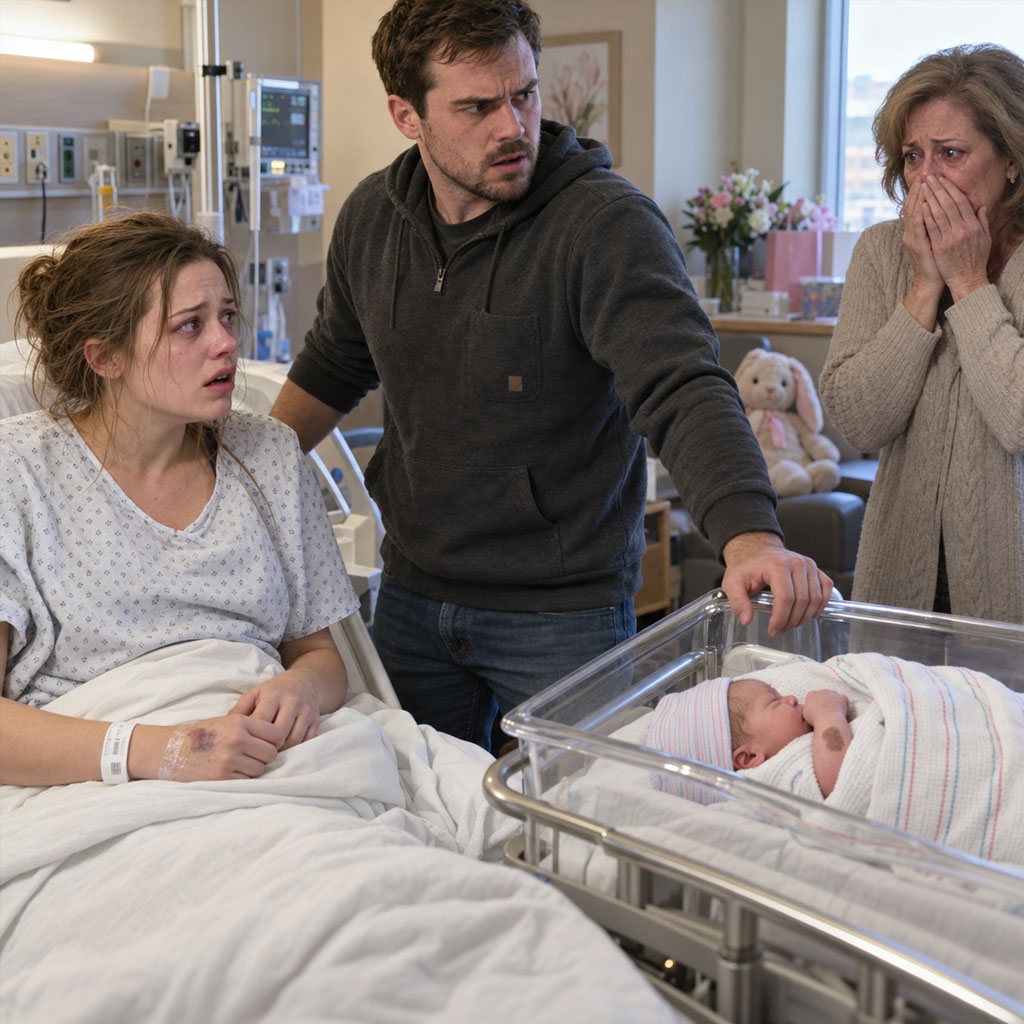
I sometimes think about the hospital room where everything began—the fluorescent lights, the ridiculous stuffed rabbit, the sound of Grace breathing in her bassinet, and Margaret backing away as if the floor had disappeared under her.
At the time, I thought she had brought a disaster into our lives.
In truth, the disaster had been waiting quietly for decades inside a family that believed silence was safer than honesty.
Grace’s birthmark did not create the problem.
It exposed it.
And because it did, my daughter will grow up knowing something her father never had the chance to know: where she came from, what her family carries, and why telling the truth—even when it changes everything—is sometimes the most loving thing a person can do.
THE END.
⚠️ All characters and events are fictional. Do not imitate or apply them in real life. 😌😌😌


