
Chapter 2
My father-in-law had never been particularly kind to my dad.
I could list dozens of incidents, but three had stayed with me.
The first happened at Cody and my wedding.
Merl stood up during the reception, raised his champagne glass, and delivered a toast.
“Holly comes from good, simple people,” he announced. “We’ll teach her the rest.”
Everyone laughed.
My mother squeezed Dad’s arm. Dad simply nodded, as though Merl had commented on the weather.
Later, I found my father standing outside the church beside Merl’s green Chevelle. He had his hands in his pockets and was studying the car.
When I asked what he was doing, he smiled faintly.
“Nice car,” he said.
That was all.
The second incident happened at Beckett’s ninth birthday party.
Merl came out of his shed carrying a broken leaf blower and placed it on the picnic table in front of my father.
“You’re the handy one, Gunnar. Earn your cake.”
There were thirty people in the backyard.
Dad examined the machine, cleared a clogged fuel line, and had it running again in six minutes.
Merl never thanked him.
He simply started blowing leaves toward the children until they screamed with laughter.
The third incident happened at the funeral lunch after my mother’s death.
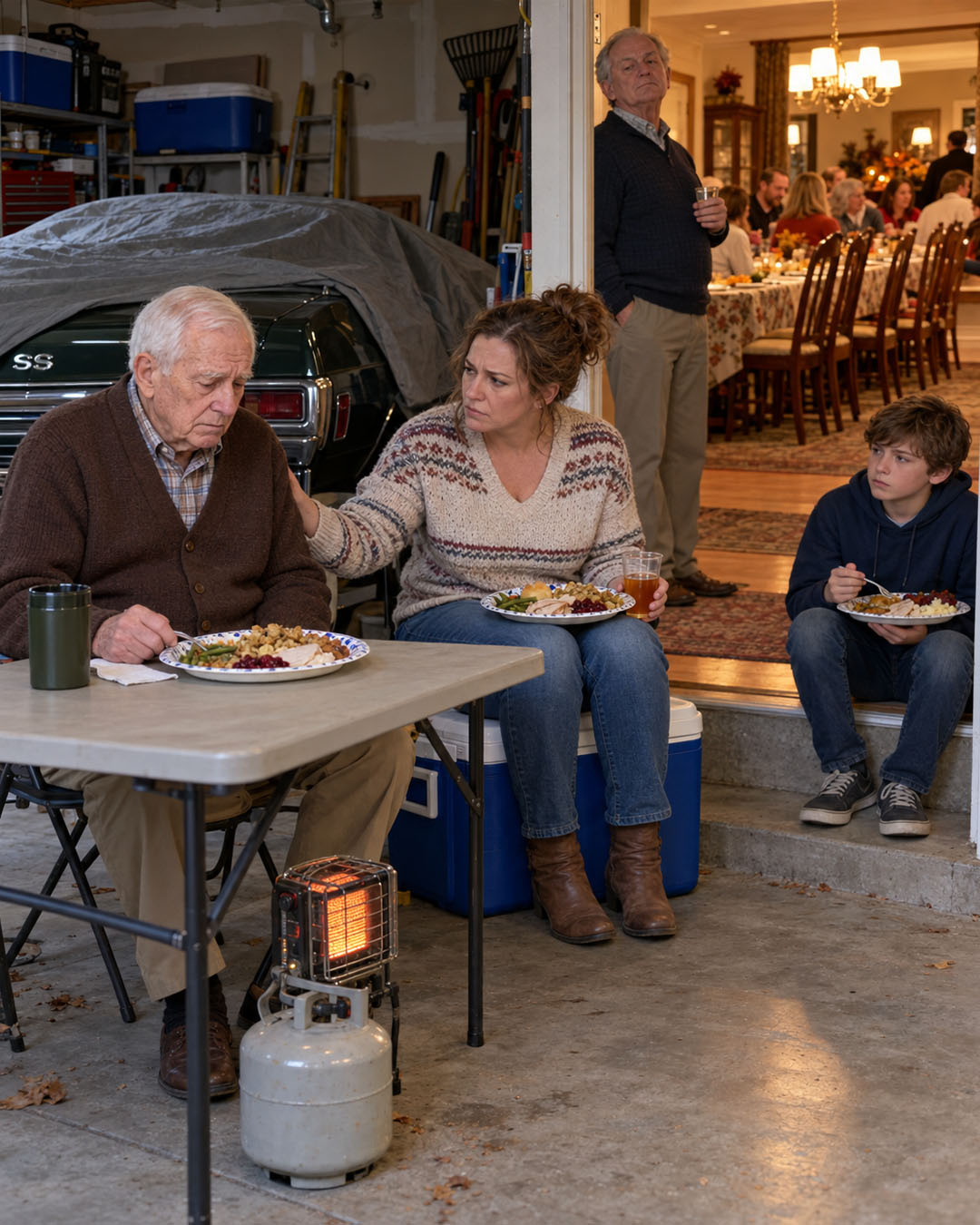
We were in the church basement. Dad sat at a folding table holding a paper cup of coffee he hadn’t touched.
Merl approached him, rested a hand on his shoulder, and spoke loudly enough for several tables to hear.
“Well, Gunnar, a teacher’s pension won’t stretch very far for one person, let alone two. I guess you’ll be moving in with the kids.”
Dad looked up.
“I guess I might.”
That May, when Dad moved into our basement, Merl told Cody, “Told you so.”
Cody actually laughed when he repeated it to me.
I didn’t.
You might wonder why I tolerated Merl’s behavior for fourteen years.
The answer was Fay.
When Beckett was a baby, I worked nights at an emergency animal hospital. Cody drove a delivery truck for a beverage distributor during the day. We needed both incomes, and childcare was expensive.
For six years, Fay drove to our house at ten every evening.
She slept on our couch so Beckett would wake up with someone who loved him. She never accepted money, never complained about the arrangement, and always made coffee before I came home at seven in the morning.
I owed her.
And she loved her husband.
So whenever I complained to Cody about Merl, he gave me the same five words.
“That’s just Dad. He’s harmless.”
I had learned to keep the peace.
But Thanksgiving had changed something.
When we drove home that night, Dad sat in the front passenger seat holding a foil packet of leftovers Fay had pressed into his hands.
Beckett was asleep in the back.
Cody drove without turning on the radio.
At a red light on Vista Avenue, Dad looked out the window.
“Your mother would have liked that garage,” he said.
I glanced at him.
“Why?”
“Best seats in the house.”
He smiled.
It was the first time I’d heard him laugh since March.
At home, I made two cups of decaf and carried them downstairs.
Dad was sitting in his recliner with one of his bankers’ boxes open on the floor. A green notebook rested in his lap.
The cover was marked in black ink:
1978–79.
He lowered his reading glasses.
“Holly, sit down a minute.”
I sat on the edge of his bed.
He looked at the notebook, then at me.
“That car in Merl’s garage,” he said. “The famous Chevelle.”
“Yes?”
“That’s my engine.”
I laughed because I thought he was joking.
He wasn’t.
Dad opened the notebook and turned it toward me.
The paper was yellow around the edges. His handwriting was the same careful square lettering I had seen on school forms and birthday cards my entire life.
The entry read:
1970 Chevelle 396. Owner: M. Upchurch. Thrown rod. Complete engine rebuild.
Below it were fifteen sets of student initials.
And beneath those were pages of measurements, parts lists, and mechanical notes.
I looked at him.
“What does this mean?”
“It means fifteen students rebuilt that engine during the spring semester of 1979.”
He tapped one of the measurements.
“We changed the camshaft because the owner wanted a stronger sound. That meant the factory timing specification wouldn’t work anymore.”
I stared at the page.
“Then that’s why it won’t idle?”
“Probably.”
He turned to the back cover and showed me a small handwritten card.
“The correct setting is here. Lonnie probably tried to tune it using the factory manual. That engine needs a different adjustment.”
I looked at the notebook again.
“Why didn’t you tell Merl?”
Dad removed his glasses and folded them.
“Because a man needs something to be proud of.”
“But he’s been telling everyone he rebuilt it himself.”
“I know.”
“You’ve heard him?”
“Every Christmas since your wedding.”
I sat quietly.
Dad closed the notebook.
“Some men have many things they’re proud of. Some have one. That car is Merl’s one thing. He needs it more than I need the credit.”
I thought about the card table.
About the paper plate.
About the way Merl had looked at my father.
“Dad, he put you in the garage.”
“It’s a nice garage.”
“That’s not the point.”
Dad looked at me for a long moment.
Then he made a request.
“Promise me you won’t tell him about the engine.”
I wanted to refuse.
But it was my father’s work, his secret, and his choice.
So I promised.
Chapter 3
The following Friday morning, Fay called and asked if Beckett could come over to rake leaves for twenty dollars.
Beckett would have raked the entire neighborhood for twenty dollars.
I drove him to Merl’s house.
When we arrived, the garage door was open. A young woman with a camera was photographing the green Chevelle from different angles.
Merl waved me over.
“Holly! Come meet Jan. She’s writing a piece for the neighborhood paper.”
Jan was about twenty-five, with a notebook tucked beneath her arm.
She explained that the Rotary Club had selected Merl’s Chevelle as a possible lead vehicle for the Vista holiday parade.
“If it passes inspection, Mr. Upchurch, you’ll be at the front,” she said.
Merl looked delighted.
“That car will run. It’s never let me down for long.”
Jan asked about the engine.
Merl straightened his shoulders.
“I rebuilt the whole thing myself in the summer of 1979. Right in my driveway. Borrowed a hoist, used a library book, and didn’t sleep for a month.”
He described the work in detail.
He explained how he had done everything himself, how nobody had taught him, and how some people needed expensive classes to learn what he had figured out through determination.
Jan wrote down every word.
I stood beside the driveway holding my car keys.
I had promised my father.
So I said nothing.
Then Merl turned toward me.
“Your dad can come watch the parade, Holly. We’ll find him a good spot on the curb.”
Beckett was standing beside me with a rake.
“Grandpa Gunnar likes cars,” he said.
“Sure he does, buddy,” Merl replied, patting his head. “Everybody likes cars.”
On the drive home, Beckett was unusually quiet.
Then he asked, “Mom, why did Grandpa Gunnar look at Grandpa Merl’s car like that on Thanksgiving?”
“Like what?”
“Like you look at old pictures of Grandma.”
I had to pull into a parking lot.
I didn’t know how to explain it to him.
The next morning, Fay called to ask us to return her large turkey roaster and blue cooler.
Dad carried the cooler to the car because it was heavy.
We arrived at Merl’s house just as Lonnie Abara’s flatbed tow truck backed into the driveway.
Lonnie was fifty-eight, with a gray ponytail and the kind of arms that came from years of working on engines.
He had owned Treasure Valley Auto Body for twenty-five years.
Merl stood beside the driveway in his Saturday flannel shirt, giving Lonnie instructions.
Dad carried the cooler into the garage.
The folding card table from Thanksgiving was still standing beside the car. Nobody had bothered to put it away.
Dad set the cooler down and sat in the folding chair to rest his knees.
I remained near the driveway.
Lonnie climbed out of his truck with a chain over his shoulder. He looked toward the Chevelle, then stopped.
He stared into the garage.
“Mr. Bjornstad?”
Dad looked up.
For the first time that morning, his face brightened.
“Lonnie Abara. Third period, 1985–86. You put a Pinto in the ditch behind the gym.”
Lonnie laughed.
“Sure did. You made me write an essay about it.”
Merl looked from one man to the other.
“You two know each other?”
Lonnie walked into the garage.
“Mr. Bjornstad taught me everything I know about engines.”
He moved toward the Chevelle and looked beneath the hood.
Then he turned to Merl.
“There’s something I’ve been trying to figure out for six years. Every time I pulled this air cleaner off, I noticed something scratched into the metal underneath.”
Merl frowned.
Lonnie continued.
“GB CHS79. And fifteen little sets of initials around it.”
My father remained seated.
Lonnie looked directly at Merl.
“The man who knows how to make this engine run is sitting in your garage.”
For several seconds, nobody spoke.
Then Merl laughed.
It was the loud, confident laugh he used when an insurance customer said something foolish.
“That man taught kids how to change oil,” he said. “I rebuilt this engine myself.”
Lonnie shook his head.
“He taught me. And those initials tell me he did a whole lot more than teach someone how to change oil.”
Merl turned toward my father.
“Tell him that’s nonsense, Gunnar.”
Dad looked at him.
“I’d rather not say anything.”
It was a quiet answer.
But it was not the answer Merl wanted.
He turned toward me.
“Holly?”
I looked at my father.
Then I looked at Lonnie.
My promise had been to my dad. But Lonnie had already discovered the truth independently.
“He’s right,” I said. “Dad’s class rebuilt that engine in the spring of 1979. I saw the notebook.”
Merl’s face turned red.
He walked into the house without another word.
Lonnie picked up his chain.
“I guess I’m not taking it today.”
Dad nodded.
“You could try the timing.”
“Not without the owner’s permission.”
Lonnie shook my father’s hand with both of his.
“You taught me that, too.”
Then he drove away with an empty flatbed.
Fay came out of the house a minute later.
She took the cooler roster from my hands, didn’t look at either of us, and walked back inside.
She was humming again.
Chapter 4
Cody came home that evening after visiting his parents.
He found me in the kitchen.
“Dad says you’ve been feeding your father stories.”
I put down the dish towel.
“Lonnie said it. Not me.”
“He thinks Gunnar is confused. He says your dad is mixing up cars because he’s getting older.”
I stared at my husband.
“Go downstairs and ask him for the notebook marked 1978–79.”
Cody looked uncomfortable.
“Why?”
“Read one page. Then tell me who’s confused.”
He went downstairs.
He stayed there for forty minutes.
When he came back, he didn’t say anything at first. He opened the refrigerator, took out a beer, looked at it, and put it back.
Then he sat across from me.
“His handwriting hasn’t changed,” he said.
“I know.”
“Not one bit.”
I nodded.
Cody rubbed his face.
“Dad is going to be humiliated.”
I leaned forward.
“Your father put my widowed father in a garage with two coolers on Thanksgiving. In front of twenty-two relatives. The first Thanksgiving after my mother died.”
Cody looked down.
“I know. I was there.”
For once, he didn’t say his father was harmless.
The following Sunday, Merl called Cody.
Cody put the phone on speaker while I stood beside the stove.
“Here’s what we’ll do,” Merl began. “Have Gunnar come by Tuesday. Fay will be at her sewing group. He can take care of whatever he does with the timing. Quietly. No need for a fuss.”
Cody looked at me.
“Why Tuesday?”
“Jan’s article is already written,” Merl said. “It runs next Sunday. Nobody needs to know the details. It’s a parade, not a court case.”
Cody’s expression changed.
“Dad, he’s not coming over on Tuesday so you can keep the credit.”
There was a long silence.
“If you want his help, ask him yourself.”
Merl didn’t answer.
Instead, he announced that Fay was having another family dinner the following Sunday for their Christmas tree-trimming gathering.
“Bring the boy,” he said. “Bring whoever you want.”
Then he hung up.
Cody placed the phone face down.
“That’s the closest my father has ever come to an apology,” he said.
“He invited my dad without using his name.”
Cody didn’t disagree.
The next morning, I took a day off from the veterinary clinic.
I told myself I needed to catch up on laundry.
Instead, I went downstairs and opened Dad’s notebook again.
I know I shouldn’t have done it without asking. It was his personal record, and I had already promised not to reveal the story.
But I wanted to understand the entire truth.
I read the Chevelle pages carefully.
There were measurements, parts lists, and fifteen sets of initials. One belonged to Dorothy Krauss, the only girl in the class. She had drawn a little star beside her name.
At the bottom of the final page, I noticed a line written in blue ink.
It was different from the original entries.
Parts total: $640.
Upchurch check returned. Insufficient funds.
Spoke to Mrs. Upchurch by phone. Covered parts myself. Do not bill.
GB.
Stapled to the page was an old check.
It was made out to Capitol High Auto Shop for $640.
The signature belonged to Fay Upchurch.
I sat on the basement floor for a long time.
Six hundred and forty dollars in 1979 was a considerable amount of money. Dad was a second-year teacher, and my mother worked at a bakery. That payment represented nearly two months of their rent.
He had paid for Merl’s engine parts out of his own pocket.
And he had never told anyone.
Not Merl. Not me. Maybe not even my mother.
I thought about Fay at the wedding, holding my father’s hand a little too long. I remembered her disappearing into the restroom for twenty minutes.
I remembered the way she had trembled when she brought the pies into the garage.
She knew.
I needed to talk to her.
Chapter 5
On Tuesday, I drove to Fay’s sewing group at the Lutheran church on State Street.
The women met every week around folding tables, with an old coffee maker sitting near the kitchen entrance.
I waited in the parking lot until noon.
When Fay came outside, she saw my car and said goodbye to her friends.
Then she climbed into the passenger seat without waiting for an invitation.
“You found it?” she asked.
I nodded.
“Dad doesn’t know I looked.”
She held her purse tightly in her lap.
“I was twenty-three,” she began. “Merl and I had been married two years. He had just started his insurance agency and was making almost nothing. He was proud, Holly. So proud. He wouldn’t let my father help us, and he wouldn’t accept help from anyone.”
She looked through the windshield.
“When the engine blew, he said he’d fix it himself if he had to sell his blood.”
I listened.
“The school took the car. The students rebuilt the engine. Merl was embarrassed, but he was also thrilled. He kept telling me how impressed he was with the teacher.”
“Then the bill came?”
She nodded.
“Six hundred and forty dollars. Merl gave me the checkbook and told me to pay it. Then he left for a sales conference in Pocatello.”
She paused.
“There was $112 in the account.”
I turned toward her.
“What did you do?”
“I wrote the check anyway. I thought I could cover it before it cleared. I couldn’t.”
Her eyes filled.
“A teacher called me at home. Mr. Bjornstad. He was so polite. He told me the check had been returned, and I started crying. I couldn’t help it.”
“What did Dad say?”
“He told me it was covered. He said not to worry and not to tell my husband. He said Merl had enough to worry about already.”
Fay gave a small, sad laugh.
“Then Merl came home and started telling everyone he’d rebuilt the engine himself in his driveway. I heard him tell the story at church that summer.”
“Why didn’t you correct him?”
“Because then I would have had to tell him about the check. And I was frightened. I knew how much his pride meant to him.”
She looked down at her hands.
“Then your father showed up at your wedding. He shook my hand and looked straight into my eyes. He didn’t say anything. Not that day. Not ever.”
I remembered that wedding.
Fourteen years of Christmas dinners, birthdays, and family gatherings.
My father had listened to Merl claim credit for work that had been done by a teacher and fifteen students.
Fay continued.
“He let my husband tell that story for forty-six years to protect me. And then Merl put him in the garage.”
Her voice broke.
“And I let him.”
I didn’t know what to say.
“I wrote those twenty-two place cards, Holly. Merl told me not to write one for Gunnar. I was afraid that if I argued with him, the truth would come out. So I sat there and let a man who had helped us when we had nothing eat Thanksgiving dinner beside two coolers.”
She wiped her eyes.
“I’m seventy years old. I’ve been afraid of a bounced check since the Carter administration.”
Despite everything, I almost laughed.
“What do you want to do?” I asked.
She took a deep breath.
“Give me until Sunday. It’s my family dinner. My table. Let me fix it there.”
She opened her purse and removed a folded envelope.
“Will you bring me the check?”
I looked at her.
“It’s Dad’s.”
“I know.”
“I’ll ask him.”
That evening, I told my father everything.
I admitted I had read the notebook and spoken with Fay.
He listened without interrupting.
When I finished, he went downstairs and returned with the old check.
He had carefully removed the staple so the paper wouldn’t tear.
“Give it to her,” he said.
“Are you sure?”
“It was always hers.”
I looked at him.
“Are you angry that I read your notebook?”
He thought about it.
“No. I’m a little annoyed I put it in a notebook. I should have burned it in 1979.”
I smiled.
“But you keep everything.”
“Your mother used to say that.”
He sat down.
“She also used to say you were the most stubborn person in Ada County.”
“Canyon County,” I corrected him.
Dad shook his head.
“I was born in Canyon County. She knew that. She just enjoyed getting it wrong.”
For the first time in a long while, we both laughed.
Chapter 6
The article appeared in the neighborhood paper on Sunday morning.
Merl had it framed by noon.
I’m not exaggerating.
He had received an early copy from Jan and paid extra at the mall frame shop to have it ready.
The headline read:
“Benchman’s Handbuilt Chevelle May Lead Holiday Parade.”
The article described the dark green paint, the white stripe, the Rotary Club’s selection, and Merl’s supposed accomplishment in rebuilding the engine himself in 1979.
At four that afternoon, we drove to Fay’s family dinner.
Cody, Beckett, Dad, and I arrived together.
My father wore his brown cardigan again.
I watched him put it on and nearly suggested something different.
I’m glad I didn’t.
When I walked into the dining room, I counted the place cards.
Twenty-three.
My father’s was at the head of the table, beside Fay’s seat.
Merl’s was at the opposite end.
He noticed it immediately.
He picked up the card, studied it, and put it back down.
He didn’t move it.
We ate first.
Fay had prepared roast beef, potato rolls, and vegetables. The cousins argued about football. The children talked about school.
Everyone avoided the obvious subject.
Then Merl stood up holding the framed article.
“I want to read something since we’re all here.”
He read the entire piece.
He seemed especially pleased with the paragraph describing how he had supposedly rebuilt the engine without any help.
“Nobody taught me,” he read aloud. “I learned it by doing it.”
He looked up.
Some of the relatives applauded.
His brother from Twin Falls whistled.
Beckett was sitting beside his other grandfather, holding a potato roll.
Then he asked a question in his clear twelve-year-old voice.
“Grandpa, if you rebuilt the engine yourself, why are Grandpa Gunnar’s initials under the air cleaner?”
The whistling stopped.
Merl looked at Beckett.
“Where did you hear that?”
“Lonnie told us. Mom showed me Grandpa’s notebook.”
I had brought it.
Fay had asked me that morning, and Dad had agreed.
I stood and walked down the length of the table.
Twenty relatives watched as I placed the notebook beside Merl’s dessert plate.
I opened it to the original Chevelle entry.
“Merl,” I said, “you’ve told this story at every holiday for fourteen years. I’ve never questioned you. But I have one question now.”
He stared at the notebook.
“What?”
“What’s the timing specification on your engine?”
He blinked.
“Factory specification. Same as any 396.”
From the other end of the table, my father spoke.
“Factory specification is why it won’t idle.”
His voice was calm.
“That engine has a different camshaft. We changed it during the rebuild. The correct setting is written on a card inside the back cover.”
Merl looked down.
He saw his own name in my father’s handwriting.
He saw the fifteen student initials.
Then he placed his hand flat on the notebook.
“I was there,” he said. “I drove it there. I paid for the parts.”
And that’s when Fay stood up.
She had the old check in a small envelope.
She walked to Merl’s end of the table and placed it on the notebook.
The red bank stamp was still visible.
“No, Merl,” she said. “You didn’t pay for all the parts. I wrote this check. It bounced.”
The room became completely silent.
“Your father-in-law paid the $640 himself. He did it because I was crying on the phone and didn’t know what else to do. He told me not to worry, and he told me not to tell you.”
Fay looked around the table.
“He never asked for the money back. He never told anyone. He let you take credit for that engine for forty-six years.”
Then she turned toward her husband.
“Dining rooms are for family, Merl. That’s what you told Gunnar at Thanksgiving. Well, he’s been family since 1979. He just never sent us the bill.”
Merl stared at the check.
He read it twice.
Then he looked at Fay.
“You hid this from me for forty-six years?”
Fay nodded.
“And you hid an entire classroom of students from everyone for forty-six years. You told the story so many times that I didn’t have the heart to correct you.”
One of the cousins made a strange sound into his napkin.
It might have been a cough.
It wasn’t.
Merl’s expression changed.
“Fay, honey, we’ll pay him back. We’ll calculate the interest. We can talk about this tomorrow.”
“No,” she said. “We’re talking about it today. At my table.”
Merl stood.
He picked up the framed article and stared at it.
Then he turned it face down on the sideboard and walked through the laundry room into the garage.
The door clicked shut.
Nobody followed him.
Not even Cody.
Fay returned to her chair at the head of the table.
She picked up Merl’s fork and took a bite of his apple cake.
“Well,” she said quietly, “who wants coffee?”
For a while, nobody answered.
Then the relatives began talking again, slowly and awkwardly. The children went into the living room to decorate the Christmas tree.
My father remained seated beside Fay.
On the way home, he said something that surprised me.
“I’d rather not have embarrassed him.”
I looked over.
“You didn’t embarrass him, Dad.”
He stared out the window.
“I suppose I just sat at the right end of the table for once.”
Chapter 7
I thought that was the end of it.
Merl would sulk for a while. The Chevelle would remain under its tarp. The holiday parade would find another lead vehicle.
But on Tuesday, Fay called me at the clinic.
I was holding a beagle still for a blood draw when my phone buzzed. I called her back during my break.
“He’s selling the car,” she said.
I leaned against the counter.
“What?”
“A man from Spokane is coming Saturday with a trailer. Merl listed it Sunday night. Fifty-two thousand dollars if it runs. Thirty thousand if it doesn’t.”
I couldn’t believe it.
“He loves that car.”
“He’d rather sell it than let your father touch it.”
Fay was quiet.
“It’s in his name, Holly. I can’t stop him.”
That evening, I told Dad.
He was sitting at the kitchen table working on a crossword puzzle in pen.
“Fifty-two thousand?” he repeated.
“That’s what they’re asking.”
“For a car that won’t idle?”
He returned to his crossword.
“Less if it doesn’t run.”
Then he put the pen down.
“Saturday, you said?”
“Yes.”
He didn’t explain what he was thinking.
On Saturday morning, Fay called at seven-thirty and asked if we could come over.
She didn’t say why.
She didn’t need to.
Beckett insisted on coming. Cody came, too.
Dad wore his old canvas work coat, the one with CAPITOL HIGH AUTO stitched above the pocket.
He brought his toolbox and the green notebook.
The man from Spokane was already in the driveway when we arrived.
His name was Otis Sabo. He was in his sixties, had a gray beard, and wore a sweatshirt that read, “Hot rods are cheaper than therapy.”
His pickup was attached to an empty car trailer.
Merl stood in the open garage beside the uncovered Chevelle.
The green paint looked beautiful in the morning light.
The folding card table was still beside it.
Dad walked past the table, set his toolbox on it, and looked toward Merl.
“Nobody asked you to come, Gunnar,” Merl said.
“Fay did.”
Otis glanced between them.
“Folks, I just want to hear it run. If it runs, it’s fifty-two thousand cash. If it doesn’t, I’ll give you thirty and take it as-is.”
Merl climbed into the driver’s seat.
He turned the key.
The engine roared to life, shaking the shelves.
Beckett grinned.
Then it coughed.
It shuddered, struggled, and died.
Merl tried again.
The same thing happened.
On the third attempt, the engine wouldn’t catch at all.
Otis folded his arms.
“Thirty thousand,” he said kindly. “It’s still a beautiful car.”
Merl remained in the driver’s seat.
He stared through the windshield at the pegboard on the garage wall.
Then he turned toward my father.
For a long time, neither man spoke.
Finally, Merl asked, “Can you make it run, Gunnar?”
Dad stood beside the folding table.
“I can.”
Merl waited.
“But not for him,” Dad added, nodding toward Otis. “No offense.”
“None taken,” Otis replied.
Dad looked back at Merl.
“For you, I’ll do it. If you ask me.”
Merl’s hands tightened around the steering wheel.
Then he lowered his head.
“I’m asking.”
He paused.
“Please.”
Dad opened his toolbox.
He handed Beckett a flashlight.
“Hold it where I point. Not in my eyes. Your mother used to shine it in my eyes on purpose.”
“I did not,” I protested.
“You did. Nineteen ninety-four. The lawn mower.”
Even in that moment, I smiled.
Dad walked to the engine and removed the air cleaner’s wing nut. He lifted the round metal lid and handed it to Merl.
Then he leaned over the engine.
He stopped.
Beckett aimed the flashlight.
There, scratched neatly into the metal base, were the letters:
GB CHS79.
Around them were fifteen sets of initials.
Some were neat. Some were crooked. One had a tiny star.
Dad touched them one by one.
“Wendell Hogan,” he said. “Went into the Navy. Robert Allen drove a school bus for thirty years. Dorothy Krauss. The only girl in the class.”
He pointed to the little star.
“She put that dent under the left headlight with a floor jack.”
His voice grew quieter.
“I told them to sign their work. Somebody might open this up someday. I wanted them to know who had been there.”
Nobody spoke.
Otis removed his cap.
Merl held the air cleaner lid in both hands.
“I never took this off,” he said. “Not once in forty-six years.”
Dad looked at him.
“You wouldn’t have broken anything. We built it so you couldn’t.”
Then he opened the green notebook to the back cover.
He showed Merl the handwritten timing card.
He explained the adjustment, loosened a bolt, turned the distributor slightly, and tightened everything again.
The entire process took about four minutes.
“Go ahead,” Dad said.
Merl climbed back into the driver’s seat.
He turned the key.
The engine caught immediately.
It roared once, rattling the jars on the shelf.
Then it settled into a smooth, steady rumble.
No coughing.
No shaking.
Just the low, even sound of a healthy engine.
Merl didn’t move.
He sat with both hands on the steering wheel and listened.
His shoulders rose and fell once.
Then he leaned out the window.
“Mr. Sabo,” he called. “I’m sorry you drove all this way.”
Otis laughed.
“Don’t apologize, Mr. Upchurch. I’d have done the same.”
He shook my father’s hand.
“If you ever want to make some money in Spokane, give me a call. I’ve got three engines sitting in a barn that need attention.”
“I’m retired,” Dad said.
“So am I,” Otis replied. “It’s the busiest I’ve ever been.”
He climbed into his truck and drove away with an empty trailer.
At noon, Merl called the Rotary Club and put the Chevelle back in the parade.
For the first time since Thanksgiving, he didn’t tell anyone he had fixed the engine himself.
Chapter 8
The following Thursday, the Chevelle passed inspection.
Lonnie came to watch, leaning against his truck with a toothpick in his mouth.
When the inspector asked who had adjusted the timing, Lonnie answered before Merl could.
“Capitol High Auto Shop. Class of 1979. They’re a little slow, but they do good work.”
The holiday parade was the following Saturday evening.
The temperature was nineteen degrees.
The Chevelle led the procession down Vista Avenue.
Merl drove.
My father sat in the passenger seat wearing his old shop coat.
Beckett rode in the back with the window cracked, waving at everyone as though he were the mayor.
There were magnetic signs on both front doors.
Beckett had designed them on the computer at school, and Merl had paid to have them printed.
They read:
ENGINE REBUILT IN 1979 BY CAPITOL HIGH AUTO SHOP — MR. BJORNSTAD’S CLASS.
Fay and I stood on the curb holding hot chocolate.
When the car passed, she grabbed my arm.
“Look at him,” she said.
I assumed she meant my father.
Then I noticed Merl.
He was smiling.
Not the broad insurance-agent smile he used when greeting customers. This was different. It was the smile of a man who had finally stopped worrying about who deserved the credit.
He was saying something to my father.
Dad nodded.
“What do you think he’s saying?” Fay asked.
“Probably arguing about the timing.”
She laughed so hard that she spilled hot chocolate on her boots.
Three days before Christmas, Merl came to our house.
He had never been inside our basement before.
He stood at the bottom of the stairs holding his hat and looking at Dad’s recliner and the nine bankers’ boxes.
Then he held out an envelope.
“Six hundred and forty dollars,” he said. “Plus forty-six years of interest. Fay did the math.”
Dad didn’t take it.
“I don’t want it, Merl.”
“It’s yours.”
“Then give it to the kids.”
Dad explained that Capitol High now had only one auto shop section. The school had cut two others, and the remaining instructor sometimes bought brake pads with his own money.
Merl looked at the envelope.
Then he slipped it back into his coat.
In January, he wrote the school a check for $6,400.
Ten times the original parts bill.
He delivered it himself and insisted the principal take a photograph of him handing it over.
But he also insisted that my father stand beside him in the picture.
On the memo line, Merl wrote:
Parts, 1979. Paid in full.
Fay told me she checked the account balance before he mailed it.
“Just once,” she said, “I wanted to know one of his checks would clear.”
I laughed.
She did, too.
Chapter 9
Christmas dinner was at Fay’s house.
All twenty-two relatives were there, along with my father.
When we walked into the dining room, I stopped.
The card table was there.
It had been pushed against the end of the long dining table and covered with a white tablecloth. The arrangement extended from the front window to the kitchen doorway.
There were twenty-three chairs.
Twenty-three place cards.
My father’s card was beside Merl’s at the head of the table.
The children, however, had other plans.
They decided they wanted to sit together, the way children always do. All nine of them crowded around the card table, laughing and arguing about who got the chair closest to the dessert.
Merl looked at the arrangement.
Then he picked up his own plate without being asked.
He carried it down to the children’s end and sat in the folding chair at the corner.
His knees were almost up to his chin.
My father looked down the table at him.
“You’re comfortable out there, Merl?”
Merl pointed his fork at Dad.
“There’s a heater, Coach.”
The entire table laughed.
Even Fay.
Even me.
My father shook his head and pretended to be annoyed.
Merl has called him Coach ever since.
He pretends to hate it.
He doesn’t.
Something else changed that winter.
Every Saturday morning, my father started driving to Merl’s house at nine.
Merl always had coffee ready.
They would open the garage door and stand beside the Chevelle with the hood raised, discussing carburetors, ignition systems, and whatever mechanical problem happened to interest them that week.
Some Saturdays, they didn’t touch a single bolt.
They simply stood there talking.
In February, Merl contacted Dorothy Krauss.
He found her number through her towing company in Nampa.
She was sixty-four now, with short white hair and a business that owned six tow trucks.
When she arrived, she walked into the garage, saw the dent beneath the left headlight, and burst out laughing.
“I told you I’d pay for that, Mr. Bjornstad!”
Dad smiled.
“You still owe me.”
Merl let her remove the air cleaner herself.
When she found her initials and the tiny star, she took a picture with her phone.
Then she asked if she could start the car.
Merl handed her the keys.
When the engine settled into its familiar rumble, Dorothy rested her hand on the steering wheel and stood quietly for a moment.
She was looking at the work she had done as a teenager.
The work that had survived nearly half a century.
Lonnie stopped by regularly, too.
He claimed he was checking the timing.
Mostly, he drank Merl’s coffee and talked about old cars.
Cody changed as well.
He had been the man who stood in the doorway on Thanksgiving and told me I had made my point.
But in March, on the anniversary of my mother’s death, he took a day off work.
He drove my father to the cemetery.
Then he took him to the sugar beet farm near Nampa where Dad had grown up.
They were gone all day.
When Cody returned, he had mud on his shoes and a thoughtful expression.
“Your dad drove a tractor when he was seven,” he said.
“I know.”
“He told me about it.”
I smiled.
“Then tell me what he said.”
Cody sat down.
And for the next half hour, he told me stories about my father that I had heard a dozen times before.
I let him tell them anyway.
I understood that he was trying to know the man he had failed to defend.
I also understood that forgiveness wasn’t a single conversation. It was something people had to earn through the way they behaved afterward.
Chapter 10
I think about that Thanksgiving card table more often than I expected.
I remember Merl snapping the legs open between the blue coolers. I remember my father’s brown cardigan and the paper plate. I remember sitting on that cooler, wondering how a man who had spent his life helping others could be treated as though he didn’t belong.
And I remember the gray tarp.
For forty-six years, Merl had told a story about himself. He had built an identity around a car, an engine, and the belief that he had accomplished something entirely on his own.
I don’t think he was a terrible man.
I think he was a proud young man who became frightened when life exposed how little money he had. Someone helped him, and he was so ashamed that he turned the help into a story about independence.
Then he repeated that story until he forgot where it began.
My father understood that.
He had known the truth since 1979, yet he never tried to embarrass Merl or take away the one accomplishment that gave him pride.
But understanding someone’s weakness doesn’t mean they have the right to hurt you.
Dad had been patient.
He had been generous.
He had even been willing to eat Thanksgiving dinner in the garage rather than create a scene.
And that was precisely why I had needed to pick up my plate.
The people who do the most for us aren’t always the ones telling the loudest stories. Sometimes they’re sitting quietly at the edge of the room, holding a paper cup of coffee, hoping nobody notices that they’ve been left out.
You don’t always need a speech to stand up for them.
Sometimes you just need to move your chair.
Last Saturday, I drove to Merl’s house to bring Dad his lunch. He had forgotten it on our kitchen counter again.
The garage door was open.
The folding card table was set up beside the green Chevelle.
My father and Merl were sitting there with two cups of coffee. The green notebook from 1979 was open between them.
Merl was reading the initials aloud while Dad explained what had become of each student.
“Wendell went into the Navy,” Dad was saying. “Robert drove a school bus. Dorothy owns that towing company. And I think Steve moved to Oregon.”
Merl listened carefully.
He wasn’t telling his old story anymore.
He was learning theirs.
There was a third chair beside the table.
Merl saw me standing in the doorway and pulled it out with his foot.
“Sit down, Holly,” he said.
I smiled.
“Is there a heater?”
He pointed toward the little propane heater in the corner.
“Best one in Boise.”
I sat beside them.
For a moment, I looked at the three chairs, the green notebook, and the car that had brought all of us to this strange place.
Then Merl poured me a cup of coffee.
“Family sits out here now,” he said.
My father shook his head.
“Some of us prefer the dining room.”
Merl laughed.
“Then you’d better bring your own chair, Coach.”
Dad smiled into his coffee.
And I thought about my mother, who would have loved that garage. She would have loved the children gathered around the card table, the old students finding their names beneath the air cleaner, and the two old men who had finally learned to stand beside each other without needing to compete.
The lesson wasn’t really about a car or a bounced check.
It was about respect.
It was about recognizing the quiet people who have helped hold up the lives of others, even when nobody thanked them.
And it was about understanding that family isn’t determined by who gets the best seat, who has the biggest house, or who tells the most impressive story.
Family is what happens when someone notices an empty chair and refuses to leave the person sitting alone.
Sometimes the most important thing you can do is pick up your plate, walk into the garage, and sit beside the person everyone else overlooked.
Because sooner or later, someone is going to lift the lid.
And when they do, the truth may reveal an entire lifetime of work, kindness, and sacrifice that was never meant to be forgotten.
THE END.\
⚠️ All characters and events are fictional. Do not imitate or apply them in real life. 😌😌😌


