
Chapter 2
My mother returned twenty minutes later.
She pulled the visitor’s chair close to my bed and placed a thick folder on her lap.
“Sweetheart, I need you to listen to me carefully.”
I looked at her.
“What’s going on?”
“How much do you know about Derek’s first wife?”
I frowned.
“Lena?”
Mom nodded.
Lena Marsh had been married to Derek before me. According to his story, she’d drowned in Lake Mead, Nevada, in September 2019.
I’d heard about her on our third date.
Derek had cried while telling me how he’d gone to sleep at a rented cabin and awakened to find Lena missing. He said she’d taken a small pontoon boat out alone. The boat was eventually discovered drifting near Boulder Beach.
He said no body had ever been recovered.
He told me the grief had nearly destroyed him.
I remembered bringing flowers to her grave on the anniversary of her death. There was a headstone in Nevada, and Derek had shown me photographs of it.
“She drowned,” I said. “Why are you asking?”
Mom opened the folder.
“Because I don’t believe she did.”
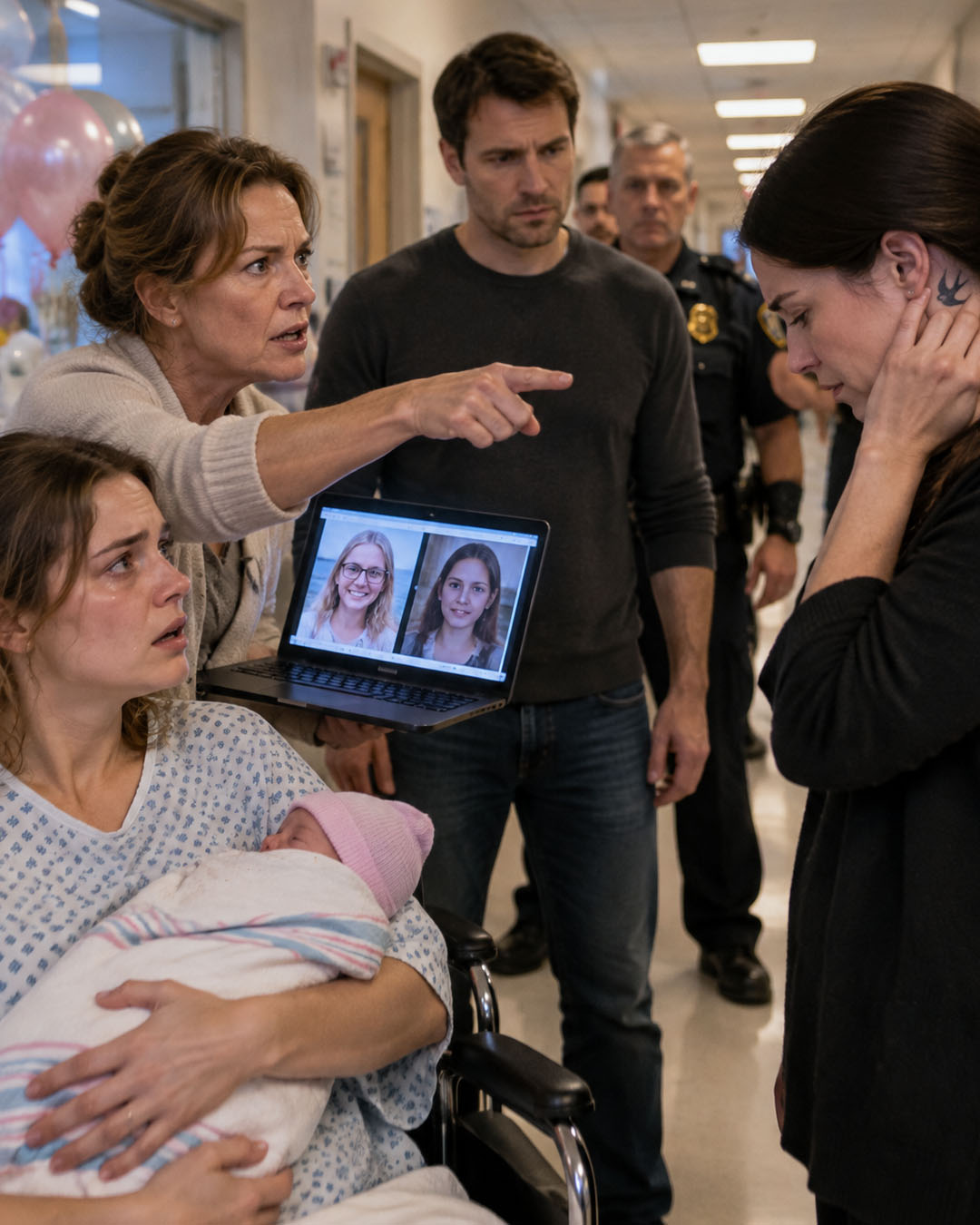
She turned her laptop toward me.
On the screen was an obituary photograph of a blonde woman wearing wire-framed glasses. She was smiling on a beach, her hair blowing across her face.
“Her name was Lena Marie Marsh,” Mom said. “And she was reported dead in Clark County, Nevada, in September 2019. But there was no recovered body. Just an abandoned rental boat and a missing life jacket.”
I looked at the photograph.
“What’s that got to do with Sienna?”
Mom didn’t answer immediately.
Instead, she opened another photograph.
It showed a dark-haired woman standing outside a restaurant.
I recognized the face.
It was Sienna.
But there was something else.
Behind her left ear was a small tattoo, shaped like a swallow.
Mom enlarged the picture.
“People change their hair. They lose weight. They wear contact lenses instead of glasses. But certain things don’t change.”
She pointed to the woman’s ear.
“Look at that tattoo.”
My mouth went dry.
I’d seen it dozens of times. Sienna often tucked her hair behind her ear while sitting on our couch.
“Mom, you’re saying…”
“I’m saying I believe Sienna is Lena Marsh.”
I shook my head.
“That’s impossible.”
“Her mother is still alive. Her name is Carol. She lives in Tucson, Arizona. She has posted a memorial message for Lena every year since 2020.”
Mom closed the laptop.
“Meanwhile, the insurance company paid Derek one million dollars after Lena was declared dead.”
I stared at her.
One million dollars.
Derek had told me the money was tied up in legal expenses and that most of it had gone toward settling old debts.
He’d also told me he’d burned every photograph of Lena because seeing her face was too painful.
I looked toward the door.
“Why would he let her live in our house?”
My mother took my hand.
“That’s what we’re going to find out.”
Then she explained how she’d become suspicious.
In July, an old colleague named Bev Turner, who still worked in the fraud department at Great Lakes Federal, had called her about a checking account opened in my name.
The account had my Social Security number and home address.
But the phone number belonged to a prepaid phone purchased with cash at a Dollar General.
The account had been used to move money between several financial institutions.
Mom knew I hadn’t opened it.
She also knew Derek had been handling our household finances for years.
She began checking records.
She compared the obituary photograph with pictures of Sienna. She contacted Lena’s mother. She located the original insurance claim and found discrepancies in the paperwork.
She’d spent three months collecting documents.
“I wanted to call you,” she said. “Every night, I wanted to call you. But I knew he’d convince you I was imagining things. I needed proof before I brought this to you.”
I began crying.
“Why didn’t you just tell me?”
“Because I was afraid you’d defend him before I could show you anything.”
I didn’t have an answer.
For five years, Derek had told me my mother was controlling, jealous, and unable to accept that her daughter was grown.
Eventually, I’d changed my phone number and stopped answering her calls.
I had even stopped opening the birthday cards she mailed because Derek always said they contained another lecture.
Mom wiped my cheek.
“I didn’t stop being your mother, Maya.”
I squeezed her hand.
“I know.”
At that moment, a man in a gray suit appeared in the doorway.
He introduced himself as Marcus Hail from the Ohio Department of Insurance fraud division.
He had been investigating suspicious life insurance claims connected to the old Nevada case.
“Mrs. Collins contacted my office,” he explained. “I’d like to ask you a few questions about your husband’s financial activities.”
He showed me a copy of a recent life insurance application filed with Meridian Mutual.
The applicant was Derek Vance.
The proposed insured was me.
My signature appeared at the bottom.
I had never signed it.
“Mr. Vance submitted this two weeks ago,” Hail said. “We’re still examining the document, but we have reason to believe the signature may be forged.”
I felt sick.
“Why would he take out life insurance on me?”
Hail closed the folder.
“That’s one of the questions we’re trying to answer.”
He explained that Derek had been questioned and released pending further investigation.
Then he asked whether I knew where my husband was.
I shook my head.
“I haven’t spoken to him since the ambulance arrived.”
Hail nodded.
“If he contacts you, don’t agree to meet him alone. Save every message. Don’t delete anything.”
After he left, Mom sat silently beside me.
The room was quiet except for the monitor and the soft breathing of my daughter.
Then my phone buzzed.
A message from Derek.
Your mother is filling your head with nonsense. I’m still your husband and I’m still that baby’s father. I’ll come see you tomorrow. Kiss my daughter for me.
I read it three times.
My mother took the phone.
She called Hail immediately.
And for the first time since I’d known him, someone was finally asking questions Derek couldn’t answer with tears.
Chapter 3
At 10:30 the next morning, Derek returned to the maternity ward.
He wore a freshly pressed blue shirt and carried a bouquet of flowers. Beside him stood a man in a camel-colored overcoat holding a leather briefcase.
The man introduced himself as Bradley Kesler, Derek’s attorney.
“My client is the legal father of this child,” he told the nurse. “He has every right to see his daughter.”
My entire body went cold.
The hospital called Dana Okafor, the social worker assigned to maternity cases.
Dana was a calm woman in her forties who wore reading glasses on a beaded chain. She listened to everyone before making a decision.
Kesler did most of the talking.
“Mr. Vance is deeply concerned about his wife’s postpartum condition. Her mother has a documented history of hostility toward him. We believe Mrs. Vance is being manipulated during an emotionally vulnerable period.”
He used the word vulnerable four times.
Dana finally interrupted.
“Hospital policy allows a supervised visit unless there’s a court order restricting access. I’ll remain in the room. Fifteen minutes.”
I wanted to scream.
Instead, I watched Derek approach the bassinet.
He lifted our daughter carefully and held her toward Kesler’s phone.
“Get one of us together,” he said.
Click.
He kissed the baby’s forehead.
Click.
He adjusted his shirt and smiled.
Click.
He never asked whether she had a name.
He never asked how the surgery had gone.
He never asked how much blood I’d lost.
When Dana stepped out to answer a call, Derek leaned toward my bed.
His smile disappeared.
“Your mother can’t stay here forever, Maya.”
I stared at him.
“When she goes home, you’ll remember who you need.”
He straightened as Dana returned.
“Thank you for allowing me to see my daughter,” he said warmly. “I know this has been difficult for everyone.”
After they left, Dana sat beside me.
“I want you to know that I document every visit,” she said.
She turned her clipboard toward me.
She’d written:
Father did not inquire about infant’s name, feeding, or medical condition. Did not inquire about mother’s surgical recovery. Primary focus appeared to be photographs.
“I write down what I see,” she explained. “That’s all I can do.”
I asked how to get a protection order.
“You need an attorney.”
My mother already had one.
Priya Nadarajan had practiced family law in Franklin County for twenty-two years. She came to my hospital room that afternoon wearing running shoes and carrying a stack of papers.
She read my mother’s folder while standing beside the window.
Then she looked at me.
“I’ll file for an emergency protection order today.”
But the magistrate denied it at 5:40 p.m.
The ruling stated that there wasn’t sufficient evidence of an immediate threat of physical violence. The financial allegations were being handled by criminal authorities, and the full hearing would take place in ten days.
Ten days.
At 6:15, Priya called again.
“Derek’s attorney has filed an emergency motion for temporary shared parenting.”
I closed my eyes.
“They’re saying I’m unstable?”
“Yes. They’re also claiming your mother is interfering with his relationship with the baby.”
“The baby is four days old.”
“I know.”
The hearing was scheduled for Friday morning.
I spent that night watching my daughter breathe.
Every three hours, I fed her. Every time she made a small sound, I woke up. My mother slept in the recliner, her reading glasses still on her face.
I couldn’t stop thinking about the possibility that a judge might order my newborn daughter into the care of a man who had walked out while I was bleeding.
Wednesday morning, my phone began buzzing at 6:03.
My coworkers, my old landlord, and people I hadn’t spoken to in years were sending me the same link.
A TikTok account called Sienna Vance Life had posted a forty-one-second video from the maternity ward.
It showed my mother speaking angrily in the hallway.
Then it cut to Derek holding pink balloons.
Then it showed me lying in the hospital bed, pale and exhausted.
The caption read:
My brother’s wife’s toxic mother turned her against him on the day his daughter was born. He just wanted to meet his baby. Fathers have rights, too.
The video had 1.2 million views.
The comments were worse.
People called me unstable. They called my mother cruel. Some suggested I should be evaluated before being allowed to care for my child.
My shift manager at Walgreens called shortly afterward.
“Corporate has seen the video,” Karen said gently. “Nobody is accusing you of anything, but they want to know whether there will be a problem when you return from leave.”
I told her I was recovering from surgery and ended the call.
My mother watched me put down the phone.
Then she picked up hers.
She called Detective Angela Ruiz at the Columbus Division of Police.
Ruiz arrived that afternoon.
She had sixteen years of police experience, short dark hair, and a habit of standing rather than sitting.
She listened to everything.
The missing money. The suspicious insurance application. The woman living in our house. The fake-death documents.
Finally, she looked at me.
“I believe your husband is involved in financial fraud,” she said. “I also believe there’s something deeply wrong here. But I need evidence that establishes more than a bad marriage.”
Before I could answer, Dr. Brooks entered carrying two medical reports.
“Detective, I think you need to see these.”
She placed the first report on the table.
It was my surgical record.
Placental abruption.
The placenta had separated from the uterine wall before the baby was delivered. I’d lost approximately 1.6 liters of blood.
Dr. Brooks looked directly at Ruiz.
“Thirty more minutes, and we might have lost both mother and child.”
Then she placed another report beside it.
It was from my thirty-four-week appointment.
I remembered that visit clearly.
Derek had come with me, although he’d spent most of the appointment looking at his phone.
Dr. Brooks had explained the warning signs of placental abruption, including sudden abdominal pain and vaginal bleeding.
The note read:
Patient and partner counseled on warning signs. Advised to call 911 immediately and not drive. Partner verbalized understanding.
Ruiz read the final sentence twice.
“Partner verbalized understanding,” she repeated.
Dr. Brooks nodded.
“I asked him to repeat the instructions. He did.”
The detective put down her coffee.
“Then he knew.”
Nobody spoke.
And for the first time, I allowed myself to consider the possibility that Derek’s decision to leave me alone that morning hadn’t been careless.
It might have been deliberate.
Chapter 4
That evening, Marcus Hail called with an update.
He had obtained an order to freeze two accounts at Midwest Heritage Bank believed to belong to Derek.
The combined balance had been $412,000.
But the money was gone.
Two days before my surgery, it had been transferred in three separate transactions to a cryptocurrency exchange.
Hail was working with financial investigators to trace the transfers.
My mother listened without speaking.
After he hung up, she sat on the edge of my bed.
“He knew something was coming,” she whispered. “He was moving money before you went into the hospital.”
The following morning, I was discharged.
I couldn’t go home alone, so Priya arranged for a police officer to accompany me while I collected my belongings.
When we arrived at the house, the locks had been changed.
Derek opened the door holding a coffee mug that said World’s Best Husband.
I’d bought it for him our first Christmas together.
He allowed the officer and me inside for ten minutes.
My clothes had been emptied into black garbage bags. My shoes were scattered across the bedroom floor.
I expected that.
What I didn’t expect was the nursery.
The white crib was gone.
The rocking chair was gone.
The little dresser I’d painted sage green at seven months pregnant was gone.
The room was completely empty except for a pale square of carpet where the crib had stood.
“Where’s everything?” I asked.
Derek leaned against the doorway.
“Sold it online. Six hundred dollars. Figured you weren’t coming back.”
The officer looked at him.
Then he looked at me.
“I’m sorry, ma’am. It’s his property, and there’s no order preventing him from selling it.”
I bent down and picked up a tiny yellow onesie that had fallen behind one of the garbage bags.
It said HELLO, WORLD.
I held it against my chest.
Derek didn’t say anything.
I left without looking at him again.
My mother lived in a brick ranch in Westerville. The magnolia tree in her front yard had been there since I was a child, and my old bedroom still had the same blue curtains.
She’d never changed them.
That evening, I sat in the room holding my daughter while Mom prepared dinner.
At 11:40 p.m., somebody knocked on the front door.
Mom looked through the peephole.
Her expression changed.
“It’s Gloria.”
Derek’s mother stood on the porch wearing a rain jacket. She looked twenty years older than she had at the hospital.
She was holding a Nike shoebox.
Mom opened the door but didn’t invite her in.
“I can’t stay long,” Gloria said. “Derek thinks I’m at Bible study.”
She pushed the box forward.
“Please. You need to see what’s inside.”
Mom carried it into the kitchen.
I followed her.
Inside were three things.
The first was a Nevada driver’s license belonging to Lena Marie Marsh. The photograph showed a blonde woman wearing wire-framed glasses.
The second was a spiral notebook filled with Derek’s handwriting.
There were dates, amounts, and calculations.
My name appeared on one page, followed by a dollar sign and the number 20,000,000.
Beside it was a medical term.
Placenta previa.
The third item was a printed airline booking confirmation.
Columbus to Atlanta.
Atlanta to Cancun.
The flight was scheduled for Friday morning at 6:05.
The passenger was listed as Sienna R. Vance.
Gloria began crying.
“I found everything in the garage. Inside the toolbox he thinks I don’t know about.”
Mom looked at her.
“Why are you bringing this to us?”
Gloria pressed her hands together.
“Because I picked out the words on Lena’s headstone. I paid six thousand dollars for it. I chose the flowers. I stood there every year on her birthday and cried.”
She looked toward me.
“And she was alive the entire time.”
Her voice broke.
“He told me she was dead. Then he introduced her as his sister. I knew something wasn’t right, but I didn’t want to believe it.”
Mom glanced at the notebook.
“What about the money?”
Gloria looked frightened.
“The down payment on my house came from the insurance money. Derek gave it to me. I didn’t know where it came from.”
Mom’s expression hardened.
“You knew enough to ask.”
Gloria lowered her head.
“Yes.”
She admitted that she’d accepted Derek’s explanation that Lena had been a troubled woman who wanted to disappear. He told Gloria that the insurance company had settled the claim and that the money was legally his.
When Sienna arrived in Ohio, Gloria had been told to call her Derek’s sister.
She’d gone along with it.
“Why?” I asked.
Gloria looked at me with tears in her eyes.
“Because I was afraid of losing my son.”
I looked down at my daughter.
“And you were willing to help him deceive another woman?”
Gloria had no answer.
She left shortly afterward.
Mom called Detective Ruiz.
By 12:41 a.m., Ruiz had called back.
She’d spoken with Clark County, Nevada. There was an old missing-person file and a fraud referral that had never been resolved because investigators believed Lena was dead.
They were prepared to seek an arrest warrant.
But they needed positive identification.
“The airline ticket uses a false identity,” Ruiz explained. “If she has a passport under that name, she could clear security. We need someone who knows her face to identify her before she boards.”
“Gloria knows her,” Mom said.
“She’s not answering her phone.”
The kitchen went silent.
Ruiz continued.
“I’ve called four times. We have until that flight leaves.”
Everyone looked at me.
I was five days out of surgery. Twenty-two staples ran across my abdomen. Dr. Brooks had told me not to drive, not to lift anything heavier than the baby, and to avoid unnecessary stairs.
My daughter needed feeding every three hours.
I hadn’t slept properly since the emergency surgery.
And at nine that morning, Derek had a custody hearing.
If Lena boarded that plane, she could be in Mexico before noon.
Without her, Derek’s attorney could stand in court and claim that the entire story was invented by my mother.
Mom shook her head.
“Absolutely not. Maya can barely walk.”
“I can walk,” I said.
She turned toward me.
“Sweetheart.”
“I can.”
Ruiz watched me carefully.
“If you come, you won’t approach her. You identify her, and the officers handle everything.”
I looked at the clock.
12:52 a.m.
I thought about my daughter sleeping in the next room.
I thought about the woman who had sat on my couch for two years, painting her nails while I tried to convince myself she was family.
Then I thought about Derek’s handwriting in that notebook.
My name.
A dollar sign.
Twenty million.
I didn’t know what the number meant.
But I knew I couldn’t let the woman who had helped him disappear.
“Can you put a car outside the house?” I asked.
“I’ll put two.”
I looked at my mother.
“Stay with the baby.”
Mom’s eyes filled.
Then she nodded.
Chapter 5
At 2:30 a.m., I pumped two bottles of milk in my old bedroom.
My hands were shaking so badly that I spilled some on the comforter.
Mom stood in the doorway holding my daughter.
“I’ll be right here,” she said. “Nobody gets through that door.”
I kissed the baby’s head.
She smelled like milk and hospital soap.
I still hadn’t chosen her name.
Everything had happened too quickly. I’d kept thinking there would be a quiet moment when I could sit down and decide what to call her.
There hadn’t been one.
Detective Ruiz arrived at 3:40 in an unmarked gray Ford Explorer. A Westerville patrol car was already parked outside, and another pulled up while I was putting on my coat.
I walked down my mother’s front steps one at a time, holding the railing.
Every movement pulled at my incision.
Ruiz didn’t rush me.
She opened the passenger door and waited until I was seated.
The highway was almost empty.
Orange streetlights passed overhead as she drove toward John Glenn Columbus International Airport.
She explained the plan.
“We’ll stand near the checkpoint. You look at the people coming through. Don’t approach anybody. Don’t call her name. Just tell me when you’re certain.”
“What if I’m wrong?”
“Then we apologize to a stranger.”
“And if I’m right?”
Ruiz glanced at me.
“Then we stop her.”
The airport was bright and strangely quiet at 4:20 in the morning.
A cleaning machine hummed somewhere near the closed restaurants. A man slept across three chairs with his shoes still on. The security line was already growing.
Ruiz positioned me beside a pillar where I could see people approaching the checkpoint.
Two airport officers stood nearby, pretending to talk.
I began looking.
A woman with a toddler.
A college student wearing an Ohio State sweatshirt.
A tall blonde with sunglasses.
None of them.
My legs began trembling.
I leaned against the pillar and tried to breathe.
Then I saw a woman wearing a gray athletic hoodie, dark sunglasses, and a ponytail.
She was pulling a small black suitcase.
At first, I almost missed her.
Then she took out her phone and tapped the screen with her fingernail.
Tap.
Tap.
Tap.
The sound was familiar.
For two years, I’d listened to that exact tapping while she sat on my couch painting her nails.
I remembered the coral polish. The chipped thumb. The way she’d tuck her hair behind her left ear.
The woman pulled her phone closer to her face.
I saw the small swallow tattoo.
My heart began pounding.
“Her,” I whispered.
Ruiz leaned toward me.
“Are you sure?”
I nodded.
“That’s her.”
The detective gave a small signal to the officers.
They approached slowly.
The woman looked up.
For one second, our eyes met across the terminal.
Her mouth opened.
“You’re supposed to be…”
She stopped.
But it was too late.
The officers were already beside her.
She dropped her security bin and ran.
Her suitcase tipped over, and she stumbled over the handle. One officer reached her before she could get back up.
She began shouting.
“I am Sienna Vance! Check my passport! My passport is real!”
The passport was professionally made.
The name was Sienna Rose Vance.
The officers checked it, then placed her under arrest.
Inside her carry-on were two bathing suits, a prepaid phone, and a cashier’s check from Midwest Heritage Bank for $40,000.
My knees gave out.
Ruiz caught me and helped me onto a metal bench.
Someone brought me water.
I couldn’t open the bottle.
“You’re okay,” Ruiz said quietly. “You did good.”
It was 5:02 a.m.
The 6:05 flight to Atlanta departed without Lena.
At 7:48, while I was sitting in the back of Ruiz’s Explorer outside the Franklin County courthouse, her phone rang.
She listened for a long time.
Then she turned toward me.
“Lena’s talking.”
I stared at her.
“About Derek?”
“About everything.”
Her attorney had arrived twenty minutes earlier. Faced with the Nevada charges, the insurance fraud, and the false passport, Lena had decided to cooperate.
The prepaid phone recovered from her suitcase was the same one used to run the TikTok account.
It contained two years of messages between Lena and a contact saved as D.
Ruiz read one message aloud.
It was dated three weeks before my surgery.
Doc says if the placenta tears she’s got maybe an hour. If it happens at home, don’t call anyone. Just let it happen. We call 911 after like we found her. Nobody questions a husband who’s crying.
I couldn’t breathe.
The terminal disappeared.
The car disappeared.
All I could hear was Derek at our kitchen door.
Women have babies every day.
I opened the passenger door and threw up on the courthouse sidewalk.
Ruiz waited until I was able to sit upright again.
Then she showed me another message.
Derek had written:
Once the policy clears, we leave. Gloria gets her house. Sienna gets her share. No more complications.
I looked at the detective.
“How much was the policy?”
She didn’t answer immediately.
“Twenty million dollars.”
The number in the notebook.
My name.
A dollar sign.
Twenty million.
I closed my eyes.
The $23,000 he’d taken from my delivery savings was only one part of it.
The money he’d moved out of the bank, the false insurance application, the old million-dollar payout, and the woman he’d hidden in our home had all been connected to something far worse than I had imagined.
Derek hadn’t simply planned to abandon me.
He’d planned to profit from my death.
At 8:51, Priya met us at the side entrance of the courthouse.
Her eyes were wet.
“Before we go in,” she said, “I need you to see something.”
She held out her phone.
It was a video recorded by a woman named Deborah Price, who had been visiting her daughter in the maternity ward when Derek first returned with the balloons.
Deborah had filmed the entire hallway encounter.
No cuts.
No edits.
The full conversation.
She had seen Sienna’s TikTok video and posted her own recording at midnight.
The caption read:
I was there. Here’s what actually happened. Watch the whole thing.
By morning, it had reached 4.6 million views.
People were apologizing for believing the edited version.
Some had found Derek’s employer, Buckeye Mechanical Systems.
At 7:15, the company released a statement.
Derek Vance was no longer employed by the company. They were cooperating fully with law enforcement.
I handed Priya’s phone back.
“Let’s go in.”
Chapter 6
Courtroom 6B was smaller than I expected.
The walls were covered in dark wood paneling, and the old clock above the judge’s bench ticked loudly enough to hear from the back row.
Judge Teresa Holloway had served on the domestic relations bench for fifteen years.
Derek sat at the left table in a navy suit I’d never seen before.
It probably cost more than the crib he’d sold.
His attorney, Bradley Kesler, was already speaking.
“And frankly, Your Honor, the fact that Mrs. Vance isn’t even present this morning says everything we need to know about her stability and her commitment to—”
The courtroom door opened.
Kesler stopped.
Derek turned.
He saw me sitting in the wheelchair.
Then he saw my mother enter behind me, carrying the baby in her car seat.
His expression changed.
It didn’t turn red or white.
It simply went empty.
Priya approached the bench.
“Your Honor, I apologize for the delay. My client was at John Glenn International Airport this morning assisting the Columbus Division of Police with an arrest.”
The room went quiet.
Judge Holloway adjusted her glasses.
“An arrest?”
“Yes, Your Honor. I’d like to submit several exhibits relevant to Mr. Vance’s motion for temporary shared parenting.”
She handed the clerk a series of documents.
Exhibit A was a forensic document report prepared by Walter Kim, a certified document examiner with twenty-six years of experience.
The signature on the Meridian Mutual insurance application did not match my known writing samples.
The report described the signature as a probable simulation.
In plain English, it was a forgery.
Exhibit B contained the bank statements showing $412,000 transferred out of Derek’s accounts two days before my surgery.
Exhibit C was Dr. Brooks’s surgical report, documenting the placental abruption and the 1.6 liters of blood I’d lost.
Exhibit D was the note from my thirty-four-week appointment.
Partner counseled on warning signs.
Partner verbalized understanding.
Judge Holloway read that page for a long time.
Then came Exhibit E.
Lena Marsh’s sworn statement, along with screenshots of the messages recovered from the prepaid phone.
The judge read the sentence about letting me die at home.
She looked up.
“Mr. Vance, do you have an explanation for this?”
Kesler stood.
“Your Honor, we dispute the authenticity of these communications.”
Derek stood, too.
“This is all fake.”
His voice was too loud.
“My mother-in-law made all of it. She’s a bank investigator. She knows how to fake things.”
Judge Holloway looked at him.
“And the woman arrested at the airport?”
Derek hesitated.
“That woman isn’t…”
He stopped.
“Isn’t who, Mr. Vance?”
“Lena would never say those things.”
Silence filled the courtroom.
Judge Holloway slowly removed her glasses.
“Are you telling this court that you know the current state of mind of a woman you previously reported drowned?”
Derek opened his mouth.
Nothing came out.
The court reporter continued typing.
Then Gloria stood from the second row.
Her hands were shaking so badly that her purse slipped from her shoulder.
“Your Honor?”
Judge Holloway looked toward her.
“Yes, ma’am?”
“I’m on his list to speak for him,” Gloria said. “But I’d like to speak for her instead.”
Derek turned sharply.
“Mom, sit down.”
She ignored him.
“I found a notebook in his garage. It had Maya’s name in it, a dollar sign, and the name of her pregnancy condition. I gave it to her mother.”
Her voice cracked.
“I was afraid to go to the police because the money for my house came from the insurance payout. I knew something wasn’t right, and I didn’t ask enough questions.”
She swallowed.
“I’m ashamed. That’s different from being afraid.”
Derek sank into his chair.
Before the judge could respond, the courtroom doors opened.
Detective Ruiz entered with two uniformed deputies. Marcus Hail followed carrying a manila envelope.
“Your Honor,” Ruiz said, “I apologize for the interruption. I have an arrest warrant for Derek Vance.”
Judge Holloway looked at the papers.
“Proceed, Detective.”
Ruiz approached Derek.
“Derek Vance, you’re under arrest on suspicion of attempted murder, conspiracy to commit murder, forgery, identity fraud, and insurance fraud.”
Marcus Hail added that federal authorities were preparing charges related to the original million-dollar insurance payout and the movement of funds across state lines.
Properties purchased with the fraudulent proceeds would be subject to forfeiture proceedings.
Gloria sat down slowly.
She held her purse in both hands and stared at the floor.
The deputies placed handcuffs on Derek.
The sound of the metal closing seemed louder than the courtroom clock.
Kesler stood and buttoned his jacket.
“Your Honor, given these circumstances, I’ll be filing a motion to withdraw as counsel.”
“I’m sure you will,” Judge Holloway replied.
Then she turned toward me.
“Mrs. Vance, your husband’s motion for temporary shared parenting is denied. Your attorney has also requested a protection order. I’m granting it from the bench, effective immediately, for five years.”
My mother covered her mouth.
A sound escaped her that was half laughter and half sobbing.
At that moment, my daughter woke in her car seat and gave an enormous, ridiculous yawn.
Her tiny mouth opened.
Her little arms stretched.
For a second, the whole courtroom seemed to disappear.
The deputies began walking Derek toward the back exit.
He stopped when he reached my wheelchair.
Up close, he looked smaller than I remembered.
His expensive suit hung awkwardly from his shoulders. There was a small shaving cut on his chin, covered with a piece of toilet paper.
His eyes were wet.
The same tears I’d seen at the Waffle House.
The same tears he’d used when telling me about his supposedly drowned wife.
“Maya,” he whispered. “Please tell them this is a mistake.”
I said nothing.
“I’m her father. I was scared. I panicked. You know me. You know I’d never hurt you.”
He looked at our daughter.
“Please. She’s my little girl.”
I looked at his face.
For years, I’d believed his tears meant he was telling the truth.
Now I understood that tears could be real and still be used to hide something terrible.
I looked down at my daughter.
She was five days old.
She had no idea how close she’d come to never having a chance to grow up.
Then I looked back at Derek.
“Women have babies every day,” I said quietly.
His face changed.
He understood.
Those were his own words, the ones he’d used while walking out of our house.
The deputies continued toward the door.
I didn’t look back.
Chapter 7
The investigation took months.
Lena Marsh, whose real name had been hidden beneath the identity of Sienna Vance, was charged in connection with the fraudulent insurance claim and her role in the conspiracy.
The Nevada authorities reopened the original death investigation. The old cemetery records were examined, and the headstone Derek had paid for was eventually removed.
The million-dollar insurance payout was recovered through a combination of frozen assets and property forfeiture proceedings.
Derek’s hidden accounts, the cashier’s check, and the messages from the prepaid phone became central evidence.
The investigation also uncovered the fake account opened in my name and several additional transfers I hadn’t known existed.
Gloria cooperated with investigators.
Her house was seized because the down payment had come from fraudulent insurance proceeds. She lost the home she’d been so desperate to protect.
She called me once.
“I know you don’t owe me anything,” she said. “I just wanted you to know I’m sorry.”
I listened.
Then I told her I hoped she’d use the rest of her life to become someone she could respect.
I didn’t promise forgiveness.
Some things take longer than a phone call to repair.
Derek eventually faced multiple criminal charges in Ohio and Nevada. The attempted murder investigation became the most serious part of the case, supported by the medical records, the messages, and Lena’s cooperation.
He was no longer the man who could walk into a room and make everyone believe his version of events.
His employer had dismissed him.
His professional reputation was gone.
And the woman he’d pretended was his sister was now a witness against him.
The family court proceedings continued separately.
Judge Holloway granted me sole legal and physical custody of my daughter, with Derek’s parental rights and any future contact subject to the outcome of the criminal proceedings and further court review.
I also filed for divorce.
Priya helped me recover part of the money Derek had taken from my delivery savings. The remaining financial claims were handled through the court and the recovery process.
It wasn’t quick.
It wasn’t simple.
But I was no longer doing it alone.
Three weeks after the arrest, I finally named my daughter.
I called her Grace.
My mother sat beside me at the kitchen table while I completed the paperwork.
“Why Grace?” she asked.
I looked at the baby sleeping in her carrier.
“Because I want her to grow up knowing that being gentle doesn’t mean being weak.”
Mom smiled.
“That’s a good name.”
I returned to Walgreens when my medical leave ended.
Karen, my shift manager, welcomed me back without asking about the video. She had kept my position open and arranged a lighter schedule while I recovered.
Some coworkers apologized for believing the edited footage.
Others simply hugged me.
I didn’t ask anyone to explain themselves.
People had seen a short video and made a judgment. I knew how easily that could happen. I had spent years making excuses for a man because I wanted to believe the best about him.
The nursery was another matter.
I couldn’t afford to replace everything immediately, but my mother helped me find a secondhand crib. My old neighbor, Colleen, brought over a rocking chair she’d kept in her attic.
A woman from church donated a dresser.
One of my coworkers bought a small lamp shaped like a moon.
Within two months, the empty room began looking like a nursery again.
It wasn’t the room I’d imagined when I was pregnant.
It was better in a way I hadn’t expected.
Every piece had come from someone who wanted Grace to have a safe place to sleep.
One afternoon, I found myself standing beside the crib, watching her breathe.
My mother appeared in the doorway.
“You all right?”
I nodded.
“Just thinking.”
“About him?”
“About how much I ignored.”
Mom came closer.
“You loved him. That’s not something you should be ashamed of.”
“I should have listened to you.”
She shook her head.
“You should have been allowed to make your own decisions without someone making you afraid of your own mother.”
I looked at her.
She had been right about Derek, but she never used that fact to make herself feel important.
That was one of the things I loved most about her.
She didn’t need to win.
She only needed me to be safe.
Chapter 8
The following summer, Grace celebrated her first birthday.
We held the party in my mother’s backyard beneath the magnolia tree.
There were paper decorations, a grocery-store cake, and more food than anyone could possibly eat.
My coworkers came.
Colleen brought potato salad.
Priya arrived with a stuffed rabbit nearly as big as Grace.
Detective Ruiz stopped by for twenty minutes and left a gift bag containing a little blue blanket.
Even Dr. Brooks came after finishing her afternoon appointments.
Grace sat in her high chair wearing a pink dress, smearing frosting across her cheeks.
My mother took pictures.
For the first time in a year, I felt like my life belonged to me again.
Derek was still dealing with the criminal proceedings. He was no longer allowed to contact me directly, and all communication regarding the case went through Priya.
The divorce had been finalized.
I didn’t know what his future would look like.
I didn’t spend much time wondering.
There was a day when I had believed my entire future depended on whether Derek loved me.
Now I knew better.
A few days after Grace’s birthday, I received a letter from him through his attorney.
It was short.
He wrote that he had made terrible decisions and that he wanted me to understand how much pressure he’d been under. He said he’d been trying to protect everyone and that the situation had gotten out of control.
He asked me to remember the good years.
He asked me to tell Grace that her father loved her.
I read it once.
Then I folded it and placed it in a drawer.
He hadn’t mentioned the $23,000.
He hadn’t mentioned the forged insurance application.
He hadn’t mentioned the money transferred out of the bank.
Most of all, he hadn’t mentioned the morning I was bleeding on the kitchen floor while he walked out the door.
He still wanted to be understood.
He still wanted his tears to do the work of an apology.
But I was finished trying to explain away what he’d done.
That evening, I sat on the back porch with my mother.
Grace was asleep inside.
The magnolia tree moved gently in the summer breeze.
“Do you ever think about what would have happened if I hadn’t gone to the airport?” I asked.
Mom looked at me.
“Sometimes.”
“Would he have gotten away with it?”
She took a moment before answering.
“I don’t know. But I know you did everything you could with the strength you had.”
I looked down at my hands.
They had once counted every dollar in that Nike shoebox.
Twenty-three thousand dollars.
Every extra shift. Every missed lunch break. Every night I’d stayed at Walgreens until sunrise because I wanted my daughter to have a safe delivery and a good beginning.
Derek had taken that money in a few minutes.
He had treated it like something he could spend without asking.
But he hadn’t taken everything.
He hadn’t taken the years I’d spent working honestly. He hadn’t taken my mother’s love. He hadn’t taken the friends who showed up when I needed them.
And he hadn’t taken Grace.
My daughter was safe.
That was enough for that evening.
A week later, I went back to the hospital for a follow-up appointment with Dr. Brooks.
She examined my incision and told me I was healing well.
Then she looked at me over her glasses.
“How are you doing emotionally?”
I considered giving her the usual answer.
Fine.
Getting better.
Taking it one day at a time.
Instead, I told her the truth.
“Some days are harder than others. But I don’t feel afraid all the time anymore.”
She nodded.
“That’s progress.”
Before I left, I thanked her for bringing those medical records to Detective Ruiz.
She waved away the gratitude.
“I was doing my job. But I want you to remember something. You were right to seek help when you knew something was wrong. Never let anyone convince you that asking for medical care is being dramatic.”
I carried those words with me.
A few weeks later, I received a final notice from the insurance company confirming that the forged policy had been canceled and that my identity had been secured against further applications.
My mother helped me open a new bank account.
This time, I handled the paperwork myself.
I changed every password.
I made sure every statement came directly to my address.
And I started saving again.
Not because I was afraid something would happen, but because I wanted Grace to grow up watching a woman who could take care of herself.
One Saturday morning, while I was folding laundry, she began laughing in her crib.
It was a wonderful sound.
I lifted her into my arms and carried her to the window.
Outside, a delivery truck passed along the street.
For a moment, I thought about the morning Derek had left.
I remembered the blood on the kitchen floor, the empty savings box, and his voice telling me to stop being dramatic.
I remembered the airport lights, the false passport, and the message on that prepaid phone.
I remembered sitting in a courtroom while he asked me to save him.
And I remembered what I’d said.
Women have babies every day.
He had used those words to dismiss the danger.
I’d used them to remind him that giving birth wasn’t an excuse to abandon someone who needed help. It wasn’t permission to take her money. It wasn’t a reason to gamble with her life.
It was a responsibility.
I kissed Grace’s forehead.
She wrapped her tiny hand around my finger.
I didn’t know what kind of woman she’d become. I didn’t know whether she’d be a doctor, a teacher, a mechanic, or something I couldn’t even imagine.
But I knew what I wanted her to understand.
Love should never require someone to become smaller.
Family should never mean accepting betrayal.
And forgiveness should never be demanded from the person who was hurt simply because the person who caused the damage finally feels sorry.
My mother called from the kitchen.
“Maya, breakfast is ready!”
I smiled.
“Coming!”
I carried Grace downstairs.
The morning sunlight came through the windows, illuminating the little dining table where my mother had placed two plates and a bottle of milk.
For a long time, I’d believed that the worst thing a husband could do was leave.
I was wrong.
The worst thing was to make the person who loved him believe she deserved to be left.
Derek had taken my money, my trust, and the home I’d imagined for my daughter.
But he hadn’t taken my future.
And he never would.
THE END.\
⚠️ All characters and events are fictional. Do not imitate or apply them in real life. 😌😌😌


