
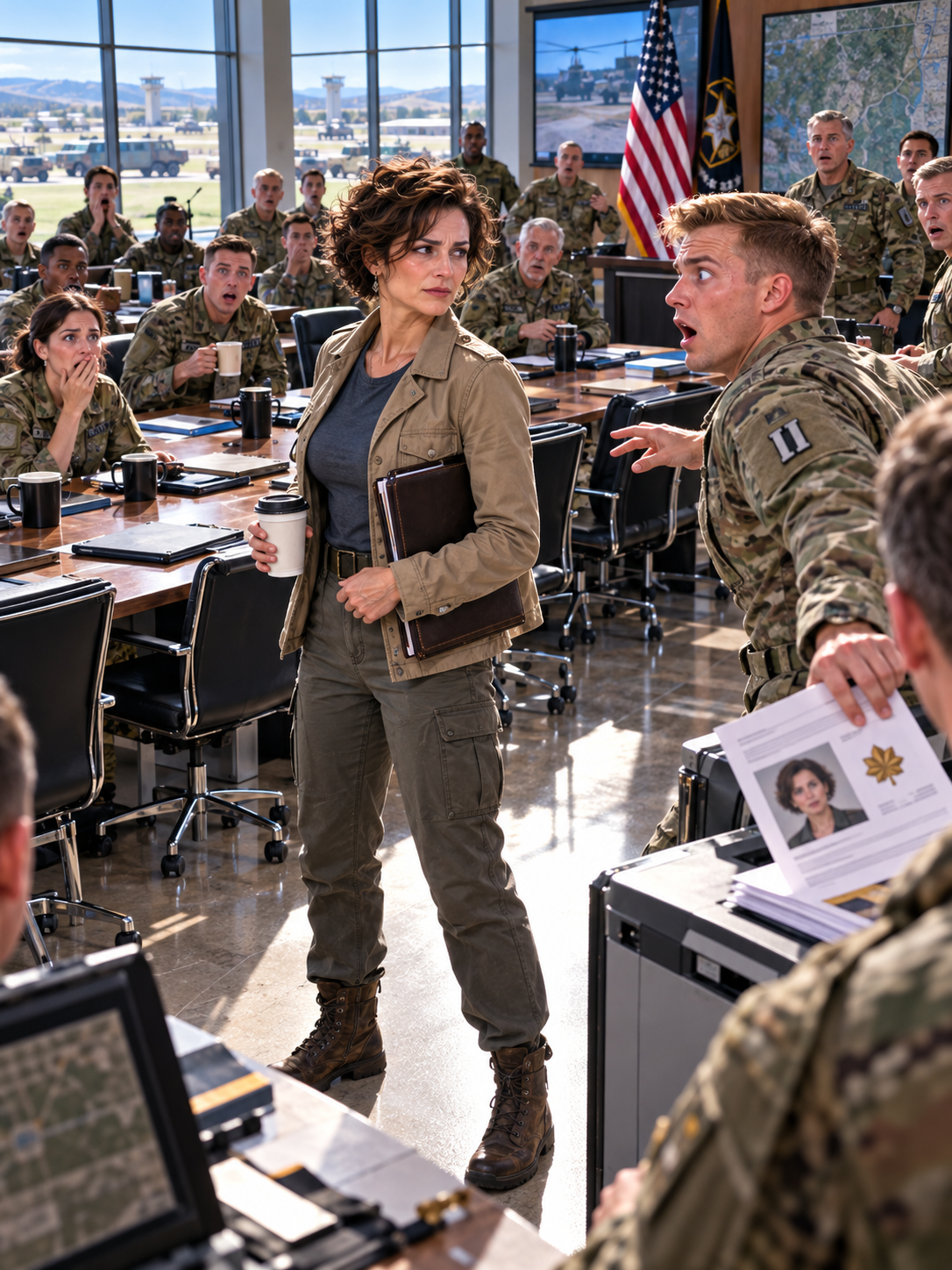
“You couldn’t lead a fire team,” the lieutenant told me in front of twenty-two officers, never realizing the woman in worn boots holding a paper cup of coffee was the major sent to evaluate him. Seconds later, the official instructor roster printed behind him, and the laughter died one chair at a time. I could have ended his career before lunch. Instead, I made a choice that forced both of us to confront something harder than humiliation: the leaders we had become when nobody challenged our assumptions.
### Part 1
The first thing I noticed about Lieutenant Evan Mercer was how easily other people laughed around him.
It was 6:20 on a damp Tuesday morning at a Marine Corps leadership school in Virginia, and I was standing near the end of a fluorescent-lit passageway holding coffee that tasted like scorched cardboard. Evan had three newly commissioned second lieutenants gathered around him while he teased a fourth about failing a land-navigation screening, and every time Evan smiled, the others smiled half a second later. The lieutenant being mocked tried to laugh too, which told me more about the situation than Evan’s words did.
I had been on base since 4:30.
Old habits wake earlier than alarm clocks. Eighteen years as a combat engineer had taught me to walk unfamiliar ground before other people filled it, so before sunrise I had driven the perimeter roads, checked the training lanes, inspected the obstacle course, and found a drainage ditch behind the eastern classroom wing deep enough to swallow an ankle after rain. Nobody had ordered me to do any of that, but nobody had needed to.
The ground never cared about your rank.
That lesson had followed me from Afghanistan to company command, from route-clearance operations to staff assignments, and finally to this schoolhouse, where I had been assigned as the incoming course director for an advanced leadership program. On paper I was Major Claire Benton, forty years old, two deployments, eighteen years in uniform, and responsible for deciding whether twenty-two young officers were ready to lead Marines. That morning, however, I wore jeans, a gray T-shirt, old boots, and no visible rank.
I wanted to see the school before the school knew I mattered.
Inspections rarely show you an organization. They show you what an organization looks like when it knows someone important is coming, which is about as useful as judging a family by the living room five minutes before company arrives. I wanted the dirty coffee pot, the whispered complaints, the tired staff, the shortcuts, and especially the way instructors treated students when they believed nobody senior was watching.
Evan Mercer provided an answer quickly.
He was twenty-six, athletic, sharp, and handsome in the uncomplicated way that made people assume confidence and competence belonged together. According to the personnel file I had reviewed the night before, he had graduated near the top of every formal course he had attended, had never received less than glowing evaluations, and had somehow made it through nearly four years as an officer without a single written sentence suggesting he had meaningful weaknesses.
That worried me more than a bad evaluation would have.
Nobody reaches twenty-six without weaknesses. A spotless record usually means either a miracle occurred or the people responsible for developing someone decided praise was easier than honesty.
“Twice?” Evan said to the nervous lieutenant in the passageway. “You failed land nav twice?”
The young man nodded.
Evan grinned at the others. “My aunt gets lost driving to the grocery store, and I’d still bet on her.”
Everyone laughed.
I kept walking.
I wanted to stop him immediately, but there are corrections you make in public and corrections you save until you understand what you are correcting. A careless joke can be evidence of arrogance, nervousness, immaturity, or simply a culture that rewards instructors for entertaining a room rather than developing it. I had seen enough careers damaged by commanders who confused first impressions with complete diagnoses.
Unfortunately, I was about to make the same mistake in the opposite direction.
Inside the classroom, a young second lieutenant sat alone with a field manual open beside a notebook filled with tiny handwriting. She looked up as I entered, gave me a polite nod, and returned to the same page she had apparently been reading for several minutes. Her name, according to the roster on the desk, was Leah Moreno.
She was so quiet I nearly classified her as weak without realizing I was doing it.
It happened in seconds.
Evan was loud, so I marked him mentally as the obvious problem. Leah was hesitant, so some old reflex in me labeled her the officer who would disappear once the training became difficult.
I hated realizing that later.
At that moment, though, the judgment passed through my mind so smoothly that I barely noticed it.
That is what makes assumptions dangerous. The obvious ones embarrass us; the comfortable ones become part of the furniture.
I carried my bag into the staff office and met Captain Mara Ellison, one of the senior instructors, before seven. Mara looked exhausted but alert, with a pencil stuck through her bun and three folders under one arm, and because she thought I was another instructor checking in rather than her new course director, she spoke with unusual honesty.
“Watch Mercer,” she said while pouring coffee.
“What about him?”
“He’s good.”
“That sounds terrible.”
Mara gave me a tired smile. “That’s why he’s dangerous.”
She explained that Evan knew the curriculum better than instructors ten years older than he was. He could command a room, brief without notes, improvise examples, and turn dry material into something students remembered, but he also humiliated anyone who slowed him down. Nobody corrected him because his class averages were excellent, his previous commander adored him, and arguing with him took more energy than letting him perform.
“Who tells him no?” I asked.
Mara’s smile disappeared.
“Nobody.”
There it was.
I thought of Gunnery Sergeant Samuel Reed.
In 2011, I had been the young officer nobody told no.
I was twenty-five, commanding a route-clearance platoon in Afghanistan, convinced that rapid decisions were the same thing as decisive leadership. I talked over experienced Marines because silence made me feel uncertain, and I corrected men publicly because I thought authority weakened if anyone watched me reconsider something.
Gunny Reed could have destroyed me.
Instead, he let me fail safely.
He allowed me to be wrong when being wrong cost pride, then stepped in brutally fast when being wrong might cost blood. After one terrible night when an armored vehicle was destroyed and everyone escaped by margins I still did not like remembering, I stood beside a cleared lane at sunrise trying not to shake.
Reed handed me his canteen.
“You talk too much, ma’am,” he said.
I stared at him.
Then he added, “But when it counted, you stayed with them. Keep that part. Fix the rest.”
He could have reduced me to every mistake I had made.
Instead, he separated the officer worth keeping from the habits that needed to die.
For fifteen years I had told myself I remembered that lesson.
Then I opened Leah Moreno’s personnel file.
She had one of the highest navigation scores in her commissioning class. Her physical fitness results were excellent, her peer evaluations repeatedly described her as steady under stress, and one instructor had written, “Moreno observes longer than most, then acts with unusual precision.”
I sat back.
The quiet lieutenant I had nearly dismissed before breakfast might have been exactly the kind of officer I claimed to value.
A few minutes later I opened Evan Mercer’s file again.
The loud lieutenant I disliked might still be exactly the kind of officer somebody once believed I could become.
By 7:55, all twenty-two students were seated.
I entered last carrying my coffee and seabag, still wearing civilian clothes because I had spent the previous hour inspecting the outdoor lanes. Evan stood near the instructor podium with a clipboard, speaking loudly enough to hold the room without a microphone.
He saw me.
His eyes moved from my old boots to my plain shirt, then to the coffee in my hand.
I watched him decide who I was.
The frightening part was how familiar the process looked.
It was the same thing I had done to Leah.
“Wrong room,” he said.
Several students smiled.
I kept walking toward the podium.
Evan stepped slightly into my path.
“Ma’am, this is an officer leadership course.”
“I’m aware.”
Something in my tone should have slowed him down.
Instead, the attention from the students encouraged him.
“You here for maintenance?”
A few people laughed.
I set my coffee down.
“No.”
He tilted his head, enjoying himself now.
“Then enlighten me.”
Behind him, Master Sergeant Julian Cross walked toward the printer as a fresh sheet slid onto the tray.
Evan looked at my worn boots again.
Then he smiled for his audience and said the sentence that would follow both of us for years.
“You couldn’t lead a fire team.”
I did not answer immediately.
Master Sergeant Cross picked up the printed roster.
His eyes moved to the first line.
Then his expression changed.
The laughter stopped before anyone understood why.
And Evan Mercer, still smiling at me, was the last person in the classroom to realize the ground beneath him had just disappeared.
### Part 2
Master Sergeant Cross did not rescue Evan.
That mattered.
A less experienced senior enlisted Marine might have snapped the class to attention dramatically, announced my rank like a courtroom verdict, and allowed the room to enjoy Evan’s humiliation. Cross had spent twenty-two years learning that authority becomes weaker when it needs theater, so he simply straightened, held the roster in one hand, and said, “Good morning, ma’am. Course director is present.”
Twenty-two chairs scraped backward.
Evan turned toward Cross.
I watched his face change as the meaning caught up with him.
The confident expression disappeared first. Then his shoulders tightened, his jaw stopped moving, and his eyes flicked toward the sheet of paper before returning to me.
“Major Benton,” Cross added quietly.
That completed the arithmetic.
Everyone stood.
“Seats,” I said.
They sat immediately.
Evan remained standing for half a second longer before sitting in the back row, his clipboard abandoned on the podium like evidence.
I could have humiliated him then.
Part of me wanted to.
Anyone who claims rank permanently cures pride is either lying or has never had twenty-two people watch someone insult them publicly. I remembered the laughter. I remembered “sweetheart” in his voice. I remembered the certainty with which he had examined a stranger and decided she belonged beneath him.
But I also remembered Leah Moreno’s file.
If I punished Evan while congratulating myself for superior judgment, I would be ignoring the fact that I had made the same kind of assumption less than two hours earlier. Mine had stayed inside my head instead of becoming a joke in front of a classroom, which made it less damaging, but not more intelligent.
“My name is Major Claire Benton,” I told them. “I’ll be directing this course.”
No résumé.
No deployments.
No decorations.
The point had already been made, and pressing it harder would have transformed a professional correction into revenge.
“We begin in ten minutes. Coffee now if you need it.”
Nobody moved.
“I wasn’t making a suggestion.”
That broke the room.
Half the students headed for the hallway, while the others suddenly became fascinated by notebooks, water bottles, and anything that prevented accidental eye contact with Evan. Leah stayed seated near the front and closed her manual.
Our eyes met briefly.
There was no satisfaction on her face.
That interested me.
The first lesson that morning covered troop-leading procedures, and the irony was almost irritating. I taught for ninety minutes without using Evan as an example once, because turning the entire block into punishment would have trained the students to watch a personal feud rather than study leadership.
Evan did not speak.
That was probably the longest he had remained silent inside a classroom since arriving at the school.
Afterward, Mara Ellison followed me into the staff office and closed the door.
“You could have him removed today.”
“I know.”
“I’m serious.”
“So am I.”
She crossed her arms. “He publicly disrespected the incoming course director in front of the entire class. Colonel Whitaker would sign the relief paperwork before lunch.”
I opened Evan’s personnel file again.
“That’s what worries me.”
Mara stared at me.
“His behavior worries you?”
“No. How easy the answer is.”
She waited.
I told her about Samuel Reed.
Not everything. Some memories belong partly to the people who stood inside them with you, and I have never believed military experience becomes public property simply because enough years pass.
I told her enough.
I explained how Reed had dealt with an arrogant twenty-five-year-old lieutenant who talked too much, listened too little, and mistook rank for proof. He corrected me privately when he could, publicly when safety demanded it, and never once converted my ignorance into entertainment.
“He could have made me a story,” I said. “Instead, he made me better.”
Mara leaned against the desk.
“And you think Mercer is you?”
“No.”
That answer surprised her.
“I think believing he’s me would be another shortcut. I don’t know what he is yet.”
I looked toward the classroom through the narrow glass window in the office door.
“And I don’t know what I am in this situation yet either.”
Later that afternoon, I observed Evan teach.
I wanted evidence beyond the insult.
For twenty-five minutes, he was excellent.
He explained mission analysis clearly, moved through complex material without losing the students, asked questions that forced them to think, and used the whiteboard better than instructors twice his age. I understood immediately why commanders had praised him.
Then Second Lieutenant Aaron Bell raised his hand.
Bell was the same student Evan had mocked about land navigation.
“Sir, what happens if the timeline changes before the subordinate units finish planning?”
It was a fair question, but Bell asked it slowly.
Evan smiled.
“Well, Lieutenant, ideally you develop the ability to think faster than continental drift.”
The class laughed.
Aaron smiled weakly.
Then he lowered his hand.
He never raised it again.
That was the moment I stopped wondering whether the first morning had been an isolated lapse.
Evan’s problem was not arrogance by itself.
His problem was that he confused attention with influence.
He believed a room responding to him meant a room learning from him.
Those are not the same thing.
At 17:30, I found Colonel Daniel Whitaker in his office.
He was fifty-three and had served long enough to understand why I was there before I started speaking.
“Mercer?”
“Yes, sir.”
“He’s yours to keep or remove.”
“I want to keep him.”
Whitaker took off his glasses.
“That isn’t what I expected.”
“I don’t want him forgiven.”
“I didn’t say forgiven.”
“I know. I’m saying I don’t want that either.”
I explained what I had seen.
Talent, cruelty disguised as humor, a record inflated by constant praise, and no evidence anyone had forced him to confront failure honestly.
Whitaker listened.
“You realize,” he said, “if he embarrasses the school again, people will ask why you left him in place.”
“Yes, sir.”
“And they’ll be right.”
“Yes, sir.”
“So what exactly are you proposing?”
“A fair problem he cannot talk his way through.”
Whitaker’s mouth moved slightly.
“A field evaluation.”
“The hardest one.”
That evening, I called Evan into my office.
The door remained closed.
He entered rigidly, stood at attention, and looked like a man expecting execution.
“At ease.”
He relaxed by approximately one inch.
“Sir—ma’am, about this morning—”
“Not yet.”
His mouth closed.
“You are remaining on the instructor cadre.”
He blinked.
That was not the sentence he had rehearsed for.
“You will participate in the advanced night-leadership evaluation next week.”
“Ma’am?”
“You’ll command a mixed team of twelve. No students you select. No special preparation beyond the standard brief. I will evaluate you personally.”
His expression hardened.
“So this is punishment.”
“No.”
“It sounds like punishment.”
“Punishment would be treating you differently because you embarrassed me. I’m doing the opposite.”
I slid the exercise packet across the desk.
“You’ve spent several years being told you’re exceptional. For one night, Lieutenant, you’re going to receive the same terrain, the same darkness, the same uncertainty, and the same standard everyone else receives.”
He stared at the packet.
“And if I fail?”
“Then the record will say you failed.”
He looked at me.
No smirk now.
“And if I pass?”
“The record will say you passed.”
“That’s it?”
“That’s it.”
He gave a humorless laugh.
“You’re giving me enough rope.”
“No, Lieutenant.”
I leaned back.
“I’m removing the rope entirely. No audience. No special treatment. No commander protecting you. No major punishing you. Just the problem.”
He looked down at the packet again.
“What are you trying to prove?”
“Nothing.”
That finally unsettled him.
“I’m trying to find out who you are when there’s nobody left to impress.”
Evan left without another word.
Through the office window, I watched him walk past Leah Moreno, who was studying a terrain model alone.
He never looked at her.
She watched him for three seconds.
Then she went back to studying the ground.
The following night, I reviewed the field problem and realized something else that bothered me.
Evan Mercer was not the only person about to be evaluated.
So was I.
### Part 3
The next seven days changed the classroom before the field exercise even began.
People stopped orbiting Evan.
It was subtle at first. A student who normally lingered near his desk went directly to lunch, then another began asking Captain Ellison questions instead of him, and by Friday Evan ate alone at a corner table in the mess facility while two lieutenants who had previously laughed at everything he said sat thirty feet away discussing navigation with Aaron Bell.
I did not enjoy watching that.
If I had, I would have been using isolation as revenge.
Instead, I watched Evan carefully to see what he did when applause disappeared.
He became quieter.
Not humbler yet.
Quiet and humble are not synonyms.
Sometimes silence is reflection; sometimes it is simply wounded pride waiting for another opportunity to speak.
Leah Moreno, meanwhile, began making herself impossible for me to overlook.
During a logistics discussion, another student proposed carrying extra supplies through a narrow route that appeared faster on the map. Leah waited through three louder opinions before raising her hand.
“What happens after twelve hours of rain?”
The room paused.
She pointed to a contour line.
“That drainage channel becomes the route.”
Captain Ellison looked at the terrain map again.
Leah was right.
Two days later she noticed a timing conflict buried in an operations order that everyone else, including me, had read twice.
She never announced her corrections triumphantly.
She simply placed them on the table like useful tools.
Every time she did, I remembered my first impression of her.
I began to understand that the course was doing exactly what I wanted it to do, just not in the direction I had expected.
I had arrived prepared to teach twenty-two officers.
Instead, one quiet lieutenant was exposing a flaw in the way I had started judging them.
On Monday evening, the temperature dropped sharply.
By 20:00, Evan stood at the edge of a wooded training area with twelve officers, helmets secured, red-filtered lights clipped to their gear, and a mission brief in his hand. Their objective was simple on paper: move through several kilometers of rough terrain, establish security around a simulated communications site, recover critical equipment, and reach an extraction point before the exercise window closed.
Nothing about it was designed to be clever.
The difficulty came from tired people, poor visibility, incomplete information, and the way every small mistake grows when twelve people must absorb it together.
I stood fifty yards away with Master Sergeant Cross.
“Think he knows what tonight is?” Cross asked quietly.
“He thinks it’s about proving he can lead.”
“And what is it actually about?”
“Finding out whether anyone wants to follow him.”
Cross nodded.
“That’ll preach.”
The first thirty minutes went well.
Evan issued a solid initial plan.
His route made sense, his timelines were reasonable, and his task organization showed he had studied the problem instead of assuming talent would rescue him.
Then one fire team missed a control point.
The delay was five minutes.
Evan reacted as if five minutes were a betrayal.
“Move faster.”
Two minutes later: “Why are you still there?”
Then: “Team Two, push left. No, farther. Bell, not that trail. Moreno, get him off that trail.”
Orders began piling on top of one another.
His people stopped solving problems because Evan solved them again before they had time to execute his previous solution.
By the first hour, he had become a radio station nobody could turn off.
At 21:17, Aaron Bell asked for confirmation on a direction.
Evan answered sharply enough that everyone on the radio heard it.
“We covered this in the brief, Lieutenant.”
Bell went silent.
Ten minutes later a different team made almost the same mistake because the clarification Bell had tried to request would have helped everyone.
I wrote the time down.
At 21:46, Leah quietly suggested adjusting the route to avoid a flooded low area.
Evan rejected it without asking why.
The team lost another fourteen minutes.
At 22:20, the objective changed.
A simulated casualty forced them to reorganize.
That was when Evan finally lost the exercise.
He began blaming individuals.
Not screaming.
That would have been easier to identify.
He used precise, cutting sentences that sounded professional enough to survive on paper.
“You were briefed.”
“You should have anticipated that.”
“I can’t compensate for everyone.”
Each sentence moved responsibility downhill.
The team responded exactly as teams usually do when blame becomes the leader’s primary tool.
They stopped taking initiative.
People waited for instructions because initiative had become dangerous.
The exercise stalled.
Cross shifted beside me.
“You going to stop it?”
“No.”
“They’re done.”
“I know.”
He looked at me.
I hated what I was about to say because I remembered being the young officer inside exactly this kind of failure.
“Let him reach the bottom.”
So we watched.
At 23:38, Evan’s team arrived at the final control point thirty-one minutes late.
Nobody spoke.
They were cold, irritated, and exhausted in the safe artificial way training allows you to experience emotions that become much more expensive later.
Evan stood several yards from them.
His first words were, “We had multiple execution failures.”
I walked forward.
“No.”
He stopped.
I laid my notebook on the hood of a utility vehicle.
“We had one leadership problem expressed twelve different ways.”
His jaw tightened.
I motioned everyone closer.
I did not lecture.
I went through the timeline.
21:17, Bell asked for clarification.
21:32, the same misunderstanding affected another team.
21:46, Moreno warned about terrain.
22:02, the route became impassable.
22:20, the mission changed.
22:24, Evan issued four orders in less than a minute, two contradicting the previous two.
I gave no opinion.
I only read what had happened.
Facts can be merciless when you stop decorating them.
Finally I looked at Evan.
“How many people did you command tonight?”
“Twelve.”
“No.”
He frowned.
“Ma’am?”
“How many people trusted you?”
His eyes moved toward the team.
Nobody looked away.
“Twelve,” he said more carefully.
“A fire team is four Marines who trust one leader enough to move when that leader says move.”
I pointed toward the group.
“You had three fire teams’ worth of trust tonight.”
He said nothing.
“Count how many times you spent that trust because protecting your authority mattered more than solving the problem.”
He looked angry.
Good.
Anger often arrives before understanding because understanding hurts more.
“Ma’am, with respect—”
“Count.”
He glanced at my notebook.
“I don’t know what number you want.”
“I don’t want a number.”
That silenced him.
“I want yours.”
For almost a minute, nothing happened except wind moving through wet branches.
Then Evan looked toward Aaron Bell.
Bell’s face was expressionless.
Evan looked at Leah.
Then the others.
His shoulders changed.
Not collapsed.
Changed.
“Too many,” he said.
“That isn’t a number.”
He swallowed.
“Seven.”
I waited.
“Seven times I shut someone down when they were trying to help.”
Nobody moved.
Then Aaron Bell spoke.
“The first plan was good, sir.”
Evan turned toward him.
Bell continued.
“I would’ve followed it. I think everybody would’ve followed it.”
Evan looked almost relieved.
Then Bell finished.
“You just kept giving us new versions until none of us knew which one you actually trusted.”
That sentence landed harder than anything I had said.
Evan nodded once.
For the first time since I had met him, he accepted correction without defending himself.
The group was dismissed twenty minutes later.
As everyone moved toward the transport vehicles, I found Leah tightening the strap on her pack.
“You saw the drainage issue early.”
“Yes, ma’am.”
“Why didn’t you push harder?”
She considered the question.
“Because he wasn’t listening yet.”
The answer bothered me.
“You knew that?”
“I watched him all week.”
Something about the way she said it reminded me of myself walking the schoolhouse grounds before sunrise.
“You always watch first?”
“Usually.”
“Why?”
She shrugged slightly.
“I don’t like leading until I understand the terrain.”
For several seconds, all I heard was the idling truck behind us.
That was my sentence.
Not literally, but close enough.
The quality I had valued most in myself was standing in front of me wearing lieutenant bars, and I had almost mistaken it for weakness because it arrived quietly.
Leah walked toward the truck.
I remained in the darkness thinking about two mistakes.
One Evan had made loudly.
One I had made without saying a word.
The second one frightened me more.
### Part 4
Evan reported to my office at 06:45 the next morning.
He looked as though he had slept badly, which meant either he had spent the night replaying the exercise or someone had finally introduced him to the coffee in the enlisted dining facility. He remained standing until I motioned toward the chair.
“Ma’am, I want to rerun it.”
I expected an apology.
That was not what I got.
“The exercise?”
“Yes.”
“For the grade?”
“No, ma’am.”
That got my attention.
“My evaluation stands,” I said.
“I know.”
“I’m not changing your score.”
“I know.”
“Then why?”
He looked uncomfortable.
It was the first useful discomfort I had seen in him.
“Because I didn’t know how bad it felt from their side.”
I waited.
He continued.
“I thought I was keeping control.”
“And now?”
“I think I was keeping everyone dependent on me.”
That was a better answer than anything I could have assigned him.
“You can rerun it Thursday,” I said.
He looked surprised.
“Same standard?”
“Harder.”
He almost smiled.
Almost.
“Yes, ma’am.”
Before he left, I stopped him.
“Lieutenant.”
He turned.
“Do not apologize to me yet.”
His eyebrows lifted.
“You think I shouldn’t?”
“I think you want the discomfort gone.”
He said nothing.
“An apology offered to make yourself feel better is just another way of making the moment about you. Figure out who you actually harmed first.”
He nodded and left.
Two days later, Master Sergeant Cross mentioned casually that Evan had approached Aaron Bell after dinner.
“Public apology?” I asked.
“Nope.”
“Good.”
Cross grinned.
“Thought you’d say that.”
Evan had found Aaron alone near the navigation lab and apologized without gathering witnesses. Then, instead of telling Aaron to improve, he asked where the problem began.
Aaron admitted contour interpretation kept slowing him down.
Evan spent the next three evenings helping him.
Nobody received credit for it.
No report mentioned it.
I did not learn about it from Evan.
That mattered.
The second field exercise belonged to Leah.
I assigned her a leadership role intentionally, partly because her record justified it and partly because I needed to test my corrected judgment instead of congratulating myself for having one.
A leader who realizes an assumption is wrong but never changes behavior has only upgraded from prejudice to awareness.
Leah received eight officers and a problem involving movement through restrictive terrain, establishing a temporary position, and adapting to two unexpected changes.
She briefed for seven minutes.
Evan’s comparable briefing had lasted nineteen.
She gave three priorities.
“Stay oriented. Protect the timeline. Tell me early when something stops making sense.”
Then she let her team work.
I placed Evan in a support role.
He noticed.
Of course he noticed.
But for once he did not treat an assignment outside the center as an insult.
The exercise began at dusk.
Within forty minutes, Leah’s team encountered a blocked crossing.
She asked her lead team for options.
One lieutenant proposed reversing course.
Another recommended moving farther north.
Leah listened to both.
Then she chose the northern route.
No speech.
No effort to prove the solution originated with her.
They moved.
Twenty minutes later the northern path narrowed badly, forcing the team to reorganize.
Leah moved forward, helped manage the bottleneck, and changed her own plan without treating the change as humiliation.
I glanced toward Evan.
He was watching her.
So was everyone else.
That was when I saw the class beginning to reorder itself.
At the start of the course, attention had belonged to Evan because he generated the most energy.
Now the students watched Leah because her decisions worked.
Popularity and trust often look identical from across a room.
Pressure tells you which one you are actually seeing.
Leah completed the mission inside the standard.
No celebration.
She gathered her team for the debrief and asked, “Where did I make your job harder?”
Evan looked down briefly.
He heard it.
Later that evening, while we waited for transport, he approached me.
“She doesn’t talk much.”
“No.”
“But everyone moved when she talked.”
“Yes.”
He stared toward Leah, who was helping another student repack equipment.
“How?”
“That’s your assignment.”
He looked at me.
“No written response?”
“No.”
“What do you want?”
“I want you to figure out why eight people followed three sentences more effectively than twelve people followed fifty.”
For once, he did not immediately answer.
The rerun happened Thursday.
Evan took a fresh team through a similar but not identical problem.
The first hour tested him almost immediately.
A team leader misunderstood a route change.
I saw Evan’s jaw tighten.
His old reflex appeared physically before he acted on it; his shoulders moved forward, he inhaled sharply, and his hand lifted toward the radio.
Then he stopped.
One breath.
“Team One, give me your picture.”
The lieutenant explained.
Evan listened until he finished.
“All right. Use your route. Update me at the crossing.”
That was all.
Master Sergeant Cross stood beside me.
“Well,” he whispered.
“Don’t say anything.”
“I didn’t.”
“You were thinking loudly.”
He suppressed a smile.
The mission continued.
Later, equipment failed.
Evan asked his team leaders for recommendations before choosing a workaround.
When the final movement slowed, he moved forward rather than standing behind the formation criticizing people.
He was not transformed.
He still interrupted twice.
He still issued one unnecessary correction over the radio.
He still visibly wanted to take back control whenever uncertainty appeared.
But wanting to do the wrong thing and choosing not to is where change usually begins.
Afterward, I graded the rerun privately.
“Better.”
He waited.
That single word disappointed him for perhaps half a second.
Then he understood why I was not giving him more.
“Thank you, ma’am.”
We sat on an equipment case near the edge of the training lane while the others loaded vehicles.
The ground was cold enough that I could feel it through my boots.
I told him about Samuel Reed.
Not the polished version.
I told him how arrogant I had been at twenty-five.
How Reed had watched me speak too fast and listen too slowly.
How he let me make mistakes that bruised pride while preventing the ones that would have damaged Marines.
I told Evan about the night our vehicle was destroyed, and about sunrise, and the canteen.
“You talk too much, ma’am. But you carried them.”
Evan stared into the darkness.
“He said that?”
“Exactly.”
“Why didn’t he crush you?”
“Maybe he was smarter than I was.”
“That isn’t what I mean.”
“I know.”
I rubbed my hands together against the cold.
“He understood something I didn’t.”
“What?”
“That correcting someone and defeating someone are different missions.”
Evan was quiet.
“Everyone told me I could remove you after the first morning.”
“I assumed.”
“I thought about it.”
He nodded.
“Why didn’t you?”
There it was.
The question I had been asking myself since day one.
“Because someone once decided I was worth more developed than destroyed.”
He turned toward me.
“That doesn’t mean I forgive what you did.”
“I know.”
“Second chances aren’t forgiveness anyway. They’re debt.”
He frowned slightly.
“You owe the opportunity forward. Someday you’re going to meet your version of you.”
He almost laughed.
“That sounds terrible.”
“It will be.”
Then I looked directly at him.
“And you will get to decide whether the story ends with you proving you were better than that person or making that person better than they were.”
The trucks arrived.
We stood.
Before Evan walked away, I added one final sentence.
“Don’t waste what people carried for you.”
He nodded.
Three days later, I saw him do something I had not expected.
And nobody who mattered to his career was watching.
### Part 5
It happened in the navigation lab on a Sunday evening.
I had returned to the building to retrieve a folder and expected the classrooms to be empty, but voices came from behind a partially open door. When I looked through the narrow glass pane, I saw Evan and Aaron Bell leaning over a terrain board.
Evan was not lecturing.
Aaron moved a marker across the map while Evan asked questions.
“Where are you now?”
Aaron pointed.
“What tells you that?”
“The draw here.”
“What if you miss it?”
Aaron studied the board.
“Road becomes my backstop.”
Evan nodded.
“Good. Again.”
I left before either of them saw me.
That moment mattered more than his successful rerun.
Performance under evaluation can change because consequences changed.
Behavior in an empty building changes because the person changed.
The next morning Aaron passed a difficult navigation lane on his first attempt.
Evan did not mention helping him.
Aaron did.
That distinction mattered too.
As the course moved into its final month, Evan became less entertaining.
His teaching evaluations initially dropped.
That surprised him.
“You told me to stop turning people into jokes.”
“I did.”
“My student satisfaction score went down.”
I looked at the report.
“Because you’re less funny.”
“So I got worse?”
“No.”
He waited.
“You’re confusing applause with effectiveness again.”
He exhaled through his nose.
“I walked into that one.”
“Yes.”
I handed the evaluation back.
“Your questions improved. Student participation increased. Fewer students leave confused. Which score are you here for?”
He looked at the paper again.
“The one that matters after they leave.”
“Now you’re learning.”
Leah continued performing with the same quiet consistency.
She was not perfect.
During one planning exercise, she waited too long to intervene while two team leaders argued over priorities, costing her group nearly ten minutes. During the debrief I asked why.
“I wanted them to solve it themselves.”
“When did that stop being useful?”
“About five minutes before I stepped in.”
“Why didn’t you?”
She considered it.
“I didn’t want to seem controlling.”
There it was.
Every strength casts a shadow.
Evan’s decisiveness became domination.
Leah’s restraint could become absence.
A leadership course fails if it teaches loud people to become quiet and quiet people to become loud. The point is not personality replacement; the point is knowing what the moment requires.
“Your team doesn’t need you to avoid control,” I told her. “They need you to use it at the correct time.”
She wrote that down.
Evan, sitting two chairs away, also wrote it down.
I noticed.
We reached the final major field exercise during a week of miserable weather.
Cold rain turned the training area into slick mud, and everything smelled like wet nylon, diesel exhaust, and pine needles crushed beneath boots.
For the exercise, students rotated through leadership positions while instructors observed from a distance.
Leah performed first.
She made one bad route decision, admitted it quickly, corrected it, and kept moving.
Evan performed later.
His team encountered an equipment malfunction that delayed communication.
I watched him reach for the radio before remembering it was useless.
For several seconds, he stood in the rain considering options.
The old Evan would have filled those seconds with noise.
The new one turned to his nearest team leader.
“What do you see?”
The lieutenant answered.
Evan listened.
They adjusted.
No drama.
No brilliant speech.
Just twelve people solving a problem together.
That evening, Captain Ellison found me sitting beneath an awning outside the staff building, cleaning mud from my boots.
“You were right about him.”
I shook my head.
“Too early.”
“He’s different.”
“Yes.”
“That’s usually what being right looks like.”
I looked at her.
“And I was wrong about Moreno.”
Mara sat beside me.
“You corrected that.”
“Eventually.”
“Claire, everybody misreads people.”
“Everybody also says that right before doing it again.”
Rain hammered the metal roof above us.
I scraped mud from one boot.
“When I met Mercer, I saw the lieutenant I used to be and decided I understood him. When I met Moreno, I saw someone unlike the lieutenant I used to be and decided she was weaker.”
Mara considered that.
“You think the course changed you.”
“It reminded me how easy it is to turn experience into arrogance.”
“That sounds cheerful.”
“Military education is a festival of joy.”
She laughed.
Then her expression became serious.
“What happens after graduation?”
“They leave.”
“That isn’t what I mean.”
I knew.
“You’re worried he’ll become old Mercer again when nobody here is watching.”
“Yes.”
“So am I.”
That was the limit of instruction.
You can build conditions.
You can expose habits.
You can make someone experience the cost of behavior in controlled environments.
Then eventually you have to release them into places where mistakes stop being academic.
I understood why Samuel Reed had seemed older than thirty-eight during Afghanistan.
He had probably watched me leave on missions carrying lessons he could no longer enforce and wondered whether I would remember them when fear became louder than his voice.
I had never asked him.
The thought followed me into graduation week.
Final rankings were prepared on Tuesday.
Leah Moreno earned the highest leadership evaluation in the class.
Not because she dominated every category, but because she adapted faster than anyone else once weaknesses were identified.
I read the recommendation twice before approving her as Distinguished Honor Graduate.
Then I found Evan’s result.
Eleventh.
Exactly the middle.
Captain Ellison stood behind me.
“He’ll hate that.”
“He should.”
“After everything?”
“Especially after everything.”
She looked at me.
“You don’t think he deserves higher for improvement?”
“No.”
“Why?”
“Improvement isn’t bonus credit for spending the first third of the course learning something everyone else already understood.”
Mara smiled faintly.
“You really don’t play favorites.”
“I’m trying not to start.”
I signed the list.
Evan arrived for his final counseling that afternoon.
I placed his evaluation on the desk.
He read the ranking.
For a moment, I saw the old reaction flicker across his face.
Then it disappeared.
“Middle.”
“Yes.”
He read the comments.
No inflation.
No revenge.
His strengths were listed clearly.
So were the failures.
Finally he looked up.
“Fair.”
That one word meant more to me than an apology would have on day one.
“You understand why?”
“I spent half the course catching up emotionally.”
“That isn’t the phrase I used.”
“It’s the phrase I’m using.”
I almost smiled.
“Then yes.”
He stood to leave, then stopped.
“Ma’am, about that first morning.”
I waited.
“I was wrong.”
“Yes.”
“I don’t mean because of your rank.”
That mattered.
“I know.”
He looked uncomfortable again.
Good discomfort.
“I had already decided what you were before you spoke. Then I used the class to prove my decision.”
I said nothing.
“I’ve been thinking about Bell.”
“And?”
“And how many times I probably did that before somebody had enough rank to make me notice.”
There was no useful answer to that.
Regret cannot repair people retroactively.
It can only change who gets hurt next.
“You can’t fix every room you were careless in,” I said. “You can change the next one.”
He nodded.
At the door, he turned back.
“Did you ever apologize to your gunny?”
“For being difficult?”
“Yes.”
“No.”
His eyebrows lifted.
“I thanked him eventually, but I never told him I understood.”
“Why not?”
I looked toward the window.
Because time lies.
It convinces us important conversations can wait simply because they have already waited this long.
“I assumed I still had time.”
Evan left.
That evening, I searched Samuel Reed’s name for the first time in years.
What I found made the room feel suddenly too quiet.
### Part 6
Samuel Reed had died five months earlier.
I stared at the veterans’ association notice on my laptop while the office ventilation system hummed above me.
The obituary was short.
Samuel Patrick Reed, fifty-three. Husband, father, grandfather, retired Marine. It mentioned deployments, community volunteer work, and the fact that he coached youth baseball badly but enthusiastically.
Nothing about me.
Of course there was nothing about me.
I had been one lieutenant among dozens whose lives crossed his.
Still, grief can be selfish before it becomes generous.
My first thought was that I had missed my chance.
For fifteen years, whenever Reed entered my mind, I imagined there would eventually be a phone call. I would tell him I finally understood why he had not destroyed me when destruction would have been easier. I would tell him about young Marines I had tried to develop using lessons he probably never realized he had taught.
Now the conversation existed only in my imagination.
I closed the laptop.
For several minutes, I was twenty-five again in Afghanistan with dust in my teeth and sunrise hitting the side of a damaged vehicle.
Reed handing me a canteen.
“You talk too much, ma’am.”
I had been furious when he said it.
Then he added, “But you carried them.”
At twenty-five, I heard praise.
At forty, I finally understood the warning.
Keep the courage.
Lose the ego.
That was what he had been saying.
The following morning was graduation rehearsal.
Twenty-two officers stood in formation while staff checked names, seating, awards, and timing.
Leah learned she had been selected as Distinguished Honor Graduate when Captain Ellison called her forward.
Her reaction was perfectly Leah.
One blink.
“Thank you, ma’am.”
Then she stepped back.
Afterward I found her near the auditorium entrance.
“You seem surprised.”
“I am.”
“Why?”
“There are louder people in the class.”
The sentence made me laugh unexpectedly.
She looked confused.
“That,” I said, “is exactly why this award matters.”
She studied me.
“I thought I was too quiet when I started.”
“So did I.”
Her eyebrows rose slightly.
There was no reason to hide it.
“I underestimated you.”
She waited.
“I saw you alone with a manual on the first morning and decided you might disappear under pressure.”
“What changed your mind?”
“You did.”
A smile appeared.
Small, but real.
“I’m glad you were wrong, ma’am.”
“So am I.”
I could have told her I had recognized her talent immediately.
Instructors are tempted to rewrite history once a student succeeds.
We remember seeing potential earlier than we actually did because hindsight makes us want credit.
I refused myself that comfort.
I had almost missed her.
Remembering the mistake was more useful than erasing it.
Evan’s rehearsal was uneventful.
He crossed the stage, accepted the mock certificate, and returned to his seat without attempting to make anyone laugh.
Afterward he shook my hand.
“Thank you, ma’am.”
“For what?”
He considered that.
“For not making the worst thing I did the only thing you saw.”
That hurt more than he intended.
Because Samuel Reed had done exactly that for me.
I tightened my grip briefly before releasing his hand.
“Do it for someone else.”
“Yes, ma’am.”
The actual ceremony took place Friday morning.
Families filled the auditorium, children fidgeted in dress clothes, parents aimed phones at the stage, and somebody’s baby began crying halfway through the opening remarks.
I prefer ceremonies when they contain imperfect human noises.
Otherwise they become too easy to confuse with mythology.
Leah crossed the stage to sustained applause.
Her parents stood near the back, both crying.
I watched her shake Colonel Whitaker’s hand and accept the leadership award.
Then I remembered the young woman rereading the same page alone before dawn.
Quiet is not weakness.
I had known that before meeting her.
Somehow I had needed her to teach it back to me.
Evan graduated eleventh.
When his name was called, he walked across the stage exactly like everyone else.
No special mention of improvement.
No public story about redemption.
I wanted it that way.
If I had announced how far he had come, his growth would have become another performance centered on him.
After the ceremony, families and students crowded into the reception area.
I stood near the edge of the room speaking with Colonel Whitaker when I noticed Evan across the hall with Aaron Bell.
Aaron’s parents had arrived.
His father looked like a man trying unsuccessfully not to cry.
Aaron introduced Evan.
I could not hear the first words.
Then Evan said something.
Aaron’s father looked toward his son with sudden pride.
I moved a little closer without making my presence obvious.
“He worked harder than anybody here,” Evan was telling them. “You should know that.”
No mention of tutoring.
No mention that Evan had helped.
Nothing that redirected the father’s pride toward himself.
Just a sentence lifting someone he had once cut down for amusement.
Nobody from the chain of command was standing close enough to reward him.
He did not know I heard.
That was the moment I believed the lesson might survive us.
Later, Master Sergeant Cross and I stepped outside.
Fog hung low over the parade deck, almost identical to the morning I arrived.
Cross held an unlit cigar.
“You know what bothers young instructors?” he asked.
“Everything?”
He grinned.
“Students forget us.”
“That bothers you?”
“Used to.”
We watched families move toward the parking lot.
“Then I figured out that’s the deal.”
“What is?”
“They forget the instructor. They keep the standard.”
He rolled the cigar between his fingers.
“We trade our names for habits.”
I looked at him.
“That sounds like something you rehearsed.”
“It sounded better in my head.”
“It’s still good.”
“Don’t tell anyone.”
The fog softened the far edge of the parade deck.
I thought of Reed again.
Maybe Cross was right.
Maybe Reed never needed me to call.
Maybe the point had never been remembering his name.
Maybe the only thanks that mattered was whether something he gave me survived after neither of us was in the room.
Colonel Whitaker found me before I left.
“Benton.”
“Sir.”
“You could have relieved Mercer on day two.”
“Yes, sir.”
“Most people would have.”
“Probably.”
“I offered.”
“I remember.”
He placed his hands in his pockets.
“Tell me why you didn’t.”
I thought about the easy answer.
Mercy.
Patience.
Leadership.
All true and all incomplete.
“Because relieving him would have solved my humiliation, sir.”
Whitaker waited.
“The Corps didn’t send me here to win arguments with lieutenants. It sent me here to build them.”
“And if he hadn’t changed?”
“I would have documented it honestly and removed him.”
“So this wasn’t forgiveness.”
“No, sir.”
He nodded.
“Good.”
Then he looked toward the building.
“The next instructor who wants to destroy a student because the student embarrassed him—I’m stealing that answer.”
“You can have it.”
I left the schoolhouse that afternoon believing the story was finished.
Evan had learned.
Leah had taught me something.
The class graduated.
Samuel Reed was gone.
Four months later, a message arrived from a unit hundreds of miles away.
When I read the first paragraph, I realized none of us had seen the ending yet.
### Part 7
The message came through official channels but had not been intended for me originally.
A staff sergeant had written an after-action note after a difficult overnight field operation involving equipment failure, worsening weather, and a team forced to reorganize under pressure. Nobody was seriously hurt, which was the first thing I checked, but the note praised a young officer for staying calm while everything around him became less cooperative.
His name was First Lieutenant Evan Mercer.
I read the line twice.
The report described poor visibility, communications problems, and a delayed support element.
Old Evan would have increased the volume.
Instead, according to the staff sergeant, Evan gathered his team leaders, listened to each in turn, issued a small number of clear instructions, and placed himself where the most uncertainty existed.
My heart beat a little faster as I continued.
Afterward, during the debrief, one Marine asked why Evan had refused to micromanage when the situation became confused.
The report quoted his answer.
“A fire team is people trusting you to spend their effort wisely. Count the people before you spend them.”
It was not exactly my sentence.
That made it better.
He had carried the idea forward in his own language.
I sat alone in my office with the message open and thought about a cold training lane, twelve frustrated lieutenants, and a young officer reluctantly counting seven moments when his pride had cost trust.
Then I thought about Samuel Reed.
I opened my desk drawer.
A month earlier, after finding his obituary, I had written him a letter I could never send.
I had not known what else to do with the things I should have said.
Gunny,
I finally understand what you did.
That was how it began.
The rest filled two pages.
I told him I remembered the canteen.
I told him I remembered how often he corrected me without making me small.
I told him there had been another lieutenant, loud and talented and careless, who reminded me of things about myself I would rather have forgotten.
I told him I almost punished that lieutenant because punishing him would have felt clean.
I told him I chose the harder version because Reed once chose it for me.
Then I wrote the sentence I wished I could have said while he was alive.
You carried me until I could carry somebody else.
I read the letter again after receiving Evan’s field report.
For the first time, it no longer felt unfinished.
A debt like that cannot be paid backward.
That was what I had misunderstood for fifteen years.
I had imagined gratitude as a line running from me to Reed, as though one perfect phone call could close the account.
But what Reed had given me had never been meant to return to him.
It was supposed to keep moving.
A week later, Leah Moreno emailed me.
Her message was shorter.
Ma’am, first platoon assignment is going well. I still watch longer than people expect. I’m learning when not to.
I smiled.
Below that she had added another sentence.
Also, one of my squad leaders told me yesterday that I need to make decisions faster when I already know enough. Apparently leadership continues after graduation.
I replied.
That is unfortunate but true.
Then I stared at the screen for a while before adding:
Keep listening. Just remember silence is a tool, not a hiding place.
She responded ten minutes later.
Roger that.
The class was gone, but its lessons were still moving in directions I could not control.
That made me think differently about teaching.
When I first became an instructor, I believed success meant transferring knowledge accurately.
Then I believed success meant changing behavior.
Now I think success is stranger.
You place something useful in another person and accept that you may never know what they do with it.
Sometimes you receive a report four months later.
Usually you receive nothing.
Master Sergeant Cross had been right.
We trade our names for standards.
I called him after reading Evan’s field report.
He answered on the fourth ring.
“Cross.”
“You busy?”
“Always.”
“I got something about Mercer.”
There was a pause.
“Good something or career-ending something?”
“Good.”
“Shame. Career-ending stories are easier to tell at reunions.”
I read him the relevant paragraph.
Cross remained quiet for several seconds.
Then he said, “Guess it stuck.”
“Looks that way.”
“You sound surprised.”
“I am.”
“You’re impossible to satisfy, ma’am.”
“I learned from excellent people.”
Cross laughed.
Before hanging up, he said something that stayed with me.
“You know the funny part?”
“What?”
“Mercer probably thinks the lesson was about him.”
I frowned.
“What was it about?”
“All of you.”
He disconnected before I could answer.
I hated when master sergeants did that.
The problem was that he was right.
Evan had learned not to confuse authority with performance.
Leah had learned that restraint becomes failure if it lasts past the moment action is needed.
I had learned that experience can become a shortcut just as easily as arrogance can.
We were different versions of the same danger.
We saw a person.
We saw one behavior.
Then we built an entire human being around it.
Evan had looked at civilian clothes and old boots and decided I could not lead.
I had looked at Leah’s silence and decided she might not lead.
I had looked at Evan’s arrogance and almost decided he was not worth leading.
Same mechanism.
Different targets.
That realization bothered me more than the original insult ever had.
At forty, after eighteen years of service, two deployments, command, mistakes, funerals, promotions, and more professional military education than I cared to calculate, I still had not graduated from being human.
There was something comforting about that.
Also irritating.
Several months after Evan’s report, I visited the cemetery where Samuel Reed had been buried.
His family had moved to another state, and I had never met them, so I went alone.
The day was bright and cold.
I found his marker after walking the wrong row twice.
For a man who had occupied so much space in my memory, the physical place containing his name was remarkably small.
I stood there holding the unsent letter.
I did not read it aloud.
That would have felt theatrical.
Reed hated theater.
Instead, I folded it once more and placed it briefly against the top of the marker before putting it back into my coat.
“You were right,” I said.
That was all.
On the walk back to my car, I realized I did not feel the closure people always promise in stories about graves.
I missed him.
I regretted waiting.
Nothing fixed that.
But regret and gratitude could occupy the same body without canceling each other.
The important thing was that his work had continued.
Through me.
Then through Evan.
Maybe through Aaron.
Maybe through Marines whose names none of us would ever learn.
I reached the parking lot and stopped before opening my car door.
My phone buzzed.
A message from an unfamiliar number.
Ma’am, this is Evan Mercer. I hope you don’t mind me reaching out. Something happened today, and I think you should know.
I opened the rest.
What he wrote made me understand that the debt had already moved farther than I thought.
### Part 8
Evan’s message was about a second lieutenant named Nolan Pierce.
Pierce had joined Evan’s unit three weeks earlier.
According to Evan, the young officer was smart, aggressive, physically capable, and completely exhausting.
I laughed when I read that.
Some patterns do not even bother changing clothes.
Pierce interrupted senior Marines, corrected subordinates publicly, and treated every disagreement as an opportunity to prove he understood more than everyone else.
After a disastrous planning session, several experienced leaders recommended documenting the pattern immediately and moving him out of a key position before he caused larger problems.
Evan almost agreed.
Then, he wrote, he remembered a classroom.
I kept reading.
I wanted to crush him because he reminded me of myself.
That sentence stopped me.
Evan described taking Pierce aside privately.
No audience.
No humiliation.
He explained exactly which behavior was damaging the team.
Pierce argued.
Evan let him.
Then Evan assigned him a difficult but fair problem and observed him without interference.
Pierce failed.
Instead of lecturing him afterward, Evan walked him through the timeline decision by decision and made him identify where trust had been lost.
The method sounded familiar.
At the end of the message, Evan wrote:
I don’t know whether he’ll change. I understand now that isn’t the part I control. My job was making sure he had a fair chance to see himself before I decided he was finished. I think that’s what you meant about paying it forward.
I read the message three times.
Then I cried.
Not dramatically.
No collapse.
No grand release.
I simply sat at my kitchen table in a quiet house and felt tears reach my jaw while morning light moved across the hardwood floor.
For years, I had believed Samuel Reed’s influence survived because I remembered him.
I was wrong.
His influence survived because eventually I behaved like him.
Now Evan was doing the same.
That was the proof.
Not a salute.
Not a graduation.
Not an apology.
Replication.
A standard surviving inside someone who no longer needed you in the room.
I replied to Evan.
You understood it.
Then I deleted the sentence and tried again.
You’re doing the work. Keep going.
That felt more like Reed.
Months passed.
I received occasional updates from former students.
Leah earned a reputation for running unusually calm training.
Aaron Bell qualified near the top of his unit during a navigation evaluation and apparently became intolerable about teaching contour lines to anyone who would listen.
Evan never became quiet by personality.
I was glad.
The goal had never been to turn him into Leah.
He was still energetic, funny, fast-thinking, and capable of owning a room.
He simply stopped believing ownership was the purpose.
Those are different things.
As for me, I began changing how I opened new courses.
I stopped reviewing personnel photographs before meeting students when I could avoid it.
I spent more time watching who asked questions after class, who checked on classmates, who admitted mistakes before being cornered, and who stayed functional after the easy plan collapsed.
I also started telling instructors something on the first morning.
“Your first impression is data. It is not a verdict.”
Somebody eventually asked where I learned that.
I told him a lieutenant once insulted me in front of an entire classroom.
The instructor laughed.
“That taught you?”
“No.”
I looked toward a row of students entering the room.
“What I almost did afterward taught me.”
Years later, people who heard pieces of the story usually focused on the roster.
They loved that part.
The young lieutenant makes fun of the anonymous woman.
The printer produces the official staff list.
The master sergeant looks down.
The room realizes she is the major.
It has the shape people like.
Arrogance.
Reveal.
Instant humiliation.
Justice.
But that is the least interesting part to me now.
Evan being wrong about my identity cost him thirty seconds of embarrassment.
If I had responded badly, I could have turned those thirty seconds into the defining event of his career.
I had enough rank to do it.
That is what power actually tests.
Not whether you can punish someone who deserves consequences.
Most people can do that.
Power tests whether you can separate what repairs the institution from what satisfies the wounded part of yourself.
Sometimes those things overlap.
Sometimes removal is necessary.
Sometimes the dangerous officer has been coached repeatedly, knows the harm, refuses to change, and must be moved before someone else pays for that refusal.
I have done that too.
Mercy without standards is negligence.
But punishment without development is laziness dressed as strength.
Evan had talent.
He had also been protected from honest failure for too long.
What he needed was not praise.
Not humiliation.
Not forgiveness.
He needed consequences that taught something.
Leah taught me the mirror image of that lesson.
We talk constantly about difficult people because difficult people demand attention.
Quiet talent asks for almost nothing, which makes it easier to neglect.
Leah could have completed the entire course competently while remaining invisible if nobody placed her where leadership became observable.
That would have been our failure, not hers.
The loud student and the quiet student both needed instructors to look longer than two seconds.
So did I.
That may be the lesson I carried longest.
We all want to believe experience makes judgment faster.
Sometimes it does.
A combat engineer learns to notice disturbed earth, unnatural patterns, drainage, exposed wires, the tiny signals that say the ground is not what it appears to be.
Those instincts save lives.
But people are not roads.
A shortcut in terrain analysis might save time.
A shortcut in human judgment can erase someone before they ever had a chance to show you who they were.
I still wake early.
Even after leaving that schoolhouse assignment, I remained the person who preferred empty roads before sunrise.
Some mornings the smell of wet pavement still brings me back to Afghanistan.
Some mornings coffee in a paper cup takes me back to that classroom.
I can still see Evan smiling.
“You couldn’t lead a fire team.”
Then Master Sergeant Cross looking at the printed roster.
Then the students going silent one by one.
For a long time I thought the sentence was ironic because Evan had underestimated me.
Now I think the irony is deeper.
He was questioning whether I could lead four people.
The real test was whether I could lead one.
Him.
And leading him did not mean defeating him.
It meant refusing to become careless with his future simply because he had been careless with my dignity.
Samuel Reed did that for me.
I did it imperfectly for Evan.
Evan was trying to do it for Nolan Pierce.
Somewhere, if we were lucky, Nolan would eventually do it for somebody else.
That is how the debt moves.
Not backward.
Forward.
I never got to give Reed the thank-you I thought he deserved.
For years, that hurt.
It still does sometimes.
But I finally understand why he probably never waited for it.
People like Reed do not invest in younger leaders because they expect repayment.
They invest because one day those leaders will stand in a classroom, a motor pool, a field, an office, or beside some exhausted young Marine who has just failed publicly.
They will have enough authority to destroy.
Enough justification to walk away.
Enough anger to make either decision feel righteous.
Then, maybe, they will remember someone who once carried them.
They will decide to teach before they discard.
They will enforce a standard without turning humiliation into entertainment.
They will look twice at the loud officer everyone hates and the quiet officer everyone forgets.
And if the lesson truly survived, they will understand that none of this means saving everybody.
It means seeing people clearly before deciding what they have earned.
A year after that first course, I received another message from Evan.
Pierce had improved.
Not completely.
Better.
Evan wrote that the lieutenant had recently corrected one of his Marines harshly in front of others, then stopped halfway through, sent everyone else away, and restarted the conversation privately.
Four seconds.
That was all.
Four seconds between habit and choice.
I remembered watching Evan do exactly the same thing in the dark during his rerun.
I remembered Reed watching me years before that.
Maybe leadership is built from thousands of those four-second moments.
The breath before you speak.
The pause before you humiliate.
The question you ask instead of the order you shout.
The second look at the person you already decided you understood.
People rarely see those moments from the outside.
There is no ceremony afterward.
No medal.
No roster printing from a machine at exactly the right dramatic second.
Usually nobody knows anything almost went wrong.
That is probably why they matter.
The most important decisions I made in uniform rarely looked important while I was making them.
One Tuesday morning, I walked into a classroom wearing old boots.
A lieutenant laughed.
A printer ran.
A room went silent.
Everyone thought the lesson was that he should have known who I was.
It wasn’t.
He should have respected me even if I had been exactly who he assumed I was.
And I should have looked more carefully at him even after he gave me every reason not to.
That is the standard I carried forward.
Not because I mastered it.
Because I know how easily I can fail it.
Somewhere along the way, I stopped needing Samuel Reed to know I finally understood him.
Evan knows.
Leah knows part of it.
Aaron carries another piece.
Maybe Nolan will someday carry the rest.
That is enough.
The people who build us rarely get to watch the entire result.
They clear a little ground.
They mark the safe lane.
They wave us forward.
Then eventually we walk beyond where they can follow.
The only way to honor that kind of work is to turn around when someone else reaches the dangerous ground behind us.
Hold up a hand.
Show them where to step.
Then let them pass.
That is how I finally paid Samuel Reed back.
By understanding that I never could.
THE END!
Disclaimer: Our stories are inspired by real-life events but are carefully rewritten for entertainment. Any resemblance to actual people or situations is purely coincidental.

