I spent 20 years letting my family believe I was the woman who had joined the Marines because she had nowhere better to go. I smiled through the jokes, ignored the comments about my “costume,” and never mentioned the medal locked in a box in my bedroom. Then, at forty-three, I sat through one more humiliating family dinner—until the decorated retired Marine my aunt had invited as her guest of honor heard my name, slowly put down his fork, and stared straight at me.
### Part 1
There were two ways to measure a human being in my family, and I learned both before I was old enough to understand what either one meant.
My father, Thomas Caldwell, measured people by what they could carry without complaining. He was a machinist in western Pennsylvania, the kind of man who could pick up a metal component, run one thumb along the edge, and know before the gauge touched it that something was wrong. He believed good work should survive without applause.
My aunt Marlene measured people by how loudly the room noticed them.
Marlene was Dad’s older sister, and they had been raised in the same narrow house beside the railroad tracks. Dad stayed, married my mother Diane, worked at the plant, and built a life within six miles of the street where he had grown up. Marlene married Howard Pike, whose family owned several auto dealerships, moved forty minutes away, and spent the rest of her life proving that those forty minutes might as well have been forty thousand miles.
Her house had a dining room nobody was allowed to call a dining room.
It was “the formal room.”
There were cloth napkins, place cards, crystal glasses, a chandelier she told every new guest had come from Italy, and chairs arranged according to an invisible social ranking that everybody understood but nobody admitted existed. Important guests sat beside Marlene. Successful relatives sat near them. Dad, Mom, and I usually ended up somewhere near the far end.
Dad preferred it.
“So we can eat while everybody else performs,” he once whispered when I was thirteen.
I nearly inhaled a green bean.
Dad had that kind of humor. Quiet enough that you had to be paying attention.
When I was ten, the transmission in our old station wagon failed during the coldest January I can remember. A repair shop gave Dad an estimate that made Mom go silent at the kitchen table, so the following Saturday he pushed the car into the garage, laid cardboard beneath it, and spent two days working in temperatures that barely climbed above freezing.
I handed him tools.
At first I handed him the wrong ones.
“Three-eighths ratchet.”
I gave him a wrench.
He looked at it, looked at me, and said, “Excellent wrench.”
By Sunday afternoon, I knew the difference.
When the engine finally turned over, Dad climbed out from underneath the car with grease across his cheek. He didn’t cheer. He didn’t photograph it. He closed the hood, rubbed his hands together, and said, “Good. Your mother can get to work tomorrow.”
That evening I asked why he wasn’t going to tell Aunt Marlene what he had done.
We were going to her house the following weekend, and even at ten I understood that rebuilding a transmission sounded impressive.
Dad looked genuinely confused.
“Why?”
“Because you fixed it.”
He shrugged.
“It runs now, Erin. That’s the part that mattered.”
I carried that sentence longer than he ever knew.
At Marlene’s dinner the following weekend, she spent fifteen minutes describing a resort in Arizona where she and Howard had stayed. Dad listened politely and never mentioned lying under a broken car for two freezing days.
On the drive home, I understood something I had not understood before.
Dad and Marlene had grown up poor in the same town, but they had learned opposite lessons from it.
Dad decided dignity came from usefulness.
Marlene decided dignity came from escaping anything that reminded you where you came from.
That difference shaped the rest of my life.
I was seventeen when the world changed during my senior year of high school. Like everyone my age, I watched events on television that made adulthood seem to arrive overnight, and during the months afterward an idea settled inside me with surprising calm.
I wanted to serve.
It wasn’t rebellion.
It wasn’t patriotism performed for anyone.
It felt practical.
There was work that needed doing, and something in me believed I could do it.
I told my parents first.
Mom cried.
Dad sat at the kitchen table, rubbed one thumb across the handle of his coffee mug, and studied me.
“You’re certain?”
“Yes.”
He nodded once.
“Then learn your job.”
That was his blessing.
Marlene heard about it at dinner.
Of course she did.
Everything important in our family eventually became material for one of Marlene’s dinners.
She stared at me across the table.
“The Marines?”
“Yes.”
“Why?”
I thought the question was genuine.
“I want to serve.”
She laughed.
Not cruelly at first.
Almost affectionately.
“Oh, Erin.”
The tone bothered me more than the laugh.
“What?”
“You’re a smart girl. The military is for people who need the military to give them direction.”
Dad put his fork down.
I saw it.
Marlene didn’t.
“I have direction,” I said.
She reached across and patted my wrist.
“I’m only saying you could do something more with yourself.”
Something moved in Dad’s jaw.
I knew that movement.
I touched his sleeve beneath the table.
Don’t.
He looked at me.
I shook my head.
Marlene changed the subject within a minute.
That should have been the end of it.
Instead, it became the first line in a story she would tell about me for the next twenty years.
I left home, became a Marine officer, learned logistics, learned leadership, and discovered that moving people and equipment through dangerous places required a kind of attention I seemed to have inherited directly from my father.
Details mattered.
Routes mattered.
Fuel mattered.
Timing mattered.
Most of all, people mattered.
A mistake on a machine could ruin a part.
A mistake in my world could leave someone stranded where nobody wanted to be stranded.
I became good at the work.
Not spectacularly, loudly good.
Dad-good.
The kind where people started handing you increasingly difficult problems because they knew that once the problem reached you, it tended to stop being a problem.
Promotions came.
Responsibility came.
There were deployments I could discuss only in pieces and others I did not want to discuss at all.
But when I came home, Marlene never asked much about them.
She had already decided what my career meant.
Her version was easier.
I was Erin, the cousin who had never figured out civilian life.
Erin, who still “played Marine.”
Erin, who had taken a strange detour instead of building a real career.
I could have corrected her.
I didn’t.
Part of it was professional habit. When you spend years knowing where the line is between what can and cannot be discussed, silence becomes easier than explaining the line.
But the deeper reason was pride.
Marlene’s whole life operated like a scoreboard.
I refused to put my score on it.
So every Christmas, every birthday dinner, every summer gathering, I let my aunt underestimate me.
At first I believed my silence cost nothing.
Then the jokes spread.
My cousin Jason started asking whether my uniform came with a toy sword.
An uncle once saluted me with a dinner knife.
Marlene introduced me to guests as “our little warrior” with a smile that made the words feel like quotation marks.
Everybody laughed because I laughed too.
And somewhere along the way, the family stopped understanding that there had ever been another version of the story.
They had invented a smaller Erin Caldwell.
Then they forgot they had invented her.
For nearly twenty years, I let that woman sit in my chair at family dinners.
I thought the real me lived too far away for the two versions ever to meet.
At forty-three years old, I finally discovered how wrong I was.
Because one autumn evening, Aunt Marlene invited a retired Marine to dinner.
And when she put him in the seat of honor beside her, neither of us knew that eighteen years earlier, on the worst afternoon of both our lives, our paths had already crossed.
### Part 2
Silence becomes a habit much faster than people realize.
At first, I didn’t tell my family much because I couldn’t. Later, I didn’t tell them because the things that mattered were difficult to translate into conversations involving roast beef, wine glasses, and Aunt Marlene asking whether anybody had noticed her new floors.
By my early thirties, keeping my two lives separate required almost no effort.
There was Major Caldwell.
Then there was Cousin Erin.
Major Caldwell walked into briefing rooms where people stopped talking and waited for her assessment. Cousin Erin sat near the end of Marlene’s table while Jason asked whether Marines got discounts at Halloween stores.
I told myself it was funny.
Sometimes it actually was.
Jason wasn’t a malicious person. He had simply learned, from childhood, that making a joke about me earned an easy laugh from his mother.
People repeat whatever gets rewarded.
Once, when Jason was twenty-six, he called me after two in the morning because he had gotten himself into a financial mess he was too embarrassed to explain to his parents. I was several states away, but by sunrise I had helped him calm down, contact the right people, and work out a plan.
“Don’t tell Mom,” he said.
“I won’t.”
“Seriously.”
“Jason, I heard you.”
He thanked me.
At Christmas three months later, he asked whether I had polished my “plastic medals” before coming home.
The table laughed.
Jason glanced at me afterward, almost apologetically.
I passed him the potatoes.
That was the arrangement.
Mom hated it more than I realized.
One evening after a family gathering, I found her in Marlene’s kitchen loading dishes into the dishwasher while everybody else drank coffee in the next room.
“I hate when they talk about you like that,” she said.
“It’s fine.”
“It isn’t.”
“It doesn’t matter.”
She dried her hands and looked at me.
That look stayed with me.
She knew I was lying before I did.
“It matters a little,” she said.
I stacked two plates.
“Then let it matter a little.”
“Why don’t you tell them?”
“Tell them what?”
“The truth.”
I smiled.
“They don’t want the truth, Mom.”
She didn’t argue.
That was another thing I learned from her. Quiet people sometimes recognize truths long before anybody says them aloud.
Dad understood even more.
He never knew every detail, but after one deployment I came home changed enough that he noticed.
I remember arriving at my parents’ house just before midnight. Dad was still awake, sitting at the kitchen table reading a machining magazine beneath the yellow light over the sink.
He looked at me once.
That was all.
“You hungry?”
“No.”
“Coffee?”
“Maybe.”
He made it without asking questions.
I sat across from him and stared at the steam.
After several minutes, he said, “You don’t have to tell me anything.”
I swallowed.
“I know.”
“But whatever happened, you’re home.”
“Yeah.”
He pushed the mug closer.
“Then be home tonight.”
That was Dad.
No speech.
No demand to enter a part of my life I couldn’t open for him.
He simply sat there until sunrise began coloring the window over the sink.
Years later, when Marlene joked that I probably spent my deployments organizing filing cabinets, Dad’s eyes met mine.
He knew better.
He didn’t know how much better.
There was one afternoon in particular that neither of us ever discussed directly.
Summer, 2008.
A supply movement.
A road south of a river.
I was still young enough to remember believing competence could protect you from chaos if you prepared hard enough.
That afternoon corrected me.
Preparation doesn’t prevent chaos.
It gives you something to hold when chaos arrives.
A nearby Marine element was in trouble. Our own vehicles were taking damage, communications were fractured, and the clean route out was disappearing faster than we could use it.
For several minutes, everything became arithmetic.
People.
Distance.
Time.
Vehicles.
Cover.
What could move.
What couldn’t.
What we could abandon.
What we absolutely could not.
I made a decision that redirected our movement toward the Marines who needed a way out instead of taking the safer option available to us.
I remember a nineteen-year-old driver watching me.
He looked terrified.
So was I.
The difference was that he needed me not to look terrified.
I gave him a task.
His hands stopped shaking.
Then I gave the next Marine a task.
Then another.
Eventually, enough people were doing specific things that chaos became movement again.
We got out.
More importantly, they got out.
The official language afterward was clean and orderly in the way official language always is.
It made the afternoon sound as if every choice had been obvious.
Nothing had been obvious.
I received the Silver Star for what happened.
The medal eventually ended up inside a dark presentation box in my bedroom.
I almost never opened it.
Marlene never knew it existed.
Neither did Jason.
Mom knew I had received decorations but not which ones, because whenever she asked, I said, “Mom, everybody gets something eventually.”
Dad never asked.
Once he saw the box while helping me move.
He looked at it.
Then he looked at me.
“You want this packed separately?”
“Please.”
He wrapped it in one of his old work shirts and put it in the passenger seat of my car.
That was the closest we came to discussing it.
Around 2016, the family almost discovered more than I intended.
Marlene had invited a local businessman who had once served in the reserves. He ended up beside me during dinner, and we started talking quietly while Marlene held court at the other end.
He asked what I did.
“Logistics.”
“What kind?”
“The kind that moves.”
He smiled.
“Convoys?”
I looked at him.
“Sometimes.”
His expression changed.
People who have actually done the work sometimes hear entire paragraphs inside a single word.
He asked one or two precise questions.
I gave precise answers.
Then he leaned back.
“What rank are you?”
Before I answered, Marlene called down the table.
“Don’t encourage her.”
The man turned.
Marlene laughed.
“Erin loves letting people think she’s some kind of action hero.”
A few relatives chuckled.
The man didn’t.
He studied Marlene for a moment, then me.
I gave him the slightest shake of my head.
Leave it.
He understood.
Later, while people were putting on coats, he stopped beside me.
“I’ve known people who spent every waking minute reminding others that they served,” he said quietly. “And I’ve known people who never needed to.”
I said nothing.
He extended his hand.
“Good meeting you, ma’am.”
“You too.”
He left.
I sat in my car afterward longer than necessary.
A stranger had needed one dinner to suspect there was more to me than my family understood after decades.
That bothered me.
I buried the feeling.
The years passed.
My career kept moving.
The family joke kept moving with it.
Then, in the fall of my forty-third year, Mom called me.
“Your aunt is planning another dinner.”
“I gathered that from the seventeen messages.”
Mom laughed softly.
“She has a special guest.”
“Governor?”
“No.”
“Movie star?”
“Better, according to Marlene.”
I could hear the smile in Mom’s voice now.
“A retired Marine sergeant major. Nathan Keene. Apparently he’s very decorated.”
Something in me tightened, but only because the Marine world is smaller than civilians think.
“Do I know him?”
“She says he served forty years.”
“That doesn’t answer my question.”
“I don’t know.”
I almost skipped the dinner.
I had flown too many miles that month already, and the idea of spending Saturday evening watching my aunt borrow prestige from a decorated Marine sounded exhausting.
Then Dad called.
He didn’t ask me to come.
He never did.
He only said, “Your mother’s hoping to see you.”
That was enough.
I booked the flight.
What I didn’t know was that Nathan Keene had spent almost eighteen years wondering about the officer whose voice he had heard over a radio on a road south of a river.
He knew only a call sign.
He had never known my face.
And until Aunt Marlene laughed at me across her dining table, he still didn’t know my name.
### Part 3
I arrived at Marlene’s house twenty-five minutes late.
That probably saved me from the tour.
Her driveway was crowded with expensive cars, and warm light poured through the front windows onto clipped shrubs that looked as if each branch had signed a contract. I parked behind Dad’s old sedan and sat for a second listening to the ticking engine.
My dress uniform was in a garment bag in the trunk.
I had brought it because I had a formal event the following morning.
I never considered wearing it inside.
Marlene would have loved that.
She would have turned me into part of the entertainment.
I went in wearing dark slacks, a white blouse, and a navy jacket.
Mom met me near the foyer.
“Thank God.”
“That bad?”
“She has told the story about meeting Sergeant Major Keene four times.”
“How long have I been here?”
“Forty seconds.”
I kissed her cheek.
Dad appeared behind her and hugged me.
He had gotten thinner.
I noticed it every time I came home now, which meant I was reaching the age when you begin measuring visits differently.
“You ate?” he asked.
“Not yet.”
“Then we’ll survive.”
From the dining room came Marlene’s voice.
“…forty years in the Corps.”
Dad raised an eyebrow.
I bit the inside of my cheek to keep from laughing.
Then Marlene swept into the hallway.
“There she is.”
She air-kissed my cheek.
“You look tired.”
“Nice to see you too.”
“I’m worried about you.”
“That’s comforting.”
She missed the sarcasm.
“Come meet everyone.”
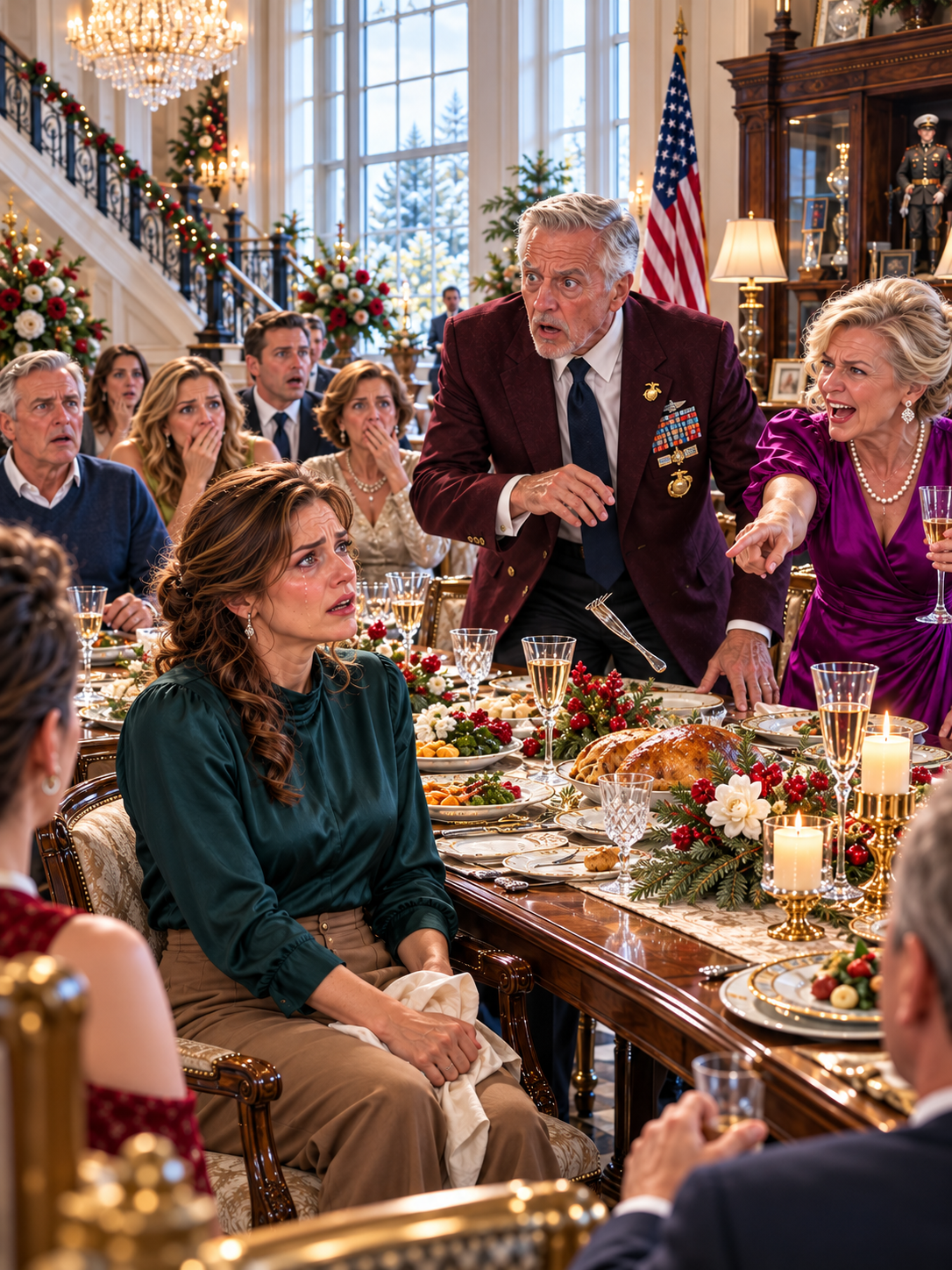
I followed her into the dining room.
Nathan Keene sat at her right.
The first thing I noticed was stillness.
Military people recognize it in one another.
Not stiffness.
Economy.
A man who didn’t waste movement.
His hair was white and closely cut, his shoulders still broad beneath a dark suit. He was listening to Howard describe some charity event, but his eyes moved through the room in a way that told me he noticed much more than he commented on.
Marlene introduced us casually.
“My niece Erin.”
I offered my hand.
“Sir.”
His grip was firm.
“Erin.”
Nothing happened.
No recognition.
No dramatic pause.
We were strangers.
I felt vaguely foolish for having wondered otherwise.
Marlene placed me near the far end beside Dad.
Perfect.
The meal began.
For the first twenty minutes, I barely spoke.
Marlene talked about a vacation.
Howard talked about dealership expansion.
Jason talked about a house he was renovating.
Sergeant Major Keene answered questions about his career politely, although I noticed he redirected praise whenever possible.
“Forty years,” Marlene said, touching his sleeve. “Can you imagine the stories?”
Keene gave a small smile.
“Most of the useful ones aren’t dinner stories.”
I looked down at my plate.
That answer told me almost everything I needed to know about him.
Marlene didn’t notice.
She kept going.
“You must have been everywhere.”
“A few places.”
“And seen everything.”
“Enough.”
“Erin has been in the military too.”
The words floated down the table.
I looked up.
Here we go.
Keene turned toward me.
“Marine?”
“Yes.”
His eyebrows lifted.
“Officer?”
Before I could answer, Marlene laughed.
“Oh, don’t encourage her.”
Dad’s fork stopped.
Keene glanced toward Marlene.
She was smiling.
“My niece likes being mysterious about her little career.”
A few relatives smiled automatically.
I kept eating.
Keene looked at me again.
“What field?”
“Logistics.”
Something subtle changed in his face.
“Ground?”
“Mostly.”
“What years?”
Marlene interrupted again.
“Nathan, you’ll have her telling you she’s Rambo.”
Jason laughed.
Nobody else laughed quite as quickly.
Keene’s eyes remained on me.
I could have answered.
Instead, I reached for my water.
“It’s not very interesting dinner conversation.”
Marlene pointed at me with her glass.
“See? That’s how she does it.”
“How she does what?” Keene asked.
The room quieted slightly.
Marlene seemed delighted that her guest of honor was playing along.
“Makes everything sound classified.”
“It sometimes is,” I said.
She laughed louder.
“Oh, Erin.”
That tone again.
The same one from when I was seventeen.
“You’ve been doing this for twenty-five years. You can finally admit it isn’t some spy movie.”
“I’m not a spy.”
Jason grinned.
“Do you still get the sword?”
Dad inhaled through his nose.
Mom stared at her plate.
I felt the familiar sensation settle over me.
Not anger exactly.
Compression.
As if the room had become smaller and I had to reduce myself to fit inside it.
I had done this so many times that my body knew the routine.
Smile.
Do not react.
Wait for the subject to change.
Keene didn’t smile.
“What sword?” he asked.
Jason seemed surprised.
“You know. Her Marine dress-up stuff.”
The room gave the expected laugh.
Keene didn’t.
I looked at him now.
Something had changed.
His attention had sharpened.
Marlene leaned back, pleased with the reaction she thought she was getting.
“Erin was always such a serious girl. Then she joined up and never really grew out of playing soldier.”
Dad placed both hands flat against the table.
I touched his wrist.
“No.”
He looked at me.
“Erin.”
“Please.”
He held my gaze for several seconds.
Then his hands relaxed.
Marlene had already moved on.
“Every family has one person who refuses to grow up.”
Keene’s eyes narrowed.
“How long did you say she’s served?”
Marlene waved the question away.
“Forever.”
I answered.
“Twenty-five years.”
He looked directly at me.
“Deployments?”
“Several.”
“Middle East?”
My heartbeat changed.
“Yes.”
“What year first?”
I stared at him.
Marlene was still smiling.
“Honestly, Nathan, you don’t need to interrogate her. Erin loves this.”
He ignored her.
“Ma’am?”
There was something different in that word now.
Professional.
I set down my glass.
“2006.”
His gaze remained fixed.
“2008?”
The dining room seemed to pull farther away.
“Yes.”
His fork stopped halfway to his mouth.
I saw him working through something.
A memory.
A voice.
A map.
I knew the look because I had worn it myself when some smell or sound unexpectedly opened a door I thought I had locked.
“Where?”
I hesitated.
“Several places.”
“The river corridor?”
My fingers went cold.
Nobody else understood the question.
I did.
“Yes.”
Keene lowered his fork.
Very slowly.
It touched the plate with a tiny click.
Marlene kept talking.
Something about how I had once shown up for Christmas in uniform and frightened the neighbors.
Keene wasn’t listening anymore.
He stared at me.
“Your last name has always been Caldwell?”
“Yes.”
His face changed.
The color seemed to leave it.
“Call sign?”
That question went through me.
Nobody in my family had ever asked it.
Nobody at the table even knew why it mattered.
I felt Dad watching.
I felt Mom watching.
Marlene finally stopped talking.
“Erin?”
Keene didn’t look at her.
I answered him.
“Cedar Six.”
He closed his eyes.
Only for one second.
When he opened them, I knew.
I didn’t know how I knew.
I simply did.
He whispered something too softly for anyone except Marlene to hear.
She leaned toward him.
“What?”
Keene pushed back his chair.
The wooden legs scraped across the floor.
Every conversation stopped.
He stood.
Slowly.
His eyes never left mine.
I stood too.
I had no conscious memory of deciding to.
Keene straightened.
Then the decorated Marine my aunt had spent all evening displaying like a trophy looked across her table at the niece she had just called a woman playing dress-up.
“Ma’am,” he said.
His voice was low.
“Road south of the river. Summer of 2008.”
My mouth went dry.
Marlene looked between us.
Nobody moved.
Keene continued.
“Cedar Six.”
I nodded once.
His jaw tightened.
Then he said the sentence that destroyed twenty years of family jokes before anybody at the table even understood what it meant.
“I’ve been trying to find you for eighteen years.”
### Part 4
For several seconds, I was back on that road.
Not metaphorically.
Completely.
Heat against glass.
Dust hanging in the air.
A radio filling with too many voices at once.
The metallic taste fear leaves behind when your body understands danger before your mind gives it a name.
I gripped the back of my chair.
Keene saw it.
He didn’t come toward me.
That told me he understood.
“You were with the unit north of our convoy,” I said.
His expression tightened.
“First sergeant then.”
Everything aligned.
A pinned Marine element.
Reports after the fact.
Names I had read but faces I had never seen.
“Nathan Keene.”
“Yes, ma’am.”
I shook my head slowly.
“We never met.”
“No.”
“But you were there.”
“Every second.”
Marlene made a small sound.
“What exactly are you two talking about?”
Neither of us answered immediately.
The room had stopped existing in the normal sense.
Keene and I were standing in a beautiful dining room with flowers between us, but somewhere underneath it was a damaged roadway eighteen years earlier.
That afternoon had begun routinely.
Routine is a dangerous word.
A convoy can spend hours moving through silence until silence itself begins to feel like protection.
Then one moment rearranges everything.
Our lead movement stalled.
Communications overlapped.
Another Marine element nearby was exposed and losing mobility.
I remember one junior Marine asking whether we were turning back.
I remember looking at the map.
There was a path that improved our odds.
It did nothing for the Marines who were trapped.
There was another choice.
Worse for us.
Better for them.
I heard Dad’s voice in my head.
Not actual words.
Just the logic of him.
A machine doesn’t care whether repairing it is convenient.
You do what the problem requires.
So I changed the plan.
We redirected what we still had toward the exposed Marines.
People sometimes imagine courage feels like certainty.
It doesn’t.
At least mine didn’t.
Mine felt like fear forced into a narrow enough channel that it became useful.
“Move vehicle three.”
“Shift that team.”
“Get them behind us.”
“Count everybody.”
“Again.”
The nineteen-year-old driver beside me kept glancing over.
At one point he said, “Ma’am, are we getting out?”
I remember answering without hesitation.
“Yes.”
I didn’t know.
He needed me to know.
So for him, I did.
Minutes became tasks.
Tasks became movement.
Movement became distance.
Eventually we were far enough away to count people instead of options.
Nobody under my responsibility had been left behind.
Neither had Keene’s Marines.
I remember sitting afterward and discovering one of my hands was bleeding from gripping something sharp.
I hadn’t noticed.
Two days later, I was working again.
Months later, people began using words like “valor.”
Those words never matched the memory.
I remembered scared young faces waiting for somebody to tell them the next thing to do.
That was all.
When the Silver Star citation arrived, Dad asked whether I wanted to celebrate.
“No.”
He nodded.
“All right.”
That was why I loved him.
He never made me perform an emotion because the calendar said I was supposed to feel it.
Now, eighteen years later, Nathan Keene stood across from me.
“You turned toward us,” he said.
His voice broke slightly on the last word.
I looked down.
“It was the right move.”
“No.”
He shook his head.
“It was the dangerous move.”
“The two aren’t mutually exclusive.”
His mouth twitched.
Not quite a smile.
“I remember your voice.”
That hit harder than I expected.
I sat down because my knees had begun feeling unreliable.
Keene remained standing.
Marlene looked completely lost.
“Nathan, what happened?”
He finally turned toward her.
The warmth he had shown her all evening was gone.
“Your niece saved my Marines.”
Nobody moved.
Marlene blinked.
“I’m sorry?”
Keene’s voice stayed calm.
“On a very bad afternoon, our element lost the ability to move the way we needed to. Her convoy had an opportunity to continue out.”
He looked at me again.
“She didn’t.”
Jason’s face had gone blank.
Mom covered her mouth.
Dad stared at his plate.
Keene continued.
“She redirected people and vehicles toward us. Got us consolidated. Got everybody moving.”
Marlene looked at me.
Then back at him.
“You mean Erin?”
I almost laughed.
Not because anything was funny.
Because the question was so perfectly Marlene.
Keene didn’t laugh.
“Yes.”
Marlene looked down the table at me as though she were trying to reconcile two photographs that should have depicted the same person and didn’t.
“But she never said—”
“No,” Keene replied.
“She didn’t.”
He understood before she did.
That mattered.
Jason spoke next.
“Wait.”
His voice was quieter than I had ever heard it.
“You’re saying she actually—”
Dad looked at him.
“Actually what?”
Jason stopped.
Dad almost never challenged anyone.
That made the question heavier.
Jason lowered his eyes.
“Nothing.”
Keene sat again, but the dinner was over whether Marlene understood it yet or not.
Nobody ate.
The candles flickered between us.
Finally Marlene said, “Why didn’t you tell us?”
I looked at her.
The first answer in my head was angry.
Because you never deserved to know.
I let it go.
Dad had taught me better than that.
“You never asked.”
She frowned.
“Of course I asked.”
“No.”
“You must have—”
“You asked whether the Marines had stopped me from getting a real career.”
She flinched.
“You asked whether I still got to play with swords.”
Jason stared at his hands.
“You asked whether I wore the uniform because I liked attention.”
The irony sat between us.
Marlene, of all people, had accused me of wanting attention.
I continued.
“You never asked what my work was. Not once.”
Her mouth opened.
Closed.
Keene said nothing.
That silence helped more than anything he might have added.
Marlene looked almost angry now, but I recognized the anger.
It wasn’t directed at me yet.
It was the panic people feel when a version of themselves they have protected for years suddenly becomes impossible to defend.
“You let me believe—”
Dad moved.
Only his eyes.
Marlene saw it and stopped.
I answered quietly.
“I let you believe what you had already decided.”
“That’s not fair.”
“Isn’t it?”
“You could have corrected me.”
“I could have.”
“Then why didn’t you?”
There it was.
The question beneath twenty years.
I looked at Dad.
His face gave me my answer.
“Because I wasn’t going to audition for your respect.”
The room went completely silent.
“I wasn’t going to bring medals to dinner. I wasn’t going to tell deployment stories so you could decide whether my life had finally become impressive enough.”
Marlene stared at me.
“For years, you turned everyone in this family into a ranking. Dad stayed here, so he lost. You married money, so you won. I chose service, so I wasted my potential.”
Dad looked at me sharply.
I had never said that aloud.
Neither had he.
“Erin—” Mom whispered.
“It’s okay.”
I looked back at Marlene.
“I decided a long time ago that I wouldn’t live on your scoreboard.”
Her eyes filled, but I didn’t soften the truth.
“So yes. I stopped correcting you.”
Marlene looked toward Keene.
Perhaps some part of her hoped he would rescue her from the moment.
He didn’t.
Instead, he turned to me.
“Ma’am, if I may ask one question.”
“Of course.”
“Did they give you the Silver Star for that day?”
Mom gasped softly.
I wished he hadn’t asked.
But I wasn’t going to lie.
“Yes.”
Jason whispered something I couldn’t hear.
Marlene’s eyes dropped to the tablecloth.
Dad closed his eyes.
Only for a moment.
When he opened them again, he looked straight at me.
There was no surprise there.
That was what nearly broke me.
He hadn’t known.
But somehow he still wasn’t surprised.
Keene understood that too.
He looked from my father to me and then stood again.
This time, he turned toward Dad.
“Mr. Caldwell?”
Dad rose.
Keene extended his hand.
“Your daughter brought my Marines home.”
Dad took it.
His voice remained steady.
“I know what kind of woman I raised.”
Keene squeezed his hand.
“Yes, sir.”
For the first time that evening, I had to look away.
### Part 5
I intended to leave quietly.
That was still my instinct.
No victory lap.
No dramatic exit.
No medal produced from a handbag like evidence in a trial.
I simply wanted to take my parents home.
Mom collected her purse.
Dad buttoned his coat.
I hugged Howard because none of this had really been about him.
Then Marlene followed us into the hallway.
“Erin.”
I stopped.
Her voice sounded unfamiliar without its usual confidence.
“I didn’t know.”
“I understand.”
“No, you don’t.”
I turned.
Her face was flushed.
“I didn’t know any of that.”
“That’s true.”
“How could I?”
The answer came easily.
“You could have been curious.”
She stared at me.
“For twenty years, you could have asked one real question.”
“I asked questions.”
“You asked questions when you already knew the answer you wanted.”
Her eyes filled.
That didn’t give me pleasure.
Humiliation had never been the point.
“You let me embarrass myself,” she said.
Dad shifted beside me.
I answered before he could.
“No, Marlene.”
I rarely called her by her first name.
She noticed.
“You embarrassed yourself.”
She looked as if I had struck the air out of her.
I continued, softer.
“I just stopped protecting you from it.”
Behind us, chairs moved.
Then Keene appeared in the hallway.
He had his coat over one arm.
Marlene turned.
“You’re leaving too?”
“Yes, ma’am.”
“But dessert—”
“Thank you.”
His tone ended the subject.
Then he looked at Dad.
“May I walk you out?”
Dad nodded.
We stepped toward the door.
Keene stopped.
He turned around.
Almost everyone from the dining room was watching us.
I knew immediately he was about to do something I wouldn’t have done myself.
“Sergeant Major,” I said quietly.
He looked at me.
I shook my head slightly.
He understood.
Then he ignored me.
Some habits outrank officers.
He faced the room.
“I want to say one thing.”
Nobody breathed.
“I heard some jokes tonight about Marines. Usually I don’t care about jokes.”
His gaze moved from Jason to Marlene.
“But I care when people mistake quiet for emptiness.”
Jason lowered his head.
Keene continued.
“Eighteen years ago, Marines under my responsibility were in a position that was getting worse by the minute. Erin Caldwell had a safer option available.”
I felt heat rising into my face.
“She chose us.”
His voice stayed level.
“No drama. No speech. She made decisions, moved people, and gave my Marines a way home.”
He paused.
“Some of those men became husbands. Fathers. Grandfathers.”
Mom was crying now.
Keene looked directly at Marlene.
“When you called her career dress-up, you were talking about the reason those families got their people back.”
Then he nodded once.
“Thank you for dinner.”
He opened the door.
That was it.
Four or five sentences.
No raised voice.
No insult.
No attempt to punish anyone.
Yet I knew before we reached the driveway that Marlene would hear those sentences for the rest of her life.
Keene walked us to Dad’s car.
Cold air hit my face.
I hadn’t realized how warm the house had become.
Dad and Keene stood beneath the porch light for a moment.
Keene looked at him.
“I meant what I said.”
Dad nodded.
“So did I.”
They shook hands again.
Mom hugged Keene, surprising all of us.
“Thank you,” she whispered.
He seemed uncomfortable with gratitude.
“Ma’am, your daughter did the work.”
Mom looked toward me.
“I know.”
That sentence carried more pain than pride.
I knew what she was remembering.
Every dinner where she had looked down instead of speaking.
Every time she had let peace win over truth.
I hugged her.
“Go home.”
“What about you?”
“I’ll drive my rental.”
Dad squeezed my shoulder.
“Call when you’re in.”
“I will.”
They left.
Keene and I remained beside my car.
For a few seconds, neither of us spoke.
“You really spent eighteen years wondering?” I asked.
He smiled faintly.
“Longer than I should admit.”
“Why?”
“You remember everyone who shows up when leaving would have been easier.”
I looked toward the house.
Through the front windows, I could see shadows moving.
“What were you told afterward?”
“Almost nothing.”
He exhaled.
“Different command structure. Different paperwork. I knew the call sign and that a convoy commander turned toward us.”
“Cedar Six.”
“Cedar Six.”
He laughed once.
“I imagined a fifty-year-old colonel.”
“Sorry to disappoint you.”
“Major disappointment.”
“Colonel now.”
His eyebrows rose.
“Of course you are.”
I smiled.
It was the first genuine smile I’d managed all evening.
Then his expression softened.
“I hope I didn’t overstep.”
“You did.”
“Thought so.”
“Thank you.”
We exchanged numbers.
Before leaving, he looked back at Marlene’s house.
“Family?”
“Unfortunately.”
He nodded.
“Worst chain of command you’ll ever have.”
I laughed so hard I had to lean against the car.
That probably saved me.
Because once he drove away, the laughter disappeared, and everything I had held down for twenty years came rushing upward.
I sat behind the steering wheel.
My hands were shaking.
Not from Marlene.
Not even from the revelation.
From being known.
There is a strange loneliness in carrying something important that nobody from your old life understands.
I had become so accustomed to that loneliness that I had mistaken it for independence.
Then a man I had never met looked across a table and recognized the heaviest afternoon of my life.
The wall collapsed.
I called Sofia Alvarez.
She had been a master sergeant when we first worked together and was now one of my closest friends.
She answered on the third ring.
“Caldwell.”
“You awake?”
“It’s nine-thirty.”
“Right.”
“Are you drunk?”
“No.”
“Then something happened.”
I told her.
Not elegantly.
I started with the dinner.
Then the fork.
Then Keene.
When I finished, Sofia was silent.
Finally she said, “I told you.”
I groaned.
“Sofia.”
“I told you that if you kept those two lives in separate boxes long enough, eventually one box would fall on the other.”
“The box stood up and gave a speech.”
She laughed.
Then she became serious.
“You okay?”
“I don’t know.”
“Good.”
“What does that mean?”
“It means you’re finally admitting something landed.”
I rested my head against the seat.
“Maybe.”
“Your family has been insulting you for years.”
“I know.”
“And every time I said it hurt you, you gave me that robot officer garbage.”
“It didn’t matter.”
“Erin.”
“Fine.”
She waited.
“It mattered.”
There it was.
Two words I had resisted for years.
Sofia’s voice softened.
“Of course it did.”
I closed my eyes.
“I kept thinking if I reacted, Marlene would win.”
“That’s because you were still using her scoreboard.”
That irritated me because it was true.
I sat with it.
“Then what should I have done?”
“Nothing different.”
“What?”
“You protected what mattered to you. You weren’t ready to tell them. That’s allowed.”
I stared through the windshield.
“But now?”
“Now you decide who still gets access to you.”
That sentence changed the direction of everything that came afterward.
Not forgiveness.
Not revenge.
Access.
For years, I had believed my choices were either to tolerate Marlene or start a family war.
There was a third option.
Distance.
Marlene had spent twenty years showing me how little interest she had in knowing me.
I didn’t have to punish her for that.
But I also didn’t have to pretend one humiliating dinner had erased it.
That night, after I reached my hotel, there was a message from her.
Erin, please call me.
I read it.
Then I put my phone face down.
For the first time in my life, I didn’t rush to protect Aunt Marlene from the consequences of being Aunt Marlene.
### Part 6
Marlene called eleven times during the next two weeks.
I answered none of them.
That wasn’t cruelty.
It was space.
I had spent years adjusting myself around her discomfort. I wanted to know what my own feelings sounded like without hers talking over them.
Dad called twice.
Neither time did he mention the dinner.
The first conversation was about a leak beneath his kitchen sink.
The second was about whether my tires were ready for winter.
On the third call, I brought it up.
“You really didn’t know about the Silver Star?”
“No.”
“Mom?”
“No.”
“Why aren’t you surprised?”
Dad was quiet.
“Erin, I raised you.”
I waited.
He continued.
“I didn’t know what happened. But I knew you weren’t playing.”
That was all.
I had spent decades pretending other people’s opinions didn’t affect me.
Yet hearing my father say that almost undid me.
“I should’ve told you.”
“No.”
“No?”
“You tell people what belongs to them.”
I smiled through tears.
“And that didn’t belong to you?”
“The medal doesn’t.”
“What does?”
“You coming home.”
There are sentences too large to answer.
I let the silence hold mine.
Three weeks after the dinner, a letter arrived.
Not an email.
Not a text.
A handwritten letter from Marlene.
That surprised me enough to open it immediately.
The first paragraph was terrible.
Polished.
Carefully worded.
Very Marlene.
Then halfway down the page, the handwriting changed.
Less controlled.
She wrote that she had tried to draft an apology that sounded good, then realized sounding good was part of the problem.
She wrote that she had spent her whole life ranking rooms.
She had ranked relatives, friends, neighbors, strangers, even her own brother.
She admitted that Dad’s staying in the mill town had always frightened her because it reminded her of the life she had escaped. Making his life look small had helped her believe hers was large.
Then she wrote my name.
Erin, I did the same thing to you.
I kept you beneath me because I needed someone beneath me.
I stopped reading.
Walked around my apartment.
Came back.
The next line was harder.
I don’t expect you to forgive me.
That mattered.
People who demand forgiveness are usually asking to escape consequence, not repair damage.
Marlene didn’t ask.
She finished by saying she was ashamed and wanted to apologize in person if I ever allowed it.
I waited another week.
Then I called.
She answered on the first ring.
“Erin.”
“Hello, Marlene.”
The pause hurt.
“I deserve that.”
“This isn’t about what you deserve.”
“No.”
She sounded smaller.
Not defeated.
Uncertain.
“I am sorry.”
“I read the letter.”
“I meant it.”
“I believe you.”
She inhaled.
“Can we fix this?”
There it was.
I had expected the question.
“No.”
Silence.
I continued.
“Not quickly.”
“Oh.”
“You don’t get twenty years back because you had one terrible night.”
“I know.”
“You don’t know yet.”
That sounded harsher than I intended, but I let it stand.
“Trust isn’t an apology. The apology gets you to the door.”
“What gets me inside?”
“Time.”
She was crying quietly now.
I didn’t rescue her from it.
Then I told her the part she hadn’t expected.
“If you want to repair something, start with Dad.”
“Thomas?”
“Your brother.”
“I know who—”
“Do you?”
She stopped.
“You have spent your entire adult life acting like he failed because he stayed in the town you wanted to escape.”
“I never said—”
“You didn’t have to.”
Silence.
“Every dinner had a seating chart, Marlene.”
She understood.
Finally.
“What do you want me to do?”
“Nothing for me.”
I looked at Dad’s old work shirt folded over the medal box on my shelf.
“See him.”
“Erin—”
“Not as the machinist who never made it out.”
My voice tightened.
“As the man who taught me everything that kept me useful when things went wrong.”
She didn’t speak.
“The reason I kept my head on that road wasn’t because I thought I was brave.”
I swallowed.
“It was because Dad spent my childhood teaching me that when something breaks, you stop talking and start solving the problem.”
Marlene began crying harder.
I waited.
Finally she said, “I was awful to him.”
“Yes.”
That one word carried forty years.
“I don’t know how to undo that.”
“You don’t.”
I thought of Sofia.
“You decide who you become next.”
Marlene and I ended the call twenty minutes later.
I didn’t forgive her.
Not that day.
Maybe forgiveness was the wrong word anyway.
Some wounds don’t require hatred, but they also don’t require restoration.
I stopped being angry enough to punish her.
I did not become close enough to trust her.
There was peace in that distinction.
Two months later, Marlene hosted a smaller family dinner.
I nearly declined.
Dad asked me to come.
So I did.
When I entered the dining room, I stopped.
The place card at Marlene’s right hand said:
Thomas Caldwell.
Dad stared at it.
Then at his sister.
Marlene didn’t make a speech.
That was how I knew something in her had genuinely shifted.
“No announcement?” Dad asked.
She gave an embarrassed smile.
“No.”
“Good.”
He sat down.
She placed a serving bowl near him.
“Potatoes?”
“Please.”
That was it.
Forty years of history changed by one chair and no applause.
I watched Dad throughout dinner.
He did not seem taller.
He did not look victorious.
The seat had added nothing to him because he had never needed it.
But it cost Marlene something to give it.
And Dad understood that.
So he accepted it gracefully.
Later, while I was helping Mom with her coat, Jason approached me.
“Can I talk to you?”
“Sure.”
He shoved both hands into his pockets.
The confident cousin I had known since childhood seemed suddenly thirteen.
“I was an idiot.”
“Frequently.”
He laughed nervously.
“I mean about you.”
I waited.
“All those jokes.”
“Yeah.”
“I never thought about whether they were true.”
“I know.”
“I just repeated Mom.”
“I know that too.”
He looked miserable.
“I’m sorry.”
I studied him.
Years earlier, I had helped him when he called me in the middle of the night.
Part of me wanted to remind him.
To make him feel the imbalance.
I heard Dad’s voice instead.
Because it runs now.
“I accept the apology.”
Jason looked relieved.
“Are we okay?”
“Not exactly.”
His face fell.
“But we can be better.”
He nodded.
That was enough.
As we left, I saw Marlene watching Dad put on his coat.
For once, she wasn’t worried about whether anyone was watching her.
That was new.
I didn’t trust it yet.
But I noticed.
### Part 7
Real change is boring.
That’s one of the reasons people fake it so often.
Fake change arrives with speeches, promises, tears, declarations, and sudden dramatic gestures.
Real change looks like remembering somebody’s coffee order six months later.
Marlene changed slowly.
She stopped introducing people by achievements.
She stopped turning every act of generosity into a story.
At Christmas, Mom mentioned casually that Marlene had driven her to a medical appointment.
“Why didn’t she tell anyone?” I asked.
Mom smiled.
“Maybe she’s learning.”
At another gathering, I watched Marlene carry Mom a plate without announcing that she had made the dish specifically because Mom liked it.
Nobody noticed.
Except me.
That mattered more than the seat of honor.
Marlene also began asking me questions.
Real ones.
“Where are you stationed now?”
“What does your staff actually do?”
“Do you enjoy command?”
At first, I distrusted every question.
I waited for the performance.
It didn’t come.
She listened.
Sometimes awkwardly.
Sometimes with visible effort.
One evening she asked, “Are there things I shouldn’t ask?”
“Yes.”
“Will you tell me if I cross a line?”
“Yes.”
She nodded.
“Okay.”
That simple exchange would have been impossible five years earlier.
Still, I kept distance between us.
We spoke occasionally.
We saw each other at family events.
I did not call her when something important happened in my life.
She had missed too many years to automatically receive that privilege.
The difference was that I no longer needed her to understand why.
Meanwhile, Nathan Keene and I began exchanging messages.
Mostly brief ones.
He sent me a photograph one afternoon of three men standing beside a fishing boat.
Recognize anyone?
I enlarged it.
Two faces meant nothing.
The third hit me immediately.
“That’s Palmer.”
Keene called five minutes later.
“Father of four.”
I smiled.
“Still talks too much?”
“Worse.”
“Good.”
Another Marine from that afternoon had become a high school teacher.
Another ran a hardware store.
One had died years later from an illness unrelated to service.
Keene never romanticized any of it.
Neither did I.
The point wasn’t that everyone had gone on to extraordinary lives.
The point was that they had gotten the chance to live ordinary ones.
That mattered more.
Keene eventually came to visit my parents.
Dad invited him.
I learned about it after both men had already arranged the date.
“Traitor,” I told Keene.
“Your father outranks you.”
“He’s a retired machinist.”
“Exactly.”
The cookout happened the following summer in my parents’ backyard.
Mom made potato salad.
Dad complained that everybody overcooked hamburgers.
Keene arrived carrying a pie and immediately ended up beside Dad near the grill.
Within fifteen minutes they were discussing machine tolerances.
I watched from the porch.
Sofia, who had driven in for the weekend, came beside me.
“That’s adorable.”
“Don’t say that where they can hear you.”
“Why?”
“They’ll both leave.”
Dad laughed at something Keene said.
The sound stopped me.
He was seventy-one.
His hair had gone almost entirely white.
For years, I had thought of him as permanent.
Children do that even after they become middle-aged.
Then one day you notice the thinner shoulders.
The slower movement.
The way somebody grips a railing they once ignored.
I walked down and put a hand briefly on his shoulder.
He looked up.
“You need something?”
“No.”
He studied me.
“Then why are you hovering?”
“Can’t a daughter stand near her father?”
“Suspicious.”
Keene laughed.
“She’s an officer. Always monitoring.”
“Always been like that,” Dad said.
“At six she reorganized my toolbox.”
“It was chaos.”
“It was mine.”
Marlene arrived thirty minutes later.
There was a time when she would have entered carrying something extravagant and apologizing loudly for being late so everybody would notice she had arrived.
That day she brought lemonade.
She set it on the table.
“Where’s Diane?”
“Kitchen,” I said.
“Thanks.”
She went inside.
No announcement.
No performance.
Sofia raised her eyebrows.
“Is that the aunt?”
“Yes.”
“The famous one?”
“Unfortunately.”
“She seems normal.”
“Do not insult her like that.”
We both smiled.
Later, Jason came with his wife and their young son.
His boy found one of Dad’s old toy trucks and sat in the grass running it across the dirt.
Jason stood beside me watching.
“I think about that dinner sometimes.”
“So do I.”
“I still feel like an idiot.”
“That part is optional now.”
He looked at me.
“What?”
“Feeling guilty forever doesn’t help anybody.”
He exhaled.
“So you forgive me?”
I thought carefully.
“I don’t keep score with you anymore.”
He nodded.
Maybe that was forgiveness.
Maybe it wasn’t.
I had stopped caring about the label.
Mom came outside carrying a tray.
I took it from her.
She resisted.
“Erin, I can carry a tray.”
“I know.”
“Then stop commanding me.”
“Can’t.”
She smiled.
Later, while we stood alone near the kitchen window, she touched my arm.
“I’m sorry.”
I knew instantly what she meant.
“You already said that.”
“Not properly.”
“Mom—”
“I should have stopped them.”
I looked through the glass at Dad and Keene.
“You kept a home peaceful enough for me to return to.”
“Sometimes peace is cowardice.”
“Sometimes.”
She winced.
“But not always.”
I took her hand.
“I needed somewhere that wasn’t another fight.”
Her eyes filled.
“I wish I’d been braver.”
“You were brave differently.”
She squeezed my fingers.
That evening, Marlene found me sitting on the back steps.
She lowered herself beside me.
For a while, we listened to Dad and Keene arguing about whether modern machinery made mechanics lazy.
Then she asked quietly, “Can I ask about the road?”
Every muscle in me tightened.
She noticed.
“I don’t have to.”
“No.”
I looked at her.
“You can ask.”
“What was it like?”
The old Marlene would have asked for a story.
Something dramatic.
Something impressive.
This Marlene seemed to want an answer.
So I gave her one.
“It was confusing.”
She waited.
“And loud.”
Another pause.
“And I was afraid.”
She turned toward me.
“You?”
“Of course.”
“I always imagined people who do things like that aren’t afraid.”
“People who aren’t afraid in dangerous situations are usually dangerous themselves.”
She absorbed that.
“What did you think about?”
“My job.”
“Nothing else?”
“My Marines.”
I hesitated.
“And Dad.”
She looked across the yard at her brother.
“What about him?”
I smiled.
“I thought about fixing the thing in front of me.”
Marlene lowered her eyes.
“He gave you that.”
“Yes.”
She remained silent for a long time.
Then she said, “I spent my whole life thinking he stayed because he lacked ambition.”
I didn’t answer.
“I think maybe he stayed because he already knew where he belonged.”
“Maybe.”
“And I kept running because I didn’t.”
That was as close to understanding herself as I had ever heard Marlene come.
I didn’t comfort her.
I didn’t need to.
Neither did she.
We simply sat there.
For the first time in my life, my aunt and I occupied the same silence without either of us pretending it meant something else.
### Part 8
Near sunset, most of the family drifted inside.
Dad stayed beneath the maple tree with Nathan Keene.
Two lawn chairs.
Two paper plates balanced on their knees.
Two old men who had spent their lives doing very different jobs and somehow arrived at almost identical conclusions about people.
I carried them fresh drinks.
As I approached, Keene was talking.
“In forty years,” he said, “I learned the loudest person in the room is rarely the one you want beside you when something actually goes wrong.”
Dad took a drink.
“Machines are similar.”
Keene frowned.
“Machines are loud.”
“When they’re broken.”
Keene stared at him.
Then both men started laughing.
I shook my head.
“Should I leave?”
“Yes,” Dad said.
“Immediately,” Keene added.
I put the drinks down.
“You’re welcome.”
As I turned away, Keene said, “Erin.”
I looked back.
He nodded toward the empty chair beside them.
“Sit.”
I did.
The backyard smelled like charcoal and cut grass.
Fireflies were beginning to appear near Dad’s garden.
From inside the house came the sound of plates being stacked and Mom telling somebody not to put a wooden cutting board in the dishwasher.
For a while, nobody spoke.
Then Dad looked at Keene.
“Tell me something.”
“Yes, sir.”
Dad gave him a look.
“I’m not ‘sir.'”
“You raised a colonel. You’re sir.”
Dad considered that.
“Fair.”
I rolled my eyes.
Dad ignored me.
“On that road.”
I went still.
He had never asked.
Not once.
Keene looked toward me.
Dad noticed.
“I’m not asking for anything she doesn’t want told.”
“Good,” Keene said.
“I just want to know one thing.”
Dad looked at me now.
“Were you alone?”
The question surprised me.
“No.”
“I don’t mean physically.”
I understood.
“No.”
He nodded.
That was all he needed.
Keene leaned forward.
“She had people with her.”
Dad looked toward him.
“Good people?”
“Very.”
“Did they trust her?”
Keene smiled.
“Enough to follow her the wrong direction.”
Dad’s eyebrows rose.
“The wrong direction?”
I laughed quietly.
“From a survival perspective.”
Keene nodded.
“Exactly.”
Dad studied me.
“Sounds familiar.”
“What does?”
“When you were twelve, floodwater got into the Petersons’ basement. Everybody else was carrying boxes toward the stairs, and you went deeper into the basement.”
“I shut off the breaker.”
“You were told to get out.”
“The breaker needed shutting off.”
Keene laughed.
“She’s always been like this?”
“Unfortunately.”
I looked between them.
“This is becoming hostile.”
Dad smiled.
Then his expression changed.
“You did what needed doing.”
It wasn’t a question.
“Yes.”
He nodded.
“There it is.”
“What?”
“The whole thing.”
I waited.
Dad looked toward the garden.
“You spent twenty years worried Marlene didn’t understand you.”
“I wasn’t worried.”
He glanced at me.
“Fine.”
Keene coughed suspiciously.
Dad continued.
“But you were waiting for people to see something that had been there the whole time.”
I thought about that.
“Maybe.”
“Your aunt thought success had to announce itself.”
He looked at his hands.
“I probably went too far the other way.”
That surprised me.
“What do you mean?”
“I taught you not to need applause.”
“You did.”
“Maybe I accidentally taught you not to let anybody clap.”
I stared at him.
Dad rarely gave speeches.
When he said more than three consecutive sentences about feelings, I paid attention.
“There are people who love you,” he continued. “Sometimes letting them know what you’ve carried isn’t bragging.”
Keene nodded slowly.
That idea bothered me because I suspected it was true.
Dad looked at me.
“You don’t have to perform your life.”
“I know.”
“But you don’t have to hide it either.”
For twenty-five years, I had believed those were the only two options.
Marlene performed.
Dad stayed silent.
I had chosen Dad’s way so completely that I had turned silence into another kind of armor.
Armor protects.
It also separates.
“I’ll think about it,” I said.
Dad smiled.
“That’s officer language for no.”
“Correct.”
Keene laughed.
Mom called us from the porch.
Dessert.
Dad groaned and stood.
Keene rose beside him.
I stayed seated.
For a moment, I watched them walk toward the house.
Marlene opened the screen door for Dad.
He said something to her.
She laughed.
Not loudly.
Not for anybody.
Just a sister laughing at her brother.
I thought about all the dinners that had come before.
The place cards.
The rankings.
The jokes.
The woman I had allowed my family to invent because fighting the invention seemed beneath me.
I had been partly right.
Their opinion never changed what I had done.
It never altered the road.
It never touched the Marines who went home.
But I had also been wrong.
Being dismissed by people you love does matter.
Pretending otherwise doesn’t make you strong.
It only makes you silent.
Nathan Keene had not given me my dignity at Marlene’s dinner.
I already had it.
What he gave me was permission to stop pretending that being misunderstood had cost nothing.
That was different.
I followed the others inside.
Marlene was cutting pie.
When she saw me, she held up the knife.
“Small piece or normal?”
“Normal.”
She put a slice on my plate.
Then, with an awkward smile, she said, “Colonel.”
I looked at her.
There was no joke in it.
No exaggerated salute.
Just the rank.
Correctly used.
“Thank you, Marlene.”
Her eyes met mine.
That was enough.
We never became especially close.
I want to be clear about that.
Life is not a movie where one apology erases twenty years and everybody suddenly becomes the family they should have been from the beginning.
Marlene became kinder.
I became less guarded.
We built something new, but it was not the relationship we had lost, because you cannot lose a relationship that never truly existed.
She became an aunt I could speak to.
Not an aunt I depended on.
I forgave enough to stop carrying anger.
I never forgot enough to hand her unquestioned access to my life again.
That balance felt honest.
Jason stopped making military jokes.
Eventually they disappeared from the family completely.
Nobody announced their disappearance.
One year I simply noticed that an entire holiday had passed without anybody mentioning swords, costumes, or playing soldier.
Silence, for once, meant healing.
Keene stayed in my life.
Every few months, one of us called the other.
Sometimes we discussed the road.
Usually we didn’t.
There was no need.
He had known me before he knew my face.
That bond required surprisingly little maintenance.
Years after Marlene’s dinner, he mailed me a photograph.
It showed several men from his old unit gathered at a reunion.
On the back, he had written:
Still here.
I kept that photograph beside the Silver Star.
Not because the medal mattered less.
Because the photograph explained what the medal meant.
Dad saw it once.
He held it carefully.
“Those the men?”
“Some of them.”
He counted the faces.
Then handed it back.
“Good.”
That was all.
Of course it was.
One winter afternoon, I went with Dad into his garage.
He had been restoring an old lawn tractor because retirement had apparently convinced him he needed more broken machinery in his life.
I handed him a socket.
Wrong size.
He looked at it.
“Forty-three years old.”
“Actually older now.”
“Colonel in the United States Marine Corps.”
“Correct.”
“Still can’t hand me the right socket.”
“I command people who do that.”
He laughed.
I found the right one.
He slid beneath the tractor.
For a while, I stood there smelling cold concrete, machine oil, and the faint metallic scent that had defined my childhood.
Then I looked at the old station wagon tools still hanging along one wall.
“Dad?”
“Yeah?”
“You remember rebuilding the transmission when I was ten?”
“Unfortunately.”
“I asked why you didn’t tell Marlene.”
He grunted.
“Sounds like her.”
“You told me it ran, and that was the point.”
Dad slid out slightly and looked up.
“Still is.”
I smiled.
For most of my life, I thought that sentence contained everything I needed to know.
Maybe it contained almost everything.
Do the work.
Carry your weight.
Don’t confuse applause with value.
But Dad had added something later.
You don’t have to stop people who love you from knowing what the work cost.
I finally understood both lessons.
My aunt once believed my uniform was a costume.
I no longer cared.
A table full of relatives once believed I had spent my adult life playing soldier.
That story was gone now.
Not because I defeated it.
Not because I produced evidence.
Not because I finally gave the perfect speech.
It ended because the truth happened to sit down beside my aunt, pick up a fork, hear my name, and remember.
Nathan Keene stood for me that night.
But what mattered most was not that everybody else finally stood corrected.
It was that afterward, when the room had gone quiet and all the old jokes had collapsed, I realized I had never needed that room to tell me who I was.
Dad had known when I was seventeen.
My Marines had known when things went wrong.
Keene had known from one voice over a radio.
Eventually, I learned to know it without needing to compare myself to anybody at all.
Years later, the Silver Star still sits inside its dark box.
I rarely open it.
Beside it is the photograph Keene mailed me.
Men older now.
Gray hair.
Glasses.
Families.
Ordinary lives.
Still here.
Sometimes I look at that photograph and think about Marlene’s dining room, her beautiful china, her seating chart, and the decorated Marine she invited because she wanted everyone to admire the company she kept.
She wanted the room to be impressed.
She succeeded.
Just not in the way she expected.
Because the most important thing that happened that evening began with almost no sound at all.
A fork touched a plate.
A chair moved backward.
An old Marine stood.
And after twenty years of laughter, the truth finally stood with him.
THE END!
Disclaimer: Our stories are inspired by real-life events but are carefully rewritten for entertainment. Any resemblance to actual people or situations is purely coincidental.