Chapter 2
The silence lasted longer than I expected.
During the first week, I kept checking my phone. Every time it buzzed, I hoped it would be Dad asking to talk or Mom admitting that the dinner had gone too far.
Instead, I received work emails, delivery notifications, and reminders about upcoming appointments.
By the fourth day, I began to understand that they weren’t giving me space.
They simply didn’t believe they had done anything wrong.
Sutton never pressured me to call them. She understood how much the situation hurt, even though I’d spent years pretending it didn’t.
One evening, while Eliza was getting ready for bed, she asked me why Grandpa hadn’t called.
I told her Grandpa was busy.
She thought about that for a moment.
“Can we go to the zoo next Saturday?”
“Absolutely,” I said.
And for the first time in years, I meant it without mentally calculating how many hours I would have to spend at my parents’ house afterward.
About two weeks later, Tully sent me a text.
Hey, man. I think dinner got blown out of proportion. Mom and Dad are pretty upset. Maybe just call them and smooth things over.
I read it twice.
Smooth things over.
I wondered whether he had any idea how many weekends I’d spent crawling beneath their house, replacing pipes while water dripped down my sleeves. I wondered whether he knew how many times I’d postponed paying jobs to finish something at their place.
I didn’t respond.
Over the next few months, I started reclaiming my weekends.
Sutton and I took Eliza to the zoo. We visited farmers markets, drove to Gatlinburg, and rented a small cabin for a weekend without bringing a single tool.
We even bought nine pounds of tomatoes at a farmers market because they were on sale. Sutton thought we’d use them for salads. I ended up learning how to make marinara sauce because neither of us knew what else to do with them.
Those ordinary weekends felt like a luxury.
I also began focusing on my business.
Hartwell Custom Builds had been struggling to grow because I was spending so much time on unpaid work. I had turned down paying jobs, delayed estimates, and passed opportunities to other contractors simply because my schedule was full.
Now I had room to work.
I accepted a kitchen renovation in West Knoxville. The homeowners recommended me to their neighbors, who hired us for two bathroom remodels. Those clients recommended us to another family.
By January, we had our best quarter since I started the company.
I hired a fifth employee, a young man named Everett who had just graduated from trade school. He reminded me of myself at twenty-two: enthusiastic, hardworking, and convinced that a level was the most important tool ever invented.
By spring, we had landed a full renovation on a historic home in South Knoxville.
It was the largest contract I’d ever signed.
Sutton noticed the change before I did.
One evening, we sat on our back porch after Eliza had gone to bed.
“You seem happier,” she said.
“I think I am.”
“You’re home more.”
I looked at her.
She wasn’t complaining. She was simply stating something that should have been obvious.
For three years, I’d been trying to earn something from my parents that I couldn’t build, repair, or buy.
Their recognition.
Their pride.
Their acknowledgment that I mattered as much as Tully.
Therapy helped me understand why I had kept trying.
My counselor, Dr. Mercer, was a calm man with a gray beard and a habit of asking questions that made it difficult to hide behind jokes.
One afternoon, he asked me what bothered me most about the dinner.
“The money,” I said.
He waited.
“No,” I admitted. “It’s that my dad called him the son who actually shows up.”
Dr. Mercer nodded.
“And what did that make you feel?”
I thought for a while.
“Invisible.”
He explained that being dependable can become a trap when everyone around you starts treating your reliability as an unlimited resource.
I had mistaken being needed for being valued.
That distinction changed how I looked at my family.
Five months after the dinner, Mom called.
I answered because I still wanted to believe she might have something important to say.
“Daniel, I just wanted to let you know the kitchen faucet is dripping again,” she said. “Your father can’t figure out what’s wrong with it.”
I leaned back in my truck.
I could hear the television in the background and Dad coughing in his recliner.
The old instinct immediately surfaced.
I could be there in twenty minutes. I knew exactly which valve to shut off. I could probably replace the cartridge without even going to the hardware store.
But then I remembered the dinner.
“Mom, you should call a plumber.”
There was a pause.
“I thought since you know the house so well…”
“I do know the house better than anyone. But I’m not your contractor anymore. I’m your son. You might want to start thinking about the difference.”
She didn’t answer.
We exchanged a few polite words, then ended the call.
I sat in my driveway for several minutes, surprised by how calm I felt.
I wasn’t trying to punish her.
I was simply telling her the truth.
Chapter 3
The first real problem came about seven months after that dinner.
Dad called Tully because the water heater I’d installed was making an unusual noise.
Tully drove up from Chattanooga, looked at the tank, searched something on his phone, and reportedly announced that everything seemed fine.
Then he went home.
Two weeks later, the water heater began leaking.
My parents finally hired a licensed plumber named Cordell, a contractor I knew professionally. He repaired the problem and charged them $600.
While inspecting the plumbing, he discovered that one of the shutoff valves had been turned too tightly, putting unnecessary strain on an older connection.
He corrected it and explained that the house needed regular maintenance.
According to Cordell, Dad shook his head and said, “Our son used to take care of all this. He’s just too busy for us lately.”
Too busy.
Three years of weekends, thousands of dollars in materials, and countless hours of work had somehow become a story about a son who had gotten too busy.
I heard about it through Cordell.
It bothered me for an evening, but I didn’t call my parents.
Then spring brought several days of heavy storms to East Tennessee.
Strong winds tore through the neighborhood, and a large oak limb came down in my parents’ backyard. It struck the roof above the guest bedroom, breaking through the shingles and damaging the ceiling.
Water began entering the room.
The roof had been old for years. Two years earlier, I had warned Dad that it needed replacing. I’d even arranged an estimate with a roofer named Sullivan, whose work I trusted.
Dad had dismissed the quote.
“We’ll think about it,” he’d said.
Now the roof had a hole in it, water was spreading through the guest bedroom, and the damp drywall would soon require professional inspection for mold.
Mom called me.
“Daniel, we’ve had some terrible storm damage. Your father doesn’t know what to do.”
I closed my eyes.
“Have you called the insurance company?”
“We haven’t gotten that far.”
“Then call them first. You need a roofer, and you may need a water-damage restoration company.”
“But we can’t afford all that.”
I heard the familiar pause.
Then she said the words I’d been expecting.
“Can’t you just do it like you used to? You’re so good at it.”
There it was again.
The invisible agreement that had governed our family for years.
Daniel fixes things.
Daniel doesn’t complain.
Daniel doesn’t need to be paid.
Daniel will always come.
I took a slow breath.
“Mom, I’ll send you Sullivan’s number. He’s fair, and he does good work. You should also file an insurance claim.”
She sounded disappointed.
“I’ll talk to your father.”
I sent her the contact information and called Sullivan myself. I explained the situation and asked him to give my parents a fair estimate.
I wasn’t going to take advantage of them.
But I wasn’t going to subsidize them anymore.
Sullivan inspected the roof, the damaged bedroom, and the affected insulation. His estimate came back at $22,000.
The roof replacement was substantial. The interior repairs would require removing damaged materials, checking the affected areas, and replacing the ceiling and sections of the wall.
My parents were shocked.
I understood why.
Twenty-two thousand dollars was a lot of money for two retirees living on fixed incomes.
But the numbers told a different story.
If Dad had replaced the roof two years earlier, the job would have cost around $14,000. If he’d accepted my offer to handle part of the work, they could have saved even more.
Instead, the storm had turned an overdue repair into an expensive restoration project.
Mom called Tully.
According to Jolene, his girlfriend, his response was that they should shop around for cheaper quotes.
He didn’t offer money.
He didn’t offer to come help.
He didn’t even offer to call a roofing contractor.
The brother who had been celebrated as the one who showed up had apparently run out of ways to contribute.
That evening, Sutton and I sat at our kitchen table.
“You know they’re going to call you again,” she said.
“I know.”
“And what are you going to do?”
I looked at the estimate on my phone.
I thought about the deck, the plumbing, the electrical panel, and the $2,000 check.
Then I thought about my parents’ fixed income.
“I’ll help them,” I said.
Sutton raised an eyebrow.
“Really?”
“But it’s going to be different this time.”
I explained my plan.
Sullivan would handle the roof. I would coordinate the interior repairs and complete some of the restoration work myself.
But before any work began, I wanted a family meeting.
I wanted my parents and Tully to sit at the same table and discuss what had happened.
Not just the check.
Everything.
I called Mom the next morning.
“I’ll help coordinate the repairs,” I said. “But I have a few conditions.”
Dad got on the phone.
“What kind of conditions?”
“First, you’re filing an insurance claim. I’ll help with the paperwork. Second, I’ll charge you for materials at cost. No markup, but I’m not paying for them myself. Third, I want all of us to meet at the house before I start.”
“A meeting about what?” Dad asked.
“About the dinner. About the last three years. About why you think Tully’s one afternoon of mowing deserved more recognition than everything I’ve done.”
Silence.
Finally, Dad said, “I’ll talk to your mother.”
I hung up and found Sutton standing in the kitchen doorway.
“Are you sure about this?”
“No,” I said. “But I’m sure I can’t keep pretending everything is fine.”
Chapter 4
The family meeting was scheduled for the following Saturday at ten in the morning.
Tully nearly canceled.
He sent me a message that morning saying he didn’t understand what the big deal was, but he’d come if everyone insisted.
He arrived at 11:15.
Some things never change.
My parents were already seated at the kitchen table when I arrived. Mom had made coffee and placed a plate of butter cookies between them.
Dad sat with his arms crossed.
He had the expression of a man who believed he was about to be unfairly accused of something.
Tully came through the back door, glanced around, and sat across from me.
“So, what’s this about?”
I hadn’t prepared a speech.
I’d considered writing one, but Dr. Mercer had suggested that I simply tell the truth.
So I did.
“For three years, I worked on this house. I rebuilt the deck, replaced the plumbing, upgraded the electrical system, painted the exterior, repaired the windows, fixed the bathrooms, and handled just about everything else that went wrong.”
Dad started to speak.
I held up my hand.
“Let me finish.”
He closed his mouth.
“I spent more than $45,000 in labor and materials. I never charged you. I never asked for a thank-you. I did it because I loved you and because I wanted you to be safe and comfortable.”
I looked at Mom.
“Then, at dinner, you gave Tully $2,000 for mowing the lawn once. And Dad called him the one who actually shows up.”
Mom stared at the table.
“You told me my work didn’t count because it was my profession. Dad said I was keeping score. But I wasn’t keeping score until you made it impossible not to.”
I turned toward Tully.
“And when the roof was damaged, what did you do? You told them to shop around for cheaper quotes. That’s all. Meanwhile, I’m the one arranging contractors and helping with the insurance claim.”
The kitchen became completely quiet.
I could hear the coffee maker dripping behind Mom.
Dad stared at the wall.
Then Tully did something I hadn’t expected.
He placed both hands on the table.
“Daniel’s right.”
Dad turned toward him.
“What?”
“He’s right,” Tully repeated.
My brother looked directly at our parents.
“Daniel’s been carrying this family on his back for years. I’ve been coasting.”
Nobody moved.
Tully took a breath.
“I knew it was wrong when you gave me that check. I knew he had done all that work. I knew he’d spent weekends here while I barely visited. And I took the money anyway.”
He looked at me.
“I should have refused it. I should have told them to give it to you. I should have been helping instead of showing up once in a while, drinking beer on a deck I didn’t build.”
I didn’t know what to say.
Tully had always been good at talking. He could charm customers, smooth over disagreements, and make almost any situation sound better than it was.
But this wasn’t charm.
He looked uncomfortable.
And for once, he wasn’t trying to escape responsibility.
“I’m sorry,” he said. “I let them treat you like you didn’t matter because it was easier for me.”
Mom began crying quietly.
Dad’s expression changed, but he didn’t speak.
Mom finally reached for a napkin.
“We never meant to make you feel that way,” she said. “We always knew you could handle things. You’ve always been so capable. Tully needed more encouragement.”
I nodded slowly.
“I understand why you thought that. But understanding your reasons doesn’t mean I have to pretend it didn’t hurt.”
She looked at me.
“You were the strong one,” she whispered.
“And that meant you didn’t have to notice me?”
She couldn’t answer.
I turned to Dad.
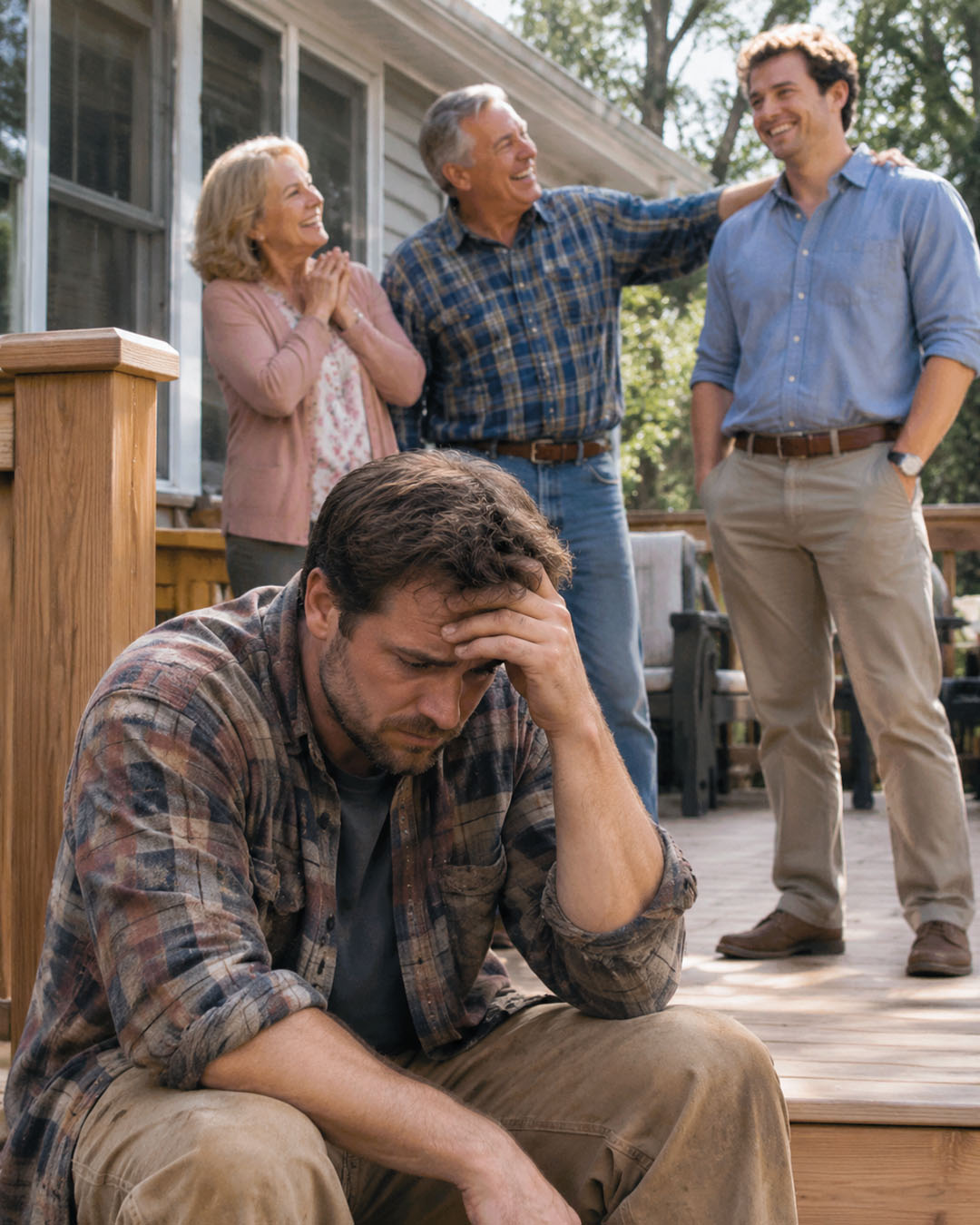
“You stood at that dinner table and called Tully the son who showed up. I was sitting right there. I had spent three years working on this house. I needed you to see me, Dad. Just once, I needed you to see what I’d done.”
For a long time, he stared at the tabletop.
Then something unexpected happened.
He uncrossed his arms.
He looked directly at me.
“I’m sorry, Daniel.”
Three words.
No excuses.
No explanation about how I had misunderstood him.
No suggestion that I was too sensitive.
Just an apology.
From my father, it meant more than I could easily explain.
We talked for another hour.
It wasn’t a perfect conversation. Mom repeated herself. Dad struggled to explain why he had always expected me to be the dependable one. Tully admitted that he’d enjoyed being treated like the favorite and hadn’t wanted to question it.
There were uncomfortable silences.
There were moments when I wanted to walk out.
But nobody left.
For the first time in years, we weren’t performing the roles we’d been assigned.
We were actually talking.
Chapter 5
The following week, we started dealing with the roof.
Mom filed the insurance claim, and I helped her gather the photographs, repair records, and information the adjuster requested.
Sullivan handled the roofing work.
I coordinated the interior repairs, removed the damaged sections of drywall, and replaced the affected materials after the restoration work was completed.
I charged my parents approximately $3,000 for materials.
Their insurance reimbursed almost all of it.
I didn’t charge for my own labor.
But there was an important difference this time.
I was doing it because I wanted to.
Not because I was afraid that saying no would make me a bad son.
Dad began spending time with me while I worked.
His back and knees weren’t good enough for heavy construction, but he could hand me tools, hold a measuring tape, and ask questions.
One afternoon, he stood beside me while I was installing new trim in the guest bedroom.
“I don’t know how you learned to do all this,” he said. “I sure as hell didn’t teach you.”
I laughed.
“Trade school, Dad. Remember?”
He shook his head.
“Guess I should have paid more attention.”
I didn’t know what to say, so I handed him the next piece of trim.
Tully came up for one of the weekends.
He was terrible at construction.
He couldn’t measure a board accurately, kept forgetting which end of the tape to hold, and nearly nailed his own boot to a piece of flooring.
But he stayed.
He worked.
He listened when Dad explained something, and he didn’t disappear after lunch.
At the end of the afternoon, we sat on the back deck I’d built three years earlier.
Tully reached into his wallet and handed me a folded check.
I looked at it.
Two thousand dollars.
“What’s this?”
“It’s yours.”
I stared at him.
“You don’t owe me anything.”
“I know. But I should have given this back a long time ago.”
He looked down at his hands.
“I took it because it felt good to be the one getting praised. I didn’t want to admit that you were doing more than I was. It was easier to let everyone believe I was helping.”
I held the check without opening it.
“Why now?”
“Because I don’t want to keep being that guy.”
For a moment, I considered refusing it.
Then I understood something.
This wasn’t payment for three years of work. Two thousand dollars couldn’t begin to cover that.
It was my brother’s way of acknowledging that he’d accepted something he hadn’t earned.
So I folded the check and put it in my pocket.
“Next round of beers is on you,” I said.
He laughed.
“It’s always been on me.”
“You usually forget your wallet.”
“That’s a separate issue.”
We both laughed.
It wasn’t a complete repair of our relationship, but it was a start.
Chapter 6
Eight months have passed since that meeting.
Things aren’t perfect.
Dad still occasionally gives Tully more attention than he gives me. Mom still sometimes calls me first when something breaks, then remembers that she’s supposed to call a professional.
Old habits don’t disappear because of one good conversation.
But something important has changed.
They ask before expecting me to help.
They no longer assume my weekends belong to them.
And when I do something for them, they acknowledge it.
Last month, a small envelope arrived in our mailbox.
It was from my parents.
Inside was a card with a handwritten message.
Daniel,
Thank you for everything you’ve done for this house and for our family. We know how much time, effort, and love you’ve given us. We see you, and we’re grateful.
Love,\
Mom and Dad.
I read it twice.
Then I placed it on the refrigerator.
Sutton noticed me looking at it later that evening.
“You earned that,” she said.
I nodded.
For a long time, I’d believed that if I worked hard enough, helped enough, and sacrificed enough, eventually my parents would recognize my value.
I had thought the answer was to give more.
But I was wrong.
I had to stop giving away so much of myself before anyone had a reason to notice what it cost.
My business is doing better than ever.
Hartwell Custom Builds now has six employees, and the historic renovation in South Knoxville was featured in a local home and garden magazine.
We have more work than we can comfortably schedule through the fall.
Everett, the young employee I hired, has become one of my most dependable crew members. He’s learning quickly, and I make a point of telling him when he does good work.
Not because he needs constant praise.
Because people deserve to know when their efforts matter.
Eliza recently told her kindergarten class that her daddy could build anything.
Her teacher sent me a note saying Eliza had explained that I could fix houses, fences, doors, and even broken toys.
I put that note in my office.
It’s probably the best professional recognition I’ve ever received.
Tully has started visiting more regularly.
Not every weekend, of course. He’s still Tully.
But he comes up about once a month, helps Dad with small projects, and occasionally takes Mom grocery shopping.
Last time he visited, he helped clean out the detached garage.
Dad didn’t hand him a check afterward.
That’s progress.
And sometimes, when I visit my parents, I catch Dad looking at the deck.
He’ll mention the sturdy railing or the bench where Mom watches the birds. Once, he told a neighbor that I had built it.
He didn’t say it casually.
He sounded proud.
I don’t need him to praise me every time I walk through the door. I don’t expect my parents to suddenly become perfect people, and I don’t expect Tully to transform into someone who never makes another selfish decision.
But I do expect respect.
And I’ve learned that I can love my family without making myself responsible for every problem they have.
There’s a difference between being generous and being invisible.
There’s a difference between being dependable and being treated like furniture.
For thirty-four years, I had confused the two.
I thought being a good son meant showing up whenever someone needed something, regardless of the cost to my own family, my business, or my peace of mind.
Now I know better.
The night of that dinner, I thought I was walking away from my parents.
What I was really walking away from was the belief that I had to earn my place in their lives through unpaid work.
I still help them.
I still love them.
But I have my own home, my own wife, my own daughter, and a business that deserves the same care I’ve spent years giving everyone else.
And when I look at the deck in my parents’ backyard, I don’t see a reminder of everything they failed to appreciate.
I see something I built.
Something solid.
Something that will last.
But the most important thing I built wasn’t a deck, a bathroom, or a beautifully renovated house.
It was the ability to say what I needed to say, even when the people listening didn’t want to hear it.
That evening, two simple words changed the way I lived.
I’m done.
And for the first time, I finally started living for myself, too.
THE END.\
⚠️ All characters and events are fictional. Do not imitate or apply them in real life. 😌😌😌