Chapter 2
Brandon’s behavior became stranger the longer I remained composed.
He criticized my clothes, my cooking, and even the way I spoke to patients. When I answered calmly, he looked almost offended, as though I’d broken an agreement neither of us had ever discussed.
One evening, he announced that he wasn’t sure he wanted children with me.
That hurt deeply.
I’d spent years dreaming of becoming a mother, and he knew it.
I felt tears gathering but refused to let him see them.
“Then you should take time to think about what you want,” I answered.
He pushed back his chair.
“That’s it? That’s all you have to say?”
“What would you like me to say?”
He stared at me, then stormed into the bedroom.
A few minutes later, I heard him speaking on the phone.
His voice was low and urgent.
I couldn’t understand the words, but he sounded like someone explaining why an important plan had failed.
The following Sunday, we attended a family barbecue at Uncle Raymond’s house.
Halfway through lunch, Brandon suddenly announced, “Did Emily tell everyone she had another meltdown over an old recipe card?”
Conversation stopped.
My cousin Natalie looked uncomfortable.
Raymond gave his familiar laugh.
“That’s our Emily. She could cry over a sunset.”
Several relatives turned toward me.
I felt the expectation hanging in the air.
They were waiting for me to become upset.
Instead, I smiled.
“It was Grandma’s lemon cake recipe. I’m making it for my birthday.”
Then I asked Natalie about her daughter’s college applications.
The conversation resumed.
But I noticed Brandon looking across the table at Raymond.
My uncle gave him a barely perceptible shake of the head.
That brief exchange troubled me more than any insult.
Something about it felt practiced.
That night, while Brandon slept, I opened the folder containing Grandma’s estate documents.
I hadn’t read them carefully since the funeral.
Now I examined every page.
The trust contained a troubling provision concerning my emotional judgment at age thirty.
If Raymond presented evidence that I couldn’t manage my affairs responsibly, he could petition the court to delay distribution while my fitness was evaluated.
Until the matter was resolved, he would remain trustee.
I stared at those words.
Then I remembered the family dinners, the embarrassing stories, and Brandon’s insistence on describing every moment I cried as a breakdown.
A terrible possibility emerged.
What if Brandon wasn’t trying to make me less emotional?
What if he was trying to collect evidence that I was too emotional to inherit my grandmother’s estate?
I didn’t sleep much that night.
The next morning, after Brandon left for work, I began gathering information.
While organizing some items he’d asked me to retrieve from his car, I found a black notebook beneath a stack of receipts.
On the cover, he’d written my name.
Inside were dated descriptions of my supposed emotional episodes.
Some were recognizable.
The burned casserole. The quilt. The wedding where I’d cried during the vows.
Others were exaggerated beyond recognition.
One entry described me as “uncontrolled and irrational” after I’d become upset about the quilt.
Another claimed I’d experienced an extended emotional disturbance in front of several coworkers.
Beside each entry were names.
Witnesses.
My hands grew cold.
There were more than fifty entries.
On the final page, Brandon had written:
“Birthday dinner. Lake house. Attorney attending. Need strong demonstration. Rose’s teapot.”
I read those words repeatedly.
Grandma’s teapot.
He was planning to destroy the one thing he knew would break my heart.
And he wanted to do it in front of witnesses.
I photographed the notebook pages and returned everything to its original place.
Then I called Margaret Sullivan.
“I need to see you,” I said. “It’s important.”
She invited me to her office that afternoon.
Margaret was seventy-three, sharp-minded, and still dressed like she might be called into court at any moment.
When I showed her the photographs, her expression darkened.
She read every page without interrupting.
Finally, she removed her glasses.
“Emily, I’ve been concerned about this possibility for some time.”
I felt sick.
“You knew?”
“I suspected your uncle might misuse his position. I didn’t know Brandon was involved.”
She explained that Raymond’s dealership had been struggling financially for years.
He owed money to creditors, had borrowed heavily against his home, and had repeatedly tried to persuade Grandma to invest in his business.
She’d refused.
Then Margaret showed me a recent newspaper article.
A development company was purchasing lakefront properties near Grandma’s house for a proposed luxury resort.
The land surrounding the house had become extremely valuable.
Margaret estimated my inheritance was worth approximately $2.4 million.
I stared at the figure.
“I don’t understand. Uncle Raymond can’t simply take my money.”
“No,” Margaret said. “But if he can delay the transfer, he remains in control of the trust during the dispute. That could create opportunities for serious misuse.”
She folded her hands.
“Your grandmother left safeguards, but Raymond may be counting on a lengthy legal battle.”
I thought about Brandon.
“What does he have to do with this?”
Margaret leaned forward.
“That’s what we need to establish.”
Over the next several days, she arranged for a licensed investigator to examine publicly available business records and Brandon’s employment history.
What he discovered destroyed the life I thought I’d been living.
Brandon had lied about his job.
He’d told me he worked in commercial equipment sales.
In reality, he’d been employed by Uncle Raymond’s dealership for years.
He was already working there before the day we supposedly met by chance.
The investigator found an old company photograph showing Brandon standing beside Raymond at an employee celebration.
They were smiling, holding a sales award between them.
The picture had been taken eight months before Brandon approached me in the bookstore café.
I looked at their faces.
Three years of memories passed through my mind.
The napkin he’d offered when I cried.
The flowers after difficult shifts.
The nights he’d held my hand.
The promises he’d made.
Had any of it been real?
I sat in Margaret’s office feeling as though the floor had disappeared beneath me.
“He knew who I was before we met.”
Margaret’s silence confirmed what neither of us wanted to say.
I covered my mouth.
“He wasn’t interested in me. He was interested in Grandma’s money.”
“We don’t know what he felt,” Margaret said gently. “But we have strong reasons to question his intentions.”
For a long time, I stared out her office window.
Then I asked the only question that mattered.
“What should I do?”
Margaret opened a locked drawer and removed a sealed envelope.
“Your grandmother anticipated that Raymond might attempt something like this.”
I looked up.
“What is that?”
“A document she instructed me to open under certain circumstances.”
“What circumstances?”
“If Raymond formally tries to block your inheritance using the emotional-judgment provision.”
I reached toward it, then stopped.
“Can you tell me what it says?”
“Not yet. Your grandmother was very specific.”
Margaret placed the envelope back inside the drawer.
“But I can tell you something, Emily. We should be prepared, we should preserve the evidence, and we should make sure your uncle cannot quietly misuse the trust.”
I nodded.
Then she added, “And whatever Brandon does at your birthday dinner, remember that you don’t owe him a performance.”
For the first time in weeks, I felt a small measure of strength returning.
I had spent months believing my emotions were the problem.
Now I understood that someone had been deliberately trying to turn them into a weapon against me.
Chapter 3
The following four weeks were the hardest of my life.
I continued living with Brandon while Margaret helped me prepare to leave safely and protect my inheritance.
Laura knew everything.
When I showed her the photograph of Brandon and Raymond, she covered her mouth.
“Oh, Emily.”
Her eyes filled with tears.
I sat at her kitchen table and stared into my coffee.
“I don’t even know which memories were real anymore.”
She reached across and held my hand.
“Then don’t try to decide that today. You don’t have to solve three years of lies in one afternoon.”
I finally cried.
I cried for the woman I’d been when I met Brandon, for the marriage I’d imagined, and for the children we’d talked about having.
Laura sat with me until I could breathe normally again.
That was when I realized something important.
I hadn’t stopped feeling.
I’d simply stopped giving Brandon access to my feelings.
And that was a very different thing.
At home, he became increasingly desperate.
He brought me flowers, cooked elaborate dinners, and suggested romantic weekends.
When kindness didn’t produce the response he wanted, he returned to criticism.
One evening, he claimed Grandma had been emotionally unstable too.
I put down my fork.
“She was a strong woman who raised me after my mother died.”
“I’m just saying you take after her.”
“That’s something I’m proud of.”
He stared at me.
“Why can’t you ever have a normal conversation?”
“We’re having one right now.”
His expression tightened.
A few days later, he accused me of hiding something from him.
I answered honestly that I’d been thinking about our future.
He asked whether I wanted to break up.
I said I needed time.
For several seconds, he looked genuinely frightened.
Then he smiled too brightly and announced that my birthday dinner would help us reconnect.
“Your uncle has everything planned,” he said. “It’s going to be perfect.”
I thought about the word written in his notebook.
Teapot.
“I hope so,” I answered.
One night, I woke shortly after midnight and discovered Brandon wasn’t in bed.
His voice drifted from the kitchen.
“I don’t know what happened to her,” he whispered into his phone. “She doesn’t react anymore.”
I heard a faint voice responding.
Then Brandon said, “I’m trying. Nothing works.”
There was a pause.
He sounded frustrated.
“Fine. I’ll handle it.”
I recognized Raymond’s voice at the other end, though I couldn’t make out every word.
That conversation confirmed what I already suspected.
They were working together.
Margaret advised me to keep records, avoid confrontation, and allow the legal process to handle the trust.
She also contacted the appropriate professionals to review Raymond’s management of the assets.
By then, I understood that the birthday gathering might become an important turning point.
Still, I dreaded it.
Grandma’s house was the safest place I’d known as a child.
Now two men intended to use it as the setting for my humiliation.
I considered canceling the dinner.
But Margaret reminded me that my thirtieth birthday was the date Grandma had chosen for the trust distribution.
“We can complete everything formally,” she said. “And we can make certain your uncle understands that he cannot act without scrutiny.”
Laura insisted on attending.
“I’m not letting you face them alone.”
“I need you to stay calm,” I warned.
She gave me a determined look.
“Then I’ll stay calm. But I’m sitting close enough to reach you.”
On the morning of my birthday, I woke before sunrise.
Brandon was still asleep.
I drove to Grandma’s house alone and stood for a while on the back porch.
The lake was quiet, with a thin layer of mist drifting across its surface.
I remembered summer mornings when Grandma and I drank tea while watching the ducks gather near the shore.
I could almost hear her voice.
“Don’t let anybody convince you that kindness makes you weak.”
I went inside and baked her lemon cake.
The recipe card stood against a glass jar filled with flowers.
I followed every instruction carefully, adding the extra lemon she knew I loved.
As the cake cooled, I looked around the kitchen.
The yellow curtains.
The old wooden cabinets.
The little crack in the floor beside the refrigerator.
This wasn’t merely valuable property.
It was the place where I’d been loved without conditions.
And I finally understood why protecting it mattered so much.
By six that evening, the house was full.
Uncle Raymond arrived with his wife, Patricia. My cousins Natalie and Christopher came with their families.
Two neighbors who had known Grandma for decades joined us, along with Laura and Margaret.
Brandon seemed unusually cheerful.
He kissed my cheek, carried dishes into the dining room, and kept checking his watch.
Uncle Raymond had arranged the table himself.
When I walked in, I stopped.
Grandma’s blue-and-white teapot sat in the center.
I hadn’t put it there.
Brandon followed my gaze.
“Beautiful, isn’t it?”
“Yes,” I answered.
He smiled.
“I thought it deserved a special place tonight.”
I looked at him.
He was watching my face carefully.
“That was thoughtful,” I said.
For an instant, his smile faltered.
Dinner began pleasantly enough.
People told stories about Grandma’s kindness, her terrible singing, and the summer she accidentally locked herself out of the house while wearing her gardening clothes.
Everyone laughed.
Even I smiled at the memory.
Margaret sat at the far end of the table with a leather folder beside her chair.
She said little but missed nothing.
When the dishes were cleared, Raymond stood and tapped his glass.
“Before we have cake, I’d like to say a few words about our birthday girl.”
He smiled at me.
“Emily has always been special. Her grandmother worried about her more than anyone.”
I felt Laura shift beside me.
Raymond continued.
“We all know Emily has a tender disposition. Sometimes that tenderness can make life difficult for her.”
The room grew quiet.
“I’ve done my best to look after her these past five years. But recently, I’ve become concerned about her ability to handle serious responsibilities.”
My heart began pounding.
Here it comes, I thought.
Raymond turned toward Brandon.
“You’ve been closest to her. Wouldn’t you agree?”
Brandon stood.
His expression changed into one of practiced sadness.
“I love Emily,” he said. “But she’s been struggling.”
I looked at him.
“She’s unpredictable. Small things overwhelm her. She gets terribly upset over objects and memories.”
He gestured toward the teapot.
“Take this old thing. She’s so attached to it that you’d think her entire life depended on it.”
My hands rested quietly in my lap.
Brandon stepped closer to the table.
He picked up the teapot.
I felt every muscle in my body tighten.
He held it between his hands.
“This is exactly what I mean. If anything happened to this, she wouldn’t know how to cope.”
He looked directly at me.
Then he opened his hands.
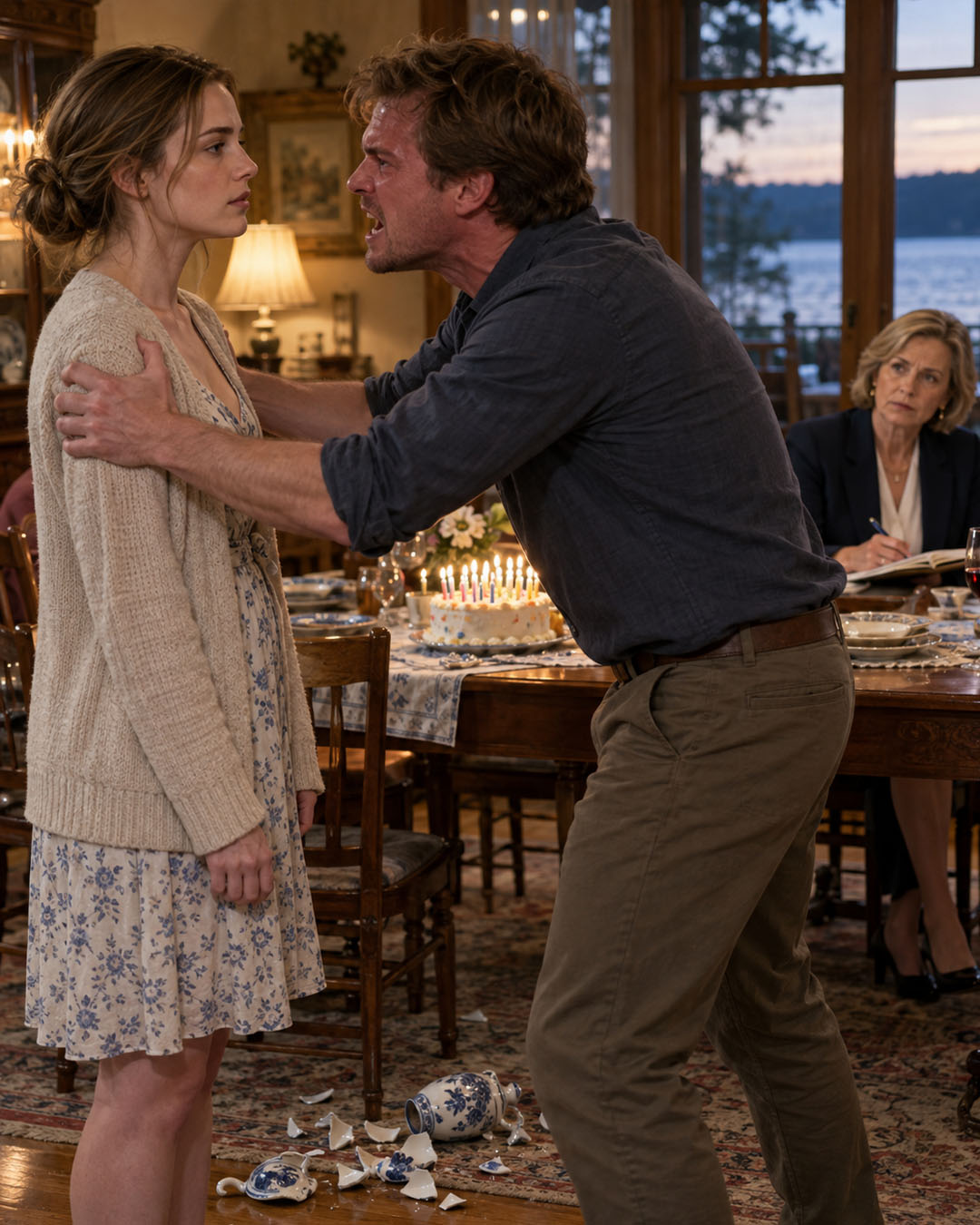
The teapot struck the hardwood floor.
It shattered.
Chapter 4
The sound echoed through Grandma’s dining room.
Blue-and-white porcelain scattered beneath the table.
Someone gasped.
Natalie’s youngest daughter covered her mouth.
For one terrible moment, I could barely breathe.
That teapot had survived generations.
It had been carried carefully through moves, holidays, and family hardships.
Grandma had wrapped it in towels whenever she traveled because she feared even a small crack.
And Brandon had deliberately destroyed it.
Every instinct told me to kneel on the floor and gather the broken pieces.
I wanted to cry.
I wanted to ask him how he could do something so cruel.
But I remembered his notebook.
I remembered the fifty-three entries describing moments of grief as evidence of instability.
And I remembered that my feelings belonged to me.
I took a slow breath.
Then I looked at Brandon.
“Someone should get a broom,” I said. “There are children here, and I don’t want anyone getting hurt.”
Silence.
Brandon stared at me.
His mouth opened, but nothing came out.
Uncle Raymond leaned forward.
I could see the expectation on his face slowly turning into confusion.
Brandon’s hands began trembling.
“That’s it?” he demanded.
I looked at him calmly.
“What else would you like me to say?”
He took a step closer.
“Your grandmother’s teapot is broken!”
“I can see that.”
“Don’t you care?”
“Of course I care.”
“Then why aren’t you crying?”
I said nothing.
His expression changed.
The charming man who once comforted me in a bookstore seemed to disappear.
“Why won’t you react?” he shouted. “What is wrong with you?”
He caught my shoulders.
Christopher stood immediately.
“Brandon, let her go.”
But Brandon was barely listening.
“Just cry, Emily! For once, just cry!”
Christopher stepped between us and gently but firmly moved him away.
“That’s enough.”
Brandon stumbled backward, breathing hard.
He looked around the room.
Everyone was staring at him.
For the first time, he seemed to understand how he appeared.
Margaret calmly wrote several lines in her notebook.
Then she looked at Uncle Raymond.
“Did you have something you wanted to discuss regarding the trust?”
Raymond’s expression stiffened.
“Yes. As a matter of fact, I do.”
He removed a folded document from his jacket.
“I have serious concerns about Emily’s emotional judgment. As trustee, I believe distribution should be delayed.”
He gestured toward Brandon.
“Her boyfriend has documented numerous incidents. He can testify that she’s incapable of handling emotional stress.”
Brandon reached into his pocket.
He pulled out the small black notebook.
The same notebook I’d photographed weeks earlier.
Margaret looked at it without surprise.
“Raymond,” she said, “are you formally seeking to invoke the trust’s emotional-judgment provision?”
“Yes.”
“Before these witnesses?”
“Yes, Margaret. That’s exactly what I’m doing.”
She placed her pen beside her folder.
“Then I have another document to present.”
Raymond frowned.
“What document?”
Margaret opened her leather case and removed a cream-colored envelope.
I recognized Grandma’s handwriting immediately.
Across the front were three words.
“For Emily’s protection.”
My throat tightened.
Margaret carefully opened the envelope.
“Rose instructed me to read this if the trustee attempted to delay Emily’s inheritance under the emotional-judgment provision.”
She unfolded several pages.
Then she began.
“My dear Emily, if these words are being read aloud, someone has tried to use your tender heart against you.”
Tears pressed behind my eyes.
I kept my hands folded.
Grandma’s words continued.
“I have watched you grow from a frightened little girl into a compassionate young woman. You have always felt things deeply, and I have always considered that one of your greatest strengths.”
Margaret paused briefly.
Then she looked at Raymond.
“To my son Raymond, I must say something difficult. I have loved you all your life, but love has never prevented me from seeing your weaknesses.”
Raymond’s face tightened.
“You have repeatedly placed money above trust. I fear that one day you may try to do the same with Emily.”
His wife slowly turned toward him.
Margaret continued.
“That is why I directed my attorney to establish safeguards. Any attempt to use this provision dishonestly will trigger a review of the trustee’s conduct and may result in immediate removal under the terms of the trust.”
Raymond stood abruptly.
“That’s ridiculous.”
Margaret raised one hand.
“I’m not finished.”
She turned the page.
“Alongside these instructions, I have executed the necessary legal documents granting an independent successor trustee authority if Raymond acts against Emily’s interests. My intention is that Emily receive her inheritance at thirty without manipulation, intimidation, or unnecessary delay.”
Raymond looked furious.
“She can’t just write that in a letter and make it legally binding.”
“She didn’t,” Margaret replied calmly. “The letter explains her wishes. The trust amendments and supporting documents were properly executed and are already part of the legal record.”
She lifted another document from her folder.
“The independent trustee has reviewed the evidence. Raymond, your conduct has been referred for formal examination, and you no longer have authority to make unilateral decisions concerning the estate.”
A stunned silence filled the room.
Margaret then looked at Brandon.
“There’s another matter.”
He stood rigidly beside the china cabinet.
“We have evidence that you worked for Raymond’s dealership long before you met Emily.”
Brandon’s face drained of color.
Margaret opened a second folder.
“Employment records and photographs establish that relationship. We also have copies of your written descriptions of Emily’s supposed emotional episodes.”
She looked at the notebook in his hand.
“Several entries appear misleading, and some may be entirely fabricated.”
Raymond interrupted.
“That’s nonsense.”
Margaret’s expression remained steady.
“Then you’ll have the opportunity to explain them during the review.”
Brandon turned toward Raymond.
“Tell them,” he said.
Raymond didn’t answer.
“Tell them what you promised me.”
His voice cracked.
Raymond stared at the floor.
Brandon laughed once, bitterly.
“Unbelievable.”
Then he looked at me.
For the first time that evening, he seemed to see me as a person rather than a problem to solve.
“Emily, I can explain.”
I stood.
“Did you know Uncle Raymond before you met me?”
He hesitated.
“Yes.”
“Did he ask you to approach me?”
Brandon looked away.
That was answer enough.
I felt something inside me break, but it wasn’t the same helpless feeling I’d carried for months.
It was the final thread connecting me to a relationship that had never been what I believed.
“Did you ever love me?” I asked.
His eyes glistened.
“At some point, I think I did.”
The answer hurt more than a complete denial.
Because love that could be traded for money wasn’t the love I’d spent my life hoping to find.
I nodded.
“Then you should have treated me better.”
He stepped toward me.
“Emily, please.”
“No.”
My voice was quiet but steady.
“We’re finished. I’ll arrange for your belongings to be collected from the apartment. Don’t come here again.”
For a moment, he looked as though he might argue.
Then he turned and walked out.
Raymond left shortly afterward.
His wife refused to accompany him.
“I’ll find my own way home,” she said, without looking at him.
When the front door closed, the house became very still.
Outside, the lake water moved gently against the shore.
I looked down at the broken porcelain.
Then I knelt.
Laura joined me immediately.
“Be careful,” she whispered.
Natalie brought a dustpan.
Margaret lowered herself carefully onto one knee.
Together, we began gathering the pieces.
I picked up a curved fragment decorated with half a blue flower.
I remembered Grandma holding that teapot in her hands.
I remembered being nine years old, crying because I missed my mother.
I remembered her voice.
“Let it out, sweetheart. Then we’ll figure out what to do.”
And finally, I cried.
Chapter 5
The tears came so suddenly that I couldn’t hold them back.
I sat on Grandma’s dining room floor with a piece of blue porcelain in my hand and cried for everything I’d lost.
I cried for the grandmother who’d loved me without conditions.
I cried for the relationship I’d believed was real.
And I cried for the woman I’d become while trying to make myself small enough for someone else’s comfort.
Laura wrapped her arms around me.
Nobody told me to stop.
Nobody rolled their eyes or called me dramatic.
Margaret sat beside me, holding a napkin.
“Your grandmother would be proud of you,” she said.
I looked at her through my tears.
“I couldn’t save her teapot.”
Margaret gently squeezed my hand.
“Oh, Emily. Your grandmother didn’t leave you that teapot because she cared about porcelain.”
I stared at her.
“She left it because of what it represented. The comfort she gave you. The memories you shared. The love that still belongs to you.”
I looked down at the broken pieces.
For the first time, I understood.
Brandon could destroy an object, but he couldn’t destroy what Grandma had taught me.
Over the following weeks, the legal review uncovered more about Raymond’s financial situation.
His dealership was deeply in debt, and he had hoped to use his control of the trust to gain access to funds or arrange a sale of the lakefront property before I could take possession.
Brandon had apparently expected a substantial payment if he helped delay my inheritance.
Their arrangement had begun before Brandon and I met.
Knowing that was painful.
But the truth also brought clarity.
For years, I’d wondered whether I was asking too much from the people I loved.
Now I could finally see how little I’d actually asked for.
Honesty.
Respect.
Kindness.
The right to feel something without having it used against me.
Those weren’t unreasonable expectations.
They were the foundation of a healthy relationship.
Margaret guided the trust through its final review. After the appropriate legal proceedings, Raymond was formally removed from any remaining authority, and the assets were transferred into my control.
The property appraisal confirmed that Grandma’s home, land, and investments were worth approximately $2.4 million.
I stared at the financial documents in disbelief.
For most of my life, I’d worried about paying bills, replacing my aging car, and setting aside enough money for retirement.
Now I had choices I’d never imagined.
But I knew immediately what I wanted to do.
I wasn’t selling Grandma’s house.
Not to a resort developer.
Not to anyone.
Instead, I used part of the inheritance to restore it.
The porch swing was repaired properly. The kitchen cabinets were refinished, and the old yellow siding received a fresh coat of paint.
I kept the creaky floors.
Some things didn’t need improving.
I also established a fund through the children’s hospital where I worked to help families who couldn’t afford travel, temporary housing, or other expenses while their children received treatment.
Grandma had always said that money was most valuable when it eased someone else’s burden.
I wanted her generosity to continue.
A few months later, I received an unexpected letter from Brandon.
It was handwritten.
He apologized for lying about his job, manipulating my emotions, and participating in Raymond’s scheme.
He wrote that he’d originally approached me for money but had eventually developed genuine feelings.
Then he added that he understood why I would never believe him.
I read the letter twice.
Years earlier, I would have searched every sentence for a reason to forgive him.
I would have wondered whether I had misunderstood his intentions or somehow contributed to what happened.
This time, I didn’t.
I folded the letter and put it away.
His apology was his responsibility.
My recovery was mine.
I never answered.
Laura worried that I’d become afraid of relationships.
She brought it up one Sunday afternoon while we were drinking coffee on Grandma’s porch.
“Do you think you’ll ever date again?”
I watched the sunlight moving across the lake.
“Probably.”
She smiled.
“That’s encouraging.”
“But I’m not in a hurry.”
“Good.”
I looked at her.
“For three years, I thought being loved meant being careful. Careful about what I said, how I reacted, whether I cried too much or laughed too loudly.”
Laura’s expression softened.
“I know.”
“I don’t want to live like that anymore.”
She reached for my hand.
“Then don’t.”
It sounded simple.
In some ways, it was.
I started taking better care of myself.
I returned to painting, something I’d loved in high school but abandoned during nursing school.
I joined a community gardening group.
I took long walks around the lake and allowed myself to enjoy quiet evenings without feeling obligated to explain my thoughts to anyone.
Some days were difficult.
I’d hear a song Brandon once played in the car or see a couple laughing in a bookstore, and the memories would return.
But I stopped judging myself for feeling sad.
Grief wasn’t failure.
It was part of healing.
The following spring, I brought the broken teapot pieces to a local ceramic artist named Helen.
She was a retired art teacher who specialized in restoring family heirlooms.
I spread the fragments carefully across her worktable.
“Can you fix it?”
Helen examined them.
“I can restore its shape, although the cracks will remain visible.”
I nodded.
“That’s all right.”
She smiled.
“Sometimes the cracks become part of the story.”
Several weeks later, I returned to her studio.
The teapot stood on a shelf beneath a warm light.
It had been carefully reconstructed, with fine golden lines highlighting the places where the porcelain had broken.
It wasn’t exactly the teapot I remembered.
It was different.
But it was beautiful.
I lifted it gently.
The blue flowers still circled its sides, and the curved handle fit my hand the way it always had.
Tears filled my eyes.
Helen handed me a tissue.
“Would you like a minute?”
I smiled.
“Yes, please.”
And I cried.
Not because I was weak.
Not because I couldn’t control myself.
But because something precious had survived.
On my thirty-first birthday, I hosted another dinner at Grandma’s house.
This time, I planned it myself.
Laura came with her husband. Natalie brought her children. Margaret arrived carrying a bouquet of yellow roses.
We cooked together, laughed over old family stories, and enjoyed a long meal without anyone measuring my reactions.
After dinner, I carried Grandma’s restored teapot to the table.
Everyone grew quiet.
Margaret smiled when she saw the golden lines.
“Well, look at that.”
I placed it beside the lemon cake.
“It’s not perfect anymore,” I said.
Natalie shook her head.
“I think it’s prettier.”
I ran my fingers gently along one of the repaired cracks.
“Grandma used to tell me that feelings weren’t something to be ashamed of.”
Margaret nodded.
“She certainly did.”
“For a while, I forgot that. I thought I needed to become someone who never cried, never complained, and never showed when something hurt.”
I looked around the table at the people who had stood beside me.
“But I learned something. Being strong doesn’t mean you stop feeling. It means you stop allowing people to use your feelings against you.”
Laura raised her glass.
“To Grandma Rose.”
Everyone joined her.
“To Grandma Rose.”
Later that evening, after the guests had gone, I sat alone on the porch swing.
The lake reflected the moonlight, and a gentle breeze rustled the leaves.
I held Grandma’s recipe card in my lap.
“For Emily’s birthdays. Extra lemon, just how my girl likes it.”
I read those words and smiled.
For years, I’d believed my sensitivity made me vulnerable.
Perhaps it did.
But it also made me compassionate enough to comfort frightened children at the hospital, patient enough to sit beside grieving families, and loving enough to recognize beauty in ordinary moments.
I wasn’t going to surrender those parts of myself because someone had once tried to exploit them.
I thought about Brandon’s desperate question.
“Why won’t you just cry?”
The answer seemed so clear now.
I’d never stopped being capable of tears.
I’d simply learned that not everyone deserved to witness them.
That night, I went inside, washed the last few dishes, and placed Grandma’s restored teapot on the kitchen shelf.
Then I made myself a cup of tea.
I sat at the same wooden table where Grandma had comforted me as a child.
For a moment, I imagined her sitting across from me, smiling over the rim of her cup.
“Well, sweetheart,” I could almost hear her say, “what are we going to do now?”
I looked around the warm kitchen.
At the repaired teapot.
At the photographs on the walls.
At the house that was finally, completely mine.
And I answered softly.
“We’re going to live, Grandma.”
I took a sip of tea.
Then I smiled through my tears.
Because the greatest gift my grandmother left me wasn’t worth $2.4 million.
It was the knowledge that my heart had never been the problem.
The problem was trusting people who mistook kindness for weakness.
And I would never make that mistake again.
THE END. ⚠️ All characters and events are fictional. Do not imitate or apply them in real life. 😌😌😌