Chapter 2
Elena wouldn’t tell me who had made the previous complaints or what they’d alleged. She explained that child welfare records were confidential and that foster home licensing involved a different department. But she listened carefully when I described Noah’s account, and she agreed that the information required another review.
I asked Noah if he would feel comfortable speaking with a specially trained child interviewer. He was nervous, so I explained that the interviewer’s job was to listen, not to punish anybody. I promised him he hadn’t done anything wrong.
At the Child Advocacy Center, Noah sat in a cheerful room decorated with picture books and soft cushions. A trained interviewer spoke with him while I waited nearby. He repeated his description of the yellow door, the timer, and the little hook.
He also remembered Betty calling through the door when Lily became upset.
“Quiet children get to come out sooner,” she’d told them.
According to Noah, Marcus had known exactly what to do. He’d instructed the younger children to sit still and wait because he’d been there many times before.
When the interview ended, the investigator thanked Noah for speaking honestly. I drove him for ice cream afterward, even though it was December. He chose chocolate with rainbow sprinkles and seemed happy for the first time in days.
Claire didn’t share my relief. She insisted that her mother had always loved children and that Noah had misunderstood a harmless discipline technique. When I reminded her that locking children in a dark closet was not an acceptable punishment, she accused me of judging her childhood.
“You’re making Mom sound like some kind of monster,” she said one evening.
“I’m telling you what our son experienced.”
“She raised me, Adam. She helped us when Noah was born. She babysat for free when we couldn’t afford daycare.”
“That doesn’t make what happened okay.”
Claire went into the guest room and shut the door.
She slept there for nineteen nights.
Meanwhile, Betty began calling our relatives. She told them I was exaggerating an innocent misunderstanding and allowing an overzealous school nurse to influence me. Daniel sent an angry text saying I was attacking a woman who’d spent decades helping vulnerable children.
Betty herself called on Sunday afternoon.
“Adam, honey,” she began warmly, “I’m sorry Noah got confused. The little closet was a reading space. The children liked taking books and flashlights inside. Nobody was ever locked in there.”
“Then why did he draw a hook on the outside?”
She paused. “Children have wonderful imaginations.”
“Did you close him in there on Thanksgiving?”
“I think we should stop this before you do something you’ll regret. Families need to protect one another.”
Her voice remained gentle throughout the conversation. Somehow, that frightened me more than if she’d shouted.
Four days later, we received a letter from the county licensing division. It stated that the foster home had been reviewed, the caregivers had cooperated, and the concern was considered unsubstantiated. The letter described the room as a child-friendly reading area with no external locking mechanism.
I read it three times.
The letter was signed by licensing supervisor Patricia Caldwell.
I called Elena immediately. She sounded surprised by how quickly the review had closed, but she couldn’t discuss internal decisions. She promised to ensure Noah’s interview was included in the appropriate records.
That Saturday, I drove to Betty and Richard’s house. Richard answered the door wearing reading glasses and a cardigan, looking confused but welcoming. I told him I wanted to see the upstairs closet.
He hesitated before allowing me inside.
The yellow door was gone.
Or rather, it was still there, but someone had painted it white. The paint smelled fresh, and the trim had a small circular patch near the top where something had recently been removed.
Inside were three cushions, children’s books, and a battery-powered lantern. Everything looked carefully arranged, as though someone had created a display for visitors.
Betty appeared at the bottom of the staircase.
“Well?” she asked. “Are you satisfied now?”
I looked at the patch on the doorframe. “What used to be attached here?”
“Nothing important.”
“Why did you repaint the door?”
“Because I wanted to.”
She folded her arms, and for the first time, I saw anger beneath her gracious smile.
“You’ve caused enough trouble, Adam. I suggest you go home and take care of your own family.”
I left without arguing.
That night, I searched through the photographs on my phone from Thanksgiving. Most showed relatives laughing around the table or Noah making silly faces with dinner rolls. Then I found a picture I’d taken of Claire and Betty standing near the upstairs landing.
Behind them was the yellow closet door.
And attached to the frame was a small brass hook.
I enlarged the image until the details became blurry. The hook was unmistakable. It had been secured in place, exactly where Noah said it was.
The next morning, I printed several copies and sent the original photograph to Elena through an appropriate evidence-submission channel. My attorney advised me to preserve the file without editing it.
But I still had one question.
Why had the school nurse recognized the drawing so quickly?
I arranged to meet Martha Reynolds at the school after classes ended. She was a quiet woman in her late thirties, with dark hair pulled into a loose bun. When I entered her office, she looked tired rather than defensive.
I placed the photograph on her desk.
She studied it for a long moment.
“That’s not the hook I remember,” she said.
I frowned. “What?”
“The one they had when I lived there was silver. It bent after a few years, so Betty replaced it.”
The room seemed to tilt.
“You lived there?”
Martha nodded slowly.
“I was eight when the county placed me with the Parkers. I stayed almost two years.”
She opened a drawer and removed an old photograph. In it, a thin little girl with braided hair stood beside Betty at a church picnic. I recognized the image immediately because I’d seen it hanging on the staircase at my in-laws’ house.
“I knew that door the moment I saw Noah’s drawing,” Martha said. “I’ve been waiting twenty-five years for someone to believe what happened behind it.”
She told me about the timer, the silence rule, and the children who learned to remain perfectly still. She remembered comforting a younger boy who was afraid of the dark. She remembered believing that adults would only love her if she never complained.
At twenty, she’d reported the experience to the county. The complaint was dismissed within days. The final notice carried the same signature as the letter I’d received.
Patricia Caldwell.
I asked why Martha had reported our household instead of Betty’s.
She looked directly at me.
“Because I knew a report against the Parkers would go back to the same office that dismissed mine. I wanted someone outside that system to listen to the child.”
“You knowingly dragged my family into an investigation?”
“Yes,” she answered. “And I am sorry.”
I stood up so quickly my chair scraped across the floor. I told her about Claire sleeping in another room, Noah checking his bedroom door, and the fear he’d felt when a stranger came to our house. Martha didn’t interrupt or try to defend herself.
When I finally stopped speaking, she took a thick blue binder from her cabinet.
“You’re right to be angry,” she said. “But please read this before you decide what happens next.”
Across its spine, someone had written a single word.
WILLOWBROOK.
Chapter 3
I spent three nights reading Martha’s binder at our kitchen table after Noah went to bed. It contained copies of historical complaints, correspondence from former foster children, and notes describing the Parker home over many years. The details varied, but certain things appeared again and again.
A narrow upstairs closet. A door with an exterior hook. A kitchen timer used to control how long children remained inside.
One former foster child, now a firefighter in Ohio, wrote that he’d believed the quiet room was normal until he became an adult. Another remembered watching younger children become frightened whenever Betty reached for the white plastic timer. Several said they’d been warned that outsiders would misunderstand and that good children kept family matters private.
The binder contained references to complaints made in 2004, 2011, and 2017. Each appeared to have been closed quickly by the same licensing office. The documents Martha possessed didn’t prove exactly what every investigator had done, but the pattern was troubling.
The name Patricia Caldwell appeared repeatedly.
Near the back, I found a photocopied church newsletter from 1996. It showed a ribbon-cutting ceremony for a foster family outreach program called Open Hearts. Betty stood beside several church leaders, smiling proudly.
Next to her was a younger Patricia Caldwell.
I examined the photograph for several minutes. The two women stood shoulder to shoulder, each holding part of the ribbon. The caption identified Caldwell as a founding volunteer and a county child welfare administrator.
According to Martha’s research, Open Hearts had recruited foster families from the church for decades. Numerous homes associated with the program had later received county approvals. She’d also collected accounts from former foster children who described troubling discipline practices in more than one household.
I didn’t know how much of it would stand up to scrutiny. But the combination of personal relationships, repeated allegations, and rapid case closures raised questions that deserved independent answers.
On the third night, Claire came downstairs while I was reading.
She stood behind my chair, looking at the old newsletter. When she saw the photograph of her mother beside Patricia Caldwell, her face changed.
“I remember her,” she whispered.
“Patricia?”
“She used to come to our house for dinner. Mom called her Patty.”
Claire pulled out a chair and sat beside me. For several minutes, we looked through the binder together without speaking. Then she rose, walked upstairs, and returned carrying a small spiral notebook with a faded unicorn sticker on the cover.
It was her childhood diary.
She opened it to a page dated October 1993. The handwriting was uneven, the words cramped together near the bottom. I recognized the name Daniel in the first sentence.
“Daniel cried again and Mom said we had to stay until we learned to be quiet. I tried to be good but I was scared.”
Claire pressed her fingers against her mouth.
“I’d forgotten writing that,” she said.
I put my hand over hers. She didn’t pull away.
For the first time, Claire told me what she remembered about growing up in that house. Her mother had been affectionate, generous, and admired by everyone at church. But when the children upset her, Betty sometimes became unnervingly calm.
She didn’t always raise her voice. She’d send them into the little room and tell them to think about their behavior. Later, she’d serve dinner and expect everyone to act as if nothing unusual had occurred.
“I honestly believed every family did it,” Claire said. “Mom told us discipline was love. Whenever I felt frightened, she said I was being dramatic.”
I asked whether she still believed that.
She looked at the diary. Her eyes filled with tears.
“No. But admitting it means admitting my mother frightened me when I was little. And I’ve spent forty years pretending she didn’t.”
We sat together until nearly three in the morning. Claire cried for the little girl she’d once been, and I apologized for expecting her to confront memories she wasn’t ready to face. Neither of us could undo what had happened, but we agreed that Noah would never be asked to keep an unsafe secret.
The following week, we met with a child welfare attorney and discussed the documents. She advised us to provide the relevant information to state oversight authorities and to avoid publishing confidential details about children. Martha agreed to cooperate, as did several former foster children willing to share their own experiences.
An investigative reporter named James Ellison began examining the licensing records. He worked for a regional newspaper and had previously reported on failures in public institutions. He was careful, skeptical, and unwilling to publish claims he couldn’t independently substantiate.
For nearly two months, he interviewed adults who’d once lived in foster care, reviewed public records, and requested information from state agencies. He also sought responses from Betty, Patricia Caldwell, the county licensing office, and church representatives.
By early spring, he’d confirmed enough to publish.
The article appeared on a Sunday morning beneath a headline questioning how repeated complaints against church-connected foster homes had been handled. It described former foster children’s accounts of confinement, the recurring appearance of one licensing supervisor’s signature, and concerns about oversight.
The story spread quickly.
Within days, additional former foster children contacted the newspaper. Some described experiences similar to Martha’s. Others said they’d never been mistreated but wanted to know why complaints involving their former homes had been dismissed so quickly.
The state announced an independent review of the county’s licensing practices. Investigators began examining historical complaints, supervisory decisions, and potential conflicts of interest.
Eleven days after the review intensified, Patricia Caldwell submitted her retirement paperwork.
That afternoon, Betty drove to Patricia’s house carrying a pecan pie.
A neighbor’s doorbell camera recorded the two women embracing on the front porch. Someone later shared the brief clip online, where it circulated alongside the newspaper coverage.
The video itself proved no wrongdoing. But seeing my mother-in-law comforting the official whose office had repeatedly dismissed concerns made me understand why so many former foster children had believed their voices didn’t matter.
Forty-eight hours after the article appeared, Marcus and Lily were moved to different approved placements while authorities completed their assessment. For privacy reasons, we weren’t told where they went. I understood the need to protect them, though I thought about them constantly.
Betty’s foster license was eventually revoked following administrative proceedings. The authorities also pursued a child welfare-related case concerning inappropriate confinement. The final outcome included court supervision and restrictions on future caregiving responsibilities.
Richard was not charged. Daniel stopped speaking to us entirely, insisting we’d betrayed their mother for public attention. The church issued a carefully worded statement promising cooperation with the review.
Patricia’s departure didn’t end the investigation. State officials examined additional files, though the process moved more slowly than any of us wanted. Some allegations were old, records were incomplete, and many people involved had moved away.
Martha received a reprimand from the school district for aspects of how she’d handled the original report. She was transferred to another school, though she continued working as a nurse. I never forgot that she’d deliberately put our household under scrutiny.
But I also stopped pretending she’d been wrong about the danger.
One afternoon, I sent her a copy of the complaint I’d drafted against her. I added a short note explaining that I no longer believed she was the person I needed to fear. I also told her that using my son as a way around a broken system had caused real harm.
She replied the following day.
“You have every right to feel both things.”
I printed those words and placed them beside Noah’s drawing in the folder I’d kept from the beginning.
For a little while, I believed the worst was behind us.
Then my telephone rang at 6:10 on a Thursday morning.
It was Elena Martinez.
Chapter 4
Elena sounded troubled when I answered. She explained that she had ongoing concerns about a child welfare placement associated with another foster home mentioned in the state review. She couldn’t provide private information about a child or reveal a confidential placement location, but she wanted me to know that the oversight questions hadn’t ended with the Parkers.
“The investigation is still open,” she said. “Some of the same concerns are being raised again, and people are working to make sure they’re independently reviewed.”
I asked whether she believed children were still at risk.
“I believe every concern deserves a fair investigation,” she answered. “And I don’t want anyone assuming the problem was solved just because one home lost its license.”
After we hung up, I opened Martha’s binder.
One section described a couple named the Hollands, longtime members of the Open Hearts ministry. A former foster child had reported being confined in a small pantry as a punishment years earlier. Her complaint had also been closed without substantiation.
The next evening, Claire found me at the kitchen table studying the records.
She recognized the couple’s photograph immediately.
“Mrs. Holland taught my Sunday school class,” she said. “She used to bring homemade cookies to our house.”
Then she grew quiet.
“I remember a girl from one of their foster placements. We went to a birthday party together, and she disappeared for part of the afternoon. When I asked where she was, an adult told me she’d been sent away to calm down.”
Claire sat down and tried to remember more. She couldn’t recall the girl’s full name, only that she wore her hair in two braids and had a pink sweater with little flowers on it. Rather than guess, Claire wrote down exactly what she remembered, separating memories from things she wasn’t sure about.
We gave that information to our attorney for appropriate referral. We didn’t visit the home or try to contact any child privately. We’d learned that concern for a child must be matched by care, accuracy, and respect for the child’s safety.
Over the following months, Claire became more involved in supporting adults who had grown up in foster care. She attended meetings organized by a local advocacy group and listened to people whose stories echoed parts of her own childhood. For the first time, she understood that children raised in homes others admired could still carry painful memories.
Her relationship with me began changing too.
We started marriage counseling after nineteen days of sleeping in separate rooms. At first, our conversations were awkward and full of unfinished sentences. Claire was ashamed that she’d defended her mother, while I was angry that she’d dismissed Noah’s experience.
Our counselor helped us understand that Claire’s response hadn’t been indifference. She’d spent decades learning that questioning her mother threatened the family harmony she’d been taught to preserve. When Noah spoke about the closet, Claire had felt the old fear before she consciously remembered where it came from.
That understanding didn’t excuse her reaction. She acknowledged that she’d failed to listen to our son when he needed us most. But it gave us a place to begin repairing our marriage.
One evening, Claire came into Noah’s room while I was reading to him. She sat on the other side of his bed and brushed the hair away from his forehead. Her voice trembled as she spoke.
“Sweetheart, I want you to know something. You were very brave when you told Daddy about Grandma’s quiet room. I’m sorry I didn’t listen the way I should have.”
Noah watched her seriously.
“Are you mad at Grandma?”
Claire took a slow breath.
“I’m sad about some choices Grandma made. But none of that is your responsibility.”
“Will I have to go there again?”
“No,” I answered. “You’re safe with us, and you can always tell us when something makes you uncomfortable.”
He considered that for a moment, then reached for both our hands.
“Can we finish the dragon book?”
We laughed softly. Claire settled beside us, and I continued reading.
It was the first time in months that the three of us had sat together without the past feeling like another person in the room.
Still, Noah’s worries didn’t disappear overnight.
He began asking us to leave his bedroom door open. He wanted a night-light in the hallway and sometimes woke to check that he could open the door himself. His pediatrician helped us find a child therapist who specialized in supporting children after frightening experiences.
We followed the therapist’s guidance, allowing Noah to talk when he wanted and reassuring him without repeatedly questioning him about Thanksgiving. Gradually, his sleep improved. He started playing with friends again and drawing pictures that had nothing to do with the yellow room.
But every so often, he’d wake in the middle of the night and call for me.
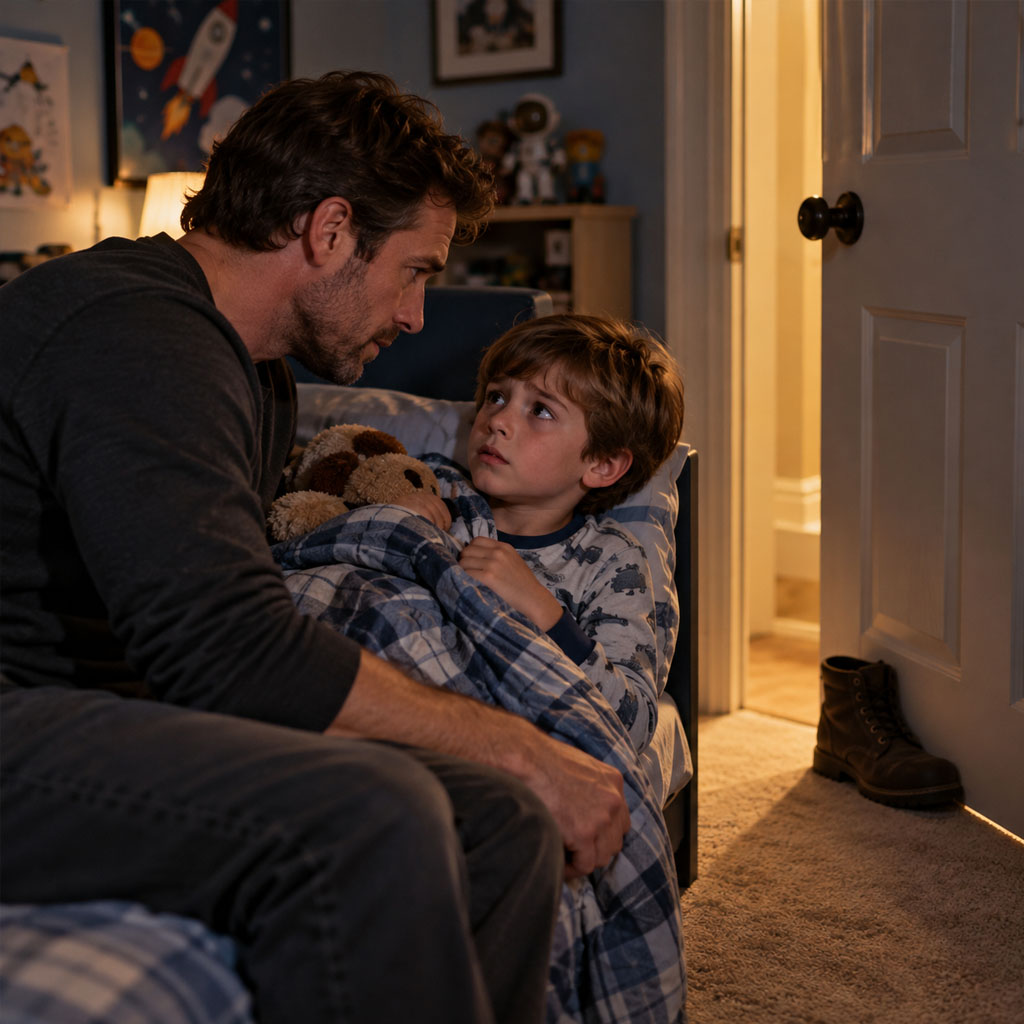
I’d sit beside his bed until he felt safe. Sometimes we’d talk about school or the dog he wanted us to adopt. Other times, he simply needed me to stay there for a few minutes.
There were nights when I felt guilty for what I’d missed that Thanksgiving afternoon. I’d been downstairs watching football while my son was frightened upstairs. I’d trusted familiar faces and a respectable reputation more than I’d paid attention to the children.
The hardest part was accepting that I couldn’t go backward and check on him sooner.
I could only listen now.
Chapter 5
Thanksgiving came around again before I felt ready for it.
In previous years, we’d spent the holiday at Betty and Richard’s house, surrounded by relatives, elaborate decorations, and enough food to feed a small neighborhood. That year, Claire and I decided to stay home.
We bought a rotisserie chicken from the grocery store, made mashed potatoes, and let Noah choose the dessert. He picked chocolate pudding instead of pumpkin pie. Claire laughed and said that was the best Thanksgiving tradition she’d heard in years.
Our table was small, with only three chairs. There were no elaborate centerpieces or arguments about football, and nobody pressured us to pretend that everything was perfect. We ate slowly, told stories, and listened to Noah explain how he’d learned to multiply by six.
After dinner, he brought out his crayons.
I watched him draw three people sitting around a table. He gave Claire long brown hair, me an enormous pair of glasses, and himself a smile almost as wide as his face. Then he added a plate of chicken and three cups.
“That’s us,” he announced proudly.
Claire looked at the picture, and tears filled her eyes.
“It’s beautiful, sweetheart.”
Noah carried it to the refrigerator and fastened it with a magnet shaped like Oklahoma. He stepped back to admire his work, then returned to help us clear the table.
There was no yellow door.
For a long time, I stood in the kitchen looking at that drawing. I realized how differently I understood the word family now. I’d once believed it meant loyalty to relatives, respect for elders, and keeping private disagreements behind closed doors.
Those things could have value, but they weren’t enough.
A family also had to be a place where children could speak honestly without fear. It had to be somewhere mistakes could be acknowledged rather than hidden. Most of all, it had to be somewhere love didn’t depend on silence.
The state investigation continued into the following year. Some licensing procedures were changed, and additional reviews were conducted involving homes connected to the original complaints. Not every allegation led to a finding, and several families disputed the accounts made against them.
I learned to accept that accountability sometimes came slowly and imperfectly. The official reports couldn’t return the years former foster children had spent feeling unheard. Nor could a newspaper article erase the worry that Noah still occasionally carried.
But the people who’d spoken were no longer alone.
Martha helped connect former foster children with independent support resources. Claire joined a private group for adults working through difficult childhood experiences. More than a hundred people eventually participated, sharing memories, asking questions, and helping one another find professional support.
Some wanted investigations. Others wanted apologies. A few simply wanted someone to believe that the little rooms and the rules they’d remembered had been real.
I sometimes attended public meetings about child welfare oversight, though I no longer believed one angry father could solve every failure in a complicated system. I focused on accurate reporting, protecting children’s privacy, and supporting people qualified to investigate concerns. It was less dramatic than the confrontation I’d once imagined, but it was more useful.
One afternoon, Martha invited me to visit her new school. She wanted to show me a small project she’d started with the principal: a quiet, welcoming space where students could speak with a counselor or nurse when they felt overwhelmed.
The room had comfortable chairs, books, soft lighting, and a door that opened freely from the inside. Children could choose to enter or leave, with adults nearby to provide support. Nothing about it resembled the punishment room she’d remembered.
Martha stood beside the doorway as I looked around.
“I wanted children to know that quiet can mean peace,” she said. “It doesn’t have to mean fear.”
I nodded, remembering the yellow rectangle in Noah’s drawing.
“I’m glad you made this.”
She glanced at me. “How’s Noah?”
“Better. He still has some hard nights, but he’s laughing a lot more.”
Martha smiled, and we stood quietly for a moment.
Before leaving, I thanked her for taking my son’s drawing seriously. I also told her I hoped she’d never feel compelled to put another family through an unnecessary investigation to get a child’s concerns heard. She agreed, acknowledging that even when systems failed, children and parents deserved honesty.
I left feeling that we’d finally said everything we needed to say.
That winter, Claire received a letter from her mother. Betty wrote about loneliness, regret, and the pain of losing contact with her grandchildren. She said she missed the family gatherings and hoped they could somehow begin again.
Claire read the letter twice.
Then she put it away without answering.
She told me she wasn’t ready to rebuild a relationship with someone who still hadn’t directly acknowledged what had happened. I supported her decision. Forgiveness, we agreed, couldn’t be demanded simply because enough time had passed.
Daniel remained distant. Richard occasionally sent birthday cards for Noah, which we checked and shared with him when appropriate. Our extended family looked different now, and some relationships might never recover.
But inside our own house, something healthier had begun to grow.
We adopted a gentle older golden retriever named Sunny from a local rescue. Noah took responsibility for filling her water bowl each morning, though he needed occasional reminders. She quickly learned that the warmest place in the house was beside his bed.
One night, about eighteen months after the Thanksgiving drawing, I heard Noah moving around upstairs. I went to his room and found him standing beside the door, with Sunny watching sleepily from her blanket.
“Everything okay, buddy?” I asked.
He nodded. “Just checking.”
I looked at the little rubber doorstop he kept near the baseboard. He’d chosen it himself because he liked the bright blue color. His door could open easily without it, but the doorstop made him feel more comfortable.
“Want me to sit with you for a while?”
“Just until Sunny falls asleep.”
I smiled and sat on the edge of his bed. Sunny was already snoring softly, but neither of us mentioned it.
Noah climbed beneath his blanket and looked toward the hallway.
“Daddy?”
“Yeah, buddy?”
“If I see something that scares me, I can always tell you, right?”
I felt my throat tighten.
“Always. Even if it’s about someone we love. Even if you’re afraid nobody will believe you.”
He nodded thoughtfully and settled back onto his pillow.
“Okay. Good night, Daddy.”
I kissed his forehead and switched off the lamp. The hallway light spilled gently through the open doorway, illuminating Sunny’s golden fur and the little blue doorstop.
Downstairs, Claire was waiting with two cups of tea. We sat together on the couch beneath the quilt her grandmother had made years before, talking quietly about the day. The house was peaceful in a way it hadn’t been for a long time.
I thought about all the people who’d insisted our family should have kept its problems private. I thought about Betty’s awards, Patricia Caldwell’s signature, Martha’s binder, and the children whose stories had finally been heard. I also thought about my own mistakes, especially how quickly I’d blamed the person who’d noticed something wrong.
One child’s drawing hadn’t destroyed our family.
It had revealed what some adults had worked very hard not to see.
And although I couldn’t change the past, I could give my son something the children in that yellow room had desperately needed: a home where he was believed, where questions were welcome, and where nobody had to earn the right to feel safe.
Upstairs, a little boy slept with his door open and his dog beside him. His newest family drawing hung on our refrigerator, showing three smiling people around a Thanksgiving table. It wasn’t the grand family celebration we’d once known.
It was something better.
It was the truth.
THE END.
⚠️ All characters and events are fictional. Do not imitate or apply them in real life. 😌😌😌