
Chapter 2
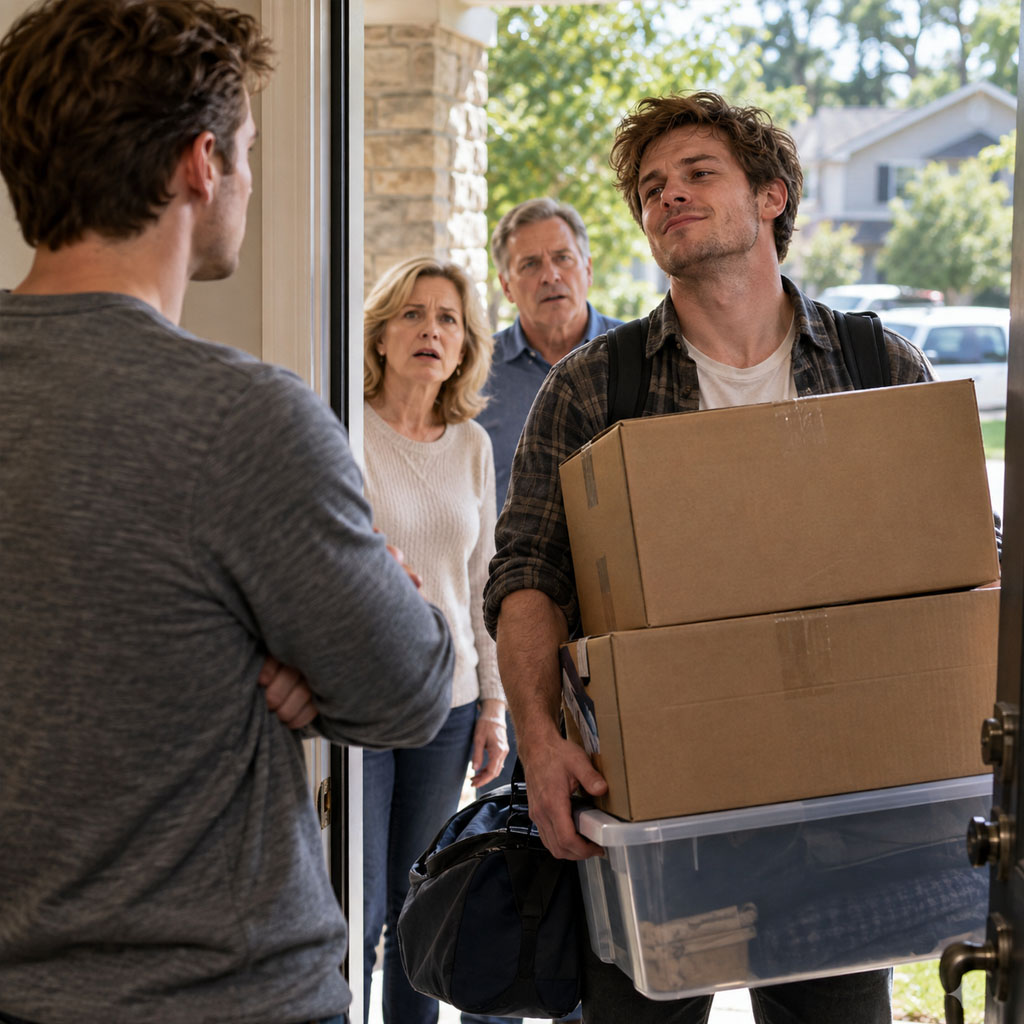
For several seconds, neither of us moved.
“What did you just say?”
Greg crossed his arms. “Mom said they were downsizing and that I should start bringing my things here.”
My anger shifted direction.
“Did she tell you the house belonged to me?”
“No.”
“Did Dad?”
“No.”
I pulled out my phone.
Greg’s expression changed. “Who are you calling?”
“Mom.”
She answered on the fourth ring.
“Mike? Is everything all right?”
“I’m standing at the lake house with Greg.”
Silence.
Not confusion.
Not surprise.
Silence.
That told me everything.
“Mom,” I said, “why does Greg think he can live here?”
“Well, sweetheart, we were going to talk to you.”
“You told him to come?”
“I didn’t exactly tell him. We discussed possibilities.”
Greg called from behind me, “You said I could stay here!”
Mom inhaled sharply.
I closed my eyes.
“Mom, you sold me this property.”
“I know that.”
“Then what part of this seemed reasonable?”
Her voice became soft and pleading. “Greg needs somewhere to go. Your father and I simply can’t have him in the new apartment. It’s a one-bedroom plus den. You don’t live at the lake house, Mike.”
There it was again.
You don’t need it.
The words had changed, but the message hadn’t.
Greg needed more, so whatever belonged to me remained negotiable.
“I don’t live there,” I said, “because it’s my vacation property. That doesn’t make it available.”
“But he’s your brother.”
“And I’m your son.”
She went quiet.
I lowered my voice.
“You took my money. You signed a legal sale. You used the proceeds to cover debts, including debts Greg helped create. And now you’re trying to hand him the property anyway?”
“We’re not handing him anything. It would only be temporary.”
I looked at Greg’s boxes. Some were labeled BEDROOM. Others said KITCHEN.
He wasn’t packed for a weekend.
“No.”
“Mike—”
“No. This stops here.”
I hung up.
Greg shook his head. “You really enjoy this, don’t you?”
“Enjoy what?”
“Finally having something over me.”
I almost smiled at the absurdity.
“Greg, I didn’t make you unemployed. I didn’t make you forty-nine years old with no savings. I didn’t tell Mom and Dad to cover your credit cards or lend you money every time you got into trouble.”
“You’ve always thought you were better than me.”
“No. I thought the rules should apply to both of us.”
He stepped closer.
“You don’t even need this place.”
The words landed harder than he intended.
I had heard that argument my whole life.
You don’t need tutoring.
You don’t need help.
You don’t need the car.
You don’t need the lake house.
You don’t need anything because you’re Mike, and Mike always figures it out.
I looked at my brother and suddenly felt tired rather than angry.
“Do you know why I don’t need people to rescue me, Greg?”
He stared.
“Because no one ever did.”
His expression changed slightly, but pride closed the door before anything meaningful could come through.
“Well, congratulations.”
“Take the boxes back to your car.”
He laughed. “I’m already here.”
“And now you’re leaving.”
“You’re serious?”
“Completely.”
I gave him until evening to remove everything. He complained, cursed under his breath, accused me of stealing his future, and eventually loaded his boxes back into the car.
Before driving away, he leaned out the window.
“Mom and Dad won’t let you do this.”
I almost felt sorry for him.
“Greg, they can’t stop me.”
That night, I called Dad.
Unlike Mom, he didn’t pretend innocence.
“We thought you might soften up once Greg was actually there,” he admitted.
I stared through my Chicago apartment window at traffic moving below.
“So this was planned.”
“Don’t make it sound sinister.”
“You sent someone to occupy property you sold me.”
“He’s your brother, not some stranger.”
“That makes it worse, Dad.”
He became irritated.
“You’ve always been hard on Greg.”
“No. You’ve always protected him from consequences.”
“He isn’t like you.”
“I know.”
“He needs support.”
“He’s had fifty years of it.”
Dad sighed heavily. “What do you want us to do? Put him on the street?”
I thought about that.
“No. I want you to stop pretending I am responsible for keeping him off it.”
The conversation ended badly.
The next morning, I had cameras and motion sensors installed around the lake house.
It felt ridiculous. This was my brother, not a burglar. But family history had taught me something important: boundaries that aren’t enforced eventually become suggestions.
For two weeks, nothing happened.
Then my neighbor, Mr. Carpenter, called.
“Mike, I figured you ought to know Greg’s been walking around your property.”
“How often?”
“Three times that I’ve seen.”
I checked the cameras.
There he was.
On Tuesday afternoon, he walked along the deck and tried the back door. Thursday evening, he looked through a kitchen window. Saturday morning, he spent nearly fifteen minutes near the basement entrance.
He hadn’t broken anything or forced his way inside.
But he was testing.
I contacted the local police department, explained the ownership dispute, and asked what steps I should take. They advised me to document everything and call immediately if he tried to enter without permission.
I hoped embarrassment would end it.
Instead, three days later my phone alerted me to movement at the lake house.
Greg had returned.
This time, he brought two friends.
And more boxes.
Chapter 3
I drove from Portsville to the lake in less than forty minutes, though I don’t remember much of the road.
When I arrived, Greg and two men were standing on my porch. One of them held a television. The other had a suitcase and looked increasingly uncomfortable.
I parked behind their truck.
Greg gave me a defiant smile.
“We’re moving in.”
His friend with the television looked at him.
“You said your family owned this place.”
“We do.”
“No,” I said. “We don’t.”
I took the deed copy from my glove compartment.
“This is my property.”
Greg rolled his eyes. “Here we go again.”
I handed the document to his friend.
The man glanced at it, then at Greg.
“Dude, his name is on it.”
Greg snatched the paper.
“Mom and Dad promised me this place twenty years ago!”
“And then they sold it.”
“You took advantage of them when they were desperate.”
That accusation finally made me angry.
“I paid what the property was worth. They had their own attorney. They used the money to pay bills they couldn’t afford, including some of yours.”
His face reddened.
“You’ve always been jealous.”
“Of what?”
“You think because you’ve got your Chicago job and your money, you’re better than everybody.”
I shook my head.
“This isn’t about my job. It isn’t even about the house anymore. It’s about the fact that for your entire life, every time something didn’t go your way, Mom and Dad rearranged the world until it did.”
“That’s garbage.”
“Then tell me what you’ve ever had to solve by yourself.”
He stared at me.
I continued before he could answer.
“When your car broke, Dad paid. When you lost your apartment, they gave you the basement. When you quit jobs, Mom called it bad luck. When you ran up debt, they covered it. When they couldn’t afford to support you anymore, they sold this house to me. And somehow even after that, you still believe I should provide the next rescue.”
One of his friends quietly set the television down.
Greg’s jaw tightened.
“You’re my brother.”
“Yes.”
“That ought to mean something.”
“It does. It means I won’t lie to you.”
He looked genuinely confused.
So I said the thing nobody in our family had ever been willing to say.
“Greg, you’re not unlucky. You’re dependent.”
His face fell.
I immediately regretted how sharp it sounded, but I didn’t take it back.
“You’ve spent years waiting for somebody else’s house, somebody else’s money, somebody else’s solution. Mom and Dad taught you that love meant rescuing you. They were wrong.”
“Go to hell.”
“Maybe someday you’ll thank me.”
“Don’t hold your breath.”
I pointed toward the driveway.
“You need to leave.”
He didn’t move.
I took out my phone.
“Are you really going to call the police on your own brother?”
“If you force me to choose between being your brother and being your doormat, yes.”
His friends had already started loading the television back into their truck.
Greg stood alone on the porch.
For one strange second, I didn’t see the golden child who had irritated me for decades. I saw an aging man who had built his entire life around promises that other people would take care of him.
There was something sad about it.
But sadness doesn’t create ownership.
Finally, he picked up a box and walked past me.
“You got what you wanted.”
“What do you think I wanted?”
“To win.”
I watched him carry the box down the steps.
“No, Greg. I wanted a brother who didn’t treat everything I earned like something he could claim.”
He stopped.
Then he kept walking.
The following morning, my attorney sent him a formal notice informing him that he did not have permission to enter or occupy the property.
Mom called within hours.
“A lawyer, Mike? Really?”
“He tried to move in twice.”
“You humiliated him in front of his friends.”
“He brought his friends to help take over my house.”
“He’s having a terrible time.”
I leaned back in my chair.
“Mom, I need to ask you something.”
“What?”
“Why did you tell him the lake house would always be his?”
She didn’t answer immediately.
“Because we worried about him.”
“You worried about me?”
“Of course.”
“No. I mean really worried. Did you ever wonder whether I was lonely in Chicago? Whether my job was secure? Whether I could afford my mortgage? Whether I needed help?”
“You never asked.”
That hurt more than I expected.
“Exactly.”
Silence stretched between us.
Then I said, “You assumed I was fine because I learned not to ask.”
Her voice softened.
“We knew you could handle things.”
“And Greg learned he didn’t have to.”
For once, she didn’t argue.
A week later, Dad called.
His voice sounded older.
“Your mother and I made mistakes.”
I didn’t say anything.
“We thought helping Greg would eventually make him stable. Every time he stumbled, we said, just one more time. Then another. Then another.”
“What changed?”
Dad sighed.
“He asked us yesterday to take out a loan for him.”
“For what?”
“He owes almost thirty thousand dollars.”
I closed my eyes.
“And?”
“We said no.”
I sat upright.
My father had told Greg no.
I almost asked him to repeat it.
“What happened?”
“He shouted. Your mother cried. Then he left.”
I waited.
Dad’s next words surprised me even more.
“You were right.”
Chapter 4
Nothing magically repaired itself after that phone call.
Families don’t heal like television shows, where one apology sends everyone home smiling before the credits roll. Resentments built over forty years don’t disappear because someone finally admits they exist.
But something shifted.
My parents stopped paying Greg’s bills.
They also stopped calling me to solve his problems.
For the first month, Greg blamed me for everything. According to relatives, I had turned our parents against him, stolen his inheritance, embarrassed him, and destroyed the family.
Then came the silence.
Six months passed.
I rented the lake house to a retired couple from Milwaukee for part of the year. Walter and Denise treated the place beautifully. They planted flowers near the porch, kept the dock spotless, and sent me photographs of sunsets over the water.
The rent covered taxes and maintenance, with some left over.
For once, the house was simply peaceful.
Then, one November afternoon, Greg called.
I stared at his name on my phone until the ringing nearly stopped.
“Hello?”
“Hey.”
His voice sounded different.
Not defeated exactly.
Quieter.
“How are you?”
“Fine.”
Another pause.
“I got a job.”
I waited for the explanation about how terrible the boss was.
It didn’t come.
“Where?”
“Maintenance department at St. Joseph’s Hospital.”
“That’s solid work.”
“Yeah.”
He cleared his throat.
“I’ve been there four months.”
That surprised me.
“I got a small apartment too.”
I smiled despite myself.
“Good for you.”
“Don’t sound shocked.”
“I’ll work on that.”
He laughed.
It was the first normal sound I’d heard from him in years.
Then he became serious.
“I was angry with you.”
“I know.”
“I still think buying the lake house without telling me was lousy.”
“Mom and Dad were responsible for telling you.”
“I know that now.”
Something in his voice made me sit down.
He continued.
“When they finally stopped helping me, I thought everybody had betrayed me. Then I spent two weeks sleeping on a friend’s couch, and he told me I had thirty days to figure something out.”
I remained quiet.
“So I figured something out.”
There was no pride in the statement. No performance.
Just a man acknowledging a basic truth he’d avoided for decades.
“I hated you for making me leave that house,” he said.
“I didn’t enjoy doing it.”
“Yeah, you did.”
I laughed softly. “Maybe for about five minutes.”
He laughed too.
Then his voice grew serious again.
“You said something that day. You said I was dependent.”
“I remember.”
“I wanted to punch you.”
“I remember that too.”
“You were right.”
Those words seemed almost painful for him.
I didn’t celebrate them.
“Greg, Mom and Dad played a part in this.”
“I know. But I’m almost fifty. At some point, I can’t keep blaming them.”
I looked out my window at the gray Chicago sky.
“No.”
He cleared his throat again.
“I wanted to ask you something.”
I tensed automatically.
Old habits.
“Go ahead.”
“Can I come see the lake house sometime?”
Not move in.
Not stay indefinitely.
See it.
I smiled.
“Sure.”
Three weeks later, Greg arrived alone.
No boxes.
He stood on the porch for a while before knocking, even though I was visible through the window.
When I opened the door, he raised a six-pack of root beer.
“Peace offering.”
“You remembered.”
We had drunk the same brand as kids at the lake.
He walked through the renovated kitchen and whistled.
“You did a nice job.”
“Contractors did most of it.”
“Still.”
We sat on the deck overlooking the water. The November air had teeth, but neither of us seemed eager to go inside.
After a while, Greg said, “I always thought this place would fix me.”
I turned toward him.
“What do you mean?”
“If I had the house, I’d finally have something. Something permanent. I kept telling myself once Mom and Dad gave it to me, I’d get serious. Maybe find steady work. Maybe settle down.”
“And?”
He looked across the lake.
“I realized I was waiting for a building to make me become somebody.”
That was probably the most honest thing my brother had ever said.
“You know what really bothered me?” he continued. “When you bought it, I thought you hadn’t just taken the house. I thought you’d taken proof that Mom and Dad loved me more.”
I stared at him.
He gave a tired smile.
“Pretty pathetic, right?”
“No.”
“Come on.”
“No. But maybe that’s why this got so ugly.”
He nodded.
For all the years I resented Greg, I had rarely considered what our parents’ favoritism had done to him.
It had hurt me by teaching me I shouldn’t need anyone.
It had hurt him by teaching him he would never need to stand alone.
Neither lesson was healthy.
“I’m sorry,” Greg said.
I looked at him.
“For trying to move in?”
“For a lot more than that.”
The apology wasn’t dramatic.
Maybe that’s why I believed it.
Chapter 5
Two summers later, the entire family gathered at the lake house for Dad’s seventy-eighth birthday.
That sentence alone would have sounded impossible a few years earlier.
Mom brought enough food for twenty people. Dad spent most of the afternoon sitting near the dock, complaining that nobody knew how to tie a proper fishing knot anymore. Greg arrived carrying a cooler and a toolbox.
The toolbox caught my attention.
“What’s that for?”
“Loose railing on the back steps.”
I stared at him.
“What?”
“Nothing.”
“Say it.”
“I was just wondering whether you knew which end of the screwdriver to hold.”
He laughed and shoved my shoulder.
Greg had kept the hospital job. He’d been promoted to shift supervisor and had paid off more than half his debt. He wasn’t suddenly wealthy or perfect. He still complained too much, occasionally spent money foolishly, and could turn a ten-minute story into half an hour.
But he paid his own rent.
He handled his own problems.
And when something went wrong, he no longer called our parents before trying to solve it himself.
Mom and Dad changed too.
They stopped confusing rescue with love.
There were uncomfortable conversations. Apologies. A few arguments. Mom admitted that she had relied on me because I seemed strong and protected Greg because he seemed fragile.
“I thought I was balancing things,” she told me once. “I didn’t realize I was teaching both of you the wrong lesson.”
I appreciated that she said both.
For years, I had imagined vindication would feel like watching Greg lose while I finally won.
It didn’t.
Real vindication was sitting at the old dining table while Greg carried plates into the kitchen without being asked.
It was hearing Dad tell me he was proud of me without adding a request afterward.
It was watching Mom praise Greg for keeping a job instead of making excuses for why he couldn’t.
That evening, after everyone else had gone inside, Greg and I remained on the dock.
The sun was settling behind the trees, turning the lake copper and gold.
“You ever regret buying this place?” he asked.
“No.”
“Even with all the trouble?”
I thought about the boxes on the porch, the arguments, the cameras, the lawyer’s letter, and nearly half a century of resentment that finally had nowhere left to hide.
“No,” I repeated.
He nodded.
“Good.”
After a moment, he added, “For what it’s worth, I’m glad you didn’t let me move in.”
I turned toward him.
“That’s something I never expected to hear.”
“Don’t get sentimental.”
“Wouldn’t dream of it.”
He smiled.
Then he looked across the water.
“If you’d let me stay, I’d probably still be sitting in that living room waiting for Mom to buy groceries.”
“Probably.”
“You could pretend to disagree.”
“I’ve decided honesty is healthier.”
He shook his head, laughing.
I used to think boundaries were walls.
Now I understand they’re more like doors with locks. They don’t exist to keep everyone outside. They exist so the person who owns the house gets to decide who enters, when they enter, and under what circumstances.
That lesson applied to far more than property.
For most of my life, I allowed my family to treat my competence as permission to ask more of me and give less in return. I thought saying no would make me selfish. I thought being a good son meant swallowing disappointment because somebody else supposedly needed more.
Standing up for myself changed that.
But something else surprised me.
It also helped Greg.
The day he arrived with those boxes, he thought I was taking something from him. In reality, I was refusing to give him one more place to hide from adulthood.
He hated me for it.
For a while.
Then he built something of his own.
Mom came out onto the porch and called us in for cake.
Greg stood and stretched.
“Race you.”
“To the house?”
“Yeah.”
“We’re in our fifties.”
“So?”
“You’ll pull something.”
“Afraid you’ll lose?”
There he was.
My brother.
Not the golden child.
Not the burden.
Not the man I had spent decades resenting.
Just Greg.
He took off toward the porch.
I gave him a three-second head start, mostly because of his knee.
Then I ran after him.
That old lake house never belonged to Greg simply because somebody promised it would.
And it didn’t become meaningful to me merely because my name eventually appeared on the deed.
Its real value was in what happened after I finally said no.
My parents learned that helping someone isn’t the same as carrying them forever. Greg learned that entitlement could never substitute for ownership, responsibility, or effort. And I learned that protecting what I had earned didn’t make me cruel.
Sometimes the kindest boundary is the one that disappoints someone.
Sometimes love means opening the door.
And sometimes love means standing in that doorway and saying, clearly and without apology:
“No. You can’t move in.”
THE END.
⚠️ All characters and events are fictional. Do not imitate or apply them in real life. 😌😌😌


