
Chapter 2
I left work early and drove straight to my parents’ house.
The Mustang was parked at the end of the driveway, freshly washed, with a handwritten FOR SALE sign sitting on the dashboard. Seeing it displayed like merchandise brought back memories of every sacrifice I’d made to buy it.
I remembered working through the summer heat at a tire shop, eating peanut butter sandwiches because I couldn’t afford lunches, and counting every dollar in an envelope beneath my mattress.
That car had represented my first real taste of independence.
Dad was watching television when I entered the house.
“Take the advertisement down,” I said.
He barely glanced up.
“What advertisement?”
“The Mustang. My Mustang.”
He switched off the television with exaggerated patience.
“That car has been sitting around collecting dust. Lauren needs transportation, and somebody offered a fair price.”
“You don’t own it.”
“It’s on my property.”
“That doesn’t make it yours.”
His expression changed.
“Don’t lecture me about ownership, son. I gave you a roof over your head for eighteen years.”
“And I’m grateful you raised me. But you didn’t buy that car.”
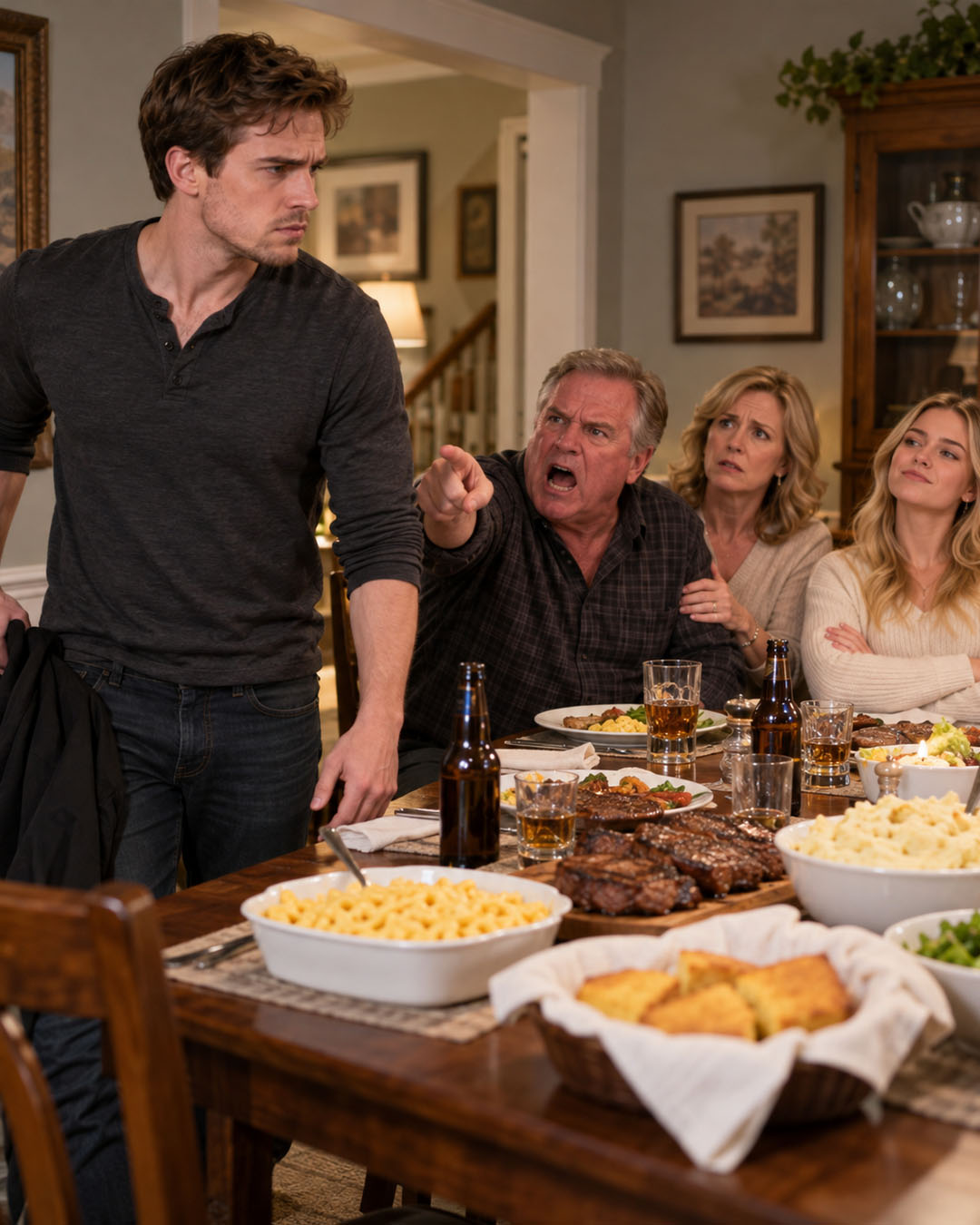
Dad rose from his recliner.
“You’d rather let it sit in my garage than help your sister?”
“I’d rather make that decision myself.”
He stepped closer.
“I already told the buyer to come.”
“Then call him and apologize.”
I walked into the garage, took the Mustang’s keys from the hook where I’d left them, and opened the driver’s door.
The familiar smell of worn leather and engine oil greeted me. When I turned the ignition, the engine started with its old, comforting rumble.
Dad hurried outside.
“Ethan, don’t you dare!”
I rolled down the window.
“The registration and title are in my name. I’m taking my car home.”
His face flushed.
“You’re making a terrible mistake!”
I backed carefully out of the driveway.
For the first time in years, I didn’t feel the need to argue further.
I rented a secured parking space near my apartment and moved the Mustang there that afternoon.
I also called Mom.
“Did you know Dad was trying to sell my car?”
She hesitated.
“He said you weren’t using it.”
“Mom, that wasn’t my question.”
Another silence.
“Your father has been under a lot of pressure lately.”
“That doesn’t answer it either.”
She sighed.
“Please don’t make this into something bigger than it has to be.”
I looked at the Mustang parked safely behind the security gate.
“He already made it bigger.”
Over the next two days, I ignored several angry calls from Dad. Lauren sent a message accusing me of caring more about an old car than her future.
I didn’t respond.
On Thursday evening, I came home carrying takeout and a bag of groceries.
Something felt wrong the moment I opened my apartment door.
The television was still there, and the furniture hadn’t moved. But the space beside the television stand was empty.
My gaming console was gone.
I hurried into the bedroom.
My laptop had disappeared from the desk. The drawer containing my watches stood slightly open, and the velvet case that held my grandfather’s old wristwatch was missing.
I put down my groceries.
There were no broken windows or damaged locks. Nothing had been knocked over, and the ordinary valuables a stranger might have grabbed were untouched.
Someone had selected particular things.
Someone who knew what I owned.
My father still had an emergency key from the year I’d moved into the apartment.
I called him.
He answered on the second ring.
“Took you long enough,” he said.
My heart sank.
“Where are my things?”
“I sold some things you weren’t using.”
I sat down slowly.
“You entered my apartment?”
“I had a key.”
“And took my laptop? My watches?”
“You’re always talking about being independent. Consider this a lesson in what independence costs.”
For several seconds, I couldn’t speak.
Then I asked, “Where’s Grandpa’s watch?”
Dad made an impatient sound.
“Probably with the rest of it. Some dealer over on West Broad Street bought the whole lot.”
My grandfather, Walter Mitchell, had given me that watch shortly before he died.
It wasn’t particularly valuable. The gold plating had worn thin around the edges, and the leather strap had been replaced twice.
But Grandpa had worn it through thirty-eight years at the railroad.
When he gave it to me, he’d closed my fingers around it and said, “A man’s time belongs to him, Ethan. Don’t let anybody convince you otherwise.”
Dad knew what that watch meant.
“That was Grandpa’s,” I whispered.
“It’s just an old watch.”
“No,” I said. “It isn’t.”
Dad’s voice softened, but only slightly.
“Look, I got enough to put a down payment on a car for Lauren. Once you come to your senses, we can forget this happened.”
I stared at the empty space on my desk.
“You sold my belongings to buy Lauren a car?”
“I did what a father has to do.”
I ended the call before I said something I’d regret.
For a long time, I sat in silence.
I kept remembering the man who had taught me how to change a tire, taken me fishing as a boy, and cheered at my high school graduation.
Somewhere along the way, I’d confused those good memories with permission for him to control my adult life.
I knew I couldn’t keep making that mistake.
The next morning, I called an attorney recommended by a coworker.
Her name was Rebecca Ellis, and she listened without interrupting while I explained everything.
“Do you have proof these items belonged to you?” she asked.
“Receipts for the laptop and console. Photographs of the watches. And Dad admitted taking everything.”
“Write down exactly what he said while it’s fresh. Keep the messages and the Craigslist advertisement.”
I asked whether involving the police would be going too far.
Rebecca’s answer was measured.
“That’s your decision. But being related doesn’t give someone permission to enter your home and take your property. You have every right to report what happened.”
I thanked her.
Then I called the police non-emergency number.
An officer came to my apartment, took my statement, and documented the missing items. I showed him the records I’d gathered and explained that my father had possessed an emergency key.
The officer made no promises about what could be recovered.
But he listened.
That alone meant more than I expected.
Later that afternoon, I received a call from Dad.
“What have you done?” he demanded.
“I filed a police report.”
“You called the police on your own father?”
“Yes.”
There was a long silence.
Then his voice changed.
“Ethan, come on. We can work this out. There’s no reason to embarrass the family.”
“You had plenty of opportunities to work it out.”
“You’re really going to throw away our relationship over a laptop?”
I closed my eyes.
“Grandpa’s watch was in that drawer, Dad.”
He said nothing.
“I want the items returned. Anything that can’t be recovered needs to be paid for. And I want my apartment key back.”
His breathing grew heavy.
“Fine,” he muttered. “I’ll fix it.”
But the following morning brought a surprise neither of us had anticipated.
The dealer who had purchased my belongings called after being contacted during the investigation.
He still had my grandfather’s watch.
When I arrived, he placed the little velvet case on the counter.
I opened it carefully.
The watch was scratched and worn, exactly as I remembered.
I held it against my palm, and for a moment, I felt as though Grandpa were standing beside me.
The other possessions weren’t so easily recovered.
Dad eventually transferred the money he’d received from selling them, and he agreed to reimburse me for the remaining documented losses. I provided that information to the investigating officer, knowing that repayment wouldn’t automatically erase what had happened.
I also had my apartment locks changed.
For the first time, I understood that protecting myself might mean accepting a future without my father’s approval.
Chapter 3
Three weeks after the police report, I received an email offering me an interview for a position in Colorado.
I’d applied months earlier, back when moving away had been nothing more than a pleasant daydream.
The company was based in Fort Collins, a city near the Rocky Mountains. The job offered better benefits, a modest salary increase, and the chance to work with a smaller, more supportive team.
For years, I’d convinced myself that leaving Ohio would be selfish.
My parents were getting older. Lauren was still in college. Somebody always needed something, and somehow that somebody always ended up being me.
But sitting in my apartment, with my grandfather’s watch on the desk, I started wondering what my life might look like if I stopped waiting for permission to live it.
I took the interview.
Two weeks later, I accepted the offer.
I didn’t announce my plans at Sunday dinner. I didn’t ask my father for advice or try to persuade my mother that I had a good reason to leave.
I gave notice at work, arranged the move, and hired a company to transport my Mustang.
Before leaving, I sent my parents a short letter.
I told them I was safe, that I needed distance, and that I wouldn’t be accepting further financial demands. I also explained that I would consider rebuilding our relationship only if they respected my boundaries.
I didn’t include my new address.
Leaving Columbus was harder than I’d expected.
As the city disappeared behind me, I remembered backyard cookouts, Christmas mornings, and Grandpa teaching me to fish beside a muddy river.
I wasn’t escaping a childhood made entirely of bad memories.
I was leaving because those memories no longer justified what had happened.
Fort Collins surprised me.
The mountains looked almost unreal on clear mornings. People smiled at strangers in the grocery store, and the pace of life felt calmer than the endless tension I’d grown accustomed to.
I rented a small apartment with a view of a tree-lined courtyard.
My coworkers invited me to lunch, and I began spending weekends exploring hiking trails and farmers markets.
For the first time in years, I had money left over at the end of the month.
Not because I’d become wealthy.
Because I wasn’t paying for someone else’s decisions.
I started cooking proper meals and exercising again. I restored a few details on the Mustang and took it for drives through the foothills.
Sometimes I would catch myself enjoying an ordinary Saturday and feel a sudden, unreasonable wave of guilt.
Then I’d remember the empty drawer in my old apartment.
And the feeling would pass.
Nearly four months after I moved, someone knocked on my door on a rainy Saturday afternoon.
I wasn’t expecting visitors.
When I opened it, I found my mother standing in the hallway.
She looked older than she had at our last dinner together.
Her hair was damp from the rain, and the familiar confident expression she wore at family gatherings had disappeared.
“Hi, Ethan,” she said quietly.
I stared at her.
“Mom? How did you find me?”
She looked down.
“Lauren hired someone to locate you. I know we shouldn’t have done that, but I didn’t know how else to reach you.”
A cold feeling settled in my chest.
“You could have written to me through the attorney.”
“I know.”
She clasped her hands.
“May I come in?”
I hesitated, then stepped into the hallway and closed my apartment door behind me.
“We can talk here.”
Her eyes filled with tears.
“Your father lost the business.”
Dad had owned a small home-repair company for nearly twenty years. He’d always spoken proudly of being his own boss, even during difficult periods.
“What happened?” I asked.
She swallowed.
“He borrowed too much to keep it going. Some contracts fell through. Then the payments started piling up.”
I studied her face.
“How long has this been happening?”
“Longer than I knew.”
She admitted that Dad had been hiding unpaid bills and borrowing money to cover business expenses. The business had closed, and they’d sold the house to settle debts.
They were now renting a small place outside the city.
“I’m sorry to hear that,” I said.
Mom nodded, looking momentarily relieved.
Then she continued.
“Lauren is pregnant.”
I blinked.
“Pregnant?”
“She’s due in January. The baby’s father is involved, but they’re both trying to get on their feet. She’s frightened, Ethan.”
I leaned against the hallway wall.
My sister, who’d spent years being protected from consequences, was preparing to become a mother.
For a moment, I felt the old instinct to fix everything.
Mom saw it in my face.
“We’re having such a difficult time,” she whispered. “If you could just help us get through the next few months—”
“There it is,” I said.
She frowned.
“What?”
“The reason you came.”
“Ethan, please.”
“You traveled more than a thousand miles to ask me for money.”
Her expression crumpled.
“We’re your family.”
I looked at the woman who had packed my school lunches, stayed up when I was sick, and hugged me at my graduation.
I loved her.
That made what I needed to say even harder.
“Mom, when Dad sold my car without asking, you defended him. When he took things from my apartment, you told me not to embarrass the family. When did any of you stop to consider what that did to me?”
Tears slipped down her cheeks.
“I didn’t know how to stand up to him.”
“I believe you.”
She looked hopeful.
“But you still had a choice.”
Her shoulders sagged.
“I know we made mistakes.”
“They weren’t small mistakes, Mom. He entered my home and took things that belonged to me. Grandpa’s watch was one of them.”
She covered her mouth.
“I didn’t know about the watch.”
“He knew.”
We stood in silence while rain tapped against the hallway window.
Eventually, she asked, “What would it take for you to come home?”
I shook my head.
“I’m not coming home.”
“Ethan—”
“I’m building a life here. I like my job, and I finally feel at peace.”
She wiped her eyes.
“What about Lauren?”
“Lauren needs to work with the baby’s father and make a plan. There are community resources and people who can help her. But I can’t be everyone’s emergency fund anymore.”
Mom looked away.
“Your father says you’ve turned against us.”
“Then Dad still hasn’t understood what happened.”
Her voice trembled.
“He’s not the same man anymore.”
I thought about that for a moment.
“Neither am I.”
Mom stayed another few minutes. Before leaving, she told me she loved me and wished things had been different.
I told her I loved her, too.
Then I asked her not to share my address or come without contacting me again.
She nodded and walked toward the elevator.
As the doors closed, I felt an ache in my chest that didn’t disappear when I returned to my apartment.
But for once, I allowed myself to feel sad without treating sadness as proof I’d made the wrong decision.
That evening, I took Grandpa’s watch from its case.
I remembered the words he’d spoken when he gave it to me.
A man’s time belongs to him.
I fastened the watch around my wrist and went for a walk in the rain.
Chapter 4
Winter settled over Colorado with bright mornings and evenings cold enough to leave frost along the windows.
My new life continued taking shape.
I made friends at work, joined a weekend hiking group, and began dating a woman named Sarah, a high school librarian with a gentle sense of humor and an enormous collection of old mystery novels.
Sarah had lost her husband several years earlier and understood that happiness could coexist with difficult memories.
She never pushed me to discuss my family.
When I eventually told her everything, she listened quietly.
“You can miss people and still know they’re not good for your peace of mind,” she said.
It was such a simple observation that I thought about it for days.
In December, I received a message from Lauren.
“Ethan, please call me. I really need to talk.”
I didn’t respond immediately.
A few days later, another message arrived.
“I’m scared about the baby. You’re my big brother. Doesn’t that mean anything?”
I read it several times.
Of course it meant something.
I’d carried Lauren on my shoulders at the county fair when she was five. I’d taught her how to ride a bicycle and stayed up helping with homework when Mom was working late.
I wasn’t indifferent to her.
But caring about someone and taking responsibility for every difficulty in their life were not the same thing.
Before responding, I looked at her social media page.
There were photographs of baby showers, expensive nursery furniture, and restaurant outings.
I knew pictures didn’t tell the whole story. People could enjoy occasional celebrations and still experience genuine financial hardship.
But beneath one photograph, Lauren had written a comment that made my stomach sink.
“Some people have plenty of money but absolutely no heart. Imagine abandoning your own pregnant sister.”
Several friends had replied with sympathetic messages.
I closed the page.
The familiar anger rose, followed by something more disappointing.
Sadness.
Lauren still seemed unable to imagine that I might have reasons for saying no.
I wrote a careful response.
“Lauren, I hope you and the baby are healthy. I care about you, and I genuinely want things to go well. But I won’t send money or accept being publicly blamed for your circumstances. If you ever want a relationship built on mutual respect rather than financial expectations, I’m open to a conversation.”
She replied almost immediately.
“Unbelievable. You really are just like Dad says.”
I set down my phone.
There was nothing else I needed to explain.
I blocked her number for the time being, not to punish her, but to stop the cycle of pressure and accusations.
Christmas came quietly.
Sarah invited me to spend the holiday with her sister’s family in Loveland.
I almost declined.
The thought of sitting at someone else’s Christmas table brought back too many memories.
But Sarah insisted there would be no expectations, no complicated obligations, and absolutely no speeches about gratitude.
“There will, however, be terrible singing,” she warned.
I went.
Her family welcomed me with ordinary kindness. Nobody asked about my salary or suggested that success obligated me to buy expensive gifts.
After dinner, Sarah’s brother-in-law handed me a plate of pie and asked whether I’d help him fix an old lawn mower when spring arrived.
“Sure,” I said.
“Great. I’ll supply the coffee.”
That was the entire negotiation.
Driving home later, I felt a surprising warmth.
I’d spent so long believing that family love always arrived with a bill attached that I’d forgotten relationships could be generous without being transactional.
In late January, Lauren gave birth to a healthy baby girl.
I learned about it through a brief email from Mom, sent through the address I’d provided for essential family news.
The baby’s name was Grace.
There was a photograph attached.
She had a round face, a tiny pink hat, and one hand curled against her cheek.
I stared at the picture for a long time.
I was an uncle.
I sent a card welcoming Grace into the world, along with a children’s book Grandpa used to read to me.
Inside, I wrote that I hoped she would grow up surrounded by kindness, courage, and people who respected her dreams.
I didn’t include money.
Mom later emailed to say Lauren had received the package.
There was no thank-you from my sister.
I told myself not to expect one.
Then, unexpectedly, another message arrived.
It was from my father.
The subject line contained only two words.
“Your grandfather.”
I almost deleted it.
Instead, I opened the message.
Dad wrote that he’d found an old photograph while packing away belongings from the house.
It showed Grandpa standing beside me when I was nineteen, one hand resting on the hood of the blue Mustang.
I remembered the day.
I’d just brought the car home. Grandpa had grinned so broadly that Mom insisted on taking a picture.
Below the photograph, Dad had written:
“I remember how proud your grandfather was when you bought that car. I should have remembered it before I tried to sell it.”
I read the sentence three times.
There was no request for money.
No accusation.
No mention of Lauren.
Just those words.
Then I saw the final line.
“I don’t expect you to forgive me. But I’m sorry for what I did.”
For the first time in months, I cried.
Not because everything was suddenly fixed.
Because I’d waited most of my life to hear my father acknowledge that my hard work deserved respect.
I didn’t reply that evening.
Some apologies need time to settle before you can decide what they mean.
A week later, I wrote back.
“Dad, thank you for acknowledging what happened. I appreciate the apology. I’m not ready to rebuild our relationship, but I hope you’re taking care of yourself.”
His response came two days later.
“I understand. Take care of that Mustang.”
I smiled through tears.
It wasn’t reconciliation.
But it was the first conversation we’d had in years that didn’t end with someone demanding something.
Chapter 5
By the following summer, Colorado felt like home.
The mountains no longer seemed like a place I was visiting. They were part of my everyday landscape, appearing beyond grocery store parking lots and office windows, steady and familiar.
I’d been promoted at work.
Sarah and I were still together, taking things slowly and enjoying the ordinary pleasure of spending time with someone who didn’t expect me to become a different person.
On Saturday mornings, we visited the farmers market.
She bought flowers and homemade bread while I searched for fresh tomatoes, peaches, and whatever ingredients might inspire a new recipe.
Sometimes we drove the Mustang into the mountains with the windows down and an old country station playing.
Life wasn’t perfect.
I still missed my mother sometimes, particularly when I smelled cinnamon rolls or heard one of the songs she used to sing while cooking.
And there were evenings when I thought about Lauren and wondered what kind of uncle I might have been if things had turned out differently.
I learned that protecting your peace didn’t mean you stopped caring.
It meant you stopped sacrificing yourself to prove that you did.
One afternoon, a small package arrived from Ohio.
The return address belonged to Mom.
Inside was Grandpa’s old fishing knife, safely folded in its worn leather pouch, along with a handwritten letter.
Mom explained that she’d found it among the things they’d put in storage after selling the house.
She’d also included several childhood photographs and a recipe card in her familiar handwriting.
At the bottom, she’d written:
“Ethan, I’ve spent a long time thinking about what you said. I kept calling you independent because it made it easier to ignore how often we asked you to manage things alone. I thought I was keeping the family together, but I was asking you to carry burdens that weren’t yours. I’m sorry I didn’t protect you when you needed me.”
I sat at my kitchen table with the letter in my hands.
For a long time, I couldn’t move.
The apology didn’t erase the past.
But unlike the excuses I’d heard before, it acknowledged something important.
My mother wasn’t blaming me for the consequences of her choices.
She was finally accepting them.
I wrote back and thanked her for the photographs and the letter.
We began exchanging occasional emails.
At first, we talked about harmless things: the weather, her new garden, a book she’d enjoyed, or a meal I’d cooked.
Then, gradually, we started talking about the harder subjects.
Mom told me Dad had found work supervising maintenance at a local apartment complex. The hours were steady, and he seemed relieved not to carry the pressure of running his own business.
Lauren had finished college and was working part-time while raising Grace with her boyfriend.
Things weren’t easy.
But they were managing.
Without me.
That realization brought me a strange mixture of relief and grief.
For years, my family had insisted that everything would fall apart if I stopped rescuing them.
Yet when I finally did, they found ways to move forward.
They made adjustments, accepted responsibilities, and learned to live within their means.
Things I had wanted them to do all along.
One evening, Mom asked whether I’d consider speaking to Dad on the phone.
I thought about it for several days.
Then I agreed.
When his voice came through the speaker, he sounded older.
“Hello, Ethan.”
“Hi, Dad.”
There was an awkward pause.
“How’s the Mustang running?”
“Better than ever. Replaced the alternator last month.”
“Good. Those old engines can last a long time if you take care of them.”
I smiled faintly.
“That’s what Grandpa always said.”
Dad cleared his throat.
“I’ve been doing a lot of thinking.”
I waited.
“What I did to you was wrong,” he continued. “Selling your property, entering your apartment, acting like your paycheck belonged to the whole family. I was angry because you wouldn’t do what I wanted.”
He paused.
“I told myself I was helping Lauren. Truth is, I couldn’t stand hearing my own son tell me no.”
His words settled heavily between us.
I looked at Grandpa’s watch resting beside my coffee cup.
“Thank you for saying that.”
Dad took a slow breath.
“I don’t suppose we can go back to how things were.”
“No,” I replied gently. “We can’t.”
“I figured.”
“But maybe someday we can build something different.”
He was quiet for several seconds.
“I’d like that.”
We talked for another fifteen minutes.
There were no demands, no lectures, and no promises we couldn’t keep.
When we hung up, I felt neither triumphant nor defeated.
Just hopeful, and cautiously so.
Lauren remained a different matter.
Mom occasionally sent pictures of Grace, and I enjoyed seeing my niece grow.
But I didn’t reach out to my sister again.
She hadn’t apologized for the things she’d said or acknowledged how she’d benefited from the pressure placed on me.
I hoped maturity and motherhood would help her see our relationship differently someday.
Until then, I accepted that love couldn’t create mutual respect by itself.
That September, on a crisp Sunday morning, Sarah and I drove the Mustang to a scenic overlook outside Estes Park.
The aspen leaves had begun turning gold. The mountains stretched beneath a clear blue sky, and the air carried that unmistakable feeling of autumn.
We parked beside a wooden fence overlooking the valley.
Sarah leaned against the car, holding two cups of coffee.
“You’ve been quiet today,” she said.
“Just thinking.”
“About your family?”
I nodded.
She handed me a cup.
“Good thoughts or bad thoughts?”
“A little of both.”
I told her about the photographs Mom had sent and the conversation with Dad.
Sarah listened as the breeze moved through the trees.
“Do you think you’ll visit them?” she asked.
“Maybe someday. If things keep improving.”
She smiled.
“That sounds reasonable.”
I looked toward the mountains.
For most of my life, I’d believed being a good son meant never disappointing my parents. I’d thought being a good brother meant fixing problems before my sister had to face them.
But I’d finally learned that love without boundaries could become something unhealthy.
Helping someone was a choice, not an obligation they could demand.
And saying no didn’t make me cruel.
It made me responsible for my own life.
I reached into my pocket and took out Grandpa’s watch.
The second hand moved steadily around the faded face.
When I was nineteen, Grandpa had told me that a man’s time belonged to him. I’d understood the words then, but not their full meaning.
Now, standing in the Colorado sunshine beside a woman I loved, I finally did.
I’d lost the version of my family I’d spent years trying to please.
But I’d gained something I hadn’t known I was missing.
Freedom to make my own choices.
Peace that didn’t depend on anyone else’s approval.
And the possibility of loving my family without surrendering myself.
Sarah slipped her hand into mine.
“Ready to head home?”
I looked at the Mustang, its blue paint shining beneath the afternoon sun.
Then I looked at the long road winding through the mountains.
“Yeah,” I said, smiling. “Let’s go home.”
And for the first time, I knew exactly where home was.
THE END. ⚠️ All characters and events are fictional. Do not imitate or apply them in real life. 😌😌😌


