
Chapter 2
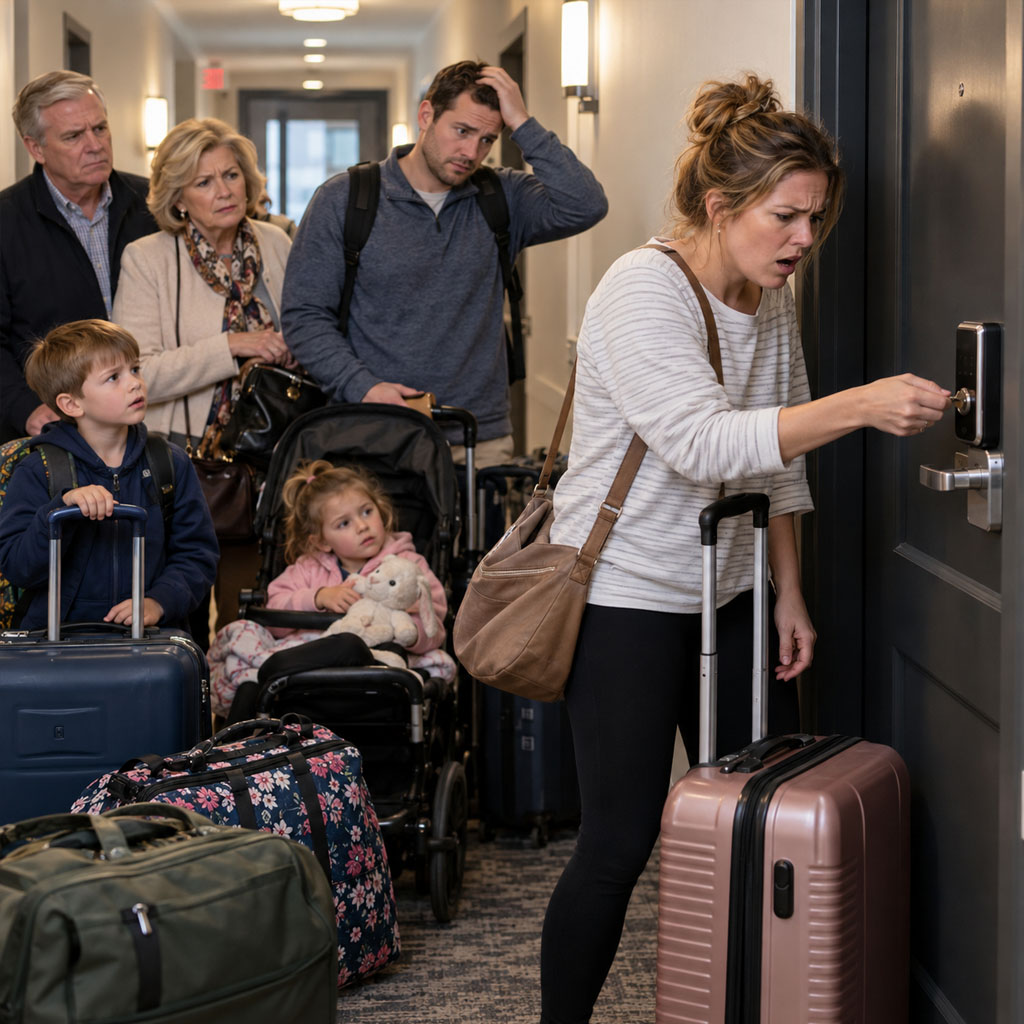
I sat motionless in my office, watching my sister struggle with a key that no longer worked.
For several seconds, nobody spoke.
Then Melissa laughed awkwardly.
“That’s weird.”
Brian looked at the lock.
“Maybe the building changed something?”
“No. I’ve used this key before.”
She tried again, jiggling it as though the door might eventually surrender out of embarrassment.
I watched the expressions behind her change.
Linda, Brian’s mother, was a carefully dressed woman in her early sixties who wore pearl earrings and seemed to have an opinion about almost everything. Her husband, Paul, owned a small chain of hardware stores. He had the confident posture of a man accustomed to being listened to.
Their son Ethan stood behind them with his girlfriend, Kayla. Brian’s grandmother, Ruth, held the handle of a floral suitcase, while Linda’s sister Denise carried a travel pillow.
They all looked increasingly uncomfortable.
Melissa knocked three times.
Not politely.
“Cynthia!”
I didn’t answer.
She called my phone. I declined.
She called again. I declined again.
Then the family group chat exploded.
Melissa: Your lock is broken!
Mom: Cynthia, answer your sister!
Dad: Can you open the door remotely?
Aunt Carol: This is getting ridiculous.
I looked at the camera again. Melissa was now attempting to force the old key into the deadbolt so aggressively that I worried she might break it.
I started recording my screen.
Then I copied the live camera link and posted it in the family group chat.
Underneath, I wrote:
“Since everyone believes I should hand over my home without permission, you can watch what happens when someone tries to enter after being told no.”
For about ten seconds, nobody responded.
On the camera, Melissa’s phone buzzed.
She looked down.
Her face changed.
First came confusion. Then embarrassment. Finally, anger.
She looked directly into the camera.
“You have got to be kidding me.”
Brian looked up.
“There’s a camera?”
Melissa immediately adjusted her expression.
“Oh my God. Cynthia, open the door. This is ridiculous.”
I typed into the group chat.
“I’m not opening the door. I told her no this morning.”
Mom replied almost instantly.
“You are humiliating your sister.”
I stared at the message.
Then I wrote, “No. She is standing outside my apartment with eight people after telling me I could stay in a hotel.”
Aunt Carol chimed in.
“Private family matters shouldn’t be broadcast.”
I replied, “Then private family members shouldn’t try to enter someone’s home without permission.”
The words seemed to change the atmosphere.
On the camera, Linda turned toward Melissa.
“She didn’t know we were coming?”
Melissa opened her mouth.
“She knows. She’s just being difficult.”
Brian looked at his wife.
“Mel, what?”
Melissa lowered her voice.
“Stop.”
“No,” he said. “You told me Cynthia offered.”
I leaned closer to my phone.
There it was.
The first real crack in Melissa’s story.
She hadn’t told them I refused. She hadn’t mentioned the text. She had told her husband and his family that I had offered my apartment because I’d be away for the weekend.
She had apparently presented herself as the generous sister arranging a comfortable place for everyone to stay.
Linda’s expression hardened.
“Melissa, did your sister actually offer?”
Melissa laughed, but it sounded strained.
“It’s fine. She does this. She likes control. She’ll open it.”
Then she leaned toward the camera.
“Cynthia, stop being bitter because some of us have families.”
I felt something inside me go completely still.
There it was again.
The old family belief that because I lived alone, my life somehow mattered less.
No husband. No children. No legitimate reason to protect my home.
I didn’t argue.
Instead, I sent three screenshots into the family chat.
The first showed Melissa’s original message.
“We need your apartment for the weekend. My in-laws are visiting. You can stay at a hotel.”
The second showed my response.
“No. My apartment is not available.”
The third showed her answer.
“Perfect. I’m using your key.”
For several seconds, the chat went quiet.
Then my cousin Naomi, who rarely involved herself in family arguments, wrote:
“Wait. She literally told you no.”
Nobody answered her.
On camera, Brian set the suitcases down.
“You told me she was excited to host us.”
Melissa whispered something I couldn’t hear.
Brian shook his head.
“No. Don’t lower your voice now.”
Linda looked mortified.
“We never would have come if we knew she hadn’t agreed.”
Her words surprised me.
A stranger understood the situation more quickly than my own parents.
Melissa suddenly turned toward the camera again.
“You’re really going to leave Grandma standing in a hallway?”
Ruth, who had been quiet until then, looked up.
“Don’t use me.”
I almost smiled.
Dad sent another message.
“Cynthia, enough. Open the door and discuss this later.”
I replied:
“No.”
He answered immediately.
“You’re making the family look bad.”
I took a breath.
“Melissa made the family look bad when she arrived with luggage at a home she was told she couldn’t enter.”
Then I sent photographs.
The wine stain on my rug. The cracked ceramic tray. The scratched clasp on my handbag. I included a screenshot of Melissa admitting she’d borrowed the bag and a photograph of the receipt for my new lock system.
Finally, I sent one more message.
“The old key stopped working because none of you were supposed to have it anymore.”
Mom responded.
“You changed the locks and didn’t tell us?”
I stared at those words.
Not, “Why did you feel you needed to do that?”
Not, “Has Melissa been entering your apartment without permission?”
Just outrage that their access had been removed.
“Yes, Mom,” I wrote.
“What if there was an emergency?”
“Then you call emergency services. You don’t send Melissa with eight people and a collection of suitcases.”
Melissa began pounding on the door again.
“Open it! You’re acting insane!”
A neighboring apartment door opened slightly.
I felt the old instinct rise in my chest. The instinct to apologize, smooth things over, and make sure nobody felt uncomfortable.
But I stayed in my chair.
Then the building concierge appeared on the camera.
Mr. Alvarez was in his sixties, calm and professional. He’d helped me carry a broken planter to the trash several months earlier and always greeted me by name.
He approached the group.
“Good evening. Is everything all right here?”
Melissa turned toward him.
“Yes. My sister lives here. The lock isn’t working.”
Mr. Alvarez looked at the suitcases, then at the camera.
“Miss Parker informed management last week that nobody else is authorized to access this unit.”
Melissa froze.
Brian closed his eyes.
Mr. Alvarez continued politely.
“Guests cannot block residential access. You’ll need to move the luggage and leave the hallway.”
Melissa pointed toward my door.
“But I’m her sister.”
He nodded.
“Yes, ma’am. And you’re not on the access list.”
I could almost feel the tension leave my shoulders.
Melissa grabbed her phone and sent me a voice message. Then another. Then a third.
In the family chat, she typed:
“You’re dead to me.”
Naomi answered before anyone else could.
“Because she won’t let you break into her apartment?”
For the first time in my adult life, someone in my family had defended me while the argument was actually happening.
Melissa looked furious.
“You all think this is funny?”
Then I unmuted the camera’s microphone.
My voice came through the small speaker beside the door.
“Melissa.”
Everyone stopped moving.
Chapter 3
Melissa stared at the camera.
“What?”
“I told you no. You came anyway. You lied to your in-laws, tried to use an old emergency key, and brought eight people to my home after telling me to stay in a hotel.”
I paused.
“That isn’t family. That’s entitlement.”
Nobody said anything.
Even Mr. Alvarez seemed to be waiting.
Melissa’s eyes filled with angry tears.
“You’re embarrassing me.”
“No,” I said. “I’m refusing to rescue you from a lie you told.”
Brian slowly picked up one of the suitcases.
“Let’s go.”
Melissa turned sharply.
“Are you serious?”
“Yes. I’m not standing in a hallway while you yell at a camera.”
Linda looked toward my door.
“Cynthia, I’m very sorry. We were told this was arranged.”
“I understand. I’m sorry you were put in this position.”
Her expression softened.
“Thank you.”
The group began gathering their belongings. Ethan picked up a duffel bag, Kayla stopped recording on her phone, and Paul helped Ruth with her floral suitcase.
Melissa remained where she was, arms crossed, glaring at my camera.
Mr. Alvarez gently reminded her that she needed to leave.
She grabbed her suitcase handle and said something that made my stomach tighten.
“This was supposed to make me look good.”
She hadn’t meant to say it loudly.
But the hallway camera caught every word.
The family group chat saw it, her in-laws heard it, and Brian stood only a few feet away.
I sat in my salon office, looking at the screen.
Not, “We needed help.”
Not, “We had nowhere else to go.”
Not even, “I’m sorry.”
This was supposed to make me look good.
Suddenly, everything made sense.
My apartment was a prop. My belongings were props. Even my absence was part of the arrangement.
Melissa wanted to impress Brian’s parents by presenting herself as someone who could offer a beautiful downtown home for their visit.
She wanted the credit without the cost.
And she expected me to disappear into a hotel while she played hostess in a life I had worked years to build.
The group finally left six minutes later.
Melissa was the last one to walk away. Before turning the corner, she leaned toward the camera and whispered:
“You’ll regret this.”
I saved the footage.
Not because I planned to use it against her, but because I had learned something about my family. Their memories of uncomfortable events had a remarkable tendency to change depending on who needed to be protected.
By nine that evening, my phone was practically vibrating off the desk.
Mom left a voicemail saying I’d traumatized everyone.
Dad texted:
“You proved your point. Now apologize.”
Aunt Carol sent a long message about how public humiliation was never acceptable.
I answered her with one sentence.
“Neither is entering someone’s home after they’ve said no.”
She didn’t reply.
Around ten, Brian sent me a text.
“Cynthia, I’m sorry. I didn’t know. My parents didn’t know either. Melissa told us you offered your place because you’d be away. We’re at a hotel. I’ll make sure nobody contacts you tonight.”
I read it three times.
Then I answered.
“Thank you for telling me. I hope your family is okay.”
He replied that everyone was embarrassed but fine. He apologized again for the situation and said he’d speak to Melissa.
It was strange receiving an apology from the person least responsible.
The people who actually owed me one were busy explaining why I had gone too far.
The next morning, I woke up to 73 unread messages.
I made coffee and sat on my green velvet couch.
Melissa had once joked that the couch was too fancy for one person.
I looked around my living room. The cream curtains were open, sunlight was falling across the floor, and the apartment was quiet.
For the first time in years, the silence felt sacred.
Not empty.
Not lonely.
Mine.
I opened the family group chat.
Mom had written several paragraphs overnight. She said Melissa had cried for hours. Brian was angry. Linda was being judgmental. My sister’s marriage was under unnecessary stress.
Then came the familiar sentence.
“You should have just opened the door and dealt with everything later.”
I read it slowly.
Then I typed:
“No. That’s what I’ve always done. I’ve absorbed the disrespect privately so Melissa could avoid the consequences publicly. I’m not doing that anymore.”
Dad replied:
“You sound cold.”
I answered:
“I sound finished.”
Then I sent one final message.
“Effective immediately, nobody in this family has access to my apartment. Nobody gets free salon services. Nobody borrows my clothes, handbags, products, or car. If you book at my salon, you pay the same deposit as every other client. If you show up at my home without permission, building security will remove you. I’m not discussing this again.”
Mom sent a shocked emoji.
Aunt Carol wrote:
“That’s extreme.”
Naomi replied:
“Honestly, it’s overdue.”
That started a different argument.
Not between Melissa and me, but between the relatives who had watched this pattern for years and those who had benefited from it.
Naomi admitted that Melissa had once told her I acted independent but always caved eventually.
An uncle said he’d always thought Melissa asked too much of me.
Aunt Carol insisted this wasn’t the time to bring up old problems.
Naomi answered:
“It’s been the time for ten years.”
I didn’t participate.
I’d said enough.
That Monday, I arrived at Velvet Room early. Tasha was already arranging fresh towels when I walked in.
She glanced at me.
“So, did the hotel guests survive?”
I burst out laughing.
It was a genuine laugh, the kind that loosened something in my chest.
By lunchtime, three relatives had called the salon trying to get me to reconsider my position. My receptionist, Maya, handled each one professionally.
“Velvet Room Beauty Studio is for appointments only. Personal matters should be directed to Cynthia’s personal phone.”
Then she blocked the numbers from the business line.
When I thanked her, she shrugged.
“You pay us on time and bring good coffee. We protect you.”
I nearly cried.
My own family had spent years telling me love meant unlimited access. Yet the people who worked for me understood the importance of respect without needing a family meeting.
Meanwhile, Melissa was dealing with the consequences of her decisions.
Brian had stayed at a hotel with his family that weekend. According to Naomi, he and Melissa spent much of the time arguing.
Linda had apparently asked her son, in front of everyone, why his wife thought it was acceptable to lie about someone else’s home.
Paul paid for the hotel rooms and told Melissa calmly that honesty was considerably cheaper than embarrassment.
Brian didn’t leave her. Not then.
But something between them had changed.
A week later, Melissa finally texted me.
Not an apology.
She wrote:
“I hope you’re happy. Brian’s parents think I’m a liar.”
I replied:
“You lied.”
She answered almost immediately.
“You didn’t have to expose me like that.”
I wrote:
“You exposed yourself at my door.”
She didn’t respond for two days.
Then another message arrived.
“Are you really choosing a lock over your sister?”
I looked around my apartment before answering.
At the couch I’d paid for. The kitchen I’d decorated myself. The bedroom where I’d once found my belongings scattered across the bed.
Then I looked at the front door.
It had stayed closed unless I opened it.
I typed:
“I’m choosing my peace over your entitlement.”
Melissa blocked me for a while.
I thought I would feel guilty.
Instead, I felt something I hadn’t experienced in years.
Relief.
Chapter 4
My mother tried a different approach the following Thursday.
She showed up at the salon without an appointment.
I was finishing a consultation with a client when Maya stepped into the room.
“Your mother is here.”
There was something in her voice that told me this wasn’t a casual visit.
Mom stood near the reception desk wearing a beige cardigan. She held her purse tightly against her stomach, looking around the salon as though she expected someone to explain why things had become so uncomfortable.
The old me would have rushed toward her.
I would have apologized for making things difficult, taken her into my office, and listened while she explained why Melissa’s feelings mattered more than my boundaries.
Instead, I finished my consultation, thanked my client, and walked over.
“Hi, Mom.”
She looked at me.
“Can we talk?”
“I have twelve minutes before my next appointment.”
Her expression tightened.
“So I get a time limit now?”
“You came to my workplace without asking. So, yes.”
She glanced around the salon.
“I don’t recognize you anymore.”
I almost said, That’s because you never really looked.
Instead, I waited.
Mom sighed.
“Melissa made a mistake. She’s under a lot of pressure.”
“She made several decisions, Mom.”
“She’s embarrassed. Brian is upset. His parents are judging her.”
I folded my hands.
“And what about me? I was under pressure too when eight people arrived at my apartment after I told her no.”
Mom looked away.
“You could have handled this privately.”
“I tried. I said no privately. She ignored it publicly.”
“She’s your sister.”
“And I’m your daughter.”
That stopped her.
For a moment, I saw something flicker across her face. Not quite guilt, but perhaps discomfort at hearing the situation described in a way she couldn’t easily dismiss.
Then she recovered.
“You’ve always been so hard, Cynthia.”
I nodded slowly.
“No, Mom. I became hard in the places where you kept asking me to be soft for people who kept hurting me.”
She didn’t answer.
Just then, my next client arrived. It was Mrs. Alvarez, the concierge’s wife, a sweet woman in her late sixties who always brought a cheerful energy into the salon.
She glanced at my mother, then smiled at me.
“Ready when you are, Cynthia.”
I looked back at Mom.
“I have to work.”
She left without hugging me.
I watched her walk through the front door.
I expected the moment to break my heart.
It didn’t.
It simply confirmed something I’d spent years trying not to understand.
Peace doesn’t always arrive as happiness.
Sometimes it arrives as the absence of panic. The absence of explaining yourself. The absence of bracing for another unreasonable request every time your phone lights up.
Over the following weeks, my life became quieter.
Not perfectly quiet.
Melissa unblocked me twice to send dramatic messages, then blocked me again when I didn’t chase her.
Dad sent one text.
“Pride will cost you your family.”
I replied:
“Disrespect already did.”
Aunt Carol posted vague quotes about forgiveness and family loyalty on social media. I didn’t respond.
Naomi sent me a private message one evening.
“I wish I’d spoken up sooner.”
I answered:
“You spoke up when it mattered.”
Brian texted once more to tell me he’d paid to repair a small scratch Melissa’s suitcase had left on the hallway wall. He apologized again.
I thanked him and left the conversation there.
I wasn’t interested in gossip, revenge, or convincing anyone to take my side.
The footage existed. The screenshots existed.
But more importantly, the boundary existed.
About a month after the incident, I woke up on a Sunday morning without an alarm.
Sunlight filtered through my cream curtains. My apartment smelled like fresh coffee and the lavender candle I only burned when I was home alone.
I decided to make pancakes.
They turned out terrible.
I was excellent at brow shaping, skincare consultations, and running a business, but apparently pancakes required a different set of talents.
I ate them anyway.
At my own kitchen table.
On my own plate.
In my own home.
Nobody had left suitcases in the hallway. Nobody was searching through my closet. Nobody had opened my refrigerator and taken whatever they wanted.
Nobody was telling me to be reasonable.
That afternoon, I invited people over for the first time since the incident.
Not a big gathering.
Tasha came with a bottle of wine. Maya brought flowers. Naomi arrived holding a small cake from a bakery near her office.
She looked nervous when I opened the door.
“Are you sure it’s okay that I’m here?”
I smiled.
“Naomi, I invited you.”
She laughed.
“I know. I just thought I should ask.”
“You’re always welcome when you’re invited.”
She nodded, and something about that simple exchange felt important.
We spent the afternoon talking in the kitchen and sitting on the green velvet couch. Tasha told us about a difficult client. Maya shared a funny story about a delivery driver who’d mistaken the salon for a doctor’s office.
Nobody opened doors without asking.
Nobody wandered into my bedroom.
Nobody treated my home like a showroom they were entitled to inspect.
At one point, Tasha raised her glass.
“To locked doors.”
Maya laughed.
“And smart women.”
Naomi looked at me and added quietly:
“And finally being done.”
I raised my glass.
That was the toast that stayed with me.
Because the smart lock had never really been about technology.
It wasn’t punishment.
It wasn’t revenge.
It was a finish line.
For years, I’d believed being a good daughter and a good sister meant staying available. Available to help, available to lend, available to forgive, available to rearrange my life whenever somebody else needed something.
I’d confused being needed with being loved.
And I’d mistaken my family’s expectations for obligations I had no right to question.
But love shouldn’t require you to surrender your home, your privacy, or your dignity.
It shouldn’t mean that one person gets everything while another person is expected to quietly disappear.
Real family doesn’t assume access.
Real family asks.
And when the answer is no, real family respects it.
I still loved my sister. That didn’t mean I had to let her walk into my apartment whenever she wanted. I still loved my parents, but that didn’t mean I had to accept every demand they made in the name of keeping the peace.
Some relationships would take time to repair.
Others might never return to what they had been.
I could live with that.
Melissa had wanted my apartment for the weekend. She wanted my bedrooms, my towels, my refrigerator, my view, and the comfortable home I’d worked so hard to create.
She wanted me to check into a hotel so she could check into my life and pretend it belonged to her.
Instead, she got a hallway, an outdated key, and eight people who finally heard the truth.
And I got something better than revenge.
I got my home back.
I got my peace back.
Most importantly, I got myself back.
That evening, after everyone had left, I walked through the apartment turning off the lights. I collected the empty glasses, put the leftover cake in the refrigerator, and straightened the pillows on my couch.
Everything was exactly where I’d left it.
At the front door, I pressed the lock button and listened to the familiar click.
For years, I’d heard that sound and thought about keeping people out.
Now I understood what it really meant.
My home was a place where I could rest without apologizing. A place where I could invite people in because I wanted them there, not because someone had decided I owed them space.
When the door locked behind me, I no longer heard guilt.
I heard freedom.
THE END.
⚠️ All characters and events are fictional. Do not imitate or apply them in real life. 😌😌😌


