
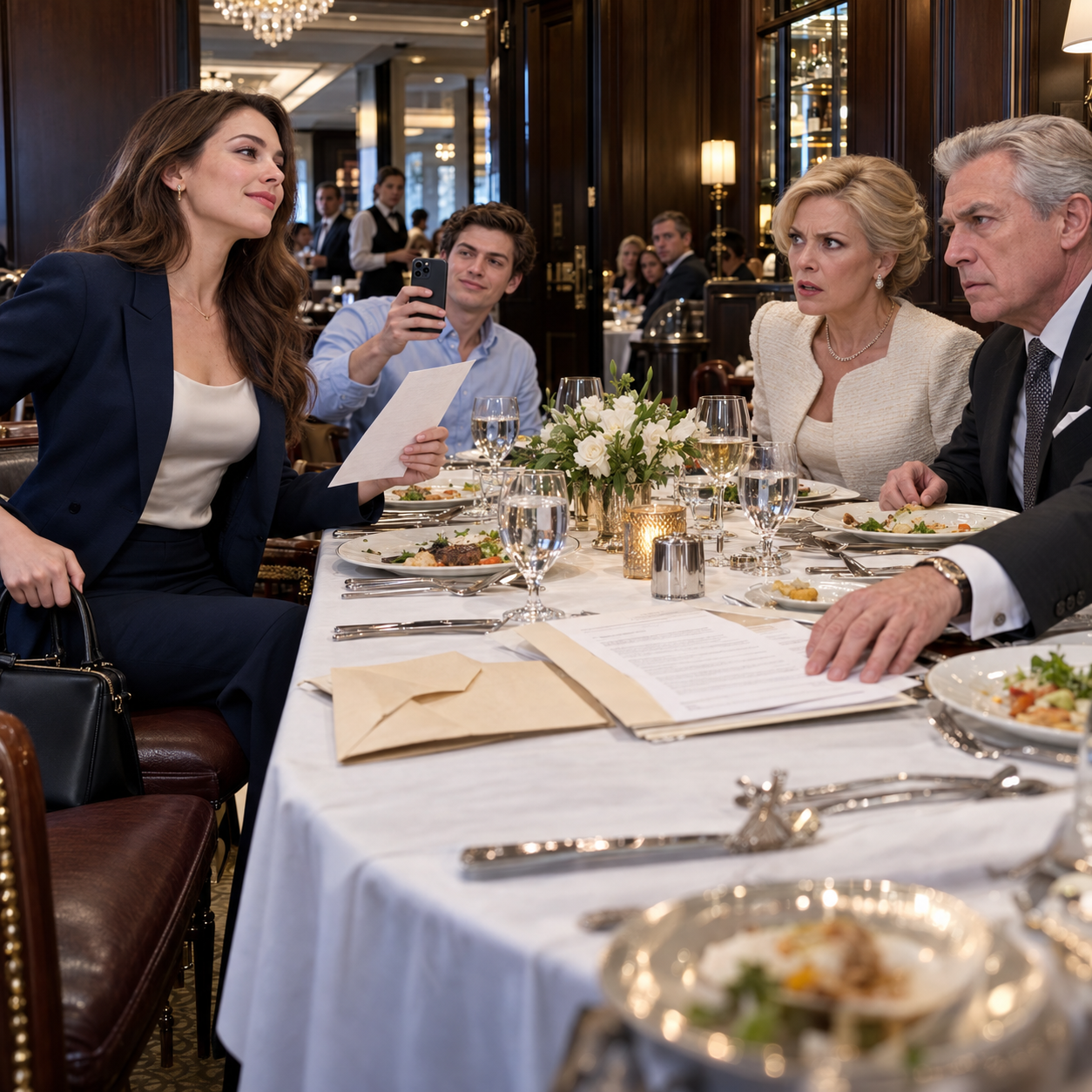
### Part 2: My Father’s Attempt to Stop the Broadcast Exposed Everything
Dad entered Marlow Terminal without greeting me, surveying the restored brick walls like an inspector searching for violations. “Who owns this property? Which company holds the leases? Who financed the construction?” Caleb answered calmly until Dad began demanding copies of our contracts. Behind them, Logan narrated into his livestream, joking that his sister had transformed an old warehouse into an expensive personality crisis.
I walked past him toward our production table. “Try not to block the actual cameras,” I said. He laughed, certain he’d embarrassed me, while I signed a final equipment checklist.
At 7:50, Marissa pulled me aside. Our third sponsor had called after seeing Logan’s viral video and was considering withdrawing from the broadcast. Suddenly, my stomach tightened. Forty people had helped prepare this launch, and twenty-three businesses were depending on the attention it might generate. I couldn’t allow my family’s behavior to jeopardize their opening day.
I took the call behind the old baggage counter. “We invested in a restoration project, not a public family argument,” the marketing director explained. I watched through the glass as Logan filmed Dad questioning Caleb. “Neither did I,” I answered. “There will be no personal accusations or public attacks from our production.” After a long silence, the director agreed to stay.
When I returned, Caleb was preventing Dad from entering the restricted production area. “Sophie, explain who I am,” Dad demanded, gesturing at the barrier. I met his eyes. “He knows exactly who you are.” Dad’s face hardened, and Logan swung his phone toward us, delighted by the confrontation.
Mom stepped closer, lowering her voice. “Your father believes you’ve used his company’s relationships to secure this project.” I pointed toward our contract folders. “Everything is documented. He’s welcome to consult our attorneys.” Dad scoffed. “Stop behaving like this is a legitimate enterprise.” Marissa approached and attached my microphone. “Two minutes, Sophie.”
At exactly eight, the mechanical departures board clicked overhead, replacing the vendors’ names with three words: SECOND LIFE SPACES.
Our broadcast began.
I guided viewers through the terminal, showing original freight doors transformed into storefront entrances and century-old metalwork incorporated into modern fixtures. We had preserved sixty-eight percent of usable original materials, reduced projected interior construction costs by seventeen percent, and recovered more than four tons of steel. Historic tax incentives had helped complete the financing, and twenty-three independent businesses had signed leases.
Caleb joined me to explain how thoughtful restoration could outperform demolition financially. Behind the cameras, I noticed Logan checking comments instead of making jokes. People were sharing before-and-after photographs, asking about the businesses, and linking to an industry article published the previous month. His audience was discovering that the supposed family failure had a functioning business.
At 8:27, Dad cornered Marissa. “Whatever announcement she’s planning, you need to stop it.” Marissa didn’t move. “On what grounds?” He glanced toward me. “It could create a conflict involving my company.” She opened a folder. “Your company has no ownership, financial participation, or contractual relationship with this production.”
At 8:30, I received my cue.
Six photographs appeared on the departures board, each showing an aging hotel awaiting renovation. “I’m delighted to announce,” I told our viewers, “that Northline Hospitality has commissioned Second Life Spaces for preservation planning across six additional properties.”
Mom stared upward. Logan stopped speaking.
Dad looked as if someone had removed the floor beneath him.
Northline’s chief development officer, Rachel Mercer, appeared remotely on our large screen. She explained that our proposal had beaten two larger firms on projected long-term costs and preservation expertise. She praised our material recovery methods and relationships with local suppliers.
She never mentioned the Hunter family.
Logan apparently couldn’t bear it. Still broadcasting, he turned toward Dad. “Didn’t Northline approach Hunter Development first? Isn’t Sophie basically taking our business?”
Rachel heard him.
“For clarity,” she said, her voice carrying across the entire terminal, “Northline has no active agreement with Hunter Development. We evaluated several firms through a competitive process, and Sophie’s team earned this work independently.”
A dreadful silence followed.
Dad took one step toward Logan. “Turn off that phone.”
But Logan had already broadcast the correction to thousands of viewers. Contractors, journalists, prospective tenants, and business owners had heard everything. My father had spent years insisting that any opportunity I received came from his influence. Now an executive whose approval he desperately wanted had publicly confirmed otherwise.
I watched his face and waited for the satisfaction I’d imagined so often.
Instead, I felt something unexpected.
Relief.
For once, I didn’t need to defend myself.
### Part 3: My Brother’s Camera Captured the Truth He Wanted Hidden
By 9:15, visitors were gathering outside the terminal, and our broadcast had become the morning’s most talked-about local business story. I was reviewing the next segment when Mom approached, holding her purse tightly against her side. “You financed all this without your trust?” she asked. I nodded. “No collateral from the family? No money through your father’s company?” I shook my head again.
“Why didn’t you tell us?” Her question made me look away toward the restored ticket counters. “I told you what I was working on for years, Mom. You only wanted to know when I planned to join Dad’s company.”
Before she answered, Logan appeared with his livestream running. “Tell everybody about the loan, Sophie,” he demanded. “Doesn’t sound very independent when you’re borrowing money.” I turned toward his camera. “It’s a commercial loan, negotiated at market rates, and every payment is current.”
“So you’re in debt,” he announced triumphantly.
“Yes, Logan. That’s generally how borrowing works.”
Someone nearby laughed. His cheeks reddened, but he pressed forward, accusing me of pretending I’d accomplished everything alone. “I have forty people working on this launch,” I replied. “I never claimed I built it alone. Independence means choosing the people you work with, not surrendering control to whoever pays your bills.”
He immediately changed tactics. “At least admit you grew up privileged.” I nodded. “Absolutely. I had opportunities many people didn’t. That doesn’t mean my father owns every decision I make.”
Caleb stepped beside us. “Her preservation proposal was the most cost-effective among our finalists,” he said. Logan swung the camera toward him and snapped that nobody had asked for his opinion. Caleb barely blinked. “You’re standing inside a building your sister helped save, trying to persuade people she accomplished nothing. Someone should explain the contradiction.”
The comments began moving too quickly for Logan to follow.
People asked why he seemed desperate for me to fail. Others wondered why a successful businessman would disown his daughter the night before her biggest professional announcement. One viewer questioned why my brother needed a camera at every family disagreement.
Logan ended his broadcast without another word.
At ten, Marlow Terminal opened to the public. Hundreds of visitors entered beneath the restored departures board, exploring shops, interviewing vendors, and photographing the renovated hall. I was speaking with a grocery tenant when Dad approached. Mom followed several steps behind, while Logan hovered near the doors.
“Outside,” Dad ordered. “We need a private conversation.”
“I’m working.”
“You’re embarrassing this family.”
I stared at him. “You removed me from it last night.”
Several nearby conversations stopped. Dad lowered his voice and demanded that I acknowledge Northline had previously considered Hunter Development. I confirmed that the company had evaluated multiple firms, including his. “Then you should have stepped aside,” he insisted. “There are professional boundaries you don’t cross.”
“Which contract did I take from you?” I asked. “Which proposal contains your signature? Which invoice did your company pay?”
Dad’s jaw tightened. “Your surname opened doors.”
“Some doors closed because of it,” I answered. Caleb, standing nearby, confirmed he’d initially questioned my qualifications precisely because I was Grant Hunter’s daughter.
Dad glanced around at the watching crowd, then reached toward a wireless microphone on the equipment table. Caleb placed a hand over it. “That’s production equipment, Mr. Hunter.” When Dad demanded it, Caleb refused. Marissa joined us and explained that interfering with the event would result in security asking him to leave.
Logan raised his phone again.
“You’re enjoying humiliating us,” he accused.
“No,” I answered. “I’m trying to finish my work.”
He laughed bitterly. “This whole show was about proving us wrong.”
I looked toward the crowded shops and paused. “At first, part of it was. I wanted Dad to regret calling my career worthless, Mom to defend me, and you to stop making jokes.” My voice steadied as I continued. “But after months of negotiating leases, repairing budgets, solving construction problems, and helping these owners open their businesses, something changed. I stopped needing your permission to succeed.”
The old departures board clicked above us.
Before Logan could respond, Rachel Mercer entered with two Northline executives. She crossed the room, handed me a folder, and smiled. “Sophie, our board has approved the Milwaukee hotel as a potential seventh project. We’d like your team to lead the adaptive reuse concept, subject to final contracting.”
I stared at her, genuinely surprised.
Dad recognized Rachel immediately. She greeted him politely, then returned her attention to me, suggesting we discuss the new project Monday.
Logan slowly lowered his phone.
For the first time, there was no performance left in his expression.
And the most damaging video of the morning had already been recorded.
### Part 4: The Final Revelation Changed My Family’s Future Forever
Ten minutes after Rachel left to tour the businesses, Marissa hurried toward me with her phone. Logan had restarted his livestream during Dad’s confrontation without realizing the platform had retained his automatic publishing settings. Everything had gone online: Dad demanding control over my contracts, Caleb blocking him from the microphone, Marissa warning him about security, and my explanation of why I’d stopped seeking my family’s approval.
By noon, strangers had saved the recordings and placed them beside Logan’s edited dinner video. The comparison was devastating. In one clip, my parents cut me off because they believed I would fail. In another, Dad demanded a share of the success he’d insisted I could never achieve.
Logan deleted his original post, but copies were already circulating. A reporter approached me near the entrance and asked whether I wanted to respond to my family’s accusations. I looked toward the vendors serving their first customers. “This project was scheduled long before yesterday’s dinner,” I answered. “Today belongs to the people opening businesses here.”
Dad departed without saying goodbye. Logan followed after several visitors recognized him from the videos. Mom remained behind, standing beneath the century-old departures board as though she had forgotten where she was supposed to go.
Later, I found her sitting on an empty bench near the old platform wall.
“May I explain something?” she asked.
I sat beside her, leaving a little space between us. She studied her clasped hands before speaking. “I knew your father intended to remove you from the trusts. I supported it.” My chest tightened, though I had suspected as much. “We convinced ourselves we were forcing you to make responsible decisions,” she continued. “But seeing this place today made me realize something unpleasant.”
I waited.
“I think I was afraid you’d succeed without us,” she whispered. “If you did, it would mean we’d spent years demanding that you follow your father’s path because it suited us, not because it was right for you.”
For a moment, I watched a young shop owner arranging flowers behind a salvaged window frame. My mother had finally said something more meaningful than congratulations. She had admitted the truth.
“Mom, you don’t have to admire every choice I make,” I said. “But you can’t threaten my place in the family whenever I disagree with you. And you can’t keep treating Logan’s humiliation videos as harmless entertainment.”
Tears gathered in her eyes. “You’re right.”
I didn’t embrace her. The confession mattered, but one morning couldn’t repair years of silence.
“If we have a relationship,” I continued, “it must exist without financial conditions, without Dad’s permission, and without the threat of being discarded.”
She nodded slowly. “I understand.”
“I hope you do.”
Before leaving, she glanced around the terminal. “This building is extraordinary, Sophie. I wish I’d said that when you first showed us the plans.”
“So do I, Mom.”
She accepted those words and walked toward the exit.
Logan called twice that afternoon. His first voicemail blamed me for the criticism he was receiving online, while the second asked me to explain publicly that his videos lacked context. I listened without responding. For years, he’d removed context whenever it made me look better. Now he wanted the protection he’d never offered me.
Still, I instructed our production team not to engage with personal attacks against my family. I wanted our reputation built on restoration, not a permanent public feud.
By Monday, Northline had formally added the seventh property to our commission. Within a month, Second Life Spaces hired two project coordinators and a preservation researcher, while Marlow Terminal’s businesses began settling into their new spaces.
Dad eventually sent an email claiming I’d misunderstood his intentions. I replied that I understood them perfectly, but would no longer accept money or obedience as conditions of a relationship. He never answered.
Mom began calling occasionally. Our conversations were careful, sometimes awkward, but she asked about my work without comparing it to Dad’s company. Logan disappeared from my social feeds for several weeks and eventually returned without his usual collection of embarrassing family clips.
One evening, I visited Marlow Terminal after the crowds had gone home. A grocery owner was locking her counter, and warm light spilled across the restored brick floor. She thanked me for helping create a place where her family could finally open the business they’d dreamed about for years. I watched her turn the key, remembering how Dad had once described buildings like this as worthless ruins.
I reached into my wallet and removed the torn corner of his letter.
Effective immediately.
For months, I’d carried those words as evidence of the night my family rejected me. Standing beneath the departures board, I finally understood what they meant. My father had given me opportunities, education, and advantages, but somewhere along the way, he’d mistaken those gifts for ownership.
I slipped the paper back into my wallet and looked around the terminal we’d brought back to life.
On that terrible night, my mother believed she was removing me from the family’s future. She never imagined I had already been building one of my own.
And when my brother pointed his camera at me, hoping to capture the moment I fell apart, he accidentally recorded the beginning of something else.
The moment I stopped asking my family to see my worth.
The moment I finally saw it myself.
THE END.
All characters and events in this story are fictional, created for storytelling and entertainment purposes. Thank you sincerely for reading. Your feedback and support are invaluable and motivate me to continue sharing more stories with you.


