
Chapter 2
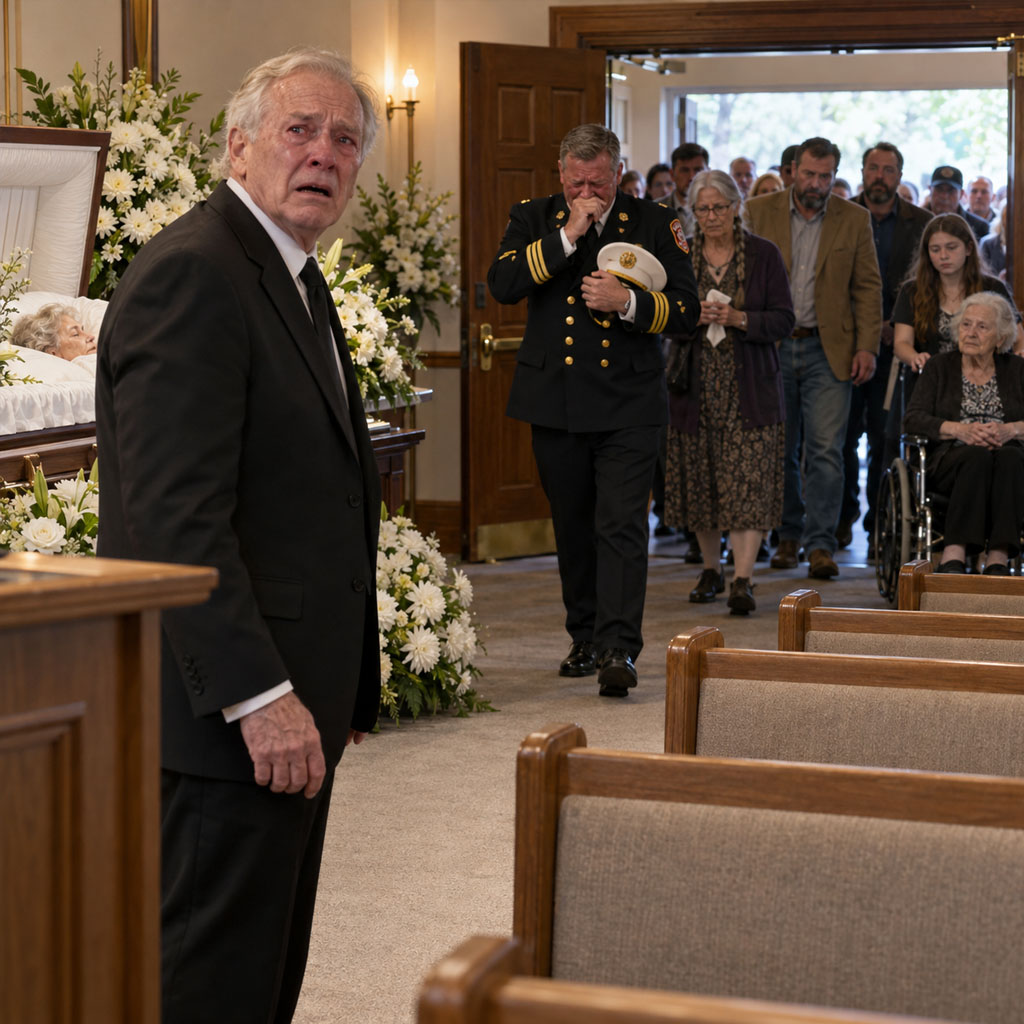
By one o’clock, the coffee in the reception room had gone cold. The last mourners were leaving with casserole dishes, leftover sandwiches, and damp tissues tucked into their pockets.
I thanked every person who came.
I shook hands, accepted hugs, and listened to stories about my wife that I had never heard before.
Only after the building had emptied did I look at my phone properly.
Bruce found me sitting alone in a small side room.
“You haven’t eaten anything,” he said.
“I’m not hungry.”
He pulled out a chair.
“How many messages?”
“Nine voicemails.”
He looked at the phone lying on the table.
“Nine?”
I nodded and pressed play.
Dylan’s voice filled the room.
“Dad, this is an emergency. The card keeps getting declined. The whole bill is thirty-one thousand dollars. Connie’s party, the hall, the band, the open bar. I used the card you gave me for emergencies. This is an emergency. Call me.”
The next message was louder.
“Dad, Terry is losing his mind. He’s telling everyone I’m a freeloader. The banquet manager says they’re not releasing us until the balance is handled. Please pick up!”
Another message contained a man’s voice in the background.
“Get this freeloader away from my guests!”
I recognized Terry Richardson, Connie’s husband. He owned a regional transportation company called Cole Logistics. He was wealthy, loud, and accustomed to people doing what he wanted.
Dylan had always admired him.
Bruce shook his head.
“Forty-four calls, Glenn. And not one of them was to ask how you were doing.”
I stared at the phone.
Darlene would have answered by the second ring.
But I wasn’t Darlene.
The door opened.
A woman stood there holding a little boy’s hand.
It was Brianna, Dylan’s wife. She was wearing a party dress beneath an ordinary winter coat. Her mascara was smudged, and her hair had come loose from its careful arrangement.
Beside her stood Wyatt, their eight-year-old son, wearing a blue school blazer and holding a rolled-up piece of paper.
“We left,” Brianna said.
Her voice was quiet.
“I told Dylan I couldn’t stay at that party. He said I was being dramatic. I’m sorry, Glenn. I’m so sorry we weren’t here earlier.”
I looked at Wyatt.
He stepped forward and handed me the paper.
It was a crayon drawing of a woman with curly gray hair standing in a garden. There were yellow flowers around her feet and a large smiling sun in the corner.
Across the top, in uneven letters, he had written:
GRANDMA’S FLOWERS.
I knelt in front of him.
“Buddy, that’s beautiful.”
“Mom helped me make it.”
I looked at the drawing again.
“Grandma would have loved this.”
Wyatt studied my face.
“Is Grandma cold?”
I swallowed.
“No, son. She’s with the flowers now.”
He nodded as if that answered everything.
Brianna covered her mouth and began crying.
I hugged them both.
Then I noticed someone standing near the coat rack.
Monica Hayes, our family attorney, had been waiting for me. She had prepared our wills twenty years earlier and had known Darlene almost as long as I had.
She was holding a thick cream-colored envelope sealed with red wax.
“Glenn,” she said. “Your wife left this for you.”
I recognized the handwriting immediately.
Across the front were the words:
For Glenn. Not until the right moment. Monica will know.
I stared at it.
“What is this?”
Monica held it carefully.
“Darlene made me promise not to give it to you until I believed the time was right. She gave me very specific instructions three weeks before she died.”
“When was I supposed to open it?”
“When you were ready to understand why she made certain decisions.”
I looked at the red wax.
“Did she tell you what was inside?”
Monica shook her head.
“She told me only that I was not to let you open it too early, no matter how much you insisted.”
I almost smiled.
“That sounds like Darlene.”
Monica placed the envelope in my hand.
It felt heavier than a single sheet of paper should have.
I slipped it inside my coat.
By the time I arrived home, the sun was beginning to disappear behind the neighboring houses.
And Chelsea was waiting on my front porch.
She rushed toward me before I had fully stepped out of the car.
“Daddy!”
She threw her arms around my neck and sobbed into my funeral coat.
“I’m so sorry. I’m so, so sorry.”
I hadn’t heard her call me Daddy in years.
I held her for a moment, then gently stepped back.
She was thirty-five, but she looked much younger and considerably more frightened. Her face was pale, her mascara had run, and her clothes looked as though she’d spent the day traveling.
But something didn’t make sense.
There was no suitcase.
And her skin was as pale as it had been when she’d left home.
“I thought you were in Mexico,” I said.
“I was.”
She looked down.
“I got sick, Dad. Really sick. They kept me in the hospital for four days.”
I didn’t respond.
“It’s been awful. I have an $11,000 hospital bill, and my insurance won’t cover it. I didn’t know what else to do.”
I looked at her.
“Which hospital?”
She hesitated.
“The big one near the beach.”
“What was its name?”
“Dad, I don’t remember. I was sick.”
I noticed a folded paper sticking out of her purse.
She saw me looking and tried to push it farther inside.
I reached for it.
She pulled back too late.
It was a bus ticket.
Detroit to Grand Rapids.
Departure time: 5:40 that afternoon.
I looked at the ticket, then at her shoes.
The soles were covered in road salt and gravel.
“Interesting,” I said.
She began crying again.
“Dad, please. I need eleven thousand dollars by Monday.”
I had spent thirty years as an insurance claims adjuster. I had listened to people explain accidents, illnesses, and losses. I knew the difference between someone who was frightened and someone who was trying to sell me a story.
I also knew my daughter.
“How long have you been in Detroit?”
She stared at the porch boards.
“Four months.”
“With whom?”
“A man named Aaron.”
I closed my eyes.
She explained everything in pieces.
Aaron had a business idea involving an online wellness platform. He claimed he needed a small investment to launch it. Chelsea believed him and used the $22,000 Darlene had given her in June to start a yoga studio.
The money disappeared.
Then came a private lender who had begun calling her late at night.
Now she wanted me to pay the latest debt.
“Mom would have helped me,” she said.
I looked at her.
“Your mother did help you. She gave you twenty-two thousand dollars and more chances than I can count.”
Chelsea’s expression hardened.
“You’re really going to turn me away?”
“Not today. Not after what you’ve just told me.”
“Dad, please.”
I shook my head.
“Your mother spent her final weeks asking for you. You weren’t there.”
Her eyes filled.
“She didn’t want to see me.”
“She did want to see you. But something happened a month before she died. Something she heard.”
Chelsea went still.
“What does that mean?”
“It means you should go home, Chelsea.”
She stared at me as though I had struck her.
“You’re a cruel old man.”
Then she turned toward the door.
“Mom was too good for you. Everyone knew it.”
The door slammed.
The family photographs rattled against the hallway wall.
I stood on the porch, unable to move.
Bruce was at the end of my driveway. He had come over after seeing Chelsea arrive.
He walked toward me and put an arm around my shoulders.
“Come inside, Glenn.”
I followed him into the kitchen.
He placed a small silver device on the table.
It was the doorbell camera from our front entrance.
“Darlene asked me to keep this footage in September,” he said.
I stared at it.
“What footage?”
Bruce looked uncomfortable.
“She gave me the recording after something happened at the house. I haven’t had the heart to watch it. But I think it’s time you did.”
I looked toward the staircase.
Then at the cream envelope inside my coat.
“What’s on it?”
Bruce lowered his voice.
“Your children.”
Chapter 3
Monica came over Sunday morning with her laptop and a folder of documents.
I sat in my study, where Darlene’s reading glasses were still folded beside a cup of tea nobody had been able to bring themselves to clear away.
The room still smelled faintly of her lavender hand cream.
Bruce had placed the camera footage on a flash drive. Monica wanted to review it before deciding what could be done with it.
“Glenn,” she said, opening her laptop, “I want you to understand something. We’re not going to use this recording carelessly. We need to consider privacy and the circumstances in which it was obtained. But you should know what your wife discovered.”
She pressed play.
The date on the screen was September 6.
The time was 3:12 p.m.
The recording showed our front entrance.
Darlene had been resting in the front room. The hospice nurse had told us she would probably sleep until five.
A few minutes later, the front door opened.
Dylan walked in first.
Chelsea followed.
They were using keys I’d given them years earlier.
Dylan glanced toward the living room.
“She’s out cold. The nurse said she’d sleep until five.”
Chelsea looked nervous.
“Then do it now.”
Dylan held up a folder.
“Where’s the power of attorney?”
“Right here.”
He opened it.
The words were visible on the first page.
Continuing Power of Attorney for Property.
I felt my stomach tighten.
The conversation continued.
“She signs it, and we control everything. The house, the accounts. We get access to the money without having to ask Dad for every little thing.”
Chelsea looked toward the hallway.
“What if she refuses?”
“She won’t. We tell her it’s for Dad. We say we need to make things easier because he’s getting old.”
“And if he asks questions?”
Dylan laughed.
“We get a capacity assessment. Half the neighborhood already thinks he’s slipping.”
I stared at the screen.
Then Chelsea said something that made Monica stop typing.
“I’m drowning, Dylan. Terry needs money by the end of the year. I promised him I’d have it.”
“Then get Mom to sign.”
“This house is worth eight hundred thousand easily. What about her jewelry?”
“Take it. Just get me the house.”
Chelsea looked toward the living room.
Then she said something that made the room seem to lose all its air.
“The old girl is taking forever. They gave her six weeks in July.”
Dylan’s voice became urgent.
“Chels, don’t.”
“Why not? She’s living too long.”
Then she laughed.
A small, bright laugh.
I remembered running behind Dylan’s first bicycle down our street, one hand holding the seat, shouting that I would never let go.
I remembered Chelsea at six years old, asleep on my chest during a thunderstorm.
Those children had existed.
I was certain of it.
I simply couldn’t find them anymore.
I looked at Monica.
“Was Darlene awake?”
Monica closed the laptop halfway.
“She was.”
I turned toward her.
“What?”
“She told me about it that night. She had been resting in the front room when they came in. She heard enough to understand what they were planning.”
I felt something tighten behind my ribs.
“Why didn’t she tell me?”
“She didn’t want you confronting them while you were caring for her. She was afraid the situation would become even more difficult.”
I lowered my head.
For six weeks, I had been helping my wife through the final stage of her illness. I had slept in a chair beside her bed, helped her with medication, and held her hand when she woke frightened in the middle of the night.
Meanwhile, our children had been planning how to take control of the house.
Monica continued.
“Darlene called me the following Monday. She was very clear about what she wanted.”
I looked up.
“What did she do?”
“She contacted the bank herself. She canceled the supplementary card on the joint account.”
I thought about Dylan’s forty-four calls at the funeral.
The declined card.
The $31,000 bill.
Suddenly, it all made sense.
Monica turned another page.
“She also wrote each of them a letter. She specifically instructed me not to let you pay any debts they accumulated after her death.”
I stared at her.
“She knew about the party?”
“She knew they were becoming financially irresponsible. She knew about Chelsea’s investment problems. She had also discovered that Dylan had been using the emergency card for expenses that had nothing to do with emergencies.”
I rubbed my face.
“Why didn’t she tell me?”
Monica’s voice softened.
“Because she wanted them to stand on their own. She said that every time you rescued them, they learned that somebody else would eventually pay for their decisions.”
I sat back.
Darlene had been protecting me.
And she had been protecting our children from the consequences of their own behavior.
But she had also been dying.
I couldn’t understand how she’d carried all of that without telling me.
Monica placed her hand on the folder.
“There’s something else. She asked me to make sure you understood that setting boundaries wasn’t the same as abandoning your children.”
I looked toward the photograph of Darlene on my desk.
“She always knew how to say things I didn’t want to hear.”
Monica smiled sadly.
“She was very good at that.”
The next morning, Dylan arrived.
It was 10:09.
He wore yesterday’s shirt, and dark circles sat beneath his eyes.
I opened the front door before he could ring.
“Dad.”
“Dylan.”
He stood on the welcome mat, looking past me into the hallway.
I moved aside.
He walked in slowly.
His eyes stopped on the family photographs. Darlene’s wedding portrait was still on the small table near the staircase.
He looked at it for a long moment.
“Brianna’s at her mother’s with Wyatt,” he said. “She won’t answer my calls. Everyone’s turning against me.”
“I’m sorry you’re having a difficult time.”
He sat on the sofa.
“Terry made me sign for the hall personally. Thirty-one thousand four hundred dollars. He said you would cover it.”
I didn’t answer.
“He told me you and Mom had approved the card as a gift. I thought everything was fine.”
I sat opposite him.
“Did you?”
He looked down.
“I have maybe four thousand dollars in my account. I’ll pay you back with interest.”
“With what?”
“Work. Terry’s company. I don’t know, Dad. I’ll figure something out.”
He leaned forward.
“Mom would have written the check without asking questions.”
I looked at him.
“Your mother stopped writing checks for you on September 8.”
He went still.
“What does that mean?”
I waited.
“Where were you on September 6 at three in the afternoon?”
The color drained from his face.
His eyes moved toward the hallway, then toward the stairs.
“I don’t know what you’re talking about.”
“I watched the recording.”
He said nothing.
“Your mother was awake, Dylan.”
He looked at me.
I had never seen his expression change so quickly.
“She heard everything.”
He stood.
“You’re blaming me for what happened to her?”
“I’m asking you to tell me why you were in this house with your sister, carrying a power of attorney.”
He shook his head.
“You don’t understand.”
“Then explain it.”
He stared at me.
Then his expression hardened.
“You let her die in that bed, Dad. A hospital would have had real doctors. You turned our house into a place where she had to suffer, and you made me watch from a distance.”
The words hit me square in the chest.
I stood up.
“That’s enough.”
A voice came from the kitchen.
“No. It isn’t.”
Kathy Garcia, Darlene’s hospice nurse, was standing in the doorway with a dish towel twisted in her hands.
She had come to return the walker we’d borrowed during Darlene’s final weeks.
“I sat with your mother every night for six weeks,” Kathy said. “Your father was there every single time I visited. He learned how to help her eat when she couldn’t manage a full meal. He stayed awake when she couldn’t sleep. He held her hand when she was frightened.”
Dylan looked away.
“Where were you?”
Nobody answered for him.
I stepped closer.
“Sit down, Dylan.”
He didn’t move.
“Ask me one question. Any question you want, before you ask me for another dollar.”
He stared at me.
I waited.
His mouth opened.
Nothing came out.
“Ask me how I’m holding up,” I said.
He looked down at the floor.
He couldn’t do it.
Not one question.
He picked up his jacket and turned toward the door.
His elbow caught the small shelf beside the hallway.
Darlene’s framed photograph toppled.
The glass shattered against the hardwood.
We both looked down.
For a moment, I saw the little boy who had once broken a vase and hidden the pieces beneath the stairs.
Then his face hardened.
“I hope you rot in this house, Glenn.”
The door slammed.
I sank to my knees among the broken glass.
I picked up the photograph carefully.
A small piece of glass cut my palm, and a thin line of blood crossed the corner of Darlene’s smiling face.
Kathy knelt beside me and pressed the towel against my hand.
“He’s upset,” she whispered.
I looked at the photograph.
“No. He meant it.”
Chapter 4
Monica read Darlene’s will on Thursday afternoon in her office downtown.
Dylan and Chelsea were already waiting.
It was the first time in years I’d seen either of them arrive early for something that didn’t involve money.
Monica sat behind her desk and opened the file.
“Your mother’s instructions are straightforward,” she said. “Her individually owned assets pass to Glenn Peterson.”
Chelsea frowned.
“Everything?”
“The jointly owned family home is not part of the estate. It passes to your father under the existing ownership arrangement.”
Dylan shifted in his chair.
“What about the life insurance?”
Monica turned a page.
“The $400,000 policy names the Grand Rapids Hospice Foundation as beneficiary.”
Chelsea stared at her.
“She gave all of it to hospice?”
“She changed the beneficiary in September.”
“She wasn’t thinking clearly!”
Monica opened another folder.
“Her physician certified her decision-making capacity in writing on September 12. I have the documentation.”
Dylan leaned forward.
“That’s not fair.”
Monica continued.
“Your mother also left each of you a personal letter.”
She placed two envelopes on the desk.
Neither child reached for them.
Then she slid two additional pages across the table.
“There is another matter. Your mother requested that Glenn be given legal protection concerning the family home. Both of you are formally notified that you do not have permission to enter the property without his consent.”
Chelsea stared at the pages.
“You’re locking us out?”
“Your mother wanted to ensure her wishes were respected.”
I looked at my children.
“She knew what you were planning.”
Dylan stood so quickly his chair struck the wall.
“Fine. Keep it. Keep your eight-hundred-thousand-dollar mausoleum.”
He grabbed his jacket.
“Come on, Chels.”
At the door, Chelsea turned toward me.
Her lips trembled.
“I hope you die in that house, Dad, so we can finally stop waiting.”
Then she left.
Monica remained silent for several seconds.
I looked down at my hands.
They weren’t shaking.
That surprised me.
The consequences didn’t arrive all at once, and they didn’t come from me.
Chelsea’s financial troubles eventually became public to the people involved.
The man she’d trusted with her money, Aaron, had been using the same investment story with other women. His online platform had little more than a website and a collection of promises.
The private lender who had given her money was charging interest at an unlawful rate.
Monica helped her contact the appropriate authorities. A financial investigator began looking into the lender’s activities, and the loan’s enforceability became part of the legal dispute.
But the original $11,000 was still a real obligation.
Chelsea had lost the $22,000 her mother had given her, her deposit on a small condominium, and the job she had held at a wellness studio.
By November, she was working the early shift at a Tim Hortons on Fairway Road.
Five in the morning until one in the afternoon.
She wore a brown visor, served coffee, cleaned tables, and rented a basement room from a woman in a nearby town.
I heard about it through Bruce.
Chelsea called me twice.
I let both calls go to voicemail.
I wasn’t ready.
Dylan’s consequences were louder.
The banquet hall sent him a demand letter. He had personally signed the agreement for the $31,400 balance.
With fees and interest, the amount had grown to more than $33,000.
The black pickup truck he had been so proud of was repossessed during the second week of the following month.
Terry didn’t offer to help.
When Dylan approached him in his driveway, asking him to contribute toward the party bill, Terry told him to stop being dramatic.
Apparently, a man who had once been happy to spend someone else’s money became much less generous when the bill arrived at his own door.
Then Terry came to see me.
He stood on my porch wearing an expensive camel-colored overcoat. He was a big man with silver hair and a smile that never quite reached his eyes.
He had once told a table of forty people that I was a nobody who happened to own a decent house.
Now he was calling me Glenn as though we were old friends.
“Terrible business,” he said. “Terrible. I’m sorry about Darlene.”
“Thank you.”
“Of course, the card was Dylan’s mistake, not mine. We don’t want to turn this into a disagreement.”
I waited.
He smiled wider.
“I actually came to talk about the property on Industrial Drive.”
I knew exactly what he meant.
Peterson Holdings had owned a six-acre commercial yard since 1994. Darlene had helped me purchase it, and she’d kept the books by hand for years.
Cole Logistics operated from that property.
Their lease expired December 31.
“Renewal time,” Terry said. “Same rate, I assume. Five years?”
I leaned against the doorframe.
“Terry, you called my son a freeloader in front of 120 guests. You let him sign a thirty-one-thousand-dollar agreement for your wife’s birthday party, then expected me to cover it. You also told him I had approved a card I never authorized.”
Terry raised his hands.
“That was between Dylan and the banquet hall.”
“It was. Now this is between you and me.”
I told him the new lease would be based on current market rates.
Forty-one percent higher.
Month-to-month, with ninety days’ notice.
His smile disappeared.
“You can’t do that. I have forty trucks.”
“Then you’d better find somewhere to park them.”
He stared at me.
For once, Terry Richardson had no clever response.
He walked down the steps and sat in his car for several minutes before driving away.
By March, Cole Logistics had moved to a rented yard outside the city and laid off nine drivers.
Brianna eventually told me that her father had never forgiven me.
I didn’t lose any sleep over it.
Brianna left Dylan in December.
She said it wasn’t necessarily forever, but she needed time and a plan she could believe in. She took Wyatt to stay with her sister in London, Ohio, and told Dylan he had to begin taking responsibility for his own life.
Dylan moved into a basement apartment and found work on the night shift at a distribution center.
He operated a forklift, moved pallets, and earned eighteen dollars an hour.
Bruce heard about it from a man at the American Legion whose nephew worked there.
I didn’t visit.
I’d signed the notice regarding the house, and I intended to honor the boundaries Darlene and I had agreed upon.
Months passed.
I kept busy with the property business and small repair projects around the house.
I cleaned the garage, repaired the back steps, and planted chrysanthemums along the fence.
Every September, Darlene had planted them herself.
I couldn’t bring myself to let that tradition disappear.
Chelsea’s letters eventually stopped arriving, but I heard through Bruce that she was still working at the coffee shop.
Dylan made payments toward the banquet bill.
Four hundred dollars every month.
He didn’t have much, but he was finally learning what it meant to owe someone something.
I didn’t know whether that was enough to change a person.
I only knew it was a beginning.
Chapter 5
October 24 arrived with a cold wind and a sky the color of old silver.
It was the first anniversary of Darlene’s funeral.
I drove to the cemetery with a thermos of her favorite tea and the cream-colored envelope Monica had given me.
Her headstone had been installed during the summer. It was gray granite, with her name, the dates of her life, and a small chrysanthemum carved into one corner.
I’d planted real chrysanthemums around it.
They were beginning to fade, their petals turning bronze at the edges.
I sat on the cold bench beside the stone.
For a while, I watched the trees move in the wind.
I thought about the funeral, the crowded chapel, the empty family pew, and the forty-four calls from Dylan.
I thought about the recording.
And I thought about the woman who had spent forty-one years beside me, quietly making sure our family never went too far without a chance to come back.
I opened the thermos and poured a little tea into the lid.
Then I heard footsteps on the gravel.
I looked up.
Dylan was standing about ten feet away.
He wore a new coat, though it was inexpensive, and work boots with the toes scuffed white. He had lost weight. His hair was shorter, and there was something different about the way he held himself.
He carried an envelope.
“Hi, Dad.”
I nodded.
“Hello, Dylan.”
He looked toward the bench.
“May I?”
I moved the thermos to make room.
He sat down.
For several minutes, neither of us spoke.
A pair of geese flew overhead, calling to one another.
Finally, Dylan cleared his throat.
“I’ve been working nights for eleven months.”
“I heard.”
“I’ve been paying the banquet hall four hundred dollars a month. I haven’t missed one payment.”
I nodded.
“That’s good.”
He turned the envelope over in his hands.
“I’ll be finished in about six more years.”
“Keep going.”
He looked at me.
“Brianna and Wyatt came back in June. She has rules. I’m following them.”
“Good.”
He stared at the headstone.
“I didn’t come here for money.”
I waited.
His voice began to shake.
“I came because of what you asked me in the front hall.”
I knew exactly what he meant.
One question.
Ask me how I’m holding up.
He had been unable to do it.
“I’ve thought about that question every night,” he said. “I couldn’t answer it then because I wasn’t thinking about you. I was only thinking about what I needed.”
I looked at him.
He wiped his eyes.
“I’m sorry I wasn’t at Mom’s funeral. I’m sorry I let Chelsea say those things. I’m sorry I went into the house that day with that power of attorney. And I’m sorry I broke her picture.”
His chin trembled.
“I was angry because she wouldn’t give us what we wanted. I kept telling myself you were keeping everything from us. I didn’t want to admit that we’d been taking things from you for years.”
I looked at the grave.
Darlene had always said people revealed themselves through what they did when nobody was watching.
Dylan had spent a year working nights and making payments.
I didn’t know whether that made him a different man.
But he had come without asking for a check.
That mattered.
“Ask it now,” I said.
He looked at me.
For the first time in a long while, my son looked at me as though I were a person rather than a source of money.
“Dad,” he said quietly, “how are you holding up?”
My throat closed.
I had waited twelve months for that sentence.
And now that it had finally arrived, I couldn’t answer immediately.
I looked toward the chrysanthemums.
Then I looked at my son.
“Upright,” I said. “Mostly.”
He laughed.
It was a broken, wet laugh, and he covered his face with both hands.
I placed my hand on his back.
It was a thin back. His shoulders shook beneath my palm.
“I haven’t forgiven you,” I told him.
He nodded.
“I know.”
“That isn’t a word I can hand out because you’ve had a difficult year. Your mother believed forgiveness had to be earned through actions, not promises.”
“I understand.”
“But you came here on your own. You didn’t ask me to pay anything. You didn’t ask me to fix your problems. You asked how I was doing.”
He looked at me.
“That counts for something.”
He nodded again.
Then he glanced toward the cemetery entrance.
“There’s someone else here.”
I followed his gaze.
A woman stood near the gate, holding two paper cups.
She wore a brown work jacket, and a visor was tucked beneath one arm.
Chelsea.
My daughter looked smaller than I remembered. Her shoulders were hunched, and her face carried the tiredness of someone who had spent a long time learning how expensive mistakes could become.
She didn’t approach.
“She’s afraid you’ll send her away,” Dylan said.
I watched her.
“What’s she doing here?”
“She wanted to bring you coffee. She’s been working at the shop for eleven months. She said she wanted to come, but she didn’t think you’d want to see her.”
I looked at the paper cups.
“She brought coffee?”
“Yes.”
I was quiet for a moment.
Then I reached into my coat and took out the cream envelope.
The red wax seal was still intact.
I had carried it for months without opening it. Monica had told me Darlene wanted it delivered when the right moment arrived.
I looked at Dylan.
“Your mother wanted me to read this when one of you came back without being called.”
He stared at the envelope.
I broke the seal.
Inside was one sheet of paper, written in Darlene’s familiar handwriting.
I began reading aloud.
“My dearest Glenn,
“If you’re reading this, one of our children has come back without being called. I am so glad that I could cry.
“Please don’t let me make you crueler than you are.
“I built a wall because I was angry and afraid. I wanted to protect you, and I wanted to make them understand that love does not mean paying for every mistake.
“But walls are only walls. The door is yours to open.
“If one of them proves through actions, not words, that they’ve changed, you may open it.
“Only if it is real.
“I love them. I love you.
“Always, Darlene.”
I stopped reading.
The cemetery was quiet except for the wind moving through the trees.
Dylan had his head bowed.
At the gate, Chelsea was crying.
I looked at the letter again.
My wife had understood something I was only beginning to learn.
Boundaries were necessary.
But they weren’t supposed to become a prison.
I stood up.
Dylan remained seated.
I walked toward the gate.
Chelsea saw me coming and straightened.
For a moment, neither of us spoke.
Then she held out one of the paper cups.
“I didn’t know how you liked it anymore,” she said. “So I brought regular coffee. I can get you tea if you’d rather.”
I looked at her.
“Your mother always said I put too much sugar in my coffee.”
Chelsea gave a small, tearful smile.
“She used to say you were sweet enough without it.”
I laughed.
It was the first time I’d laughed with my daughter in more than a year.
She handed me the coffee.
It was too hot.
It was too sweet.
And it was exactly right.
“I’m sorry, Dad,” she whispered.
I held the cup between my hands.
“I know you’re sorry.”
“I was wrong about everything. Aaron, the money, Mom. I kept telling myself I was going to fix it all before anyone found out. Then it got worse, and I was too ashamed to come home.”
I listened.
“I know I can’t ask you to forget what I did.”
“No,” I said. “You can’t.”
She nodded.
“But you can start by telling the truth. And then you can keep telling it, even when it’s uncomfortable.”
She wiped her cheeks.
“I want to do that.”
“Then do it.”
I didn’t pull her into a hug immediately.
I didn’t tell her everything was forgiven.
But I didn’t send her away.
We walked back toward the grave together.
Dylan stood beside the bench. Chelsea placed her remaining coffee on the stone ledge and knelt to straighten one of the chrysanthemums.
For a few minutes, the three of us stood quietly.
Nobody asked for money.
Nobody mentioned the house.
Nobody blamed anyone else.
We simply stood there, remembering the woman who had loved us all, even when she had finally decided that love required limits.
As we walked back toward the parking lot, Dylan fell into step beside me.
“Do you think Mom would be happy?” he asked.
I looked back at the headstone.
“I think she’d be glad you came.”
He nodded.
“And the rest?”
I considered the question.
“That depends on what you do tomorrow.”
He gave a small smile.
“Fair enough.”
Chelsea walked on my other side, holding her empty coffee cup.
At the cars, she asked whether she could call me sometime.
“Yes,” I said. “But don’t call because you need something. Call because you want to talk.”
She nodded.
“I can do that.”
I watched them drive away, one car following the other.
Then I returned to the cemetery bench for a few more minutes.
The chrysanthemums were fading, but they were still standing.
I thought about how much of my life I’d spent trying to protect my children from disappointment. I’d paid bills they should have paid themselves, repaired mistakes they should have learned from, and made excuses when I should have insisted on accountability.
Darlene had understood the danger before I did.
A parent who catches every fall teaches a child that the ground is optional.
Consequences are sometimes the most loving thing a parent can allow.
But consequences don’t have to mean permanent rejection.
Forgiveness isn’t something people receive simply because they ask. It’s something they earn through honesty, patience, and consistent actions.
And family isn’t defined only by who shares your name or your blood.
It’s also defined by who shows up when it matters.
I poured the last of Darlene’s tea into the little cup and placed it beside her flowers.
“Well, Darl,” I whispered, “they finally came.”
The wind moved gently through the trees.
I picked up the thermos and walked toward my car.
For the first time in a year, I wasn’t waiting for my phone to ring.
I was simply grateful that, somewhere along the way, my children had finally begun to understand what their mother had tried to teach them.
Love without limits isn’t always love.
Sometimes it’s a rescue that never ends.
And sometimes the kindest thing a parent can do is stop rescuing long enough for a child to learn how to stand.
I had lost my wife.
I couldn’t change that.
But perhaps I hadn’t lost my children forever.
That was enough for one October afternoon.
THE END.\
⚠️ All characters and events are fictional. Do not imitate or apply them in real life. 😌😌😌


