Chapter 2
The next morning, I walked across the street and knocked on Karen’s door.
She answered wearing matching workout clothes, full makeup, and the expression of someone who had already decided she didn’t like the reason I was there.
A small security camera blinked above her shoulder.
“Russell.”
“Morning, Karen. I wanted to clear the air about Ren’s birthday.”
Her eyes moved briefly toward my work van.
“I assume your daughter is going to apologize to Hollis?”
I took a breath.
“He was welcome to use the camera at the party. She just didn’t want to lend it out.”
Karen’s smile disappeared.
“He doesn’t need her camera. He has plenty of his own things.”
I remembered that her husband, Wade, worked as a pipeline welder. He spent three weeks at a time in North Dakota and came home for roughly one week each month.
“How’s Wade doing?”
“He’s working. Providing for his family, like a husband should.”
She mentioned that Wade’s daughter from his previous marriage, ten-year-old Kenzie, visited every other weekend.
“Kenzie is such a sweet girl,” Karen added. “Always grateful. Not every child is easy, you know.”
I looked at her.
“What does that mean?”
“Please don’t come over here trying to diagnose my family.”
Then she closed the door.
I stood on the welcome mat for a moment, reading the cheerful words printed across it.
GATHER IN.
I returned to work.
I told myself I was overthinking things.
But three weeks later, I began noticing something that was much harder to explain.
Every child on Finch Hollow seemed to own something they carried everywhere. Bicycles, scooters, toy trucks, water guns, baseball gloves.
Hollis walked everywhere with his hands in his pockets.
One afternoon, I mentioned it to Paula.
“Doesn’t that boy have a bicycle?”
She frowned.
“Of course he does. The neighborhood gave him one for his eighth birthday last year. Red, with black handlebars. You made the brass tag.”
“Maybe it was stolen.”
I said it confidently, as though I had already solved the mystery.
But I was beginning to run out of explanations.
The following Sunday, I was searching Ren’s desk for a phone charger when I found a torn sheet of notebook paper underneath her math workbook.
At the top, in her careful block handwriting, was one word.
PROOF.
Below it was a numbered list.
Red bicycle.
Fishing rod from Mr. Pruitt.
Remote-control truck.
Purple swim goggles.
Lego set.
Baseball glove.
There were twenty-six items in all.
Beside each one was a check mark and the words:
PHOTO TAKEN.
I sat on the edge of her bed when she came home.
“Ren, can you explain this?”
She stared at the paper.
For several seconds, she didn’t speak.
Then she sat beside me.
“He takes pictures of his stuff because it doesn’t stay.”
“What do you mean?”
“One day it’s in his room. Then it’s gone. When he asks where it went, his mom says he never had it.”
I felt something tighten in my stomach.
“Maybe she puts things away.”
Ren shook her head.
“She tells him he makes things up.”
She began picking at her thumbnail.
“He told me sometimes he thinks he’s crazy, Dad. So I take pictures. That way, when something disappears, he can look at the picture and know it was real.”
I stared at my daughter.
“How long has this been happening?”
“Since Christmas.”
“Christmas?”
She nodded.
“His mom wraps up his presents and gives them to Kenzie when she comes over.”
I felt my face grow hot.
“You’re sure?”
“I saw it.”
Ren looked down.
“Sometimes he asks about his toys, and she says he must have dreamed about them. She tells him he’s selfish because he doesn’t want Kenzie to have nice things.”
I tried to find a reasonable explanation.
“Maybe they’re sharing things between the children.”
Ren looked at me with an expression that made me wish I could take those words back.
“Then why does Hollis never get them back?”
I had no answer.
That week, Odell stopped me beside his mailbox.
“Tell me I’m not losing my mind, Russell.”
“What happened?”
“Last summer, I gave Hollis a fishing rod. An Ugly Stik with a little Zebco reel. The boy slept with that thing beside his bed.”
Odell shook his head.
“I asked him Sunday if he wanted to go fishing at the pond. He looked straight at me and asked what fishing rod.”
“Maybe he forgot.”
“No, son. He didn’t forget. He looked at me like I was the one who couldn’t remember.”
Two days later, Teddy Galvin came over.
He looked uncomfortable.
“This is going to sound strange, but my wife follows Wade’s mother on Facebook. They’re in the same quilting group.”
I waited.
“At Christmas, Wade’s mother posted pictures of Kenzie opening presents. One of them was a remote-control truck.”
He paused.
“Looked exactly like the truck we gave Hollis.”
I felt the ground shift beneath me.
That night, I waited until Paula and Ren were asleep before opening my laptop.
Wade’s mother was easy to find.
Her name was Lorna Sutter, and her Facebook profile was public.
Her cover photograph showed Kenzie wearing a glittery sweatshirt with the words GRANDMA’S GIRL.
I opened her Christmas album.
There were photographs of Kenzie surrounded by presents.
A fishing rod with a small reel.
A remote-control truck.
Purple swimming goggles.
A Lego set.
I recognized almost everything.
Then I opened the birthday album.
There was Kenzie sitting on a red bicycle in a driveway, a large white bow tied to the handlebars.
My heart began beating faster.
I enlarged the photograph.
There was something small and gold attached to the left handlebar.
I knew exactly what it was.
My brass tag.
HOLLIS — 8 — 6.
The number five on my stamping set had a chipped corner, causing the bottom of the character to lean slightly to the left.
I’d made hundreds of tags that way.
I could recognize that mark from across a room.
I went through every album.
By midnight, I had identified thirty-one objects that matched gifts our neighborhood had given Hollis.
Thirty-one gifts.
Some had been photographed in Kenzie’s bedroom. Others appeared in holiday pictures, birthday celebrations, or family outings.
Every one had originally belonged to Hollis.
I called Paula downstairs.
She stood behind me, studying the photographs.
“Is that your tag?”
“Yes.”
She scrolled through the images.
Then she sat down.
“Russell, don’t go over there.”
I looked at her.
“She’s giving his presents to another child.”
“And telling him he never had them,” Paula said quietly.
She crouched beside my chair.
“Think about what happens when you confront her. Who does she take it out on when you leave?”
I knew she was right.
But I also knew I couldn’t pretend I hadn’t seen those photographs.
I took screenshots of everything.
Then I went across the street.
Karen opened the door almost immediately.
This time she wasn’t wearing makeup.
For the first time since I’d known her, she looked tired.
I held up my phone.
“Do you recognize this bicycle?”
She glanced at the screen.
Her expression changed.
Not surprise.
Not embarrassment.
Anger.
“Is that supposed to mean something?”
“That’s the bicycle our neighborhood gave Hollis.”
She crossed her arms.
“You gave it to my son. What I do with things in my house is none of your business.”
“Then why is Kenzie riding it?”
“Hollis doesn’t take care of anything. Kenzie appreciates what she’s given.”
“He told people he never had it.”
Karen’s jaw tightened.
“He’s a difficult child. Always complaining. Always jealous.”
I stared at her.
“He’s eight years old.”
“And I’m his mother.”
She stepped closer.
“Everything in that house belongs to me. If I decide to give something to Kenzie, I can.”
I glanced toward the hallway.
“Then why did you cancel the birthday gift tradition?”
For the first time, Karen seemed unable to answer immediately.
A tiny movement crossed her face.
Then she recovered.
“Because your daughter started this. She’s been sneaking around my yard with that camera, making Hollis think he needs to collect evidence against his own family.”
“Ren hasn’t taken anything.”
“She has no business photographing my property.”
“She’s photographing Hollis’s things.”
Karen leaned toward me.
“Say one word to anyone, Russell, and I’ll tell this whole street that your daughter has been creeping around my fence, taking pictures through my windows.”
Her voice dropped.
“I’ll call the police. Hollis will back me up. He’ll say whatever I tell him to say.”
I stared at her.
“You’d put that on a nine-year-old?”
“I’ll do whatever I have to.”
Then the door closed.
I stood on her porch, looking at the cheap lock.
My locksmith’s mind immediately calculated how quickly I could open it.
Eleven seconds, perhaps less.
But for once, I couldn’t think of a lock worth opening.
That afternoon, Lorna Sutter’s Facebook albums disappeared behind privacy settings.
Karen knew someone had found them.
That night, Ren came into our bedroom carrying her camera.
She sat at the foot of the bed.
“I saw you at her house.”
I nodded.
“Did you find out?”
“Find out what?”
She looked at me for a long time.
Then she asked the question I wasn’t prepared for.
“Did you see where my pictures go?”
Chapter 3
I sat up and patted the space beside me.
Ren moved closer.
“Tell me everything you know,” I said.
She held the camera in her lap.
“His mom has been doing this since Christmas. Whenever Hollis gets something, she waits until he’s asleep and wraps it up again.”
“Why?”
“For Kenzie.”
I swallowed.
“Does Kenzie know?”
Ren shook her head.
“I don’t think so. Hollis said she thinks all those things belong to her.”
I looked toward Paula, who had quietly entered the doorway.
Ren continued.
“When Kenzie visits, Hollis has to stay in his room. His mom says he gets jealous and doesn’t want Kenzie to have fun.”
“Does Wade know?”
“I don’t think so.”
She looked down at her camera.
“His mom tells him nobody will believe him because he’s the kid who makes things up.”
I felt a painful pressure behind my eyes.
“And that’s why you wouldn’t lend him the camera?”
Ren nodded.
“If I let him take it home, his mom would give it to Kenzie. Then he couldn’t take pictures anymore.”
She looked at me.
“He was crying because he knew I couldn’t lend it to him. He needed me to keep it.”
I pulled her close.
“What did you whisper to him when Karen walked away at your birthday party?”
Ren wiped her nose with her sleeve.
“I told him, ‘I’ll take them for you.'”
I held my daughter tightly.
Then I remembered something I’d said to her after the party.
I’d told her to share.
I’d made her feel selfish for protecting something that belonged to her.
“I’m sorry,” I whispered.
She rested her forehead against my shoulder.
“It’s okay, Dad.”
“No, sweetheart. It wasn’t okay. I should have listened.”
She was quiet for a moment.
Then she said something that made my stomach turn.
“He keeps the pictures somewhere his mom can’t find them.”
“Where?”
“The post office.”
I frowned.
“What post office?”
Ren explained that Hollis had given the hiding place that name because it was where he kept all his photographs.
It was an old abandoned peach stand behind the houses, at the far end of the hayfield.
The stand had closed eleven years earlier.
The wooden building was still there, with plywood walls, a rusted tin roof, and an old white chest freezer in the back.
I knew the place.
Last August, the owner’s son had called my locksmith shop. He wanted me to remove the freezer’s broken latch because he was worried someone might get hurt.
I had agreed to do it.
Then a busy week came along.
Then another.
And I never went back.
I looked at Ren.
“Does Hollis go inside that freezer?”
“No. He keeps a cookie tin in it. He puts a brick in the lid so it can’t close.”
“Are you sure?”
“Yes. He says it’s the only place nobody looks.”
I couldn’t sleep that night.
I lay beside Paula, imagining a little boy crossing a field with a tin box full of photographs.
At 6:30 the next morning, I walked across the street to Odell’s house.
He opened the door before I knocked.
“Come in, Russell.”
He looked at my face.
“About time.”
I told him everything.
The gifts.
The photographs.
The accusations.
The old freezer.
When I finished, Odell sat quietly with his hands wrapped around a coffee mug.
“I knew something was wrong,” he said.
He looked down.
“I gave that boy a fishing rod last year. When he said he’d never had one, I knew he was telling the truth. But I didn’t want to accuse his mother without proof.”
He sighed.
“Thirty-one years delivering mail. I should know better than to leave a child waiting for something important.”
Then he stood and went to his hall closet.
He returned with a stack of small spiral notebooks held together by a rubber band.
“I write things down,” he said. “Every birthday on this street for nine years. Every house. Every gift.”
He opened the top notebook.
There were names, dates, and descriptions written in his careful handwriting.
Odell and I spent the next two days visiting neighbors.
Ten of the twelve households had something to contribute.
Mrs. Okampo remembered seeing Kenzie wearing the purple swimming goggles she’d bought for Hollis.
Teddy identified the remote-control truck.
A mother from house number four remembered the red bicycle.
By Monday evening, we had a complete record.
Odell’s notebooks on one side.
Lorna’s photographs on the other.
Thirty-one gifts.
Thirty-one matches.
I sat at my kitchen table with the evidence spread out in front of me.
I could have posted everything online.
I could have exposed Karen in front of the entire neighborhood with one click.
But Odell put his hand over mine.
“Think carefully, Russell.”
“What else is there to do?”
“Where does that boy go tonight after she finds out we’ve been talking?”
I looked at him.
“Home.”
“Exactly.”
He shook his head.
“We need to think about the child before we think about the woman.”
That stopped me.
I had spent two days thinking about what Karen deserved.
I hadn’t spent enough time thinking about what Hollis needed.
“Does Wade know?” Odell asked.
I realized I had never asked.
Wade Sutter was a big man who worked pipeline construction in North Dakota. He spent long stretches away from home and usually returned on weekends.
I found his phone number through an old online advertisement for a used boat.
I called him Tuesday evening.
The first attempt went to voicemail.
The second did too.
On the third call, he answered.
Wind and the steady roar of machinery filled the background.
“Who’s this?”
“Russell Talbot. I’m two houses down from you on Finch Hollow.”
He went quiet.
“Is Hollis okay?”
The way he asked told me something important.
He hadn’t asked whether Karen was okay.
He’d asked about Hollis.
I spoke for six minutes.
I told him about the missing gifts, the photographs, and what Ren had discovered.
He kept saying, “Okay.”
Then he stopped talking altogether.
Finally, he said, “She told me he didn’t want Kenzie around. Said he threw fits whenever she visited.”
I waited.
“She said he was jealous of her. I believed her because I wasn’t there.”
His voice grew thin.
“I send her an extra $300 every month for Kenzie. For school clothes and activities. Karen sends pictures of Kenzie opening presents. I thought she was trying to make sure the girl felt welcome.”
He paused.
“Where did the money go?”
“I don’t know,” I said. “But the photographs suggest there are other things going on.”
Wade took a long breath.
“I’m flying into Nashville Saturday at noon. It’s Hollis’s birthday.”
He asked me not to confront Karen before then.
He wanted to be there.
“I want to see my boy,” he said. “And I want to hear the truth.”
I promised.
After the call, I sat in the kitchen for a long time.
Four days remained before Hollis’s birthday.
And I had never felt so helpless.
On Wednesday, Karen brought home four large shopping bags.
On Thursday, a delivery van stopped twice outside her house.
I noticed everything.
I still didn’t understand what she was preparing for.
Then, Friday morning, she posted an invitation in the neighborhood group.
Hollis’s ninth birthday would be held Saturday at two.
At the bottom, in bold capital letters, she had added:
REMINDER: NO GIFTS. FINCH HOLLOW HAS AGREED.
Odell called me.
“She really put it in bold.”
I looked at the invitation.
“What do we do?”
“We obey,” he said.
“Bring a card. Bring yourselves. But whatever happens, that boy needs to see people walk through his gate.”
I looked toward Ren’s bedroom.
She was sitting at her desk, carefully arranging photographs in a small envelope.
For the first time in weeks, I understood what we needed to do.
We needed to show Hollis that the whole street hadn’t forgotten him.
Chapter 4
Saturday, June 13, arrived with a temperature of ninety-one degrees.
The Kentucky heat settled over Finch Hollow like a heavy blanket.
At 1:55, I walked across the cul-de-sac holding Ren’s hand.
Paula followed with a cooler of bottled water.
Ren carried a homemade birthday card. On the front, she’d drawn a small camera. Inside, she’d written:
I’ll always take the picture.
Every family on the street came.
Eight children.
Fourteen adults.
Everyone carried a card.
Nobody brought a wrapped present.
Karen had gone to considerable expense.
Blue and gold balloons decorated the yard. There was a rented bounce house, a snow-cone machine, and a large photo backdrop announcing HAPPY NINTH BIRTHDAY, HOLLIS.
She stood at the gate wearing a white sundress and holding a clipboard.
“Cards go in the basket,” she instructed.
Her smile was wide enough to look painful.
Kenzie was there too.
She wore a matching white dress and was riding a red bicycle around the cul-de-sac.
Each time she passed the gate, something small and gold flashed on the left handlebar.
I didn’t need to look closely.
I knew what it was.
Hollis sat alone at the far end of the birthday table wearing a paper crown.
He watched Kenzie circle the street on his bicycle.
When he spotted Ren, his face brightened.
It was a quick, beautiful smile.
Then his eyes moved toward his mother.
The smile disappeared.
I felt something tighten in my chest.
At 2:45, Karen began checking her phone.
She looked toward the driveway.
Then she counted the cards in the basket.
She walked behind the coolers, glanced beneath the tables, and checked the space near the garage.
By three o’clock, her expression had changed completely.
She brought out the cake.
Everyone sang.
Hollis closed his eyes and blew out nine candles.
Then he looked toward the long white table beside the cake.
A gold sign above it read:
GIFTS.
The table was empty.
His face fell.
He looked at his mother.
“Where are the presents?”
Karen’s voice became tight.
“Well, sweetheart, everybody brought cards.”
“But where are the boxes?”
She looked around the yard.
Nobody answered.
Then she turned toward the neighbors.
“Really? Twelve houses, and not one present?”
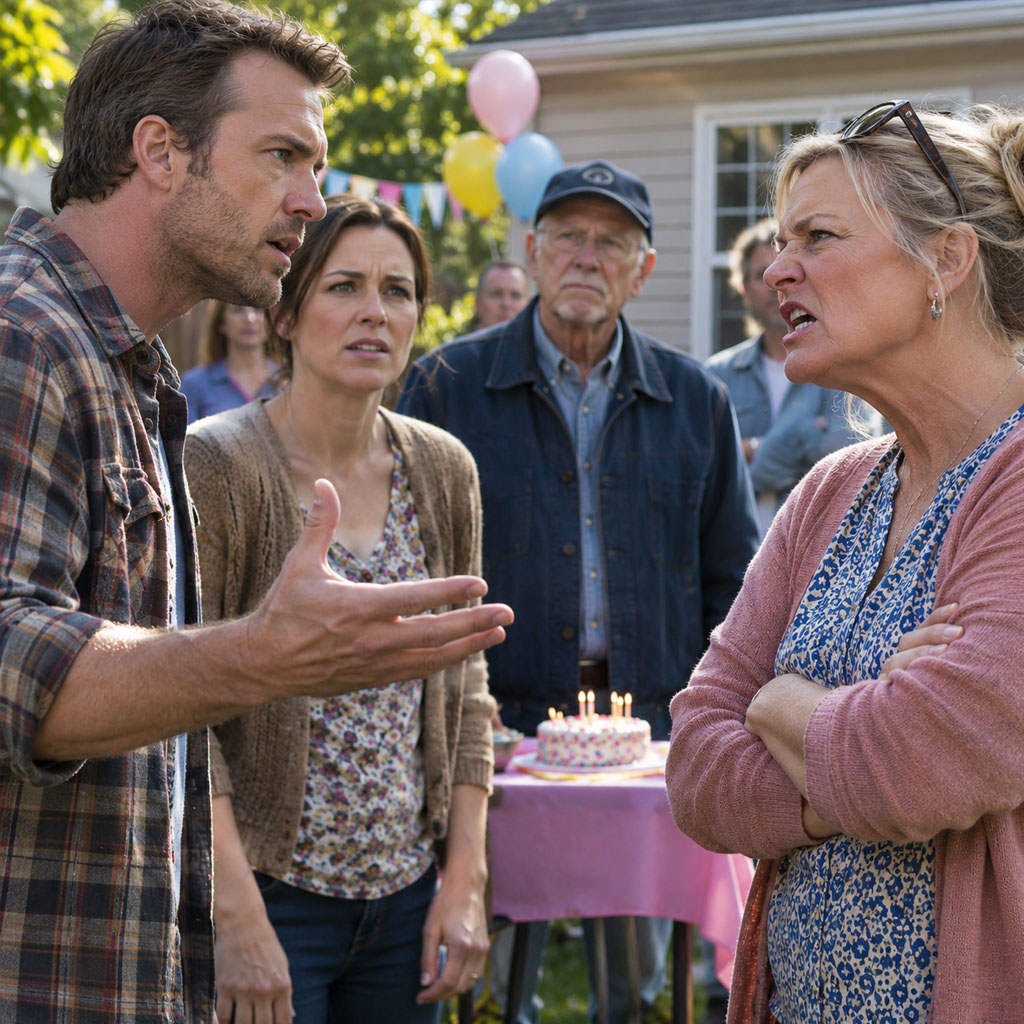
I stood up.
“Karen, you asked us not to bring any.”
Her eyes flashed.
“I didn’t mean for Hollis!”
“You wrote it in bold.”
“Don’t put words in my mouth.”
The yard went quiet.
Karen’s face reddened.
“You people showered that boy with presents for nine years. And now, on the one day it actually matters, everybody decides to make a point?”
Odell slowly rose from his lawn chair.
His knees were bothering him, but he stood straight.
“Karen, you told us twice. In writing.”
“I didn’t mean—”
“You said no gifts,” I interrupted.
She turned toward me.
“Is this some kind of punishment?”
Then she looked at the empty table again.
Her composure finally broke.
“I need those gifts!”
The words came out before she could stop them.
Silence settled over the backyard.
I looked at her.
“Why do you need them, Karen?”
Her eyes moved from one face to another.
Then she answered.
“Because Kenzie’s birthday is in two weeks!”
Nobody spoke.
“Wade’s whole family is coming down from Louisville. His mother already treats me like I’m the hired help. I can’t have nothing to give her granddaughter!”
Her voice shook.
“I needed this party. I needed everything to look right.”
A small voice came from the edge of the driveway.
“Mom?”
Kenzie had stopped riding the bicycle.
Blue snow-cone syrup was running down her wrist.
She looked at the empty table.
Then at her mother.
“Were my presents Hollis’s?”
Karen turned toward her.
“Sweetheart, that’s not—”
Kenzie looked down at the bicycle.
She touched the little brass tag on the handlebar.
She turned it toward the sunlight and slowly sounded out the letters.
“Hollis.”
Karen’s head snapped toward me.
For the first time, I saw the anger beneath her carefully maintained smile.
“You did this.”
I didn’t answer.
“You and that little brat with her camera. You think you can walk into my house and ruin everything?”
Hollis stood up.
His paper crown slipped sideways.
He looked at his mother.
“You said I never had a bicycle.”
Karen turned.
“Not now, Hollis.”
“You said I made it up.”
“Hollis, stop.”
“You said I was crazy!”
His voice broke on the final word.
Then he ran.
He pushed through the gate, past Kenzie, and across the Okampos’ lawn.
A blue shirt flashed through the tall grass behind the houses.
Then the field swallowed him.
I started toward the gate.
Ren grabbed my arm.
“His post office!”
I turned.
“What?”
“He goes there when he’s sad. Dad, he goes to the peach stand!”
Her voice cracked.
“He took the brick out of the freezer last week. His mom saw him from the road. He said he’d find another way to keep his pictures safe.”
My heart seemed to stop.
I looked toward the hayfield.
The old peach stand sat at the far end, nearly four hundred yards away.
The sun was beating down.
The tin roof would be scorching.
I ran.
Behind me, I heard Odell shout my name.
Chapter 5
The tall grass reached my waist in places.
I’m forty-two years old, and twenty years of locksmith work have left me with a bad back and stiff knees.
I didn’t feel any of it.
I ran toward the old peach stand as fast as I could.
The plywood door hung open.
Inside, the air was unbearably hot.
The tin roof had been absorbing sunlight since morning, and the little building smelled of dust, rust, and old wood.
In the back corner sat the white chest freezer.
Its lid was closed.
Beside it lay a brick.
“Hollis!”
For one terrible second, there was no answer.
Then I heard a faint knock.
“Mr. Talbot?”
I dropped to my knees.
“I’m here, buddy.”
“I just wanted to put my pictures away.”
His voice sounded muffled.
“The lid fell. I can’t push it.”
I stared at the freezer.
The old outside handle had broken off years earlier. The spring-loaded latch had been designed to keep the lid closed, and without the handle, there was no simple way to release it from inside.
“Hollis, listen to me. I need you to keep talking.”
“It’s really hot.”
“I know. I’m going to get you out.”
I pulled the small locksmith’s pick set from my keyring and tried to work the latch through the rusted opening.
My hands were shaking.
The metal was old, and the mechanism wouldn’t move.
I adjusted my grip.
“Tell me about the pictures, buddy.”
“Ren took them.”
His voice was faint.
“She writes on the bottom.”
I tried again.
The pick slipped.
Then someone came crashing through the grass behind me.
“Where is he?”
It was Wade.
He was still wearing his work clothes, with a duffel bag hanging from one shoulder. He must have arrived at the birthday party just as Hollis ran.
Every person in the yard had pointed him toward the field.
Wade looked at the freezer.
“He’s in there?”
I nodded.
Wade ran back outside and returned less than a minute later carrying an old tire iron.
He wedged it beneath the lid and pushed with all his strength.
The lid creaked.
The latch held.
“Careful!” I shouted. “You’ll damage the mechanism.”
Wade backed away, breathing hard.
I returned to the lock.
The pick slipped again.
Then it snapped.
The broken metal edge cut across my palm.
Blood ran down my wrist.
I barely noticed.
“Hollis?”
No answer.
“Hollis, talk to me.”
Nothing.
I knocked against the lid.
“Hollis!”
Still nothing.
Wade made a sound that seemed to come from somewhere deep inside him.
He dropped to his knees beside me.
“Please.”
I looked at the freezer.
I looked at my broken pick.
Then my eyes fell on the small brass tag hanging from my keyring.
It was my own tag.
RUSSELL — 6.
I had made it years earlier.
I thought about Ren telling me that everything could be opened if I had the right tool.
I thought about the thousands of locks I’d worked on.
And I realized I was holding something thin enough to reach the part of the latch I couldn’t otherwise touch.
I pulled the tag free.
My fingers were slick, and the metal was stubborn, but I managed to bend one end into a narrow hook.
I worked it through the rusted opening.
For several seconds, I felt nothing.
Then the metal caught.
I lifted gently.
A small click sounded beneath the lid.
“Now!” I shouted.
Wade threw his weight against the cover.
The lid flew open and struck the wall.
Hollis was curled on his side, holding a small cookie tin against his chest.
His face was bright red.
His clothes were soaked with sweat, and his eyes were barely open.
Wade reached inside and lifted him into his arms.
“Buddy. I’ve got you.”
He carried his son outside and lowered himself into the grass.
Hollis barely responded.
Then I heard footsteps.
Paula came running across the field with the cooler.
Teddy was behind her, carrying the large container of ice from the snow-cone machine.
Paula was a school nurse, and the moment she saw Hollis, she took charge.
She checked his breathing, felt his pulse, and began cooling him with water and ice packs while we waited for emergency responders.
“Stay with us, sweetheart,” she said.
Wade held Hollis’s hand.
“Come on, buddy. Dad’s here.”
For a few terrifying moments, the little boy seemed unable to focus.
Then he coughed.
His eyes moved toward Wade.
“Dad?”
Wade bent close.
“I’m here.”
Hollis began to cry.
“I’m sorry.”
Wade shook his head.
“No, son. No apologies.”
“I’m sorry I’m not Kenzie’s brother.”
Wade’s whole face changed.
He pulled his son close, careful to let Paula continue helping him.
“You listen to me. You’re my boy. You’ve always been my boy.”
He pressed his cheek against Hollis’s damp hair.
“Nothing changes that. Nothing.”
People began arriving at the edge of the field.
Odell was there, leaning on Mrs. Okampo.
Teddy’s wife stood beside Paula.
Ren was holding my sleeve with both hands, her dress covered in grass.
Kenzie had followed the adults.
She stood a little behind the others, crying quietly.
And at the back of the group stood Karen.
Her white dress was dusty.
Her face looked as though she couldn’t understand what she was seeing.
The ambulance arrived at 3:31.
One of the paramedics later told us that Hollis’s body temperature had reached 104.6 degrees.
He needed immediate treatment.
The paramedics worked quickly, placed him on the stretcher, and prepared him for transport.
Wade climbed into the ambulance.
Before the doors closed, he turned toward Karen.
His voice was quiet.
“Three hundred dollars a month, Karen. For Kenzie’s expenses. Where did it go?”
Karen stepped forward.
“Wade, honey, can we please not do this here?”
He looked at her.
“You did it here. In front of our son.”
Her face crumpled.
She began explaining that she had wanted Lorna to accept her.
Wade’s mother had finally praised her at Christmas, she said. For the first time in three years, she’d told Karen she was doing a wonderful job with Kenzie.
Karen had wanted to keep that approval.
She’d spent the money on birthday parties, clothes, and expensive outings.
She’d wanted Kenzie to look spoiled and happy in every photograph.
She’d wanted Wade’s family to believe she was a good mother.
And Hollis had paid the price.
Wade didn’t raise his voice.
He simply looked at her.
“Start with the truth,” he said. “That’s all I need from you now.”
Then the ambulance doors closed.
I stood in the field holding the little cookie tin Hollis had been clutching.
I hadn’t even realized I’d picked it up.
The lid was slightly dented.
Inside were dozens of instant photographs tied together with a hair elastic.
I began looking through them.
There was the red bicycle.
The fishing rod.
The remote-control truck.
The purple swimming goggles.
The Lego set.
Every photograph showed an object that had once belonged to Hollis.
On the white strip beneath each picture, Ren had written a small caption.
Hollis’s bike. Real.
Hollis’s fishing rod. Real.
Hollis’s truck. Real.
The writing was careful and consistent.
Then I reached the final photograph.
It showed Hollis standing on the other side of the broken fence, looking toward Ren’s camera.
He was squinting into the flash.
At the bottom, my daughter had written:
HOLLIS. REAL.
Wade had returned from the ambulance to collect the tin.
When I showed him the photograph, his shoulders began to shake.
He held it against his chest.
Behind us, Karen stood alone.
Nobody approached her.
Not one person.
The silence in that field was heavier than anything I’d heard before.
Chapter 6
That evening, while Hollis was being treated at the hospital, Karen posted a long message in the neighborhood group.
She claimed the neighbors had deliberately sabotaged her son’s birthday.
She said the confrontation had caused unnecessary stress and nearly ended in tragedy.
She talked about the difficulties of blended families and demanded that everyone apologize.
Nineteen seconds later, Odell responded.
He posted one document.
It contained the complete record of all thirty-one missing gifts.
On one side were the dates, descriptions, and names of the neighbors who had purchased them.
On the other were Lorna’s screenshots showing those same objects in Kenzie’s possession.
At the bottom, Odell had written:
“Karen, nobody attacked you. We simply read your own mail back to you.”
Then the comments began.
Teddy posted a photograph of the remote-control truck he’d bought for Hollis.
Mrs. Okampo posted the purple goggles.
A mother from house number four admitted she’d seen the red bicycle at the Sutters’ home months earlier but had convinced herself it was a hand-me-down.
“I’m sorry, Hollis,” she wrote.
Another neighbor followed.
Then another.
By midnight, thirty-eight apologies had appeared.
Every one was addressed to a little boy who didn’t even have a Facebook account.
I sat on my back steps with my hand wrapped in a bandage.
Ren came outside and leaned against me.
“Is he okay?”
“He’s getting better. Wade is with him.”
She was quiet for a while.
Then she said, “I’m sorry I didn’t tell you sooner.”
I looked at her.
“Why are you apologizing?”
“Because I knew and I didn’t tell you.”
I pulled her close.
“You were trying to protect your friend.”
She leaned her head against my shoulder.
“I thought you’d be mad.”
“I was wrong about the camera. I should have listened to you.”
She considered that.
“You’re forgiven.”
I smiled.
“Thank you.”
She looked down at my bandaged hand.
“Does it hurt?”
“A little.”
“Did you use your tag?”
I nodded.
She looked toward the house.
“That’s funny.”
“What is?”
“You always tell me that names on things make them harder to lose.”
I looked at the little brass tag that was no longer hanging from my keyring.
For the first time, I understood that some things were worth giving away.
The next morning, I drove to the old peach stand with my grinder and removed the freezer latch.
Then I hauled the entire chest freezer to the scrapyard.
I’d agreed to repair it ten months earlier.
I should have done it.
That failure would stay with me.
The rest of the story unfolded over the following weeks.
Lorna Sutter drove down from Louisville and spent three hours talking with Wade at his kitchen table.
When she left, her eyes were swollen.
The extra money Wade had been sending Karen for Kenzie’s expenses amounted to $6,600 over twenty-two months.
Every dollar was gone.
Wade learned that Karen had spent it on clothing, birthday celebrations, and expensive outings meant to impress his family.
He also learned that Hollis had been repeatedly told that his missing possessions were imaginary.
Karen moved to her sister’s home in Paducah while she tried to work through what had happened.
She signed temporary guardianship arrangements allowing Wade to care for Hollis while she addressed the situation.
Wade quit his pipeline job.
He took a position at the Corvette plant in Bowling Green.
The pay was lower, but he would be home every evening by four.
For the first time in years, Hollis had a father who could be there for dinner, homework, and bedtime.
Kenzie came back to the neighborhood three weeks later.
She arrived with the trunk of her mother’s car full of wrapped presents.
She had wrapped them herself, using far too much tape.
Each one carried a little note written in purple marker.
THIS IS HOLLIS’S.
I’M SORRY.
LOVE, KENZIE.
She stood beside Wade while he carried the boxes into the house.
Hollis was still quiet around her, but he didn’t run away.
That was enough for the moment.
Three weeks after the freezer incident, Odell posted a message in the neighborhood group.
HOLLIS SUTTER’S BIRTHDAY AGAIN.
SATURDAY, 2 P.M.
BRING A GIFT. PUT HIS NAME ON IT.
Wade called me that evening.
His voice was uncertain.
“Russell, is this too much? I don’t want Hollis feeling like a charity case.”
I looked across the room at Ren.
She was carefully sorting through the photographs from the cookie tin.
“Let me ask Odell,” I said.
The next morning, I found the old mail carrier sitting on his porch.
I explained Wade’s concern.
Odell looked over his glasses.
“Thirty-one years delivering mail, Russell. I never stopped delivering to a house because somebody was stealing from the box.”
He paused.
“You put a lock on the box.”
I smiled.
That Friday night, I stamped twelve brass tags.
Each one read:
HOLLIS — 26.
Instead of a house number, I used my own number six as a mark of the neighborhood’s commitment.
I gave one tag to every household.
Then I built something else.
A small steel lockbox with a five-pin lock that I assembled myself.
I stamped Hollis’s name into the lid.
I made one key.
Only one.
And then I did something I’d never done in twenty years of locksmith work.
I destroyed the key code.
There would be no duplicate.
No spare key hidden in a drawer.
No second person who could open it without Hollis’s permission.
I wanted the boy to have something that belonged completely to him.
Ren had her own gift ready.
She bought five packs of instant film and a new photo album.
On the first page, she wrote:
PICTURES OF THINGS YOU STILL HAVE.
Then she carried her camera over to Hollis’s house.
“I have an idea,” she told him.
He looked at the film.
“What?”
“We can share the camera.”
Hollis looked uncertain.
“Really?”
“Half the week each. I already decided.”
He smiled.
Not the cautious smile he’d worn at the birthday party.
A real one.
Chapter 7
Hollis’s birthday celebration was smaller than Karen’s party had been.
There was a grocery-store cake, paper plates, a few balloons, and a folding table in Wade’s backyard.
But there were thirty people there.
Every family on Finch Hollow came.
Kenzie sat near the front with a little gift of her own.
Odell brought a card.
Teddy brought a wrapped package.
Mrs. Okampo carried a bag of homemade cookies.
Paula brought a cooler of drinks.
And Ren stood beside me with her camera.
At two o’clock, Wade opened the back door.
Hollis stepped outside.
He stopped on the porch.
His father stood behind him with one hand resting gently on his shoulder.
The entire neighborhood began singing.
“Happy birthday to you!”
The singing was ragged.
Some people were too loud, others were hopelessly off-key, and Odell started the second verse before anyone else had finished the first.
But nobody cared.
Hollis stared at the long folding table.
Twelve wrapped presents sat in a row.
Every package had a small brass tag.
He walked toward them slowly.
He picked up the first tag and turned it over.
“Hollis,” he read.
Then he looked at Wade.
“Are these really mine?”
Wade nodded.
“Every one of them.”
“All of them?”
“Every single one.”
Hollis touched the tag again.
“Can I keep them?”
Wade crouched beside him.
“That’s why they’re here, buddy.”
The boy opened the presents carefully.
He didn’t tear the paper or throw it aside.
He unfolded each piece as though he were afraid the gift might disappear if he moved too quickly.
Ren photographed every present before he opened it.
Then she took another picture of him holding each one.
When Hollis reached the final package, he found a small steel box.
His name was stamped across the lid.
A single brass key rested on top.
He picked it up.
“What’s this?”
I stepped forward.
“It’s yours.”
He studied the lock.
“Can I open it?”
“That’s what the key is for.”
He fitted it into the lock and turned.
Click.
The lid opened.
He turned the key again.
Click.
Locked.
Hollis stared at the little box.
Then he looked up at me.
“Who has the other key?”
I knelt beside him.
“There isn’t another one, Hollis.”
He held the key tightly.
“Nobody can open it without this?”
“That’s right.”
He looked at the lock again.
For a moment, he didn’t speak.
Then he asked, “Even if they say it’s theirs?”
I felt my throat tighten.
“Even then.”
He looked toward Wade.
His father nodded.
“It’s yours, son. Nobody gets to take it.”
Hollis slipped the key into his pocket.
Then he turned toward Ren.
She was standing beside the table, holding her camera.
“Can you take one picture of me?” he asked.
“Of course.”
He stood between Wade and Kenzie.
Ren lifted the camera.
The flash went off.
A few seconds later, the little photograph slid out.
Hollis watched the image appear.
Then he smiled.
“Can I keep it?”
Ren handed it to him.
“That’s the whole point.”
He carefully placed the photograph inside the steel box.
Then he locked it.
I watched him turn the key and test the lid once more.
For the first time, he seemed completely certain that something belonged to him.
Wade wrapped an arm around his shoulders.
Kenzie moved closer.
She had been quiet throughout most of the party, but now she held out a small envelope.
“I made you something,” she said.
Hollis took it.
Inside was a drawing of the two of them riding bicycles.
At the bottom, she’d written:
I’M SORRY I DIDN’T KNOW.
Hollis looked at her.
“Do you want to ride bikes sometime?”
Kenzie nodded.
“Yes.”
He thought about it.
“Maybe tomorrow.”
She smiled.
“Okay.”
It wasn’t a magical solution to everything that had happened.
There would be difficult conversations ahead. Hollis would need time to trust the people around him. Karen would have to take responsibility for what she’d done, and Wade would have to rebuild a family life that had been damaged by years of distance and misunderstandings.
But that afternoon, a little boy had presents with his own name on them.
He had a father who came home every evening.
He had a friend who believed him.
And he had a key that nobody else could use.
As the party wound down, Odell came over and stood beside me.
“Looks like the old tradition survived,” he said.
I nodded.
“Maybe it’s better now.”
He watched Hollis showing his new bicycle to Wade.
“Traditions are only worth keeping if they protect the people they’re supposed to serve.”
I looked toward Ren.
She was photographing the children playing in the yard.
Her camera flashed.
Then she ran over to show Hollis the picture.
I remembered the day of her ninth birthday.
I remembered Karen calling her a spoiled brat because she refused to lend out something that belonged to her.
I remembered telling my daughter that sharing was the point of having nice things.
And I remembered the look on her face.
I’d been wrong.
A child should learn to share.
But a child should also learn that kindness doesn’t mean surrendering everything they own. And being generous doesn’t mean allowing someone else to decide what belongs to them.
Ren had understood something I hadn’t.
Hollis didn’t need another person telling him to share.
He needed someone to believe him.
That evening, after everyone had gone home, I sat on the back steps with Paula.
My hand was still healing.
The brass tag I’d sacrificed to open the freezer was gone, but I didn’t regret it.
Paula rested her head against my shoulder.
“You did good today,” she said.
“We all did.”
She looked toward the yard.
“Ren did, too.”
I nodded.
For a while, we listened to the quiet street.
The twelve houses looked exactly as they always had. The same porches, the same mailboxes, the same children riding bicycles beneath the streetlights.
But something had changed.
We had spent years believing the birthday tradition was about presents.
It wasn’t.
It was about making sure no child felt forgotten.
And when one little boy was made to believe his own memories were lies, the entire neighborhood had almost failed him by staying silent.
Odell had been right.
You don’t stop delivering because someone steals from the mailbox.
You protect the mailbox.
And sometimes, you build a stronger one.
A few months later, Hollis brought his steel box to my shop.
He had filled it with photographs.
There was the red bicycle, the fishing rod, the remote-control truck, and the picture Ren had taken at his birthday party.
He placed the box on my counter.
“Mr. Talbot?”
“Yes, buddy?”
“Can you make sure this lock never breaks?”
I smiled.
“I can certainly try.”
He looked at the little brass key in his palm.
“Because these are mine.”
I nodded.
“Yes, they are.”
He slipped the key into his pocket.
Then he went outside to wait for Wade.
I watched him through the shop window as he stood beside his father’s truck.
He wasn’t looking at the ground anymore.
He was looking toward the street, where Ren was waiting with her camera.
And when she raised it, Hollis didn’t hesitate.
He smiled.
The flash went off.
This time, nobody needed to write the word real beneath the photograph.
He knew.
THE END.\
⚠️ All characters and events are fictional. Do not imitate or apply them in real life. 😌😌😌