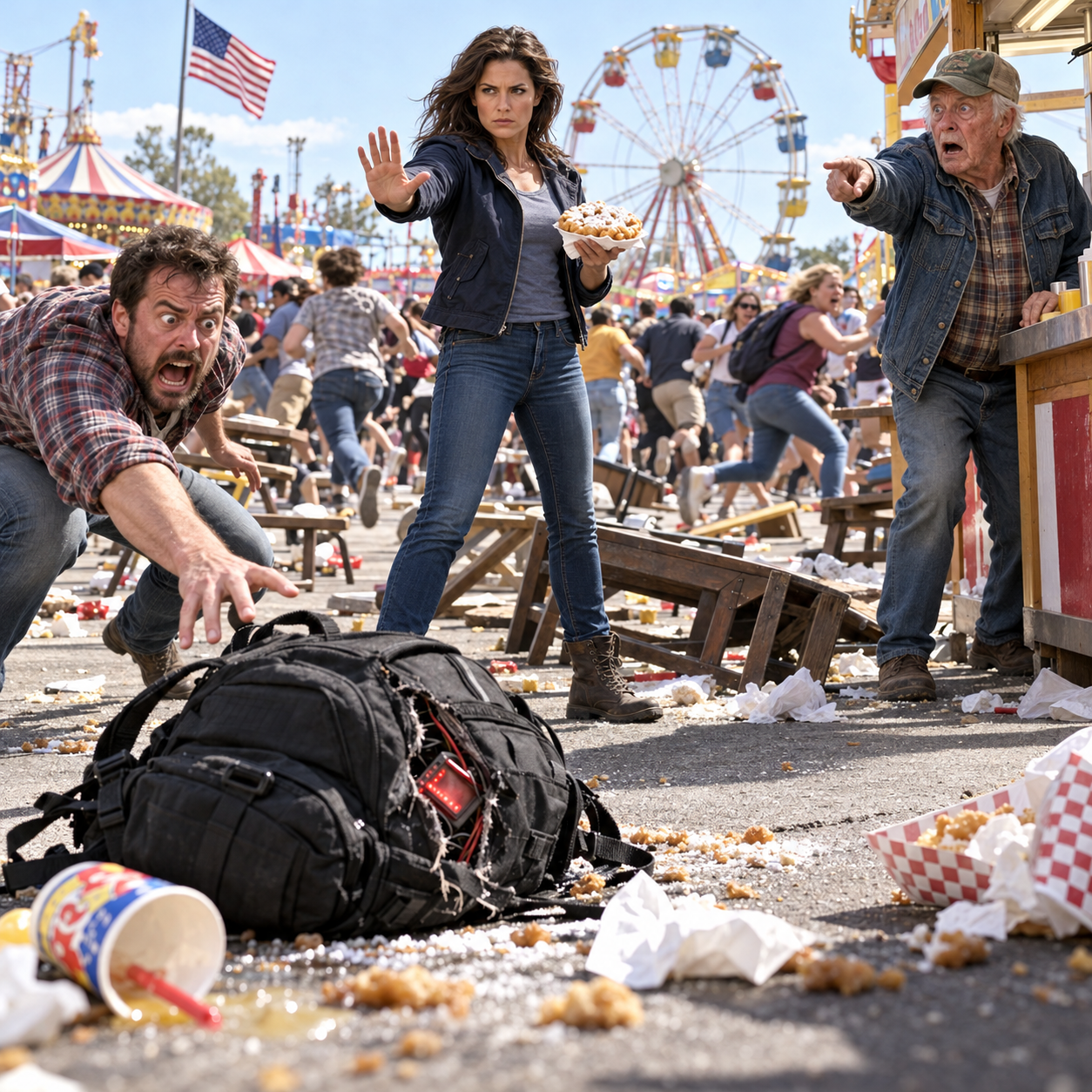
“Let The Committee Handle It.” Everyone Else Was Running. She Was Holding A Funnel Cake. A Backpack. A Split Seam. A Screen Counting Down. Her Brother-In-Law Reached For The Strap. Then An Old Man In A Feed-Store Cap Went Pale. “Metronome? Is That You?”
My brother-in-law blocked my path at the county fair and snapped, “You’re just a guest here.” Behind him, people were screaming, and my seven-year-old daughter was disappearing into the crowd. I ordered him away from a suspicious backpack, and a retired bomb technician suddenly recognized my voice. “Metronome?” he whispered. I kept my family safe without explaining who I was. Six days later, an investigator showed me an inspection report for a locked emergency exit. My brother-in-law had signed it.
Part 1
The first sound I remember from the Briar Glen Harvest Fair wasn’t screaming. It was the brittle crack of a paper cup beneath someone’s shoe, followed by a woman’s voice asking why everybody was running. The afternoon had been almost offensively beautiful, with October sunlight spilling across the livestock barns, children carrying enormous stuffed animals, and the smell of fried dough drifting over the midway. Somewhere near the Ferris wheel, a local bluegrass band was playing a song my father used to whistle while fixing things around our house.
My name is Leah Bennett, and until that Saturday, most of my husband’s relatives thought I spent my working days behind a desk. I had never bothered to correct them at family dinners, mostly because nobody had ever paused long enough to ask what I actually did. My brother-in-law, Graham, liked to introduce me as “our military paperwork expert,” usually with a little chuckle that encouraged everyone else to laugh. After nine years of marriage, I had learned that interrupting Graham only gave him another audience.
My husband, Will, was standing beside the lemonade booth with our daughter, June, when the first warning came. A teenage volunteer in an orange safety vest stumbled backward from a row of grain wagons and shouted for someone to call the police. People turned toward him, expecting a medical emergency or perhaps a fight between vendors, until he pointed toward a black backpack sitting in the gravel. Then somebody shouted that there was a bomb, and the fairground seemed to contract around that single word.
Will looked across the midway and found my eyes. He didn’t ask what to do, because we had discussed emergencies more times than June had discussed her favorite cartoons. He picked her up, turned toward the nearest clear route, and started moving without attempting to reach me. The fact that he trusted me enough to leave was one of the reasons I loved him.
I was holding half a funnel cake and wearing a faded gray sweatshirt that June had decorated with a crooked purple heart. Nothing about me looked remotely official, which was exactly how I preferred spending my Saturdays. I put the funnel cake on an empty wooden crate and moved toward the backpack, watching the crowd instead of the bag. Panic was already spreading faster than information, and a group of people had begun forcing their way toward a narrow gate between two storage buildings.
Graham Bennett was the first familiar face I saw near the grain wagons. He wore a fluorescent yellow vest, a laminated security badge, and a handheld radio that he treated like a personal symbol of authority. As chairman of the fair’s Safety and Operations Committee, he had spent the previous three months explaining to everybody how efficiently he intended to run the event. Now he was crouched beside the backpack, preparing to grab its handle.
“Graham, step away from that bag,” I said.
He looked over his shoulder with irritation rather than concern. “Leah, somebody abandoned their stuff, and now these kids have got everyone worked up. I’m moving it out of the walkway.”
“Don’t touch it.”
He reached again, and I caught his wrist before his fingers closed around the strap. The movement was automatic, faster than any conscious decision I could remember making, and he stared at my hand as though I had slapped him. For one extraordinary second, he seemed more offended by being stopped in public than frightened by what might be inside the backpack.
“Take your hand away, stand up, and move backward,” I told him.
His expression hardened. “You’re just a guest here today. This is my committee, and you’re not going to embarrass me in front of my volunteers.”
“Move, Graham.”
Something in my voice finally reached him. He stood, pulled his arm free, and took several reluctant steps backward, although his mouth continued moving as he complained about people overreacting. I ignored him and studied what little I could see without disturbing the bag. Through a damaged section of fabric, there were enough unfamiliar components to tell me that this was not somebody’s forgotten lunch.
Behind me, an elderly man spoke a name I hadn’t heard in nearly a decade.
“Metronome?”
I turned just enough to see a tall, weathered man wearing a faded feed-store cap. His hair had gone almost completely white, but I recognized the narrow eyes and the way he stood with his weight slightly forward. A young boy clung to his hand, looking between us with the bewilderment of someone who knew something terrible was happening but couldn’t understand what. My stomach tightened for a reason that had nothing to do with the backpack.
“Everett?”
Retired Sergeant Major Everett Pike had been my first real mentor in Army explosive ordnance disposal. I had last seen him at a military retirement ceremony in Georgia, where he had promised to spend the rest of his life fishing and never again listening to a radio at four in the morning. Now he was standing at an Ohio county fair, holding his grandson’s hand and looking at me as if the last twelve years had folded themselves into a single afternoon.
“Good Lord, Marlow,” he said, using my maiden name. “Is that really you?”
“It is. Please get your grandson somewhere safe.”
His eyes moved toward the backpack, then back to my face. The change in his expression was immediate, not because he understood everything about the situation, but because he understood what my presence and my voice meant. He didn’t waste time asking why I was standing there in sneakers.
Graham stepped forward again. “Do you know this woman?”
Everett looked at him. “Yes.”
“Well, she’s interfering with an official security response.”
For a moment, Everett simply stared. Then he took his grandson by the shoulders, pointed him toward a sheriff’s deputy approaching from the parking area, and asked the boy to go directly to her. Once the child was moving, Everett turned back toward Graham.
“Listen carefully,” he said. “Whatever you think you’re in charge of, put it aside. Right now, you listen to her.”
Graham opened his mouth, but I was already reaching for his radio. I identified myself to county dispatch as a former Army explosive ordnance disposal specialist, described the suspected threat, and requested immediate help from the nearest qualified response team. I also asked for firefighters, medical personnel, and a coordinated evacuation beyond the surrounding buildings. The dispatcher repeated my information with the clipped precision of someone desperately trying to stay calm.
Deputy Sofia Reyes arrived moments later, breathing hard. She was young, with dark hair pulled into a tight ponytail and the serious expression of someone determined not to make the wrong decision. After confirming my background, she began coordinating with dispatch while Everett helped identify a safe location for people who had already evacuated. The deputy told me the state bomb squad was responding from more than forty miles away.
I looked toward the backpack again. There was no comfortable way to reconcile what I had observed with the time it would take professional equipment and personnel to reach us. Around the midway, the evacuation had become uneven, with some families already beyond the barns and others trapped in confusion. I told Sofia that moving everyone away from the area was our first priority. She nodded, then stopped suddenly as a burst of shouting came over her radio.
The east evacuation gate wasn’t opening.
I knew that gate. Graham had proudly pointed it out during a family barbecue in August, describing the improvements he had supposedly arranged with a new county safety grant. He had called the fairground evacuation system one of the best in the region, and my mother-in-law had practically glowed with pride. I remembered offering to review the emergency plans and being told they already had professionals handling everything.
Now hundreds of people were heading toward a gate that should have been unlocked and staffed. Sofia directed volunteers to reroute the crowd while firefighters tried to establish another safe exit. Everett stood beside me, watching the confusion gather around the storage buildings. I could hear the strain in his breathing even though his face remained composed.
“Leah,” he said quietly, “you remember what I taught you about priorities?”
I thought of June in Will’s arms and the crowd struggling toward a locked gate. I thought of every person who had arrived expecting nothing more dangerous than carnival rides and overpriced lemonade. Then I looked at Graham, who was arguing into his radio about who had possession of the emergency gate key.
“Every single one of them,” I answered.
And for the first time that afternoon, I realized the backpack might not be the only thing threatening the people at Briar Glen.
Part 2
The first person to reach the locked gate was a grandfather pushing a wheelchair. I saw him through a gap between two vendor trailers, leaning his entire weight against the metal frame while people pressed forward behind him. A little girl in a pink jacket was crying beside the wheelchair, and her grandmother kept repeating that there had to be another way out. A firefighter finally pushed through the crowd and began redirecting everyone toward the livestock barns, where an open service road provided a safer route away from the midway.
Deputy Reyes was already coordinating the evacuation, but information arrived faster than she could organize it. One volunteer reported that the north entrance was blocked by parked delivery trucks, while another said a group of families had gone back toward the food tents looking for missing children. Graham continued giving instructions over his radio, sometimes contradicting the deputies and sometimes repeating orders that were already being carried out. I finally took the radio from him again and handed it to Sofia.
“One person needs to control this,” I said. “And that person isn’t Graham.”
She didn’t hesitate. “Agreed.”
Graham looked wounded, which would have been almost funny under different circumstances. He had spent years confusing being listened to with being right, and suddenly nobody cared about his title. When Sofia ordered him to help keep the access road clear, he started explaining that he was responsible for security operations. She looked directly at him and said, “Then you can start by following the emergency plan.”
Everett stayed close enough to hear me but far enough to respect the danger. He had trained generations of technicians, including people who later taught entire classes of their own, and I trusted his judgment more than anyone else’s on that fairground. When I explained what I had seen, he listened without interrupting. The expression on his face reminded me of Kandahar, where we had once stood beside a disabled military vehicle and quietly discussed options neither of us liked.
“The response team’s still too far away,” he said.
“I know.”
“You don’t have to prove anything to anybody here.”
I looked toward the barns, where the last groups of visitors were moving away under the deputies’ direction. “That’s not why I’m staying.”
There are details about what happened next that I will never describe, not because I believe they make a particularly interesting secret, but because nobody should learn dangerous procedures from somebody telling a story about a county fair. What matters is that I made a judgment based on my training, the visible circumstances, and the limited time available. Sofia knew what I intended, Everett understood the risk, and the surrounding area had been cleared as thoroughly as we could manage. I told both of them that if anything changed, getting themselves away mattered more than helping me.
I remember the smell of damp gravel and diesel fuel from the parked grain wagons. I remember a loose thread inside the cuff of my sweatshirt that kept brushing my wrist, and a fly landing on the wooden crate where I had abandoned my funnel cake. My father’s voice came back to me, the same patient voice that used to read safety checklists at our kitchen table before leaving for the quarry. Every action deserved its own moment, he would say, because rushing didn’t make a dangerous situation any less dangerous.
For several minutes, my entire world narrowed to the responsibility in front of me. Everett spoke occasionally over the radio, offering the kind of calm, disciplined support I remembered from our deployments. I responded in short sentences, not because I wasn’t frightened, but because fear couldn’t be allowed to decide the pace of my thinking. When I finally knew the immediate danger had been contained, I backed away and told Sofia that the arriving bomb squad would need to examine everything independently.
She stared at me for a moment before answering. “Are you telling me it’s safe?”
“I’m telling you the immediate threat appears to be under control. Keep everybody out until the specialists confirm it.”
She nodded and relayed the update. Only then did I notice that my knees hurt from the gravel and my sweatshirt was soaked with sweat beneath the arms. A loose gust of wind carried the sound of a church bell from the center of town, reminding me that the rest of Briar Glen was continuing its ordinary Saturday.
The state bomb squad arrived to find the fairground empty and several hundred frightened people gathered at a nearby school. Their lead technician, Captain Nolan Pierce, was a compact, gray-haired man who asked precise questions and listened carefully to the answers. He confirmed that the backpack contained a genuine explosive threat and praised the emergency response while making it clear the investigation was only beginning. Before leaving, he asked who had first identified the suspicious bag.
“A volunteer,” I said. “A teenager. You need to find him.”
The boy’s name was Colin Hayes, and he was seventeen years old. By the time I located him, he was sitting behind the shuttered pie tent with his orange vest folded in his lap, staring at his hands. His mother worked at Briar Glen Medical Center, and nobody had been able to reach her during the evacuation. When I approached, he looked up as though he expected to be arrested.
“I moved it,” he said before I could introduce myself.
“Moved what?”
“The backpack. It was in the walkway, and people kept stepping around it. I dragged it over by the grain wagons because I thought somebody had forgotten it.” His voice broke, and he rubbed his face with both hands. “Then I saw something through the torn bottom, and I knew it wasn’t normal.”
“You called for help.”
“After I moved it.”
I sat on an overturned bucket beside him. “Colin, I need you to hear this carefully. You made a mistake because nobody had taught you what to do with an unattended bag, and then you recognized something dangerous and warned people. Both things can be true.”
He stared at his shoes. “Mr. Bennett said I caused the panic.”
“Mr. Bennett is wrong.”
The simplicity of that sentence seemed to surprise him more than anything else I said. He told me he had worked three fairs before this one and had received exactly twenty minutes of volunteer orientation each year. They had covered lost children, traffic control, ticket disputes, and where to send people who became overheated. Nobody had mentioned suspicious items or the importance of keeping emergency exits clear.
“I asked about emergencies last month,” he admitted. “Because one of the storage building doors was chained shut, and I thought somebody might get trapped.”
“Who did you ask?”
“Mr. Bennett.”
I felt something unpleasant settle beneath my ribs. Colin explained that Graham had told him not to worry about things outside his responsibilities, then threatened to remove him from the volunteer roster if he continued questioning the committee. The boy had apologized because he needed the small scholarship the fair awarded to graduating seniors who volunteered enough hours.
When Will found me twenty minutes later, I was still sitting beside Colin. He had taken June to his parents’ farmhouse, where she was eating crackers and watching cartoons under the supervision of my mother-in-law, Marianne. He gave Colin his phone number in case the boy needed anything and offered him a ride home if his mother couldn’t come. Then he helped me stand, noticing the way I shifted my weight away from my left knee.
“You’re shaking,” he said softly.
“Not yet.”
It started in the minivan. My hands trembled so badly that the keys rattled against the steering wheel, and for a while I couldn’t make myself put them into the ignition. Will climbed into the passenger seat and closed the door without speaking. He knew that my calmness was not the absence of fear; it was a temporary arrangement I had learned to maintain until everyone else was safe.
When the shaking finally stopped, he took my hand. “June asked whether you were coming home.”
“Did you tell her yes?”
“I told her you always try.”
That was the moment I cried.
We drove to the farmhouse beneath a sky turning the color of bruised peaches. Graham’s truck was already in the driveway, parked crookedly across the gravel as though he had arrived in a hurry. Through the dining-room window, I could see him speaking animatedly to his parents and several relatives. He was demonstrating something with both hands, leaning forward as everyone listened.
Will stopped the minivan beside the porch. “You don’t have to go in.”
I looked at my daughter’s small bicycle leaning against the steps. “She’s inside.”
When I opened the front door, Graham was halfway through telling the family how his security committee had prevented a complete disaster. He stopped when he saw me, but not because he was embarrassed.
“Leah,” he said, smiling tightly, “we were just explaining how fortunate it was that the volunteers followed our safety procedures.”
I looked at him for several seconds, remembering Colin alone behind the pie tent and the grandfather struggling with that locked gate. Then I asked the question nobody at the table seemed interested in asking.
“What procedures, Graham?”
Part 3
Graham lowered his glass of iced tea and studied me with the expression he normally reserved for people who challenged his opinions about farming equipment. Around the table sat Marianne, my father-in-law Robert, Graham’s wife Beth, and two cousins who had come over after hearing about the fair. June was curled up beneath a blanket on the living-room couch, thankfully too far away to hear the conversation. Will walked in behind me and remained standing beside the doorway.
“We had an evacuation plan,” Graham said. “Obviously, no plan works perfectly when people start panicking.”
“The east gate was locked.”
“That was a temporary situation.”
“A temporary situation during an evacuation is still a failure.”
He pushed his chair backward. “Do you have any idea how many moving parts there are at an event like that? I’ve spent six months working with the board, and you show up for one afternoon and act like you understand everything.”
I could have reminded him that I had spent much of my adult life studying emergencies under conditions considerably worse than a county fair. I could have described the people I had helped evacuate overseas or the years I had spent training soldiers to recognize threats before those threats became tragedies. But watching him defend a locked gate while our daughter slept in the next room, I suddenly found myself too tired to compete for permission to speak.
“Colin warned you about that exit last month,” I said.
Graham’s eyes narrowed. “That kid talks too much.”
“He tried to tell you there was a problem.”
“He was a volunteer, Leah. Volunteers don’t get to tell committee members how to run a fair.”
Will moved forward. “Neither do people who almost carried a suspected bomb through a crowd, apparently.”
Silence fell over the table.
Graham stared at his brother. They were only two years apart, but Will had spent most of his life accommodating Graham’s need to be the oldest person in every room. He often smoothed over disagreements before they became arguments, especially when Marianne was present. Seeing him refuse to do that now was almost as surprising as Everett appearing at the fair.
“That’s not fair,” Marianne murmured.
Will turned toward her. “Mom, he nearly picked up that backpack.”
“He didn’t know what it was.”
“That’s precisely why he shouldn’t have touched it.”
Marianne began folding her napkin into smaller and smaller squares. She was a kind woman in ordinary circumstances, the sort of person who remembered birthdays and delivered casseroles when neighbors were sick. But whenever Graham created a problem, her instinct was to make the conversation more comfortable rather than make him accountable. I had watched her practice that habit for nine years, and until that afternoon, I had mostly accepted it as a family inconvenience.
Robert finally spoke. “What does the sheriff say about the gate?”
Graham answered before I could. “They’re reviewing the evacuation. That’s all.”
“What about the grant money?” Robert asked.
Beth glanced at her husband, and something passed between them too quickly for me to understand. Graham set down his glass and explained that the county safety grant had funded significant upgrades, many of which weren’t visible to the public. His explanation sounded rehearsed, and when Robert asked which contractor had handled the work, Graham changed the subject to the criminal investigation.
I remembered that exchange later, when I knew enough to recognize what he had been avoiding. At the time, I was concentrating on the simple fact that June needed to go home. I picked her up from the couch, feeling her warm cheek settle against my shoulder. She opened one eye and whispered, “Did you fix the bad backpack, Mommy?”
“I helped keep people away from it, sweetheart.”
“Was it scary?”
“Yes.”
She thought about that for a moment. “Were you scared too?”
“Very.”
June slipped her small hand around my neck. “You don’t look scared.”
I carried her outside without answering, because I didn’t know how to explain that looking calm and feeling calm had very little to do with each other.
The next morning, Everett called before eight. He had stayed in Briar Glen overnight with his grandson, Owen, and wanted to stop by before driving back to Tennessee. Will made coffee while Everett and I sat at the kitchen table, where sunlight fell across a pile of unpaid utility bills and June’s spelling homework. For several minutes, we talked about ordinary things: his arthritis, his grandson’s fascination with tractors, and whether the old diner on Route 42 still served decent biscuits.
Eventually, Everett looked at Will. “Did she ever tell you why we called her Metronome?”
Will smiled faintly. “She said it had something to do with being irritatingly consistent.”
“That sounds like her.” Everett leaned back in his chair. “We were training in Florida when an instructor noticed she kept exactly the same pace through every exercise, even when the rest of the class started rushing. It wasn’t that she was never afraid. She just refused to let being afraid make her careless.”
I remembered my father’s kitchen table and the battered metal lunchbox he carried to the limestone quarry. He had worked around explosives for twenty-three years, but what impressed me as a child wasn’t the danger of his job. It was the seriousness with which he treated paperwork, protective equipment, and the same repetitive questions he asked before every shift. When I once complained about hearing his checklist again, he told me that familiarity was useful until it convinced you to stop paying attention.
He died when I was seventeen, collapsing at work from a heart attack nobody had seen coming. The quarry sent his lunchbox home with a condolence card, and for months I couldn’t bring myself to open it. I joined the Army the following year, partly because I needed a way out of a town where every road reminded me of him, and partly because I wanted to become someone he would have trusted to take responsibility.
Everett had been there during my second deployment when a routine route-clearance operation turned into a prolonged emergency. Two separate threats had been discovered along a road crowded with vehicles, and what should have been a straightforward mission became a test of everyone’s judgment. I had spoken continuously over the radio while Everett coordinated the team, describing what I observed and refusing to rush simply because others were waiting. We completed the mission without anyone being injured, but for weeks afterward I couldn’t hear a truck engine idling without remembering that afternoon.
The Army eventually awarded me a Bronze Star Medal with a “V” device. I kept it in a cloth pouch inside my dresser, not because I was ashamed of it, but because it belonged to a part of my life that didn’t need to be displayed over the fireplace. When medical problems ended my military career, I began working as a civilian emergency-preparedness instructor, helping organizations plan for disasters without expecting everyone to have military experience. Graham referred to that work as “giving PowerPoint presentations.”
Everett finished his coffee and rested a hand over mine. “You did enough yesterday, Leah. Don’t let anybody make you responsible for everything that went wrong before you arrived.”
I wanted to believe him.
By Monday morning, the fairground had become a crime scene covered by television crews. Investigators confirmed that the threat had been real, and authorities were searching for whoever had left the backpack near the grain wagons. A sixty-eight-year-old vendor named Rosa Delgado was recovering from a fractured wrist sustained during the evacuation, and several other people had received treatment for minor injuries. The sheriff announced that his department would review both the criminal incident and the fair’s emergency response.
Graham appeared on a local television interview that evening. Wearing his committee jacket, he explained how quickly volunteers had responded and described the locked gate as an unfortunate consequence of crowd movement. He praised the courage of the fair’s emergency personnel while avoiding any mention of Colin or the warnings he had received. When the reporter asked about my involvement, Graham called me “a family member with some military background who happened to be nearby.”
Will switched off the television.
“He’s not going to stop,” he said.
“I know.”
On Thursday, Colin’s mother called me. Her son had been summoned to a meeting with the fair board, where Graham apparently intended to question whether his actions had contributed to the panic. She had asked for a copy of the volunteer training materials and been told those documents were confidential committee records. I offered to accompany them if Colin wanted me there.
The following afternoon, six days after the fair, Deputy Reyes called from the county administration building. She asked whether I remembered the east evacuation gate and explained that a state investigator had obtained records related to its maintenance. When I arrived, a woman from the county auditor’s office placed a single sheet of paper on the conference table.
It was an inspection certificate dated three weeks before the fair.
The report stated that the emergency gate had been tested, cleared, and confirmed operational. Beneath those words was a handwritten signature I recognized immediately.
Graham Bennett.
Part 4
The investigator’s name was Dana Walsh, and she had the tired, deliberate manner of someone who had spent too many years listening to people explain why their signatures appeared on documents they had supposedly never seen. She wore a plain navy blazer and carried a narrow folder filled with paper tabs. Across the table, Deputy Reyes sat with a notebook while a county auditor named Rebecca Cole reviewed the inspection certificate. Neither woman seemed particularly interested in my opinion of Graham’s personality.
“Mrs. Bennett,” Dana began, “can you describe the condition of the east gate as you observed it?”
I explained where I had been standing, what I could see, and what I had learned through the emergency radio. I was careful to distinguish between direct observations and information reported by others, a habit I had developed during military investigations. Dana asked whether I had personally examined the locking mechanism. I told her I hadn’t, because my attention had been on the threat near the grain wagons.
“That’s helpful,” she said. “We need facts, not assumptions.”
Rebecca turned the certificate toward me. “The fair received a state-funded safety improvement grant through the county last year. The money was designated for emergency exits, evacuation signs, radios, and crowd-control equipment.”
“How much money?”
“One hundred sixty-eight thousand dollars.”
I looked down at the document again. Graham’s signature appeared below a statement certifying that the east gate was fully operational and had passed its required inspection. The certificate also identified a contractor named Ridgefield Event Systems, a company I had never heard of. According to the records, the gate improvements were completed and paid for in late September.
“Did the county inspect the gate themselves?” I asked.
Rebecca hesitated. “We’re reviewing how the completion was verified.”
Dana closed her folder before I could ask anything else. She explained that the criminal investigation into the backpack remained separate from the financial review, although some of the same witnesses and documents could be relevant to both. The sheriff’s department had identified several people who might have had reasons to threaten the fair, including a former vendor who had been removed from the grounds the previous spring. She asked me not to discuss the inspection certificate publicly while investigators were still collecting records.
I agreed, then drove home wondering how long a locked emergency gate could exist before someone decided it was somebody else’s responsibility.
Will was working in the garage when I returned. He repaired agricultural machinery for a living, mostly tractors and hydraulic equipment, and he could usually tell which part had failed from the sound an engine made. That afternoon, however, he stood with a wrench in his hand while I explained the inspection certificate. When I mentioned Ridgefield Event Systems, he lowered the wrench.
“I’ve heard that name,” he said.
“Where?”
“Graham mentioned them last winter. Something about an equipment contract.”
“Did he say who owned the company?”
Will shook his head. “He said they were people he trusted.”
That evening, we searched through the public records available online, but Ridgefield’s ownership wasn’t immediately clear. The company had been registered only eighteen months earlier, and its listed office was a commercial mailing address outside Columbus. It advertised temporary-event security equipment, gate installation, and emergency planning services. The website contained polished photographs of festivals and concerts, but none showed anything I recognized from Briar Glen.
Will leaned back in his chair. “Maybe they’re legitimate, and somebody simply failed to unlock a gate.”
“Maybe.”
I wanted that to be the explanation. I wanted Graham to have been arrogant and careless rather than dishonest, because ordinary carelessness was already difficult enough to live with. But the numbers on the grant documents kept returning to me, especially when I remembered the inadequate radios and the confused volunteers. One hundred sixty-eight thousand dollars should have bought more than fluorescent vests and a laminated evacuation map.
On Saturday morning, a photograph appeared in a local Facebook group. It showed the east gate immediately after the evacuation, with several firefighters standing beside it and a heavy chain visible around the frame. The caption criticized the fair board for sending frightened families toward a locked exit. Within an hour, hundreds of residents were arguing beneath the photograph, and somebody tagged Graham by name.
He called me shortly after lunch.
“I assume you’ve seen what people are saying,” he began.
“I’ve seen the photograph.”
“You need to help me clear this up.”
“How?”
“Tell people the gate wasn’t the real problem. Tell them nobody would have been hurt if that idiot kid hadn’t started screaming.”
I stood beside the kitchen window, watching June draw a chalk rainbow across our driveway. “Colin did exactly what he should have done when he recognized the danger.”
“He moved the bag.”
“Because your volunteers weren’t properly trained.”
His breathing changed. “You really enjoy making me look incompetent, don’t you?”
“Graham, I haven’t said anything publicly.”
“Then keep it that way.”
The call ended before I could respond. I stared at the dark screen for several seconds, not because I was intimidated, but because he had never once asked how June was coping with the incident. He hadn’t asked whether I was sleeping or whether the injured vendor was recovering. The only emergency he seemed interested in managing was the damage to his reputation.
That night, Everett called with news about the former vendor investigators were questioning. His name was Perry Slade, and he had operated a generator-rental business that served agricultural events across southern Ohio. Perry had been barred from the fair after a confrontation with Graham involving disputed payments and alleged safety violations. Everett had spoken with an investigator who confirmed that Perry had previously made threatening statements about the fair board.
“Does that mean he did it?” I asked.
“No. It means the investigators have a reason to examine him.”
“Did he complain about the emergency exits?”
Everett was quiet for a moment. “How did you know that?”
I told him about the inspection certificate and the photograph. He explained that Perry had filed several written complaints before being banned, including one alleging that fair officials routinely secured exit gates during operating hours to prevent visitors from entering without paying. Those complaints hadn’t established who was responsible, and Perry’s behavior afterward had made the dispute considerably more serious.
“His complaints don’t excuse whatever he may have done,” Everett said.
“I know.”
“And Graham being wrong about the gates doesn’t make him responsible for somebody planting a bomb.”
“I know that too.”
Everett sighed. “Just making sure you remember there can be more than one guilty person in a story.”
I kept thinking about those words as the investigation unfolded. Perry might have committed an unforgivable crime, while Graham might have spent years ignoring legitimate warnings. Those facts could exist together without making either man’s actions understandable or acceptable. What frightened me was how easily our family wanted to choose one villain and pretend everything else would disappear once that person was arrested.
On Monday, Will stopped by his parents’ farmhouse to collect a tool Robert had borrowed. Marianne invited him inside for coffee, then asked why I was cooperating with investigators who were reviewing Graham’s committee. Will told her the authorities had asked questions and I had answered them truthfully. She became upset and said the family ought to be helping Graham through a difficult time rather than embarrassing him.
“What about the people who couldn’t get out?” Will asked.
Marianne replied that Graham had already suffered enough humiliation.
Will came home without the tool.
The following morning, Beth called me while Graham was at work. She was a quiet woman who managed payroll for a small dental practice and normally avoided disagreements with her husband. I expected another request to stop discussing the fair, but her voice sounded so different that I sat down before she finished her first sentence. She asked whether we could meet somewhere private, preferably without telling Graham.
“Is something wrong?” I asked.
“I don’t know anymore,” she whispered.
When we met at a diner outside town, she brought a yellow envelope and placed it between our coffee cups. Her fingers stayed on top of it for a long moment, as though releasing it might change something she couldn’t take back. Finally, she slid out a photocopy of a payment authorization for Ridgefield Event Systems.
“My name is on this,” she said. “But the money wasn’t spent on what the invoice says.”
I looked at the amount, then at her pale face.
“Beth, what are you telling me?”
She swallowed.
“I’m telling you Graham made me sign for equipment that never arrived.”
Part 5
Beth had been helping the fair’s volunteer treasurer with paperwork for almost two years. Her responsibilities were supposed to be straightforward: match invoices to delivery receipts, organize expense reports, and prepare files for the annual review. Graham had convinced her that the job would be good for the community and would help keep administrative costs down. She agreed because she believed in the fair, not because she wanted anything to do with his committee politics.
The first troubling invoice arrived in February. It listed eighteen new emergency radios, upgraded lighting for two evacuation routes, and installation work on the east gate. Graham brought it home one evening and asked Beth to acknowledge that the paperwork had been received so the grant administrator could process the reimbursement. She questioned the amount, but he said the equipment would be delivered in stages and that the contractor needed payment before scheduling the remaining work.
“I signed because I thought it meant I had received the invoice,” she said. “Later, I learned Graham had submitted it as confirmation that everything had been delivered.”
I examined the photocopy without touching the other documents. “Did you ever see the radios?”
“Eight of them. Graham said the others were being kept in storage.”
“What about the gate?”
She shook her head. “I asked him after the fair. He told me the contractor had inspected it and that the firefighters simply didn’t know how to open it.”
I thought of the grandfather pushing the wheelchair and the girl crying beside him. Nobody had needed to invent a complicated explanation for what happened at that gate. It had been chained shut while people were trying to leave, and someone had signed a report stating that it was operational. The fact that Beth had been persuaded to approve paperwork she didn’t understand made the situation worse, not better.
“Why bring this to me?” I asked.
“Because Graham thinks you’re trying to destroy him.” She looked toward the windows. “And I think he’s hiding something that started long before the backpack.”
Beth admitted that she had asked for an independent review of the grant records several months earlier. Graham told her an outside accounting firm had already completed one, but he wouldn’t provide a copy of its findings. When she pressed him, he accused her of undermining him in front of the board. She stopped asking after he threatened to remove her from the volunteer treasurer’s office.
“You should speak with the investigators,” I told her.
“I’m afraid they’ll think I helped him.”
“They may have hard questions for you. That doesn’t mean hiding what you know will make anything better.”
Beth stared at the envelope for a long time, then slipped it back into her purse. I gave her Dana Walsh’s office number and suggested she obtain independent legal advice before making decisions about documents bearing her signature. I wasn’t a financial investigator, and I had no intention of pretending otherwise. All I could offer was the same thing I had offered Colin: the truth mattered, even when telling it became uncomfortable.
The next day, I accompanied Colin and his mother, Angela Hayes, to the fair board’s volunteer review meeting. Angela was an emergency-room nurse with tired eyes and a voice that became remarkably steady whenever someone threatened her son. She carried a notebook filled with dates, names, and questions, and she had already requested copies of the orientation records through the appropriate channels. Colin wore a clean button-down shirt and sat beside her with his hands clasped so tightly that his knuckles had turned white.
Graham chaired the meeting beneath a framed photograph of the previous year’s Harvest Queen. He opened by thanking everyone for their service, then described the need to review “individual decisions that contributed to unnecessary panic.” A board member named Harold Finch asked whether the committee had provided adequate training about suspicious packages. Graham replied that common sense should have been sufficient.
Angela raised her hand. “Then why does your orientation checklist say volunteers should remove unattended belongings from public walkways?”
The room became quiet.
She opened her notebook and read the relevant instruction from the copy Colin had received in September. The paragraph concerned lost property, but it made no distinction between ordinary abandoned items and potentially dangerous ones. Colin had followed the only guidance he had been given, then raised the alarm when he discovered something suspicious. Graham tried to explain that the instruction had obviously been intended for harmless objects.
“How was a seventeen-year-old supposed to know the difference?” Angela asked.
Graham glanced toward me. “Perhaps Mrs. Bennett would like to turn this into another lecture about military procedures.”
“No,” I said. “I’d like you to answer his mother’s question.”
He didn’t.
A county representative attending the meeting reminded the board that the response remained under official review and that individual volunteers should not be assigned blame without evidence. The discussion ended abruptly after several members requested copies of the training materials. Colin left with his mother, still frightened, but no longer carrying the particular shame Graham had tried to give him.
Outside, Angela hugged me beside the courthouse-style steps of the county administration building. “Colin said you told him he did the right thing.”
“He did.”
She shook her head. “He’s been having nightmares. He thinks if he hadn’t moved that bag, none of this would have happened.”
I understood the shape of that guilt. Soldiers sometimes spent years returning to a single decision, searching for the moment when everything might have gone differently. I told Angela that Colin deserved professional support if the nightmares continued, not another adult insisting he should simply get over them. She promised to speak with someone at the hospital who worked with young people after traumatic incidents.
That evening, the sheriff announced an arrest.
Perry Slade had been taken into custody following a week-long investigation involving the state bomb squad and several law enforcement agencies. Authorities said evidence connected him to the backpack and that additional charges might follow. The sheriff emphasized that the criminal case was ongoing and asked the public not to interfere with witnesses or speculate about evidence.
The relief throughout Briar Glen was immediate. People wanted a face to associate with their fear, and Perry’s photograph appeared across television screens and social media within hours. Former customers described his increasingly bitter arguments with the fair board, while other residents expressed shock that a man who had supplied generators to local events for years could be accused of something so terrible. None of the reports changed the fact that hundreds of innocent people had been placed in danger.
Graham called Will that night.
“They caught him,” he announced. “Now maybe your wife can stop making the fair committee look like criminals.”
Will put the call on speaker so I could hear. “The arrest doesn’t explain the locked gate.”
“Here we go again.”
“Or the missing equipment.”
There was a pause.
“What missing equipment?” Graham asked.
I watched Will’s expression change. He hadn’t mentioned the invoices to his brother, and neither had I. The defensive edge in Graham’s voice suggested that the question had reached something he was already worried about.
“Why don’t you tell me?” Will replied.
Graham ended the call.
Two days later, Marianne invited us to Sunday dinner and specifically asked that we not discuss the fair. I declined, but Will went alone to check on his father. He returned looking exhausted and placed a small cardboard box on the kitchen table. Inside were several old fair programs, copies of committee meeting notes, and a folded letter dated the previous January.
“Where did you get these?” I asked.
“Dad kept them. He said he wanted to throw them away, but something never felt right.”
The letter was from a local building inspector who had offered to review the fairground’s emergency access routes before the grant money was released. He had listed several deficiencies and requested a follow-up meeting with the committee. The final paragraph stated that no grant-funded improvements should be certified until the required work was verified.
At the bottom of the page, someone had written in red ink: “Graham says unnecessary. Handle internally.”
I recognized Marianne’s handwriting.
Will stared at the note until I gently took the paper from him.
His mother hadn’t merely defended Graham after the disaster. Months before it happened, she had known someone was warning him.
Part 6
Will didn’t sleep much after finding his mother’s handwriting on the inspector’s letter. He sat at the kitchen table until nearly three in the morning, turning the same page over and over as though the words might eventually mean something else. By breakfast, he had decided to visit his parents without me. I understood why, although I wasn’t certain he would get the answers he wanted.
He returned before noon with Robert following several steps behind him. My father-in-law looked older than he had two weeks earlier, his shoulders rounded beneath a brown work jacket. He asked whether we could sit down together, and Will pulled out a chair without speaking. I put the letter between them.
Robert studied it. “I knew the inspector had concerns,” he admitted. “I didn’t know Graham had decided not to follow up.”
“Mom wrote this,” Will said.
“I know.”
“Did you ask her why?”
Robert folded his hands. “Your mother believed the inspector was making the project more expensive than it needed to be. Graham told her the contractor had already approved another plan.”
Will gave a short, disbelieving laugh. “And everybody just accepted that?”
“We trusted him.”
That answer bothered me more than an elaborate excuse would have. Trust wasn’t supposed to mean abandoning every opportunity to verify something important. Robert had spent forty years operating machinery and knew perfectly well that safety inspections weren’t optional simply because someone found them inconvenient. Yet when Graham’s confidence collided with an outside warning, the family had chosen confidence.
“Why did you keep the letter?” I asked.
Robert looked at the tabletop. “Because I wasn’t convinced.”
“Then why didn’t you do anything?”
He didn’t answer.
Marianne arrived twenty minutes later, after Will called and insisted that she come. She entered our kitchen already upset, clutching her purse with both hands and asking why everyone was treating Graham like a criminal. Will showed her the letter. She looked at her own handwriting and sat down heavily.
“That was months ago,” she said.
“Before people were hurt,” Will replied.
“I had no reason to believe something like this would happen.”
“You knew there was a problem with the exits.”
“I knew Graham had an argument with an inspector.”
“And you decided he must be right.”
Marianne’s mouth trembled. She said she had only wanted to prevent another unnecessary family dispute and that Graham had been under terrible financial pressure after his agricultural supply business lost several major accounts. She insisted that he had worked hard for the fair and that one mistake shouldn’t erase years of community service. I listened until she described the emergency gate as a minor administrative oversight.
“Rosa Delgado broke her wrist trying to get out,” I said. “A grandfather couldn’t get his wife’s wheelchair through that gate. Colin is having nightmares because Graham blamed him for following the training he received.”
Marianne looked down. “I didn’t know about all that.”
“You could have asked.”
She began crying, but I didn’t move to comfort her. I had comforted her after Graham’s rude remarks, after his arguments with neighbors, and after his refusal to apologize for humiliating Will at family gatherings. Every time, comforting Marianne had become a substitute for expecting Graham to change. I wasn’t going to participate in that arrangement anymore.
“We’re not bringing June to your house while you’re defending this,” Will told his parents. “And Graham isn’t welcome around her until we understand what happened.”
Marianne stared at him. “You’re keeping my granddaughter away from me?”
“I’m keeping her away from people who refuse to take her safety seriously.”
Robert closed his eyes, and for once nobody hurried to soften Will’s words.
The following week, Beth met with Dana Walsh and Rebecca Cole. She brought the records she was authorized to possess, explained the circumstances of her signatures, and agreed to cooperate with the financial investigation. An attorney accompanied her, which I considered wise given how many documents had passed through her hands. She didn’t tell me everything discussed, and I didn’t ask her to violate the confidentiality of the ongoing investigation.
What she did tell me was that the auditors had already discovered substantial discrepancies. Several pieces of equipment had been listed as delivered despite having no corresponding inventory records. Charges for gate improvements appeared inconsistent with the actual work visible on the fairgrounds. The investigators were also examining payments connected to a subcontractor Graham had recommended to the board.
That subcontractor had a name I recognized: Bennett Agricultural Supply.
Graham’s own business.
Will learned about the connection through records obtained during the investigation, then sat in our garage for nearly an hour without saying anything. He had worked at Bennett Agricultural Supply during summers in high school, and Graham had taken over the company after Robert retired. The business had struggled recently, but Graham always blamed the economy, competition, and customers who didn’t appreciate personal service. We had never imagined that his financial problems might overlap with public safety money.
I found Will staring at an old photograph of the two brothers standing beside their father’s first tractor. Graham was fifteen in the picture, smiling broadly with one arm around Will’s shoulders. Will looked about twelve, wearing muddy boots and a baseball cap too large for his head. They had seemed inseparable back then.
“Do you remember when Graham taught me to drive that tractor?” Will asked.
“No.”
“I drove straight into the fence. Dad was furious, and Graham told him he’d been driving because he didn’t want me to get in trouble.”
“That was kind of him.”
“It was.” Will put the photograph down. “I keep trying to find that person.”
I sat beside him on a dusty workbench. “He may have been that person. It doesn’t mean he hasn’t become someone you need to hold accountable.”
Will rubbed his face. “I don’t want June growing up thinking love means covering for somebody.”
“Then don’t teach her that.”
Three days later, the county temporarily suspended Graham’s authority over fair operations pending the financial review. The decision wasn’t a criminal conviction, but it was the first official consequence he couldn’t argue away during a family dinner. Graham reacted by sending furious messages to board members and accusing Beth of stealing private business information. He also left a voicemail for Will claiming that I had manipulated everyone into turning against him.
I listened to that voicemail once before deleting it from my own phone. Will preserved his copy in case the investigators needed it, then blocked his brother’s number. For the first time since I had known him, Will looked relieved by the possibility of not speaking to Graham. That relief was followed almost immediately by grief.
Meanwhile, the criminal case against Perry Slade developed in a different direction. Investigators confirmed that he had been involved in a series of increasingly hostile confrontations after losing his position as a fair vendor. The prosecutor alleged that he had deliberately chosen a crowded public event to retaliate against people he blamed for his financial losses. His attorney disputed portions of the allegations, and the evidence would ultimately have to be tested in court.
Then Deputy Reyes called with information that changed how I understood Graham’s behavior at the fair.
The investigators had obtained communications Graham received shortly before the event. Perry had sent a message accusing the committee of cheating him and warning that people would remember what happened at that year’s Harvest Fair. The wording was troubling enough that a reasonable person might have reported it to law enforcement, particularly given Perry’s earlier confrontations.
Graham hadn’t reported it.
Instead, he had discussed it with another committee member and insisted that contacting the sheriff would create unnecessary publicity. He apparently believed that acknowledging a possible threat would damage attendance and undermine confidence in his security arrangements. The investigators were now examining whether he had deliberately excluded that communication from the committee’s incident records.
I stood in our hallway with my phone pressed against my ear, remembering Graham’s hand reaching for the backpack and his angry insistence that he was in charge.
All that time, he hadn’t merely been ignoring a danger he couldn’t understand.
He had been afraid of admitting that someone had warned him.
Part 7
The first public hearing took place six weeks after the Harvest Fair. By then, the leaves had fallen from the maple trees outside the county administration building, and Christmas decorations were appearing in store windows. The criminal prosecution against Perry Slade was proceeding separately, while county officials were deciding whether the fair association could continue operating public events under its existing management. The hearing room filled with vendors, volunteers, families, and reporters carrying notebooks.
Graham arrived wearing a dark suit and the expression of a man attending someone else’s disciplinary meeting. He sat beside his attorney and avoided looking toward our side of the room. Marianne sat two rows behind him, holding a tissue, while Robert chose a seat near the aisle. Beth arrived alone, and I noticed that she no longer wore her wedding ring.
The county auditor presented preliminary findings from the grant review. Investigators had identified tens of thousands of dollars in unsupported expenditures, including payments associated with Bennett Agricultural Supply and equipment that could not be located. The fair had also submitted completion records for work that appeared inconsistent with the condition of several emergency exits. Officials were reviewing additional transactions and considering whether the evidence warranted criminal referral.
Rebecca Cole spoke without raising her voice. She explained that the purpose of the grant had been to improve evacuation readiness and protect visitors during emergencies. A project wasn’t complete merely because someone submitted an invoice, and public funds couldn’t be treated as an informal account for solving private business problems. Every dollar that failed to reach its intended purpose represented a safety measure the community had paid for but never received.
Graham’s attorney argued that accounting errors and incomplete records didn’t necessarily establish intentional wrongdoing. That was legally true, and I was glad the hearing officers acknowledged it rather than allowing the crowd to decide guilt through applause. But the attorney couldn’t explain why the east gate had been certified as operational. He also couldn’t produce the missing equipment or a satisfactory record of the work Graham claimed had been performed.
Then Rebecca introduced a committee email from the week before the fair.
It concerned unauthorized visitors entering through the east side of the grounds without purchasing tickets. Graham had instructed volunteers to keep that access point secured during normal operating hours, despite the evacuation plan identifying it as an emergency exit. When another committee member asked whether securing it conflicted with the safety inspection, Graham replied that the gate could be opened if necessary and that preventing lost ticket revenue was an immediate priority.
I read the projected email twice.
The locked gate hadn’t resulted from a forgotten key or a confused volunteer acting independently. Graham had made a conscious decision to prioritize a few hundred dollars in admission fees over an exit that hundreds of people might need during an emergency. The fact that he probably never expected a real evacuation didn’t make the decision less reckless. It made the entire situation more familiar: someone had assumed the rule would never matter because it hadn’t mattered yesterday.
When public comments began, Rosa Delgado approached the microphone with her injured wrist still supported by a brace. She was a small woman with silver hair and a blue cardigan buttoned to her throat. She had operated a pie stand at the fair for twenty-six years, and she knew most of the board members by their first names. Her voice trembled when she described the rush toward the gate, but she didn’t ask anyone to feel sorry for her.
“I paid my booth fee,” she said. “I followed your rules. When somebody shouted that we needed to leave, I believed there would be a way out because you told us there would be.”
She lifted her injured arm slightly.
“I don’t want anybody’s sympathy. I want you to fix the gate before another family needs it.”
The room remained silent as she returned to her seat.
Colin spoke next, accompanied by Angela. He had written his statement on three pages of notebook paper, but after the first few sentences, he stopped reading and looked directly at the board. He said that he regretted moving the backpack and would never do it again. Then he explained that he had asked for better emergency guidance before the fair and had been told to stop creating problems.
“I wasn’t trying to make anybody look bad,” he said. “I was trying to learn how to do my job.”
Graham stared at the table.
Colin’s hands shook around his notes, but his voice became steadier as he continued. He described the crowded walkway, the abandoned bag, and the moment he realized he needed to warn people. He didn’t make himself sound heroic, and he didn’t pretend that fear had disappeared once everyone reached safety. He simply asked the board to teach its volunteers how to recognize situations they weren’t qualified to handle.
When my turn came, I walked to the microphone without my uniform or medals. I wore an ordinary navy sweater and black trousers, and I spoke as a local resident, a mother, and someone with professional experience in emergency response. I described the confusion surrounding the evacuation, the importance of clear command responsibilities, and the consequences of training people to prioritize appearance over safety. I didn’t discuss how the device had been made safe, because that wasn’t information the committee needed.
One board member asked whether my military experience had made me unusually critical of civilian volunteers. I told him the opposite was true. Volunteers performed essential work with limited resources, and they deserved instructions they could actually use. The responsibility for providing those instructions belonged to the people who recruited and supervised them.
Graham’s attorney then asked whether I had personally witnessed Graham securing the east gate. I answered no, because I hadn’t. He asked whether I could prove that additional training would have prevented Perry’s alleged crime. I told him no training program could guarantee that, but appropriate training could reduce the chances of an avoidable mistake.
“Then you can’t say Mr. Bennett caused this incident,” he concluded.
“I haven’t said that,” I replied. “The person who placed the device is responsible for placing it. The people who mismanaged the evacuation are responsible for their decisions. Those are separate questions, and both deserve answers.”
I stepped away before he could turn the hearing into an argument about my brother-in-law’s feelings.
The following week, the fair association voted to remove Graham from its operations committee permanently. State authorities referred the suspicious financial transactions to investigators, and the county announced that future safety grants would require independent verification before final reimbursement. Several committee members resigned, including Harold Finch, who admitted that he had approved reports without reviewing the supporting documents. The entire fair board was required to undergo an independent operational review before it could receive approval for another large event.
Graham did not apologize.
Instead, he sent Will a long letter accusing our family of abandoning him when he needed us most. He wrote about everything he had done for his younger brother, from defending him at school to helping him purchase his first truck. He described Beth’s cooperation with investigators as betrayal and my testimony as a deliberate attempt to humiliate him. Nowhere did he mention the people who had struggled to escape through the locked gate.
Will read the letter once. Then he folded it and placed it in a drawer containing documents he intended to keep but never again organize his life around.
That night, June climbed into my lap while I was sitting on the living-room couch. She had heard classmates talking about the fair and wanted to know why Uncle Graham wasn’t coming to Thanksgiving. I told her that adults sometimes made serious mistakes and that protecting people we loved didn’t require pretending those mistakes hadn’t happened. She considered this while twisting the end of her ponytail around one finger.
“Is Uncle Graham a bad person?” she asked.
I thought about Will’s photograph of two brothers standing beside a tractor. I thought about Marianne’s tears, Beth’s yellow envelope, and the people waiting outside the locked gate. It would have been easier to give June a simple answer, but children eventually grow old enough to discover when adults have hidden difficult truths behind comforting words.
“He’s made choices that hurt people,” I said. “And he needs to take responsibility for those choices.”
June leaned against me. “Even if he’s family?”
“Especially when people trusted him because he was family.”
She was quiet for a while, then asked if we could make popcorn. We did, and for the first time in weeks, our evening felt almost ordinary.
But three days before Thanksgiving, Will received another letter.
This one wasn’t from Graham.
It was from Marianne, and inside the envelope was a photograph of my daughter standing beside Graham at the fair, taken less than an hour before the evacuation. On the back, Marianne had written a single sentence.
“I finally understand what I almost helped him take away from you.”
Part 8
I held the photograph for a long time before giving it to Will. June was standing beside a pumpkin display, wearing her favorite red sweater and holding a caramel apple almost as large as her face. Graham stood behind her with one hand resting on her shoulder, smiling directly at the camera. Nothing in the picture suggested that less than an hour later, thousands of ordinary decisions would converge into an emergency none of us would ever forget.
Marianne had included a three-page handwritten letter. She admitted that she had known Graham was ignoring warnings about the fairground exits and that she had discouraged Robert from challenging his decisions. She explained that Graham’s business problems had frightened her, particularly after he mentioned the possibility of losing the company Robert had spent decades building. She had convinced herself that protecting her oldest son meant believing his explanations, even when those explanations stopped making sense.
Then she wrote something I hadn’t expected.
She said she had spent years watching Graham dismiss me at family gatherings and had repeatedly asked me to overlook it. She had told herself that keeping the peace was an act of kindness, when in reality it required the same person to absorb every insult. After seeing the photograph of June and learning more about the emergency, she had realized how easily that habit of silence had carried over into decisions that endangered people outside the family.
“I cannot undo what I helped excuse,” she wrote. “I can only stop excusing it.”
Will read the letter twice before setting it down. I watched his face as he moved through emotions he had been postponing since the fair: anger, disappointment, grief, and finally something quieter. He asked whether I thought his mother was sincere. I told him that I believed she was beginning to understand what had happened, but understanding wasn’t the same as repairing the damage.
“Do you want to see her?” he asked.
“Not right now.”
He nodded. “Neither do I.”
We wrote Marianne a short response. We thanked her for acknowledging the truth, explained that we needed distance, and made it clear that we weren’t prepared to resume our old family routines. We also told her that any future relationship with June would depend on sustained changes, not apologies made during a moment of guilt. There was no argument because we didn’t invite one.
By January, Beth had moved into an apartment near her sister in Columbus. She filed for divorce after learning additional details about Graham’s financial dealings, including several transactions he had concealed from her during their marriage. I saw her once when she came to retrieve a box of belongings from our garage, where Will had stored them at her request. She looked exhausted, but she also seemed lighter without the constant need to anticipate her husband’s reactions.
“I keep wondering how much I should have noticed,” she told me.
“Enough to ask questions, maybe. Not enough to make his decisions your responsibility.”
“I did sign those papers.”
“And you told the investigators the truth about them.”
Beth looked toward the driveway, where Will was helping load the last box into her car. “I wish I’d asked harder questions sooner.”
“So do I,” I said.
It wasn’t the comfortable answer she might have wanted, but she nodded. We both understood that regret could be useful only if it changed what someone did next. Beth had started volunteering with a nonprofit that helped small community organizations improve their financial reporting. She said she wanted to spend some time doing work that didn’t require pretending everything was fine.
The criminal cases continued through the following year. Perry Slade was ultimately convicted of charges connected to the explosive device and received a lengthy prison sentence. During the proceedings, evidence established that he had deliberately targeted the fair after months of resentment toward its leadership. His earlier complaints about the committee’s conduct were examined, but nothing about those complaints excused the danger he had created for innocent people.
Graham’s case ended differently. After investigators traced unsupported grant payments through Ridgefield Event Systems and Bennett Agricultural Supply, prosecutors charged him with financial offenses involving public funds and falsified records. He eventually entered a guilty plea to felony theft and related record-falsification charges under an agreement that required restitution. The court imposed a prison sentence, and the fair association pursued recovery of additional losses through its own legal channels.
Will attended the sentencing. I didn’t.
When he came home, he sat beside me on the porch and told me that Graham had spoken about the pressure of running a struggling business, his fear of disappointing his father, and the humiliation of losing his position in the community. He had apologized to the court for the financial wrongdoing, but Will said he still seemed unable to understand why the locked gate mattered as much as the money. In Graham’s version of events, the disaster was something unfortunate that had happened while he was trying to keep everything together.
“Did he ask about June?” I said.
“No.”
“Did he mention Colin?”
Will shook his head.
We sat in silence while the last light disappeared behind the fields. Our marriage had survived deployments, separations, injuries, and the difficult adjustment after I left the Army. I had sometimes worried that the life we built afterward was too quiet compared with what came before. Now I understood how much work had gone into making it peaceful.
We didn’t need another crisis to prove we were strong.
The next Briar Glen Harvest Fair opened with a smaller crowd and an entirely different safety committee. The county required updated emergency plans, independent inspections, documented volunteer training, and clear procedures for reporting concerns. The east gate had been repaired, and its access route was kept unobstructed throughout the event. An independent inspector verified the improvements before the first visitor entered.
I wasn’t on the organizing committee, but I had agreed to help develop a volunteer training session earlier that summer. Everett joined me for the first presentation, driving from Tennessee with Owen and arriving in a pickup truck that sounded as though it might lose a muffler at any moment. He teased me about using too many slides, and I teased him about insisting on reading every printed handout. We spent two hours with volunteer coordinators discussing how to recognize concerns, communicate clearly, and leave dangerous situations to properly trained responders.
Colin attended that session as an assistant instructor. He was eighteen, preparing to start college, and considering a career in public safety after spending several months working with a counselor to process what had happened. He had learned that his fear didn’t make him unreliable, and he was beginning to understand that helping people didn’t require being fearless. His confidence came from knowing his responsibilities and his limits.
At the fair’s new volunteer orientation, Colin stood in front of forty teenagers and told them about the backpack. He explained that he had moved it because he believed he was doing his assigned job, then described realizing that something was wrong. He didn’t dramatize the story or make himself its hero. Instead, he emphasized the importance of recognizing a possible threat, moving away, reporting it, and letting qualified personnel respond.
When he finished, he looked toward me.
“Leah told me something afterward,” he said. “She said being afraid wasn’t proof that I failed. It meant I understood something mattered.”
I felt my eyes sting, but I managed to smile.
Everett leaned toward me. “Metronome getting emotional?”
“Don’t start.”
He grinned. “Wouldn’t dream of it.”
On opening day, Will, June, and I returned to the fairground. I had debated whether going back was a good idea, particularly after several nights when the memory of the backpack had returned unexpectedly. Will told me we could leave whenever I wanted, and June promised she wouldn’t complain if we skipped the rides. We agreed to go for an hour and see how everyone felt.
The midway looked familiar, though some things had changed. A new emergency information booth stood near the entrance, and volunteers carried clear maps showing evacuation routes and designated meeting locations. The old grain wagons had been moved to a different area, leaving a wider passage beside the pie tent. Rosa Delgado was back behind her counter, selling the same apple pie she had been making for more than two decades.
She recognized me before I reached the booth.
“Leah Bennett,” she called. “You’d better be hungry.”
I bought three slices, but Rosa insisted on adding an extra one for Everett, who was somewhere near the tractor exhibition with Owen. Her wrist had healed, although she admitted it still bothered her when the weather changed. She said the fair board had finally listened to its vendors about several problems that had been ignored for years. Then she pointed toward the east gate, visible beyond a row of picnic tables.
“See that?” she said.
I looked.
The gate was open, its access area clear, with a volunteer assigned nearby. There was nothing remarkable about it, which was exactly what made the sight so satisfying. It was an ordinary piece of public infrastructure finally doing the job it had always been supposed to do.
“That’s what I wanted,” Rosa said.
I understood.
Later that afternoon, June persuaded Will to take her on the Ferris wheel. I stayed below because heights had never interested me, despite the many dangerous things I’d done during my military career. I watched their car rise slowly above the midway, June’s red sneakers swinging beneath the safety bar while Will pointed toward our neighborhood beyond the fields. When they reached the top, she waved both arms until I waved back.
For a moment, I remembered watching Will carry her away from the lemonade stand the previous year. The same fear tightened my chest, and I had to remind myself that the wheel was operating normally, that the people around me weren’t running, and that nothing required my intervention. I took a slow breath and let the memory pass without arguing with it.
After they climbed down, June asked whether we could buy funnel cake.
“Of course,” I said.
She looked at me suspiciously. “Are you actually going to eat it this time?”
Will laughed so hard that he had to turn away.
I bought the largest one the vendor sold, covered in powdered sugar and strawberries, and we carried it to a picnic table beneath a maple tree. June insisted on cutting it into three equal portions with a plastic knife, concentrating so fiercely that she stuck out the tip of her tongue. She gave Will the biggest piece anyway, then claimed she hadn’t noticed.
A few minutes later, Everett appeared with Owen, carrying a paper bag of roasted peanuts. He sat across from me and looked toward the midway, where volunteers were helping an elderly couple find the accessible entrance to the livestock exhibition. He seemed pleased by the simple competence of the people around us.
“You know,” he said, “your father would have liked this.”
I looked at him. “The fair?”
“The part where they finally started reading the checklist.”
I smiled, but my throat tightened.
That evening, after we brought June home and she fell asleep still wearing her fairground wristband, I opened the bottom drawer of my dresser. My military decorations rested in the same cloth pouch where I had kept them for years. Beneath them was my father’s old quarry checklist, the paper yellowed and soft along the folds. I had carried it through several moves, two deployments, and the birth of my daughter without ever deciding what to do with it.
I unfolded it on the bedroom floor.
His handwriting filled the margins, small notes reminding himself to verify information, ask questions, and never assume that yesterday’s safe conditions guaranteed today’s. Near the bottom, he had underlined one sentence twice.
“Every person is responsible for noticing what others may have missed.”
For years, I had believed my father’s greatest lesson was how to keep my hands steady when things went wrong. The Harvest Fair taught me that steadiness was only part of it. The harder lesson was recognizing danger before it became a crisis, even when doing so meant confronting people who would rather be admired than questioned.
Graham had spent nine years telling people I was just a woman who did paperwork. In the end, it wasn’t my military record that brought his actions into the open. It was the paperwork he had falsified, the warnings he had dismissed, and the ordinary people who finally refused to remain silent.
I never visited him in prison. I didn’t send a letter, attend a family reconciliation dinner, or offer forgiveness to make someone else’s holidays easier. Will made his own decisions about contact with his parents, and I respected them, but our daughter was no longer expected to participate in maintaining appearances. Our home became a place where questions were answered rather than discouraged.
The following morning, June found me at the kitchen table reading my father’s checklist. She climbed onto the chair beside me, studied the unfamiliar handwriting, and asked why I kept something so old.
“Because it reminds me of somebody who taught me to pay attention,” I said.
“Is that why you always check everything twice?”
“Sometimes three times.”
She considered that, then picked up her backpack and checked that the zipper was closed before heading toward the front door. Will was waiting outside to drive her to school, and I could hear him calling that they were going to be late.
June turned around halfway down the hallway.
“Mom?”
“Yes, sweetheart?”
“If I see something wrong, even if a grown-up says it’s fine, should I still tell somebody?”
I looked at my father’s handwriting, then at the small, serious face waiting for an answer.
“Yes,” I said. “Always tell somebody.”
She nodded and ran outside.
I folded the checklist, placed it safely in the drawer, and went to the window to watch my family pull out of the driveway. Nothing extraordinary happened that morning. No alarms sounded, nobody needed rescuing, and the only urgent problem in our house was whether June had remembered her lunch.
For the first time in a very long time, I was grateful that there was nothing for me to fix.
THE END!
Disclaimer: Our stories are inspired by real-life events but are carefully rewritten for entertainment. Any resemblance to actual people or situations is purely coincidental.