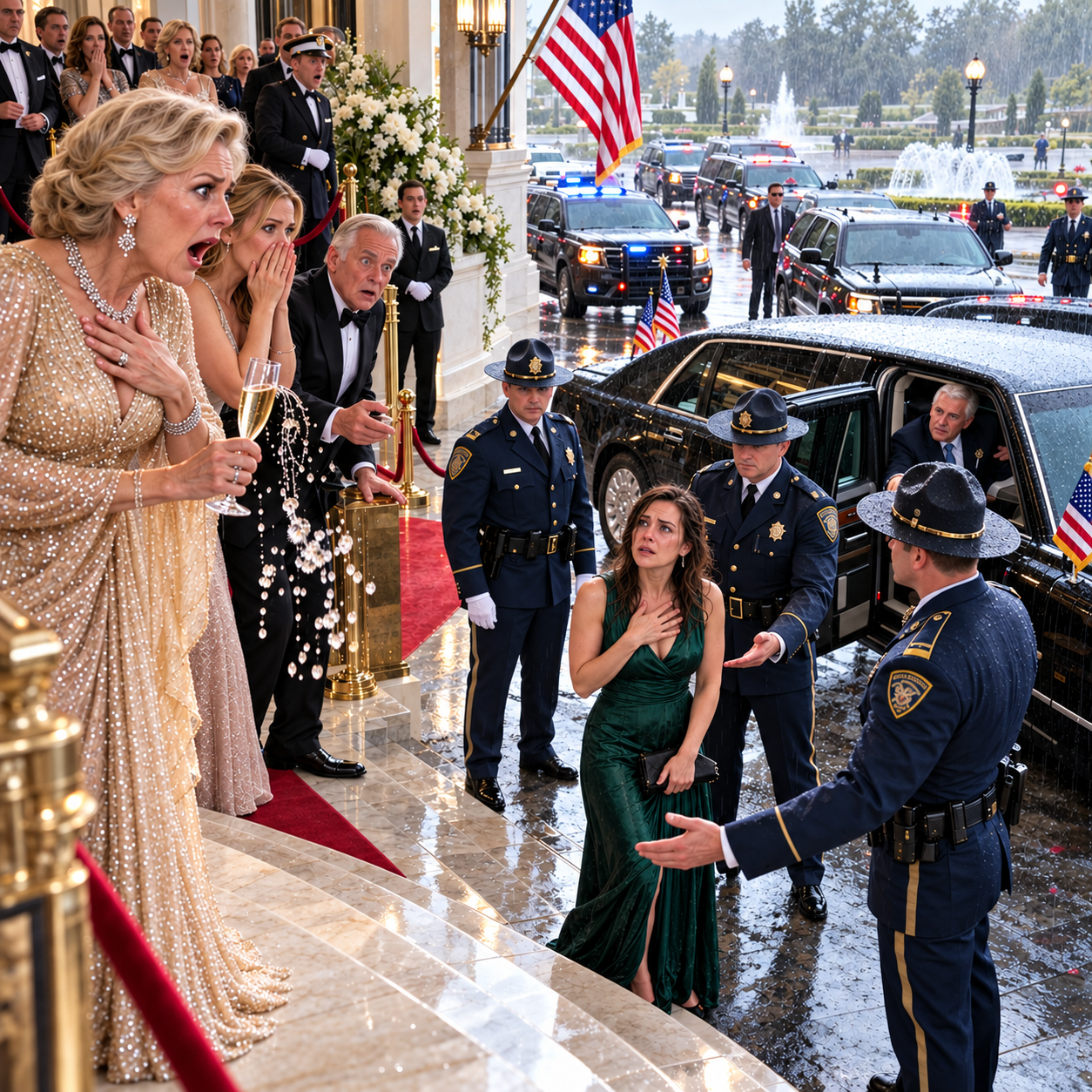
My Mother Erased My Name From The Family Gala Guest List. “Tonight Is Only For High-Society People, Not Failures.” So I Turned Around And Walked Into The Rain. Before I Reached My Car, The Governor’s Motorcade Blocked The Exit, And Four Troopers Stepped Out. “Ma’am, The Governor Refuses To Enter Without You…”
My mother removed my name from our family gala guest list because she thought my government job would embarrass her in front of the governor. I didn’t argue. I left my invitation on a silver tray and walked into the pouring rain, still wearing the military uniform she’d never bothered to ask about beneath my coat. Twenty minutes later, the governor insisted I return. Three days afterward, a woman from the flood zone handed me a document bearing my father’s signature—dated two years after his funeral.
Part 1: The Daughter Who Didn’t Belong
The first time my mother called me a disappointment, I was twenty-six, sitting at her kitchen island with a promotion letter folded inside my purse. The second time, I was thirty-eight, standing beneath a chandelier in a downtown hotel while she explained why I wasn’t welcome at a charity event carrying our family’s name. Between those two moments, I had learned to command military personnel, coordinate disaster evacuations, and make decisions that could determine whether entire communities received food and shelter. Apparently, none of that qualified me to attend dinner with my own mother.
My name is Arden Wexler, and for most of my adult life, my mother, Celeste, introduced me as “our daughter who works for the state.” She always delivered that description with a sympathetic little smile, as though I had suffered an unfortunate professional setback. My older brother, Beckett, received a considerably more enthusiastic introduction: executive director, development strategist, rising philanthropist, and the brilliant future of the Wexler Reach Foundation. He enjoyed correcting people’s pronunciation of expensive wines and discussing real estate projects that never seemed to break ground.
Our father, Graham Wexler, established the foundation nearly thirty years earlier, after a spring flood destroyed hundreds of homes along the Merrin River. Dad had grown up in a two-bedroom house behind a feed store, and he remembered what it felt like when insurance companies stopped answering the phone. His original organization bought temporary housing, repaired damaged schools, and delivered groceries to families who had lost everything. By the time he died, five years before the gala, it had become one of the region’s most respected charitable institutions.
My mother changed its direction gradually, beginning with a new logo, expensive fundraising consultants, and an annual black-tie celebration at the Ashbury Grand Hotel. She insisted that relationships with influential donors were essential to expanding our father’s mission, and initially, I believed her. But the foundation’s annual reports began devoting more space to photographs of fundraising dinners than to the families receiving assistance. Whenever I asked about program expenses, Beckett reminded me that nonprofit management was more complicated than organizing government paperwork.
He had never actually asked what my paperwork involved.
For eight years, I had served as a lieutenant colonel in the Air National Guard while working in state emergency management. My primary assignment involved coordinating transportation, communications, and supply distribution during regional disasters. Much of my work happened behind computer screens, but those screens displayed evacuation routes, aircraft availability, road closures, shelter capacity, and the locations of people waiting for rescue. I was proud of the work, even when nobody outside our operations center knew my name.
Three weeks before the gala, a section of the Merrin River levee collapsed after four days of relentless rainfall. The water swept through two neighborhoods before dawn, reached the industrial district by breakfast, and eventually forced evacuations across three counties. I spent most of the following four days inside the emergency operations center, drinking bitter coffee and coordinating helicopter crews, rescue boats, and truck convoys. By the time the floodwaters stabilized, more than four hundred stranded residents had been brought to safety through the combined efforts of local responders, state personnel, and National Guard crews.
One of those residents was a retired school cafeteria worker named Lenora Pike, who had climbed onto the roof of her house with her seven-year-old grandson. Their rescue team encountered power lines hanging across the flooded street, forcing us to reroute an aircraft while daylight was disappearing. When Lenora finally reached the evacuation center, she asked a volunteer whether somebody could save the photographs from her living room. The volunteer promised to try, although neither of them knew whether the house would still be standing.
Five days later, I attended Sunday dinner at my mother’s house wearing clean jeans and the only boots I hadn’t packed away. I had slept six hours in the previous two nights, and the smell of floodwater seemed permanently trapped in my hair. Beckett was describing a development proposal involving a renovated waterfront complex when I mentioned that displaced families desperately needed additional temporary housing. My mother set down her wineglass and gave me the patient, embarrassed expression I remembered from childhood.
“Arden, please don’t turn dinner into another discussion about your government filing job,” she said. “Your brother is working on something important, and I’d prefer that we concentrate on his opportunities.” Beckett smiled without looking at me and continued describing a proposed partnership with the state. I noticed the words emergency recovery printed across the top of his presentation folder, but when I reached for it, he casually moved it beside his plate.
That evening, I received a formal invitation to the foundation’s annual gala, accompanied by a handwritten note from the event coordinator confirming my seat at the family table. My mother had never welcomed my career choices, but she had always permitted me to attend the event Dad started. I considered declining because our response operation was still active, then remembered how Dad used to introduce me to donors by saying, “This one’s going to do something useful with her life.” I placed the invitation beside his framed photograph and decided to go.
Two days before the gala, the state controller’s office notified me that Wexler Reach had applied for a significant share of the new disaster recovery funding. I immediately submitted a written disclosure of my family connection and requested removal from all related evaluations. The independent review office acknowledged my recusal, leaving me with no authority over the foundation’s application. I was relieved, although something about Beckett’s sudden enthusiasm for emergency housing continued to bother me.
On the night of the gala, an afternoon briefing ran late, leaving me barely enough time to drive across the city. Beneath my long black coat, I wore my formal Air Force dress uniform, carefully pressed and decorated for an awards ceremony I had been told might occur later that evening. My mother had no idea that the governor’s office had requested my presence, and I assumed she would discover the reason during dinner. I was mistaken about how much time she intended to let me spend inside the building.
When I reached the Ashbury Grand, rain was hammering against the glass canopy and the lobby smelled of white lilies and polished wood. The young woman at registration searched her tablet twice, then looked up at me with obvious discomfort. “I’m sorry, Ms. Wexler, but your name was removed from the seating chart about twenty minutes ago,” she whispered. Before I could ask who had authorized the change, I heard my mother’s familiar heels clicking rapidly across the marble floor.
Part 2: Twenty Minutes Before the Governor Arrived
My mother approached with Beckett beside her, both dressed as though the evening had been arranged for their personal benefit. Celeste wore a deep green evening gown with a diamond necklace Dad had given her for their twentieth anniversary, while Beckett adjusted the cuffs of a tailored tuxedo. Her smile disappeared when she recognized me, and she glanced nervously toward a group of donors waiting near the ballroom entrance. She took my elbow and steered me behind a decorative partition before speaking.
“Arden, what exactly are you doing here?” she asked, keeping her voice low enough to avoid attracting attention. I explained that I had received an invitation, that the coordinator had confirmed my seat, and that I had come directly from work. She looked down at my black coat, the damp ends of my hair, and my practical shoes, then closed her eyes as if trying to control her irritation. “I thought we made it clear that tonight was especially important.”
“You told me the governor was attending,” I answered. “You didn’t tell me I wasn’t invited.”
Beckett leaned against the wall, watching the registration desk rather than my face. “Governor Rowan Halden is announcing a major disaster recovery initiative tonight, and our foundation is positioned to become a central partner,” he explained. “We’ve spent months cultivating the right relationships, Arden, and every detail matters.” He gestured vaguely toward my clothing, leaving the rest of his judgment unspoken.
My mother wasn’t nearly as subtle.
“The governor will be surrounded by business leaders, elected officials, and people who have contributed substantial amounts of money,” she said. “I cannot spend the evening explaining why my daughter abandoned a promising corporate career to work in some government basement.” When I reminded her that Dad had created the foundation to help ordinary families, she gave a short, impatient laugh. “Your father was an idealist, Arden, and idealism doesn’t pay for programs.”
I stared at her for several seconds, remembering the weekends Dad had spent loading donated mattresses into an aging delivery truck. He used to come home with muddy boots and aching shoulders, happy because another family had somewhere warm to sleep. I had believed my mother understood what those weekends meant, even if she disliked the inconvenience. Standing in that hotel lobby, I realized she remembered the foundation very differently.
“You’re embarrassing me simply by being here,” she continued. “You’ll ruin my image, and tonight is for people who belong in these circles, not for someone who has accomplished nothing worth discussing.”
I could have unbuttoned my coat.
Underneath it were the silver oak leaves of my rank, the service ribbons I had earned over years of assignments, and the uniform I had worn beside people whose courage I respected more than any ballroom full of donors. For an instant, I imagined revealing everything and watching her expression change. But I had spent too much of my life trying to earn a kindness that should never have depended on my salary, title, or clothing.
“All right,” I said.
Celeste blinked, apparently expecting an argument. Beckett straightened, looking almost disappointed that he wouldn’t have to help escort me outside. I removed my invitation from my purse, placed it on a silver tray near the registration desk, and thanked the young coordinator for her assistance. Then I walked toward the revolving doors before my mother could decide how to make my departure more humiliating.
Outside, the rain had become a solid curtain that blurred the headlights along the avenue. My car was in the overflow lot beyond the hotel’s landscaped courtyard, and my dress shoes slipped slightly against the wet pavement. I tightened my coat around myself and tried to concentrate on the next morning’s supply meeting instead of the words that kept repeating in my head. You have accomplished nothing worth discussing.
My phone vibrated before I reached the parking lot, displaying a message from Major Tessa Calder, my deputy at the operations center. “Governor’s office asking where you are. Ceremony moved up. Are you inside?” I stared at the screen, wondering whether to explain that the evening’s hosts had withdrawn my invitation. Before I could answer, a siren sounded behind me, sharp enough to cut through the pounding rain.
Three black SUVs entered the driveway, their blue emergency lights reflecting across puddles and the hotel’s glass facade. The first vehicle stopped near the parking lot exit while the other two pulled beside the curb. Four state troopers stepped out, scanning the courtyard until one of them spotted me. He hurried toward me beneath a large black umbrella.
“Lieutenant Colonel Wexler?” he called.
“Yes?”
“I’m Sergeant Ellis with the governor’s protective detail,” he said, holding the umbrella over my head. “We’ve been trying to locate you. Governor Halden won’t enter the ballroom without speaking with you first.”
I glanced toward the hotel, where guests were still arriving beneath the illuminated awning. “There’s been a misunderstanding about my attendance,” I explained, choosing my words carefully. “The hosts have withdrawn my invitation.”
Sergeant Ellis looked surprised, but before he could respond, the rear passenger door of the second SUV opened. Governor Halden stepped into the rain wearing a dark overcoat, followed by a senior staff member carrying a leather portfolio. I had worked with his emergency management office for years, although most of our meetings involved maps, damaged infrastructure, and difficult decisions rather than public ceremonies. He approached with the brisk manner of someone whose schedule had already been disrupted.
“Colonel Wexler, why are you standing in the parking lot?” he asked.
I opened my coat enough for him to see my uniform and answered, “Governor, the foundation’s director has asked me to leave.”
His expression changed from concern to disbelief. “The foundation’s director is your mother, correct?” When I nodded, he glanced at his chief of staff, who immediately opened the portfolio. Inside was an official presentation program bearing my name and a formal citation recognizing my leadership during the Merrin River evacuation.
“I came here to recognize the people who kept those communities alive,” Halden said. “Your coordination team made that possible, and you represent everyone who worked through those four days.” He looked toward the hotel entrance, where photographers were gathering behind velvet ropes. “You’re walking in with me, Colonel, and we’re going to make sure your team receives the recognition it deserves.”
I hesitated, not because I feared my mother’s reaction, but because I could already imagine how the evening might become a spectacle. The governor seemed to understand without my explaining. “This isn’t about settling a family disagreement,” he added. “It’s about making sure we don’t lose sight of why we’re here.”
I followed him back beneath the awning, handed my wet coat to an aide, and checked that my uniform was still properly arranged. Sergeant Ellis opened the ballroom doors as an announcer introduced the governor and his delegation. My mother and brother hurried forward with their practiced welcoming smiles, stopping only when they noticed the woman walking immediately beside him.
My mother’s gaze moved from my face to the insignia on my shoulders, then to the decorations above my breast pocket. Her expression changed so quickly that I almost felt sorry for her. Almost.
Part 3: The Question My Brother Should Never Have Asked
The ballroom held nearly four hundred guests, and for several uncomfortable seconds, their conversations faded as the governor entered with me at his side. A string quartet continued playing near the windows, seemingly unaware that anything unusual had occurred. Celeste recovered first, smoothing her gown before extending her hand toward Governor Halden. Beckett remained a step behind her, staring at my uniform with an expression I had never seen on his face.
“Governor, welcome to the Wexler Reach Gala,” my mother said brightly. “We’re delighted you’ve joined us, and we’ve reserved an excellent seat for you at the family table.” Halden shook her hand and thanked her for hosting an event supporting regional recovery. Then he glanced toward the seating coordinator, who stood frozen beside the entrance holding her tablet. “I understand Colonel Wexler’s original seat was reassigned,” he said. “Fortunately, we’ve arranged for her to join the state delegation.”
My mother opened her mouth, then closed it without speaking. Several nearby donors looked from her to me, clearly trying to understand what relationship could explain our identical surnames. The governor made no reference to our disagreement, and I appreciated his discretion. Unfortunately for Celeste, nothing about the situation required an explanation for everyone to notice her discomfort.
An older gentleman approached while we waited for the receiving line to move. He introduced himself as Martin Hensley, a retired transportation commissioner who had worked with my father during the foundation’s early years. “Graham used to talk about you constantly,” he told me, studying my uniform with a warm smile. “He said you could organize a rescue operation before breakfast, although I assumed he was exaggerating.” I laughed for the first time that evening and told him Dad had exaggerated plenty of things, especially the size of the fish he caught.
Across the room, Beckett watched our conversation with growing agitation.
The governor’s staff directed me to a table near the stage, where several emergency management officials were already seated. Major Tessa Calder stood when she saw me and whispered, “Your mother looks like somebody just canceled the entire party.” I gave her a warning glance, and she quickly returned to discussing the condition of several damaged bridges. Before the first course arrived, however, Beckett appeared beside my chair and asked whether I could speak with him privately.
I followed him into a small conference room off the main hallway, expecting another complaint about embarrassing our mother. Celeste entered immediately behind us and closed the door with considerably more force than necessary. Once we were alone, she stared at my uniform as though it had been manufactured specifically to deceive her. “I want an explanation,” she demanded. “When did you become some kind of senior military officer?”
“I’ve been an officer for years, Mom,” I answered. “I received this rank last summer, and you were invited to the ceremony.”
Her eyes narrowed. “You told me it was some departmental promotion.”
“No. You called it that after I explained what the ceremony was, and then you said you couldn’t attend because Beckett had a donor luncheon.” I remembered how I had waited outside the auditorium, checking my phone before the ceremony began. Dad had been gone for four years by then, and the empty family seats had bothered me more than I wanted to admit.
Beckett interrupted before she could respond. “Forget the uniform for a minute. Your department coordinates the emergency relief programs, doesn’t it?” He approached the conference table and lowered his voice. “Tell me something, Arden. Were you involved in reviewing our application for the regional recovery partnership?”
I told him that I had formally disclosed our relationship and removed myself from every part of the selection process. His shoulders relaxed, although the speed of his reaction made me uneasy. Then I explained that the application had proceeded to the independent review office, where financial records and program claims would be examined without my participation. The relief initiative was substantial enough that every major applicant would undergo the same scrutiny.
Beckett’s relief vanished.
“What kind of financial records?” he asked.
“The records any organization applying for public funding should be prepared to provide,” I said. “Financial statements, related-party transactions, project expenses, and evidence that previous services were delivered.” I watched him grip the back of a chair until the leather creased beneath his fingers. “Why are you asking?”
My mother answered before he could. “Because this partnership is important to the foundation, and your brother has worked extremely hard to secure it.” She moved closer, her voice becoming almost pleading. “Surely you can explain to the governor how much your father’s organization deserves this opportunity.”
“I can’t endorse an application I’m required to stay out of,” I replied. “And I wouldn’t ask anyone to overlook the review.”
Beckett turned away and stared at the closed door. “We have consulting agreements that might look complicated if someone doesn’t understand them,” he muttered. When I asked which agreements, he said they were ordinary arrangements with outside professionals and accused me of treating him like a suspect. Celeste immediately told me the foundation’s accountants handled everything properly, although I noticed she never asked him to explain those agreements.
My phone vibrated with a message from Tessa confirming that the governor’s remarks were beginning shortly. I told them I needed to return to the ballroom, but Celeste stepped between me and the door. “Whatever happens tonight, I expect you to remember that this is your father’s legacy,” she said. “He would be devastated if you allowed strangers to destroy what he built.”
For a moment, I saw the old kitchen island where Dad used to sort handwritten requests from families needing assistance. He had trusted the foundation because it represented ordinary people helping one another, not because our surname appeared on its stationery. I looked at my mother and realized she was asking me to protect the organization’s reputation without knowing whether its work deserved protection. “Dad would want every dollar accounted for,” I said, and walked past her.
Back in the ballroom, I noticed something I had missed earlier. Beside the stage stood an enormous display celebrating the foundation’s disaster response, complete with photographs, statistics, and a statement claiming that Wexler Reach had provided temporary housing to more than twelve hundred flood survivors. I recognized two of the photographs because they had been taken at state-operated evacuation centers, not foundation shelters.
One picture showed Lenora Pike sitting beneath a gray emergency blanket beside her grandson.
I knew precisely which rescue crew had brought them there, and I knew which agency had paid for the shelter where that photograph was taken. What I didn’t know was why my brother’s foundation was presenting their experience as evidence of its own work.
Part 4: What the Governor Announced Instead
I was still studying the display when a foundation employee approached and asked whether I wanted my picture taken beside it. Her name tag identified her as Sloane Mercerfield, director of public relations, and she carried a professional camera with a flash attachment. I asked who had supplied the photographs and whether the people pictured had consented to their use. She hesitated, then explained that Beckett’s office had provided everything for the exhibition that afternoon.
I thanked her without agreeing to a photograph.
At our table, Tessa was reviewing the display’s printed statistics on her phone. She had noticed the same discrepancy and quietly asked whether the foundation was actually operating the housing facilities it claimed. “I don’t know,” I answered. “I recused myself from their funding review, and I’d rather keep our operational concerns separate from that process.” She nodded and said she would verify whether any state photographs had been released with the necessary permissions.
The governor took the stage shortly after nine, accompanied by the quiet movement of staff members adjusting microphones and presentation folders. My mother sat at the center family table, perfectly upright, while Beckett repeatedly checked his phone beneath the tablecloth. I could see the enormous foundation logo projected behind the podium. Its elegant lettering was familiar, but the organization it represented had become increasingly difficult for me to recognize.
Halden began by thanking volunteers, local responders, municipal employees, and the residents who had helped their neighbors survive the levee failure. He spoke about families still living in temporary accommodations, damaged water systems, and the enormous amount of rebuilding ahead. Then he explained that the state’s next funding allocation would go through county emergency agencies and established regional service providers rather than through a new statewide intermediary agreement. The decision, he said, followed a procurement review identifying unresolved compliance questions involving several prospective partners.
A murmur moved through the ballroom.
The announcement didn’t name Wexler Reach, but everyone who had heard my brother discussing his anticipated partnership understood what had changed. Beckett lowered his eyes to the table, and my mother’s smile became strained enough to look painful. The governor continued with details about transparent reporting requirements and direct assistance for displaced households. There was no accusation from the podium, only the unmistakable absence of the contract my family had expected him to celebrate.
Then the governor opened a small presentation case.
“Tonight, I also have the privilege of recognizing a leader whose work represents the very purpose of public service,” he said. “Lieutenant Colonel Arden Wexler helped coordinate the response that brought hundreds of residents to safety during the Merrin River disaster.”
I stood when he called my name, aware that several people were turning toward the family table. The citation described the coordination of aircraft, rescue teams, medical transport, and emergency supplies across three counties. As Halden presented the state distinguished service medal, I thought about the exhausted helicopter crews, the local firefighters who had entered rising water, and the shelter volunteers who hadn’t seen their families for days. I accepted the medal on behalf of every person who had made that operation possible.
The applause was generous and surprisingly emotional. Martin Hensley stood first, followed by other guests until nearly everyone in the ballroom was on their feet. From the stage, I could see Celeste and Beckett rise slowly beside their table, clapping with the careful restraint of people who wished to disappear. The moment should have felt like vindication, but my strongest feeling was relief that the ceremony had acknowledged the people who actually did the work.
Afterward, Halden asked whether I wanted to say anything.
I stepped toward the microphone and kept my remarks brief. “The people who survived the flood don’t need to know the names of the officers who coordinated their evacuation,” I said. “They need safe homes, clean water, working roads, and the confidence that when help is promised, it will arrive.” I thanked the responders and volunteers, then returned to my seat.
Twenty minutes later, my mother intercepted me near the coat check.
“Do you understand what you’ve done to this family?” she whispered, grabbing my sleeve. “The governor publicly undermined our partnership, and you stood beside him while he did it.” I gently removed her hand and explained that funding decisions belonged to the independent review process, not to me. She looked almost offended by that distinction.
“You could have warned us,” she insisted. “You could have helped Beckett understand what those auditors wanted instead of letting him walk into an embarrassment.”
“Beckett knew he was applying for public money,” I replied. “He shouldn’t have needed his sister to explain why he had to document how the foundation spent its funds.”
Her eyes filled, but the tears disappeared when two donors approached us. She immediately straightened her shoulders and introduced me as her distinguished daughter, the lieutenant colonel. The effortless change in her voice told me everything I needed to know about how she expected our relationship to proceed. I excused myself before she could invite me to another family dinner.
Outside the hotel, the rain had eased to a steady drizzle, and my car was waiting near the entrance. Beckett appeared beside the valet stand, carrying his phone and looking more tired than I had ever seen him. He asked whether auditors could distinguish legitimate consulting expenses from payments that simply hadn’t been documented correctly. When I told him that accurate records were essential, he rubbed his forehead and asked one more question.
“What happens if a foundation reports housing assistance that was never actually provided?”
I turned toward him, suddenly remembering Lenora’s photograph on the stage display. “Why would you ask me that, Beckett?” I said. He didn’t answer, and when his car arrived, he climbed inside without another word.
Three days later, Lenora Pike called the operations center asking to speak with me personally. She said she had found something in the paperwork her grandson rescued from their flooded house, something connected to my father and the foundation bearing his name. When I agreed to meet her, she lowered her voice and told me to come alone.
Part 5: My Father’s Name Was Still Being Used
Lenora lived in a small rental duplex outside Millbrook, nearly forty miles from the neighborhood where rescue crews had found her. When I arrived on Saturday morning, her grandson was assembling a cardboard model airplane at the kitchen table, and the room smelled of cinnamon toast and freshly brewed coffee. She thanked me for coming, then placed a plastic document folder between us. Its edges were warped from water damage, but the papers inside were still readable.
“I volunteered at the Millbrook Community Shelter for fourteen years,” she explained. “Your daddy used to bring us groceries whenever the river flooded, and he never once asked us to put his name on a sign.” She opened the folder to an agreement bearing the Wexler Reach logo and described how the foundation had promised financial support for emergency housing three years earlier. The agreement had required her shelter to certify that it was providing accommodation for hundreds of displaced residents, although it had never received the money, equipment, or staffing needed to open additional beds.
Lenora refused to sign the certification. A foundation representative subsequently told her that the paperwork had been handled elsewhere and that her services were no longer needed. She kept copies because she didn’t understand why an organization claiming to help flood victims would abandon a functioning community shelter. When she saw the foundation’s gala coverage online, including the photograph of herself and her grandson, she remembered the documents.
“Look at who approved the agreement,” she said.
Near the bottom of the final page was a reproduced signature beneath the title Founder and Program Chairman. I recognized the broad capital G, the unusual loop in the W, and the slight downward slant Dad’s handwriting always developed near the end of a sentence. The document had been issued two years after his death. My stomach tightened as I checked the date again, hoping I had misunderstood what I was seeing.
“Your father didn’t sign that,” Lenora said quietly. “I knew Graham too well to believe he approved something he wouldn’t have done when he was alive.”
I photographed the relevant pages with her permission, then contacted the independent oversight office rather than investigating the foundation myself. My recusal still applied, and I had no intention of crossing that boundary because the evidence involved my family. An investigator arranged to collect the originals, interview Lenora, and compare the documents with the foundation’s archived records. Within days, the review expanded beyond the original grant application.
The findings emerged gradually over the following six weeks. Wexler Reach had reported housing services delivered through community partners that denied receiving the corresponding funds. Substantial payments had gone to Northbank Advisory, a consulting business controlled by Beckett, while promised improvements to shelters and community facilities remained unfinished. More troublingly, the foundation had continued using my father’s name on program authorization documents long after his death, creating the appearance that its activities carried his personal approval.
The records also revealed that my mother had approved the consulting arrangement through a board resolution. She had signed annual financial disclosures describing the payments as legitimate administrative expenses, despite repeated internal questions about missing service documentation. An employee’s correspondence showed that Celeste had specifically instructed the organization to retain Dad’s old approval signature on certain materials because donors trusted his reputation. The records did not support the story that Beckett had acted alone while she remained unaware.
When Celeste learned that the investigation was expanding, she called me seventeen times in one afternoon. I finally answered that evening, standing in my kitchen while rainwater dripped from my coat onto the tile. Her voice was unusually soft, and she asked whether we could speak privately without attorneys or government officials. I agreed to listen, but refused to discuss the investigation beyond what was publicly available.
“Your brother made mistakes,” she said. “He was trying to modernize the organization, and the costs became difficult to manage.” She explained that exclusive donors expected polished events, professional consultants, and ambitious development plans. When I asked whether she understood that money promised to displaced families had been diverted toward those expenses, she remained silent long enough for me to hear her clock ticking.
“Nobody intended to hurt those people,” she finally answered.
“Lenora Pike spent three weeks sleeping in a school gym with her grandson,” I said. “Your annual report counted her family among the people the foundation housed, even though the state provided their shelter.” My mother replied that public communications sometimes simplified complicated partnerships. I told her there was a difference between simplifying a report and claiming credit for assistance that an organization had not provided.
Then her voice hardened.
“Your father spent his entire life building something important, Arden. Are you really prepared to stand by while people dismantle his name?”
I looked toward Dad’s photograph on my bookshelf, remembering how he used to repair the foundation’s delivery truck himself so there would be more money for groceries. He had never cared whether strangers knew his name, but he cared intensely whether promises were kept. I told my mother that protecting his memory was not the same as protecting her decisions.
She began crying and asked me to remember that she was still my mother.
“I do remember,” I said. “I remember exactly how you treated me when you thought nobody important was watching.”
I ended the call before she could respond.
Part 6: The Cost of Keeping Up Appearances
The foundation’s board held an emergency meeting the following month, and Celeste resigned as executive director before the independent review was completed. Beckett stepped away from his position after the state issued a formal notice suspending the organization from consideration for new emergency funding. An independent management team assumed control of existing programs while accountants reconstructed several years of spending records. None of those decisions came from me, and that distinction mattered more than the public recognition I had received at the gala.
The investigation eventually established that significant charitable funds had been spent on poorly documented consulting arrangements and projects that had never delivered their promised services. Beckett’s company was required to repay disputed payments under a civil resolution, and he sold his luxury SUV and an investment property to meet part of his obligation. Celeste entered a separate agreement requiring financial restitution, the surrender of her foundation authority, and independent oversight of the organization’s remaining assets. The authorities retained the ability to pursue additional action if further evidence justified it.
I learned most of those details through official notices and public records. My family had spent years dismissing my government work as unimportant, yet I was determined not to use that position to interfere with their case. When an investigator asked me to provide a statement regarding my father’s signature, I described the handwriting samples I possessed and explained when he had died. I did not offer conclusions about anyone’s motives beyond what I personally knew.
Four months after the gala, I received a letter from my mother.
It arrived in a cream-colored envelope bearing the embossed initials she used on personal stationery. She wrote about her childhood, her marriage to Dad, and the years she had spent maintaining a foundation whose expenses had steadily increased. She described the pressure of keeping wealthy donors interested and insisted that she had always intended to preserve our family’s reputation. Near the end, she asked whether I could find it in my heart to forgive her so we could begin again.
There was no apology to Lenora, no acknowledgment of the families whose assistance had been misrepresented, and no explanation for the documents carrying Dad’s signature. She wrote that she was proud of my military accomplishments, but even that compliment felt conditional, arriving only after an audience had applauded me. I read the letter twice, folded it along its original creases, and placed it in a drawer. I never answered.
Beckett reached out through a mutual acquaintance several weeks later. He had accepted a junior administrative position at an industrial supply company, far from the executive offices and expensive restaurants where he had spent most of his career. He wanted to explain how events had gotten out of control and hoped that I would eventually understand the pressures he had faced. I declined the conversation because I already understood the important part: he had been given resources intended to help vulnerable people and had treated those resources as an extension of his ambitions.
The new foundation trustees contacted me before their first public meeting. They intended to restore the organization’s original focus on direct community assistance and asked whether I would consider joining an advisory group. I declined because my government responsibilities could create future conflicts, but I offered to share publicly available information about disaster preparedness and emergency shelter standards. They accepted the distinction and proceeded without using my surname as an endorsement.
The first project completed under their supervision was modest: repairs to the heating system, bathrooms, and kitchen at the Millbrook Community Shelter. Lenora attended the reopening with her grandson, who had grown several inches since the flood and was already asking questions about becoming a rescue pilot. She sent me a photograph of the renovated dining room, where folding tables stood beside shelves of blankets and emergency supplies. There were no chandeliers, photographers, or enormous donor portraits.
I kept that picture on my desk.
One afternoon, nearly six months after the gala, I drove past the Ashbury Grand on my way home from an emergency planning meeting. A new charity event was being advertised beneath the hotel’s bright entrance canopy, and guests in formal clothes were gathering near the same doors where my mother had turned me away. For the first time, the memory didn’t make my chest tighten. I continued through the intersection, stopped for groceries, and went home to a quiet house that belonged entirely to me.
My life hadn’t changed as dramatically as people imagined after the governor’s ceremony. I still woke before sunrise, answered calls at inconvenient hours, and worried about road closures when the weather forecast mentioned heavy rain. Tessa still complained about the coffee at headquarters, and our operations center still had a printer that jammed whenever someone needed it urgently. I hadn’t become rich, famous, or suddenly important because a room full of strangers stood to applaud me.
I had simply stopped measuring myself against my mother’s expectations.
On the anniversary of Dad’s death, I visited his grave carrying a small bunch of yellow flowers. I told him about the reopened shelter, the families returning home, and Lenora’s grandson, who had decided that helicopters were the greatest machines ever invented. I didn’t tell him I had forgiven Celeste or Beckett, because I hadn’t. I told him that the foundation was helping people again, under new leadership, and that his work had not disappeared with the people who misused his name.
A few weeks later, another storm crossed the northern counties. I was back at the operations center before dawn, watching weather reports and coordinating trucks loaded with bottled water, blankets, and portable generators. Through the tall windows, a military transport aircraft lifted off from the runway beneath a low gray sky. Tessa handed me a revised delivery schedule, and I checked the destination codes before authorizing the next movement.
My phone lit up with a message from Lenora.
“Everything arrived,” she wrote. “The shelter is ready, and nobody has to sleep in the hallway this time.”
I read it once, then placed my phone beside the operations map and returned to work.
For years, I had wanted my mother to look at me and see someone worth being proud of. Now I had a message from a woman whose family was safe, a delivery schedule showing where every truck was headed, and an entire team making certain the next community received what it needed.
My mother could keep her invitations, her explanations, and whatever remained of the image she had spent her life protecting.
I had people depending on me, and I knew exactly where I belonged.
THE END!
Disclaimer: Our stories are inspired by real-life events but are carefully rewritten for entertainment. Any resemblance to actual people or situations is purely coincidental.