
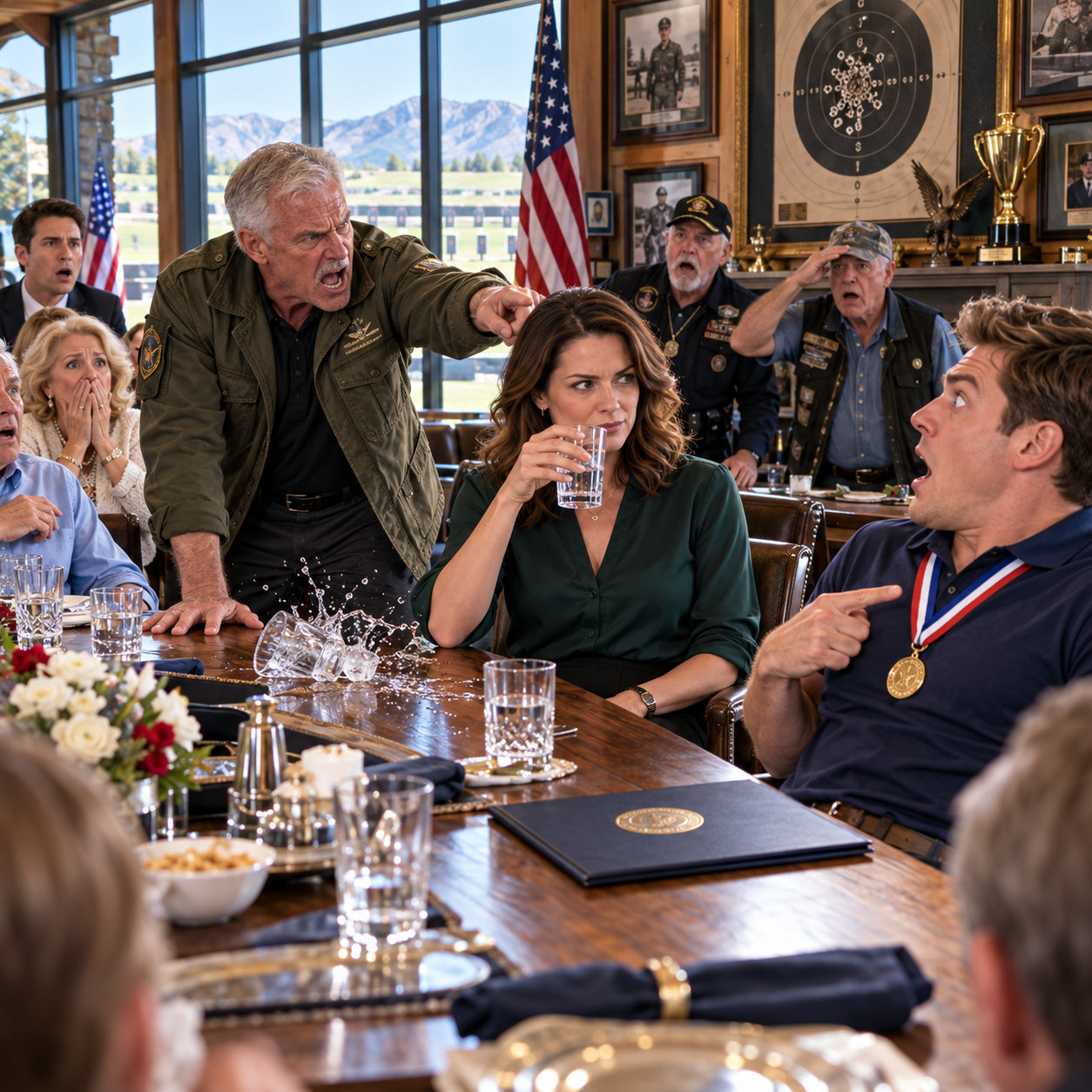
My Brother Toasted His New Marksman Certificate: “Nobody Holds A Candle To My Score! Even That Mythical ‘Iron Falcon’ Would Miss!” I Took A Sip Of Water. That Was My Secret Recon Call Sign. The Retired Chief Rangemaster Turned Pale As Death. He Slapped The Table Hard: “Stand Down, Boy! She Set That Unbroken Target Record 10 Years Ago!”
My younger brother slapped his tactical qualification badge onto our dining table and laughed that he could outshoot the legendary marksman called Iron Falcon. My mother applauded him, my father mocked my ordinary desk job, and I quietly finished my dinner. Then our grandfather’s oldest military friend noticed the scar on my right thumb and stood so abruptly that his chair struck the wall. Three days later, a forgotten safety report arrived at my office, bearing a signature that made his reaction even more disturbing.
Part 1: The Name Nobody Was Supposed to Say
My brother Tobin had always known how to turn a family dinner into a celebration of himself. That Thursday evening, he arrived at our parents’ house in western New Mexico wearing his new regional tactical academy jacket, carrying a leather folder, and grinning like somebody had just handed him the keys to the state. Before my mother could finish setting the roasted potatoes on the table, he pulled a polished qualification badge from his pocket and dropped it beside the gravy boat. “Highest score in my advanced marksmanship class,” he announced, spreading his arms as though he expected applause.
My mother, Willa Vale, provided exactly that, abandoning the serving spoon to hug him. My father, Gareth, raised his glass and declared that the Vale family finally had a genuine sharpshooter. I was sitting opposite Tobin, halfway through a piece of chicken, when my father glanced at me and added, “No offense, Maren, but your brother’s doing something a little more exciting than organizing bus schedules.” My mother chuckled, and Tobin gave me a sympathetic smile that somehow felt worse than the joke.
At thirty-seven, I had worked for the county transit authority for nearly six years, coordinating routes, maintenance windows, and emergency transportation plans. Before that, my official employment history showed eight years of military logistics assignments, including extended postings in Qatar, where I supposedly spent most of my time managing equipment inventories. My family considered me dependable, practical, and profoundly uninteresting. Nobody ever asked why I avoided discussing those years, and after a while, I stopped wishing they would.
Our other dinner guest was retired Chief Warrant Officer Five Ellis Ward, my late grandfather’s closest friend and a man who had spent decades overseeing military marksmanship evaluations. Ellis was seventy, with iron-gray hair, a stiff right knee, and a habit of noticing everything without commenting on much. He had brought my grandfather’s favorite pecan pie and spent most of dinner listening patiently to Tobin’s enthusiastic account of his training. When Tobin produced his target sheets, Ellis adjusted his reading glasses and leaned forward.
“Look at this grouping,” Tobin said, pushing a paper across my plate. “Nine hundred yards, variable crosswinds, and I still scored better than anybody in the class.” He pointed to several dark marks surrounding the center of a printed target, then looked at me. “You probably wouldn’t understand the technical stuff, Maren, but there’s a reason they don’t let just anybody handle precision rifles.” I moved the paper away from my potatoes and told him his score looked impressive, which was apparently not enthusiastic enough.
Tobin leaned back and explained that the academy maintained a legendary training record from November 2016. According to his instructors, an unidentified shooter had completed ten extraordinarily difficult long-distance evaluations without a recorded miss, despite severe desert winds and equipment restrictions. The shooter’s name had never appeared publicly; the framed record contained only a military call sign. “Iron Falcon,” Tobin announced, savoring the words before laughing. “Sounds like somebody made it up for a recruitment poster.”
Ellis stopped chewing, but Tobin didn’t notice. My brother continued explaining that the record was probably the result of favorable conditions, selective scoring, or some instructor exaggerating a story to intimidate younger trainees. He said his academy director, Harlan Sloane, liked to mention Iron Falcon whenever a student became too confident. “Personally, I think I could outshoot Iron Falcon any day of the week,” Tobin said, tapping his badge. “Put us on the same range and let the targets decide.”
My father laughed so hard he nearly spilled his wine, and my mother announced that she would happily pay to watch. I glanced at Ellis, expecting the restrained smile he usually wore when somebody said something foolish. Instead, he was staring at Tobin’s evaluation sheet, his expression tightening around the eyes. He asked who had supervised the qualification, and Tobin proudly repeated Harlan Sloane’s name. Ellis placed his fork on the plate with such care that I immediately recognized the movement: he was controlling his temper.
“Did Sloane tell you how that record was established?” Ellis asked. Tobin shrugged and replied that all anybody knew was ten hits under supposedly impossible conditions. “Then you’re missing the important part,” Ellis said, his voice suddenly flat. “Those were separate first-shot evaluations conducted over multiple sessions, with independent observers and documented environmental conditions. There wasn’t an opportunity to improve a score by repeating the same attempt.” Tobin rolled his eyes and insisted that legends always sounded more impressive after ten years.
Then Ellis looked at my hands. My right thumb rested against my water glass, exposing a pale diagonal scar left by an incident I had spent a decade trying not to remember. Ellis stared at it, glanced briefly toward my face, and pushed his chair backward. The legs scraped loudly against the hardwood floor as he rose into the rigid posture of a soldier reporting to a superior, his expression carrying an emotion I had never seen him show in our family home.
“Tobin,” he said quietly, “you need to stop talking.”
My brother laughed nervously and asked whether he had offended the old guard. Ellis ignored the question, standing with his shoulders squared and his eyes fixed on me. “You’ve spent this entire meal mocking somebody whose work you don’t understand,” he said. “And when you claimed you could outshoot Iron Falcon, you were sitting less than six feet away from the person who earned that call sign.”
My mother dropped the serving spoon. Tobin stared at me, waiting for the joke to become obvious, while I watched Ellis struggle with the memory he had just brought back into the room. The secret itself wasn’t what frightened me; it was the name printed at the bottom of Tobin’s qualification sheet. Harlan Sloane had supervised my final evaluation in 2016, and he had also signed the report that nearly destroyed another woman’s career.
Part 2: The Record Behind the Glass
For several seconds, nobody moved. Tobin’s grin gradually disappeared, replaced by the expression he used whenever somebody challenged a story he had already convinced himself was true. My mother looked from Ellis to me and whispered, “Maren?” I picked up my water glass, took a sip, and told Ellis he didn’t need to stand, but he remained upright until I repeated myself.
“This isn’t funny,” Tobin said, recovering his voice. “Maren handled shipping paperwork overseas. She doesn’t even own a rifle.” Ellis lowered himself into his chair and asked whether Tobin had ever considered that military personnel records might not describe every assignment in detail. My brother turned to Dad for support, but Gareth was studying the target sheet, and for the first time that evening, he seemed unable to find something clever to say.
I told Tobin that the record was real, although several details in the academy’s version had become distorted over time. I had participated in a joint military evaluation program involving precision marksmanship, equipment assessment, and field observation, and Iron Falcon had been my assigned call sign. Much of that work had taken place under administrative classifications that didn’t identify the operational nature of my duties. I could acknowledge my participation now, but certain personnel and mission details remained restricted, and I had no intention of turning dinner into a classified briefing.
Tobin studied my face, searching for some weakness in the explanation. “You’re telling me you were a special operations sniper?” he demanded, almost triumphantly, as if an exaggerated title would make everything easier to dismiss. “I’m telling you I performed a particular job for which I was trained,” I answered. “That doesn’t make me a legend, and it doesn’t make your qualification meaningless.” Ellis nodded, but Tobin’s cheeks reddened as he looked toward our parents for reassurance.
My mother recovered first. “Well, if all this is true, why didn’t you ever tell us?” she asked, sounding more offended than curious. I reminded her that I had tried discussing my assignments after returning home, but she had repeatedly changed the subject to Tobin’s high school sports and Dad’s business. She insisted that wasn’t fair, then remarked that she’d spent years believing I worked safely inside an office. There was something revealing about her disappointment: she seemed less worried about the dangers I had faced than embarrassed that other people might have known more about her daughter.
Tobin pushed his chair away from the table and demanded proof. He said anybody could memorize range terminology and repeat stories about military assignments, and he wasn’t prepared to accept that his older sister had somehow become the academy’s most famous anonymous shooter. Ellis offered to arrange an independently supervised range session, but I interrupted before Tobin could turn the offer into another performance. “I’m not competing for our parents’ approval,” I told him. “If we’re going to do this, it’s an assessment, not a contest, and we follow every instruction the current rangemaster gives us.”
That seemed to provoke him more than outright refusal. He insisted that Saturday would settle the question and asked whether I intended to bring an expensive rifle or borrow one from the facility. I said certified equipment would be sufficient and suggested he bring his original qualification paperwork, including the complete scoring record rather than the promotional sheet he had shown at dinner. His smile faltered when I mentioned the original records, a small reaction I noticed without understanding. Then my father announced that everyone needed dessert and abruptly ended the discussion.
After dinner, Ellis followed me outside while Tobin remained inside arguing with our parents. The evening air smelled of juniper and wet gravel, and my truck’s windshield reflected the porch light in a long, pale stripe. Ellis leaned against the railing, massaging his stiff knee, and apologized for identifying me without permission. I told him the call sign itself was no longer the important secret, and he answered with a question that made my stomach tighten: “How long has Sloane been directing that academy?”
I hadn’t heard Harlan Sloane’s name in almost ten years. During the 2016 evaluation, he had been responsible for coordinating range access, maintenance clearances, and the movement of personnel through restricted sections of the training grounds. He was efficient in front of visiting officials, charming with senior officers, and unusually careless whenever a safety concern threatened his schedule. My teammate, Bryn Calder, had questioned a maintenance clearance during our final week, and the resulting incident had left her with a permanent injury and a career she could no longer continue.
Officially, Bryn had entered a restricted service area without authorization. I knew that wasn’t true because I had been standing beside her when Sloane personally confirmed the area was cleared, and I had witnessed the emergency that followed. I submitted a statement through our command, expecting the discrepancy to be investigated, but the report released to local authorities contained a different sequence of events. When Bryn challenged it, Sloane’s supervisors described her complaint as a misunderstanding, and the remaining documentation disappeared into a sealed military review.
“I heard Sloane had moved into civilian training,” Ellis said, looking toward the dark road. “I didn’t know he had access to the same range complex again.” He explained that the academy had recently expanded into part of the old joint facility, including several outdoor firing lanes and the drainage infrastructure surrounding them. I asked whether the military had ever reopened Bryn’s case, and Ellis admitted that he had heard nothing conclusive. We stood in silence for a moment, both remembering the woman who had once trusted that proper procedures would protect her.
When I reached home, my phone showed six messages from Tobin, each more defensive than the last. The final one contained a photograph of his official scoring certificate, signed by Sloane, with a caption asking whether I was ready to be embarrassed on Saturday. I enlarged the document, noticing the identification number and a small notation indicating that the assessment had been conducted on Lane Six. That was the same section Bryn had questioned in 2016, long before Tobin was old enough to understand what the facility had cost her.
I called Bryn for the first time in eighteen months. She answered on the fourth ring, recognizing my voice before I could finish saying hello. When I mentioned Sloane and the academy, I heard a chair scrape against her kitchen floor, followed by the sound of a drawer opening. “Maren,” she said, “I need you to see something I kept from that investigation.”
Part 3: The Safety Report That Never Disappeared
Bryn lived two counties east of Albuquerque, in a single-story house behind the automotive workshop where she repaired precision measuring equipment. I drove there Friday morning after notifying my supervisor that I needed a personal day, following a highway lined with scrub brush and weathered cattle fences. Bryn opened her front door before I knocked, moving with the uneven gait she’d developed after her injury. She hugged me briefly, then stepped aside and pointed toward a folder lying open beside two untouched mugs of coffee.
Inside was a copy of a maintenance notice dated November 2016, bearing three signatures and a handwritten warning about the restricted service area adjoining Lane Six. The document identified a defective access-control system, an unresolved communication failure, and a temporary suspension of operations until repairs could be verified. I recognized the notice immediately because I’d helped Bryn prepare it the morning before the incident. What I didn’t remember was the fourth signature at the bottom, written in blue ink beside the words “Exception approved.”
It belonged to Harlan Sloane. Bryn explained that she’d received the copy from a civilian maintenance supervisor who had kept duplicate records because he distrusted the pressure being placed on his crew. According to the official account, Sloane hadn’t been informed of any equipment problem before the incident, and Bryn had ignored a warning that nobody had issued. This document established that he had known the restricted area was unsafe and authorized operations anyway. It didn’t answer every question, but it destroyed the central claim used to discredit her.
“Why didn’t you show me this earlier?” I asked, unable to conceal the hurt in my voice. Bryn rubbed the old injury beneath her left hip and admitted that she’d tried submitting the document during her administrative appeal, but the reviewing office would not accept a copy without confirming the original maintenance records. The civilian supervisor had since died, and the contractor maintaining the archive had dissolved. For years she had kept the paper because throwing it away felt like agreeing that the accident had been her fault. She looked at me across the table and said she was tired of treating the truth like something shameful.
I spent the next hour examining what could be verified without breaching the restrictions surrounding our former assignments. Bryn’s original military complaint contained sensitive operational references, but the civilian maintenance notice concerned the physical facility and its safety controls. She agreed to let me photograph the document and contact an attorney familiar with government records. Before I left, she handed me a second sheet bearing the name of the contractor responsible for drainage and maintenance upgrades during the academy’s recent expansion: Vale Infrastructure Services.
My father’s company. I read the name twice, hoping it referred to a similarly named business, but the registered address matched the office where Gareth had worked for twenty years. He had complained for months that municipal construction contracts were becoming harder to win, yet he had never mentioned an agreement with the academy. Bryn watched my expression change and asked whether he had told me anything about the project. I shook my head, thinking of the way he’d avoided looking at me when Ellis mentioned Harlan Sloane.
On my way back, I called the county’s public records office and asked how to obtain documentation concerning the expanded training facility. The clerk explained that building-permit records and some inspection notices were accessible, although certain operational plans were restricted. I collected the available material that afternoon and compared it with the public procurement documents posted by the training academy. My father hadn’t merely supplied materials; his company had certified sections of the drainage improvements surrounding the outdoor ranges, including the culvert adjacent to Lane Six.
One inspection report caught my attention. Six weeks earlier, an engineer had documented erosion near a service access route and recommended suspending use of the affected area until corrective work was completed. Three weeks later, a follow-up notice stated that the defect remained unresolved, yet the academy had continued training activities under a temporary operational exception. The name authorizing that exception was Harlan Sloane, and the contractor acknowledgment carried my father’s signature. I sat in my truck outside the records office, watching passing traffic while the afternoon sunlight moved slowly across the dashboard.
When Tobin called that evening, he sounded irritated rather than triumphant. He said somebody at the academy had told him to stop asking questions about the scoring records, and Sloane had personally reminded him not to let family disagreements interfere with his professional reputation. I asked whether Tobin had signed any safety paperwork before his qualification. He hesitated, then admitted that an instructor had handed him a tablet and told him to confirm his attendance, but he hadn’t read the full document displayed on the screen.
I asked him to check his student portal for a copy. He accused me of trying to invent an excuse for avoiding Saturday, but eventually I heard his computer keyboard clicking through the phone. After several minutes, his breathing changed, and he asked whether trainees were normally expected to certify the condition of a firing range. I told him they weren’t authorized to approve facility safety inspections, and he went quiet long enough for me to hear a dog barking outside his apartment.
He emailed me the electronic form before ending the call. It identified Tobin Vale as the individual acknowledging that Lane Six had passed its prequalification safety inspection, using a digital signature captured twenty minutes before the training session began. At the bottom, a system note showed that the form had been uploaded and categorized by an academy administrator rather than completed through the usual inspection workflow. I forwarded it to Ellis, then called Tobin again and told him not to delete anything.
He answered with a question so quiet that I barely recognized his voice. “Maren, what happens if my badge was awarded using paperwork nobody bothered to check?” I looked at the framed photograph of Bryn and me from our final overseas assignment, taken before either of us understood how thoroughly a career could be damaged by one false report. For the first time, my brother wasn’t asking whether he could defeat Iron Falcon; he was asking whether the institution he admired had made him responsible for something he hadn’t knowingly approved.
Part 4: What Happened on Lane Four
Saturday arrived beneath a low gray sky, with strong winds moving across the desert and stirring dust along the highway. I reached the Red Mesa Training Center shortly after seven, wearing faded jeans, a wool sweater, and the same worn boots I’d used for years. Ellis was waiting beside the administration building with Tessa Moreno, the facility’s current chief rangemaster, a serious woman in her forties who carried a clipboard covered in handwritten notes. She shook my hand, looked directly into my eyes, and said, “Ellis told me about the documents. We’re not using Lane Six, and nobody shoots until I’ve verified the conditions myself.”
That was the first reassuring thing I’d heard about the academy in days. Tessa explained that she had independently cleared Lane Four for supervised use, with appropriate barriers, maintained equipment, and an unrestricted emergency communication system. She had also temporarily blocked access to Lane Six after examining the inspection notice I’d forwarded through Ellis. The training session could proceed at her discretion, but she emphasized that any safety concern would end it immediately. I thanked her, remembering how differently Bryn’s warnings had been received ten years earlier.
Tobin arrived twenty minutes later in expensive shooting apparel, carrying a padded rifle case and looking as though he hadn’t slept. He avoided my eyes while Tessa reviewed the safety instructions and verified our equipment, then asked whether the distance would match the legendary record. Ellis confirmed that the designated target had been positioned at the approved long-range distance. “Same general challenge,” he said. “But nobody’s recreating the exact conditions of 2016, and this isn’t an official qualification.” Tobin nodded without arguing, an improvement I didn’t mention.
My parents appeared shortly afterward, although I hadn’t invited them. Dad climbed out of his truck carrying a thermos, while Mom walked beside him clutching her phone and asking whether she could record the competition. Tessa immediately informed her that spectators had to remain behind the designated boundary and that recording required permission. My mother seemed offended, but what disturbed me was the second vehicle arriving behind them. Harlan Sloane stepped out wearing an embroidered academy jacket, with the relaxed smile of a man accustomed to entering situations he believed he controlled.
He recognized Ellis immediately, but when he looked at me, his smile narrowed. For a moment, neither of us spoke, and I remembered the last time I’d seen him standing beside Bryn’s hospital bed, explaining to an investigator that a misunderstanding had caused the incident. “Maren Vale,” he finally said. “I heard you’d come back to settle an old score.” I told him I had come to watch my brother complete a supervised assessment, and Tessa added that she was personally responsible for today’s range operations.
Tobin went first. He settled into position, followed the safety instructions, and fired five carefully spaced shots while Ellis observed through the approved monitoring equipment. The results were respectable for a relatively inexperienced marksman facing difficult conditions: two recorded hits, with the remaining attempts outside the scoring area. He lowered the rifle and stared toward the distant target, his shoulders stiff with disappointment. “I did better in training,” he said, and Tessa answered that controlled qualification conditions did not guarantee identical results on another day.
When my turn came, I borrowed a checked facility rifle and settled into the familiar position. My wrist protested slightly, and for a brief moment I remembered the pain that had accompanied my return to ordinary life after leaving the service. I wasn’t trying to recover my younger body or prove that age couldn’t change a person. I simply focused on completing the task safely, relying on years of disciplined practice rather than the desire to impress anyone watching.
Four reports echoed across the range, followed by the distant confirmation of four clean target strikes. Tessa checked the recorded results twice before quietly showing them to Ellis, whose expression barely changed. Tobin approached the monitoring station and studied the clustered marks without speaking, while my mother lowered her phone as though she’d forgotten why she was holding it. I cleared the equipment, stood up, and felt a deep relief that had nothing to do with winning. I had been afraid that returning to a rifle range would bring back the worst day of my career, but instead, I had completed an ordinary supervised exercise and walked away safely.
Sloane began congratulating me, loudly suggesting that the academy could arrange a formal demonstration and attract considerable attention with the return of Iron Falcon. I refused before he finished, telling him my identity was not available for promotional use. Tobin suddenly stepped between us and asked why his electronic safety acknowledgment had been attached to a facility inspection. Sloane’s smile disappeared, and he said student paperwork was handled automatically by the administration department.
Tessa opened her clipboard and informed him that she had requested preservation of the original inspection records, access-control logs, and administrative activity for Lane Six. She also stated that the temporary operational exception Sloane had cited did not establish that the documented defect had been repaired. Sloane demanded to know who had authorized her review, but she calmly replied that the facility’s safety procedures required her to report unresolved hazards. Then Ellis asked whether Sloane remembered the maintenance exception he’d signed in November 2016.
For the first time, Sloane looked genuinely frightened. He glanced toward me, then toward Gareth, whose expression was ashen, before insisting that old military matters had nothing to do with a modern civilian academy. My father moved forward and told everyone that the problem was being exaggerated, but Tobin turned on him with an anger I’d never heard in his voice. “Dad, your company worked on that lane,” he said. “Did you know they were still using it before the repairs were finished?”
Gareth looked directly at Sloane before answering. It was only a brief glance, but I recognized it immediately: the instinctive look one person gives another when both are holding pieces of the same secret. My father said the temporary exception had been somebody else’s responsibility, and Mom grabbed Tobin’s arm, begging him not to jeopardize his career over paperwork. Tobin pulled away, staring at them as if he’d finally noticed something that had been happening in front of him for years.
Part 5: The Price of Keeping Quiet
By Monday morning, the academy had suspended activities on the affected lanes while an independent safety review began. The state training oversight office requested records from the academy and its contractors, and several students contacted Tobin after learning their electronic acknowledgments might have been used for purposes they hadn’t understood. He called me before sunrise, sounding exhausted, and admitted that he had signed forms without reading them because instructors had treated the process as a routine administrative requirement. “I thought being the best meant never questioning the people teaching me,” he said. “Now I don’t know whether I earned what they told me I earned.”
I told him that his actual performance belonged to him, but the accuracy of the academy’s records had to be established independently. If the paperwork was wrong, pretending otherwise would only make matters worse for everyone who trained there. He asked whether cooperating with the investigation might cost him his qualification, and I said it might require him to be reassessed. Tobin was quiet for a long time before saying he would provide the original messages and documents anyway.
At nine thirty, a courier delivered an envelope to my transit office. It contained an unsigned explanatory letter and copies of an internal contractor report dated three months earlier, before Tobin had begun his advanced course. A maintenance engineer had identified unresolved problems in the drainage and service-access structures near Lane Six, explicitly warning that the area should remain restricted pending independent approval. A handwritten note indicated that the report had been circulated to both the academy’s director and Vale Infrastructure Services.
My father’s signature appeared on the acknowledgment. Beneath it was Harlan Sloane’s signature authorizing a temporary exception, the same administrative maneuver he’d used after Bryn reported the hazards in 2016. Whoever sent the documents had also included an email stating that delaying the academy’s new training program would threaten a pending funding agreement and the contractor’s final payment. I recognized the reasoning immediately. Ten years earlier, Sloane had sacrificed a woman’s reputation to protect an operational schedule; now he was risking other people’s careers to protect a construction deadline.
I contacted the attorney Bryn had recommended, who advised us to preserve the original materials, avoid public accusations, and submit the documents through the appropriate investigative channels. Bryn agreed to reopen her old complaint using the civilian maintenance evidence that had never received an adequate examination. Ellis offered a sworn account of what he had personally observed, carefully separating firsthand knowledge from information he’d learned afterward. None of us assumed the documents would produce instant consequences, but for the first time, we had an evidentiary trail connecting both incidents.
My mother called that afternoon and ordered me to come to the house. When I arrived, Gareth was sitting at the dining table where Tobin had displayed his badge, and Willa stood behind him with her arms folded. They had clearly rehearsed what they intended to say. Dad began by explaining that his company was struggling financially, that the academy contract represented months of payroll, and that the drainage issues had been described to him as manageable under temporary restrictions.
I asked why he’d signed an acknowledgment indicating that he had received a warning requiring independent clearance. He rubbed his face and insisted that Sloane had promised the remaining work would be completed before the next major training cycle. “I wasn’t the rangemaster,” he said. “I didn’t make the final decision to use the area.” I told him he had still knowingly supported a process that allowed the facility to treat an unresolved safety concern as an administrative inconvenience.
Willa slammed her palm against the table. “Do you realize what you’re doing to your brother?” she demanded. “He’s worked his whole life for an opportunity like this, and you’re destroying it because you want everybody to know you were some secret military expert.” I stared at her, surprised by how familiar her accusation sounded. Whenever Tobin needed help, the family called it loyalty; whenever I needed honesty, they called it attention-seeking.
I asked whether either of them had ever wondered why I stopped speaking about my service. Mom dismissed the question, but Dad looked down at his hands, and I suddenly remembered an argument we’d had years earlier when I’d mentioned Bryn’s damaged career. He had told me that challenging powerful institutions was a waste of time and suggested that I concentrate on building a civilian future. I asked whether he had known Sloane back then, and after a long silence, he admitted they’d been introduced through a contracting association shortly after the 2016 incident.
He claimed he’d believed Sloane’s account that a junior service member had violated safety procedures. Even after I told him my witness statement contradicted that version, he had chosen not to investigate further because, as he put it, “People make mistakes, and sometimes it’s better to move on.” I reminded him that Bryn had lived with permanent physical limitations and lost the career she’d spent her adult life building. He answered that he couldn’t change what had happened, which was true, but he still refused to acknowledge his own willingness to benefit from working with the man who had helped bury it.
My mother began crying and accused me of tearing the family apart. I stood, collected my coat, and told her I would not withdraw truthful information from an official investigation to protect anyone’s reputation. I also explained that I would no longer attend family gatherings where my work, my service, or my judgment were treated as jokes. When Gareth asked whether I intended to cut them off over one mistake, I answered that this wasn’t one mistake; it was a pattern of choices they’d made whenever doing the right thing became inconvenient.
Outside, I found Tobin sitting in his car with both hands on the steering wheel. He had arrived while we were arguing but hadn’t come inside, and his face told me he’d heard enough to understand what had happened. He said he’d been offered an opportunity to sign a revised statement confirming that all his academy training had been completed appropriately, which would have allowed him to avoid further questioning. Instead, he’d declined and given investigators access to his original student portal records.
He looked toward our parents’ front door, then back at me. “I spent years thinking you were ordinary because that was easier than admitting I never bothered to know you,” he said. “I don’t expect you to forget how I acted.” I told him I wasn’t interested in apologies designed to make somebody feel better for one afternoon. What mattered was what he would do when telling the truth cost him something, and I could see from his expression that he understood.
Part 6: What the Badge Couldn’t Teach Him
The investigation lasted eleven weeks. During that time, I went to work, repaired bus schedules, attended two interviews with investigators, and helped Bryn organize the civilian documentation relevant to her old complaint. There were no dramatic arrests or televised confrontations, only detailed requests for records, meetings with attorneys, and long periods of silence while other people examined what we’d provided. I found the process frustrating at times, but Bryn reminded me that the absence of spectacle didn’t mean nothing was happening.
The state oversight board eventually concluded that the academy had failed to maintain appropriate documentation for restricted-area inspections and had improperly relied on administrative exceptions to continue certain training activities. Several qualifications, including Tobin’s, were referred for independent reassessment because of irregularities in the supporting records. Harlan Sloane was removed from his directorial position, and the matter was referred for additional administrative review. The training facility closed its affected outdoor lanes until an engineering assessment and verified repairs could establish that they were safe to reopen.
My father’s company faced contractual scrutiny over its certifications and the documentation it had supplied. Gareth ultimately agreed to participate in a corrective review and provide the full correspondence surrounding the drainage project. That cooperation didn’t erase his earlier decisions, nor did it restore the trust he’d lost. When Mom called to say Dad was under tremendous stress and wanted the family to put everything behind us, I reminded her that he still hadn’t offered Bryn a direct apology or acknowledged the consequences of his silence.
The earlier incident received a separate review after Bryn submitted the preserved maintenance notice. Investigators confirmed that relevant civilian safety warnings had not been adequately considered in the original account, and the institution that had relied on that account issued a formal correction to the portion of her personnel record assigning her responsibility. It couldn’t give Bryn back the years she’d lost or undo the damage to her health, but it meant she no longer carried an official accusation contradicted by the evidence. When she received the letter, she called me from her workshop and spent several minutes crying before managing to read the words aloud.
Ellis visited her that weekend and brought a framed copy of the corrected finding. Bryn hung it beside an old photograph of our unit rather than above her workbench, explaining that she didn’t want the worst event of her career to become the most important thing about her. I understood completely. She had built an independent business, developed close friendships, and created a life worth protecting long before the investigation finally recognized what had happened. The correction mattered because she deserved the truth, not because she needed an institution’s permission to move forward.
Tobin’s situation was less dramatic but personally difficult. His provisional advanced qualification was set aside pending reassessment, and the law enforcement agency considering him for a specialized assignment postponed its decision. He returned to regular patrol duties, accepted additional supervised training, and stopped presenting his academy ranking as proof that he had nothing left to learn. When we occasionally met for coffee, he talked more about the experienced officers he was learning from than about his own performance.
Three months after the family dinner, he asked whether I’d accompany him to a supervised training session at a different, fully accredited facility. I agreed on the condition that he stop treating our time together as an opportunity to collect another impressive score. He arrived carrying a notebook, several sharpened pencils, and a copy of the independent evaluation criteria. When I asked why he’d brought so much paper, he smiled sheepishly and said Ellis had advised him to record what he learned rather than what he wanted people to think about him.
We spent the morning listening to the instructor, observing the safety procedures, and discussing the decisions that had contributed to his earlier mistakes. Tobin made no excuses when he struggled, and he asked questions without worrying whether they sounded inexperienced. During a break, he mentioned that he’d received his reassessment results and had passed, although his score was nowhere near the academy record he’d once boasted about. I congratulated him, and he shrugged with a small, genuine smile.
“It’s a fair result,” he said. “That matters more than having the highest number.”
Later, we walked through the facility’s small historical display, where Ellis had arranged for a temporary exhibit about the evolution of military marksmanship evaluations. Among the photographs and archival documents was a reproduction of the November 2016 record, still identifying the shooter only as Iron Falcon. Tobin stopped in front of it and studied the ten recorded first-shot successes, the dates, and the names of the independent witnesses. This time, he didn’t make a joke about luck or ask how he could beat the score.
“Why didn’t you tell people who you were after you left the military?” he asked. I explained that for years I’d been legally restricted from discussing certain assignments, and later, when some details became permissible to acknowledge, I discovered I didn’t particularly want my life defined by them. I liked my job, my coworkers, and the satisfaction of solving ordinary problems that affected thousands of people. Being able to get stranded passengers home during a winter storm mattered to me just as much as any achievement printed on a plaque.
He looked thoughtful, then admitted that he had spent most of his twenties believing accomplishment only counted if other people admired it. I told him that recognition could be meaningful, but it became dangerous when a person’s judgment depended on protecting their reputation. He nodded toward the record and said he was beginning to understand why Ellis had been so angry at dinner. I corrected him gently: Ellis hadn’t been angry because Tobin challenged a legendary shooter; he’d been angry because Tobin showed contempt for work he hadn’t made the effort to understand.
Our relationship didn’t transform overnight. There were awkward conversations, unanswered questions, and moments when I still heard the old arrogance in his voice. But when I pointed it out, he listened rather than retaliating, and over time, that difference became more convincing than any apology. He never asked me to reconcile with our parents, and I appreciated that he understood his relationship with them didn’t have to determine mine.
Gareth sent several letters explaining his financial troubles and requesting an opportunity to rebuild our relationship. Willa sent holiday invitations and photographs from family gatherings, accompanied by messages about how much she missed having everyone together. I answered once, stating that I wished them well but wasn’t willing to resume a relationship built on minimizing the choices that had hurt other people. I didn’t hate them, and I didn’t spend my days imagining revenge; I simply stopped giving them access to a life they’d repeatedly treated as less important than their own comfort.
By the following spring, Bryn had expanded her workshop, Tobin was doing well in his regular duties, and Ellis was spending his retirement restoring an old fishing boat that he complained would never float properly. The Red Mesa facility had begun reopening approved areas under revised oversight, while the remaining administrative proceedings continued. I still coordinated transit schedules, attended community planning meetings, and occasionally drove home exhausted after solving problems nobody outside the transportation department would ever hear about. My life was neither glamorous nor empty, and I no longer felt any need to explain that distinction.
One Saturday afternoon, Tobin came over to help repair the loose wooden steps leading to my back porch. He brought tools, lumber, and a bag of takeout sandwiches, then worked beside me in the sunlight while a baseball game played quietly through the kitchen window. When we finished, he sat on the repaired steps and watched a hawk circling above the empty lot behind my house. “You know,” he said, “I think the best thing that happened to me was finding out I wasn’t nearly as good as I thought.”
I looked at my brother, remembering the young man who had slammed his qualification badge onto our parents’ table and laughed at a person he believed could never answer him. He had lost an inflated ranking, an easy career opportunity, and the comforting illusion that talent exempted him from accountability. But he’d gained something more durable: the ability to recognize his limitations without being crushed by them. I handed him the last sandwich, and we watched the hawk disappear beyond the trees.
My brother eventually learned that skill deserves respect, but character determines what a person does with it. I learned that keeping my accomplishments private didn’t require me to tolerate being diminished, and that refusing to forgive repeated harm could coexist with living peacefully. Iron Falcon remained a name on an old record, belonging to a chapter of my life I was finally able to remember without bitterness. The woman sitting on those porch steps no longer needed the legend, the family’s approval, or anyone else’s permission to be proud of the life she’d built.
THE END!
Disclaimer: Our stories are inspired by real-life events but are carefully rewritten for entertainment. Any resemblance to actual people or situations is purely coincidental.


