His Parents Demanded a Spare Key—What They Found Inside a Week Later Shocked Them…
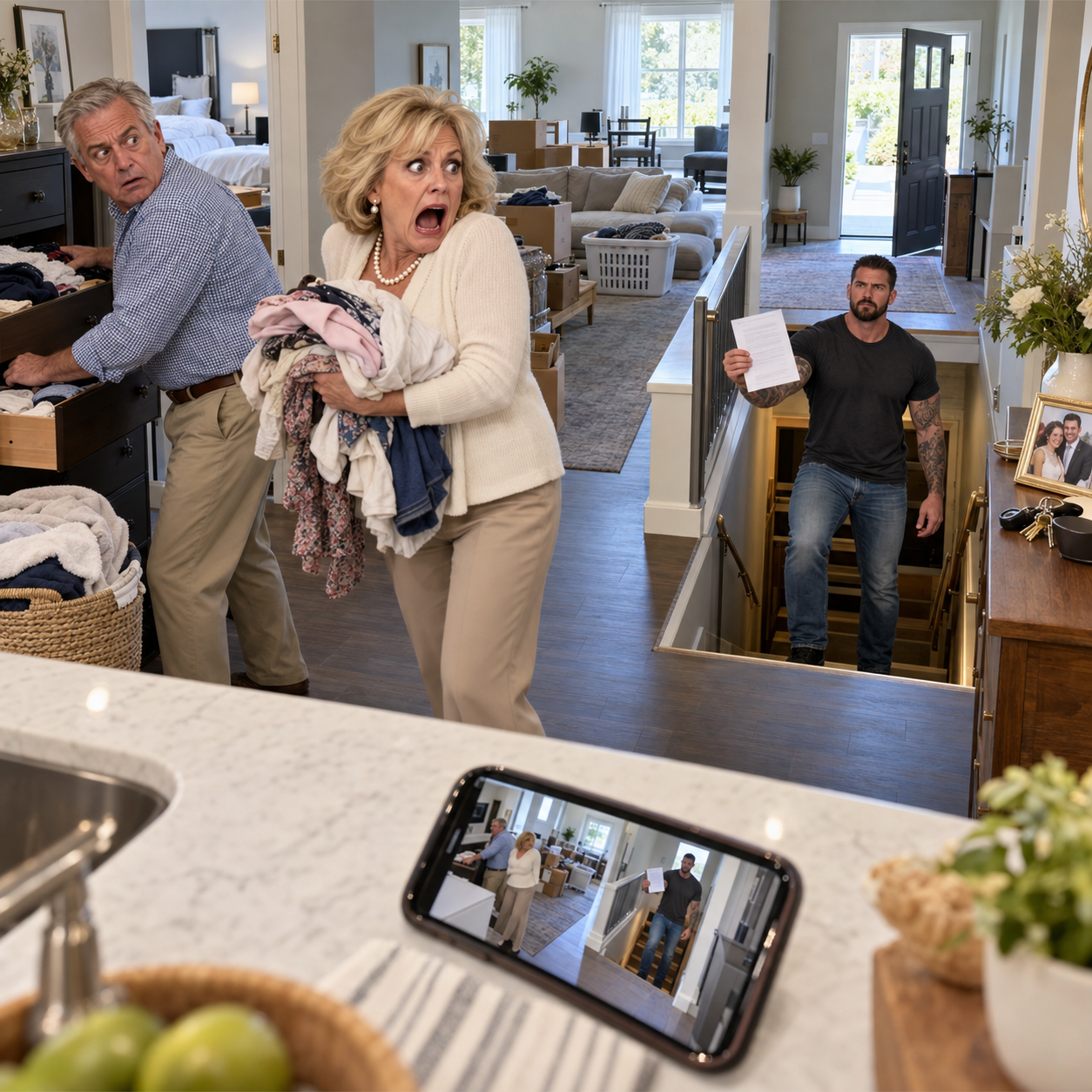
The morning after we moved into our home, my mother-in-law demanded a spare key—and my husband handed it over while I stood there speechless. She smiled and promised to “check in whenever.” I smiled back, then quietly called our landlord. A week later, my phone showed her rifling through my laundry while her husband opened our drawers. Suddenly, a six-foot-four tattooed man emerged from the basement, holding a signed agreement. My mother-in-law screamed. He answered, “I live here this week.”
### Part 1: A Spare Key Turns Our New Home Into Their Territory
Caleb and I had been married eleven months, and I had spent most of that year telling myself his parents would eventually understand that marriage changed things. Victor and Elaine had always been involved in everything. Elaine called Caleb about vitamins, dentist appointments, and whether he owned enough undershirts. Victor texted during our date nights to ask where we were. Whenever I complained, Caleb would give me the same tired smile and say, “They mean well.” Loving Caleb was easy. Living with his parents inside our marriage was not.
The morning after we moved in, a dark SUV rolled into our driveway while I was still drinking coffee from a paper cup because our mugs were buried in a box. Elaine walked in carrying a bottle of bargain wine and immediately began inspecting the living room. “You should move that chair away from the window,” she said. “And this rug is going to show dirt.” Victor followed with a printed page of maintenance reminders, as though we were teenagers borrowing a cabin. I stayed pleasant until Elaine settled onto our new couch, crossed her ankles, and said, “So, when do we get our spare key?” I thought I had misheard her. “I’m sorry?” Victor chuckled. “For emergencies.” Elaine waved one hand. “Or if we need to check in. Water plants. Make sure things are clean. You two work a lot.”
I looked at Caleb. That was the moment I expected him to become my husband instead of their son. He reached into the kitchen drawer, picked up the extra key the landlord had given us, and placed it in Elaine’s palm. “Yeah, that makes sense,” he said. Elaine smiled like she had won a contest I had not realized we were playing. “Of course,” I said. “You’re right. Stop by anytime.” Caleb glanced at me, surprised by how easily I gave in. Elaine looked delighted. Victor looked satisfied. None of them noticed that my smile had changed.
That afternoon, after they left, I asked Caleb one question. “If my mother demanded a key and I handed it over without asking you, would you be fine with that?” His shoulders dropped. “Jenna, it’s not the same.” “Why?” He opened his mouth, then closed it. I did not fight with him. Instead, I called our landlord, explained that relatives had been given a key without my consent, and asked what changes I was allowed to make. Then I called my uncle Ron. Ron was six-foot-four, tattooed from wrist to neck, owned a tattoo studio, and had a dry sense of humor.
By evening, I had a better plan than a screaming match. Our landlord approved a temporary additional interior latch as long as it was removed later and confirmed that we could have a short-term houseguest under the lease. I drew up a simple occupancy agreement making Ron our lawful guest for one week while Caleb and I stayed at my sister’s apartment nearby. Caleb stared at the paper when I explained it. “You’re serious?” “Completely.” He rubbed his forehead. “My parents are going to lose their minds.” “Only if they enter a house we told them not to treat like their own.” He looked embarrassed, which told me he finally understood the point. After a long silence, he signed.
I placed a motion camera in the living room facing only the common area and waited. Six days passed. Nothing. On the seventh afternoon, while I was at work, my phone buzzed with a motion alert. I opened the feed and saw Elaine walking through our living room with her purse still over one shoulder. Victor was already opening kitchen drawers. Elaine picked up a folded blanket, frowned at it, refolded it, and moved on to a basket of clean laundry. She began folding my clothes. “Unbelievable,” I whispered.
Then Victor tried to leave. The front door would not open because the interior latch had been set earlier by Ron, who was downstairs fixing a shelf. Victor pulled harder. Elaine’s face tightened. “What is wrong with this door?” A moment later, the basement door opened and Ron stepped into the room carrying a screwdriver and a glass of water. He stopped when he saw them. They stopped when they saw him. Ron looked from Victor to Elaine and said, “Well. This is awkward.” Elaine screamed. Victor stepped in front of her. “Who are you?” Ron took a slow sip of water. “The person currently living here.”
Victor’s face went crimson. “This is my son’s house.” Ron reached to the counter, picked up the signed occupancy agreement, and held it out. “Not for this week.” Elaine snatched the paper, scanned it, and looked as if the floor had shifted under her. “This is ridiculous.” “So is using a key to enter someone else’s home without asking,” Ron said. Victor grabbed his phone. “I’m calling Caleb.” Seconds later, my phone rang. Caleb’s voice came fast and panicked. “Jenna, my parents are at the house. Ron is there. What exactly did you do?” I looked at the live camera feed, where Elaine was still clutching my laundry. “Nothing,” I said. “They did exactly what they promised they would do.”
By the time Caleb said, “I’m coming home,” I already knew the next hour would decide more than who kept a spare key. It would decide whether my husband was finally ready to admit that his parents did not want access for emergencies. They wanted access because they believed we belonged to them.
### Part 2: Their Boundary Violations Escalate From Snooping To A Housing Attack
When I reached the house, Victor stood in the living room with the occupancy agreement crushed in one hand. Elaine sat on the couch beside a stack of my folded shirts. Ron leaned against the kitchen counter, calm enough to make Victor angrier. “There she is,” Victor snapped. “The mastermind.” I set down my purse. “You let yourselves into a house without asking.” Elaine pointed at me. “We had a key.” Ron laughed softly. “A key is not permission.”
Caleb arrived pale and breathless. Elaine rushed toward him. “Tell her this is insane.” He looked at the paper, then at me, and I saw the old reflex: calm his mother, avoid his father, make the conflict disappear. Victor shoved the agreement toward him. “You knew?” Caleb hesitated. Elaine’s face fell. “You let her humiliate us?” He rubbed his forehead. “Mom, you came in without telling us.” “Because you gave us a key.” “And I shouldn’t have,” he said. The room went silent.
Victor insisted that “family has rights.” I asked him to name one bill he paid, one line of the lease with his signature, or one emergency that required opening our kitchen drawers. Elaine said she had only been helping with laundry. I asked why helping required entering an empty house without calling. She had no answer. Ron released the interior latch and opened the door. Victor stopped on the threshold. “You’re making a serious mistake.” I met his eyes. “No. I’m correcting one.” He left with Elaine, but his expression told me this was not over.
That night, Caleb and I sat at the kitchen island beneath bright pendant lights, surrounded by half-unpacked boxes. “They’re going to hate you forever,” he said, then immediately winced. “That came out wrong.” “Very.” He stared at his hands. “I gave them the key because saying no to them feels like starting a fire.” “And giving it to them started one in our marriage instead.” He nodded. “I know.” The next morning, we changed the locks. Caleb told his parents they would never receive another key. Victor hung up on him.
Four quiet days passed. Then our landlord called me at work. “Jenna, I received a strange call from people identifying themselves as your in-laws.” He explained that Victor and Elaine had asked whether our lease could be ended early. When he said no, they offered to pay the remaining months if he removed us and rented the house to them instead. For several seconds, I heard only the office air conditioner. “They tried to have us evicted?” I asked. “They tried,” he said. “I told them no.”
I drove to their house before I could talk myself out of it. Elaine opened the door with a thin smile. Victor sat in the living room with the television on. I took the chair opposite him. “I know you called our landlord.” Elaine stiffened. Victor lowered the remote. “I don’t know what you mean.” I raised my phone. “Should I call him?” Silence. Then Victor leaned back. “Let’s say we did. You turned our son against us. Maybe he needs a place closer to people who actually care about him.”
That sentence told me everything. This was not about safety or emergencies. It was control. “You wanted us thrown out so you could rent the same house?” I asked. Elaine said, “We only wanted to be close.” Victor called me dramatic. I stood. “Call our landlord again, contact our jobs, enter our property, or interfere with anything belonging to us, and we document it.” Elaine’s face tightened. “Is that a threat?” “No. It’s a boundary.”
After that, small things began happening. Two packages vanished. Our trash bin was tipped into the street twice. A planter moved from the porch to the curb. I could prove none of it, which somehow made it worse. Three nights later, Caleb and I were watching television when metal scraped against the front lock. Caleb looked through the peephole and went still. “My dad is outside.”
Victor stood under the porch light with the old key. He tried it again, then pounded on the door. “Open up!” From the side yard came Elaine’s voice. “Caleb, honey, we just want to talk.” I began recording. Caleb’s breathing turned shallow, but he did not look at me for instructions. “Dad, you need to leave.” Victor hit the door with his palm. “This is my son’s house.” Caleb closed his eyes for a second. “No. It’s our home. Leave.”
I called the police. When officers arrived, Victor suddenly became polite. “Just a family misunderstanding.” One officer asked Caleb, “Do you know these people?” Caleb swallowed. “They’re my parents, and they’re trespassing. They don’t live here. I want them to leave.” Elaine gasped. Victor’s face hardened. As they were sent toward the sidewalk, he turned back. “One day you’ll realize she took everything from you.” Caleb answered, “She didn’t do this. You did.”
After the officers left, the house felt unnaturally quiet. Caleb sat on the couch staring at the floor. “My dad meant it,” he said. “When he said I wasn’t choosing family anymore.” I sat beside him. “He meant that you weren’t choosing obedience.” Caleb looked toward the locked door. “I think I always knew this day was coming. I just hoped they would stop before they made me choose.”
For the first time, Caleb had drawn the boundary himself. I thought that might end it. The following Tuesday, an email from a lawyer appeared in his inbox, and his face drained of color before he even opened it.
### Part 3: A Lawyer’s Letter Reveals How Deep Their Control Really Runs
Caleb opened the email at the kitchen table while I stood behind him. The letter was formal and cold. Victor and Elaine accused me of “interfering with the parent-child relationship,” demanded that Caleb resume regular communication, and warned us not to “alienate” them from their son. “They got a lawyer because I told them to leave our house.” His voice was flat. I expected anger. Instead I saw the old fear of believing disobedience always had consequences.
We sent the letter to an attorney recommended by our landlord. She explained that it was a demand letter, not a court order, and advised us to save everything: messages, videos, call logs, the landlord’s notes, and the porch recording. That evening, I made a folder while Caleb scrolled through years of texts from his parents. “Where are you?” “Why didn’t you answer?” “Your mother is worried.” “We drove by and your car wasn’t there.” “Call us before you make plans.” Caleb stared at the screen. “I used to think this was normal.” I did not say, “I told you so.” He already looked like someone mourning a version of his childhood.
Two days later, our landlord forwarded a voicemail Victor had left during the eviction attempt. I played it once by myself, then asked Caleb whether he wanted to hear it. He nodded. Victor’s voice came through the speaker, smooth and confident. He told the landlord that Caleb was “not good with practical decisions,” that I had “isolated” him, and that if we lost the lease, Caleb would probably “come back where he belongs.” Caleb paused the recording. “Come back where he belongs,” he repeated. His eyes were wet, but his expression had gone strangely calm. “They weren’t trying to live near us. They were trying to make me go home.”
That night, he received a message from his cousin Rachel, who had stayed out of the conflict until then. She wrote, “I think you should see what they’re telling everyone.” Attached were screenshots from a family group chat. Elaine claimed I had manipulated Caleb, taken over his finances, and prevented him from visiting. Victor wrote that once they got “the housing situation fixed,” Caleb would “come to his senses.” Then Rachel sent one more screenshot that made Caleb stand up so fast his chair scraped the floor. Elaine had written, “We should never have let him move that far away in the first place.”
Caleb walked onto the back patio. I followed but stayed near the door. The night air smelled like cut grass and rain. After several minutes he said, “Do you know what’s embarrassing?” I shook my head. “I’m thirty-two years old, and part of me still wants to call my mom and explain why she’s wrong. Like if I use the perfect words, she’ll understand.” He laughed once, without humor. “But she understands. She just disagrees that I get to decide.” That distinction changed him. Until then, he had treated their behavior like a communication problem. Now he understood it was a control problem.
Our attorney sent a short response: contact about legal matters should go through her; personal visits to our home were not welcome; further unwanted entry attempts would be documented. Caleb also sent his own message. He spent nearly an hour writing paragraphs, deleting them, rewriting them, trying to explain every hurt. Finally he erased everything and typed only, “Do not contact us again.” He looked at me. “Is that enough?” “If they respected you, one sentence would be enough.” He pressed send, then blocked both numbers.
The silence lasted nine days. On the tenth, an unknown number called Caleb six times before breakfast. He ignored it. An email arrived from a new address claiming Elaine had been “crying nonstop.” Another message said Victor’s blood pressure was “through the roof” because of the stress. We did not respond. Then flowers appeared at Caleb’s office with a card saying, “Family forgives.” He left them at the reception desk. Each attempt was framed as love, concern, or reconciliation, but every one carried the same hidden instruction: come back, obey, restore the old order.
The hardest moment came on a Sunday afternoon when Caleb found an old voicemail from Elaine saved on his phone. It was from years earlier, before he and I met. She was laughing, asking him to come over for dinner, telling him she had made his favorite dessert. Nothing in it sounded controlling. He listened twice, then sat on the edge of our bed with his elbows on his knees. “She wasn’t awful all the time,” he said. “I know.” “That makes this harder.” I sat beside him. “It can be hard and still be necessary.” He nodded, but I knew grief did not disappear because a boundary was correct.
A month passed. The porch stayed quiet. Our packages stopped disappearing. The trash bins remained upright. Caleb slept better. We began talking about ordinary things again—paint colors, weekend plans, whether the spare room should become an office. Then, on a cool December morning, a thick envelope arrived without a return address. Inside was a Christmas card from Victor and Elaine, a photograph of the four of us from the previous year, and a handwritten message: “There is still time to fix what she has done.”
Caleb read it, walked to the kitchen, and placed the card face down on the counter. Then he looked at me and said, “I think I finally know what I want to do.”
### Part 4: We Stop Explaining And Finally Build A Peaceful Life Together
“What do you want to do?” I asked. Caleb tapped the Christmas card with one finger. “Nothing.” I waited, thinking he needed time. He shook his head. “That’s what I want to do. Nothing. No explanation. No defense. They keep creating emergencies because emergencies force me to answer. I’m done answering.” He started to tear the card, then stopped. “Actually, we’re supposed to keep records.” He put it into our folder instead. It was a small act, but something changed. Ignoring his parents no longer looked like fear. It looked like a decision.
We spent Christmas with my sister, Ron, and friends who brought too much food. Caleb checked his phone twice out of habit even though Victor and Elaine were blocked. Nothing happened. No pounding on the door, no surprise appearance, no relative carrying a speech about forgiveness. Around midnight, Ron handed Caleb a soda and asked, “Still alive without parental supervision?” Caleb laughed. Later, driving home through streets glittering with white holiday lights, he said, “I kept thinking they’d ruin tonight somehow.” “They didn’t.” “No,” he said. “I think I’ve spent years letting them ruin things before they even happened.”
In January, Victor and Elaine’s attorney sent one final letter proposing a “family meeting.” Our attorney asked whether Caleb wanted to participate. He stared at the message for less than a minute. “No.” There was no shaking, no long explanation, no guilt disguised as reasoning. Our attorney responded that we declined and that future communication should concern legitimate legal matters. None came. There was much less to discuss once Victor and Elaine realized they could not turn their preferences into obligations.
The months that followed were almost boring, and boring felt luxurious. Caleb left his phone in another room during dinner. We hosted friends without watching the driveway. I planted rosemary by the back steps. He painted the spare room, and we argued for three days over the shade, laughing because it was the kind of ordinary disagreement married couples were supposed to have. Sometimes he missed his parents. He missed Sunday breakfasts, his mother singing badly in the kitchen, his father teaching him to change a tire. Missing good memories did not erase what they had done. Love did not cancel control, and nostalgia did not create an obligation to return.
Rachel occasionally told us what was happening from a distance. Victor said Caleb would “come around.” Elaine alternated between calling me cruel and claiming she had already forgiven me. At first, that made my blood boil. Eventually it became background noise. I stopped correcting every story because people who knew us asked questions before believing gossip. Caleb reached the same point more slowly. One evening, when Rachel offered another screenshot, he replied, “Thanks, but I don’t need to know.” Then he put his phone away and asked what we were making for dinner.
When our lease ended that summer, the landlord offered to renew it. We liked the house, but we wanted a place that felt entirely ours, without the memory of Victor rattling an old key against the lock. We bought a smaller home twenty minutes away, with a deep porch, a crooked oak in the backyard, and a kitchen that needed more work than expected. We gave the new address only to people we trusted. There was no dramatic escape. We simply closed one door and opened another.
On move-in day, Ron arrived with a toolbox and complained about our shelving. By late afternoon, the kitchen smelled like pizza and fresh paint. Caleb stood by the counter turning a new brass key between his fingers. “We should leave a spare with someone,” he said. I raised an eyebrow. “For emergencies?” He smiled. “Actual emergencies.” Then he tossed the key to Ron. Ron caught it against his chest. “What’s this?” “Our spare.” “You sure?” Caleb nodded. “Yeah. Because you understand that having a key doesn’t mean you own the door.” Ron grinned. “That might be the nicest thing anyone’s ever said to me.”
A few weeks later, Elaine mailed a letter to Caleb’s workplace because she no longer had our address. He brought it home unopened. He did not burn it, read it, or ask what I thought he should do. He placed it in the documentation box and went outside to help me hang lights over the patio. I realized then that indifference had arrived quietly. Not cruelty. Not revenge. Just the understanding that their feelings were no longer the steering wheel of our lives.
One evening, we sat on the porch while cicadas buzzed in the trees. Caleb leaned back and said, “I used to think being a good son meant never making them unhappy.” After a moment he added, “Now I think being an adult means accepting that some people get unhappy when they can’t control you.” I squeezed his hand. “Do you regret choosing us?” He looked surprised. “No. I regret that I waited so long to understand there was a choice.”
We never reconciled with Victor and Elaine. Caleb did not forgive them just because time passed, and I never asked him to. Maybe someday his feelings would change; maybe they would not. What mattered was that our peace no longer depended on their approval. The first house taught us something neither of us expected: a spare key is supposed to be a sign of trust, not a claim of ownership. Once Caleb learned the difference, nobody ever walked into our life uninvited again.
THE END!
Disclaimer: Our stories are inspired by real-life events but are carefully rewritten for entertainment. Any resemblance to actual people or situations is purely coincidental.