Chapter 2
Joel stared at Hannah’s photograph for so long that I wondered whether he could still see the kitchen around him.
Then he began talking.
In December 2003, he was a seventeen-year-old junior at Lubbock High School.
Hannah Yancey was sixteen, a sophomore who played flute in the marching band, volunteered at an animal shelter, and dreamed of becoming a veterinarian.
They’d been dating for almost a year.
“She laughed at everything,” Joel told me. “Not because everything was funny. She just loved being happy.”
He smiled faintly at the memory.
“She used to say that someday she’d have a house full of rescued dogs and I’d have to build them all a porch.”
I listened without interrupting.
Early that December, Joel bought Hannah a promise ring.
It was a thin gold band with a tiny diamond chip, purchased with money he’d saved from his after-school job at an auto parts store.
He’d paid eighty-nine dollars.
Inside, he’d asked the jeweler to engrave Hannah’s initials and the month and year.
“H.Y. 12-03,” he whispered.
The same ring Breanna had been wearing at the party.
“On December nineteenth,” Joel continued, “we went to a Christmas party at a friend’s house.”
He’d driven his father’s pickup.
He hadn’t been drinking. In fact, he’d volunteered to drive several classmates home because he wanted everyone to get back safely.
By the time he and Hannah headed toward her house, it was nearly eleven.
Earlier that evening, freezing rain had passed through the area.
The pavement looked wet.
Joel didn’t realize how much ice remained.
“We were on a farm road south of town,” he said. “Hannah was telling me about a puppy she’d helped rescue.”
His hands tightened.
“We came around a curve, and the truck started sliding.”
He stopped.
I reached across the table, but he seemed unable to notice my hand.
“I tried to correct it. I remember the headlights moving across the field. Then I remember waking up and somebody calling my name.”
The accident had been serious.
Joel suffered a broken collarbone and several other injuries.
Hannah did not survive.
He lowered his head.
“She was sixteen, Ria.”
For several minutes, there was no sound except the refrigerator humming.
I finally asked whether he’d been charged.
“No.”
The investigation found no alcohol in his system. The report attributed the crash to icy conditions and a speed that, although below the posted limit, was unsafe for the weather.
No criminal charges were filed.
But Hannah’s father refused to accept that it had been an accident.
At her funeral, he stood in the church and publicly blamed Joel.
“He told everyone I’d taken his little girl away,” Joel whispered.
Joel was sitting in the back pew with his arm in a sling.
He’d wanted to apologize.
Instead, he froze.
“Her father told me never to come near their family again.”
Two years later, the Yanceys filed a civil lawsuit against Joel’s parents.
Their insurance company eventually settled the claim.
The lawsuit didn’t establish that Joel had deliberately harmed anyone, but the public dispute left both families wounded.
Hannah’s parents divorced the following year.
Her mother, Patricia, moved to Odessa with Hannah’s little sister, Breanna.
“Breanna was eight when Hannah died,” Joel said.
He rubbed his face.
“She threw a white rose toward me at the funeral. I remember thinking she was just a little girl who’d lost her big sister, and there wasn’t anything I could say to make it better.”
I glanced at the photograph again.
“And Breanna works with you now.”
Joel nodded.
“She applied last year. I saw the last name, but I didn’t recognize her. She’d grown up. When she said she was from Odessa, I wondered, but I convinced myself it was a coincidence.”
“Did you ever ask?”
“No.”
“Did she know who you were?”
“I think she knew before she applied.”
I leaned back.
“And you never told me any of this.”
He looked miserable.
“I should have.”
“We’ve been married eleven years.”
“I know.”
“Every December, you get quiet. You spend hours alone in the garage. Is this why?”
He nodded.
“I always remember the anniversary.”
I thought about the light therapy lamp I’d bought him one winter because I assumed he was struggling with seasonal depression.
All those years, he’d been remembering a girl who never came home from a Christmas party.
“Why didn’t you trust me enough to tell me?” I asked.
Joel looked at the photograph.
“Because whenever I talk about Hannah, I become that seventeen-year-old boy again. I thought if you knew, you’d look at me differently.”
“I am looking at you differently,” I said.
He flinched.
“Not because you were in an accident. Because you let me believe I knew your whole life when you were hiding something this important.”
He began to cry.
I wanted to comfort him.
I also wanted to be angry.
Both feelings existed together, and neither made room for the other.
That night, I slept in the guest room.
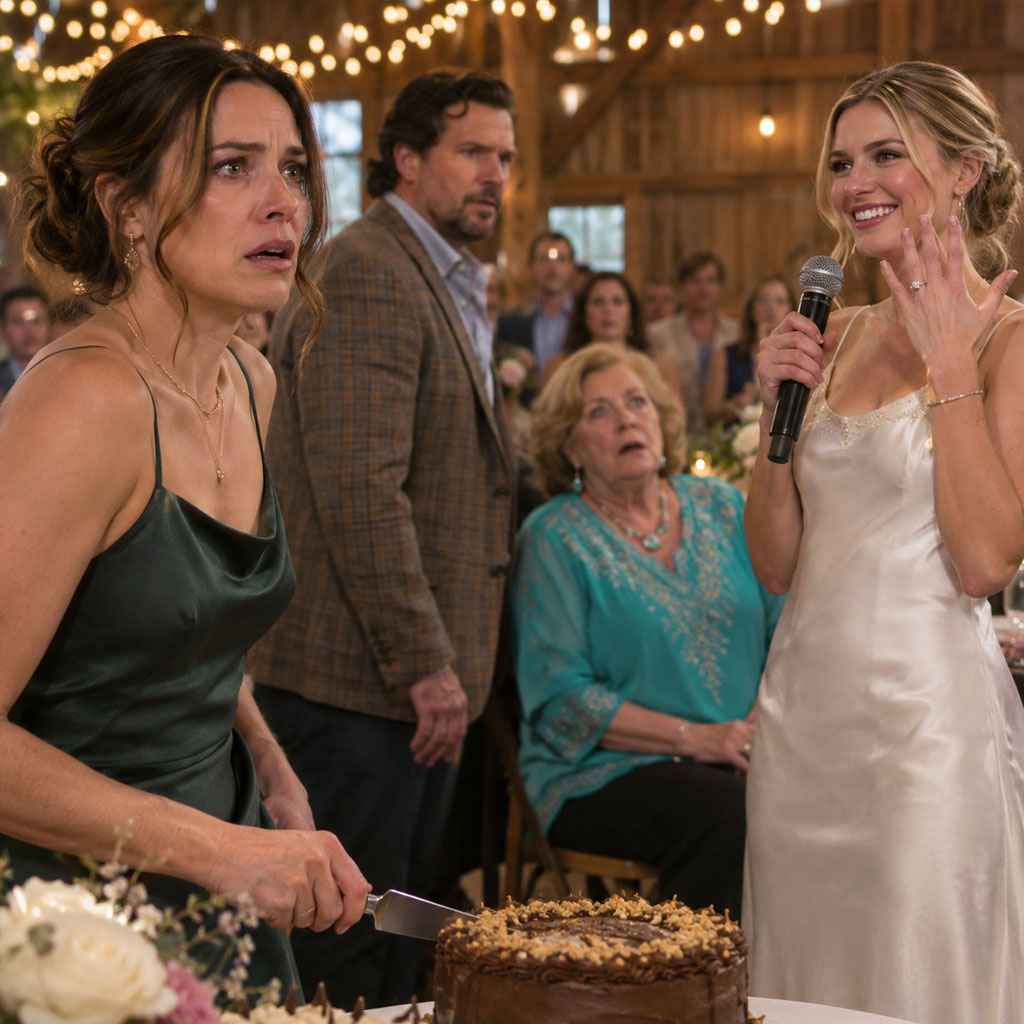
Not because I believed Breanna’s engagement announcement.
Not because I thought Joel had intentionally caused Hannah’s death.
I needed time to understand how a man could share a home, a marriage, and thousands of ordinary days with me while keeping such a painful part of himself locked away.
The following morning, my phone began buzzing.
Breanna had posted a photograph on Facebook.
Her left hand rested against the white satin of her dress, displaying Hannah’s ring.
Beside it was a cropped photograph of Joel smiling at a company picnic.
The caption read:
No more hiding. He finally said yes to our future.
Several employees from Caprock had commented with congratulations.
Others asked whether Joel was getting divorced.
Someone tagged me.
I stared at the screen until the words blurred.
Then I called Joel into the kitchen.
“Have you seen this?”
He looked at the picture.
His face tightened.
“That’s Hannah’s ring.”
“Why does she have it?”
“I don’t know.”
“Did you give Breanna any reason to think you wanted a relationship?”
“No.”
“Have you ever been alone with her outside work?”
He hesitated.
My heart sank.
“Joel.”
“She asked me to meet her for coffee once,” he admitted. “She said she needed advice about a problem at work. I met her at a café near Caprock during lunch.”
“And?”
“She asked questions about my high school years. About Hannah.”
I stared at him.
“What did you tell her?”
“That I didn’t want to discuss it.”
“Then what happened?”
“She got upset. She said I acted like I didn’t remember people I’d hurt.”
He looked at me.
“That’s when I realized who she was.”
I closed my eyes.
“Why didn’t you tell me then?”
“I thought ignoring her would make everything go away.”
It was a terrible explanation.
But looking at him, I believed it was the truth.
Unfortunately, ignoring Breanna had not made anything go away.
Three days later, Joel came home early.
His face was gray.
“Caprock put me on paid administrative leave.”
I set down the school paperwork I was reviewing.
“Why?”
“Breanna filed a complaint with human resources.”
The complaint claimed Joel had pursued a romantic relationship with her, promised to leave his wife, and threatened her job when she tried to end it.
She had included screenshots of conversations supposedly exchanged between them.
Joel handed me copies.
The messages looked convincing.
They contained affectionate language, references to private meetings, and promises about a future together.
I read one twice.
Then a third time.
It sounded like Joel.
The phrases were familiar.
But something about the screenshots bothered me.
“Is this your number?” I asked.
The screenshot showed a contact named Joel Castellano.
He shook his head.
“No. That’s not my number.”
Chapter 3
I spent the next morning examining every screenshot.
At the high school where I worked, I’d dealt with enough online harassment and fabricated conversations to know that a saved image wasn’t the same as verified evidence.
Messages could be edited. Contact names could be changed. Entire conversations could be manufactured.
Still, I didn’t want to assume Joel was innocent simply because I loved him.
I needed facts.
The phone number visible beneath his contact name had a local area code, but it wasn’t his.
Joel had kept the same number since 2008.
I called the unfamiliar number.
Nobody answered.
After several rings, a generic voicemail greeting began playing.
My stomach tightened.
I’d heard that greeting before.
It was the same one I’d reached when I called the number that had sent me the mysterious message in June.
Ask your husband about B.
I searched my phone and found the original text.
The numbers matched.
Someone had been trying to create suspicion in my marriage long before the birthday party.
That afternoon, I found another discrepancy.
One screenshot showed Joel sending Breanna a romantic message on June ninth at 2:14 in the afternoon.
I knew exactly where he’d been.
We were refinancing our mortgage that day.
Joel and I had spent nearly two hours in a bank office reviewing documents and discussing interest rates.
His phone kept ringing with work calls, so he’d asked me to silence it and hold it while we finished.
It had remained in my purse throughout the appointment.
I remembered because he’d asked for it while we were leaving and I’d teased him about being unable to survive two hours without checking his messages.
I located our appointment confirmation and the signed paperwork.
The dates and times matched.
Joel had been sitting beside me, and his phone had been with me when that message supposedly appeared.
It didn’t settle every possible question, but it was compelling evidence that the screenshot could not be trusted.
I took everything to an attorney.
She reviewed the records and advised us to preserve all communications, avoid contacting Breanna directly, and let Caprock investigate properly.
She also recommended that the company examine the original message data rather than relying on images.
That evening, I sat beside Joel at the kitchen table.
“I believe the screenshots were fabricated,” I said.
He covered his face.
“Thank God.”
“But we still need to talk about the secrets you’ve kept.”
He lowered his hands.
“I know.”
“I need honesty from you, Joel. Even when it’s uncomfortable.”
He nodded.
“You have it.”
“All of it?”
“All of it.”
I wanted those words to be enough.
They weren’t yet.
Trust, once shaken, doesn’t always return simply because someone tells the truth.
But it was a beginning.
The next morning, I searched Breanna’s older public Facebook posts.
What I found changed the way I understood her actions.
Every December nineteenth, she posted a photograph of Hannah.
Sometimes the caption was only a few words.
I still miss you.
Other years, it was more pointed.
Justice for Hannah.
In 2021, she’d shared Joel’s old high school yearbook photograph.
Beneath it, she’d written:
He gets to grow up. He gets a wife and a career. My sister got none of those things.
I stared at the post.
Breanna hadn’t simply developed feelings for a married supervisor.
She’d spent years watching the man she believed responsible for her sister’s death build a life.
And she’d come to see his happiness as an injustice.
I scrolled farther.
One photograph showed a white formal dress hanging inside a bedroom closet.
The neckline had delicate beading.
The satin was slightly yellowed with age.
I recognized it immediately.
Breanna had worn that dress to Joel’s party.
The caption beneath the old photograph said:
Hannah never got to wear this to her winter formal.
I felt a chill.
Breanna had not chosen her outfit by accident.
She’d dressed herself in her dead sister’s clothes.
And she’d worn Hannah’s ring while announcing an engagement to the boy Hannah had once loved.
The scene at the barn was beginning to make terrible sense.
I showed Joel the photographs.
He sat quietly for a long time.
Then he pushed his chair away.
“Maybe I should resign.”
“Why?”
“Because she’s never going to stop.”
“You don’t know that.”
“Her family lost Hannah. If leaving Caprock makes things easier, maybe I should.”
I sat beside him.
“Joel, you were seventeen. You made a mistake driving on an icy road, and someone died. That tragedy will always matter.”
He stared at the floor.
“But punishing yourself forever won’t bring Hannah back. And allowing Breanna to destroy our marriage won’t honor her.”
He looked at me.
“Do you really believe that?”
“Yes.”
His eyes filled.
“I’ve spent twenty-three years trying to figure out how to live with it.”
I took his hand.
“Then maybe it’s time you stopped trying to do it alone.”
A few days later, I visited Inez.
She lived in a small brick house on the south side of Lubbock, where family photographs covered nearly every wall.
She made coffee, placed a plate of cinnamon cookies between us, and waited while I explained what I’d learned.
When I finished, she stared into her cup.
“I should have told you about Hannah when you married Joel,” she said.
“Why didn’t you?”
“He asked us not to speak about it.”
I nodded.
“He’s told me.”
She hesitated.
“There’s something else.”
Her voice had changed.
I watched her rise and walk toward the bedroom.
When she returned, she carried a worn white Bible.
She opened it carefully and removed a yellowed envelope.
The postmark read Odessa, Texas.
The date was September 2009.
It was addressed to Joel.
I looked up.
“What is this?”
Inez’s hands trembled.
“A letter that came when he was finally beginning to recover.”
“From whom?”
“Patricia Yancey.”
Hannah’s mother.
I looked at the sealed envelope.
“Did Joel read it?”
Inez shook her head.
“No.”
“Why not?”
She began to cry.
“He’d started college again. He’d found a job. Some days he even laughed. I was afraid whatever was inside would send him back into that terrible grief.”
“So you hid it?”
“I told myself I’d give it to him when he was stronger.”
She wiped her cheeks.
“Then the years passed, and I was ashamed.”
I stared at her.
For seventeen years, this letter had remained inside a Bible while my husband sat alone every December, believing Hannah’s family hated him.
“May I see it?” I asked.
Inez nodded.
I opened the envelope carefully.
The handwriting was small and slanted.
Patricia began by explaining that she’d spent years feeling angry at everyone connected to her daughter’s death.
She had blamed Joel because she couldn’t accept how quickly an ordinary evening could become a tragedy.
Then she wrote about rereading the accident report, speaking with a counselor, and slowly confronting the difference between an unavoidable loss and a deliberate act.
Near the bottom was a paragraph that made my eyes fill.
Joel, I know you loved Hannah. I know you didn’t set out to hurt her. I am sorry for the way our family treated you after the accident. I forgive you. Hannah wanted you to have a good life, and I hope someday you will allow yourself to have one.
I read those lines twice.
Then I looked at Inez.
“Joel needs this.”
“I know.”
“He needed it seventeen years ago.”
She bowed her head.
“I know that, too.”
For the first time since the birthday party, I felt angry with someone other than Breanna.
Inez had acted out of fear and love, but her decision had kept a precious truth from her son.
Still, I could see how deeply she regretted it.
I folded the letter and returned it to its envelope.
“Does Patricia still live in Odessa?”
“I believe so.”
I looked at the address.
“Then I think it’s time someone spoke to her.”
Chapter 4
Patricia Yancey answered her front door on a Saturday afternoon.
She was a slender woman in her late sixties, with silver hair pulled back loosely and tired blue eyes.
When I introduced myself, her expression changed.
“You’re Joel’s wife?”
“Yes.”
She studied me for a moment.
Then she opened the door wider.
“Come in.”
Her house smelled faintly of lemon furniture polish and fresh coffee.
Family photographs lined a bookcase near the living room.
One showed Hannah holding a floppy-eared puppy.
Another showed two sisters sitting on a porch swing, their heads pressed together.
Hannah looked about fifteen.
Breanna couldn’t have been older than seven.
Patricia noticed me studying it.
“They were inseparable,” she said.
I sat across from her and explained the birthday party, the ring, the white dress, and the complaint at Caprock.
She listened without interrupting.
When I mentioned the fabricated messages, she closed her eyes.
“Oh, Breanna.”
Her voice held more sorrow than surprise.
“Did you know she was working with Joel?” I asked.
“No. She told me she worked for a farm equipment company. I didn’t know it was the same place.”
Patricia pressed her hands together.
“She never really recovered from losing Hannah.”
“She was only eight.”
“Yes.”
Patricia looked toward the photograph of her daughters.
“After the accident, my husband was consumed by anger. I was barely functioning. We argued constantly, and eventually the marriage ended.”
She paused.
“Breanna grew up listening to people say Joel had taken her sister away. Whenever she asked questions, someone gave her another reason to be angry.”
I thought of those December Facebook posts.
“Did she ever receive counseling?”
“Briefly, when she was young. But she refused after a while, and I didn’t push hard enough.”
Patricia lowered her eyes.
“I suppose I thought if we stopped speaking about Hannah, the pain would become smaller.”
I understood that impulse.
Joel had tried something similar.
But grief doesn’t disappear simply because a family refuses to discuss it.
“Breanna believes Joel has never cared about what happened,” I said.
Patricia looked at me.
“He cared very much.”
“How do you know?”
“Because I saw him at the funeral.”
Her eyes filled.
“He was just a boy. He couldn’t even stand straight with his injured shoulder, and my husband shouted at him in front of everybody.”
She wiped away a tear.
“I’ve regretted that day for years.”
I took the yellowed envelope from my purse.
“I found your letter.”
Patricia stared.
For several seconds, she didn’t move.
Then she reached for it.
“Joel never answered,” she whispered. “I thought he didn’t want to hear from me.”
“He never received it.”
She looked up sharply.
“What?”
I explained what Inez had done.
Patricia pressed the envelope against her chest.
“All these years,” she murmured.
We sat quietly.
Then she rose.
“There’s something I want to show you.”
She led me down a hallway to a small bedroom.
The room contained a narrow bed, an old bookshelf, and a wooden dresser.
A photograph of Hannah in her marching band uniform stood beside a lamp.
Patricia opened the closet.
An empty garment bag hung from the rod.
“That was Hannah’s formal dress,” she said.
“The one Breanna wore?”
Patricia nodded.
“Breanna visited in July. She told me she wanted to have the dress professionally cleaned and preserved.”
“Did you know she planned to wear it?”
“No.”
She swallowed.
“I would never have agreed.”
She opened the dresser and removed a small jewelry box.
Inside was an empty velvet ring holder.
“Hannah’s promise ring was here, too. The police returned it with her belongings after the accident.”
Patricia sat on the bed.
“I thought Breanna took it because she wanted to feel close to her sister.”
Her face crumpled.
“I didn’t know she was planning all this.”
I sat beside her.
For the first time, I saw Breanna not as the smiling woman who’d humiliated me at my husband’s birthday party, but as a little girl who had grown up inside an anger nobody knew how to help her escape.
That didn’t excuse what she’d done.
But it helped explain it.
“I think she needs you,” I said gently.
Patricia nodded.
“She does.”
We talked for another hour.
Before I left, Patricia made a decision.
“I’m coming to Lubbock.”
“Are you sure?”
“Yes. My daughter needs to hear the truth from me.”
She looked at Hannah’s photograph.
“And Joel deserves to know I meant every word of that letter.”
Back home, Breanna’s behavior continued.
A small birthday cake appeared on our porch with a message written in blue frosting.
Happy 40th, my love.
She sent me texts claiming Joel had been planning to leave me for a year.
I didn’t respond.
Instead, I saved the messages and forwarded copies to our attorney and Caprock’s human resources department.
Joel did the same.
His employer had begun examining the complaint more carefully, but the investigation wasn’t complete.
The waiting was difficult.
Joel worried about his reputation.
I worried about our marriage.
Some evenings we spoke for hours. Other evenings we barely spoke at all.
One night, as we washed dishes, Joel said, “I keep thinking that if I’d never driven that night, Hannah would still be here.”
I turned off the faucet.
“Maybe.”
He looked surprised.
I dried my hands.
“There’s no honest way to know how everything would have turned out. But you can’t spend the rest of your life living inside one decision you made at seventeen.”
He nodded slowly.
“I don’t know how to stop.”
“Then we’ll find someone who can help you.”
He agreed to see a counselor.
It was the first time he’d ever willingly sought professional help for what happened.
I was proud of him.
But I also knew our marriage needed attention of its own.
I told him we would need marriage counseling, too.
Not because Hannah had existed.
Not because he’d suffered.
Because he’d hidden an important part of himself from me for eleven years.
He accepted that without argument.
A week later, Patricia called.
“Breanna told me she’s planning something big,” she said.
“What kind of thing?”
“She wouldn’t say. But she sounded excited, and that worries me.”
I glanced toward the kitchen, where Joel was reading the newspaper.
“Do you think she’ll come here?”
“I don’t know.”
Patricia hesitated.
“Ria, she’s been talking as though she finally has something that will make Joel admit what he did.”
My stomach tightened.
We ended the call, and I told Joel.
He listened quietly.
Then he reached for my hand.
“Whatever happens,” he said, “I’m not running away again.”
Two mornings later, our doorbell rang.
I looked through the window.
Breanna stood on the porch wearing jeans and a pale pink blouse.
She held a black-and-white ultrasound photograph.
When I opened the door, she smiled.
“Ria, we need to talk.”
I kept one hand on the door.
“About what?”
She raised the photograph.
“I’m pregnant,” she announced. “And Joel is the father.”
Chapter 5
For several seconds, I simply looked at the photograph in Breanna’s hand.
She seemed to be waiting for me to cry or shout.
I did neither.
“Are you certain you want to make that claim?” I asked.
Her smile faltered.
“Of course I’m certain.”
“Then you should understand that something this serious needs to be established with medical evidence.”
She narrowed her eyes.
“You don’t believe me.”
“I believe you have something you want to say. But I won’t accept an accusation as proof.”
She took a step closer.
“Joel has been lying to you for years.”
“Yes,” I said quietly. “He has kept things from me.”
That seemed to surprise her.
“But that doesn’t mean everything you’re saying is true.”
Breanna raised the ultrasound again.
“I’m eight weeks along.”
Behind me, footsteps sounded in the hallway.
A familiar voice spoke.
“Breanna.”
The young woman’s expression changed instantly.
“Mom?”
Patricia stepped into the doorway beside me.
She’d arrived in Lubbock the previous evening and stayed with relatives.
We’d agreed that if Breanna contacted me again, we would try to arrange a calm conversation with her mother present.
Neither of us expected her to appear carrying an ultrasound photograph.
Patricia looked at her daughter.
“Sweetheart, what are you doing?”
Breanna stepped backward.
“Why are you here?”
“Because I’m worried about you.”
“Did she call you?” Breanna demanded, pointing at me.
“I asked your mother to come because this has gone too far.”
Breanna gave a bitter laugh.
“Of course. Everybody’s on Joel’s side.”
Patricia shook her head.
“This isn’t about sides.”
“It always is!”
Breanna’s voice rose.
“Everybody decided he was innocent. Everybody decided we were supposed to move on.”
Her eyes filled.
“He gets a wife. He gets a career. He gets a big birthday party with sixty people laughing and singing to him.”
Patricia reached toward her.
“Breanna—”
“Hannah doesn’t get any of that!”
The words broke out of her.
“She never got to graduate. She never got married. She never even got to wear that dress!”
I looked at the ultrasound photograph.
Breanna was holding it so tightly that the paper had begun to bend.
“Your sister’s name was Hannah,” I said.
She looked at me.
“What?”
“Hannah. Not Joel’s guilt. Not your anger. Hannah.”
Breanna’s face tightened.
“Don’t talk about her.”
“Then tell me about her.”
She shook her head.
“Stop.”
“What was her favorite song? What made her laugh? What did she want to do when she grew up?”
Breanna opened her mouth.
No words came.
Her eyes filled with tears.
“I don’t remember,” she whispered.
Patricia’s expression crumpled.
“Oh, sweetheart.”
Breanna stared at the porch boards.
“I don’t remember her voice anymore.”
The ultrasound slipped from her fingers and landed on the welcome mat.
She began crying.
Not the careful tears she’d displayed at the party.
These were the exhausted tears of someone carrying a burden she’d never learned to put down.
“I miss her, Mom.”
Patricia put her arms around her daughter.
“I know, baby.”
“I miss her so much.”
“I know.”
Breanna clung to her.
For a long time, nobody spoke.
Then Joel appeared behind us.
He had heard the raised voices from the kitchen.
When Breanna saw him, she stiffened.
“Don’t come near me.”
He stopped.
“All right.”
Patricia looked up.
“Joel, there’s something we need to talk about.”
He glanced at me.
I nodded.
Then I went to the kitchen and returned with the yellowed envelope.
“I’ve been carrying this,” I told him. “I wanted you to read it when we had a quiet moment.”
I handed it to him.
Joel recognized his mother’s handwriting on the front.
He turned it over.
The postmark caught his attention.
“2009?”
Patricia nodded.
“I wrote to you after I had time to understand what happened.”
Joel looked confused.
“I never got a letter.”
“I know that now.”
He opened the envelope.
Breanna watched silently as he unfolded the paper.
I could see his eyes moving across the page.
Then he stopped.
His shoulders began to shake.
He read the final paragraph again.
Patricia stepped forward.
“Joel, I meant every word.”
He looked at her.
“You forgive me?”
“Yes.”
His face crumpled.
“I was driving.”
“I know.”
“I should have been more careful.”
“Maybe you should have,” Patricia said gently. “But you were a seventeen-year-old boy who loved my daughter. You didn’t choose for her to die.”
Joel covered his eyes.
For years, I’d seen him retreat into silence every December.
Now, standing on our porch, he finally allowed himself to grieve in front of us.
“I’m so sorry,” he whispered.
Patricia nodded through her tears.
“I know you are.”
Breanna looked between them.
“But Dad said—”
“Your father was devastated,” Patricia said. “He wanted someone to blame. So did I.”
She took Breanna’s hand.
“We were wrong to let you grow up believing anger was the only way to remember your sister.”
Breanna shook her head.
“Joel got to have a life.”
“Yes,” Patricia replied. “And Hannah would have wanted him to.”
Breanna looked toward Joel.
“She loved you.”
He nodded.
“I loved her, too.”
“Then why didn’t you ever come see us?”
“Your father told me to stay away. I thought hearing from me would only cause more pain.”
Breanna stared at him.
“I thought you forgot her.”
Joel wiped his face.
“Not for a single day.”
The young woman began crying again.
Patricia held her hand.
After a while, Breanna looked toward the ultrasound photograph lying near the door.
Her face filled with shame.
“I’m not pregnant,” she whispered.
Nobody answered.
She swallowed.
“I found the picture online. I thought if Ria believed it, she’d finally leave Joel.”
I looked at her.
“Breanna, what you’ve done has hurt people who had nothing to do with Hannah’s death.”
She nodded.
“I know.”
“You accused Joel of serious misconduct at work. You tried to destroy our marriage.”
Her voice trembled.
“I know.”
“Grief explains why you’ve been hurting. It doesn’t make those choices right.”
She wiped her cheeks.
“I’m sorry.”
I believed she felt ashamed.
But I also knew that an apology couldn’t erase everything she’d done.
“Then the next step is telling the truth,” I said.
Patricia nodded.
“And getting help, sweetheart. Real help.”
Breanna looked toward her mother.
For the first time that morning, she didn’t argue.
Chapter 6
The following Monday, Breanna contacted Caprock’s human resources department.
With her attorney’s guidance, she submitted a written statement withdrawing her complaint and admitting that she’d fabricated the romantic messages.
She also acknowledged using a second phone number to send misleading communications.
The company completed its investigation and confirmed that the evidence she’d supplied was unreliable.
Breanna’s employment was terminated.
Joel was reinstated with an apology from the company’s owner.
The news spread quickly through Caprock, but we declined to discuss the details publicly.
I had no desire to turn Breanna’s grief into another spectacle.
She had already made her mistakes in front of enough people.
Patricia took her back to Odessa, where she began working with a grief counselor.
Before leaving, Breanna returned Hannah’s ring.
The white dress was cleaned, carefully folded, and placed back in its protective garment bag.
Patricia told me she planned to keep both items until she could decide what would honor Hannah’s memory best.
I hoped that one day Breanna could remember her sister without feeling that somebody else had to suffer.
Joel’s mother came to our house later that week.
She sat at our kitchen table with the same worn Bible in her lap.
“I owe you an apology,” she told her son.
He looked at her.
“Mom, you don’t have to—”
“Yes, I do.”
Her voice was steady despite the tears in her eyes.
“I hid that letter because I thought I was protecting you. But I was protecting myself from watching you hurt.”
Joel reached across the table.
“I know you meant well.”
“That doesn’t make it right.”
“No,” he said gently. “It doesn’t.”
They sat quietly for a moment.
Then Joel squeezed her hand.
“I forgive you, Mom.”
Inez began crying.
I looked away to give them some privacy.
There was something deeply moving about watching a sixty-six-year-old mother admit she’d made a mistake and a forty-year-old son accept her apology without pretending it had never happened.
Families don’t become healthy because nobody hurts anyone.
They become healthier when people acknowledge the hurt and take responsibility for it.
Our own marriage still needed work.
I moved back into our bedroom, but Joel and I began seeing a marriage counselor.
During one session, I told him how alone I’d felt standing beside his birthday cake while sixty people stared at me.
He reached for my hand.
“I’m sorry I left you there.”
“You were frightened,” I said.
“I was. But you deserved an explanation, not an empty parking space.”
That acknowledgment mattered more than any elaborate apology.
We talked about Hannah.
We talked about the years Joel had hidden his grief, and the ways I’d mistaken his silence for ordinary sadness.
He began telling me stories he’d never shared before.
Hannah had once rescued a stray kitten from behind the school cafeteria and smuggled it into her backpack.
She loved old country music, especially songs her grandmother played on Sunday mornings.
She wanted to own a veterinary clinic someday, with a big sign out front that said every animal deserved a chance.
As Joel told these stories, something changed.
Hannah became more than the girl in the accident report.
She became a real person to me.
A funny, stubborn teenager with dreams, friendships, and a future that ended far too soon.
One evening, Joel found me looking at her photograph.
“Does it bother you?” he asked.
“What?”
“Knowing I loved someone before you.”
I shook my head.
“No.”
He sat beside me.
“I don’t want you to think—”
“Joel, you were seventeen. You loved her. That doesn’t diminish what we have.”
He watched me carefully.
“Then what does bother you?”
“That you thought you had to hide her.”
His eyes filled.
“I thought telling you would bring all that pain back.”
“And keeping it hidden meant you carried it alone.”
He nodded.
I took his hand.
“You don’t have to do that anymore.”
At the end of August, Patricia invited Joel to visit Hannah’s grave.
He asked me to come with him.
We drove to the city cemetery on a warm, quiet morning.
Hannah was buried beneath a live oak near the back fence.
Patricia stood beside the headstone holding a small bouquet of white roses.
When Joel saw her, he stopped walking.
I touched his arm.
“Go ahead.”
“Are you sure?”
“This is something you need to do.”
He squeezed my hand.
Then he walked across the grass.
I stayed near the truck.
From a distance, I watched Patricia offer him a white rose.
He accepted it.
They stood together in silence for several minutes.
Then Joel knelt beside the headstone and placed the flower carefully at its base.
Patricia rested a hand on his shoulder.
I couldn’t hear what they said.
I didn’t need to.
Some conversations belong to the people who have carried the same grief for decades.
When Joel returned, his eyes were red.
But his expression was different.
He looked tired.
He also looked peaceful.
“How was it?” I asked.
He considered the question.
“Hard.”
I nodded.
He took my hand.
“But good.”
We stood together for a moment beneath the shade of the trees.
Then he looked back toward the grave.
“Patricia told me something.”
“What?”
“She said Hannah wouldn’t want the saddest night of her life to be the only thing people remembered about her.”
I glanced toward the headstone.
“She’s right.”
Joel smiled faintly.
“I told her I’d like to make a donation to the animal shelter Hannah used to volunteer at. Maybe help pay for a few veterinary treatments in her memory.”
“That sounds wonderful.”
He drew a long breath.
“I think she’d like that.”
We drove home without turning on the radio.
The silence between us no longer felt like a locked door.
It felt like a place where two people could sit together without being afraid of what the other might discover.
That evening, I found the photographs from Joel’s birthday party waiting in my email.
I’d almost forgotten about the photographer.
Most of the pictures showed smiling relatives, barbecue plates, and guests dancing.
There was one of Joel laughing with his cousins before the announcement.
Another showed me carrying the cake toward the table.
Then I found a picture taken just before Breanna approached the DJ.
She stood in the background in her white satin dress, Hannah’s ring catching the light.
For a moment, the memory of that terrible evening returned.
The silence.
The staring guests.
The empty space where my husband had been.
I closed the photograph.
Then I opened another.
It showed Joel and me standing together near the barn entrance earlier that evening.
His arm was around my waist.
I was laughing at something he’d whispered in my ear.
We looked happy.
We had been happy.
We had also been living with a truth that hadn’t yet been spoken.
I saved the photograph.
Not because I wanted to pretend that night had been perfect.
Because it reminded me that a marriage could contain real love and painful secrets at the same time.
And that discovering those secrets didn’t automatically mean the love had been false.
Several months later, Joel began volunteering occasionally at a local animal rescue.
He helped repair kennels, unload supplies, and transport donated equipment.
He never made speeches about Hannah.
He didn’t need to.
On December nineteenth, instead of sitting alone in the garage, he asked whether I wanted to visit the shelter with him.
We brought blankets, food, and a small donation.
Afterward, we went out for dinner.
He spoke about Hannah without lowering his voice.
He even laughed while remembering the kitten she’d hidden in her backpack.
When we got home, he placed her photograph inside a small wooden box with a few other keepsakes from his teenage years.
Not because he wanted to forget her.
Because he no longer needed to keep the memory hidden.
That night, as we prepared for bed, Joel turned toward me.
“Ria?”
“Yes?”
“Thank you for staying.”
I looked at him.
“I didn’t stay because everything was easy.”
“I know.”
“I stayed because you told the truth, took responsibility, and were willing to work on what we’d lost.”
He nodded.
“And because I still love you,” I added.
He smiled.
“I love you, too.”
I switched off the bedside lamp.
In the darkness, he reached for my hand.
And I thought about the extraordinary chain of events that had brought us to this quiet moment.
A woman had arrived at my husband’s birthday party in a white dress and announced an engagement that never existed.
She had wanted to expose him, humiliate him, and make him suffer.
Instead, she exposed a grief that had been hidden for more than twenty years.
A grieving mother finally spoke the forgiveness she’d written long ago.
A frightened man learned that surviving a tragedy didn’t mean he had to spend his entire life being punished for it.
And a younger sister, who had mistaken revenge for loyalty, finally began facing the sorrow she’d carried since childhood.
Nothing could restore Hannah’s life.
Nothing could undo the accident or the years of pain that followed.
But the living still had choices.
They could keep passing their hurt from one person to another.
Or they could begin, however imperfectly, to put it down.
I thought of Hannah’s photograph, that laughing teenage girl with her whole future in her eyes.
She had deserved a long and beautiful life.
The best way to honor her wasn’t to destroy someone else’s.
It was to remember the love she’d given while she was here.
Beside me, Joel’s breathing grew steady.
I held his hand a little tighter.
For years, he’d believed that forgiving himself would mean forgetting Hannah.
Now he understood that remembrance and peace could exist together.
And I understood something, too.
A marriage isn’t built on knowing every detail of someone’s past.
It’s built on creating enough trust that the truth can finally be spoken.
Sometimes that truth changes everything.
And sometimes, after the shock and tears and difficult conversations, it gives two people the chance to love each other more honestly than before.
Outside our window, the Texas wind moved softly through the trees.
For the first December in our marriage, Joel wasn’t sitting alone in the garage.
He was home.
And so was I.
THE END.\
⚠️ All characters and events are fictional. Do not imitate or apply them in real life. 😌😌😌