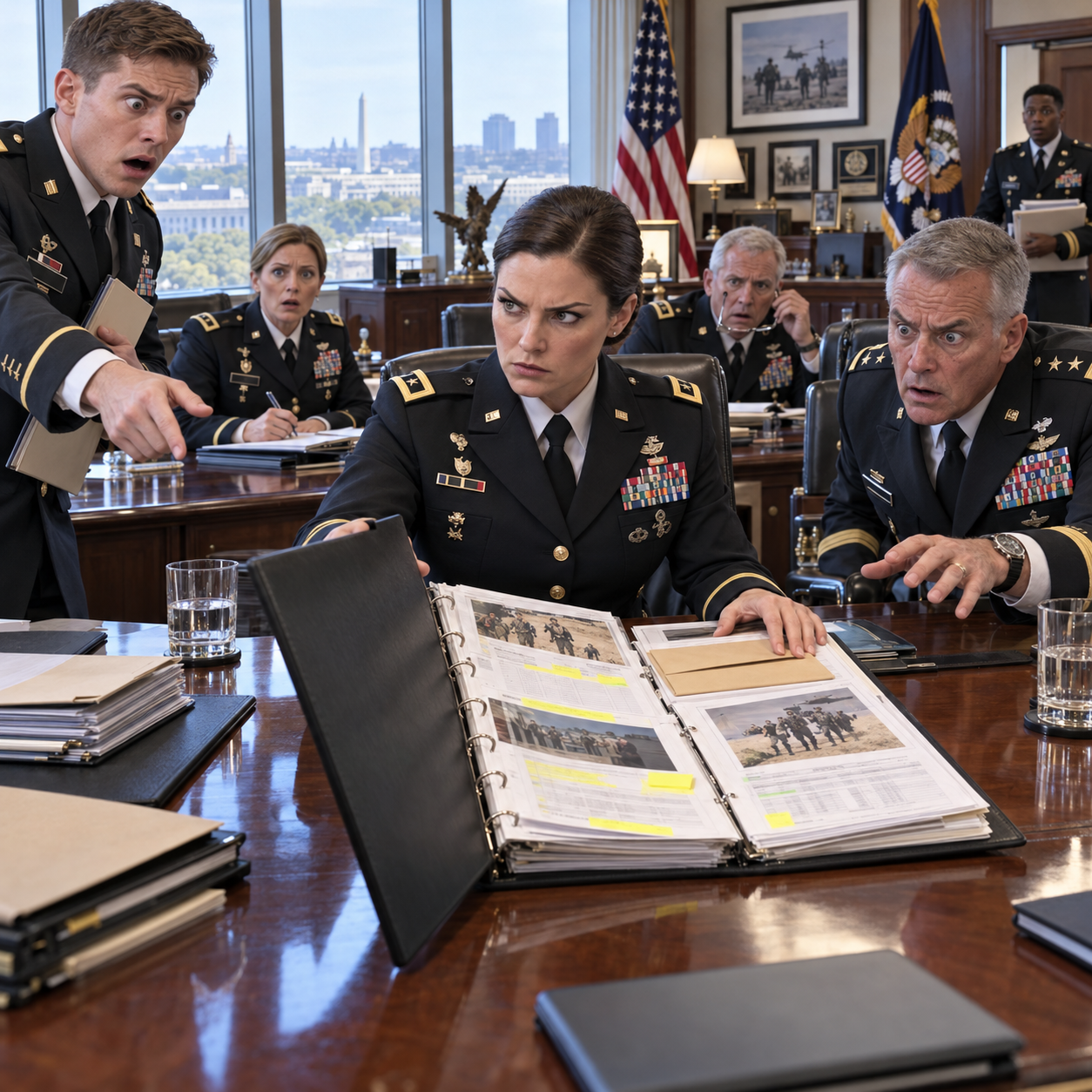
They Called Me “Cold Iron.” I Never Smiled, Never Attended A Single Dinner. My Lieutenant Reported Me For Hiding Thousands In Secret Transfers. I Sat Down In The Inspector General’s Office And Said Nothing… Then I Opened My Black Binder…
The lieutenant who accused me of stealing Army money watched investigators spread my private bank records across the table. My commanding officer wouldn’t meet my eyes. I didn’t shout or plead; I opened my binder and asked them to verify every dollar. Three days later, the accusation had begun to collapse, but a document surfaced bearing my dead husband’s signature. It was dated seven weeks after his funeral. I’d spent two years paying his debts, never imagining someone might still be using his name.
Part 1
The first thing I noticed about the interrogation room was the broken clock. Its second hand twitched between two marks without moving forward, making a dry clicking sound that repeated every few seconds. I had commanded soldiers through rocket attacks, vehicle recoveries, and three deployments, yet somehow that cheap plastic clock unsettled me more than the confidential inquiry folder resting between my hands. Across the steel table, Major Nadia Flores studied me with the careful expression of someone who had already heard an ugly story and was waiting to discover whether it was true.
“Lieutenant Colonel Larkin, we’re investigating allegations involving undisclosed financial relationships and possible misuse of government resources,” she said, pushing three photocopied bank statements toward me. “Before we proceed, I need to know whether you recognize these transactions.” I looked at the highlighted figures, the routing information, and the names of businesses spread across Texas, Ohio, and Pennsylvania. “Every one of them,” I answered.
Behind Major Flores sat First Lieutenant Caleb Rourke, twenty-six years old, perfectly groomed, with the confident posture of a man who believed the room had been arranged for his benefit. He had joined my battalion staff four months earlier, bringing excellent academic evaluations, an expensive watch, and a remarkable ability to interpret correction as persecution. When I met his eyes, he looked away just slowly enough to make his satisfaction obvious. It was the same expression he had worn when he’d handed me a readiness report containing seventeen incorrect equipment serial numbers and expected praise for finishing it early.
Colonel Evelyn Shaw, my brigade commander, stood near the window with her arms folded. She had known me for six years, had trusted me with soldiers and millions of dollars’ worth of equipment, and had once asked me to write a recommendation for her nephew’s military academy application. Now she wouldn’t look directly at me. I understood why, but understanding didn’t make it hurt less.
“These accounts have received more than forty thousand dollars over the past twelve months,” Major Flores continued. “Some beneficiaries appear connected to commercial transportation businesses that have worked with military installations.” She paused before asking whether I had accepted compensation or arranged payments connected to my official duties. I told her no, and Lieutenant Rourke shifted impatiently in his chair.
“Ma’am, the pattern is fairly clear,” he interrupted. “The transfers are recurring, the recipients are spread across several states, and the commander didn’t include them in the materials my section reviewed.” Major Flores turned toward him with a look that made him straighten. “Lieutenant, you’ll have an opportunity to answer questions when I ask them.”
I should probably explain something before going further. My name is Sarah Larkin, I am forty-three years old, and at the time of that meeting I had served eighteen years in the United States Army. For the previous eighteen months, I had commanded the 2nd Logistics Support Battalion at Fort Liberty, North Carolina. On paper, I was exactly the kind of officer whose career had been carefully built to survive scrutiny.
In practice, I was the woman younger soldiers called Cold Iron. I knew because I’d heard it twice outside the maintenance bay and once through the half-open door of the officers’ break room. They thought I was too severe, too distant, and too interested in regulations to remember that human beings existed inside uniforms. Sometimes I wondered whether they were right.
I arrived before sunrise, inspected the maintenance reports personally, and rarely laughed at jokes. I declined invitations to retirement dinners unless attendance was officially expected, skipped informal weekend gatherings, and ate the same turkey sandwich at my desk nearly every afternoon. My boots were properly maintained but older than those of several lieutenants, and the silver sedan I drove had a cracked dashboard and a heater that worked only when it felt like it.
Those things were not evidence of character, but people used them that way. My executive officer, Major Nathan Pierce, once gently suggested that joining a few social events might help the battalion see another side of me. I told him that soldiers needed competent leadership more than another officer drinking beer beside a barbecue grill. He didn’t argue, although I noticed he stopped offering invitations afterward.
What Pierce didn’t know was that I regularly sat in my car outside our rented house for ten minutes before going inside, trying to collect enough energy to be a mother. My sixteen-year-old daughter, Avery, could identify my mood by how long the engine stayed running. Sometimes she’d appear at the window with two mugs of hot chocolate, even in warm weather, because that was something her father had always done when he knew I was exhausted. Other evenings, the curtains stayed closed.
Her father, Ben Larkin, had been dead for twenty-six months.
I could say that his death changed my life, but that would suggest there had been one clean moment when everything divided into before and after. There wasn’t. There were hospital monitors, a phone call from an unfamiliar neurologist, a mortgage company, unanswered business emails, and Avery standing barefoot in a hallway asking whether her father would remember her when he woke up.
He never woke up.
By the time we buried him, I had already learned how to answer difficult questions without letting my voice shake. I hadn’t learned what to do with a daughter who sometimes looked at me as though I had personally chosen to leave her father in that hospital. I hadn’t learned what to do with his coffee mug, either, so it remained on the kitchen shelf, chipped handle facing outward.
“Colonel Larkin?”
Major Flores’s voice brought me back to the interrogation room. She was holding a document listing deposits into several civilian bank accounts. “Can you explain the source of these funds?”
“My military compensation,” I said. “Base pay, personal savings, and proceeds from the sale of our previous home. None came from Army accounts.” I reached beneath my chair for the black leather binder I had brought, but Major Flores raised a hand before I opened it.
“Before we examine your documents, I want to establish whether you’ve had any private business relationships with the recipients.”
“Yes,” I said. “But not through my military duties.”
Lieutenant Rourke leaned forward. “So you’re confirming undisclosed financial relationships with transportation contractors?”
“I’m confirming that I know the people receiving my money.”
“Why would a battalion commander send thousands of dollars to civilian freight companies?”
For the first time that morning, I felt something move beneath the careful stillness I had practiced for two years. It wasn’t fear or embarrassment. It was anger at the eagerness in his voice, the way he seemed more interested in catching me than understanding the facts. I looked at Major Flores instead of answering him.
“Are these questions part of a formal inquiry?”
“Yes, Colonel.”
“Then I would like legal counsel before discussing certain personal obligations, and I request that the source and handling of my banking records be documented.”
Colonel Shaw finally turned from the window. “Sarah, nobody here is trying to make this harder than necessary.” I wanted to ask whether she would have said the same thing if strangers had spread her family’s financial history across a table. Instead, I told her I understood the seriousness of the allegations.
Major Flores agreed to suspend substantive questioning until counsel was available. As she gathered the papers, one photocopy slid free from beneath the folder, exposing the heading of an agreement issued by a company called Calder Freight Solutions. I recognized the company immediately, but my attention went to something farther down the page.
There was a handwritten signature above the printed name Benjamin Larkin.
Beneath it was a date.
I read it twice before reaching for the edge of the table to steady myself. The agreement had supposedly been signed forty-nine days after we buried my husband.
Part 2
The first bill arrived eleven days after Ben’s funeral, in an ordinary white envelope with a yellow forwarding sticker attached to the corner. I had spent that morning washing the same load of towels twice because I kept forgetting to move them into the dryer, and I was standing at the kitchen counter when I opened it. Inside was a demand for $18,600, addressed to Benjamin Larkin and referencing an equipment guarantee connected to Eastline Freight Brokerage, the business he had started after leaving the Army. At first, I assumed someone hadn’t updated their records.
Ben had served twelve years before choosing civilian life. He was an excellent transportation specialist, the kind of soldier who remembered drivers’ names, knew which families needed extra help during deployments, and could persuade a mechanic to stay late without making the request sound like an order. His problem was that he trusted people who spoke with the same confidence he used when making promises. In the Army, there had been procedures to protect him from some of his mistakes; in business, there were people perfectly willing to profit from them.
Eastline began in a rented office behind a tire warehouse outside Fayetteville. Ben handled customer relationships, while his civilian business partner, Brett Calder, negotiated equipment financing, contracts, and carrier payments. They started with three regular shipping customers and a borrowed conference table, and for almost a year Ben came home smelling of diesel fuel and cheap office coffee, wearing the happiest expression I’d seen on him since our daughter was born.
He used to tell Avery that one day he would build a company where veterans could find stable work without missing another Christmas or birthday. She took that seriously enough to draw a logo for him, a little blue highway disappearing into mountains. He framed it beside his desk. Even when the business began losing money, he refused to remove it.
The trouble started with a distribution contract that promised regular freight runs between North Carolina and Texas. A major customer delayed payments, two carriers disputed their invoices, and Brett assured Ben that everything could be fixed with temporary guarantees. Ben signed documents, called friends who owned trucks, and promised mechanics he’d settle their bills as soon as money arrived. He told me the company was experiencing normal growing pains.
I believed him because I wanted to.
Then came the stroke. Ben collapsed in the parking lot outside his office, and by the time I reached the hospital, surgeons were explaining procedures I struggled to understand despite years of listening to military medical briefings. He survived the first emergency but couldn’t speak clearly afterward. Six weeks later, a second catastrophic stroke ended any possibility of bringing him home.
I remember sitting beside him the night before his death, holding the hand that had repaired our daughter’s bicycle and warmed mine on winter mornings. His fingers moved once against my palm. I told him we would figure everything out, because I couldn’t think of anything else to say.
Three weeks after the funeral, our attorney showed me the financial picture. There were unpaid carrier invoices, equipment guarantees, business credit obligations, and disputed payments totaling approximately $340,000. Some belonged strictly to the failed company, some were potentially enforceable against his estate, and others were promises Ben had made personally without understanding how much risk he’d accepted.
Our lawyer, Teresa Quinn, was a practical woman with reading glasses attached to a silver chain. She explained that I was not automatically responsible for my husband’s separate business debts, that creditors had different legal rights, and that bankruptcy or an orderly administration of the estate might be the most sensible option. She warned me against making promises before we knew which claims were valid. I listened, then asked for the names behind every invoice.
Teresa looked at me over her glasses. “Sarah, you’re a widow with a fourteen-year-old daughter. You don’t have to bankrupt your future to rescue a business that failed.”
I told her I understood. I didn’t, not completely, but I understood that the numbers represented people rather than just accounts. I’d seen a photograph in Ben’s office of a driver named Miguel Delgado standing beside a red truck with his wife and two children, and I’d heard Ben talk about an older couple who kept a diesel repair shop running outside Dayton.
Two days later, I called Rosa Delgado in El Paso. Her husband had taken a series of Eastline freight assignments after Ben promised prompt payment, but the company collapsed while the family was still waiting for tens of thousands of dollars. Rosa explained that Miguel had been forced to sell his second truck and had accepted night driving jobs to cover their mortgage. She spoke without accusing me, which somehow made the conversation harder.
“I’m not asking you for anything, Colonel,” she said when I introduced myself. “I know your husband passed away, and I’m sorry. I just want someone to tell us what actually happened.”
I told her I would find out.
That became my first mistake, although I didn’t recognize it as one then. I confused making things right with taking personal responsibility for every failure connected to Ben’s name. I also believed that if I absorbed enough financial damage, Avery might never have to face the uglier parts of her father’s final years.
We sold the four-bedroom house we’d bought when Avery was eight. After settling the mortgage and closing expenses, the proceeds covered a substantial portion of the claims Teresa verified, but there were still people waiting for money. I rented a smaller home five miles from post, canceled subscriptions, stopped replacing things unless they were unusable, and negotiated voluntary repayment agreements with creditors whose losses had been documented.
On average, nearly seventy percent of the compensation deposited into my checking account was committed to those payments. Teresa insisted that Avery’s college account remain untouched and helped create a written budget with a protected emergency reserve. I followed that budget with the same discipline I applied to operational planning, although it left almost no room for anything that wasn’t absolutely necessary.
At first, Avery accepted our changed circumstances as something families did after a death. She helped carry boxes into the rental house, taped her father’s favorite photograph to the refrigerator, and said her new bedroom was fine despite the water stain spreading across the ceiling. But by the second Christmas, she had begun asking questions I kept answering too carefully.
“Are we poor?” she asked one night while I repaired the strap on my old purse.
“No, sweetheart. We’re managing.”
“Then why can’t we go anywhere?”
I told her we had obligations, and she asked whether those obligations had names. I said she didn’t need to worry about adult finances. She looked down at the purse in my lap and answered, “I’m already worrying, Mom. You just won’t tell me what I’m worrying about.”
I should have told her more that evening. Instead, I finished sewing the strap, kissed her forehead, and went back to the dining table where I kept a binder containing Ben’s agreements, invoices, payment records, and creditor correspondence. I worked until nearly two in the morning, reviewing balances beneath a kitchen light that flickered whenever the refrigerator compressor started.
Near the bottom of one folder was a document Teresa had urged me to investigate before making any payments against it. It involved Calder Freight Solutions, the newer company Brett had established after Eastline shut down. The document appeared to transfer a group of outstanding obligations from Eastline to his organization, and Brett had repeatedly insisted that it was routine paperwork completed before Ben’s final hospitalization.
I had never received a clean original. Brett said the office records were damaged during a move, and at the time I’d been too overwhelmed to argue about it. I placed a yellow sticky note on the folder and wrote, “Obtain signed copy.”
For almost two years, that note remained unanswered.
Part 3
Lieutenant Caleb Rourke arrived at battalion headquarters on a humid Monday morning carrying two garment bags, three framed certificates, and a confidence that might have been useful if it hadn’t been so easily bruised. He was assigned to the administrative section and placed under Major Pierce’s supervision, with responsibilities involving personnel readiness, correspondence, and certain security-processing functions. His previous evaluations described him as exceptionally motivated and highly attentive to detail. Within a month, I discovered that he paid more attention to how a report looked than whether its contents were correct.
Our first serious disagreement concerned a quarterly readiness submission. The document claimed that six vehicles were fully mission-capable, although two were awaiting essential components and one hadn’t passed inspection. It also listed soldiers as current on training that their records clearly showed they had missed. I returned the report with corrections and told him that inaccurate readiness figures could result in soldiers being sent into operations without equipment they could depend on.
He stood rigidly beside my desk. “Ma’am, those discrepancies were already being addressed.”
“Then the report should reflect that.”
“It’s a preliminary product.”
“You’re presenting it as final.”
His cheeks reddened, but he collected the paperwork without another word. The following morning, he returned it after making most of the corrections, and I thanked him for finishing the work. I thought the matter was closed.
It wasn’t.
Rourke had been raised in a military-adjacent family with a father who occupied a senior civilian position in Washington. He frequently mentioned people he’d met, offices he’d visited, and generals who supposedly knew his family, though I couldn’t tell which connections were real. He spoke about advancement as though the Army were a series of locked rooms and he had been given a master key. To him, my insistence on procedure felt like an unnecessary obstacle.
Within weeks, I heard from Sergeant First Class Denise Carter that he was calling me impossible to work for. Carter had twenty-one years of service, a husband recovering from surgery, and almost no patience for gossip. She told me privately because she thought the comments were affecting junior soldiers’ willingness to bring problems to my attention. I asked her to document any actual interference with work, but otherwise I did nothing.
I had no idea how personal Rourke’s resentment had become until the financial inquiry began.
The immediate issue was a restricted security file containing documents I’d voluntarily provided after disclosing significant financial obligations. Officers with access to sensitive information are expected to report potentially relevant financial difficulties, and I’d been careful about that responsibility from the beginning. A security manager had requested supporting records, including proof that my debts and repayment arrangements were transparent and under control. Those documents should have remained accessible only to people with a legitimate need to review them.
During an administrative records review, Rourke encountered copies inside a folder that had been improperly placed on a shared drive. He later claimed that the transactions appeared suspicious because several payees had commercial freight addresses and unfamiliar company names. Instead of asking an authorized security official to resolve the discrepancy, he copied selected pages and built his own interpretation. He eventually submitted an allegation to the inspector general, asserting that I might be routing improper payments through civilian transportation entities.
The complaint was not automatically misconduct. Soldiers have the right to report suspected wrongdoing, and an accusation against a commander must be taken seriously regardless of the complainant’s rank. But Rourke’s decision to retain private financial information beyond his authorized duties, circulate details among coworkers, and present assumptions as established facts would become a separate issue. At the time, none of that distinction mattered to the rumor moving through headquarters.
I learned about the investigation on a Thursday afternoon. Colonel Shaw called me to brigade headquarters, placed an official notification on her desk, and explained that the allegations would receive independent review. She told me my command authority would remain intact initially, but certain financial approvals would be temporarily routed through Major Pierce. I nodded, accepted the notice, and asked when I could provide records.
“Sarah,” she said, “I wish you’d told me you were under so much financial pressure.”
I looked at the framed battalion photographs on her wall. “I disclosed everything I was required to disclose.”
“That’s not what I meant.”
I knew what she meant, and it irritated me because she had no way of knowing whether I was under unbearable pressure or merely handling my affairs carefully. I wanted to explain that every account had a real family behind it, that some nights I could remember their children’s names more easily than my own cousins’. Instead, I told her I would cooperate.
The change at headquarters was immediate, even though nobody formally announced the investigation to the battalion. Conversations stopped when I entered the operations room. A civilian clerk who usually greeted me with a cheerful “Morning, Colonel” suddenly studied her keyboard whenever I passed. Major Pierce continued treating me normally, which I appreciated more than I knew how to express.
At home, Avery noticed the difference before I said anything. I came through the door at six-thirty with my uniform jacket folded over my arm, and she was making spaghetti in a saucepan with one broken handle. “You look like somebody died,” she said, then immediately apologized when she realized what she’d said. I told her it was a difficult day at work and helped drain the pasta.
She was quiet through dinner. Later, while I was washing dishes, she asked whether I could attend her winter choir concert instead of sending Sergeant Carter again. I promised to try, and she answered, “You always try.” There was no accusation in her voice, only exhaustion.
The next morning, I drove to the installation legal assistance office and met with an attorney who helped me understand the inquiry process. She advised me to preserve my documentation, avoid discussing the allegations with potential witnesses, and obtain appropriate counsel for any substantive interview. I went home afterward and opened the binder containing my payment records, intending to organize them into categories for the investigators.
That was when I received a call from an Ohio number I didn’t recognize.
“Colonel Larkin? My name is Laura Bell,” the woman said. “You probably don’t remember me, but my parents own Bell Diesel Repair outside Dayton. My mother found your letter from last Christmas, and she asked me to call.”
I remembered writing the letter. It had accompanied a cashier’s check and a brief note thanking the family for their patience while the final portion of their documented claim was being paid. Laura hesitated before asking whether I had recently authorized someone named Brett Calder to renegotiate their settlement.
“No,” I said. “Why?”
“Because he called my father yesterday and said you were stopping payments unless we signed a new release.”
I gripped the phone more tightly. Brett had never been authorized to negotiate anything on my behalf. Then Laura added something that made the kitchen feel suddenly smaller.
“He said your husband would have wanted us to cooperate, and he claimed he had documents signed by Ben proving that.”
Part 4
I called Teresa Quinn before calling Brett. She listened without interrupting while I explained Laura Bell’s warning, the investigation, and the document bearing Ben’s signature after his death. When I finished, she asked me to photograph the older correspondence and bring every document connected to Calder Freight Solutions to her office. Her voice changed when I mentioned that Brett had apparently contacted creditors in my name.
“Sarah, you need to stop treating this as a bookkeeping problem,” she said. “Someone may be using your husband’s identity and your payments to control other people’s money.”
I drove to her office with three folders secured in a canvas bag. Teresa spread the documents across a conference table and began building a timeline, starting with Ben’s hospitalization and ending with the most recent transfers. She immediately found something I’d overlooked: Calder Freight Solutions had been registered seventeen days after Ben’s death, yet one of its agreements claimed to have been negotiated with him as an active business representative. Another document listed a bank account I didn’t recognize as the recipient for payments supposedly intended for two independent carriers.
When Teresa asked why I’d paid that account, I explained that Brett had presented it as a centralized settlement account handling claims inherited from Eastline. Early in the process, he had supplied spreadsheets matching the names and amounts in Ben’s records, and he’d answered questions quickly when I called. I had insisted that most verified creditors receive payments directly, but a handful of complicated accounts had remained under the company’s administration. That arrangement now looked much less reasonable than it had when I was trying to keep dozens of people from losing their businesses.
“How much went through this account?” Teresa asked.
“About twenty-eight thousand dollars over two years.”
She removed her glasses. “And you’ve never received an independent confirmation from the supposed creditors?”
I shook my head. Teresa didn’t scold me, which made me feel worse. She simply marked the payments for investigation and told me not to send another dollar to that account until ownership and authorization had been verified.
Two days later, I returned to the brigade inquiry office with legal counsel. Major Flores had already received certified bank records establishing that the money originated from my personal accounts, not government funds. She also had records showing that the Army-related companies Rourke had mentioned were not necessarily the recipients of Army contracts involving my battalion. Those findings substantially weakened the corruption allegations, but she still wanted to understand the civilian arrangements.
I opened my binder and began explaining the agreements. There were checks to Rosa Delgado’s family, payments to Bell Diesel Repair, money sent to a retired motor pool sergeant who had guaranteed equipment financing, and dozens of receipts signed by people who had accepted reduced settlements rather than continue fighting a bankrupt brokerage. Each payment had been matched against bank records and, where possible, original invoices. I could see Major Flores’s expression changing as she worked through the evidence, though she remained careful not to make premature conclusions.
“Why didn’t you tell your command about the scale of this?” she asked.
“I reported the relevant financial obligations through the security process.”
“That’s not exactly what I’m asking.”
I rested my hands on the binder. “Because my husband died, Major, and suddenly everyone wanted to talk about his tragedy. They wanted to tell me how wonderful he was, how strong I was, and how time would heal everything. I didn’t have the energy to explain that some of the people sending condolences were also wondering how they would pay their mortgage.”
She let that answer sit for several seconds. Then she examined the Calder agreement with the impossible signature date. She didn’t call it forgery, but she photographed it for the inquiry record and asked permission to share potentially relevant information with civilian investigators through appropriate channels.
I agreed.
When I left, Colonel Shaw was waiting outside the office. She asked if we could walk together, and we took the long corridor toward the headquarters parking lot. She apologized for the discomfort of the proceedings, then said something that surprised me. “I haven’t been a very good friend to you since Ben died.”
I told her friendship had never been a requirement of command. She stopped walking and looked at me with an expression that reminded me of the officer I’d known overseas, before both of us started measuring every conversation. “No,” she said, “but I thought we were friends anyway.”
I didn’t know how to answer. The honest response was that I had pushed her away along with everyone else, partly because explaining my grief felt unbearable and partly because silence had become easier. Before I could say anything, my phone vibrated with a message from Avery. It contained a photograph taken at school.
Someone had posted an anonymous message on a student discussion page claiming that her mother was being investigated for stealing military money. Beneath it, several teenagers had made jokes about my old car and our small house. One had written that maybe Avery’s father hadn’t left her anything because her mother had taken it.
I stood beneath the fluorescent lights reading those words while Colonel Shaw waited beside me. For two years I’d believed that protecting Avery meant keeping the ugly financial details away from her. Now strangers were filling the gaps with lies.
I drove home early and found her sitting at the kitchen table with her backpack still on. She didn’t look up when I entered, and I noticed she’d taken her father’s framed photograph off the refrigerator. It was lying face down beside her phone.
“Did Dad steal money?” she asked.
“No.”
“Did you?”
“Absolutely not.”
“Then why is everybody talking about us like we’re criminals?”
I sat opposite her and told her the truth I should have shared long before. I explained the failed business, the creditors, our repayment agreements, and the reason we’d sold our house. I admitted that I didn’t know whether every demand had been legitimate, and that I had trusted someone connected to her father’s company who now appeared to have lied.
Avery listened without crying. When I finished, she asked why I’d never allowed her to help make decisions about our family. I started to say she was too young, but she interrupted. “I was old enough to lose Dad. I was old enough to move and watch you disappear into paperwork every night.”
I had no answer that wouldn’t make it worse.
She went to her room, leaving me at the table with Ben’s photograph. An hour later, she came back carrying a cardboard box she’d kept beneath her bed since the move. Inside were old photographs, birthday cards, and the framed blue highway drawing she had made for her father’s office.
On the back of the frame, someone had taped a folded piece of paper.
Avery handed it to me. “Dad put that there when he brought the picture home from work. He told me it was important, but I forgot about it.”
I unfolded the paper and recognized Ben’s handwriting. It was a short list of payment discrepancies, followed by a sentence underlined twice.
“Brett is moving carrier funds again. Need independent audit before signing anything else.”
Part 5
I read that sentence until the words stopped looking familiar. Ben had written it twelve days before his first stroke, on the back of a receipt from a truck stop outside Raleigh. Beside the note were four invoice numbers and the initials of two carriers, along with amounts that matched entries in the Eastline ledger. It wasn’t proof that he had understood the entire problem, but it destroyed the comforting version of events I’d been carrying around for two years.
I’d told myself Ben was a generous man who trusted the wrong partner. The note suggested he had recognized financial misconduct before his illness and had been trying to investigate it. I felt angry that he hadn’t told me, even while another part of me remembered how frightened and exhausted he’d been in the months before the stroke. Loving him had never required me to believe he was incapable of making terrible decisions, but grief had blurred that distinction.
Avery sat beside me on the sofa while I called Teresa. She heard enough to understand that the paper mattered, and afterward she asked whether we should be afraid of Brett. I told her there was no evidence he intended to harm us physically, but we would stop speaking with him without an attorney involved. Then I promised something more important: I would no longer keep her completely outside decisions that affected her life.
The next morning, Teresa arranged for the original note to be preserved and began contacting the creditors connected to the listed invoices. She also recommended a forensic accountant, David Keene, who had experience examining small-business payment records and disputed guarantees. I paid his initial fee from the emergency reserve I’d spent years refusing to touch. For the first time, I was spending money to protect our future rather than repair someone else’s past.
David was a retired auditor with wire-framed glasses, an uneven beard, and a habit of writing calculations on yellow paper instead of using a computer. He studied the ledger for nearly an hour before asking whether Ben had ever questioned Brett about duplicate carrier payments. I told him I didn’t know. David pointed to two entries that supposedly represented separate shipments, then showed me that both referred to the same trailer, delivery date, and freight reference number.
“One shipment, two bills,” he said. “That doesn’t automatically prove fraud, but it gives us somewhere specific to look.”
Over the following week, we contacted creditors through Teresa’s office. Most confirmed that the payments I’d made directly had reached them, and several supplied signed acknowledgments that matched my records. Bell Diesel Repair had received every installment I’d personally sent, although the owners were understandably confused by Brett’s recent demands. Two other creditors, however, had never seen the amounts supposedly forwarded through Calder Freight Solutions.
One was a small carrier in Pennsylvania owned by a former Army mechanic named Samuel Ellis. He had driven freight for Eastline during its final year and had agreed to accept installments after Ben’s death. According to Brett’s spreadsheets, Samuel had received $11,400 from the centralized account. Samuel told Teresa he’d received only $2,100 and had assumed the remaining payments had stopped because the company was insolvent.
The second was a North Carolina subcontractor who had closed his business after months of unpaid invoices. His reported payments were equally inconsistent. Both men provided records, and David compared them with the transfers leaving my bank account. The differences were too specific and too consistent to dismiss as ordinary administrative mistakes.
I thought about all the times I’d skipped buying new running shoes, all the evenings I’d told Avery we couldn’t afford a weekend trip, all the checks I’d written believing they were helping families recover. Some money had reached people who needed it. Some appeared to have gone somewhere else entirely.
The first direct confrontation came in a phone call Brett made to my cell phone on a Wednesday evening. I was sitting in the driveway outside our house, holding a grocery bag with a carton of eggs balanced on top, when his name appeared on the screen. I let it ring and forwarded the voicemail to Teresa afterward.
“Sarah, I heard you’ve been digging around in old company records,” he said. His voice was easygoing, almost affectionate, the way it had been when he helped carry folding chairs after Ben’s memorial service. “I understand you’re stressed about the Army situation, but people are misunderstanding a lot of what happened. We should sit down and straighten things out before lawyers make everything worse.”
Brett had attended our wedding. He knew Avery’s birthday, had stood beside Ben at a dozen backyard cookouts, and had once stayed at our house for three nights during an ice storm. I remembered him helping Avery build a cardboard model of a freight truck when she was seven. Now every familiar memory felt contaminated by the possibility that he’d been using our trust to hide something.
Teresa responded with a formal request for documents, payment reconciliations, and proof of authority for any agreements bearing Ben’s signature. Brett’s attorney replied that Calder Freight Solutions had acted in good faith while administering a complicated business dissolution. The response didn’t address the signature date. It also demanded that I stop contacting former clients directly because the inquiries were supposedly damaging the company’s reputation.
Meanwhile, the Army investigation was taking a quieter but more complicated turn. Major Flores confirmed that the suspicious transfers were not linked to appropriated government funds or procurement decisions I controlled. She also discovered that Rourke had collected private documents from a restricted folder and shared selected information with another junior officer. The inspector general’s office separated his protected reporting activity from the questionable handling of financial records.
I was informed that the financial misconduct allegations against me were unsupported by the evidence collected. The command was preparing to close its administrative review, subject to final legal coordination. I should have felt overwhelming relief, but instead I sat in my office staring at the notice and thinking about Avery.
The inquiry could clear my professional reputation. It couldn’t make the comments at her school disappear, and it couldn’t restore two years of ordinary life I’d sacrificed under assumptions that might have been false.
Late that Friday, David called with the results of a corporate-record search. Calder Freight Solutions had opened a new settlement account shortly after Ben’s death, but it wasn’t the only company involved. A second business had been created using an address associated with Brett’s former bookkeeper, and payments from several disputed Eastline invoices appeared to have been redirected through it.
Then David told me something else. Before Ben’s stroke, the same bookkeeper had resigned abruptly and submitted a written complaint about unexplained transfers. Her complaint had been dismissed internally, and Brett had told Ben she was an unreliable employee who’d stolen company records.
Her name was Melissa Hart.
When David reached her former address, he discovered that she had kept copies of the disputed transactions because she was afraid Brett would eventually blame her for them.
Part 6
Melissa Hart lived in a modest house outside Greensboro, with a vegetable garden behind the garage and a faded blue pickup parked beneath an oak tree. Teresa arranged a meeting at her office rather than sending me to Melissa’s home, partly to preserve a clear record and partly because nobody yet knew the full extent of what she could establish. I took a day of leave and drove there on a gray morning with the radio turned off. By the time I arrived, my hands were damp against the steering wheel.
Melissa was in her early fifties, with short brown hair and the tired, guarded expression of someone who had spent years expecting to be blamed for something. She sat across from Teresa and me, placed a canvas bag on the table, and said she’d nearly thrown its contents away a dozen times. Inside were printed bank reconciliations, email exchanges, freight invoices, and a notebook filled with dated entries.
“I warned Ben,” she said before I could ask anything. “I warned him three different times.”
She explained that Brett had been transferring customer payments into accounts associated with separate companies while telling carriers that the money hadn’t arrived. Some transfers were labeled as reserve adjustments, and others were supported by invoices with duplicated shipment references. Melissa had questioned them, but Brett claimed they were legitimate offsets against disputed contracts. When she continued pressing for documentation, he accused her of undermining the business.
“Did Ben know?” I asked.
“He knew the records weren’t right. He didn’t know how much money had been moved.”
Melissa pulled out an email dated thirteen days before his stroke. In it, Ben had instructed Brett to suspend several payments and authorize an independent examination of Eastline’s accounts. Brett replied that an audit would destroy the company’s credit relationships and threatened to dissolve their partnership if Ben continued questioning him. Two days later, Ben requested copies of the bank statements directly from the financial institution.
I recognized his writing in the printed email. There were the same abbreviated sentences, the same habit of ending serious requests with “Please confirm,” and the same determination that had once made him stay awake helping a struggling soldier understand a vehicle maintenance procedure. I had spent two years imagining that he simply never saw the danger. Now I knew he’d seen part of it, and I’d never had the chance to ask why he didn’t come home and tell me.
Melissa also showed us a draft reconciliation prepared before Ben’s hospitalization. It indicated that Eastline’s actual outstanding carrier liabilities were substantially lower than the amount Brett had been reporting internally, although some claims remained genuinely disputed. The figures required independent verification, and David warned against treating the draft as a final audit. But the documents supported an emerging pattern of duplicate invoices, diverted payments, and obligations that had been inflated or misrepresented.
Teresa asked Melissa why she hadn’t gone to the authorities earlier. Melissa stared at her hands for a long moment. “I tried to explain it to an attorney after Ben died, but I didn’t have enough money to fight a company, and I was scared somebody would say I helped.” She glanced toward me. “Then I heard about the colonel sending her own money to drivers, and I thought maybe the accounts had finally been corrected.”
I wanted to be angry with her for staying silent. Instead, I remembered my own silences and the different fears that had kept them in place. I thanked her for bringing the records, and Teresa explained how they could be provided to investigators without making accusations beyond what the documents supported.
Over the next month, our attorney worked with civilian authorities and the appropriate Army offices to preserve the evidence. A county financial-crimes investigator reviewed the posthumous signature, the diverted payments, and the discrepancy between recorded creditor balances and actual receipts. David traced the questionable settlement transfers through the available banking documentation, while Teresa pursued separate civil claims to recover funds paid under allegedly false representations. Nothing moved as quickly as I wanted.
Brett’s attorney sent letters denying wrongdoing and claiming that Ben had approved the disputed arrangements before his death. The letters maintained that the later documents were merely administrative memorializations of prior agreements. Teresa asked for the underlying originals and supporting communications. None were produced.
Then Brett made his second mistake.
He filed a civil claim against Ben’s estate seeking additional payment under one of the very agreements bearing the questionable signature. The filing brought the document into a court process where its authenticity could be formally challenged. It also required Brett to explain the alleged debt’s history, the corporate entities involved, and the basis for the signatures.
When Teresa called with the news, I was sitting outside Avery’s school waiting for choir rehearsal to end. I had been attending rehearsals when parents were allowed to watch, partly because I wanted to support her and partly because I was tired of being a stranger to the details of her life. I watched students crossing the parking lot beneath bright security lights while Teresa explained the filing.
“He is putting his version of events into a record he’ll have to defend,” she said.
“Is that good?”
“It gives us a clearer path to test the claims. It doesn’t guarantee what we’ll find.”
That was Teresa’s way of warning me not to mistake progress for a conclusion. I appreciated it because I had already spent too much time living inside conclusions that hadn’t been supported by facts. I asked her to proceed and promised to provide whatever legitimate records were necessary.
Avery emerged from the school doors carrying her music folder against her chest. She climbed into the passenger seat, looked at my expression, and asked whether something had happened. I told her Brett had taken another legal step and that we would respond through Teresa.
“Do you think Dad knew what Brett was doing?” she asked.
“I think he suspected something was wrong.”
“Then why didn’t he tell us?”
I looked at the windshield, searching for an answer that wouldn’t unfairly condemn a man who couldn’t explain himself or turn him into a saint. “Maybe he was ashamed. Maybe he thought he could fix it before we found out. I don’t know, Avery.”
She nodded slowly. “I wish he had trusted us.”
“So do I.”
Two weeks later, the Army completed its administrative review of my conduct. The final memorandum found insufficient basis for the allegations of financial misconduct and documented that the funds reviewed originated from private sources. Colonel Shaw called me into her office to explain the conclusion and confirm that the temporary approval restrictions would be removed.
She gave me the memorandum in a plain folder. I read every paragraph before looking up, relieved but unable to forget how quickly people had decided what my silence meant. Shaw told me she was sorry the process had been painful, then asked whether there was anything she could do.
“Yes,” I said. “Make sure the people who handle personal financial records understand what those records can do to a family when they’re mishandled.”
She promised to address the security procedures, and for once I believed the promise would lead to something specific.
As I left her office, I passed Lieutenant Rourke waiting near the hallway entrance. His face was pale, and his hands were clasped so tightly that his knuckles had turned white. He stepped forward, opened his mouth, then closed it again when another officer passed.
I could have continued walking. I had imagined doing exactly that, more than once. Instead, I stopped several feet away and waited.
“Colonel,” he said quietly, “I owe you an apology.”
He swallowed, looking more frightened than I had ever seen him. “But there’s something about how I got those records that I need to tell you first.”
Part 7
I followed Lieutenant Rourke into an empty conference room but left the door open. He remained standing while I took a chair near the end of the table, and for several seconds neither of us spoke. I could hear a printer operating in the adjacent office and two soldiers discussing a training schedule in the hallway. It was an ordinary afternoon in a place where my professional life had nearly been overturned.
“Lieutenant, if you’re telling me something related to an ongoing administrative matter, you need to understand that I’m not the appropriate person to investigate your conduct.”
“I understand, ma’am.”
“Then be careful about what you say.”
He looked down at his hands. “I didn’t give the inspector general everything I found.”
I waited.
“The folder included a memorandum about personal restitution agreements,” he continued. “I thought it was an explanation you’d prepared to protect yourself if somebody discovered the transactions. I copied the bank statements and company records, but I didn’t include that memorandum with my initial complaint.”
I felt the anger rising before he finished. A report made in good faith was one thing; presenting only the material that supported a preferred accusation while withholding relevant context was another. Rourke admitted that he had also mentioned the suspected corruption to another lieutenant, who repeated it outside headquarters. He insisted he hadn’t intended for rumors to reach Avery’s school, but he couldn’t deny contributing to their spread.
“Why?” I asked.
His expression tightened. “I thought you were hiding something.”
“That’s what you suspected. I’m asking why you left out information that might have helped someone assess the suspicion fairly.”
He hesitated so long that I wondered whether he would answer. Finally, he said, “Because I wanted them to take it seriously. And because I was angry with you.”
There it was, stripped of the language of professional concern. He’d resented my corrections, interpreted every quiet conversation as criticism, and convinced himself that uncovering wrongdoing would prove he was the better officer. His evidence had been selected through that resentment, even though the concern about irregular transfers had deserved proper review.
I stood and gathered my cap from the table. “You need to provide a complete statement to the appropriate reviewing officer. Do not delete or alter anything, and do not contact other witnesses about their accounts.”
He nodded, then looked at me with something close to desperation. “Ma’am, I really am sorry.”
I believed that he was sorry. I also believed that some of his regret came from the possibility of consequences, and there was no useful way to separate those motives in a hallway conversation.
“An apology doesn’t repair an incomplete record or undo what happened to my daughter,” I told him. “You can start by telling the truth, including the parts that make you look bad.”
He accepted the answer without arguing. Later, the command reviewed his unauthorized copying and disclosure of restricted personal information separately from his right to report suspected misconduct. He received formal administrative action for the mishandling of records, was removed from duties involving sensitive personnel documents, and was eventually reassigned. I did not request punishment, intervene in the process, or offer him private forgiveness.
The experience forced me to examine my own leadership, too. I’d been so determined to prevent favoritism and incompetence that I rarely explained why my standards mattered beyond the immediate correction. That didn’t excuse Rourke’s choices, and I wouldn’t rewrite the investigation into a misunderstanding caused by my personality. But I could be a more accessible commander without becoming less demanding.
I began holding small monthly discussions with junior officers about judgment, ethical responsibility, and the difference between identifying a risk and proving an allegation. Sergeant Carter helped me establish a better system for soldiers to raise concerns about workloads and administrative errors before problems grew. I also changed the way I handled routine performance feedback, making time to explain the consequences of mistakes instead of assuming everyone already understood. Some officers were surprised to discover I could speak for twenty minutes without correcting anything.
Outside the Army, the legal dispute with Brett grew more serious.
Melissa’s documents enabled David to identify additional discrepancies involving duplicate freight invoices, altered payment instructions, and false balances. Records produced during the civil case showed that money represented as carrier payments had moved between accounts associated with Brett’s companies. A forensic document examiner found significant reasons to question the authenticity of Ben’s signature on the posthumous agreement, and Brett’s explanations continued shifting as more records appeared.
Civilian investigators eventually established enough evidence to pursue formal fraud and forgery allegations. I learned about the development from Teresa while I was standing in the grocery store deciding whether to buy strawberries that were slightly more expensive than usual. For a moment, I stared at the package in my hand, overwhelmed by the absurd contrast between the enormous case and the tiny decisions that still defined our household budget.
I bought the strawberries.
When I came home, Avery was working on an essay at the kitchen table. I washed the fruit, placed it beside her laptop, and told her what Teresa had learned. She listened carefully, then asked whether it meant our money would come back.
“Some of it might,” I said. “We have evidence supporting a recovery claim, but that doesn’t mean the money is available.”
“And the families Dad owed?”
“We’re going to make sure the actual amounts are correct. Whatever legitimate obligations remain, we’ll handle them through the agreements.”
She studied me for a moment. “Does that mean you can stop paying for things Dad didn’t do?”
“Yes.”
“And can we stop living like every dollar belongs to somebody else?”
That question struck harder than anything she’d said since the investigation began. I had been protecting creditors, preserving Ben’s reputation, and trying to prevent Avery from inheriting financial shame. Somewhere along the way, I’d begun treating her childhood as an expense that could always be postponed.
“We can,” I said. “And we should have talked about that sooner.”
That summer, I took five days of leave. Avery and I rented a small cabin near a North Carolina lake, bought groceries without calculating the price of every meal, and spent one afternoon lying on a wooden dock watching clouds travel across the water. She brought a paperback novel, and I brought a stack of reports I had no intention of reading.
On our second evening, she asked whether I still loved her father.
“Of course I do.”
“Even knowing he made mistakes?”
I considered the question while mosquitoes gathered around the porch light. “Your dad was generous and stubborn. He trusted people he shouldn’t have, and sometimes he tried to solve problems without letting me know they existed. I loved him when he was alive, and I still love him, but I don’t have to pretend every choice he made was right.”
Avery leaned against my shoulder. “I think he was scared you’d be disappointed in him.”
“I think so, too.”
She watched the lake for a while, then said, “I don’t want either of us to be scared to tell the truth anymore.”
I promised we wouldn’t be.
Three weeks after we returned home, Teresa received confirmation that funds connected to the disputed settlement accounts had been located and were being addressed through the legal proceedings. The potential recovery was substantial enough to affect our remaining obligations, though the process was far from complete. David had also finished reconciling the verified creditor claims, separating legitimate losses from inflated balances and payments that had never reached their intended recipients.
For the first time since Ben’s funeral, there was a finite number on the page instead of an endlessly expanding catastrophe.
I put that number into our household budget and sat beside Avery while we reviewed it together. We discussed college costs, emergency savings, repairs the car would eventually need, and the remaining creditor settlements. She asked more thoughtful questions than several adults I’d met in uniform.
At the bottom of the page, she wrote one additional item in blue ink.
“Mom gets a life.”
I looked at those four words for a long time.
Part 8
Thirteen months after the first inquiry meeting, I received a final accounting from Teresa Quinn. It arrived on a Tuesday afternoon while I was reviewing vehicle maintenance schedules, and I nearly set it aside with the other messages I intended to answer after duty. The subject line caught my attention: “Final Creditor Reconciliation and Releases.” I closed my office door before opening the attachment.
By then, the case against Brett Calder had moved through a lengthy investigation and negotiated legal proceedings. He had pleaded guilty to fraud-related offenses involving falsified financial documents and diverted business payments, and the resulting restitution arrangements formed part of a broader settlement process. His companies had been forced to account for money that should have gone to legitimate creditors, while our civil claims recovered a portion of what I’d paid under false pretenses.
Not every dollar returned. Some had been spent, some claims had been compromised, and several business losses remained too old or poorly documented for anyone to reconstruct completely. Teresa had warned me that civil recoveries rarely transformed a complicated failure into a perfectly balanced set of accounts. I had learned to accept that justice could be meaningful without being mathematically flawless.
What mattered was that we now knew which obligations had been genuine.
The money from our former home, the installments I’d paid over more than two years, the amounts recovered through the legal proceedings, and the final negotiated settlements had satisfied the valid creditor claims we had agreed to resolve. Every family involved had either received the agreed payment or signed a final release after independent review. There was no remaining promise requiring me to sacrifice another year of Avery’s life to preserve a distorted version of her father’s business.
I printed the final statement and placed it on my desk.
For nearly thirty months, I’d imagined that the moment everything was finished would bring tears, relief, or some overwhelming sense of victory. Instead, I sat quietly listening to the ventilation system above my office. A soldier laughed in the hallway, someone dropped a metal clipboard, and my phone reminded me about a meeting scheduled for four o’clock.
Life continued with the same ordinary indifference it had shown during the worst days.
At lunch, I called Rosa Delgado. Her husband had eventually sold his remaining older truck and purchased a smaller rig through a financing arrangement he could manage. Their youngest son had graduated from high school, and Rosa told me they’d finally taken a weekend vacation without worrying about which creditor might call. She thanked me for following through when so many other people had stopped answering the telephone.
I told her I was glad things were improving.
“Your husband did some good things for us before everything fell apart,” she said. “I want you to know that.”
I leaned back in my chair and closed my eyes. I had spent so long imagining that people would remember Ben only for the money he owed that I’d nearly forgotten they might remember more than one version of him.
“Thank you,” I said. “That means a lot.”
She paused before adding, “But you didn’t owe us your whole life, Sarah.”
I didn’t answer immediately because I knew she was right.
Later that week, I received a handwritten card from Arthur and Jean Bell in Ohio. It contained a photograph of their repair shop, recently repainted, with their grandchildren standing beneath the sign. Arthur had written that the steady installments helped them keep the business operating during a difficult stretch and that the final settlement let them plan a proper retirement. He wished Avery luck with college applications and told me that Ben would have been proud of how we’d handled things.
I read that sentence several times. I wasn’t sure whether Ben would have been proud, ashamed, or frightened by everything that had been uncovered. I knew he would have loved seeing Avery healthy and preparing for her future, and eventually I decided that was enough.
My relationship with Colonel Shaw never returned to what it had been before the inquiry, but something more honest replaced it. She stopped assuming that silence meant I needed space, and I stopped pretending that accepting assistance was a professional weakness. When she invited me to a small dinner at her house, I accepted, brought a dessert, and stayed long enough to help wash dishes afterward.
She noticed my old sedan parked beside the newer vehicles and asked whether I’d finally replace it. I told her I was considering something dependable that didn’t require hitting the dashboard to make the heater work. She laughed, and for the first time in years, I laughed without immediately feeling guilty.
The battalion changed in quieter ways. Most soldiers never learned the full details of the case, and I preferred it that way. The people who knew enough to understand stopped treating my worn boots and solitary lunches as evidence of arrogance, but I didn’t suddenly become the center of every social gathering. I remained demanding about maintenance, training, safety, and accurate reporting.
What changed was the way I listened.
A young specialist once approached me after formation to explain that he was struggling financially because his mother needed assistance after a medical emergency. Months earlier, I might have referred him directly to the appropriate support office and considered the matter handled. This time, I sat down, listened to his concerns, and helped connect him with the resources available through the installation while preserving his privacy.
I couldn’t solve his family’s problems. I could make sure he didn’t feel like a problem himself.
Major Pierce eventually told me the soldiers had started using a different nickname when they thought I wasn’t listening. He wouldn’t repeat it at first, and I threatened to assign him responsibility for the next three inventory inspections if he didn’t tell me. He grinned and said they’d begun calling me the Iron Heart.
I rolled my eyes. “That’s terrible.”
“It could be worse, ma’am.”
“Much worse.”
We both knew he was right.
At home, Avery and I began building a life that wasn’t organized entirely around repayment dates. She was seventeen, studying for college entrance exams, and considering engineering programs because she loved understanding how large systems fit together. She still missed her father, sometimes fiercely, but she no longer treated talking about him as something that required my permission. His photograph returned to the refrigerator, beside an embarrassing picture of me asleep on the lake cabin sofa.
We opened a separate account for travel and ordinary pleasures. Every month, I transferred a reasonable amount into it, not because I had become wealthy or suddenly stopped caring about money, but because I wanted our future to contain something other than obligations. Avery insisted that our first major trip should be somewhere neither of us had ever been.
“Somewhere with mountains,” she said.
“North Carolina has mountains.”
“Somewhere you’ve never inspected a vehicle.”
“That narrows it down.”
She laughed and began researching Colorado.
On the second anniversary of Ben’s funeral, I’d driven to his grave alone and apologized for not being able to do more. On the third, Avery came with me. We left early on a bright autumn morning, stopping for coffee and a blueberry muffin at a gas station along the highway. The drive to the national cemetery was quiet, but not painfully so.
We parked beneath tall trees and walked between rows of white headstones. Avery carried a small bouquet of flowers, and I held the final settlement statement inside a plain envelope. I knew perfectly well that placing a document beside a grave wouldn’t change anything for the person buried there. The gesture was for us.
When we reached Ben’s marker, Avery knelt first. She brushed away a few fallen leaves, arranged the flowers, and traced his name with one finger. I stood beside her, remembering the first time she’d come here at fourteen, trembling so badly that she’d had to hold my hand to remain standing.
“I got accepted into the summer engineering program,” she told the headstone. “I think you’d like it. Mom says I’ll probably spend the entire summer taking things apart.”
I smiled. “I said you might.”
“And she says I have to put them back together.”
“That’s the important part.”
Avery looked up at me, grinning, and for a moment I saw Ben in the shape of her smile. It didn’t feel like a wound opening. It felt like something precious that had survived.
I knelt beside her and took the final statement from its envelope. Across the top were the names of the remaining creditors, followed by the confirmation that all agreed obligations had been satisfied or released. It was an ordinary document, full of dates, amounts, and signatures. Yet the journey from the first white envelope to those final signatures had changed almost everything about how I understood duty.
“I finished what I could, Ben,” I said quietly. “The families we promised to help have their settlements. The false claims have been dealt with, and Avery knows the truth.”
My voice caught, but I continued.
“I wish you’d told me how bad things were. I wish we’d had the chance to be frightened together instead of trying to protect each other with secrets.”
A breeze moved through the trees, scattering a few dry leaves across the grass. I placed the envelope beside the flowers and rested my palm briefly against the cool stone. For years, I’d treated grief as another mission requiring endurance, secrecy, and complete personal sacrifice.
I finally understood that Ben’s memory didn’t need me to disappear in order to survive. His generosity had been real, his mistakes had been real, and the suffering caused by his business had been real. I could acknowledge all three without spending the rest of my life paying for them.
Avery stood and offered me her hand.
“Ready, Mom?”
I looked at the stone one final time, then rose beside her.
“Yeah,” I said. “I’m ready.”
We walked back toward the parking lot with the sun warming our shoulders. Avery was talking about the Colorado trip again, debating whether we should see the mountains first or spend a day exploring Denver, and I found myself considering the possibilities instead of calculating everything we’d have to give up.
At the car, I opened the passenger door and noticed the empty seat. For a long time, I’d imagined Ben sitting there beside me, a ghost I carried between home and work, between guilt and obligation. That morning, the seat was simply a place for Avery to toss her backpack before she climbed in.
I started the engine, and the heater made its familiar rattling noise.
“We really need a new car,” Avery said.
“We do.”
She stared at me. “Wait. You’re actually agreeing?”
I laughed and pulled away from the curb.
For eighteen years, the Army had taught me how to carry responsibility, make difficult decisions, and keep moving when I was exhausted. For almost three years, I’d mistaken carrying a burden for refusing to put any part of it down. It took a damaged reputation, a forged signature, and my daughter’s stubborn insistence on having a mother who was truly present to teach me the difference.
I hadn’t failed Ben by discovering that he was imperfect. I hadn’t failed the families by insisting that their claims be verified. And I hadn’t failed my soldiers by allowing them to see that discipline and compassion could exist in the same person.
As we drove home, Avery turned up the radio and began singing along, badly and without embarrassment. I joined her halfway through the chorus, missing almost every note. She laughed so hard she had to lower the volume.
That was how I knew our lives had finally changed.
Not because every debt had been erased, every wrong had been punished, or everyone who misunderstood me had apologized. Those things had never been entirely within my control.
It was because my daughter was laughing beside me, we had a future we could choose for ourselves, and for the first time since Ben died, I wasn’t trying to earn the right to enjoy it.
THE END!
Disclaimer: Our stories are inspired by real-life events but are carefully rewritten for entertainment. Any resemblance to actual people or situations is purely coincidental.