My Wife Put Me In Prison And Took Away My Company As An Owner, But She Didn’t Know I Am The On
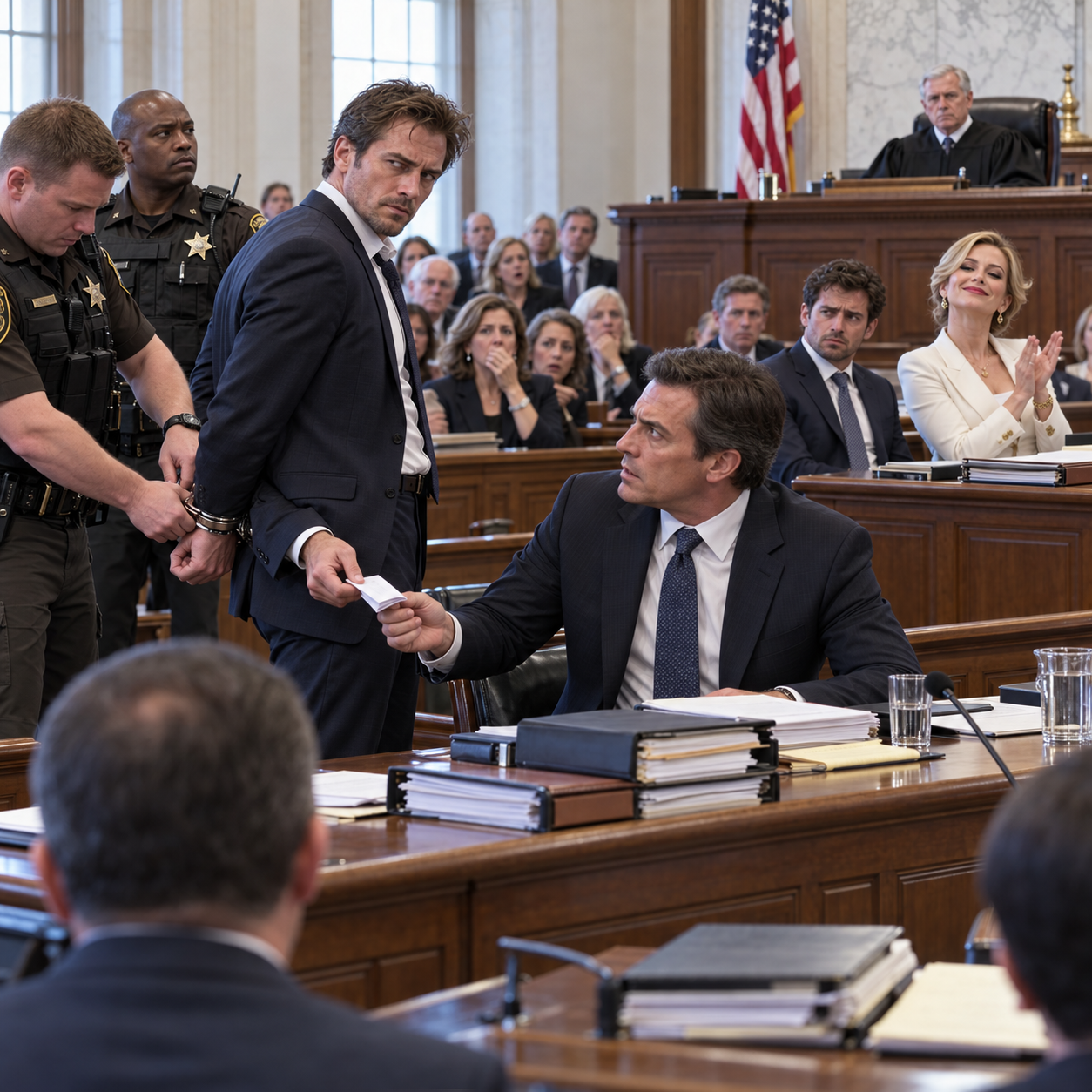
The judge sentenced me to five years for stealing from the company I built. My wife clapped and whispered, “The company is mine now.” As deputies snapped handcuffs on my wrists, I remembered my best friend testifying against me. I could have screamed that the evidence was fabricated. Instead, I quietly slipped my lawyer a note containing one name my wife had never heard: Everett Shaw. She thought she had buried me. She had no idea whom I’d just summoned.
### Part 1: My Wife Celebrates As A False Conviction Destroys My Life
“Finally, you’re out of my life,” my wife said.
Vanessa didn’t whisper. She said it clearly enough for the people behind her to hear, wearing the calm little smile she normally saved for charity dinners and investor photographs. The judge was still speaking about fiduciary responsibility when she gave one soft clap and added, “The company is mine now.” I was standing beside my attorney with my wrists seconds away from being cuffed, yet somehow that smile hurt more than the sentence. Five years. Five years for stealing money from Cole & Mercer Technologies, the company I had built from a freezing garage with my best friend, Caleb Mercer.
I didn’t turn toward Vanessa. I wouldn’t give her the satisfaction. When the deputy ordered me to place my hands behind my back, I obeyed. As my attorney, David Ross, leaned forward to collect his folders, I slipped a damp piece of paper into his palm. He looked at me questioningly, but I shook my head once. “Later.” The note contained only two sentences: “Find Everett Shaw immediately. Tell him his only son has been imprisoned on false charges.” Vanessa believed my father had disappeared before I was born. Almost everyone did. That misunderstanding was the only advantage I had left.
As I was led from the courtroom, cameras flashed behind me and reporters called my name. Vanessa had already transformed herself into the grieving wife of a corrupt husband. By evening she would be promising employees that she would “protect everything we built together.” That phrase would probably make the evening news. The truth was that Vanessa had joined our company years after Caleb and I created it. She was brilliant with numbers, composed under pressure, and frighteningly good at making other people’s decisions feel like her suggestions. I trusted her enough to make her CFO. Then I trusted her enough to marry her.
At intake, they took my belt, my watch, and my wedding ring. The ring made a tiny sound when it landed inside the plastic property tray. That sound followed me long after the steel door closed. Sitting on the edge of a narrow bunk that night, I replayed the evidence that had convicted me. Transfers to fake vendors carried my authorization. Offshore accounts appeared connected to me. Access logs showed activity under my credentials. The fraud had been built over many months, not thrown together after an argument. Whoever framed me understood my routines, my passwords, my travel schedule, and which reports I rarely reviewed because I trusted the executives preparing them.
Vanessa had that access.
So did Caleb.
I hated myself for even thinking his name. Caleb had slept on my couch when we were twenty-six and nearly broke. He had stood beside me at my wedding. When my mother died, he sat in the hospital hallway with me until sunrise because I couldn’t drive home. Some people become so deeply attached to your idea of yourself that suspecting them feels like cutting away part of your own history. I told myself Vanessa had acted alone. It was easier.
A week later, David visited me. The legal visitation room smelled like disinfectant and stale coffee. Vanessa’s face was on the newspaper he carried, beneath a headline describing her as the courageous executive saving the company after her husband’s betrayal. I pushed the newspaper aside.
“Did you find him?”
David studied me. “Everett Shaw is really your father?”
“Yes.”
He leaned back.
Everett wasn’t merely wealthy. His name belonged to the quiet level of power above ordinary wealth—the kind of investor whose phone call could move entire boards before lunch. My mother had deliberately kept me outside his public world. She wanted me to build something without carrying his surname like a key. Everett respected that. After she died, we met privately once or twice a year. Vanessa never knew.
“He’s coming tomorrow,” David said.
Everett entered visitation the next afternoon wearing a plain navy coat. He placed a leather folder on the table and skipped the sentimental reunion.
“Your wife has used at least three financial structures you never knew existed,” he said. “Two domestic entities. One offshore chain. She has moved money before.”
“Before me?”
“Yes.”
My stomach tightened.
He showed me transaction diagrams, shell companies, consulting payments, and irregular transfers stretching back years. He had already hired forensic accountants and former prosecutors. Vanessa had constructed a convincing case against me, Everett explained, so attacking the conviction immediately would alert her before we understood the entire operation.
“Then what do we attack?”
“Nothing yet.”
I stared at him.
Everett folded his hands. “We find out what she wants next.”
“The company.”
“Exactly.”
Vanessa was consolidating control while firing executives still loyal to me. She wasn’t trying to operate Cole & Mercer forever. Everett believed she wanted to package the company, create a bidding war, sell her stake, and disappear wealthy enough to rewrite the entire story.
Before leaving, he looked directly at me. “Don’t perform your anger, Adrian. Use it.”
That evening I received a letter in Vanessa’s handwriting.
“I’m sorry it had to be this way.”
I read the sentence three times.
It wasn’t an apology.
It was ownership.
And suddenly I understood something worse than the conviction itself.
Vanessa hadn’t made one desperate decision.
She had been preparing for my destruction long before I ever walked into that courtroom.
### Part 2: Hidden Evidence Reveals My Wife Had Help From My Best Friend
Prison reduced life to repetition. Buzzers. Count. Concrete. Plastic trays. Doors opening only when somebody else decided they should. I learned quickly that surviving meant building routines before despair built them for you. I worked in the library whenever possible, helped other inmates understand legal forms, and spent every evening reconstructing my own case from memory. The strange thing about losing everything is that eventually you stop wasting energy pretending certain possibilities are impossible.
Everett’s investigation kept growing.
Vanessa created a consulting company under her maiden name almost eighteen months before my arrest. Money traveled through it in amounts small enough to look ordinary. Around the same period, Caleb redesigned our internal authentication system. The changes supposedly strengthened security for expansion, but they also gave him deeper control over audit trails and administrator logs.
David brought me the first real shock during visitation.
“The financial evidence couldn’t have been manufactured by Vanessa alone.”
I already knew what name was coming.
“Caleb?”
“We don’t have proof yet.”
I looked down at the scratched tabletop.
Three days later, he returned carrying an evidence sleeve.
Inside was a photograph of Vanessa laughing beside Caleb outside a restaurant. Her hand rested flat against his chest. His arm curved comfortably behind her waist. There was nothing ambiguous about their closeness.
“When?”
“Two months before your arrest.”
My fingers went numb.
Then trial memories came flooding back. Caleb sitting on the witness stand, explaining that he had trusted me until “the evidence became impossible to ignore.” His lowered eyes. His carefully controlled disappointment. I had mistaken guilt for grief.
“He helped her.”
“It appears that way.”
That night I lay awake listening to pipes knock inside the walls and rebuilt years of memories. Vanessa defending Caleb during budget arguments. Caleb praising her judgment. Late-night meetings that apparently required both of them but somehow never me. Conversations stopping when I entered rooms. Every clue had looked harmless because trust had supplied innocent explanations.
Everett didn’t want them confronted.
He wanted them comfortable.
Through investment vehicles nobody connected to him, he began circling our company as a potential buyer. Then he created a second bidder. Vanessa believed two international groups were competing for Cole & Mercer, exactly the opportunity she needed to cash out at a premium. She encouraged rumors while publicly insisting selling was “the hardest responsible decision” she had ever faced.
Then an anonymous envelope arrived at the prison.
Inside was another photograph.
Vanessa and Caleb were entering my townhouse together.
On the back someone had written, “Check the basement security archive.”
I remembered the camera immediately. Years earlier, after a neighborhood burglary, I installed a small camera facing the wine storage room. Vanessa barely used that basement. Caleb probably never knew the camera existed.
Everett’s investigators recovered the footage.
David visited me forty-eight hours later carrying still photographs and partial transcripts recovered from synchronized home-security records. Vanessa and Caleb appeared in the basement three months before my arrest. The camera itself had no useful audio, but another system captured fragments.
Caleb’s voice: “What if he notices the logs?”
Vanessa answered, “Then we slow it down.”
Later she said, “After the audit flag, he’ll be too busy defending himself to look up.”
I stared at the page until the letters blurred.
They hadn’t simply taken advantage of my arrest.
They had designed it.
Everett instructed us not to expose the evidence yet. Vanessa was days away from signing the company sale. If we moved too early, she could retreat. If we waited, she would voluntarily place herself, Caleb, the transactions, and the buyers inside one legally documented event.
David leaned forward. “There’s another possibility.”
“What?”
“Temporary supervised transport. You’re connected to the disputed company assets. Everett’s legal team believes they can get you into the acquisition meeting under seal.”
I thought I had misheard him.
“You mean inside the boardroom?”
“Yes.”
For the first time since my sentencing, I smiled.
The morning of the sale, officers transported me before sunrise to a secured office. Someone had left a dark suit, white shirt, and polished shoes waiting. After months of prison clothing, I barely recognized myself in the mirror. I looked thinner and harder, but I no longer looked defeated.
Everett met me downstairs.
“She will recognize danger only after she sees your name,” he said.
The boardroom sat high above downtown behind walls of glass. I entered with the acquiring group’s legal team and took a quiet seat halfway down the table.
Vanessa arrived wearing white.
Caleb followed her.
Neither noticed me.
Documents circulated. Lawyers discussed liabilities. Caleb signed technical disclosures. Vanessa initialed page after page, glowing with the restrained excitement of someone trying not to celebrate too early.
Then the final ownership page reached her.
She stopped breathing.
“Adrian Cole?” she whispered.
Caleb leaned closer.
His face drained of color.
I finally spoke.
“You just sold your controlling stake to me.”
Vanessa’s head snapped upward.
“You can’t be here.”
“I am.”
“This is fraud!”
One of Everett’s attorneys calmly replied, “Every required disclosure was legally sufficient.”
I slid another folder across the table. Basement photographs. Shell-company transfers. Authentication records.
Vanessa stared at them.
Caleb didn’t touch anything.
Then the boardroom doors opened.
Two federal agents stepped inside carrying warrants.
And for the first time since Vanessa clapped at my sentencing, she wasn’t smiling.
### Part 3: Their Empire Collapses While The Evidence Finally Clears My Name
Watching federal agents take Vanessa’s phone should have felt like victory.
It didn’t.
My hands were still cuffed again during the return trip because my conviction hadn’t disappeared simply because the people who framed me were suddenly under investigation. I went back to prison while Vanessa went into a legal war and Caleb remained in custody. Justice, I learned, can move forward while still making the innocent person sleep behind bars.
Three days later, David arrived furious.
“Vanessa had a contingency.”
Of course she did.
When investigators seized company systems, an automated packet was released to regulators and journalists. Some documents were genuine. Others had been altered. Together they created enough confusion to damage the company and complicate my appeal.
To separate truth from fabrication, investigators needed the original architecture Caleb had used before creating the manipulated environment.
Everett’s team searched offices and backup systems without finding it.
Then I remembered Caleb’s obsession with physical failsafes.
“Check private storage,” I said.
They found a unit rented under an online alias Caleb had used since college. Inside were archive drives, notebooks, old security hardware, and a sealed box labeled “garage winter,” a reference only Caleb and I would understand from our freezing first office.
The drives contained everything.
Original transaction histories showed that my approvals had been digitally staged. Authentication records revealed spoofed access. Vanessa’s shell-company payments aligned perfectly with Caleb’s system manipulation. Even worse for them, Caleb had stored private messages between himself and Vanessa as insurance in case she betrayed him later.
They had never trusted each other.
One message from Caleb read, “Sometimes I think Adrian knows me too well.”
Vanessa answered, “That’s exactly why this works. People don’t imagine betrayal from those they’ve already forgiven in advance.”
My appeal was reopened immediately.
Then Caleb asked to speak with me.
I accepted.
He appeared on a video screen from county detention, exhausted and unshaven.
“Vanessa’s still lying,” he said.
“That narrows nothing.”
His mouth twitched painfully. “There’s another archive.”
“Where?”
“The garage.”
Our original building had been redeveloped, but an underground storage section survived. Behind an old electrical access panel was a metal lockbox Caleb and I had created years earlier to hold founder backups.
Everett obtained a warrant.
Inside were original source-code records, founder agreements, clean administrator keys, and a forgotten control clause stating that if either founder was removed through manipulated internal records, temporary voting authority could be restored after independent review.
But another item mattered more personally.
A sealed envelope from my mother.
Written across the front were the words, “For Adrian, if love is ever used as leverage.”
Everett opened it with me listening through a secure legal call.
My mother wrote that she had kept my connection to Everett private not because I was something to hide, but because power attracts people who want to rewrite other people’s lives. She warned me never to confuse forgiveness with allowing someone back inside.
Then came the sentence that ended something in me forever:
“Do not reward betrayal with access.”
I stopped wondering whether Vanessa deserved another conversation.
The new evidence forced prosecutors to support an emergency review. My hearing was advanced. This time I entered court wearing a suit instead of prison clothes. Everett sat quietly in the back row.
Vanessa attended too.
The woman who had once looked flawless while I was sentenced now sat under investigation, stripped of her company control and surrounded by attorneys.
The judge reviewed the forensic evidence.
Then he vacated my conviction.
Five years disappeared from my record in less than twenty seconds.
When I walked into the courthouse corridor, reporters rushed toward me.
Before I reached the exit, Vanessa stepped into my path.
“Adrian, please. One minute.”
I stopped.
Her eyes filled with tears. Maybe they were genuine. That no longer mattered.
“There are things you don’t understand,” she said.
I remembered my mother’s letter.
“No.”
Her expression shifted. “After everything, you won’t even hear me?”
“I heard you when you clapped.”
She flinched.
“You destroyed my name, my freedom, and my trust because you thought you were entitled to a better story. You don’t get another minute simply because your version failed.”
I walked past her.
Later, Caleb agreed to cooperate with prosecutors. His testimony exposed one final participant: an early investor named Graham Bell, a powerful board adviser who had encouraged Vanessa’s plan because he wanted control of our company and had discovered my connection to Everett years earlier.
Graham tried one final attack by challenging my restored ownership and using my hidden family history to create uncertainty.
That mistake brought Everett fully into the open.
The documents my mother had prepared years earlier destroyed Graham’s argument.
My name was no longer something anyone could weaponize.
For the first time since my arrest, everything that had been hidden was becoming useful for the right reason.
But I still had one decision left.
Vanessa wanted to see me again.
This time, I agreed.
Not because I missed her.
Because I wanted to end the marriage while looking directly at the person who had destroyed it.
### Part 4: I Refuse Forgiveness And Rebuild The Life They Tried Stealing
Vanessa and I met in a private room at her attorney’s office.
No courtroom cameras. No board members. No audience for either of us.
She wore a plain cream blouse, almost as if simplicity might make her look more sincere. Her wedding ring was gone.
“You look different,” she said.
“Prison does that.”
She lowered her eyes.
“I never meant for things to go that far.”
I almost laughed.
She explained that Graham Bell had pressured her. Caleb had promised the digital evidence would never send me to prison. She had supposedly believed I would receive probation, lose temporary control, and eventually “land somewhere else” because people like me always recovered.
Every explanation reduced my suffering to an unfortunate side effect of her ambition.
Then she said the sentence I had expected.
“I did love you.”
Maybe she believed that.
I leaned forward.
“I believe you loved who you became beside me. I believe you loved the house, the influence, the company, and the way people looked at you. But when keeping those things required destroying me, you didn’t hesitate.”
Tears appeared in her eyes.
“So there’s no forgiveness?”
“Forgiveness isn’t reinstatement.”
She stared at me.
“You don’t get to frame me, take my company, sleep with my best friend, celebrate while I’m sentenced, and then use regret as a hallway back into my life.”
“Adrian—”
“No.”
For once, my voice didn’t shake.
“You made those choices with full adult intelligence. Now live with them.”
Something changed in her face.
Not heartbreak.
Loss of leverage.
We divorced three weeks later.
Vanessa received what the law required and nothing more. I didn’t rescue her financially, protect her public reputation, or negotiate some comfortable future because of the years we had once shared. She faced her criminal and civil cases without me softening the consequences.
Caleb took a plea agreement and lost his position, ownership, and reputation.
Graham’s attempt to challenge company control collapsed in court after Everett’s attorneys produced the original founder documents and my mother’s sealed family records. Regulators later uncovered enough communication between Graham, Vanessa, and Caleb to establish that he had encouraged the scheme long before my arrest.
Cole & Mercer survived.
I renamed it Cole Technologies.
Caleb had surrendered the right to have his name hanging above employees who had nearly lost their livelihoods because of him.
I brought back Melissa Grant, an operations director Vanessa had fired for remaining loyal to me, and made her COO. We rebuilt financial oversight so that no executive, including me, could ever control enough systems alone to repeat what had happened. The old prototype from our garage went back onto my office wall.
I sold the townhouse.
Not because Vanessa had ruined every memory inside it, but because I didn’t want to spend the next ten years arguing with ghosts. I moved into a smaller apartment near the river. Brick walls. Big windows. No history except what I brought with me.
The first item I unpacked was my mother’s old ceramic lamp.
The second was that prototype.
Everett began visiting more often. We never pretended thirty-six complicated years could become a perfect father-son story overnight. But we had dinner. We argued. Sometimes we talked about my mother. Sometimes we sat quietly and watched baseball without trying to repair the past.
That was enough.
Months later, I was grocery shopping on an ordinary Thursday morning when something strange happened.
Nothing.
No guard told me when to move. No attorney called. No reporter recognized me. No board crisis waited on my phone. I stood beneath ugly fluorescent lights holding a basket containing bread, coffee, eggs, and apples.
I suddenly realized I could stay there as long as I wanted.
Freedom wasn’t dramatic.
Freedom was choosing apples without permission.
I laughed quietly to myself.
The company recovered slowly. Employees started joking in meetings again. Revenue stabilized. Customers returned. The headlines stopped mentioning my marriage.
Vanessa eventually became what fame fears most—not hated, but irrelevant.
I never contacted her.
She tried twice through attorneys and once through a mutual acquaintance.
The answer remained no.
Caleb disappeared from my life completely.
Years earlier, I would have wanted them both to understand exactly what they had done. I would have rehearsed speeches, imagined apologies, wondered whether Vanessa cried when nobody watched.
I stopped caring.
That was the final freedom.
One evening I stood alone in my office looking across the city. The same skyline had watched me leave a courtroom in handcuffs while Vanessa smiled.
Now my name was restored.
My company was mine.
My future belonged to nobody else.
On the shelf beside me sat my mother’s letter.
“Do not reward betrayal with access.”
I finally understood what she meant.
People think revenge is watching the person who hurt you suffer.
Sometimes it is simpler than that.
Sometimes revenge is becoming so complete without them that their regret no longer interests you.
Vanessa once told me silence could be cruel.
Maybe she was right.
Because in the end, I got everything back that mattered.
My freedom.
My name.
My company.
My life.
I just didn’t get my marriage back.
That was the one thing I never wanted returned.
I left it exactly where Vanessa had destroyed it.
And I never looked back.
THE END!
Disclaimer: Our stories are inspired by real-life events but are carefully rewritten for entertainment. Any resemblance to actual people or situations is purely coincidental.