“Lots Of People Write Numbers On Their Hands.” The Terminal Sergeant Cut The Seal On My Courier Bag. Sixty Passengers Watched Him Laugh. “It’s A Bag.” Nobody Boarded. His Supervisor Was Already Dialing. I Only Said Four Words. “Sergeant, Don’t Cut That.” “Sergeant, You Just Became Evidence.”
When the staff sergeant cut the orange seal on my classified courier bag, sixty people laughed. I didn’t shout or grab his wrist. I put both hands on the canvas and told him to stop, while the boarding announcement for our flight died halfway through a sentence. Four hours later, everyone blamed me for the delay. I could live with that. But eighteen days afterward, an overlooked report arrived in my inbox, and I learned his box cutter hadn’t been the terminal’s first warning.
Part 1
At 4:31 on a Wednesday morning, Staff Sergeant Blake Rourke picked up my courier bag at the Joint Base Charleston passenger terminal, turned it toward a line of exhausted travelers, and asked, “Anybody want to guess what this lady’s hiding?” I watched his thumb settle against the bright orange security seal. Behind me, someone chuckled, and a young Marine lifted his head from the shoulder of his sleeping friend. I was wearing jeans, a gray cardigan, and reading glasses pushed into my hair, which apparently made me look like someone who had wandered into a military terminal by mistake.
There were approximately sixty people waiting for the Air Mobility Command flight to Ramstein Air Base in Germany. The fluorescent lights flattened everyone’s complexion, and the air smelled of burnt coffee, floor cleaner, and damp canvas. Soldiers leaned against enormous rucksacks while two sailors argued quietly about missing paperwork. A retired couple shared a packet of crackers beside the vending machines, and a television above the gate displayed weather forecasts nobody was watching. I had been awake for twenty-one hours, but the exhaustion disappeared the moment Rourke touched that seal.
My name is Captain Nora Whitcomb, United States Army, and I was thirty-eight years old that morning. I served as a signal officer and communications security custodian with a brigade based at Fort Stewart, Georgia. Most people heard that description and assumed I repaired computers or helped colonels remember their passwords. My actual responsibilities involved protecting communications material that thousands of soldiers relied upon, and on that particular morning, those responsibilities were inside a plain gray canvas bag hanging from my shoulder.
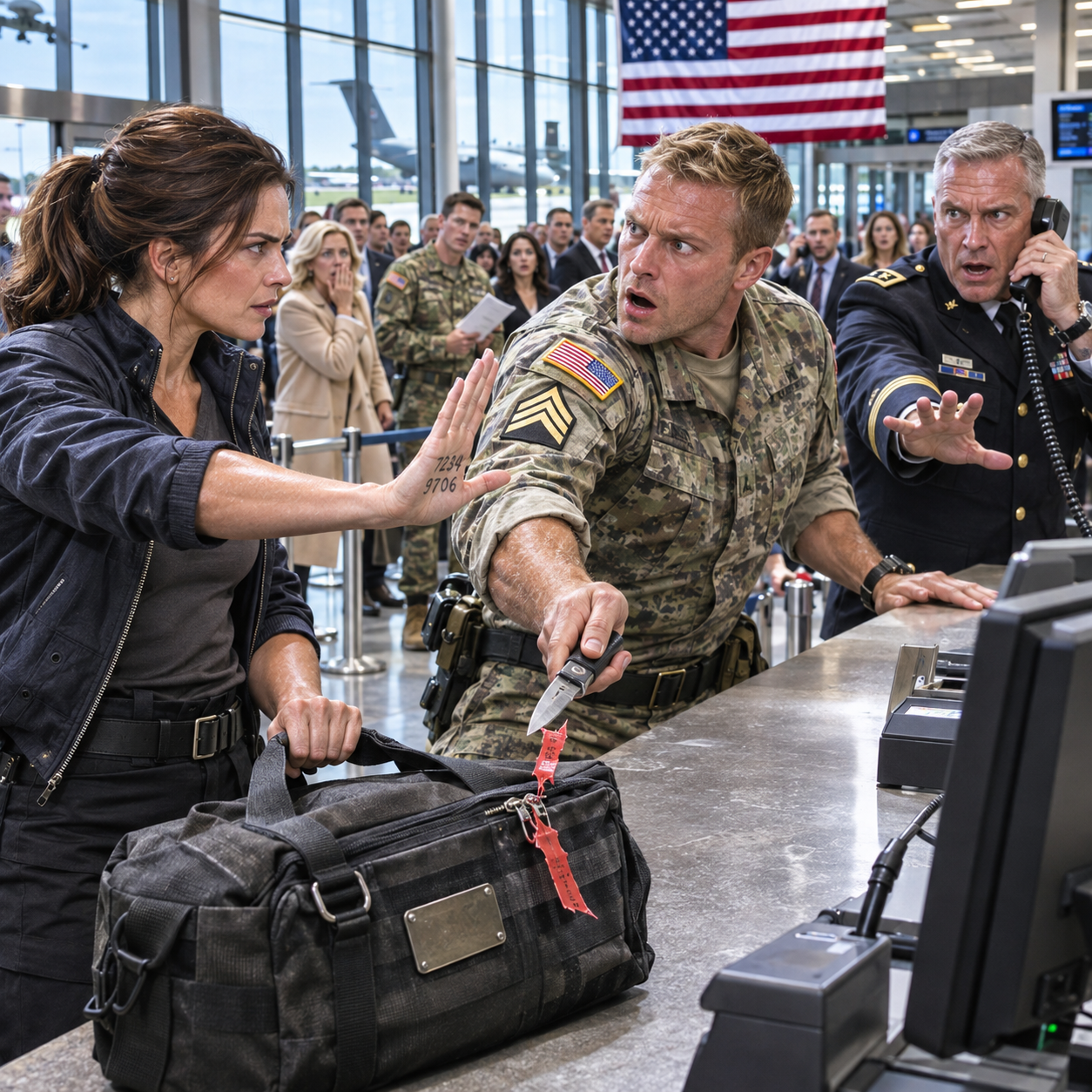
The bag was smaller than an ordinary carry-on suitcase, with a reinforced zipper secured by a numbered orange seal. Its serial number was recorded on three separate documents, and I had copied the nine digits onto the back of my left hand before leaving Georgia. Inside was an independently protected package I had been authorized to transport overseas. I couldn’t discuss what it contained with the passengers, and I certainly couldn’t let a stranger open it simply because he thought my clothing looked insufficiently military.
When my turn came at the counter, I presented my military identification, orders, courier authorization, passport, and an official letter containing the instructions for handling the shipment. Rourke examined everything with the exaggerated seriousness of a man determined to discover a problem. He was about twenty-eight, broad-shouldered, with a perfectly pressed uniform and the kind of confident smile that invited other people to laugh before he finished speaking. He found the authorization paragraph, cleared his throat theatrically, and began reading it aloud.
“Classified material. Authorized courier. Special handling requirements.” He glanced at the waiting passengers, then raised his eyebrows. “Must be nice getting special treatment because somebody gave you a fancy letter.” A few soldiers laughed, and the man immediately behind me muttered that the Army apparently had different rules for everybody. I kept my voice level. “Sergeant, the instructions include a verification number, and your terminal maintains an independent courier reference binder. You’re welcome to confirm my authorization before we proceed.”
Rourke didn’t reach for the phone. Instead, he lifted my bag by its shoulder strap and placed it on the counter between us. I allowed him to move it because struggling over a protected package in a crowded terminal would have created an entirely different problem. He rotated it until the orange seal faced the line. “Look at this,” he announced, holding the plastic strip between his fingers. “Anybody can buy one of these things. You expect us to believe every woman with a zip tie is carrying government secrets?”
“Please don’t tamper with the seal,” I told him. “If you have concerns, contact the duty officer listed in your reference materials.” He looked past me, searching for another laugh, and somebody suggested I was transporting nuclear launch codes. That earned a louder response. Rourke grinned, opened a drawer beneath the counter, and removed a yellow utility knife. I noticed the young airman at the neighboring station stop scanning a duffel bag.
“Sergeant, put the knife down,” I said. My voice was quiet enough that the retired couple near the vending machines probably couldn’t hear me. “You are not authorized to open that package.” Rourke slid the blade forward with his thumb. “Ma’am, I’m responsible for deciding what gets onto this aircraft.” I held his eyes. “You are responsible for following the verification procedure.” His expression changed at that, not into uncertainty but into irritation. He had been enjoying himself until I reminded him that his authority had limits.
The blade passed beneath the orange strip. There was a small plastic snap, almost indistinguishable from the clicking of a ballpoint pen. At 4:36 a.m., the numbered seal fell in two pieces onto the counter. Rourke hooked one finger through the zipper and opened it approximately two inches. I placed both palms firmly against the canvas, preventing the opening from widening. I didn’t grab his hand, threaten him, or raise my voice. I simply made certain that the package remained under my direct control.
“You’re making this unnecessarily difficult,” he said. “I need to finish checking your bag.” I looked at the broken seal, then at the clock above the gate doors. “Sergeant, you have already created a reportable security incident. Please stop touching the package.” His smile widened for the benefit of the audience. “A reportable incident? Over a plastic strip?” I didn’t answer. I had spent years teaching soldiers that the moment a protected shipment’s integrity became questionable, an ordinary inconvenience could become a serious security matter.
The airman beside him was no longer pretending to work. Her name tape read TURNER, and her fingers hovered over a scanner as she stared at the opened zipper. At the rear desk, a master sergeant picked up a telephone and began dialing. She wasn’t smiling. Rourke failed to notice either woman until Airman Turner stepped close enough to speak. “Sergeant, I think you should leave it alone.” He waved her away without looking. “Go back to your station, Turner. I’ve got this.”
She didn’t move. Across the room, the master sergeant spoke urgently into the phone, glancing toward my hands and writing something on a clipboard. The crowd began to quiet, although Rourke continued explaining that he couldn’t possibly allow an unverified civilian to dictate terminal procedures. I could feel my heartbeat in my wrists, pressed flat against the canvas. The package had not left my sight, but the seal was destroyed, and every second now mattered.
At 4:42, the restricted side door opened. Two Security Forces personnel entered with a technical sergeant carrying a tablet. They walked directly toward my counter, ignoring the passengers who shifted aside to make room. Rourke leaned back with an almost triumphant expression, apparently believing someone had finally arrived to remove his troublesome customer. The technical sergeant looked at the broken seal, then at my hands, and addressed me first.
“Captain Whitcomb, I’m Technical Sergeant Elias Venn. Are you maintaining custody of the material?” I nodded. “Continuous visual control and physical contact since the seal was cut at 0436. I have not observed the contents exposed.” Venn studied the opening without touching it. Then he turned toward Rourke. “Staff Sergeant, step away from the counter. Keep your hands visible.”
Rourke’s smile disappeared. “Technical Sergeant, she’s refusing an inspection.” Venn raised his tablet. “Her authorization has already been verified. Step away.” Behind us, the recorded boarding announcement began, broke off halfway through a sentence, and went silent. Security personnel moved toward the gate doors. A heavy mechanical click sounded as the boarding entrance was secured, and for the first time that morning, every person in the terminal seemed to understand that something had gone seriously wrong.
I kept my hands on the gray bag while Rourke stepped backward, his face suddenly drained of color. He had spent five minutes making me look foolish in front of sixty strangers. Now the aircraft was being held, an investigation was beginning, and the one thing I couldn’t tell the crowd was exactly why the consequences might extend thousands of miles beyond Charleston.
Part 2
Technical Sergeant Venn instructed everyone to remain inside the terminal while Security Forces identified witnesses and secured the affected counter. The man directly behind me complained that he had a connection in Germany, while another passenger demanded to know whether we were dealing with a genuine threat. Nobody answered him. Rourke stood beside the rear desk, staring at the broken orange seal as though it might somehow repair itself if he waited long enough. The master sergeant who had made the telephone call introduced herself as Joelle Carden, and she quietly asked me to confirm the exact sequence of events.
I gave her the times without consulting a clock. Authorization presented at 0431, verbal warning repeated at 0435, seal cut at 0436, Security Forces arrival at 0442. She copied everything into her notebook, then asked whether I could identify everyone who had approached the counter. I described Airman Turner, the passengers nearest the ropes, and the man who had been filming with his phone. Carden looked surprised by the precision. I told her that recording small details had become a habit after an incident early in my military career, although I wasn’t interested in explaining it with sixty irritated travelers listening.
The reason I had come to Charleston began the previous evening at Fort Stewart. Colonel Graham Larkin called me into his office shortly after nine, when most of the headquarters building had gone dark. A battalion conducting operations in Poland needed replacement communications security material, and an inventory discrepancy had forced the command to accelerate its normal replacement schedule. Nothing had been conclusively lost, but the existing material could no longer be treated as routine. A military transport flight through Germany offered the quickest approved route, and an authorized courier had to accompany the replacement shipment.
“I know you’re supposed to be off tomorrow,” Larkin said. “I also know you’re the person least likely to improvise when the paperwork gets complicated.” He gave me the option of declining because another qualified officer could eventually be located. I accepted before he finished explaining the inconvenience. There were soldiers preparing for an exercise who needed their communications systems to function, and the responsibility was straightforward. I assembled the shipment with the required documentation, checked the protective packaging, secured the outer bag, and recorded the numbered seal before departing.
I drove through the night with the gray bag strapped into the passenger seat beside me. Somewhere along Interstate 95, rain swept across my windshield so heavily that I slowed to forty miles an hour, listening to the wipers struggle against the glass. At a gas station outside Walterboro, I bought black coffee and a sandwich I never finished. I couldn’t leave the shipment unattended, so I carried it with me while paying. The cashier asked whether I was heading somewhere interesting, and I told her Germany without giving her a reason.
During that drive, I thought about my first classified inventory investigation, seventeen years earlier. I had been a young Army sergeant stationed in Germany when an encrypted radio was reported missing during a unit inventory. Captain Miles Dray, the officer supervising the count, told the investigator that I had recorded the equipment incorrectly. He was charming, popular, and persuasive; I was a junior soldier with a signed worksheet that appeared to contradict my account. My access to the secure communications room was suspended while investigators examined the discrepancy.
For eleven weeks, I worked in a supply annex answering telephones and reviewing manuals. Soldiers who had previously trusted me with equipment began treating me like an embarrassment. What saved my career wasn’t a dramatic confession or a commanding officer’s sudden realization. First Sergeant Lenora Baird asked me to reconstruct the inventory minute by minute, then helped investigators locate access records showing Dray had been somewhere else during part of the count. The missing radio was eventually discovered in another company’s charging cabinet, and I was cleared. Dray received administrative action but never apologized.
Baird told me something afterward that changed how I approached every assignment. “When somebody makes a mistake involving your name, don’t give them the opportunity to replace facts with impressions. Write down the facts before the impressions take over.” Even after I received my commission, I kept that advice. It shaped my courier classes, my inspection reports, and the small notebook I carried on every official trip. It was also why I remembered exactly what Rourke had said before reaching for his knife.
Back in Charleston, Venn arranged a stool behind the secured counter so I could sit without surrendering control of the shipment. Through the windows, I could see ground crews preparing the transport aircraft under floodlights. A man wearing a fleece jacket approached the security cordon and demanded the wing commander’s contact information. The retired passenger in a navy windbreaker stood nearby, saying nothing. When our eyes met, he gave me a brief nod, and I had the strange impression that he understood more about the situation than anybody complaining around him.
At 5:15, the civilian terminal manager arrived carrying a paper cup of coffee. He introduced himself as Martin Greaves and apologized for the disruption before asking whether an authorized employee could replace the broken seal and let the flight depart. His concern was understandable: aircrews had duty-hour limits, passengers had connections, and several units were expecting personnel overseas. But his suggested solution would have concealed the original breach without establishing whether the protected material remained trustworthy. “I can’t authorize that,” I told him. “The incident has to be evaluated and documented before anyone decides the shipment’s status.”
Greaves rubbed his forehead and asked how long that would take. I told him the answer depended on the investigators. He glanced toward Rourke, then toward the passengers who had begun photographing the security cordon. Something in his expression changed when he noticed the cameras. Instead of asking another question, he turned toward Carden and said, “Make sure the incident report doesn’t leave anything out.” She answered that she had already started writing it. I didn’t appreciate the significance of their exchange until much later.
At 5:30, Venn helped me use my phone to contact Colonel Larkin without releasing the bag. I described the incident, confirmed that the shipment remained under my control, and explained that its usability would depend on the security assessment. Larkin listened without interruption. Then he said the battalion in Poland would probably miss its planned exercise if replacement material had to be prepared. I knew what that meant: people working overnight to produce another authorized shipment, a new courier traveling overseas, and commanders explaining an avoidable delay.
There was a long silence before he spoke again. “Nora, I need you to answer something directly. Was there anything you could have done differently?” Seventeen years vanished, and I was sitting at a folding table in a German supply annex, watching another officer’s inaccurate account threaten my career. I looked at the orange seal lying on the counter. “Sir, I followed the instructions, warned him twice, and maintained custody after he cut it. The surveillance footage should confirm that.” Larkin exhaled. “Then we’ll deal with the consequences. But I want every detail preserved.”
When the call ended, Carden approached with an additional witness statement. Airman Turner had reported that Rourke had previously argued with her about courier verification procedures, although she had never seen him cut a seal before. Carden lowered her voice. “She’s worried she’ll get blamed for speaking up.” I looked across the room at the young airman, who was standing alone beside the abandoned counter. “Tell her she did exactly what she was supposed to do,” I said. Carden folded the statement, but I noticed she didn’t look relieved.
Part 3
Special Agent Simon Duvall arrived shortly before six wearing a dark jacket and carrying a battered leather portfolio. He was assigned to the Air Force Office of Special Investigations, and his manner suggested that he had already dealt with enough emergencies to recognize the difference between an actual catastrophe and a serious incident that still required patience. He introduced himself, verified my identification, and requested the terminal’s independently maintained courier reference binder. Rather than accepting the contact information printed on my own authorization letter, he compared it against the official records maintained behind the counter.
Everything matched. Duvall reviewed the documents with Venn, then examined photographs of the broken seal and the available surveillance footage. He asked whether I had seen Rourke touch the inner protective package. I told him I hadn’t. He asked whether Rourke might have read any markings inside the outer bag. I explained the angle of the zipper opening, the position of my hands, and the orientation of the inner wrapper. I was careful to distinguish what I had personally observed from what I could reasonably conclude. “The opening was approximately two inches,” I said. “I saw no indication that the contents were exposed.”
Duvall tapped his pen against the notebook. “You understand I can’t clear the shipment based solely on your statement.” I nodded. “I wouldn’t expect you to.” That answer seemed to satisfy him. He explained that the shipment would remain under controlled custody until the necessary assessment was completed, and that the operational command would determine how to replace anything that could no longer be accepted for use. I had completed more than two hundred courier assignments without an unsuccessful delivery. Now I was facing the first mission in my career that might end with the package returning to its starting point.
At 6:20, Duvall asked me to accompany him to a small administrative room behind the passenger counter. Because custody of the shipment couldn’t simply be transferred without proper arrangements, Venn coordinated the movement and remained nearby. Rourke was already seated inside, staring at a poster about workplace safety. His uniform was still immaculate, but his shoulders had rounded and his eyes were bloodshot. He looked at my bag before looking at me, and his gaze stopped on the replacement evidence tag attached to the outside.
Duvall explained Rourke’s rights and established whether he understood the incident being investigated. Rourke initially insisted he had been trying to prevent an unauthorized passenger from bringing suspicious material aboard a military aircraft. Duvall asked why he hadn’t used the documented verification procedure. “I thought she was pretending,” Rourke said. “She wasn’t in uniform, and she kept telling me what I could and couldn’t do.” Duvall placed a photograph from the overhead camera on the desk. It showed Rourke holding my authorization letter up toward the passenger line while the orange seal was still intact.
“She provided identification, written orders, and a contact number,” Duvall said. “You had the opportunity to verify those documents without opening anything. Why did you choose the knife?” Rourke opened his mouth, then closed it. After several seconds, he admitted that he had wanted to prove he could recognize a false courier. He had assumed I was exaggerating my authority and that making me open the bag would end the argument. What he hadn’t considered was that being wrong would carry consequences for people who weren’t standing in that terminal.
Duvall told him about the battalion in Poland and the possibility that its planned training would be delayed. Rourke stared at the floor. “All because I cut that seal?” he asked. “Because you ignored a required procedure,” Duvall replied. “The seal is the evidence of what happened.” Rourke turned toward me, searching my expression for some indication that the investigators were exaggerating. I didn’t offer him one. His mistake was real, and I wasn’t going to diminish it to make him feel better.
Then Duvall showed him my preliminary statement. Rourke read the account of his behavior in silence, including his remarks to the passengers and both warnings I had given him. When he reached the sentence confirming that I had not observed the protected contents exposed, he stopped. He looked at me with an expression I couldn’t immediately identify. “You told them I didn’t see inside,” he said. “I told them what I saw,” I answered. “Those are different things.” Duvall took the statement back and reminded him that an accurate account did not excuse his unauthorized actions.
Rourke didn’t apologize. He seemed more frightened than remorseful, and I wasn’t interested in helping him sort out those feelings. I knew what it was like to have an inaccurate accusation become the version everyone remembered. Captain Dray had allowed investigators to believe I had mishandled equipment because admitting his own carelessness would have embarrassed him. I wasn’t going to repeat that behavior simply because I had a stronger case and sixty witnesses who had seen Rourke humiliate me.
By 8:40, investigators had collected passenger information and authorized boarding to resume. People filed past the cordon with faces ranging from exhausted resignation to open resentment. The man in the fleece jacket shook his head as he passed my stool. “Nearly four hours because of one bag,” he muttered. I wanted to explain that the delay began with a staff sergeant choosing a utility knife over a telephone call. Instead, I remained silent, because the passengers weren’t entitled to the details of the shipment or the investigation.
The retired man in the navy windbreaker approached near the end of the line. His name was Warren Keene, and he introduced himself as a retired Air Force master sergeant. He had served thirty years, including several assignments involving protected shipments. “I saw what happened,” he said quietly. “You gave that young man every opportunity to do it correctly.” He handed me a card with his telephone number and offered to provide a statement if investigators needed one. I thanked him, and he glanced toward Rourke’s empty station before walking to the aircraft.
At 9:50, I watched the transport plane depart without me. Its engines rose above the terminal, and the aircraft climbed into a gray coastal sky while I sat beside a bag that had become the center of an official investigation. Later that afternoon, I returned to Fort Stewart with the shipment under the required safeguards, rather than delivering it overseas. The receiving battalion would need a replacement, and everyone involved would have to explain why the original mission had failed.
That night, I opened the notebook where I recorded completed courier trips. For the first time, I wrote a delivery status that made my hand hesitate: “Returned to originating command. Transfer not completed.” Beneath it, I listed the date, times, and responsible offices, then closed the cover. I expected an investigation into one sergeant’s decision, perhaps disciplinary action, and eventually another routine assignment. I had no reason yet to suspect that the same terminal had received an earlier warning about precisely the kind of behavior I’d witnessed.
Part 4
The following Monday, Colonel Larkin called me into his office with the preliminary findings from Charleston. The investigators had confirmed that Rourke knowingly disregarded the published verification process and opened the sealed outer bag despite repeated warnings. They also confirmed that the protected contents had not been visibly exposed. That distinction would matter when determining the scope of the security incident, but it didn’t restore the original delivery schedule. The battalion in Poland had already revised its training plans, and a replacement shipment was being prepared.
I had expected Larkin to ask whether I was embarrassed, angry, or disappointed. Instead, he placed a list of missed training objectives between us and asked me to review the operational consequences. Four days of planned activity would be lost, along with transportation arrangements, personnel hours, and coordination with allied units. Soldiers who had spent weeks preparing would have to rearrange their schedules. “None of this is yours to absorb personally,” he said when he saw my expression. “But I want you to understand the full cost because you’ll be helping us prevent it from happening again.”
I studied the list for several minutes. The soldiers affected were strangers to me, yet I could picture them waiting beside their vehicles in Poland, wondering why an essential shipment hadn’t arrived. I knew somebody would eventually explain the delay as a transportation problem without mentioning the exhausted woman in a cardigan or the utility knife at a passenger counter. That anonymity was part of the job. What bothered me wasn’t that I wouldn’t receive credit for protecting the shipment, but that one person’s need to demonstrate authority had disrupted the work of hundreds of others.
The replacement package traveled through Germany the following Wednesday with another authorized officer, and the battalion began its exercise four days later than planned. There was no catastrophic security failure, no dramatic rescue, and no secret ceremony recognizing my actions. I returned to regular duties, checked communications inventories, and answered the same repetitive questions about equipment receipts that had occupied my mornings before Charleston. Occasionally, a colleague would ask about the terminal incident. I gave the official version and declined to discuss anything beyond it.
Eleven days after the incident, Master Sergeant Carden called from Charleston. Rourke had been removed from the passenger counter pending disciplinary proceedings, and the command was reviewing its verification practices. She sounded tired when she told me Airman Turner had been interviewed three times. “She thinks she should have stopped him sooner,” Carden said. I remembered Turner standing beside Rourke, asking him to leave the bag alone despite being outranked. “Tell her I wasn’t the only person there with a responsibility,” I answered. “She spoke up. He chose not to listen.”
Carden hesitated before responding. “There’s something else being reviewed, Captain. I can’t discuss it until the paperwork is cleared, but I think you’ll recognize it.” She wouldn’t elaborate, and I didn’t press. The next week, I traveled to another installation to conduct a communications security inspection. I spent two days examining authorization records, equipment logs, and training certifications, and by Thursday evening, the Charleston incident had become another unfinished administrative matter waiting somewhere in my email.
On the eighteenth day after the incident, an official after-action packet arrived through my command. Most of it was familiar: timelines, witness statements, surveillance summaries, and recommendations for improving passenger terminal procedures. Buried among the attachments was a redacted copy of an earlier supervisory report. It had been submitted nearly three months before my flight by Airman First Class Brielle Turner. The subject line read, “Concern Regarding Courier Verification and Unauthorized Inspection Practices.”
I opened the attachment and read it twice. Turner had described an encounter in which Rourke challenged a passenger presenting specialized courier documentation and threatened to open a sealed package before another employee intervened. The earlier passenger’s authorization had ultimately been verified, and no seal had been broken. Turner had recommended refresher training and confirmation that employees understood the difference between checking a courier’s identity and physically inspecting protected material. Her concern had been recorded, reviewed by a shift supervisor, and closed without formal corrective training.
The closing comment was only two sentences long. It characterized the confrontation as an interpersonal disagreement and recommended better customer communication. No one had addressed the central issue Turner had raised: a staff sergeant believed his judgment entitled him to override written handling restrictions. An accompanying management review noted that terminal leadership had been emphasizing passenger-processing speed and informal resolution of counter disputes. The earlier complaint had been treated as a service problem instead of a procedural warning.
I stared at the document until the words began to blur. Rourke had made his own decision to cut my seal, and nothing in the report excused him. But the system had given him an opportunity to learn from a smaller mistake, then failed to insist that he take it. When Turner raised a concern, someone minimized it because the earlier incident hadn’t caused an operational delay. When I raised the same concern, Rourke laughed because he had never been required to take the warning seriously. It took a grounded aircraft and a compromised shipment to force everyone to examine what she had written months earlier.
I forwarded my observations to Larkin with a request that the terminal’s corrective-action review address the handling of previous employee reports. I wasn’t asking for an additional punishment or trying to turn a disciplinary matter into a public scandal. I wanted assurance that the next junior airman who questioned an improper procedure wouldn’t be dismissed for being inexperienced. Larkin agreed to raise the issue through the appropriate command channels, and the subsequent review recommended changes to supervisory training, escalation requirements, and the documentation of unresolved security concerns.
Several days later, Special Agent Duvall called with the final disposition of Rourke’s individual case. His commander had imposed nonjudicial punishment, including reduction from staff sergeant to senior airman, forfeiture of pay, and additional duties. He would not return to his previous public-facing assignment without completing further training and command review. Duvall also confirmed that the evidence supported my account of the contents remaining protected from observation. Rourke had not contested the principal findings.
Then Duvall told me something I hadn’t expected. When asked whether he wanted to submit a statement on his own behalf, Rourke had written that Airman Turner had warned him before he cut the seal and that he alone had chosen to disregard her. He had also acknowledged that his earlier conduct had contributed to the concerns she raised. It didn’t erase his behavior, but it prevented her from being made responsible for his decision. I told Duvall I was glad that distinction would remain in the official record.
That evening, I received an email from Carden inviting me to return to Charleston and teach a training session for passenger service personnel. The class would include the same airman who had tried to stop the incident and the former staff sergeant who had caused it. For several minutes, I considered refusing. My duties were demanding, and I had no desire to spend another morning in that terminal explaining a rule that should never have been controversial. Then I remembered Turner’s unanswered report and realized this was an opportunity to ensure someone finally listened.
Part 5
I returned to Charleston on a Friday morning wearing my Army service uniform instead of the gray cardigan. The terminal looked almost exactly as it had during the incident: polished floors, enormous windows overlooking the aircraft ramp, rows of plastic chairs, and the same vending machines dispensing terrible coffee. But I wasn’t heading toward the passenger counter. Master Sergeant Carden met me near the entrance and escorted me upstairs to a training room where twelve airmen were waiting around a long conference table.
Airman Turner sat near the far end, a notebook open in front of her. She straightened when I entered, and I gave her a small smile. At the front of the room sat Blake Rourke, now wearing the rank insignia of a senior airman. He rose immediately, and the others followed a moment later. I instructed everyone to sit. His face was thinner than I remembered, and he avoided looking directly at me while Carden introduced the session. I had brought sample documentation, a training bag, and a replica security seal with an unmistakable training label.
For the first twenty minutes, I explained the difference between verifying a courier’s authority and inspecting protected material. We discussed identification, independent confirmation, handling restrictions, and the importance of contacting qualified personnel when a discrepancy couldn’t be resolved at the counter. I didn’t mention Rourke by name or describe the incident as a cautionary tale about arrogance. Everyone in the room already knew what had happened. My goal was to make sure they understood what to do when faced with a difficult decision, even if the passenger standing in front of them looked entirely ordinary.
I placed the training bag in the center of the table and asked a young airman to approach as though he were processing a passenger. He examined the sample authorization and questioned whether the person presenting it was legitimate. I asked him what he would do next. “Verify the information against our independent records, ma’am,” he answered. “And if the numbers don’t match?” He considered that for a moment. “Stop processing the passenger and contact the appropriate security personnel.” I nodded. “Correct. You don’t have to decide whether the person is lying. You have to follow the procedure that establishes whether the authorization is valid.”
A second airman asked what happened if a passenger became angry and demanded immediate boarding. I told him that urgency didn’t eliminate the requirement to verify. Turner raised her hand and asked what junior personnel should do when someone senior ordered them to ignore a handling restriction. The room became noticeably quiet. I looked at her directly. “You identify the concern, refuse to participate in an action you know is unauthorized, and elevate it through the appropriate channels,” I said. “Rank doesn’t make an incorrect procedure correct. And if you raise a concern in good faith, the command has a responsibility to take it seriously.”
Carden, standing near the whiteboard, added that the terminal had implemented a new process for tracking those concerns until a supervisor documented their resolution. The original report Turner submitted would now be used as an example during supervisory training, with identifying details removed where appropriate. I saw Turner lower her eyes to her notebook. Her expression wasn’t triumphant. She seemed relieved that something she had written months earlier was finally being treated as important.
For the final exercise, I placed the training bag on the table and asked what they should do if they believed the courier’s documentation was false. Several airmen answered together: stop, verify, and escalate. I wrote a sentence on the whiteboard beneath their responses: “Uncertainty requires verification, not improvisation.” Then I ended the session. There was no applause, which suited me perfectly. The airmen gathered their notebooks, asked a few practical questions, and began filing toward the door. Turner stayed long enough to thank me before Carden walked her downstairs.
Rourke remained seated until the room was almost empty. Finally, he approached the front table with a small green notebook in his hands. “Captain, could I ask you something?” I finished arranging the training documents and told him to go ahead. “My commander showed me your statement. I know you could’ve said I saw the contents. Nobody would’ve questioned you after what I did.” I studied his expression. He wasn’t smiling, and there was no audience for him to impress. “But it wouldn’t have been true,” I said.
He looked down at the notebook. “I made you look ridiculous in front of everyone. I knew you were angry.” I acknowledged that I had been. He swallowed and continued. “I thought if I embarrassed you enough, you’d open the bag just to prove me wrong. I didn’t think about the people who might be depending on what you were carrying.” For a moment, I remembered the young sergeant I had been in Germany, sitting alone in a supply annex because another soldier preferred a convenient explanation over an accurate one.
“Years ago, an officer allowed an investigator to believe something about me that wasn’t true,” I told him. “It took months to repair the official record, and much longer to stop people from repeating the accusation. I learned what happens when someone decides the outcome matters more than the facts.” Rourke listened without interrupting. “I wasn’t protecting you when I wrote that statement. I was protecting the truth. You made a serious mistake, and you deserved to face the consequences of the mistake you actually made.”
“I’m sorry, Captain,” he said. “For cutting the seal, for laughing at you, and for ignoring Turner when she tried to stop me.” I believed that he understood more than he had before the incident. But understanding wasn’t the same as forgiveness, and an apology didn’t entitle him to relief from the damage he had caused. “I hear your apology,” I answered. “What matters now is whether you follow the procedure when there’s nobody watching and nobody important standing nearby.” He nodded, then stepped aside so I could leave.
Downstairs, I found Warren Keene waiting near the terminal entrance. Carden had invited him to attend part of the training after he submitted a formal witness statement, and he had driven over from his home outside Charleston. He was wearing the same navy windbreaker, although this time he carried a travel mug instead of a suitcase. We walked toward the parking lot together, passing the counter where the orange seal had been cut. “Think they’ll learn something?” he asked. I told him I hoped so, then explained that the earlier ignored complaint had finally prompted broader changes.
Keene shook his head. “Thirty years in uniform, and I learned that the worst mistakes rarely start with somebody planning to do something terrible. They start when somebody decides a small rule doesn’t matter.” He stopped beside my car and looked toward the aircraft on the distant ramp. “Most of those passengers will never know what really happened that morning.” I told him that was fine. They had been inconvenienced, and they were entitled to be frustrated. They weren’t entitled to classified information merely because they wanted an explanation.
Before leaving, Keene offered his hand. “For what it’s worth, Captain, I was glad somebody remembered what the job required.” I shook it and thanked him for speaking up during the investigation. He smiled, walked toward his truck, and disappeared behind a row of government vehicles. I stood beside my car for another minute, looking through the windshield at the empty passenger seat where the gray courier bag had rested during my overnight drive.
A month later, Carden sent me the final corrective-action summary. All passenger service personnel had completed the revised training, supervisory review procedures had been updated, and the terminal had established clearer reporting channels for employees who identified handling concerns. Turner had received formal recognition for her willingness to raise the issue, both before and during the incident. Rourke continued serving in a different assignment under his command’s supervision. None of those outcomes erased the four lost training days, but they meant the consequences had produced something more useful than an apology.
I printed the summary and placed it in the same folder as my original incident report. Then I wrote a letter to retired First Sergeant Lenora Baird, thanking her for what she had taught me seventeen years earlier. I told her that I had finally encountered a situation in which remembering every minute mattered not only for defending myself but for protecting the accuracy of someone else’s case. Two weeks later, a small card arrived in the mail. Inside, in the same square handwriting I remembered from Germany, she had written, “You did the work. That’s what counts.”
I never contacted Rourke again. I didn’t need another apology, and I didn’t feel obligated to become part of his redemption story. Whether he became a better airman would be determined by the decisions he made long after our encounter, not by anything I said to make him feel forgiven. My responsibility had been to protect the shipment, document the incident, and ensure the truth survived the investigation. I had done those things, even when telling the complete truth meant including facts that benefited the man who had humiliated me.
Eventually, I resumed courier duties. There were more early departures, uncomfortable seats, delayed flights, and ordinary conversations with strangers who had no idea what I was carrying. I continued wearing civilian clothes whenever the assignment permitted, continued checking every document, and continued recording every number. I never carried another shipment through Charleston without thinking of that orange seal, but the memory stopped making me angry. It became a reminder of how quickly professional responsibility could be tested by someone who mistook confidence for competence.
The passengers on that morning flight probably remembered a woman whose bag delayed their trip to Germany. The soldiers in Poland remembered an exercise that started four days late. Rourke remembered the punishment that followed a decision he could never undo. And somewhere in Charleston, a young airman who had once been ignored finally knew her warning had mattered.
As for me, I remembered the small click of a severed plastic seal, the weight of my hands against the canvas, and the moment I understood that proving someone wrong was less important than preventing their mistake from becoming something worse.
I had spent years believing that the truth would always speak for itself. That morning taught me something more practical: the truth needed someone willing to preserve it, especially when silence would be easier and revenge would feel better.
I closed my notebook, secured the next courier package, and went back to work.
THE END!
Disclaimer: Our stories are inspired by real-life events but are carefully rewritten for entertainment. Any resemblance to actual people or situations is purely coincidental.