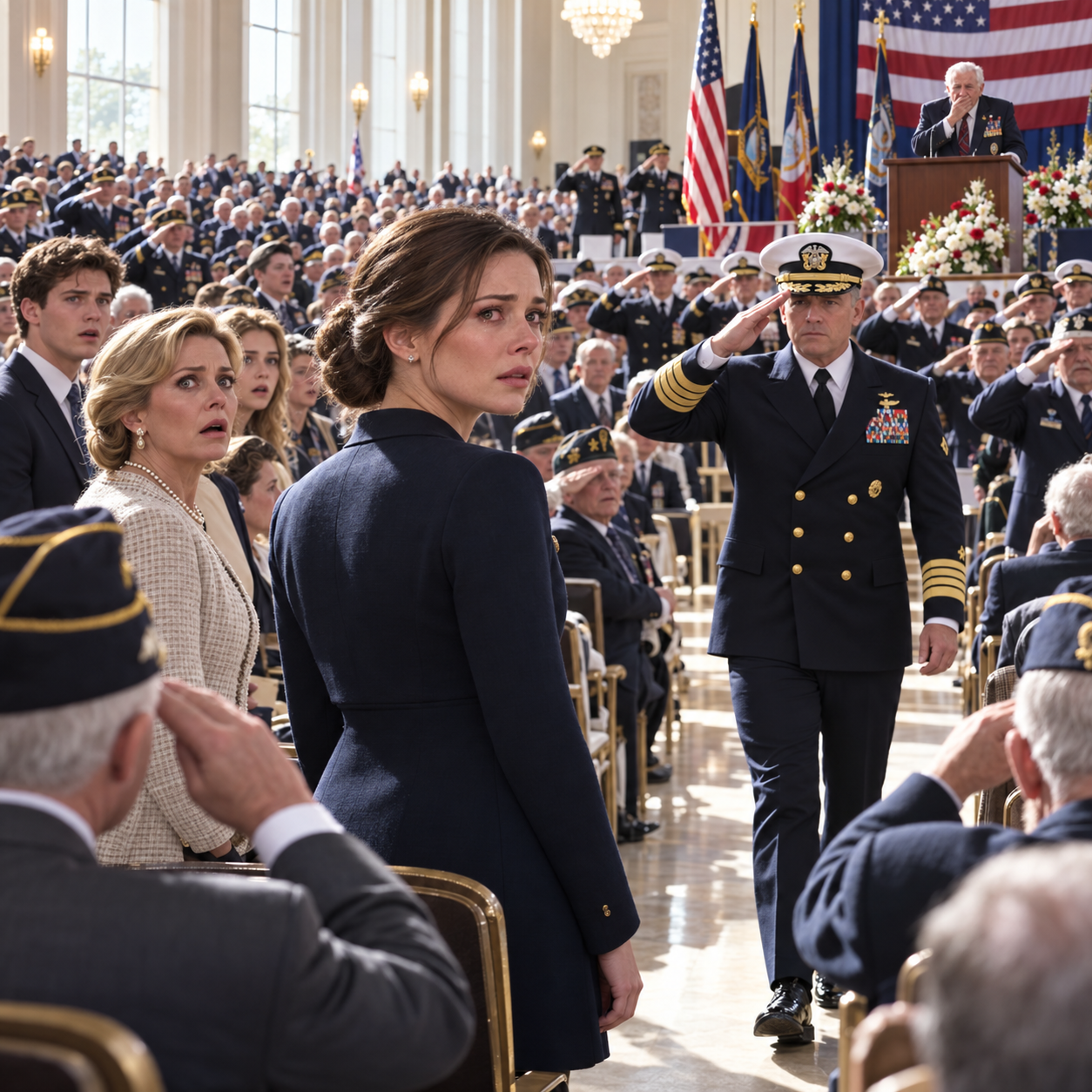
I Came Home For My Grandfather’s Veterans Ceremony Only To Hear The Rumors. “She Already Left The Service.” My Stepmother Sneered, “She Couldn’t Hack It.” I Said Nothing. Didn’t Explain. Then A Vice Admiral Bypassed The Entire Stage, Walked Straight To Me, And Saluted. “Rear Admiral Brenner, I Didn’t Expect To See You Here.” The Whole Hall—Over 150 Veterans—Rose And Saluted At Once. My Grandfather’s Voice Broke At The Podium.
My stepmother told our entire town I’d failed the Navy, and my grandfather let her say it at his veterans’ tribute. She handed me a stack of programs while people whispered about my disgrace. I passed them out without correcting anyone. Then a vice admiral crossed the hall, stopped in front of me, and called me Rear Admiral. Three days later, a former volunteer sent me an old grant application. Someone had signed my name to a story I’d never told.
Part 1
The first thing I noticed when I crossed the Tennessee state line was that my hands had tightened around the steering wheel. I had commanded people through emergencies, delivered briefings to rooms full of officers who outranked me, and made decisions that would be reviewed by people whose names appeared in newspapers. Yet the prospect of spending one weekend in Bellford, Tennessee, still made my shoulders ache. I loosened my grip, turned down the radio, and reminded myself that I was coming home for one person. Captain Samuel Vance, United States Navy, retired, had asked his granddaughter to attend a ceremony honoring his thirty-two years of service, and I had never learned how to say no to him.
Grandpa Sam was seventy-eight, stubborn enough to refuse a hearing aid, and still capable of identifying a poorly tied necktie from across a church sanctuary. Two weeks earlier, he had called my office and said, “Mara, the Veterans Council is putting together something at the old lodge. They want to recognize my service, and I’d like you there.” He hadn’t mentioned my career, asked why I visited less frequently, or complained about the Christmas I had missed. That was his way of opening a door without admitting it had been closed. I checked my calendar, rearranged two meetings, and told him I would come.
I stopped at a diner four miles outside Bellford because I needed coffee and a little time before walking into the house. The waitress recognized me before I recognized her, setting down my mug with the careful expression people wear when they think they know something unfortunate about you. “You’re Sam Vance’s granddaughter, aren’t you?” she asked, and when I nodded, she smiled sympathetically. “Your grandfather’s a good man. Whatever happened with the service, honey, there’s plenty of life after it.” I had been on active duty for more than twenty years, but I thanked her for the coffee anyway. Arguing with a stranger who was repeating someone else’s story would only make me late.
The house on Oakridge Lane looked almost exactly as it had during my childhood, with white clapboard siding, green shutters, and an American flag hanging from a pole beside the porch. My grandmother’s rosebushes still bordered the front walk, though someone had trimmed them too aggressively, leaving crooked branches beneath the October blossoms. My grandmother, June, had died six years earlier, and my father had followed two years after that, leaving a silence in the family that nobody had handled particularly well. My stepmother, Diane, had moved into the guest suite after Dad’s funeral, ostensibly to help Grandpa with bills, appointments, and maintaining the house. What began as a temporary arrangement had become permanent without anyone remembering when the decision was made.
Diane opened the door wearing a fitted navy blazer, pearl earrings, and the same polished smile she had worn at my father’s funeral. “Well, look who’s finally remembered where she came from,” she said, stepping aside just enough for me to enter. She looked at my jeans, black sweater, and overnight bag before adding, “Please tell me you brought something more appropriate for tonight. The mayor will be there, and people from the state Veterans Commission are coming.” I told her I had clothes in the car, and she gave a small, satisfied nod. “Good. Your grandfather has worked very hard to make this evening respectable, and I don’t want anything distracting from that.”
Grandpa was at the dining-room table, examining a seating chart with a man from the local Veterans Council. He stood when he saw me, and for a moment his weathered face softened into the expression I remembered from childhood, when he would meet me at the airport after months overseas with my parents. “There’s my girl,” he said, wrapping his arms around me before I could say anything. His shirt smelled of clean cotton and the cedar soap he had used for as long as I could remember. I hugged him harder than I intended, and he patted my back twice, embarrassed by how much the embrace meant to both of us.
Diane appeared with a pitcher of iced tea and immediately began talking about seating arrangements, missing centerpieces, and the councilwoman who had requested a place near the stage. She asked me to take some dishes into the kitchen, then suggested I might help assemble the welcome packets because the volunteers were running behind. Grandpa glanced at her, then at me, and returned to the seating chart without speaking. It was such a familiar exchange that I knew my role before she finished assigning it: Diane occupied the room where decisions were made, Grandpa avoided unnecessary confrontation, and I became useful somewhere out of sight.
I had known Diane since I was sixteen, when my father married her after a divorce that had left both my parents exhausted and angry. She had never been openly cruel when there were witnesses, and that was part of what made her effective. A missed school award became an unfortunate scheduling conflict; an insult about my appearance became motherly concern; a private accusation became a vague observation she was only sharing because she worried about me. When I entered the Naval Academy, she told relatives I had been lucky to receive the appointment, and when I graduated, she wondered aloud whether I could survive a career that required so much discipline. Eventually, I stopped defending myself because every explanation gave her another detail to rearrange.
At forty-six, I should have been far beyond allowing her opinions to determine whether I felt welcome in a house. My responsibilities now involved joint operations planning, coordination across military branches, and information that could not be discussed casually over Thanksgiving dinner. But my rank was not classified, and my family could have known more about my promotions if I had trusted them enough to share the news directly. I had once believed that protecting my peace meant limiting access to my life; over time, I had also let that distance spare me conversations I didn’t want to have. Diane had been quick to fill the empty space with her own explanations.
While I was rinsing glasses at the kitchen sink, she came in carrying a silver serving tray and began inspecting it for fingerprints. “Your grandfather tells people you’re still doing something in Washington,” she said, not looking at me. I answered that I was, and she gave a little hum before continuing, “I thought you had requested to be released from your commission after that reassignment three years ago. It’s nothing to be ashamed of, Mara. Not everyone is suited to the kind of responsibility they imagined they’d have.” I turned off the faucet and asked who had told her I had left the Navy, but she simply wiped the tray again. “People talk. I’m only trying to keep you from putting your grandfather in an uncomfortable position tonight.”
I dried my hands slowly because I knew she was waiting for me to become angry. “I’m attending his ceremony,” I said. “I’m not planning to discuss my career unless somebody asks me about it.” Diane’s face relaxed, and she reached across the counter to straighten a dish towel that wasn’t crooked. “That’s all I wanted to hear. He’s getting older, and he doesn’t need another disappointment.” She left before I could answer, carrying the tray like something expensive that required protection from careless hands.
I found Grandpa on the back porch a few minutes later, sitting in my grandmother’s old wooden chair with his reading glasses perched halfway down his nose. He asked whether the drive had been difficult, and we spent several minutes discussing road construction, the weather, and a neighbor whose ancient Labrador had recently died. Then he looked at my left hand, where I had removed a ring that sometimes caught against equipment during work, and asked whether I was seeing anyone. I laughed and said no, and he nodded as though this were neither good nor bad news. It struck me how little of my actual life he knew, and how much of what he thought he knew had passed through Diane first.
Before we left for the ceremony, Diane brought him a folder of documents and asked him to sign three pages. I noticed the heading on the first sheet: SECOND HARBOR VETERANS PROJECT, followed by a photograph of an old brick duplex that had belonged to my grandmother’s family. Grandpa signed without reading beyond the first paragraph, and Diane caught me looking before smoothly sliding the papers back into the folder. “Just some paperwork for the tribute,” she explained, although I hadn’t asked. I remembered Grandma once saying she wanted the duplex renovated into temporary housing for veterans who needed somewhere safe to begin again, but I had never heard that the project had actually moved forward.
As Diane disappeared into the dining room, Grandpa tucked his pen into his pocket and rose carefully from the chair. “Your grandmother would have liked tonight,” he said, watching the flag move in the afternoon breeze. I told him I thought so too, and he smiled with the quiet satisfaction of someone who had chosen to believe a difficult subject was settled. I followed him inside, but my attention returned briefly to the folder beneath Diane’s arm. At the bottom of its front page, just before she had closed it, I had seen a line that read, “A family’s experience of military transition.” Beneath it was a photograph of me taken years earlier, one I had never given Diane permission to use.
Part 2
The Bellford Veterans Hall occupied a former Masonic lodge at the edge of downtown, a two-story brick building that smelled of furniture polish, old pine floors, and coffee brewed in industrial quantities. An enormous American flag hung behind the stage, flanked by the flags of the military branches, while framed photographs of local veterans lined the walls. Folding chairs filled most of the main room, and a bluegrass quartet played near a table crowded with sheet cakes and trays of sandwiches. It was the kind of gathering my grandfather loved: modest, sincere, slightly disorganized, and filled with people whose service meant more to him than whatever recognition they had received afterward.
Diane stepped through the entrance as though she were hosting a private reception at an expensive hotel. She greeted the mayor by his first name, complimented a councilwoman’s dress, and steered Grandpa toward a knot of local officials waiting near the stage. Within minutes, she had installed herself beside him and was explaining how challenging the preparations had been, describing scheduling problems and last-minute donations with the exhausted pride of someone who wanted credit for overcoming them. I moved toward a wall display featuring veterans from Bellford who had served in Korea, Vietnam, Iraq, and Afghanistan. Most of their photographs were ordinary snapshots, yet the faces reminded me why an evening like this mattered.
I heard my name before I saw the women discussing me. “That’s Samuel’s granddaughter,” one whispered, and another answered, “The one who left the Navy?” A third woman said she believed I had taken some kind of civilian clerical position in Washington, which apparently explained why I still traveled so frequently. Nobody sounded particularly malicious; they spoke with the comfortable confidence of people passing along information from a trusted source. I looked at the photographs rather than turning around, but the casual certainty in their voices bothered me more than I wanted to admit.
Diane approached with a cardboard box of printed programs and handed it to me without asking whether I had other plans. “Could you make sure everyone receives one before they’re seated?” she said, smiling toward the women behind me. “Mara always does better when she has something practical to focus on.” One woman nodded sympathetically, and I felt something cold settle beneath my ribs. I had spent years refusing to argue with Diane in public because I believed it made me the more mature person, but in that moment I understood how effectively my silence had served her.
I took the programs and began passing them to guests, answering polite questions about the drive and directing people toward available seats. A retired Army sergeant named Walter Briggs stopped me near the rear entrance and studied my face before taking one. “You look like your father,” he said, his voice roughened by age. I thanked him, expecting the familiar conversation about Dad’s fishing trips and unreliable barbecue skills, but Walter surprised me by asking, “Did that veterans program ever help you get settled after you came home?” I stared at him for a second, then asked which program he meant.
Walter lifted the printed program and pointed to a small paragraph near the bottom of the inside page. It mentioned Second Harbor, a local organization dedicated to helping former service members transition into civilian life, and praised Diane Vance for expanding its work through community partnerships. The paragraph described my family’s experience with military separation as an inspiration for the project, though it did not identify me by name. “I donated after your stepmother spoke at the Rotary dinner last spring,” Walter said. “She told us what happened to somebody close to her, and I figured if your granddad’s family could go through something like that, anybody could.”
I asked what Diane had said, keeping my voice level. Walter shifted his weight and looked suddenly uncomfortable, as though he realized he had wandered into a private disagreement. “Just that the military doesn’t always work out the way people hope, and families can be left picking up the pieces. She said somebody had helped your family through a rough patch, and now she wanted to give other veterans that same chance.” He tapped the program against his palm and added, “I’m glad you’re doing all right now, Mara.” Then he moved toward his seat, leaving me with a piece of information I had never known existed.
I found Grandpa near the podium, laughing at something the mayor had said, and waited until the conversation ended before asking whether Diane had been using our family’s history in fundraising speeches. He looked surprised, then mildly defensive, and explained that Second Harbor had grown out of Grandma’s old wish to create temporary housing for veterans. “Diane did a lot of the organizing,” he said. “She thought our family could help people understand how difficult the transition can be, especially when things don’t go as planned.” I asked whether he believed my own military career had ended unsuccessfully, and he looked away long enough to answer the question without speaking.
“Mara, I didn’t say that,” he eventually replied. I told him that wasn’t what I had asked, and he rubbed his thumb across the edge of his program. “Diane said there had been problems with your reassignment. You weren’t talking about your work anymore, and you weren’t coming home much. I assumed you needed some space.” The answer hurt more than Diane’s remarks because he wasn’t trying to wound me; he was describing the comfortable explanation he had accepted for our distance. Before I could respond, an organizer called him backstage for a microphone check, and Grandpa squeezed my shoulder with a promise that we would talk later.
I returned to my seat carrying an uncomfortable mixture of anger and embarrassment. I had been prepared for gossip, condescension, and the occasional pointed question, but I hadn’t expected Diane to turn a fabricated failure into the emotional foundation of a fundraising campaign. I considered confronting her immediately, then looked toward Grandpa as he took his place beside the mayor and decided not to destroy the evening before his tribute began. He had earned those thirty-two years of recognition, regardless of what had happened around them. I could address Diane afterward, preferably somewhere without microphones.
The ceremony opened with a local color guard presenting the flags, followed by a moment of silence for service members who had died. A young woman sang the national anthem, her voice trembling on the first high note before growing strong enough to fill the room. Grandpa stood with his shoulders squared and his hands motionless at his sides, looking older than he had at home but also strangely peaceful. I felt my anger ease for a moment because I could see how deeply this mattered to him, and I wanted him to remember the evening for something better than another family argument.
The master of ceremonies, a radio host named Dennis Cole, introduced several local veterans before beginning a short presentation about community support for military families. Diane sat in the front row, two seats from Grandpa, smiling whenever someone mentioned Second Harbor and accepting appreciative looks from the people around her. A large screen behind the podium displayed photographs of volunteers delivering groceries, repairing porches, and arranging donated furniture. Then a slide appeared showing the old brick duplex, with a caption promising renovated transitional housing by the following spring.
I was looking at the photograph when the rear doors opened and a small ripple of movement crossed the room. People turned in their chairs, and Dennis stopped mid-sentence, lowering his notes as a woman in Navy dress blues entered with a civilian escort. The ribbons, sleeve stripes, and three stars made her rank unmistakable, and several retired officers straightened instinctively as she moved down the center aisle. I knew her before she reached the halfway point. Vice Admiral Vivian Hale had worked alongside me during difficult joint assignments overseas, and she had reviewed one of the most consequential projects of my career.
Diane leaned toward Grandpa, apparently preparing to tell him who the unexpected guest might be, while the mayor rose halfway out of his chair in anticipation of an introduction. Vivian acknowledged several veterans with small nods, but she passed the mayor, the councilwoman, and the empty VIP seats without stopping. Her eyes found mine in the third row, and her expression changed from professional concentration to unmistakable recognition. I stood as she approached, suddenly aware that the entire hall had gone quiet. She stopped directly in front of me, brought her hand to her brow in a deliberate gesture of respect, and said, “Rear Admiral Vance. I had no idea you were going to be here tonight.”
I returned her salute before extending my hand, and the sound of chairs scraping across the floor moved through the room. Several veterans rose to their feet, others followed, and people who had spent the evening speaking about my supposed failure stared as though the room had rearranged itself around them. Vivian shook my hand warmly and asked how my new assignment was going, completely unaware that she had interrupted an entire town’s understanding of my life. Behind her, I saw Grandpa standing motionless beside his chair, his eyes fixed on me. Diane was still seated, her face drained of color, and for the first time since I had known her, she appeared to have nothing prepared to say.
Part 3
Vice Admiral Hale had always been a woman who noticed changes in a room, and I watched her realize almost immediately that her greeting had caused more than the usual surprise. She glanced toward the stage, then back at me, and lowered her voice. “I hope I haven’t interrupted something important,” she said, although there was a flicker of amusement in her eyes. I told her she had arrived during my grandfather’s tribute, and her expression brightened when I explained his name and service record. “Captain Samuel Vance? I knew I’d heard that name somewhere. Your grandfather worked with one of my old commanding officers.”
I introduced her to Grandpa, who had recovered enough to stand at attention before accepting her handshake. Vivian congratulated him on his service and told him that his granddaughter had earned considerable respect for her work in joint operations, careful not to discuss anything beyond the broad facts of my public career. Grandpa thanked her in the gravelly voice he usually reserved for formal occasions, but his eyes kept moving toward me. Diane rose at last, arranging her expression into a smile that looked almost painful, and introduced herself as the person responsible for organizing the evening. Vivian thanked her politely, then accepted a seat near the aisle, leaving Diane without the conversation she had clearly hoped would restore her control.
Dennis returned to the podium and made a clumsy joke about unexpected distinguished guests, drawing a few relieved laughs. The program continued, but every speaker seemed aware that the audience was now paying attention to something beyond the scheduled tribute. People leaned toward their neighbors, whispered, and glanced in my direction with the uneasy curiosity of people realizing they might have repeated something false. I kept my hands folded in my lap and listened as the mayor read Grandpa’s commendation. The recognition he had earned still mattered, and I refused to let Diane’s embarrassment swallow the evening.
When Grandpa finally reached the podium, he unfolded three index cards and began speaking about the people who had served with him. He thanked the men who had taught him leadership, the families who had endured long separations, and the friends who had come home carrying injuries nobody could see. His voice was steady through the first two cards, but when he reached the third, he stopped and looked directly at me. For several seconds, the only sound was a faint hum from the overhead lights. Then he placed the cards facedown on the podium and said, “Before I finish, there’s something I need to correct.”
The room grew still as Grandpa admitted that he had spent three years believing and repeating a story about my military career that was untrue. He didn’t identify Diane, and he didn’t accuse anyone of deliberately misleading him, but he took responsibility for accepting secondhand information when he could have asked me directly. “My granddaughter did not leave the Navy in disgrace,” he said, his voice catching on the last word. “She continued serving, and she’s done more than I understood. I believed something that wasn’t true, and I owe her an apology.” He looked at me again and added, “I’m sorry, Mara. I should have trusted you enough to ask.”
I had imagined conversations like that during long drives and sleepless nights, usually while convincing myself they would never happen. Hearing him acknowledge his mistake in front of a hundred and fifty people unsettled me more than I expected, because his apology contained no excuse and no request for immediate forgiveness. I nodded, afraid that speaking would make my voice betray me, and the applause began somewhere near the back of the room. It spread until people were standing again, not to honor my rank this time but to acknowledge what an old man had just done in public. Diane clapped as well, although she stared straight ahead and never once looked toward me.
After the ceremony, guests gathered around Grandpa while several younger veterans approached me to ask about my career. I answered what I could and listened when they described deployments, civilian jobs, and the difficulty of feeling understood after coming home. Walter Briggs shook my hand, looking embarrassed, and apologized for the question he’d asked earlier. I told him he hadn’t done anything wrong by believing a story shared at a fundraiser, though I privately wondered how many people had donated because they thought they were helping someone like me. Near the refreshment table, a woman with a camera and a press badge introduced herself as Nina Kessler, editor of the Bellford Ledger.
Nina asked whether she could quote Grandpa’s remarks in a story about the ceremony, and I said that would be his decision. She studied me for a moment before asking a question that seemed oddly specific. “Did you know your name appears in promotional material for Second Harbor?” I told her I had only learned about it that evening, and she lowered her camera. “Interesting. I requested a copy of their annual report in August, but they kept sending me event brochures instead.” Before I could ask why she wanted the report, Diane approached us and announced that the family was needed for photographs.
I agreed to one photograph with Grandpa, then stepped away when Diane tried to position herself between us. She followed me into a narrow hallway outside the kitchen, where volunteers were stacking dirty plates and rolling carts through a side entrance. “You could have warned me,” she whispered, gripping her purse tightly enough to whiten her knuckles. I asked what she wanted me to warn her about, and her expression hardened. “Don’t play innocent. You knew how tonight would look if you suddenly announced some promotion nobody in this family had heard about.”
“My promotion wasn’t a secret,” I said. “You told people I’d been dismissed from the service, and you never asked whether it was true.” Diane glanced toward the kitchen door before stepping closer. “Your grandfather was worried about you, and I gave him an explanation he could live with. Sometimes families need a little protection from uncomfortable realities.” I reminded her that my career had been a reality she chose to invent instead of understand, but she dismissed that with an impatient wave. “You’ve always believed you’re better than the people who stayed here. Don’t pretend this isn’t about humiliating me.”
I looked at her for a long moment, trying to understand why she seemed more concerned about being embarrassed than about lying to someone she claimed to love. “Tonight isn’t about you,” I said, using almost the same words she’d spoken to me in Grandpa’s kitchen. “It never was.” Her mouth tightened, and for one moment I saw the raw resentment behind the careful presentation she maintained. Then she whispered, “You don’t understand what you’ve just interfered with,” and walked away before I could answer.
Grandpa found me near the coatroom twenty minutes later and asked whether we could speak privately. We stood beside a display of old military photographs while guests passed through the hall carrying leftover cake and folded programs. He told me Diane had said I was struggling after a failed reassignment, and admitted that my silence had made the story easier to believe than the possibility I had deliberately put distance between us. I explained that parts of my work were restricted, but my promotion had never been, and that I had stopped sharing ordinary news because every accomplishment somehow became a reason for Diane to belittle me. Grandpa listened without interrupting, then said, “I made it easier for her because it was easier for me.”
I wanted to tell him that his apology had repaired everything, but that would have been another lie offered for somebody else’s comfort. Instead, I said I appreciated what he had done at the podium, and that rebuilding trust would require more than one good evening. He accepted that without argument, then asked if I would come for Thanksgiving, even if Diane was still living in the house. I told him I would think about it, and he squeezed my shoulder in the same quiet way he had when I was little. For the first time in years, we had spoken about something difficult without pretending the conversation hadn’t happened.
As I returned my empty coffee cup to the refreshments table, I noticed that the Second Harbor brochures had been removed from the display beside the donations box. A volunteer was carrying the remaining materials toward a storage room, along with the folder Diane had brought from home. One loose page slipped free, and I picked it up before it reached the floor. The document was titled “Military Transition Assistance: Confidential Beneficiary Summary,” and beneath a description of a former naval officer struggling after separation was an unmistakable reference to my father’s death, my childhood hometown, and my military career. At the bottom was a statement claiming the beneficiary had authorized Second Harbor to share her personal experience with donors.
The signature was written in a careful imitation of my handwriting.
Part 4
I photographed the page with my phone before handing it back to the volunteer, who thanked me without noticing my expression. I had signed thousands of documents during my career, enough to recognize the difference between my handwriting and somebody’s attempt to reproduce it. The signature was close, but the first letter curled in a way mine never did, and the final stroke lacked the sharp upward angle I’d used since high school. More importantly, I had never agreed to let Second Harbor use my life in its fundraising materials. I left the hall with that knowledge pressing against everything good that had happened during the ceremony.
Grandpa walked me to my car shortly after ten and asked whether I was driving straight back to Washington. I told him I would spend the night at a hotel near the interstate, then leave after breakfast, and he nodded as though he understood why I wasn’t staying at the house. Before I got behind the wheel, I showed him the photograph and asked whether he recognized the document. He studied it beneath the porch light, his brow slowly tightening, then shook his head. “Diane told me the personal stories were cleared by the people involved,” he said. “I didn’t know she used yours.”
I asked whether Second Harbor had actually housed any veterans in Grandma’s duplex, and Grandpa’s expression grew uncertain. He said the organization had been raising money for repairs, that a contractor had examined the building, and that Diane handled the details because she had more time for administrative work. When I asked who sat on the board, he named three local businessmen, a retired school principal, and himself as honorary chairman. His answer sounded like the organizational structure of a charity that had grown around one energetic person while everyone else assumed somebody was checking the paperwork. I hugged him good night, but as I drove away, I found myself thinking about the documents he had signed without reading.
At my hotel, I enlarged the photograph and examined the beneficiary summary more carefully. It described a former Navy officer who had struggled with professional disappointment, experienced emotional instability following a family death, and required assistance securing housing and transitioning into civilian employment. The language was broad enough to avoid identifying me publicly but specific enough for Bellford residents to recognize whom Diane meant, especially after hearing her speeches. One sentence claimed that the beneficiary had received direct financial support during a difficult period, which was plainly false. Another referred to a completed assistance plan, although I had never participated in any such program.
I wrote down everything I remembered about Second Harbor, separating what I had personally observed from what people had told me. It was a habit learned from years of reviewing operational reports, where an assumption could become dangerously convincing once it appeared in the same paragraph as verified information. I knew that Diane had lied about my career, that somebody had imitated my signature, and that the charity’s materials contained false statements about my life. I did not know whether money had changed hands, whether the false story appeared in official grant documents, or whether Diane had acted alone. Those distinctions mattered, and I refused to accuse anyone of fraud without evidence.
By Monday morning, I was back at my office in Virginia, working through the ordinary demands of my assignment while messages from Bellford appeared on my personal phone. Former classmates congratulated me, distant cousins apologized for believing rumors, and people who hadn’t contacted me in fifteen years suddenly wanted to meet for coffee. Diane sent one text asking me to keep the ceremony from becoming a “family spectacle,” followed by a second message suggesting that any misunderstanding about Second Harbor could be resolved privately. I didn’t answer either one. My position in the Navy was irrelevant to determining what had happened, and I had no intention of involving military personnel or government resources in a personal dispute.
I called a civilian attorney named Rachel Mercer, an old friend who handled nonprofit governance and financial compliance in Virginia and agreed to help me understand what documents I could legitimately request. Rachel listened without interruption as I described the ceremony, the beneficiary summary, and my suspicion that my identity had been used without permission. She explained that publicly available filings and records obtained through ordinary nonprofit procedures could help establish what the organization represented to donors and government agencies. She also warned me against treating every administrative irregularity as evidence of criminal wrongdoing. “Find out what they claimed, what they received, and what they actually did,” she said. “And keep your grandfather out of the middle until you know whether he’s involved or simply uninformed.”
Two days later, Nina Kessler called after obtaining my number through a message I had left at the newspaper. She said that Second Harbor had received substantial donations after Diane began telling the story of a local military family whose daughter had struggled after leaving the service. Nina had attended one presentation herself and remembered Diane crying while describing the emotional burden of helping a loved one rebuild after professional failure. “She never said your name at the microphone,” Nina explained. “But when somebody asked afterward whether she was talking about Sam Vance’s granddaughter, she didn’t deny it.” I felt an old, familiar anger rise, not because people believed Diane, but because she had apparently learned to make money from what they believed.
Nina had begun asking questions after a construction company owner mentioned that the duplex on Elm Street still stood empty despite repeated announcements about its renovation. According to public announcements, Second Harbor had received local grants and private donations to create transitional housing, but residents nearby had seen very little construction activity. She had requested the project’s financial summaries and renovation timeline, only to receive statements from Diane about contractor delays and rising material costs. The newspaper had published none of her concerns because she lacked documentation, and Nina was careful to say she wasn’t accusing the charity of wrongdoing. “I just want to know why a building that’s supposedly almost finished still has broken windows,” she told me.
I asked whether she had seen paperwork identifying me as a beneficiary, and she hesitated before admitting that one former volunteer had shown her a partially redacted program report. The report mentioned assistance provided to a military family member but concealed the recipient’s identity, making independent verification difficult. Nina thought the charity had used several anonymous stories in grant applications, and she wasn’t certain how many were accurate. When I explained that somebody had forged my signature on a beneficiary release, her tone changed. “Mara, there was a woman who tried to raise concerns last year,” she said. “Her name is Evelyn Cross, and she used to keep Second Harbor’s books.”
Evelyn had resigned after disagreeing with Diane over financial documentation, then moved to Knoxville to be closer to her daughter. Nina gave me a phone number but warned that Evelyn had repeatedly refused interviews, apparently because she feared being blamed for bookkeeping decisions she had not authorized. I called that evening and left a message explaining only that I was Samuel Vance’s granddaughter and had discovered my name on a document I hadn’t signed. Less than an hour later, Evelyn returned the call. Her voice was quiet, and she asked me to confirm my father’s name before saying anything else.
“I tried to tell your grandfather,” she said. “I went to his house twice, but Diane intercepted me both times.” I asked what she had wanted to tell him, and she answered that she had seen beneficiary payments entered under a code associated with a member of the Vance family. She had initially assumed the payments were confidential assistance, but Diane refused to provide supporting records and instructed her to stop asking questions. Evelyn said the organization had also paid significant sums to a company she couldn’t verify, and when she asked for contracts and invoices, Diane accused her of creating problems for veterans who needed help. She resigned shortly afterward, but she had kept copies of the records she was legally entitled to retain from her own work.
I asked Evelyn whether she could identify the person who had supposedly received the assistance, and she went silent long enough for me to hear a clock ticking behind her. “I can tell you what the payment records say,” she finally replied. “But I can’t tell you who actually got the money, because I never saw the recipient.” She explained that the bookkeeping system showed a beneficiary file authorized by my signature, with multiple payments recorded against it over eighteen months. Then she gave me the figure, speaking carefully as though she understood the damage a wrong accusation could cause. According to the records she’d seen, Second Harbor had reported spending $38,600 to help me recover from a military career that had never ended.
Part 5
I slept badly after Evelyn’s call, waking several times to make sure I had not misunderstood the number. Thirty-eight thousand six hundred dollars was enough to cover months of rent, transportation, groceries, and emergency expenses for a veteran starting over. It wasn’t an amount somebody could casually mistake for a forgotten reimbursement or an administrative fee. When Rachel called the following morning, I repeated Evelyn’s account and asked whether the documents might have been incorrectly labeled. Rachel said they might, but the false beneficiary release changed the situation considerably. If a charity had reported assistance to a person who never received it, somebody needed to explain where those funds had gone.
We arranged for Evelyn to speak with Rachel, who would review the records through appropriate channels and determine whether they supported a formal complaint. I also contacted Grandpa and told him I was concerned that Second Harbor’s fundraising materials contained false statements about me. I deliberately avoided mentioning the dollar amount at first, wanting to hear what he understood about the organization before introducing information that might influence his answers. He said Diane managed the day-to-day operation, that the board met quarterly, and that he generally attended ceremonial events rather than financial discussions. When I asked how much had been spent renovating Grandma’s duplex, he guessed somewhere around sixty thousand dollars, then admitted he had never seen the final accounting.
That weekend, I drove to Bellford again, this time without telling Diane I was coming. Grandpa met me at the diner outside town, wearing an old Navy sweatshirt and looking more tired than he had during the ceremony. I placed the beneficiary summary between us, along with a printed description of the payments Evelyn had reported, and watched him read the pages slowly. He initially looked confused, then angry, then deeply embarrassed. “I thought the family story was just something Diane told people to explain why she started the program,” he said. “She told me names were removed from official reports. I never thought she’d put your name on something like this.”
I asked him whether he had authorized the payments, and he shook his head. “I didn’t approve individual expenses. I signed off on the project budget because Diane said the treasurer and board had already reviewed everything.” He looked at his coffee, then at the photograph of his wife’s duplex, and told me the building had belonged to June’s parents before she inherited it. She had wanted to turn it into temporary apartments after meeting a young veteran who had been sleeping in his truck behind their church. Grandpa had promised to honor that wish someday, and when Diane proposed creating Second Harbor, he saw an opportunity to keep his promise. “I thought she was giving me something good to hold on to after losing June and your father,” he said.
I wanted to be gentle, but there were questions kindness couldn’t answer. “Did you inspect the building after the repairs supposedly started?” I asked, and Grandpa admitted he hadn’t been inside for more than a year. He said Diane had shown him photographs of new cabinets and repaired flooring, although she claimed that delivery delays prevented the building from opening. I asked whether the photographs clearly showed Grandma’s duplex, and he frowned as though he had never considered that detail. For a man who had spent three decades examining technical reports and questioning assumptions, he had accepted an astonishing amount on trust.
After breakfast, we drove to Elm Street, where the duplex stood behind a fence sagging beneath overgrown vines. The front steps were cracked, one upstairs window had been covered with plywood, and weeds pushed through the gravel driveway. Grandpa unlocked the front door using a key he had kept since Grandma’s death, and the smell of damp plaster greeted us before we reached the hallway. Inside, old furniture stood beneath dusty sheets, and water stains spread across the ceiling of the rear apartment. There were no new cabinets, no repaired floors, and no evidence that thousands of dollars had been spent preparing the building for occupants.
Grandpa walked from room to room without speaking, touching a damaged window frame and examining a dark patch of mold beneath a kitchen sink. He stopped in what had once been Grandma’s sewing room, where a faded curtain still hung beside a window overlooking the narrow backyard. “She was going to put a little table here,” he said. “Somewhere people could sit and eat without feeling like they were being supervised.” He stood with his hand against the wall, looking at the room as though it had betrayed him. I thought about the veterans who had donated because they trusted his name, and about the people who might have slept indoors if the money had been used as promised.
Rachel called later that afternoon with preliminary findings from the records Evelyn had provided and public corporate filings. The reports appeared to show substantial payments to Cedarline Property Services for renovation work, temporary accommodations, and administrative consulting. Cedarline had been registered only months after Second Harbor began receiving larger donations, and its listed mailing address led to a commercial mailbox in Nashville. The registered organizer was a woman named Louise Caldwell, Diane’s younger sister, whom I remembered from family Christmas dinners as someone who regularly complained that nobody appreciated how difficult running a business could be. That connection did not establish fraud by itself, Rachel warned, but it raised obvious questions about conflicts of interest and whether the payments had been properly disclosed.
Evelyn’s records also included a spreadsheet of supposed beneficiary assistance, with my file listed under a code rather than my full name. Most of the entries described rent assistance, transportation, job counseling, or emergency relocation support, but the payments did not resemble direct checks to an individual recipient. Several were recorded as reimbursements to Cedarline, while others appeared under general administrative categories without a clear description of who had received the benefit. Rachel explained that the documentation was incomplete and that an independent review of bank transactions would be needed before anybody could say definitively where the money went. What we knew was narrower but serious: Second Harbor appeared to have claimed assistance on my behalf that I had never requested or received.
That evening, Grandpa asked me to come back to the house after Diane left for a church committee meeting. We sat at the dining-room table, the same place where he had signed documents before the ceremony, and he opened a battered metal file box containing copies of Second Harbor’s original paperwork. Among the documents was a five-year agreement allowing the charity to use Grandma’s duplex without rent, provided it was renovated and operated for veterans’ housing. There were also board meeting summaries showing that Grandpa had approved broad financial plans, although he said he could not remember seeing some of the attached spending schedules. When he reached a page certifying that the first phase of the renovation was substantially complete, his face changed.
“That’s my signature,” he said, tracing the ink with one finger. I asked whether he remembered inspecting completed work or receiving a contractor’s report, and he admitted he didn’t. He said Diane frequently brought paperwork to him while he was eating breakfast or watching television, usually assuring him that everything had already been reviewed. Sometimes she placed a stack of documents before him with sticky notes showing where to sign, and he signed because he trusted her to handle what she called routine administrative work. He looked at me across the table and said quietly, “I wasn’t tricked into every signature, Mara. Some of those papers are my responsibility because I signed them without asking enough questions.”
We began separating records into folders for the board and the independent review Rachel recommended. At the bottom of the file box, Grandpa found a photograph of Grandma standing outside the duplex with her hand resting on the shoulder of a young man wearing a worn military jacket. On the back, in her handwriting, she had written a first name, a date, and the words, “Everybody deserves somewhere to land.” Grandpa stared at it for a long time before placing it beside the lease. I thought about how easily Diane had attached her own story to an idea that had never belonged to her.
Before I left, someone knocked on the front door, and Grandpa went to answer it. A man in his late thirties stood on the porch, holding a folded envelope and wearing a faded Army baseball cap. He introduced himself as Daniel Price, apologized for arriving so late, and said he had served with a veteran who had been promised a room at the Elm Street property. When Grandpa explained that the renovation had never been completed, Daniel looked toward the hallway and shook his head. “That’s what I came to tell you, sir,” he said. “The organization reported housing my friend for four months last year. I helped him move into his truck because he had nowhere else to go.”
Part 6
Daniel Price came inside reluctantly, carrying the envelope as though he expected somebody to tell him he had no right to be there. His friend, Aaron Mitchell, had served two deployments before leaving the Army and returning to Tennessee after a difficult divorce. Aaron had worked construction, saved what he could, and eventually lost his apartment when an injury prevented him from keeping up with physically demanding jobs. A church volunteer referred him to Second Harbor, where he completed an application and was told that temporary housing would be available within weeks. Instead, he spent months receiving promises about contractor delays while sleeping in a truck behind a friend’s auto repair shop.
Daniel placed photocopies of emails and application documents on the table. Several messages from Second Harbor promised Aaron a housing placement, while later messages claimed his case had been transferred to another provider. A year-end summary, which Daniel had obtained while trying to secure an explanation, listed Aaron among veterans served through temporary housing assistance. He had never been given keys, occupied an apartment, or received the rental support the report seemed to describe. Daniel said Aaron had since moved to Chattanooga for a warehouse job, but he still wanted to know why an organization had used his name to claim help he had never received. Grandpa read the documents twice before asking Daniel for permission to share them with the independent reviewer.
The conversation lasted nearly an hour, and Daniel left only after Grandpa promised to contact Aaron personally. Once the door closed, Grandpa sat down heavily and pressed both palms against the table. “June would’ve known something was wrong,” he said, staring at the envelope. I told him Grandma might have asked harder questions, but nobody could know how she would have handled a charity she hadn’t lived to see established. What mattered now was that veterans had been promised housing, money had apparently been spent, and the building stood empty. Grandpa nodded, then reached for his phone and began calling the other members of Second Harbor’s board.
By the following week, the board had agreed to suspend new spending pending an independent financial review and notify the administrators of the grants involved. Diane responded by accusing everyone of overreacting to incomplete records and insisting that all payments had been authorized through normal procedures. She argued that construction delays were common, that outside contractors had charged more than anticipated, and that confidential beneficiary information was being misunderstood by people unfamiliar with nonprofit accounting. She also demanded that Grandpa stop discussing internal documents with me, calling my involvement an inappropriate attempt to use military prestige in a civilian matter. Grandpa refused, explaining that the questions involved his property, his name, and public money entrusted to the organization.
Diane called me that evening while I was preparing dinner in my apartment. She skipped the usual greetings and told me I was destroying something that had taken years to build. “Do you understand how many people rely on Second Harbor?” she demanded. “You can’t storm into town with your admirals and lawyers and decide that everything must be corrupt because you don’t like me.” I reminded her that I hadn’t used my military position to investigate anything and that the charity’s own records were responsible for the questions now being asked. She laughed sharply and said people in Bellford would eventually remember who had stayed to help Grandpa when everyone else disappeared.
I let her speak until she began blaming Evelyn for supposedly misplacing invoices, then interrupted. “Someone signed my name to a release I never authorized, Diane. Did you do that?” She was silent for several seconds before answering that administrative assistants sometimes copied information from earlier forms and that minor errors shouldn’t be treated like crimes. I asked again, and she said I was obsessed with technicalities because I enjoyed making other people feel small. When I told her that I would provide a statement to the appropriate investigators if asked, her voice changed from anger to something colder. “You’d better think carefully about how much damage you’re willing to do to your own family.”
For years, that kind of warning had been enough to make me reconsider whether a confrontation was worth the emotional cost. This time, I felt unexpectedly calm, partly because the consequences were no longer limited to me. Aaron Mitchell had spent months living in a truck while Second Harbor reported housing assistance, and Grandpa’s signature appeared on certifications about renovations that had never happened. I told Diane that the board was responsible for protecting the charity’s funds and beneficiaries, regardless of how difficult the findings might be. She hung up without responding, and I saved a written account of the conversation alongside the other records.
Meanwhile, Nina published a careful article reporting that Second Harbor’s board had suspended spending while reviewing discrepancies between publicly announced renovation progress and conditions at the Elm Street property. She quoted the board’s statement, included photographs of the unfinished building, and noted that charity officials had been asked to explain the project’s timeline. She did not mention my personal beneficiary record because it remained part of an ongoing review, and she avoided presenting allegations as established facts. Even so, the article caused an uproar in Bellford, where people who had donated money began asking for records and volunteers wondered whether their work had actually reached the people they intended to help.
The responses revealed something important about Second Harbor that had been obscured by Diane’s polished speeches. Several volunteers had provided genuine services, including transportation to medical appointments, grocery deliveries, résumé assistance, and emergency repairs for disabled veterans. They had done the work because they believed in the mission, often using their own vehicles and donating supplies when reimbursement took too long. The organization’s failure was not that every promise had been false; it was that meaningful volunteer work had helped conceal financial practices nobody had adequately supervised. Some donors were furious at Diane, while others defended her because they had personally witnessed good things being done in Second Harbor’s name.
Grandpa struggled with that distinction more than I expected. He had spent years telling people the organization was doing valuable work, and the discovery of questionable spending made him fear that every volunteer would be treated as dishonest. I told him the most responsible thing he could do was help separate legitimate work from unsupported claims, not protect the charity’s image at the expense of its beneficiaries. He listened, then admitted that Diane had repeatedly discouraged him from attending financial meetings because she said they exhausted him. She framed every attempt to examine details as evidence that he didn’t trust her, and he had gradually stopped asking.
One afternoon, he called while I was leaving my office and asked whether I remembered Grandma’s habit of keeping receipts in labeled envelopes. I said I did, and he laughed without humor. “She used to tell me that if somebody gets angry because you want to see where the money went, that’s when you should look twice.” He paused before adding that Diane had begun controlling his mail after his hospitalization three years earlier, initially because he was recovering from a minor procedure and needed help. She had also managed his online accounts and handled correspondence concerning the duplex, though he insisted he had never knowingly given her unlimited authority over his finances.
Rachel recommended that Grandpa have an independent attorney review his financial arrangements, account access, and property documents. The review revealed that Diane had been given limited authority to handle certain household bills, but not to transfer ownership of the duplex or use it as collateral for a loan. However, among Second Harbor’s files was a draft financing proposal describing the property as an asset the organization could pledge to secure additional renovation funding. The proposal had never produced a completed loan, but it contained another signature page bearing Grandpa’s name and describing him as having approved the arrangement. He insisted he had never authorized that proposal.
The independent auditors then requested additional banking records, vendor contracts, and original invoices from Cedarline. Diane delayed providing several documents, saying the files were being transferred between accounting systems, and complained that the review was preventing her from helping veterans. When the requested records eventually arrived, the auditors found repeated payments to Cedarline that lacked the kind of supporting documentation normally expected for construction work and beneficiary services. They also discovered that some invoices listed materials supposedly installed at the duplex during periods when utility records showed the building had no active service. The discrepancies were serious enough that the board referred its findings to the relevant grant administrators and authorities for further examination.
Grandpa called me late that night, his voice unusually strained, and told me Diane had packed two suitcases after learning about the referral. She had accused him of choosing me over the woman who had cared for him through grief and illness, then threatened to reveal embarrassing information about his management of Second Harbor if he refused to defend her. I asked whether he was safe, and he said he was, but that he needed to tell me something before I heard it from someone else. Three years earlier, Diane had asked him to authorize an emergency transfer from a restricted project account to cover what she called temporary operating expenses. He had agreed, believing the money would be replaced within weeks, and had never followed up to confirm that it was.
“I knew I was bending a rule,” he said, his voice barely audible. “I just didn’t know what else she was doing, and when I started wondering, I was ashamed to ask.” I sat down at my kitchen table, staring at the dark screen of my laptop while he struggled to continue. “Mara, I didn’t just fail to protect you from her stories. I helped make it possible for her to do this.”
Part 7
I wanted to tell Grandpa that Diane had manipulated him, that he was an old man who trusted the wrong person, and that he shouldn’t blame himself for anything she had done. Those words would have been easy, especially after hearing how frightened he sounded, but they would not have been entirely true. He had knowingly approved an improper transfer, even if he believed the explanation he was given, and he had allowed Diane to persuade him that financial questions were acts of disloyalty. For years, I had wanted him to take responsibility for believing her stories about me. I couldn’t abandon that principle simply because the truth had become painful for him.
“You need to tell the auditors exactly what you told me,” I said. “And you need to speak with your attorney before signing or explaining anything else.” Grandpa was quiet for a long time before agreeing, and I could hear him moving around the kitchen, opening a drawer and closing it again. He said Diane had taken her suitcases to her sister’s house in Nashville, leaving behind several boxes of personal belongings and a note accusing him of abandoning their family. He had not answered the note, and for the first time in nearly three years, he had eaten dinner alone at the table where Grandma used to serve Sunday roast. “I thought having her here kept the house from feeling empty,” he said. “I didn’t realize how little room there was left for anyone else.”
I returned to Bellford the following weekend and accompanied Grandpa to an appointment with his attorney, who reviewed the questionable transfer and explained why full cooperation was essential. Grandpa provided the authorization he remembered signing, identified the circumstances surrounding it, and acknowledged that he had failed to verify whether the money was restored. He did not attempt to blame Diane for the decision he had made, although he described the explanations she had given him. His lawyer explained that admitting a mistake did not remove potential responsibility, but concealment would only make the situation worse. Grandpa listened with the grim attention I remembered from childhood, when he insisted that a difficult truth was still preferable to a comfortable excuse.
The financial review continued for several weeks, eventually identifying more than $150,000 in spending that required explanation or recovery. Some payments appeared to involve inflated renovation invoices submitted by Cedarline, while others were connected to beneficiary assistance the organization could not substantiate. The auditors found records showing that Diane had approved payments to the company without properly disclosing her sister’s involvement, and several invoices lacked reliable evidence that the claimed services had been performed. Investigators later obtained additional financial records and began examining where the money had gone after reaching Cedarline. Rachel warned me that the audit findings were not the same as a criminal conviction, but they were substantial enough that this was no longer a private family dispute.
One of the hardest days came when Grandpa attended a special meeting with Second Harbor’s remaining board members. The group reviewed the auditors’ findings, discussed its failure to maintain adequate oversight, and voted to remove Diane from every position she still held within the organization. Grandpa also resigned as honorary chairman, explaining that his failure to question financial representations had contributed to the problem. Several members asked him to reconsider because his reputation had helped build the project, but he refused. “My name shouldn’t be used as a substitute for proper accounting,” he told them. “That’s how we got here.”
Nina reported the meeting without turning Grandpa into either a villain or a helpless victim. Her article described the unsupported expenses, the apparent conflicts of interest, and the board’s decision to cooperate with the authorities. It also included interviews with volunteers who had provided genuine assistance and veterans whose promised housing had never materialized. The most difficult testimony came from Aaron Mitchell, who agreed to speak publicly after learning that his case had been included in reports describing services he never received. He explained that he had not expected luxury accommodations or special treatment, only the temporary room he had been told would be available. “I could handle somebody telling me they didn’t have the money,” he said. “What I couldn’t understand was being counted as helped while I was still sleeping in my truck.”
His words stayed with me because they exposed the difference between a program’s intentions and its actual obligations. Diane had learned to describe suffering so convincingly that donors felt compelled to respond, but the people whose experiences gave her speeches meaning had not necessarily benefited from the money collected. My fabricated story was only one example of a larger pattern in which personal hardship became a fundraising tool, then a line in a report, then an expense that nobody independently verified. The harm wasn’t limited to my reputation. It reached people who had arranged their lives around promises the organization could not fulfill.
Diane came to Grandpa’s house one final time in late November, ostensibly to collect the last of her belongings. She arrived while I was helping him sort through boxes of old photographs, and she stopped in the doorway when she saw me. Her appearance had changed in small but revealing ways: her hair was pulled back without its usual careful styling, her coat looked hastily chosen, and she carried a paper bag instead of one of the expensive purses she once displayed at family gatherings. She asked to speak with Grandpa privately, but he told her he would not discuss Second Harbor without proper advice and that she could say anything personal in front of me.
Diane looked at him as though she had misheard. “After everything I’ve done for you, you’re going to let her supervise our conversation?” she demanded, pointing toward me. Grandpa answered that I was his granddaughter, that I was helping him in his own home, and that he would no longer ask me to leave a room simply because Diane wanted control of the conversation. She laughed bitterly and said he had become ungrateful, accusing us of destroying an organization that had provided meaningful help to people in need. When he asked why she had signed my name to the beneficiary release, she lowered her eyes and began searching through the bag she was carrying.
“I was trying to show donors what families go through,” she finally said. “Nobody gave us money when we talked about buildings and plumbing. They gave when they heard about people.” I asked whether she understood that the person in her story had never needed the assistance she claimed to provide, and she looked at me with exhausted impatience. “You weren’t around, Mara. You never called. You never came home. I had to make sense of that for Samuel, and then people started asking questions.” Her voice sharpened as she continued, insisting that everyone benefited from having a story they could understand.
For the first time, Grandpa asked the question I had wanted him to ask years earlier. “Why didn’t you just tell people you didn’t know why Mara was away?” Diane stared at him, apparently unable to imagine that uncertainty might have been an acceptable answer. She said the community expected explanations, that donors wanted emotional connections, and that Grandpa’s family history made Second Harbor feel trustworthy. When I asked about the payments recorded against my supposed beneficiary file, she stopped answering and said any financial questions would go through her attorney. I didn’t press her further; whether her words amounted to an admission was for the investigators to determine, not for me to decide in a family argument.
Before leaving, Diane turned toward me with an expression that briefly resembled the one she wore when I was sixteen and had earned an academic award she considered undeserved. “You could have corrected the story years ago,” she said. “You let everybody believe it, and now you’re acting like I did this alone.” I thought about the visits I’d cut short, the calls I’d ignored, and the ordinary accomplishments I’d withheld because I was tired of having them diminished. Some of those choices had helped create distance, and I no longer pretended otherwise. But none of them had given Diane permission to invent a discharge, imitate my signature, or use charitable money for unsupported expenses.
“You’re right about one thing,” I told her. “I should have been clearer about my life. But you knew you were telling people things you hadn’t verified, and when those stories became useful to you, you kept repeating them.” Diane shook her head, unwilling to accept the distinction, then looked toward Grandpa as though she expected him to intervene. He stayed seated beside the dining-room table, his hands folded around a photograph of Grandma outside the duplex. When Diane realized he wasn’t going to rescue her from the conversation, she picked up her bag and walked out.
Grandpa and I watched through the window as she drove away, neither of us speaking until her car disappeared around the corner. Then he said something I had never heard from him before. “I loved your grandmother for forty-seven years, and I thought I understood what loyalty meant. Somewhere along the way, I started confusing loyalty with refusing to look at what was happening.” He set the photograph down carefully, then asked whether I could help him find an organization capable of completing Grandma’s original project under proper oversight. I told him I would help him explore the options, but we would do it without shortcuts, without using my rank to open doors, and without pretending that good intentions could replace accountability.
Three days later, investigators requested a formal interview with Grandpa about his involvement in Second Harbor’s finances. He agreed, knowing his answers might expose his own mistakes, and I accompanied him to the attorney’s office without trying to influence what he said. When he emerged nearly two hours later, he looked exhausted but strangely relieved. He told me he had disclosed the improper transfer, the certifications he had signed, and every conversation with Diane that he could accurately remember. Then he reached into his coat pocket and handed me an envelope he had found among the papers she left behind.
Inside was a letter Diane had written to my father shortly before he died, asking him to support her proposal to establish Second Harbor. One sentence was underlined in blue ink: “If we can present Mara’s situation properly, people will understand why our family is uniquely qualified to lead this effort.” My father had written a response in the margin, in the unmistakable handwriting I remembered from birthday cards and childhood notes. “Mara is still serving. Do not use her name.”
For several seconds, I couldn’t speak. Diane had not merely misunderstood my silence after my father died; she had been warned about the truth before she began building her fundraising story. The false narrative that had shaped my relationship with Grandpa was not a regrettable assumption that grew beyond her control. It was a choice she continued making after someone who knew me had told her to stop.
Part 8
Six months after the veterans’ ceremony, I returned to Bellford on a rainy Saturday morning and found Grandpa waiting beneath the porch roof with two mugs of coffee. The rosebushes were beginning to bloom, the flag had been replaced with one whose edges were no longer frayed, and my grandmother’s wooden chair had been repaired and painted. He handed me a mug without asking whether I wanted sugar, remembering that I hadn’t used it since college. We stood together watching rain collect along the sidewalk, speaking about nothing more consequential than the weather until he asked if I wanted to see the work underway at the duplex. I said I did, and he smiled for the first time that morning.
The months since Diane’s departure had been difficult for everyone involved. After reviewing financial records, witness statements, and the organization’s documentation, state authorities had brought charges related to the misuse of charitable funds and falsified records. Diane and her sister retained attorneys, and Cedarline’s transactions became part of the investigation. Eventually, Diane entered a negotiated guilty plea to theft and forgery offenses, accepting financial restitution obligations and a sentence that included incarceration followed by supervision. I attended one court hearing because my name had appeared in documents central to the case, but I had no interest in sitting through every proceeding. The legal consequences belonged to the court, not to my personal satisfaction.
The public records established that Diane had approved unsupported payments and participated in creating false documentation, including records connected to my supposed military separation. The investigation also found that some legitimate Second Harbor expenses had been mixed with improper ones, complicating efforts to determine exactly how much money could be recovered. Her sister’s role was handled separately, and I left those proceedings to the people responsible for them. I did not celebrate when Diane was sentenced. Hearing the court describe what she had done was less satisfying than I might once have imagined, because the losses had already occurred and a sentence could not return the months Aaron Mitchell spent without stable housing.
Grandpa’s involvement was examined as well. His cooperation, the documentation supporting his account, and the distinction between his admitted improper authorization and the other transactions all mattered to the authorities’ assessment. He faced consequences for his oversight failures, including losing his position with the charity and accepting responsibility for the transfer he had approved. He also contributed personal funds toward the organization’s outstanding obligations after obtaining independent financial and legal advice. I was relieved that he had faced the truth instead of concealing it, but I never pretended his mistakes were harmless simply because he was someone I loved.
Second Harbor itself did not survive in its original form. The board arranged for its remaining legitimate obligations and restricted funds to be reviewed and handled under the supervision of the appropriate authorities, while donors received an accounting of what could and could not be verified. Volunteers who had delivered food, driven veterans to appointments, and repaired homes were encouraged to continue their work through established organizations with independent financial oversight. Some accepted immediately, while others needed time to recover from the anger and embarrassment of having trusted the wrong people. Bellford’s residents learned that caring about a cause was not the same as ensuring a charity carried out its promises.
Grandpa made a separate arrangement for Grandma’s duplex, allowing a well-established regional veterans’ housing nonprofit to lease it under a carefully reviewed agreement. The new organization required an independent property inspection, a realistic construction budget, and written milestones before accepting responsibility for the renovation. Donated funds were kept separate from Grandpa’s personal finances, and the project’s governing documents required regular financial reporting and independent review. I had introduced Grandpa to an attorney experienced in charitable property agreements, but the decisions belonged to him and the organization. After everything that had happened, neither of us wanted another project dependent on someone’s reputation instead of measurable results.
When we reached the duplex that Saturday, the difference was visible before we stepped out of the car. A construction crew had repaired the roof, replaced damaged windows, and removed the overgrown vines that once concealed the front fence. Inside, the walls had been cleaned and repaired, electrical work was progressing, and the first apartment had a new kitchen that smelled faintly of sawdust and fresh paint. The building wasn’t finished, and the organization made no promises about opening before the required inspections were completed. That honesty mattered more to Grandpa than the glossy photographs Diane had once shown him.
A site supervisor walked us through the renovation schedule, explaining which repairs remained and how the apartments would be managed once they were approved for occupancy. There would be short-term housing, connections to employment and counseling resources, and clear procedures for evaluating applications without promising more than the organization could provide. Grandpa asked practical questions about heating, maintenance, and accessibility, listening carefully to the answers and requesting written updates. I watched him examine the unfinished bathroom, then check a measurement against the construction plan. For the first time since the ceremony, he seemed less concerned with making up for the past than with doing the next thing properly.
After the inspection, we stopped at the diner where I had been offered condolences for supposedly leaving the Navy. The same waitress poured our coffee, recognized me, and flushed slightly before asking how work was going. I told her it was going well, and she smiled with an expression that held both curiosity and embarrassment. She said she had read Nina’s articles and hadn’t realized how much of what people believed had come from one person’s repeated stories. I told her small towns weren’t unique in that respect; people everywhere tended to trust familiar voices, especially when those voices sounded confident and claimed to be acting out of concern.
While Grandpa was paying the bill, Walter Briggs approached our booth and shook my hand. He told me that several donors had begun supporting the new housing project after reviewing its oversight arrangements, and he had volunteered to help furnish the apartments once construction was complete. Walter seemed relieved to have something useful to do, and he asked whether I thought Grandma would have approved of the plans. I looked at Grandpa, who smiled before answering that she would have insisted on seeing the receipts. Walter laughed, and the sound held none of the strained politeness that had filled the veterans’ hall six months earlier.
Back at the house, Grandpa showed me a box of photographs he had recovered from storage. There were pictures of my father as a boy, Grandma standing beside her first car, and me at twelve years old wearing an oversized Navy cap while pretending to command a ship from the end of the porch. I found one taken at my Naval Academy graduation, showing Grandpa standing beside me with his shoulders squared and a proud smile he had made no effort to hide. Diane had taken the photograph, and for a moment I wondered whether there had been a time when she genuinely wanted good things for our family. The question passed quickly because whatever she might once have felt did not change the decisions she later made.
Grandpa asked whether I would leave a copy of my current official portrait for the mantel, and I agreed, provided he didn’t build a shrine around it. He laughed and said one photograph was enough, then grew quiet as he examined the graduation picture. “I spent years thinking your silence meant you were ashamed of something,” he said. “I should have understood that sometimes people become quiet because nobody listens when they speak.” I told him I had also learned something about silence, particularly how easily it could leave room for false explanations. Neither of us attempted to turn those observations into an instant reconciliation.
Our relationship had changed, but it had not returned to what it had been before Diane’s influence. I called him more often now, and he asked direct questions instead of relying on somebody else to interpret my answers. When I couldn’t discuss details of my work, he accepted that without treating the limitation as evidence of failure. He had visited me in Virginia twice, meeting colleagues and seeing the ordinary apartment where I lived between assignments. We still had difficult conversations, especially when something reminded me of how readily he had believed the worst about me, but he no longer tried to escape those conversations by changing the subject.
Diane wrote to me once after her sentencing. The letter was six pages long and included memories of my father, descriptions of her years helping Grandpa, complaints about the investigation, and repeated claims that she had never intended to hurt anybody. She apologized for “allowing misunderstandings” about my career to develop, but she never directly acknowledged inventing those misunderstandings or forging the release carrying my name. Near the end, she asked whether I could persuade Grandpa to visit her, arguing that family should not be permanently divided over mistakes. I read the letter once, gave a copy to Rachel because the case was still being administered, and declined to respond.
I had spent too many years measuring my behavior against Diane’s expectations, trying to appear gracious enough, successful enough, and forgiving enough to make her stop rewriting my intentions. There was nothing left to accomplish by participating in that process. I did not wish her suffering, and I accepted that she would have to fulfill the obligations imposed by the court, but I did not want her back in my life. Grandpa knew how I felt, and although he had his own decisions to make about contact with her, he never asked me to reconsider. The boundary wasn’t a punishment I needed him to enforce. It was simply a decision about the kind of relationships I was willing to maintain.
That evening, Grandpa and I sat on the porch while the last sunlight moved across the lawn. He brought out Grandma’s old wooden chair for me, then settled into the one beside it with a small stack of letters from friends who had attended the ceremony. One was from Vice Admiral Hale, who had written to thank him for the invitation and congratulate him again on his years of service. She mentioned how much she respected his willingness to correct a mistake publicly, and she hoped the evening had become the beginning of better conversations between us. Grandpa read that sentence twice before folding the letter and placing it carefully in its envelope.
“I owe her a thank-you,” he said. I asked whether he meant for attending his ceremony, and he shook his head. “For walking into that hall and making me see something I should have seen without her.” He looked toward the flag beside the porch, then back at me. “But I owe you more than that, Mara. You’ve been telling me who you are for years, and I kept listening to somebody else.” I told him the difference now was that he was listening, and that was something we could continue building on. He reached over and squeezed my hand, not asking for reassurance or another promise.
I stayed until Sunday afternoon, helping Grandpa repair a loose board on the porch and sort through some of Grandma’s gardening tools. Before I left, we made plans for him to visit Virginia around Christmas, depending on my schedule and the weather. He walked me to the car carrying a paper bag of homemade biscuits and a container of stew, insisting that my refrigerator was probably empty because I worked too much. I didn’t argue, partly because he was right and partly because ordinary gestures of care felt different when they no longer came attached to conditions.
As I pulled out of the driveway, I glanced in the rearview mirror and saw him standing beside the flag, one hand raised in farewell. For years, I had believed that returning home meant allowing Diane to reshape my life into whatever story made her feel important. I had finally learned that I could love my grandfather without surrendering my judgment, recognize his efforts without erasing his mistakes, and protect my own peace without pretending the past had never happened. The ceremony had corrected a rumor about my career, but everything that followed had exposed the cost of allowing that rumor to become something more.
My military rank had never been the most important truth in the room that night. It had simply forced people to question a story they had accepted too easily, and those questions eventually uncovered the money, the forged documents, and the broken promises hidden beneath Diane’s carefully maintained reputation. The real victory wasn’t watching her lose control of that story. It was seeing my grandfather choose accountability when silence would have been easier, and knowing that veterans who had been promised help might finally receive it.
I drove toward the interstate with Grandma’s biscuits on the passenger seat and a photograph of the renovated duplex saved on my phone. The building still needed work, and so did my relationship with Grandpa, but both were finally being rebuilt on something solid. Somewhere behind me, the town that had once whispered about my failure was learning how much damage an unchallenged story could do. I no longer needed to stay and listen.
THE END!
Disclaimer: Our stories are inspired by real-life events but are carefully rewritten for entertainment. Any resemblance to actual people or situations is purely coincidental.